LISTED PROPERTY DEVELOPER Sta. Lucia Land, Inc. (SLI) said its Sta. Monica Lake Residences project in Pangasinan will have a Spanish-Mediterranean design reflecting Manaoag’s religious heritage.
“Set to be the first lake community in Manaoag, Pangasinan, Sta. Monica Lake Residences is one of the latest flagship projects of Sta. Lucia Land in North Luzon,” SLI said in an e-mail statement on March 3.
Manaoag is known as the Pilgrimage Center of the North and has a rich religious heritage and historical background.
The project will feature a man-made lake with a lighthouse.
The lake property will include a clubhouse with a swimming pool and open spaces for recreational activities.
“Our lineup of lake properties is a prominent highlight of our portfolio. With Sta. Monica, our aim is to offer an innovative neighborhood that harnesses the wellness of nature, provides the opportunities of a superior invest-ment, and embraces the identity of Manaoag as a vibrant municipality,” SLI President and Chief Executive Officer Exequiel D. Robles said.
Sta. Lucia Land has developed several projects in Pangasinan, including Centro Verde Bayambang in Bayambang and Almeria Verde in Dagupan City. The company has over seven projects in the province.
“We have projects in the cities of Dagupan and Urdaneta and, more recently, in Bayambang and Binmaley. As we enter the Manaoag market, we look forward to engaging a wider audience to address their ideals and bring them closer to their dream home,” Mr. Robles said. — Beatriz Marie D. Cruz
KENNETH COBONPUE has an enviable client list, with celebrities both local and international, a sprinkling of businesspeople, and royalty. Now you can join that list, not with his furniture, but with a meal.
On Feb. 19, Mr. Cobonpue opened his new space at the Grand Hyatt in BGC, Taguig, moving his showroom there from Greenbelt, Makati. The new space holds three ventures: his furniture showroom, artist Ronald Ventura’s CloudGrey Gallery, and Mr. Cobonpue’s latest offering, the Fable Café + Lounge.
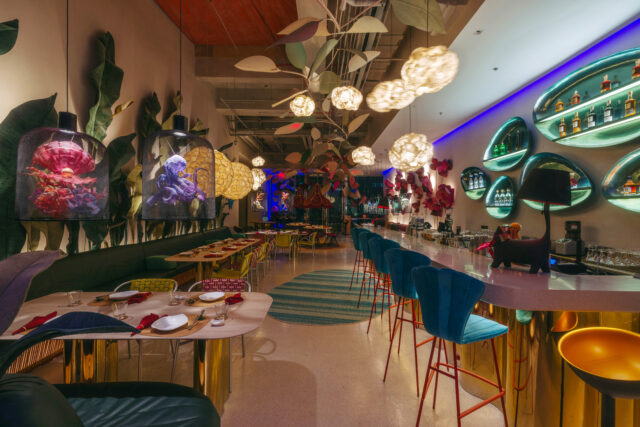
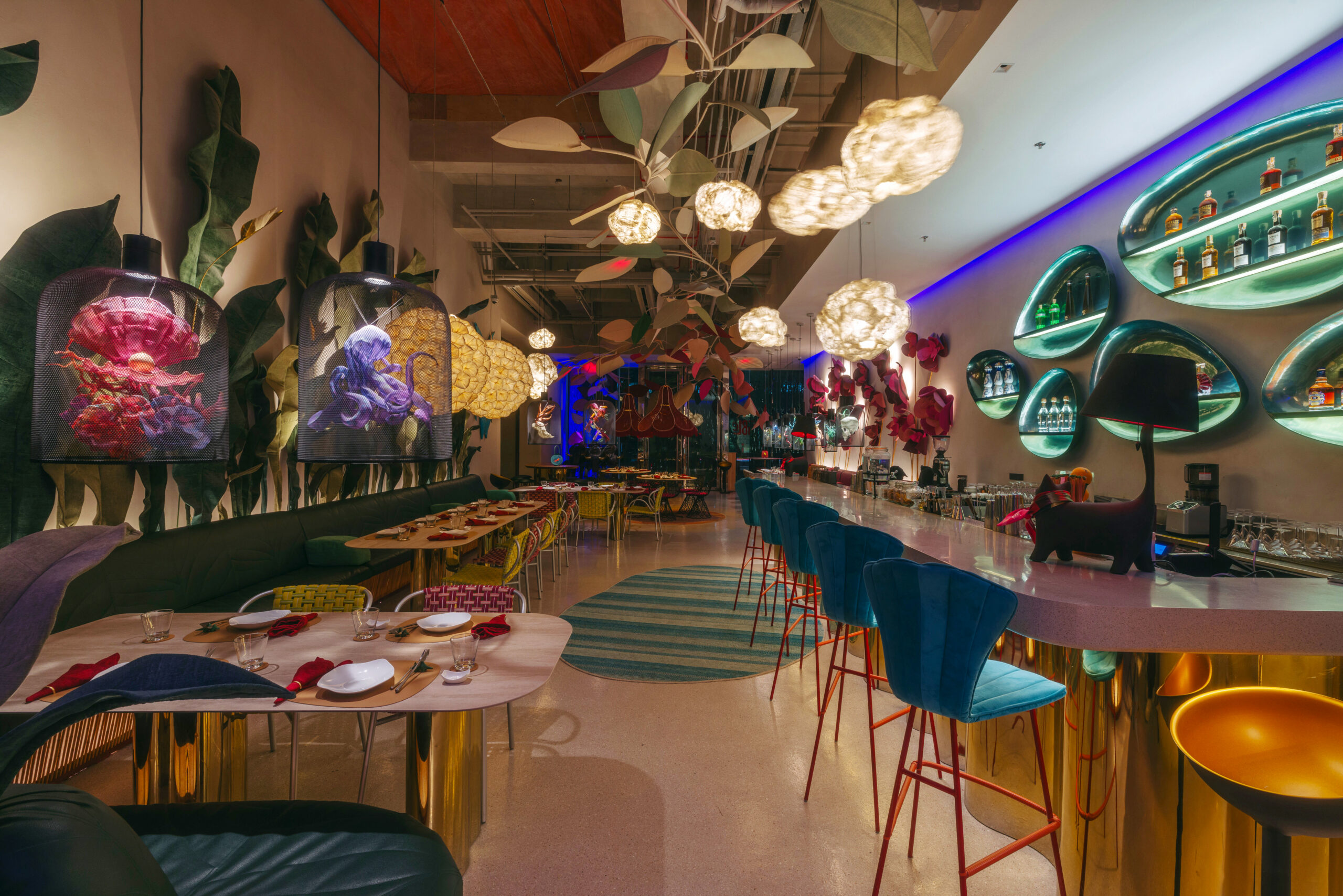
The restaurant is a treat for the eyes: every bit you see is a Kenneth Cobonpue original (which you can buy down the hall).
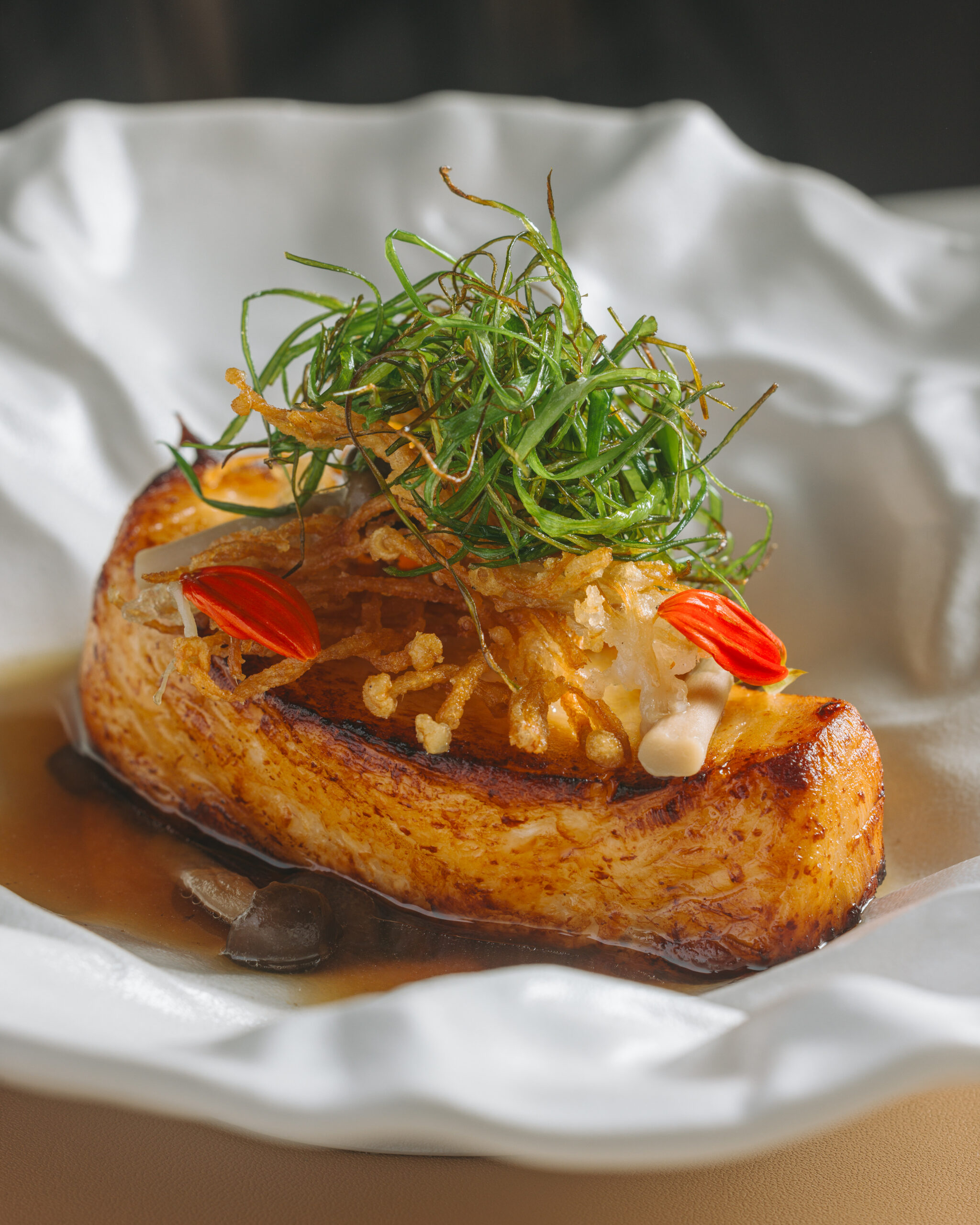
We’d be inclined to say more about the food, but the Feb. 19 grand opening had a limited menu — but we’re all praises for the meaty and forward Lamb Tacos (P550 for three), the filling and interesting Smoked Salmon Black Arancini (P650 for five), and the delightfully tangy and shocking pink Shrimp Dumplings with Ponzu Sauce (P540). Other items include pasta, sandwiches (Mr. Cobonpue stands by their turkey club, P770), cocktails, and a dinner menu with seabass, porchetta, and short ribs (between P1,240 for the Porchetta and P2,280 for the Seabass).
“Fable was just originally a café for our customers. It was supposed to be a simple space where we serve you coffee, and hopefully, you buy something. It gradually took a life of its own,” he said in a speech at the opening.
The restaurant takes its look from the fairy tales his mother, Betty Cobonpue (herself a formidable designer in her own right), read to him at night, which he would then sketch in the morning. “I had to imagine all the creatures, fairy tales, and faraway lands that she was describing.
“Everything you see here is really my childhood,” he said. “That’s why it’s called Fable.”
“This is part of my world,” he said, pointing to one of his flower lanterns. “It’s like Alice in Wonderland. It’s like going into that rabbit hole.”
This isn’t his first foray into the restaurant world: about 15 years ago, he had Morels & Malice in Cebu, for which he did the interiors. Asked about possibly opening more restaurants, he said in an interview, “I think so,” though: “It’s something I don’t necessarily enjoy.”
Apparently, designing restaurants is tricky: “You have to manage how people flow in a space; how people move. It’s a lot to do about psychology: it’s not all about form and function.”
Still, for him, there’s a thread running through the disciplines of food and design — and the act of creation itself. “All disciplines, whether music, design, art – it’s all the same. The process of creation is not a formula, and it’s not a burst of inspiration. It’s really hard work,” he said.
“You have to take time every day to just come up with something, and force yourself to do it.” — Joseph L. Garcia
former Energy Undersecretary and now “consumer advocate” recently attacked the Manila Electric Co. (Meralco) as being “unjust and unfair… charging households more than businesses,” referring to the lower rates for commercial and industrial customers compared to those of residential customers.
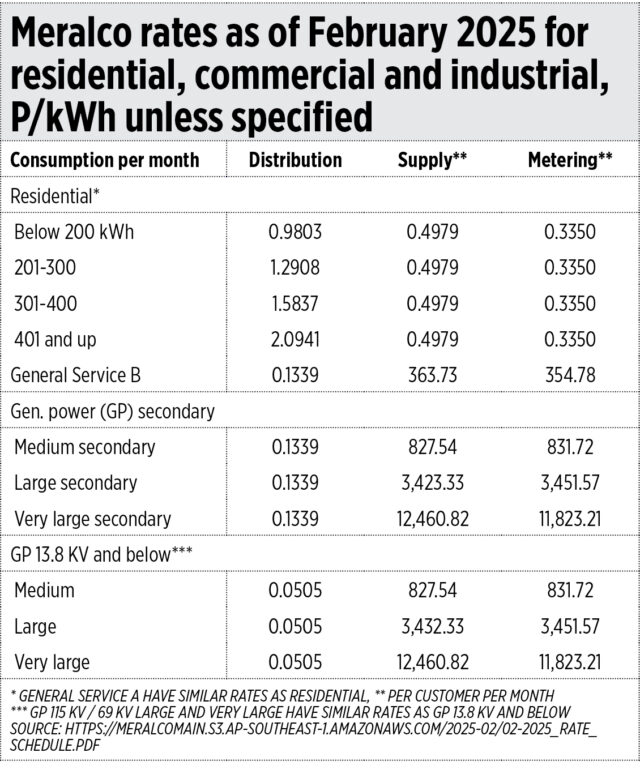
Petronilo Ilagan alleged that residential customers are subsidizing businesses. He used old numbers to make his argument, saying that residential customers pay “P1.8082 per kilowatt-hour (kWh) for 1-200 kWh users, P2.1187 per kWh for 201-300 kWh, P2.4116 per kWh for 301-400 kWh, and P2.9220 per kWh for those consuming over 401 kWh.” These were June 2022 numbers.
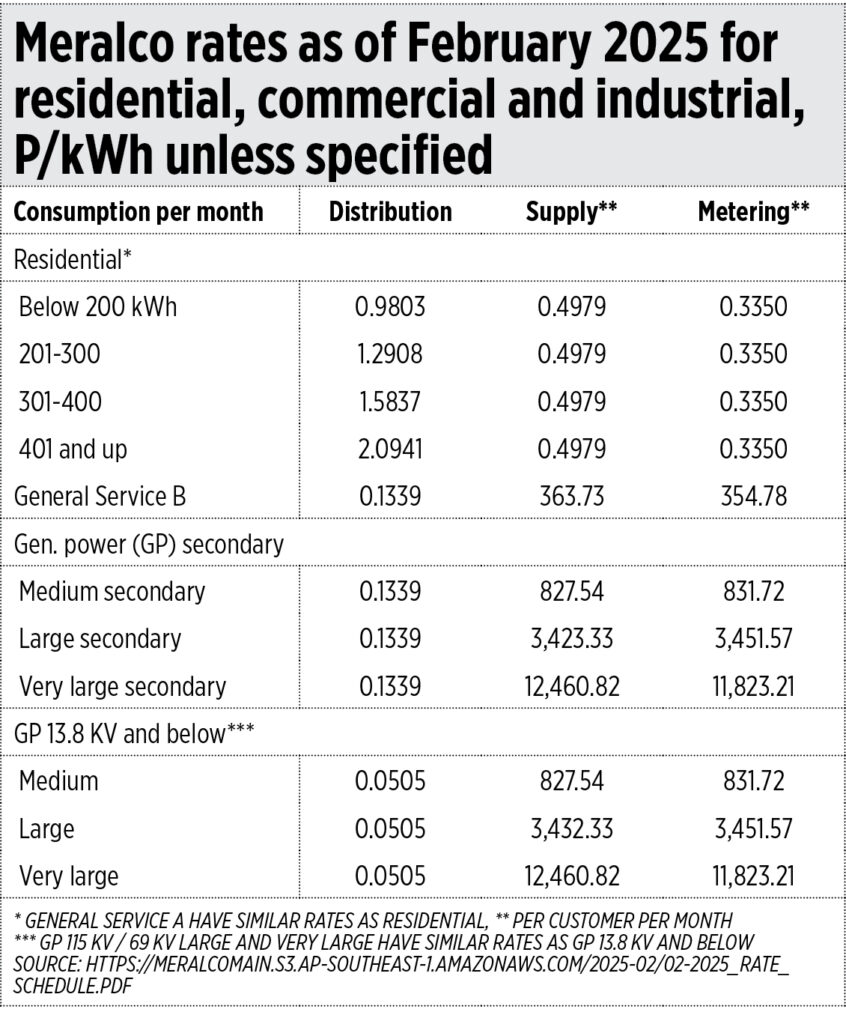
The most recent numbers are: P1.29/kWh for those consuming 201-300 kWh per month, and P2.09/kWh for those consuming over 401 kWh. In contrast, General service B and General Power (GP) Secondary customers pay only P0.134/kWh. The GP 13.8 KV pay even lower at 5 centavos/kWh. The supply charge and metering charge are up to P12,461 per large customer per month (see table).
Mr. Ilagan, who serves as president of the National Association of Electricity Consumers for Reforms, Inc. (Nasecore) is confused. Here are four reasons why.
1. The main concern of average residential or household customers like me is not “cheap at all costs” electricity but no blackouts. Electricity should be there when I need it, when I turn on the lights or the aircon. If electricity prices go up, then I can adjust by using an electric fan instead of an aircon, or turning off one or two of the many bulbs in the house. But when there is a blackout, my choices are horrible — either endure the darkness and inconvenience or light a candle. The latter is dangerous when a fire can accidentally happen, the price is damaged properties if not death to people.
2. The rates charged by private distribution utilities (DU) like Meralco are all regulated by the Energy Regulatory Commission (ERC) and not arbitrarily set by the DU. The current distribution charge rate has been there since 2003 and was not questioned for the last 22 years.
3. Setting up electric cables, meters, monitoring, and collection is more complicated and more costly with numerous small customers like households, compared with a single big hotel or mall or university.
4. The Electric Power Industry Reform Act of 2001 (EPIRA) Section 36 prohibits big customers from subsidizing residential customers, and businesses would be discouraged from coming into an area and creating more jobs if their cost of electricity gets even higher.
This attack on big DUs, the big generation companies, to force “cheap at all costs” electricity is only political noise and optics. The result would be “cheap but not available” electricity because the necessary cost and returns to entrepreneurship would not be met, so potential power businesses will not come into an area.
NGCP’S WACC
Recently the ERC set the weighted average cost of capital (WACC) for the National Grid Corp. of the Philippines (NGCP) for the 4th regulatory period (RP, 2016-2020) at 10.71%. This is lower than the 15.07% under the 3rd RP (2011-2015, under NGCP), and 15.88% under the 2nd RP (2006-2010, when the grid was under TransCo’s management).
This low level of WACC — meaning a low transmission charge to be allowed — can be problematic in terms of infusing more capital for more big transmission projects as more power generation capacities are added, espe-cially for geographically scattered, small renewable energy projects like solar.
The NGCP shoulders the Concession Fee Payment, then the 3% franchise tax, which are now considered as not being part of the revenue building blocks, or not an expenditure item for recovery. Then there are nearly a doz-en recoveries as adjustments to the annual revenue requirement (ARR) — some dating back to the 2nd RP — which are now facing uncertainty of recovery.
The regulated sub-sectors of power transmission and distribution are problematic because each costing is subject to approval or disapproval by the ERC. As an economics writer and researcher, my approach is always to have a high but realistic growth target — like 7-8% annual GDP growth — and seeing what the inputs are — like power generation-transmission-distribution levels — that can support such high growth targets. Working backwards to identify bottlenecks, regulation should adjust, not prevail. Growth targets should prevail over regulation and bureaucratic requirements.
Bienvenido S. Oplas, Jr. is the president of Bienvenido S. Oplas, Jr. Research Consultancy Services, and Minimal Government Thinkers. He is an international fellow of the Tholos Foundation.
LAPTOPS powered by Qualcomm Technologies, Inc.’s AI PC chips on display at the Snapdragon X Series Southeast Asia Media Summit held in Singapore on Feb. 26, 2025 -- Photo Cdredits: Bettina V. Roc
SINGAPORE — Qualcomm Technologies, Inc. expects the rapid adoption of artificial intelligence (AI) technologies in Southeast Asia to boost demand for laptops powered by its Snapdragon X Series chips.
Qualcomm on Feb. 26 held its first-ever Snapdragon X Series Southeast Asia Media Summit here at Sentosa island to highlight their belief in the region’s potential to become a growth driver for the AI PC market.
“When you think about AI PCs and what’s happening with the overall demand, the overall demand for AI PCs is just skyrocketing. When you look at 2024, just in one year, there were more than 8 million PCs that were shipped in just the Southeast Asia region,” Qualcomm Senior Vice-President of Product Management and General Manager for Compute and Gaming Kedar Kondap said at the summit.
Mr. Kondap said they expect AI to add more than $1 trillion in value to the Southeast Asian economy by 2030, with the region’s spending on AI seen to reach $650 million by 2026, driven by the adoption of generative AI (GenAI) technologies.
“That’s a staggering number in terms of how we see disruption in the marketplace, the way we see AI PCs fueling the economy and driving use cases across every industry like we’ve never seen before… Consumers here in Southeast Asia are leading the way when it comes to adopting GenAI.”
Kedar Kondap – Qualcomm Technologies, Inc. Senior Vice President of Product Management and General Manager for Compute and Gaming Kedar Kondap speaks at the Snapdragon X Series Southeast Asia Media Summit held in Singapore on Feb. 26, 2025. — Photo Cdredits: Bettina V. Roc
Deploying AI solutions can have a positive impact on every single industry and is expected to transform the workplace, Mr. Kondap said, driving demand for on-device AI.
The Snapdragon X Series marked Qualcomm’s return to the PC chip space. It first launched the Snapdragon X Elite processor in 2023, which is for high-end machines priced at the $1,000 range. This was followed by the X Plus chip launched in 2024 that powers laptops at the $800 range.
Completing the Snapdragon X Series chips is the Snapdragon X launched in January, which is targeted for PCs priced at around $600.
“What we’d like to do with all of this is make sure unparalleled performance, incredible battery life and the exact same GenAI experiences can run across all of these platforms. We want to make sure that these platforms support every con-sumer’s needs, more so here in Southeast Asia,” Mr. Kondap said.
DEMOCRATIZING AI ACCESS
The launch of the midrange Snapdragon X chip forms part of Qualcomm’s goal to democratize AI access, especially in Southeast Asia where economies are at different stages of development and adoption of technologies, with var-ying levels of internet infrastructure, said Nitin Kumar, Qualcomm senior director for product management.
The processor delivers up to 163% faster CPU performance versus its competition at the same power and better battery efficiency for users’ on-device AI needs, he said.
Mr. Kumar said in a roundtable with Philippine tech media and influencers on the sidelines of the summit that he expects both consumers and commercial users to find use cases for AI PCs, with the entire Snapdragon X Series line of PC chips giving them options to find their “sweet spot” in terms of cost.
“Our mission is to provide that AI capability to everyone, democratize the on-device AI capability… Qualcomm has always advocated that the good AI performance should be a hybrid AI — so, things happening in the cloud and things happening on the mobile itself,” he said.
“We want to invest in the market. This event being hosted here is the key example for that. We’re launching Snapdragon X in Southeast Asia market for you, for the Philippine market as an example, to drive that message… that there is a better ex-perience out there in the PC ecosystem. We’re going to drive that performance, drive that battery life, drive that on-device AI, and we will continue to make investment in the region to make sure that there is that adoption of that message across broader set of countries, of course, including Philippines as well. So, we understand the market and we are not going to stop here.”
ST Liew, vice-president at Qualcomm and president of its business in Taiwan and Southeast Asia, likewise said at the same roundtable that they are bullish that both personal and business PC users can find the perfect fit among devices powered by their Snapdragon X Series chips.
“I’m very confident that the platforms we have introduced will address the needed interest and the needed spots in Philippines, because very soon, the different professions and the industries are going to realize that … [they] will solve a lot of problems,” Mr. Liew said.
MANUFACTURERS
At the summit, Mr. Liew moderated a fireside chat with top executives from leading Arm-based Copilot+ PC manufacturers, namely Jimmy Lin, regional director for Southeast Asia at ASUS; Paul Carter, Dell Technologies, Inc. vice-president for Client Solutions in the Asia Pacific, Japan and Greater China region; Tarun Relhan, HP, Inc. head of Advanced Computing Systems for the Greater Asia region; and Sachin Bhatia, chief marketing officer for the Greater Asia Pacific region at Lenovo Personal Computing & Smart Devices.
The panel discussion touched on how Arm-based PCs powered by Snapdragon X Series chips are driving the on-device AI boom in Southeast Asia and how they are working to accelerate user adoption in the region.
ASUS’ Mr. Lin said Southeast Asia is made up of diverse and complicated markets at different levels of economic progress, which highlights the need for user education about the benefits of on-device AI.
“I think the first thing for us is to do the education and awareness. Because in Southeast Asia, we see that we are very different countries, like in Singapore is a high income, developed country. But we also have emerging coun-tries like Indonesia and the Philippines. For the people who live there, maybe they need to spend some amount of their salaries to afford one device. So, we have to prove to them that it is worth it to buy,” he said.
“In Southeast Asia, I would say 80% of the people will buy the stuff in the stores. People love to have a touch and feel feeling inside real stores. So, channel development is also very important.”
For their part, Lenovo’s Mr. Bhatia said to serve a diversified region like Southeast Asia, technology needs to be smart, accessible, and affordable.
“When I say smart, today the users are not looking just a device experience. They are looking at the entire ecosystem experience, whether they are using mobile, whether they are using tablet… it has to be a seamless connectiv-ity and seamless ecosystem. And second, there has to be a device for every user,” he said.
HP’s Mr. Relhan said governments in the region also play a huge role in driving AI adoption. “If you really look at it, it is not a decision which the consumer is driving… I think the drive needs to come in from the government, from big enterprises, to really adopt it, let the consumer feel it, use it, and then the drive automatically comes.”
“Southeast Asia is a leading region when it comes to the adoption of new technologies. Singapore was third on the AI index globally, but we also see it in other countries — Malaysia, Thailand, the Philippines — there tends to be a leap forward in technology, from nothing to the latest right away. And we’re starting to see that with the adoption of Qualcomm architecture,” Dell’s Mr. Carter said.
“Everybody’s waiting for that one killer app. There isn’t one killer app. It’s going to be a cumulative effect of all apps. And that is what we’re seeing in both the consumer space and in the business space. It’s actually going to be the utilization of native apps. So, this region, I do believe, is going to be at the forefront of the adoption of AI PCs.” — Bettina V. Roc
THE PESO jumped to a near five-month high on Wednesday as the dollar took a hit from trade war and growth concerns following the Trump administration’s move to impose tariffs on its major trading partners.
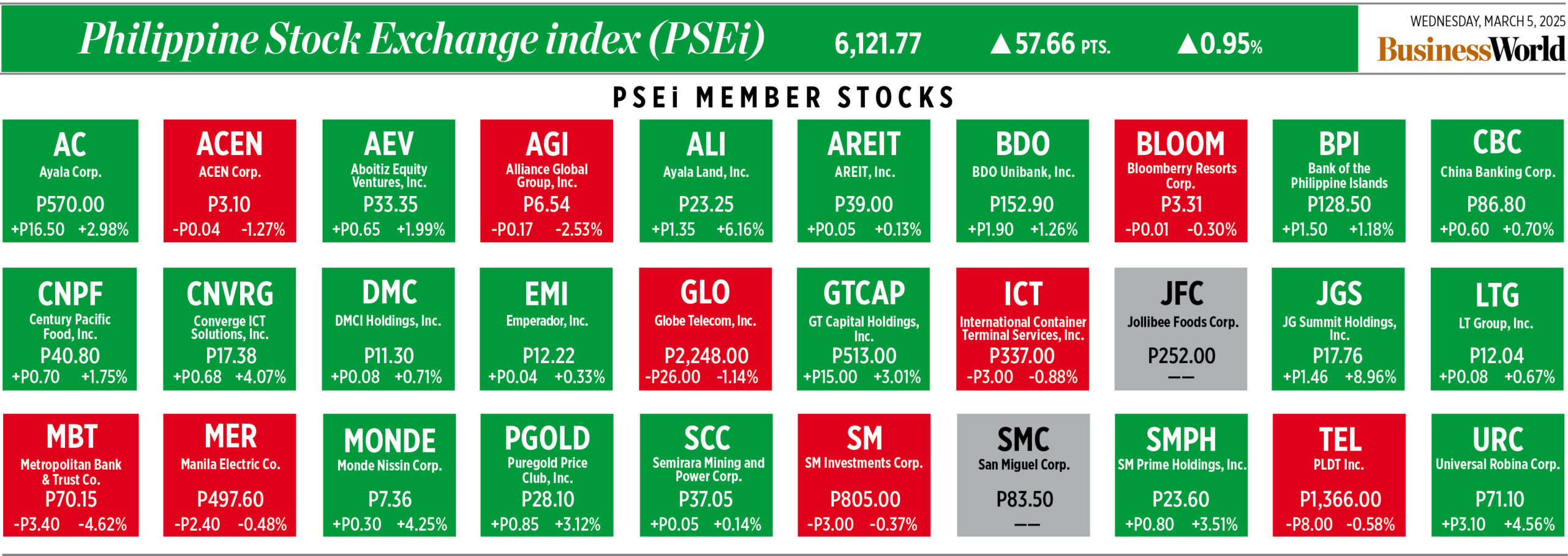
The local unit closed at P57.345 per dollar on Wednesday, strengthening by 40.8 centavos from its P57.753 finish on Tuesday, Bankers Association of the Philippines data showed.
This was the peso’s best finish in nearly five months or since its P57.205-a-dollar close on Oct. 11, 2024.
The peso opened Wednesday’s session higher at P57.60 against the dollar. It traded stronger than Tuesday’s close the entire session as its intraday low was at just P57.61, while its best showing for the day was at P57.315 versus the greenback.
Dollars exchanged rose to $1.55 billion from $1.04 billion on Tuesday.
“The peso ended higher on the back of a weak dollar amid concerns over slowing US growth, the impact of tariffs on the US economy, and after the announcement of retaliatory tariffs from China, Canada, and Mexico,” a trader said in a phone interview.
The dollar dropped to a three-month low on Wednesday as markets reeled from a trade war triggered by US President Donald J. Trump, who again vowed reciprocal tariffs in his first speech to Congress since taking of-fice, Reuters reported.
Moves in currencies were volatile as investors fretted about the impact of escalating global trade tensions on the world economy.
In an address to Congress, Mr. Trump said further tariffs would follow on April 2, including “reciprocal tariffs” and non-tariff actions aimed at balancing out years of trade imbalances.
The dollar initially ticked higher as Mr. Trump was speaking, though later erased those gains to hit a low of 105.46 against a basket of currencies, its weakest since Dec. 6.
Investors have sold the dollar in a reversal of the so-called “Trump trades” which first gathered steam late last year, as they become increasingly concerned with the growth outlook for the world’s largest economy, which is al-ready showing signs of a slowdown.
The US President’s remarks to Congress comes just after he followed through on new 25% tariffs on imports from Mexico and Canada that took effect on Tuesday, along with a doubling of duties on Chinese goods to 20%.
Canada and China quickly acted in kind, while Mexican President Claudia Sheinbaum vowed retaliation but without details, saying she would announce Mexico’s response on Sunday.
Meanwhile, slower-than-expected February Philippine inflation also supported the peso on Wednesday, Rizal Commercial Banking Corp. Chief Economist Michael L. Ricafort said in a Viber message.
Headline inflation sharply decelerated to 2.1% in February from 2.9% in January, the Philippine Statistics Authority reported on Wednesday.
The February consumer price index was the slowest print in five months or since the 1.9% clip in September 2024. It was also below the Bangko Sentral ng Pilipinas’ 2.2%-3.% forecast and the 2.6% median estimate in a Busi-nessWorld poll of 18 analysts.
For Thursday, the trader expects the peso to move between P57.10 and P57.50 per dollar, while Mr. Ricafort said it could range from P57.20 to P57.50. — Aaron Michael C. SywithReuters
When a personal health crisis arises, requiring long hospitalization, it disrupts the flow of the day one is used to. A new set of activities take over, like having one’s blood extracted at 4 a.m. — Sorry to wake you up sir. Gone is the previ-ously predictable set of meetings and lunches, the old routine.
The comfort of routine, with its anticipated set of events, is not just embraced by old people who need to put handrails on their now retired state. It is also the refuge of organizations that are sometimes visited by the unexpected.
Airport congestion, resulting in cancellations of flights maybe from stalled airplanes blocking the runway due to floods, needs to be untangled. The stranded passengers have to eventually be rebooked, the runway cleared, and the flights rescheduled in an orderly manner before the airport authorities can declare “business as usual.” Back to the routine.
A crisis is considered defused only when the expected routine is restored, and the organization is back on its feet to deliver its products and services as its customers are used to.
Disruptions of all sorts derail the ordinary course of business and life. They include interruptions like power outages, elevator repairs, floods, labor strikes, pandemics, and supply chain interruptions that result in the shortage of rice and chickens. These glitches throw off the business routine and require soothing assurances from management of an expected return to normalcy, even giving a timeline (power will be restored by tomorrow morning).
Even planned inconveniences like lobby renovations or rerouting of traffic due to the laying of new water pipes need to project how long the departure from routine is likely to take. Still, even the reduced status of service provision is announced as uninterrupted — we are still open. Such an assurance already presumes that expectations of a complete range of products and services being unavailable — chicken rice will not be on the menu today.
In situations where a crisis is as yet not publicly admitted, the illusion of normalcy is even more critical to maintain, like a placid duck floating above the water with its feet frantically paddling underneath.
This story of hiding a crisis and projecting a state of wellbeing is explored by the acclaimed Japanese director, Akira Kurosawa, in his classic film, Kagemusha. A petty criminal look-alike is recruited by a Shogun to be his double. When the lord is wounded in battle and eventually dies, the double assumes his role in ceremonies and staged events, learning his mannerisms to keep the illusion going. The deception of strength is a delaying tactic to ward off hostile attack while in a weakened state.
The use of a political decoy, such as the one employed by the Takeda Clan in the Kurosawa movie, has its risks. Attempts at normalcy while covering up a crisis can be eroded by whist and explanations that lose their con-sistency. Such crises like undisclosed health problems of leaders, unfinished projects, or failure to meet debt obligation involve a big cast of characters and have many moving parts.
Companies with an internal crisis sometimes choose to hide this from the public, or even from their investors, hoping to somehow address them quietly. This strategy of non-disclosure, even when the magnitude of the problem is a sur-vival issue, like an unreported financial loss or a bad investment that needs to be written off, sometimes seems the only option. Public knowledge of the real situation can go beyond reputational risk.
Maintaining the veneer of business-as-usual in an undisclosed crisis does not have to be a conspiracy. But so often, it is still a shared secret of those in the know, keeping many others in the dark. Like the meteors that wiped out the dinosaurs that lived for a hundred million years (give or take a few centuries), disrupters of even dominant businesses can wipe out a corporate species, even a market leader. A change in technology can do that.
Even in life, getting back to a routine after a crisis is part of the healing process. How comforting it is to have a day unfold according to expectations. No surprises? Isn’t that too predictable? Even boredom can be embraced. Thursday is the schedule for sushi. Yes, you won’t forget. (Or you can go for ribeye steak instead.)
WASHINGTON — A new task force in the Republican-controlled US House of Representatives on Tuesday began an examination of the US Federal Reserve’s role and goals, with Republicans raising questions about its track record on controlling inflation, and Democrats on watch for the impact of President Donald J. Trump’s freshly imposed tariffs and other economic policies.
Unlike some congressional task forces that mostly operate on the back burner, the Monetary Policy, Treasury Market Resilience, and Economic Prosperity Task Force’s inaugural hearing drew support from the committee’s top leadership, with both Chairman French Hill and the House Financial Services Committee’s top Democrat, Representative Maxine Waters, querying witnesses.
Each set the tone for their side of the aisle at the hearing, which comes as the Fed itself begins what’s expected to be a six-month review of its approach to achieving its congressionally mandated goals of price stability and full employment.
Mr. Hill aired concerns over the size of the Fed’s balance sheet and questioned the feasibility of the employment mandate, given the many forces that impact the labor market beyond central bank control, both longtime sticking points for Republicans critical of the Fed’s handling of the economy.
Though Fed Chair Jerome H. Powell has said the Fed’s 2% inflation goal will not be up for discussion in its own framework review, Mr. Hill said he felt the target is too high and unnecessarily erodes the public’s purchasing power.
Other Republicans took up that baton, but also touched on a wide range of other topics including ideas on how to ease regulation.
In one of the more heated moments, Republican Andy Barr forcefully advocated for stripping the Fed of its responsibility to fund the Consumer Financial Protection Bureau, which recently was put on ice by the Trump ad-ministration, and giving it instead to Congress.
Ms. Waters, the committee’s top Democrat, shook her finger and repeatedly mouthed the word “no” to nearby colleagues.
Ms. Waters for her part called out the rising price of eggs and the potential for Mr. Trump’s new tariffs to make inflation worse, a point that several other Democrats also took up.
Other Democrats, like Representative Juan Vargas from California, questioned Mr. Trump’s executive order asserting control over independent government agencies, which he said could threaten the Fed’s independence and thus its effectiveness in fighting inflation. Mike Konczal, former chief economist for the Biden administration’s National Economic Council, told the panel that though the order carves out the Fed’s monetary policy from White House control, “there’s no way to have a strict wall of separation between monetary policy and regulatory policy.”
Fed watchers are waiting to see how the central bank will interact with and be responsive to the group. No current Fed policy makers appeared at Tuesday’s hearing. The Fed assiduously guards its monetary policy independence, which economists say is critical to a central bank’s ability to fight inflation effectively. At the same time Mr. Powell readily acknowledges that the central bank is accountable to congressional oversight.
The 14-member task force, led by Representative Frank Lucas from Oklahoma, features a mix of veteran lawmakers who have spent considerable time on issues related to the Fed. Eight of them have met with Mr. Powell at least once since he became chair in 2018. — Reuters
LongHorn Steakhouse opening at Shangri-La Plaza Mall
INTERNATIONAL CHAIN LongHorn Steakhouse will be opening this month at Streetscape, Shangri-La Plaza Mall. The restaurant brings steak cravings to a fore with one-of-a-kind proprietary seasonings, and choice cuts like the bone-in Outlaw Ribeye, Flo’s Filet (center cut with signature seasoning), the New York Strip, and the Fire-Grilled T-Bone. LongHorn’s expertise extends beyond steaks with a menu that also features Baby Back Ribs, Parmesan Crust-ed Chicken, Bourbon-marinated Grilled Salmon, and Hand-breaded Chicken Tenders. There are also a variety of salads, shareable appetizers, signature sides, and desserts, including the Chocolate Stampede. Guests can likewise enjoy a range of margaritas and other hand-crafted cocktails, wine, or draft beer from LongHorn’s full bar. The entry of LongHorn in the Philippines is courtesy of The Bistro Group whose portfolio of local and international brands total 26, with 225 stores nationwide. Founded in 1981, LongHorn Steakhouse’s first location was in Atlanta, Georgia. Today, LongHorn Steakhouse has over 590 locations worldwide and is headquartered in Orlando, Florida.
Barilla Pasta Championship Asia calls for chefs
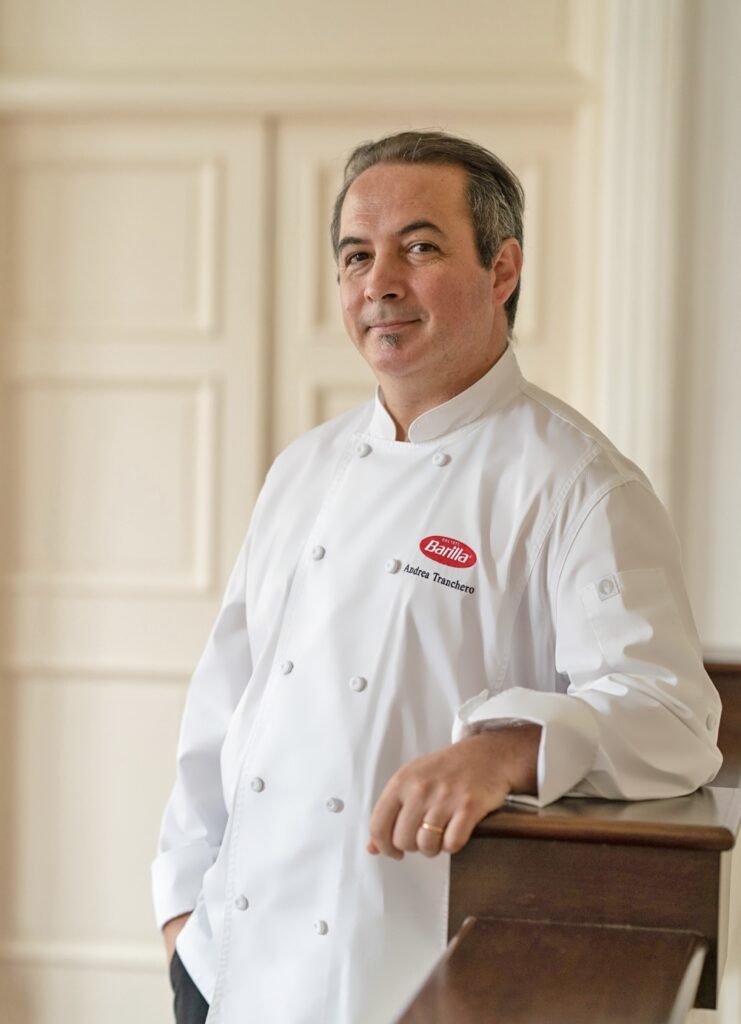
BARILLA is inviting chefs from the Philippines to showcase their culinary talent and celebrate their passion for Italian cuisine in the second edition of the Barilla Pasta Championship Asia. The winner will have the opportunity to pit their culinary skills and creativity against other chefs from China, India, Japan, Singapore, Malaysia, South Korea, and Vietnam in the Asia Finals in October. Whether seasoned professionals or rising chefs in the industry, participants will use pasta as a canvas for creativity, demonstrating their expertise and passion for Italian cooking. The event is organized by Barilla for Professionals. Applications are now open until April 15 and interested chefs are encouraged to submit their signature pasta dish featuring Barilla Spaghetti n.5 or Penne Rigate as the focal point. A step-by-step preparation must accompany each submission. The entries will be evaluated by a panel of judges. Key judging criteria include aesthetic appeal, harmony of flavors and technical execution, with a strong emphasis on achieving the perfect al dente texture. All National Finalists will receive a personalized Barilla for Professionals chef jacket as a symbol of their achievement. The top three winners from the Asia Finals will embark on a culinary tour to Parma, Italy, a UNESCO Creative City for gastronomy and the home of Barilla where they will engage with top chefs and industry leaders. The top three Asia finalists will also receive cash prizes of up to €3,000. Applications are now open. For more details and submission of entries, go to https://www.barillaforprofessionals.com/global/pastachampionshipasia/.
Red Ribbon is dedicated to caramel
RED RIBBON’S newest creation is the Supreme Caramel-Mocha Dedication Cake — a birthday cake that combines two flavors as it is made with decadent caramel, mocha icing, and rich caramel drippings. Prices start at P599. Visit the nearest Red Ribbon store or order via the Red Ribbon app or delivery website, or via the GrabFood and foodpanda apps.
7-Eleven introduces Premium Beef Sausage
7-ELEVEN’S Big Bite line gets a bold and beefy twist with Big Bite Premium Beef Sausage for P75. Also offered are new condiments for P5, like cheese and mustard, and soon chili con carne. The Beef Sausage is now available in se-lect 7-Eleven Luzon stores.
McDonald’s introduces Chili Con Carne Dunk
DAYS AFTER it brought back the Cheese Dunk, McDonald’s Philippines is whipping up a new Dunk flavor — the Chili Con Carne Dunk. The new Chili Con Carne Dunk takes McDonald’s signature burgers, with its premium ground beef simmered in a secret blend of spices. “We Filipinos love our sawsawan (sauces). With our Double Dunks, we’re celebrating this uniquely Filipino eating habit by allowing our customers to take their McDonald’s experience to the next level with not just one, but two extraordinary dunking options,” said Ashley Santillan-Delgado, McDonald’s Philippines’ marketing director, in a statement. There is an exclusive promo for Double Dunk on the McDonald’s App. Until March 14, customers can score a Double Dunk meal for P175, which includes a classic Cheeseburger, Small Fries, a drink, and both the Cheese Dunk and Chili Con Carne Dunk. This limited-time offer is available for dine-in, take-out, and drive-through via the McDonald’s App.
BRP SIERRA MADRE, a marooned transport ship which Philippine Marines live in as a military outpost, sits on the disputed Second Thomas Shoal, part of the Spratly Islands in the South China Sea. — REUTERS
THE Chinese Coast Guard on Wednesday said it monitored a Philippine civilian boat delivering supplies to an “illegally grounded” warship at the disputed Second Thomas Shoal in the South China Sea on Tuesday.
China urges the Philippines to honor its commitments, stop hyping up incidents in the area and work with China to manage the maritime situation, the coast guard said in a statement on Wednesday.
Resupply missions for soldiers aboard the BRP Sierra Madre, a World War II-era warship that Manila grounded at the shoal in 1999 to assert its claim, has been a significant cause of tension between the two countries until they reached a provisional agreement in July on such missions.
China and the Philippines claim the territory and frequently clash in its surrounding waters. In January, they also agreed to seek common ground and find ways to cooperate despite their sea dispute.
The Armed Forces of the Philippines said it had completed the routine troop rotation and resupply mission to BRP Sierra Madre “in resolute commitment to maintaining its presence and operational readiness in the West Philippine Sea.”
It carried out the mission with the Philippine Coast Guard which was “completed with no untoward incident,” it said in a statement.
“This marks the fifth consecutive routine troop rotation and resupply mission at BRP Sierra Madre… without any untoward incident,” military spokesman Xerxes A. Trinidad said in a separate statement.
A contingent of Filipino marines are stationed on the marooned ship, living in the dilapidated vessel serving as an active military outpost in a region where China and the Philippines claim territory and frequently clash.
Tensions between Manila and Beijing flared in June last year after the Chinese Coast Guard rammed and boarded Philippine vessels attempting to resupply the moored ship.
The two nations agreed on an arrangement to ease tensions at Second Thomas Shoal a month after the incident.
The Philippines and China have been at loggerheads over disputed features in the South China Sea, which Beijing claims almost in its entirety. A United Nations-backed tribunal based in the Hague in 2016 voided China’s claim for being illegal.
Philippine forces routinely conduct resupply missions about every two months to rotate stationed troops and bring in provisions. China had tried to block Philippine ships from resupplying BRP Sierra Madre.
China has expansive territorial claims in the South China Sea that overlap with the exclusive economic zones of Brunei, Indonesia, Malaysia, the Philippines and Vietnam.
Also on Wednesday, the Philippine Air Force grounded the fleet of its most advanced fighter jet as it launched an investigation of the crash of one of its units, it said in a statement.
An FA-50 plane went missing on Tuesday after it lost contact with other aircraft involved in a military operation minutes before reaching their target area in southern Philippines.
Military troops found the aircraft and the bodies of the two pilots on Mt. Kalatungan in Bukidnon province in Mindanao.
“The wreckage, all indications point to it being a crash,” air force spokesperson Ma. Consuelo N. Castillo told a virtual news briefing. “The investigation is also looking at the angle of engine damage as the aircraft could have been fired at.”
The Philippines bought 12 Korean-made FA-50 light fighter jets for a total of P18.9 billion in 2014 as part of efforts to modernize its aging military arsenal amid sea tensions with China. The jets are the Southeast Asian nation’s most advanced fighter aircraft. Its military plane inventory mostly consists of turboprops. — Kenneth Christiane L. BasiliowithReuters
MALACAÑANG on Wednesday said it would comply with the Supreme Court’s forthcoming ruling on lawsuits questioning the transfer of billions of pesos of funds from Philippine Health Insurance Corp. (PhilHealth) to the national Treasury.
“Whatever the Supreme Court orders, we will comply with it,” Presidential Communications Office Undersecretary Claire B. Castro told a news briefing in Filipino. “We will not oppose it, nor will we resist whatever the Supreme Court mandates.”
This comes after Justice Antonio T. Kho, Jr. called for a major overhaul of PhilHealth, including changes to its board, over its failure to fully implement mandated benefits for members.
During a court hearing on lawsuits questioning the transfer of P89.9 billion in the agency’s funds to the government the magistrate called out the government for PhilHealth’s shortcomings, saying the burden should not fall on shortchanged members.
He also urged PhilHealth to ask President Ferdinand R. Marcos, Jr. to return the P60 billion in PhilHealth funds that were transferred to the national Treasury as unprogrammed funds, arguing that the funds should instead be used to expand benefits, improve services, and hire additional personnel to address the country’s healthcare needs.
Mr. Kho scolded PhilHealth and Health officials for disregarding the law when it comes to its budget requests for subsidy.
Under the law, a portion of the revenue from excise taxes on tobacco and alcohol products is used to fund the state health insurer. These funds help expand PhilHealth coverage, particularly for indigent and poor Filipinos, ensuring their access to essential health services.
In 2024, the government initiated the transfer of P89.9 billion from PhilHealth to the national Treasury, labeling these as “excess funds.” The money was supposed to fund various projects, including infrastructure and social services.
PhilHealth was supposed to transfer P29.9 billion more to the state before the tribunal stopped it from doing so in October.
The plaintiffs argued that PhilHealth funds, taken from member contributions and specific taxes, should be exclusively used for health-related purposes, as mandated by the Universal Health Care Act. — Chloe Mari A. Hufana
PHILIPPINE President Ferdinand R. Marcos, Jr., has signed into law a measure that allows working Filipino professionals to earn a college degree through accredited work experience and prior learning, bypassing traditional schooling methods.
The President enacted the Expanded Tertiary Education Equivalency and Accreditation Program Act on Feb. 3, the presidential palace said in a statement on Wednesday.
“The [law] will identify, assess, validate and assign equivalent undergraduate level and special graduate programs of prior learning from formal, nonformal and informal learning systems and relevant work experiences to qualified individuals for the grant of appropriate academic degrees,” it said.
The Commission on Higher Education (CHEd) will take the lead in enforcing the law.
CHEd is will deputize higher education institutions to offer academic degrees under the law, establishing standards for diverse assessment methods that evaluate skills, values, knowledge and competence levels, and granting or revoking institutions’ authority to administer the program.
It will also oversee and assess the implementation of the program, with its Office of Programs and Standards Development serving as the permanent technical secretariat that will enforce the law.
Filipino citizens, whether based in the Philippines or overseas, may apply for equivalency and accreditation if they meet the requirements.
Applicants must be at least 23 years old and should have completed a secondary education program.
This can be proven through a high school diploma or a certification from the Philippine educational placement test or the alternative learning system accreditation and equivalency assessment, indicating their eligibility for college admission.
Applicants must have a minimum of five years of cumulative work experience in an industry relevant to the academic degree or discipline for which they seek equivalency. — Chloe Mari A. Hufana