Home Blog Page 1872

Portraits by Edvard Munch go on show in new London exhibition

Käte and Hugo Perls, 1913 by Edvard Munch © Foto Munchmuseet / Ove Kvavik/NPG.ORG.UK

LONDON — A new exhibition of portraits by Edvard Munch opens in London this week, shining a light on an important aspect of the Norwegian painter’s work and his life.

Edvard Munch Portraits, running at London’s National Portrait Gallery on March 13 to June 15, features some 45 of his works, including depictions of himself, his family, friends, collectors as well as commissions.

“It shows Munch as being a more social person than is often assumed. It takes us beyond The Scream. It takes us beyond Munch as the painter of existential isolation and loneliness,” exhibition curator Alison Smith told Reuters.

“It shows him as a man who was very connected with the artistic and intellectual currents of his time, but a man also who sought the protection of people who were active in the areas of law, business, and medicine,” she added, noting the latter provided a stabilizing influence for Munch who struggled with mental and physical health issues throughout his life.

The exhibition is the first of its kind in Britain to focus on Munch’s portraits and many works, including his 1892 painting of lawyer Thor Lutken, are on show in the country for the first time.

“It’s quite a monochromatic portrait… but if you look very closely, you can see how the sleeve merges into this sort of blue, black moonlit landscape, which is inhabited by two mysterious figures,” Ms. Smith said.

The exhibition begins with Munch’s early family portraits. There are then portraits of fellow artists as well as Munch’s patrons and collectors. Munch died in 1944, aged 80.

“Munch painted hundreds of portraits in the course of his long career and they were really fundamental to his practice because in Munch’s art, he always wanted to get beyond surface appearance to probe the inner psychology or motivations of an individual,” Ms. Smith said.

“So the portraits work on two fronts. On the one hand, they are representations of a particular sitter at a given moment in time, but also they offer insight into their inner world.” — Reuters

Cebu Landmasters secures spot in ATRAM SDG Fund

FACEBOOK.COM/OFFICIALCEBULANDMASTERS

LISTED property developer Cebu Landmasters, Inc. (CLI) has secured a spot in the P300-million ATR Asset Management Philippine Sustainable Development Growth Fund (ATRAM SDG Fund), which recognizes companies for their sustainability initiatives.

The ATRAM-managed fund consists of the top 20 listed companies demonstrating strong environmental, social, and governance (ESG) performance while maintaining financial growth, CLI said in an e-mailed statement on Wednesday.

The ATRAM SDG Fund is the third best-performing equity fund in the Philippines, with a year-to-date return of 18% as of December 2024.

“Our inclusion in the ATRAM SDG Fund strengthens our resolve to scale up our sustainability efforts. This recognition comes at a pivotal time as we prepare for the upcoming listing of our P5-billion sustainability-linked bond — another testament to our unwavering commitment to sustainability,” CLI Chairman and Chief Executive Officer Jose R. Soberano III said.

“The increasing interest from investors in companies that embody sustainability further motivates us to embed these tenets into every aspect of our business,” he added.

On Monday, CLI began the offer period for its P5-billion sustainability-linked bond issuance, which will run until March 14. The bonds are set to be listed on the Philippine Dealing & Exchange Corp. by March 21.

The issuance consists of a base offer of up to P3 billion, with an oversubscription option of up to P2 billion. It includes Series D three-year bonds at 6.6348% per annum and Series E five-year bonds at 6.9157% per annum.

This marks the second tranche of CLI’s P15-billion shelf-registered debt securities program. The first tranche was listed in October 2022.

“This capital raise provides investors an opportunity to support CLI in its mission to contribute to nation-building and the UN Sustainable Development Goals while driving long-term growth in the VisMin real estate sector,” CLI said.

On Wednesday, CLI shares closed unchanged at P2.65 apiece. — Revin Mikhael D. Ochave 

Anker launches latest Prime charging hubs

ANKER INNOVATIONS

ANKER INNOVATIONS has launched its latest line of multi-port Prime chargers in the Philippines.

The brand’s 250W Prime charger is priced at P10,495, while the more compact 200W charger costs P4,995.

“The way we work and live has changed. Our desks are no longer just workspaces; they’re also hubs for creativity and maximum productivity. As people use more devices and require more power, traditional chargers with their slow speeds, limited ports, and inefficient power distribution are simply no longer enough. No one wants a workspace with tangled cables and lots of clutter either,” Anker said. “With multiple devices used for work, multi-port chargers offer a solution that can save time, space, and energy.”

“Anker Prime chargers are designed to fit effortlessly into sleek, high-performance work environments. They combine power, efficiency and smart features to support users of multiple devices without compromise.”

Both charging hubs are equipped with GaNPrime technology to ensure efficient power delivery for all connected devices.

“The advanced safety technology also ensures that your devices are protected from overheating and power surges,” it said.

The 250W Anker Prime charger has six ports, made up of four USB-C ports and two USB-A ports. Its PD3.1-enabled USB-C port supports up to 140W max output.

It has a 2.26-inch LCD that lets users to monitor real-time power distribution. Its twist button control allows for port prioritization and power mode selection when charging multiple devices.

“It even includes a remote-control function via the Anker app, allowing you to control the charging process from wherever you are. With OTA firmware updates, your charger is always up to date with continuous improvements and new features,” the brand said.

“The Anker Prime Charger also visually enhances your workspace with a sleek digital clock display with customizable themes for added personalization.”

Meanwhile, the 200W Anker Prime charger can also charge up to six devices at a time via its four USB-C ports and two USB-A ports. It features Anker’s PowerIQ 3.0 technology, as well as MultiProtect safety features and ActiveShield 3.0 technology.

“It provides fast, uninterrupted charging and ensures your workflow runs smoothly and efficiently, and its GaNPrime technology allows it to charge at maximum power while only producing menial heat, keeping charging speed at an industry-leading level,” Anker said.

Anker Prime chargers are available via the brand’s website at anker.ph and its official Lazada, Shopee and TikTok stores. — Bettina V. Roc

Bank of Japan signals resolve to keep hiking rates

THE JAPANESE national flag is hoisted atop the headquarters of Bank of Japan in Tokyo, Japan Sept. 20, 2023. — REUTERS

TOKYO — Bank of Japan (BoJ) Governor Kazuo Ueda on Wednesday took in stride recent rises in bond yields, saying they were a natural reflection of market expectations of future interest rate hikes by the central bank.

The remarks underscore the BoJ’s resolve to keep raising short-term interest rates, and to allow markets to freely price in the chance of further hikes in borrowing costs.

While long-term interest rates have risen since last year, their moves should primarily be determined by market forces, Mr. Ueda told parliament.

“Long-term interest rates move on various factors. But the biggest determinant is the market’s forecast on the outlook for our short-term policy rate,” Mr. Ueda told parliament on Wednesday.

“It’s natural for long-term rates to move in a way that reflects such market forecasts,” he said.

There was no big divergence between the BoJ’s view and that of markets, he added, when asked about the recent steady rise in bond yields.

Markets have been focusing on whether the BoJ would issue a fresh warning after Japanese government bond (JGB) yields rose to their highest levels in more than a decade this week.

Mr. Ueda’s remarks highlight the central bank’s intention to phase out its presence from the bond market and convince investors that having ended its bond yield control policy last year, it will no longer step in to keep yields ultra-low.

In a speech last week, BoJ Deputy Governor Shinichi Uchida said a healthy, functioning market requires traders to form their own view on the central bank’s rate path based on their projections on the economic outlook — signaling the bank’s preference to allow market forces to determine yield moves.

The benchmark 10-year yield hit a 16-year high of 1.575% on Monday, before sliding to 1.525% on Tuesday as investors sought safe-haven debt in the wake of sharp falls in US and Japanese stock prices. It stood at 1.53% on Wednesday.

GLOBAL UNCERTAINTY LOOMS
Among factors driving up JGB yields were growing expectations the BoJ could raise rates sooner than initially thought on prospects of sustained wage and price gains.

Japan’s wholesale inflation, which is a leading indicator of consumer price moves, hit 4% year on year in February. Many big companies on Wednesday met union demands for substantial wage hikes for a third consecutive year.

But the outlook for Japan’s export-reliant economy has been clouded by fears higher US tariffs could hurt global growth, which may prod the BoJ to go slow in raising rates.

Speaking at a separate parliament session later on Wednesday, Mr. Ueda said he was “very worried” about uncertainty surrounding overseas economic developments. “At present, underlying inflation remains below 2%,” he added.

The BoJ is widely expected to keep interest rates steady at 0.5% at its policy review later this month, though the board may discuss a hike as soon as in May with an eye on domestic inflation and market volatility, sources have told Reuters.

A majority of economists polled by Reuters expect the BoJ to hike rates again sometime during the third quarter.

The BoJ ended its huge monetary stimulus last year, including a policy capping long-term rates around zero, on the view Japan was on the cusp of durably hitting its 2% inflation target.

The central bank raised its short-term policy rate to 0.5% from 0.25% in January, and signaled readiness to keep hiking if wages continue to increase and support consumption. — Reuters

Philippines improves in Global Opportunity Index

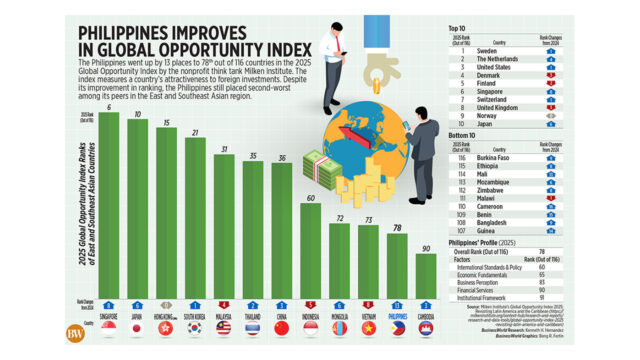
The Philippines went up by 13 places to 78th out of 116 countries in the 2025 Global Opportunity Index by the nonprofit think tank Milken Institute. The index measures a country’s attractiveness to foreign investments. Despite its improvement in ranking, the Philippines still placed second-worst among its peers in the East and Southeast Asian region.

Philippines improves in Global Opportunity Index

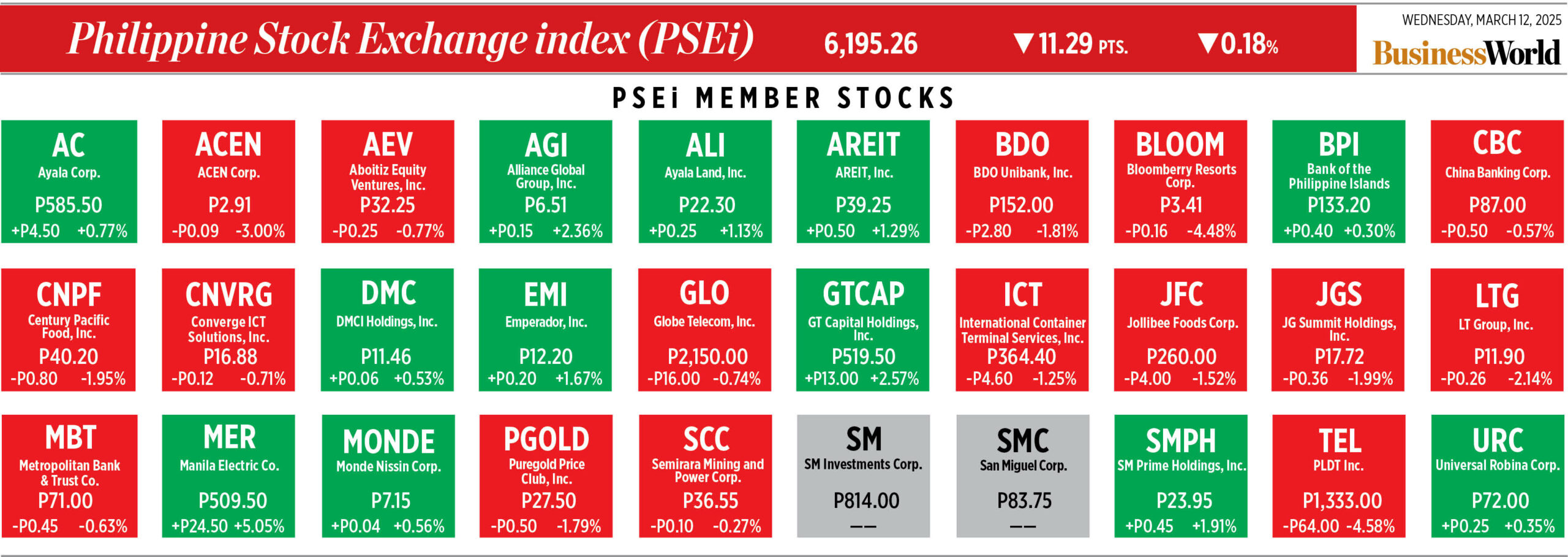
How PSEi member stocks performed — March 12, 2025

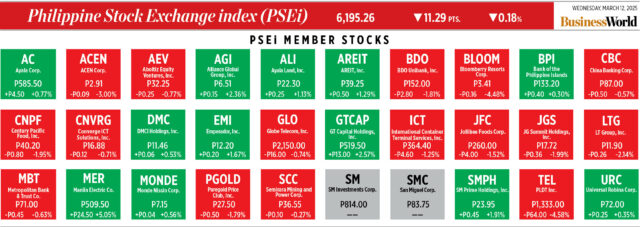
Here’s a quick glance at how PSEi stocks fared on Wednesday, March 12, 2025.


Power outlook being reviewed following Luzon yellow alert

STOCK PHOTO | Image by Natsuki from Unsplash

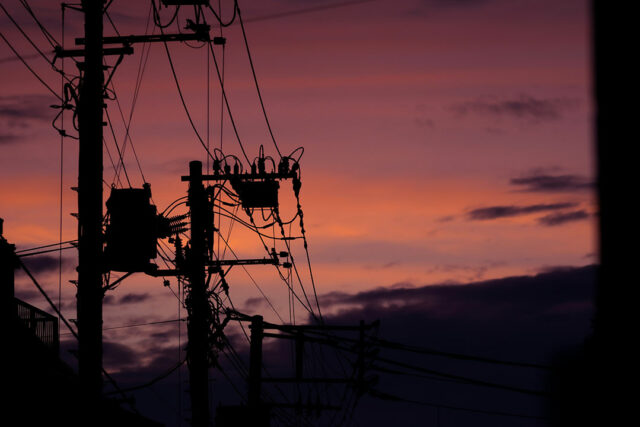
THE National Grid Corp. of the Philippines (NGCP) said it met with the Department of Energy (DoE) to adjust the power outlook following the declaration of a yellow alert last week.

“We’re still in the process of assessing and adjusting (the forecast) after the sudden spike in temperature on March 5. So as soon as we have that revised projection, considering all the factors, we will get back to you,” NGCP Spokesperson Cynthia P. Alabanza said at a briefing on Wednesday.

Ms. Alabanza said that the company will also work with power generators and distribution utilities next week to arrive at possible solutions and contingency plans to avoid disruptions to the power supply.

On March 5, the NGCP raised a yellow alert over the Luzon grid as demand spiked with the hot weather, with capacity also stretched by forced outages in some power plants. Unavailable because of unplanned outages totaled 3,362 megawatts (MW).

“With NGCP’s implementation of rapid assessment on grid stability, optimization of remaining available power, and continuous real-time monitoring and coordination with affected plants, the power situation did not escalate into a red alert,” the grid operator said.

A yellow alert is issued when the power supply-demand balance falls below safety margins.

Peak demand for the year was recorded on March 6 at 12,467 MW, up 5% compared with the DoE-approved GOP (Grid Operating Program), which had forecast demand of 11,870 MW that day.

For 2025, the Department of Energy forecast peak demand of 14,769 MW for Luzon, 3,111 MW for the Visayas, and 2,789 MW for Mindanao.

Meanwhile, the NGCP cautioned the public that while power supply “seems sufficient on paper,” unplanned outages have been the primary cause of power interruptions.

“While NGCP has complied with the DoE directive on the procurement of ancillary services (AS) through competitive selection process and payment of AS procured through the AS Reserve Market, the unplanned outages cause all power dispatched through the transmission system to be used for energy consumption,” the grid operator said.

“The contingency and dispatchable ancillary services will have been depleted and already running and dispatched as ‘energy’ for use by the consumers, and no longer reserved for ancillary services, since the contingency for which they were procured has already occurred,” it added.

A shortfall in supply, should that occur, means that while all available generators are running, including those contracted by NGCP for AS, the existing supply is still insufficient to meet demand, the company said.

Ancillary services are tapped by grid operators to support the transmission of power from generators to consumers to maintain reliable operations. — Sheldeen Joy Talavera

Dual citizens to be eligible for tourist VAT refund program — draft IRR

DUAL CITIZENS will be allowed to avail of the value-added tax (VAT) refund for tourists if they enter the country using their foreign passport, according to draft implementing rules and regulations (IRR) released by the Department of Finance.

The IRR draft considers Filipinos with dual citizenship who use their foreign passport to enter the country as falling under the definition of “tourist.”

President Ferdinand R. Marcos, Jr. signed Republic Act No. 12079, also known as “Act Creating a VAT Refund Mechanism for Non-Resident Tourists,” in December. The law allows tourists to claim VAT refunds on purchases worth at least P3,000 from government-accredited stores.

The law, as approved, holds that “sales to citizens and residents of the Philippines, and foreign nationals residing in the country, are not eligible for VAT refund.” 

The draft IRR deems “non-resident foreign passport holders who visit the Philippines” as tourists.

A public consultation on the IRR is scheduled for March 17.

The law follows the risk-based classification system for other VAT refund claims. It said claims deemed “high-risk” will require the presentation of the goods purchased for inspection and further validation by the Bureau of Customs. — Aubrey Rose A. Inosante

Sugar order calls for export of 66,000 metric tons to US

WIKIMEDIA.ORG/PATRICKROQUE01

THE sugar regulator issued an order calling for voluntary exports of 66,000 metric tons (MT) of raw sugar to the United States.

Sugar Order No. 5, issued on Wednesday, allows the Philippines to fulfill its obligations under the US Raw Sugar Tariff-Rate Quota World Trade Allocation, the Sugar Regulatory Administration (SRA) said.

Participants in the export program will enjoy priority in future import programs.

Participants complying with the order will be allowed to import 2.5 kilograms of refined sugar for every kilogram of raw sugar exported to the US.

The Office of the US Trade Representative gave the Philippines a quota of 145,235 MT raw value of raw cane sugar to the Philippines for the year to September.

Potential participants have until March 30 to submit to the SRA a written and notarized undertaking stating the amount of sugar they plan to ship to the US.

SRA Administrator Pablo Luis S. Azcona has said that the industry lobbied to export 66,000 MT of sugar instead of the initial 60,000 MT, to maximize the use of the cargo ship.

Segments of the local industry, including farmers, oppose sugar exports to the US because the US buys the commodity at a lower price.

“Sugar is bought by traders at US prices, which is about P1,000 less than domestic prices. That’s why farmers complained,” Mr. Azcona said last month, noting that the then-draft order incorporated the industry’s concerns. — Kyle Aristophere T. Atienza

Philippines exploring satellite, agricultural technology tie-ups with Slovenia

REUTERS

THE PHILIPPINES is exploring possible collaboration in satellites and agricultural technology with Slovenia, the Department of Trade and Industry (DTI) said.

Speaking on the sidelines of a forum organized for the visit of a Slovenian business delegation, Trade Secretary Cristina A. Roque said: “We really try to foresee how both countries can benefit from trade missions such as this… We discussed satellites, and they also have agri-tech, which is something that we are very interested in.”

She added at the Philippines-Slovenia Business Forum that the Philippines needs to develop technology in agriculture to achieve food security.

“We have a fast-growing population. It’s really important for us, so we don’t have to import so much because it’s expensive,” she added.

On Monday, the Philippines welcomed the delegation representing of 42 companies from the Slovenian mobility, manufacturing, food and beverage, information and communications technology, science, technology and education, business consultancy industries. Some of the companies also expressed interest in employing overseas Filipino workers.

“We are doing yearly investigations within our member companies, and the Philippines is seen as a really important hub for Slovenia because more than 80% of the Slovenian companies are exporters” according to Marjana Majerič, executive director of Chamber of Commerce and Industry of Slovenia (CCIS).

She sees the most promising areas for cooperation are technology, pharmaceuticals and medical devices, agri-food, sustainability, logistics, infrastructure, and energy.

“These are the areas that we can see as a really possible match between the Philippines and Slovenia,” according to Ms. Majerič, the head of the delegation.

At the forum, the Philippine Chamber of Commerce and Industry (PCCI) and CCIS signed a memorandum of understanding (MoU) to strengthen business and economic cooperation between the two countries.

Under the agreement, PCCI and CCIS committed to organizing outbound or hosting inbound trade and investment missions and participating in exhibitions, trade fairs, symposiums, seminars, conferences, study tours, business matching, training, and other trade and investment promotion activities.

The two parties also agreed to organize a Philippines-Slovenia business council which will implement their joint initiatives.

“Twenty years ago, we signed a contract with PCCI, and we now extended this MoU with an action plan. The previous MoU was a little bit general, but now we stick to more precise activities,” Ms. Majerič said.

“I think through that, we will have this possibility to make even further activities because we are already organizing online meetings with the companies,” she added.

PCCI Chairman George T. Barcelon said that the new MoU strengthens the two parties’ institutional cooperation.

“This agreement will provide a robust framework for regular business exchanges, trade and investment missions, and information sharing between our business communities,” he said.

“To our Slovenian friends, let me assure you that Philippine businesses are eager to explore partnerships with you. I understand that there are a few Slovenian companies currently operating in the Philippines, and I hope today will further balloon your presence in the country,” he added.

PCCI President Enunina V. Mangio said that the Philippines and Slovenia offer natural synergies in many high-value sectors.

“In manufacturing, for example, we see opportunities for technology transfer and supply chain integration. In information and digital technology, possibilities for joint ventures in software development, digital services, artificial intelligence, and other emerging technologies abound,” she said.

“Tourism presents untapped potential for cross-promotion and sustainable development models. And in human resource development, we can share best practices that enhance our competitiveness globally,” she added.

According to Ms. Majerič, Slovenian companies see the Philippines as a possible gateway to Asia.

“Your big advantage is your English-speaking people, and the second advantage that we see is your people are really eager to grow and learn,” she said.

“But besides that, your openness and your politics in terms of free zones and industrial parks give us possibilities in terms of approaching other markets,” she added.

She said that the Philippines is a possible springboard for US trade.

“In terms of the new American politics, the Philippines still has positive ties, so we see the possibility to step into the US market as well,” she added.

She said that the trade volume between the Philippines and Slovenia was 16 million euros in 2024. — Justine Irish D. Tabile


Philippines needs 9-9.5% growth to return to pre-pandemic track 

PHILIPPINE STAR/WALTER BOLLOZOS

THE economy needs to grow by at least 9% to 9.5% a year until 2028 to return to its pre-pandemic growth track, a former Bangko Sentral ng Pilipinas (BSP) official said.

During the MAP Economic Briefing and General Membership Meeting, GlobalSource Partners analyst Diwa C. Guinigundo said that the current government’s target of “between 6% to 8% annually, by 2036 (the Philippines) should be reaching only P60 trillion.”

“To overcome this setback, growth will have to be between 9% to 9.5% through 2028 to be able to return to the original growth path,” he said.

Last year, Mr. Guinigundo pushed for targets of 9.4% growth.

The Development Budget Coordination Committee (DBCC) on December trimmed the economic growth estimate for this year to 6-6.5% but widened the target band to 6-8% until 2028, due to “evolving domestic and global uncertainties.”

Finance Secretary Ralph G. Recto described as “doable” growth of between 6% and 6.5%.

In 2024, the economy expanded by 5.6%, following a 5.5% reading in 2023. It fell short of the government’s revised 6-6.5% target.

“We grew by only 5.5% in 2023 and 5.6% last year. Of course, we take pride in saying Philippine growth performance surpassed the global average in 2022 and 2023 of 3.5% and 3.3% respectively,” he said. 

“But we had the economy stall in 2020 and the years following that, so we have a lot of catching up to do.”

Mr. Guinigundo said risks to the economy include fiscal and debt sustainability, with revenue effort remaining low, food security issues, and political disunity.

“Since the Trump policy of tariff increases and tax cuts are potentially inflationary, we don’t expect the Fed to be very aggressive in reducing the target interest rate,” he added in his presentation.

“With the BSP having the space to further ease monetary policy, we see a potential capital outflow, peso depreciation, and therefore, the resurgence of inflation.”

Mr. Guinigundo noted that the budget deficit, which narrowed to P1.506 trillion in 2024, remains  in the “trillion mark.”

He said improved tax administration can only yield much, as can “squeezing” state-run firms for more dividends.

“This is after Congress forced the split banks and other GOCCs to continue to the Maharlika Investment Fund. No wonder, from the pre-pandemic (debt) of $7.7 trillion, we saw the crisis ending at $16 trillion. In January 2025, $300 billion was added to National Government debt,” he said. — Aubrey Rose A. Inosante

Finances, starting business top Filipino wish lists in 2025

PHILIPPINE STAR/MIGUEL DE GUZMAN

THE Boston Consulting Group (BCG) said financial security and health will remain the top goals for Filipinos in 2025.

Citing the results of an October study, BCG said 58% of survey participants ranked financial security as their most important goal, followed by starting their businesses at 56%.

In an interview with BusinessWorld, BCG Principal Sitti Reyes said these goals may not significantly change from last year and could be amplified given the global uncertainties prevailing.

“These dreams are underpinned really by kind of the anxiety and a lack of trust that they can thrive in those conditions,” she said.

The study also noted that Filipinos increased spending on supplements by 11%, on medicine by 5%, and on preventive healthcare by 19%. Personal spending on health maintenance organizations (HMO) declined 3%.

The dearth of spending on HMOs was explained by a preference for products promising immediate value, she said.

“It is also a perception issue at this point. So you could be spending P20,000-P30,000, something that you may not use. It’s just for when (emergencies) come,” she said.

In the same report, 60% of respondents said they have a health plan.

Only 65% considered themselves prepared for medical emergencies. Among those without a healthcare plan, the rate was 21%. — Aubrey Rose A. Inosante

ADVERTISEMENT
ADVERTISEMENT