Home Blog Page 1840

Philippine Stock Exchange to take over PDS in P2.32-B deal

REUTERS

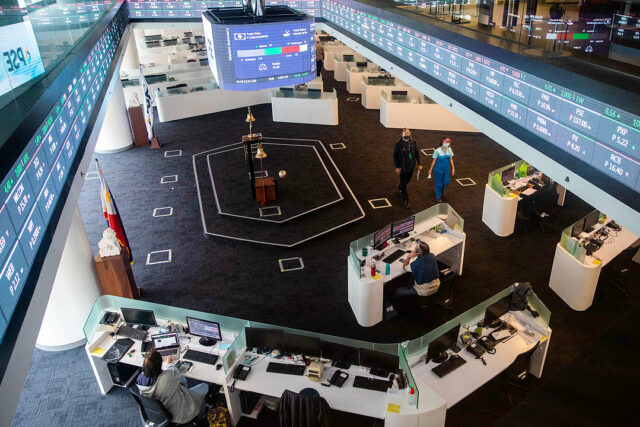
THE Philippine Stock Exchange, Inc. (PSE) is set to take over Philippine Dealing System Holdings Corp. (PDS) after buying the stakes of various shareholders in a deal worth P2.32 billion.  

In an e-mailed statement late Thursday, the PSE said it would buy 3.87 million PDS shares at P600 each for a 61.92% stake as part of its plan to unify local capital markets.    

The bourse has a 20.98% stake in PDS. The deal cost was based on the P3.75-billion enterprise value of PDS.  

PDS owns fixed income exchange operator Philippine Dealing and Exchange Corp. and Philippine Depository & Trust Corp.  

The PSE signed term sheets with the Bankers Association of the Philippines (BAP) for its 28.83% stake, as well as with Mizuho Bank Ltd. for its 0.08% stake.  

The market operator also signed share purchase agreements to acquire Singapore Exchange Ltd.’s 20% stake, Whistler Technologies, Inc.’s 8% stake, San Miguel Corp.’s 4% stake, Investment House Association of the Philippines’ 0.65% stake and Golden Astra Capital, Inc.’s 0.36% stake. — Revin Mikhael D. Ochave

SM eyes increased sales as prices ease in 2025

BW FILE PHOTO

SM Investments Corp. expects slowing inflation to boost consumer demand in 2025, which it said could create opportunities in the Philippine retail sector.

“Any moderation in inflation should trigger a strong confidence rebound,” SM President and Chief Executive Officer Frederic C. DyBuncio said in a statement on Thursday. “This could create opportunities in consumer-focused sectors in the country, and we are poised to cater to these evolving demands.”

He said the business sector has adapted well despite inflation and the peso’s volatility against the dollar.

Household spending rose 5.1% in the third quarter, according to data from the local statistics agency. Inflation quickened to 2.5% in November as prices of vegetables, meat, and fish rose due to a series of typhoons.

The peso sank to an all-time low of P59 against the dollar on Dec. 19, though it has since recovered. It closed at P57.97 a dollar on Thursday, 48 centavos stronger than its P58.45 finish on Monday, according to Bankers Association of the Philippines data posted on its website.

To meet growing demand, Mr. DyBuncio said SMIC continues to expand to underserved areas. He added that the company continues to contribute to sustainable economic development and collaborate with the government to improve access to modern retail, financial services, and integrated property development.

“By investing and expanding to more areas nationwide, SM creates new markets and improves access to these essential sectors, serving more communities and helping stimulate sustained economic activities,” Mr. DyBuncio said.

Meanwhile, the group continues to invest in renewable energy and logistics, he added.

SM has invested in the clean energy sector via Philippine Geothermal Production Co., which produces 300 megawatts of geothermal steam supply.

SM aims to continue to develop geothermal concessions through Philippine Geothermal in support of the Energy department’s goal of reaching 50% renewable energy supply by 2040.

The holding company’s property unit, SM Prime Holdings, Inc., has partnered with GUUN Co. Ltd. to implement a technology that converts nonrecyclable and hard-to-recycle packaging into alternative fuel.

SM’s consolidated net income grew 9% to P60.9 billion in the first nine months as revenue increased 5% to P462.5 billion.

SM shares dropped 2% or P18 to P882 each. — Revin Mikhael D. Ochave

A history of globalization on horseback

FREEPIK

THIS YEAR has seen a heightening of the semiconductor wars between the US and China, stoking superpower tensions and raising visions of a global economy decoupled into opposing spheres.

Does history provide clues to how this might all play out?

Let me take you on a ride to revisit a millennia-old innovation that dictated the conduct of war, the shape of trade, and the very concept of mobility and speed. A commodity that required expert handling, it was the basis of much political and military power — and the quest for supplies led to violent takedowns of would-be monopolies.

That would be the horse.

The animal has been part of Western imagination since Paleolithic humans painted the Lascaux caves around 20,000 years ago. But consider this: Those depictions were of wild horses, descendants of a species that had evolved and was already extinct in North America. They were swift and powerful, as terrifying as the mammoth and the rhinoceros that co-starred on the cave walls. No one knew how — or dared — to ride horses then.

The key breakthroughs — getting on horseback and using the steeds to ferry vehicles like war chariots — probably took place around the Ural mountains and Central Asia about 4,200 years ago. Harnessing the beast’s speed, the innovators migrated into other regions of Eurasia — taking equine breeding and technology with them. Cultures everywhere adapted or died. Kingdoms were lost and won for love or lack of horses. Quickly enough, everyone from the pharaohs of Egypt to Alexander the Great (and his legendary steed Bucephalus) were waging swift and cruel war on horseback. The threat of the horse-powered Egyptian cavalry is so great that only God has the power to drown it — and save the fleeing Israelites — by unparting the waters of the Red Sea.

And so, the horse became more than a horse, of course: It was a disrupter of the status quo, the cutting edge of military technology, mover and shaker of empires. It also became the animal spirit of trade. That’s because some places were more equal than others for horse breeding. The Indian subcontinent was too hot and humid. The soil of ancient China didn’t have enough selenium to cultivate the strong-boned military steeds required to fight wars. As a consequence, those civilizations traded for the horses they needed. The Chinese offered silk in exchange — and by doing so, helped create a demand for the textile as the luxury spread further west.

In the second century BCE, when the people of the Ferghana Valley — in what is now eastern Uzbekistan — imposed a limit on how many horses the Chinese could purchase, Emperor Wudi of the Han dynasty sent armies to punish that distant region, which was ruled by descendants of Alexander the Great’s soldiers. After a couple of tries, he got the trade back to his terms.

In that way, the horse was at the basis of the luxury commerce (not just silk but spices and delicate Indian cotton fabric) that linked one end of Eurasia to the other. The British Museum has a spectacular Silk Roads show*    which runs until Feb. 25 — that provides material evidence of this compulsion to connect across vast terrain. There are two remarkable items. The first is a replica of a glass bauble from 6th century Iran that somehow made it to the court of Japan’s Emperor Shōmu, a journey of thousands of miles through deserts and mountains or perilous seas. (The original remains in an 8th century storehouse in the city of Nara). From roughly the same period, a copper alloy Buddha from the Swat Valley in what is now Pakistan found its way to a small island just outside Stockholm.

While the glass bowl in Japan and the Buddha in Sweden may be considered exotica, the historian James Belich says, the “luxury trade was a proxy for interaction” — just as it is today, for example, with the huge presence of Hermes, Gucci, and other fashion houses in China.**

A further explosion of horse-borne military expansion propelled the Mongols into the center of history. The riches of the vast domains of Genghis Khan and his descendants would inspire Western Europeans to sail the ocean blue on their own quest for empires.

That’s how horses finally made their way back to North America — with Spanish conquistadors who used them to defeat the Aztec and Inca empires. The Europeans tried to secure the military edge by limiting the number of mares they brought over so the indigenous peoples couldn’t steal them and breed horses to match the invader. But, just as the secrets of Chinese silk technology eventually filtered westward, Native Americans got their horses. That is reflected in the legacy of the Comanche, Arapaho, and the other mighty fighters of the Plains whose might challenged the westward push of the US. Indeed, federal troops slaughtered horses to eliminate the potential of indigenous uprisings.

Horses were a globalizing force for thousands of years — for both good and ill. That’s easy to forget in our machine age, when all of human history seems to be dancing precariously on the head of a microchip. It wasn’t that long ago that horses were still crucial to the way nations functioned. In 1914, when the Great War broke out, the British Army fielded hundreds of thousands of horses in the western theater not just as cavalry mounts but to haul weapons, ammunition, and supplies. Equine utility persisted in other parts of the world, at least for a while. In Manila, in the early 1960s, my ride home from second-grade classes was sometimes on a calesa — a type of horse-drawn buggy that provided cheap transport in the older parts of the Philippine capital.

We still talk of horsepower (equivalent to 735.5 watts in the metric system) but nowadays, there are no real horses attached to them. New technology can swiftly supplant the old — and often you can’t or refuse to go back. While not entirely put out to pasture, horses have become more symbolic than utilitarian, more quaint than strategic. In some cases, they’ve become luxuries (hood ornaments or thoroughbred racers). But they still retain some terrifying power. After all, the apocalypse is embodied in four fearsome figures mounted on horses. The last steed is a pale one: “And his name that sat on him was Death, and Hell followed with him.”

BLOOMBERG OPINION

*“Silk road” is a recent formulation, translated from the German Seidenstrasse, a term popularized in 1877 by a recent formulation for the various Central Asian land routes that brought goods from China to the Middle East and Western Europe before Spain and Portugal initiated their ocean-crossing expeditions in the late 15th and 16th centuries.

**The thesis of Belich’s latest book examines the consequences of interaction well beyond the horse. The World the Plague Made: The Black Death and the Rise of Europe contends (quite convincingly in my view) that the halving of Europe’s population by the bubonic plague led to economic conditions conducive to Western expansion.

Cosco Capital terminates P500-M JV with Siam Global due to poor market conditions

PUREGOLD

COSCO Capital, Inc. on Thursday said it has ended its P500-million home improvement warehouse joint venture (JV) with Thailand’s Siam Global House Public Co. Ltd., citing market conditions.

They agreed to terminate the joint venture agreement on Dec. 23, Cosco Capital, which operates S&R Membership Shopping and the Puregold Price Club, Inc. chain of supermarkets in the Philippines, said in a stock exchange filing on Thursday.

“The management of both parties mutually decided to no longer proceed and finally terminate the agreement,” it said. “This decision was mutually arrived at after strategically reviewing the current market conditions.”

In June 2022, Cosco Capital and Siam Global signed a deal to set up and operate a one-stop home improvement warehouse for building materials, construction equipment and tools.

The joint venture had a P500-million initial investment — 55% from Siam Global and 45% from Cosco Capital.

Cosco Capital said the joint venture was part of its plan to expand into a new business and create more income sources.

Siam Global has interests in selling home, building, and construction materials.

Cosco Capital’s net income rose 10% to P10.04 billion in the first nine months from a year earlier as revenue grew 9.2% to P164.06 billion.

The grocery retailing business accounted for 69% of its net income, followed by The Keepers Holdings, Inc. at 22%, commercial real estate segment at 7%, energy and minerals at 1.5%, and specialty retail at 0.5%.

Cosco Capital shares rose 1.33% or seven centavos to P5.35 each. — R.M.D. Ochave

Metro Manila Film Festival 2024: Himala moves from screen to stage to screen again

By Joseph L. Garcia, Senior Reporter

Movie Review
Isang Himala
Directed by Jose Lorenzo “Pepe” Diokno

EARLIER this year, Broadway star Patti LuPone appeared on the talk show Hot Ones, where, instead of apologizing to singer Madonna about her previous criticism of the singer’s acting skills in the movie musical Evita (Ms. LuPone played the dictator’s wife in the 1979 Broadway run of the musical), she decided to eat an extra-hot wing and proceeded to criticize the singer even further (despite Madonna winning a Golden Globe for the role; there will be no Madonna criticism in this home).

Isang Himala, the movie musical based on the 2003 and 2018 musicals, in turn inspired by Ishmael Bernal’s epic 1982 film (all written by Ricardo “Ricky” Lee, now National Artist of the Philippines for Film and Broadcast Arts) avoids this conflict by casting almost all the same actors from the 2018 run in the 2024 musical, a contender at the Metro Manila Film Festival.

The Patti LuPone vs. Madonna conflict opens up a can of worms about the adaptability of pieces from the stage to the screen. We’ve seen its success in Broadway’s latest offering to Hollywood in the critical acclaim achieved by Wicked (Part 1), but will this same effect translate to an all-Filipino show? We’ll try to answer that in this review.

For starters, Isang Himala is shot on a set instead of arid Ilocos as in the cinematic source of the musical’s source material. That’s okay — the movie wants to resemble the musical, not the original movie.

If anything, it highlights the artifice in the story: Elsa (a provincial maiden originally played straight by Nora Aunor; cementing her status as local Superstar) claims to see the Virgin Mary and begins a faith-healing journey that shoots her to a degree of celebrity; the journey ends in tragedy. The film was regarded then as the best this country could offer, and what that story says about us, I’d rather not think about.

A colleague had told me that I should watch this movie because I was the only one among the Lifestyle reporters to have seen the musical’s 2018 run (related story: https://tinyurl.com/9nmu35n3). Big mistake: all I did in my seat was compare the magic of the theatrical run to the experience in the cinema, giving this review an unfair slant. I do, however, envy those who will see the musical for the first time in this form, for it really is quite a good movie — if you hadn’t seen the musical.

For example, one of the musical’s highlights was the interactive set (the theater at Circuit Makati was comparatively small) where actors would pop in at your side, and the sound of howling winds wrapped around your seat, making you truly feel as if you were part of the story. The movie version really made you just a watcher, though the character of the filmmaker, Orly (played by David Ezra), would often attempt to break the fourth wall. We also feel that new songs were added and the character of the prostitute Nimia (Kakki Teodoro) was expanded — to the detriment of Aicelle Santos’ Elsa.

Ms. Santos has a beautiful voice (I once described it as “having a certain purity”; she won First Runner-up in 2005’s Pinoy Pop Superstar), but her solos are few and far in between. Everybody and their mother gets a song (even the town lunatic gets a few lines) in this film, detracting attention from Elsa’s town-wide stardom. But I guess that’s okay: what the play added to the movie was making the townspeople of cursed Cupang into a hungrier and needier chorus, adding to the pressures of being Elsa.

Speaking of wasted opportunities to showcase Ms. Santos, I was very excited to hear “Gawin Mo Aking Sining,” a song that Elsa sings in the theater version while being dressed by her attendants as Orly takes videos of her. It’s a very powerful song about photography-as-immortality (I don’t think there are many songs in this theme) and self-delusion. In the movie, she just sings this as part of an interview, robbing the number and Ms. Santos’ voice of grandeur. As I’ve said, however, I will envy the person hearing this for the first time, because it really is a great song (it still gave me goosebumps after all these years). Frankly, I’d watch the movie again just to hear it; we wish they’d release a soundtrack.

As we’ve said, the movie musical is shot on a set instead of on location. While this gives more control for lighting and other elements (as needed in the story), the scale of the stage followed on the medium of cinema has a hand in diminishing its epic qualities. In the original movie, scores of people flock to Nora Aunor’s Elsa, so you can really feel the suffocation of small-town drama. In the stage production, a limited number of people can be forgiven due to the limits of the venue’s size. In this movie production, the score (singular) of people who follow Elsa around don’t really hit the spot. Furthermore, while the theater stars who populate the film have some screen experience, their acting in this movie seems to fit better onstage instead of on-screen. The entire effect seems like one of those live American TV specials of Broadway musicals.

The film, much like its source materials, is an intellectual exercise. The movie is great — but you have to want to watch it. You watch it to compare it to the musical. You watch it to compare it to the movie. You watch it because you liked the story, the singing, the actors; et cetera, but I can’t see any Juan off the street entering the theater to watch this on a blind buy. It is an excellent piece independent of its influences, but we’re all only human, and we are shaped by the things that have come before. It’s also to its handicap that the theater is often open only to those who can afford it, so the movie’s appeal will be limited to the theater’s small audience.

Still, despite all my nitpicking, the cinema where we watched it saw a full house. We truly wish for a miracle for this production — that it can go beyond its limited, fashionable audience and pick up a few new fans along the way.

MTRCB Rating: PG

Blessings for the children

FREEPIK

The world is reeling from the chaos of disasters, pandemic, war, conflicts, political unrest, hunger, and deprivation, for the people and children who are trying to restart and rebuild their lives and communities.

We pray for spiritual grace, healing, love, forgiveness, and lasting world peace.

We count our blessings and release all negative vibes.

Here’s my annual list of wishes for the children. They are future citizens, and they deserve to inherit a better world.

1. A home with loving parents who will guide and care for them. That all parents will lead by example and teach their kids good manners, family and spiritual values. That all children will be safe from domestic violence and abuse.

2. Good health. That all children, especially those in the rural areas and the marginalized communities, will have proper nourishment and medical and dental care in order to grow strong and healthy. That the essential vaccines to combat diseases will be available to all children in remote and devastated areas.

3. A pollution-free environment — clean air, pure drinking water, open fields, and parks with trees and flowers. That they may appreciate nature and learn how to protect the rivers, seas, lakes, and forests.

4. Quality education. That the public school system will be upgraded with dedicated teachers, more classrooms equipped with internet facilities, and books for students. That all kids will be given the opportunity to study and have the chance to excel.

5. Mental health care. That there will be enough psychologists and guidance counselors to help and protect adolescents with their issues such proper mental health care. Many children suffer from depression and anxiety. Some are desperate and take extreme risks. There should be a holistic psychospiritual treatment program to address this growing situation.

6. A comprehensive sports program for national and international competitions. That kids will learn the values of friendly competition, and the art of winning and losing gracefully.

7. A gender discrimination-free society that will encourage girls and boys to become leaders in school and later in their chosen professions. That they would have the resources from government and the private sector to fulfill their goals.

8. A progressive national arts and culture program and outreach projects to elevate and enhance the consciousness of children.

9. More education grants and financial stipends for good scholarships for deserving students. The appropriate work opportunities and support, both local and international, graduates.

10. Quality and balanced programming on television with more educational and entertaining shows. That producers will not exploit aspiring young performers. That there be proper protection for minors and performers who come out in shows. That all children and adolescents be protected. That social media content would be elevated to a higher level.

11. An accelerated science, math, and technology educational program to equip all future graduates with the necessary IT skills to compete in the international markets.

12. A stable economy. Jobs and livelihood opportunities for parents so that their children can go to and stay in school. Children should not be made to work in sweatshops or beg on the streets. Illegal child labor factories and armies are forbidden.

13. A country with visionary national and local leaders. An efficient, transparent government that is free from corruption. Integrity, compassion, and delicadeza (a sense of pride, honor, propriety, decorum, and/or decency) are some of the best qualities the officials should have.

14. A safe, crime-free, drug-free, abuse-free environment. That all kids be protected from the menace of incest, physical and emotional abuse, and the scourge of drugs. The internet is now being used by predators to exploit children and expose them to sexual abuse.

15. That children not be used as soldiers in areas of armed conflict.

16. Freedom of expression. That children have the right to be themselves. That adults realize that children need respect, and they are entitled to be heard. That there be open communication with parents and teachers or mentors.

17. Innocence. That they have a happy childhood and the chance to enjoy being a child. That they have time to play, study, rest, and heal. Above all, time to grow up at their own pace.

A Happy, Prosperous and Healthy New Year to all!


Maria Victoria Rufino is an artist, writer, and businesswoman. She is president and executive producer of Maverick Productions.

mavrufino@gmail.com

Wage commission approves Northern Mindanao pay hike

CAGAYAN DE ORO CITY FACEBOOK PAGE

THE NATIONAL Wages and Productivity Commission (NWPC) approved wage increases of P23 for non-agricultural workers and P35 for agricultural workers in Region X (Northern Mindanao), starting on Jan. 12.

Wage Order No. RX-23 divides the pay hike for agricultural workers in two tranches, with the first P23 coming on Jan. 12 and an additional P12 on July 1, 2025.

Agricultural workers will receive a P23 wage hike in the first tranche in January, followed by another P12 hike on July 1, 2025, according to a statement issued by the Department of Labor and Employment (DoLE) on Thursday.

Upon full implementation, these increases will raise minimum wage rates in the region to between P446 and P461, effectively removing the rate distinction between non-agricultural and agricultural workers, DoLE added.

The Northern Mindanao Regional Tripartite Wages and Productivity Board (RTWPB) is seeking to simplify and standardize its wage classification structure, it noted.

The board likewise approved a P1,000 monthly hike for domestic workers, bringing their entry-level wage to P6,000 from P5,000 through Wage Order RX-DW-04.

Federation of Free Workers (FFW) President Jose Sonny G. Matula said the new wages for workers in Region X are akin to “tossing crumbs.”

“It’s just not enough, especially compared to the needs of workers to survive as manifested by the trade unions. Worse, it widens the gap from P182 to P184 between Region X and the National Capital Region (NCR), further underlining the persistent and unjust regional wage disparities across the nation,” he told BusinessWorld via Viber. 

“In Metro Manila, where the minimum wage is P645 compared to P461 in Cagayan de Oro and nearby areas, the P184 gap is indefensible. A worker’s value—whether they’re a factory worker, a waiter, or a mason — should not be downgraded simply because of their location,” he added.

Meanwhile, the NCR board through Wage Order No. NCR-DW-05 also granted a P500 monthly increase for domestic workers. This brings their monthly minimum wage to P7,000 from P6,500.

The wage order for domestic workers in the NCR will take effect on Jan. 4.

DoLE said 4,907,584 minimum-wage earners will benefit from wage orders issued in 14 regions, along with 717,508 domestic workers in nine regions.

It added 7,528,968 full-time wage and salaried workers earning over the minimum pay may indirectly benefit as employers adjust for wage distortion.

Fourteen boards (NCR, CAR, Regions I, II, III, IV-A, Mimaropa, and Regions VI, VII, VIII, IX, X, XII and XIII) have issued wage orders for private sector workers this year, with daily wage increases ranging from P21 to P75.

Nine wage orders were issued for domestic workers (NCR, CAR, Regions I, II, MIMAROPA, and Regions VI, VIII, X and XIII, ranging from P500 to P1,100.

Meanwhile, Region V (Bicol) deferred the minimum pay determination process due to the impact of Tropical Cyclone Kristine.

DoLE said Region V will resume the process when circumstances permit or after three months from Nov. 7, 2024.

The Region XI board (Davao) is currently in consultations and will announce its minimum wage decision in January.

“The RTWPBs have been instructed to roll out productivity improvement programs and gainsharing schemes designed to foster sustainable and long-term wage growth. These programs particularly target areas within the regions with lower productivity levels, where their implementation can significantly enhance overall efficiency,” DoLE noted.

It cited the availability of exemption options for firms affected by recent typhoons.

Affected enterprises may inquire and apply through their respective wage boards to determine their eligibility for a full exemption or a specific minimum wage tranche.

Additionally, DoLE urged businesses and workers to take advantage of programs like the Adjustment Measures Program (AMP), which aims to mitigate vulnerability to economic disruption, including those caused by natural calamities. — Chloe Mari A. Hufana


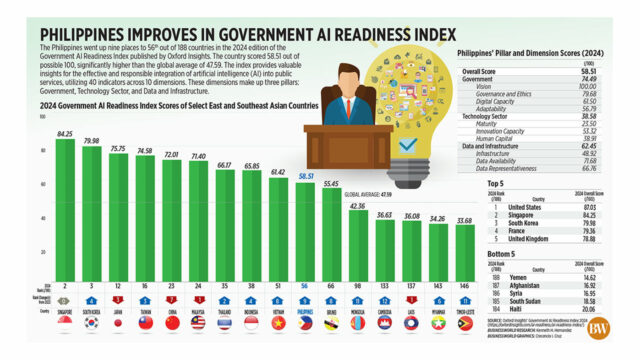
Philippines improves in Government AI Readiness Index

The Philippines went up nine places to 56th out of 188 countries in the 2024 edition of the Government AI Readiness Index published by Oxford Insights. The country scored 58.51 out of possible 100, significantly higher than the global average of 47.59. The index provides valuable insights for the effective and responsible integration of artificial intelligence (AI) into public services, utilizing 40 indicators across 10 dimensions. These dimensions make up three pillars: Government, Technology Sector, and Data and Infrastructure.

Philippines improves in Government AI Readiness Index

PLDT, Smart to launch anti-scam services

STOCK PHOTO | Image by terimakasih0 from Pixabay

PLDT, Inc. and its wireless arm Smart Communications, Inc. will launch three services in 2025 to address scams and improve customer protection.

These include silent authentication, device location validation and improved know-your-customer (KYC) processes, PLDT Enterprise First-Vice President John R. Gonzales said in a statement on Thursday.

Silent authentication will replace traditional one-time password with a more secure method of logging into apps and addresses the rising threat of password interception by malicious actors, he said.

Device location validation allows merchants to verify a user’s device location during a transaction to help detect fraud, while enhanced KYC processes help ensure that transactions are legitimate and secure, he added.

“The Philippines is a mobile-first country,” Mr. Gonzales said. “Today, 64% of transactions here are conducted on mobile devices, and because of the high volume of transactions, the Philippines has become a major target for malicious actors.”

Smart stopped almost two billion malicious text messages from reaching customers in the 10 months to October, while blacklisting almost a million numbers tied to scams.

The PLDT Group said it is also working with government agencies against smishing — a form of phishing attack that targets mobile devices — including the investigation, apprehension, and prosecution of scammers.

Hastings Holdings, Inc., a unit of PLDT Beneficial Trust Fund subsidiary MediaQuest Holdings, Inc., has a majority stake in BusinessWorld through the Philippine Star Group, which it controls. — Revin Mikhael D. Ochave

Metro Manila Film Festival 2024: Tacky revenge thriller

By Brontë H. Lacsamana, Reporter

Movie Review
Uninvited
Directed by Dan Villegas

IT’S interesting to think about why revenge thrillers are so popular. Through them, we get the satisfaction of enacting justice in a way that isn’t possible in the real world. Uninvited does this through the character of a mother whose love knows no bounds and is forced into its deepest, darkest depths after her daughter is cruelly taken from her.

Unfortunately, because it’s a genre we know so well from movies and teleseryes, the main thing that sets apart this tacky revenge thriller from others is its cast. It is ultimately a vessel for stars like Vilma Santos, Aga Muhlach, and Nadine Lustre to showcase their acting chops, all while dressed expensively and cursing like it’s a mafia film.

Uninvited follows Eva Candelaria (played by Vilma Santos), who seeks revenge on billionaire Guilly Vega (Aga Muhlach) for killing her daughter years before. Disguised as a guest, she carries out her plan while attending his lavish birthday party, where she encounters his own daughter, Nicole (Nadine Lustre).

Santos enthralls in this solemn turn as an unlikely mother exacting justice while Lustre is engaging to watch as she toes the line between cynicism and defiance. Muhlach throws the biggest swings here, delivering campy B-movie levels of acting as the film’s one-dimensional villain (sometimes effective, sometimes too much).

While this film might not convince everyone, it definitely convinced the theater I was in. Uninvited is a crowd-pleaser. It has a long, emotionally manipulative build-up and an illogical extended climax designed to elicit cheers from the crowd as the lead character serves vengeance. It relies on drawing out audience sympathy, from its flashbacks all the way to its violent conclusion, which succeeds only if we completely suspend disbelief.

(Spoilers follow.)

An old woman with no family members just teaching herself to fire a gun with precision? Only to get to the party and not actually have a plan (despite the implication that she spent years on one)? A Big Bad that personifies evil and doesn’t even hide it? A party full of important people that somehow have no bodyguards roaming the premises?  The film shapes up to be a collection of cliches that quickly veer into tacky territory.

The film opens with a reminder that Warner Brothers is distributing this, the second Philippine movie after last year’s hit, the messy folklore horror film Mallari, also by Mentorque Productions. While Uninvited is a collaboration with Project 8 Projects, a pattern still emerges that stylish genre films are what Warner Brothers is looking to distribute. Dan Villegas’ direction and Dodo Dayao’s script more than capably supply that here, but a bit more polish would be appreciated.

A clear stand-out is the party sequence, well-put-together for Santos’ Eva to react to, her seemingly polite demeanor in the face of a grossly extravagant show of an evil man’s wealth hiding pent-up rage and grief that boils just beneath the surface. The flashback scenes woven into the narrative are all right, carried by solid actors Gabby Padilla and Elijah Canlas despite their brief roles as victims. The worst and most gruesome of their scenes could’ve been depicted with a little more subtlety, coming off as gratuitous just to serve as fuel for the final act’s fiery revenge.

What’s really unforgivable, though, is how it all came down to predictable tropes and twists, the mediocre execution really showing as Eva’s revenge unravels but just as quickly somehow ends up successful. The kills feel rushed through, except for the final one, and the potential to explore the roots of crime and violence and the hypocrisy of the wealthy lasted only for a few superficial scenes.

An underutilized dynamic was that of Santos and Lustre’s characters, both being women and on seemingly opposite sides at first — a victim’s mother and a perpetrator’s daughter, both imperfect and struggling to make sense of this cruel world. An intriguing chemistry was established only to be rushed through in the span of one or two scenes.

While Uninvited is enjoyable, it could have been a more impressive feat for the revenge thriller genre, which is a tired one at this point. This was a decent attempt, but ultimately still fell short.

MTRCB Rating: R-16

Term deposit facility yields go down after BSP cut

BW FILE PHOTO

YIELDS on the Bangko Sentral ng Pilipinas’ (BSP) term deposits declined on Thursday as the offer went undersubscribed, with the market continuing to price in the central bank’s third straight rate cut.

Demand for the central bank’s term deposit facility (TDF) amounted to P99.156 billion on Thursday, well below the P240-billion offering. This was lower than the P248.991 billion in bids for a P310-billion offer last week.

Broken down, tenders for the seven-day papers reached just P59.27 billion on Thursday, below the P150 billion on the auction block. This was also lower than the P201.815 billion in bids for the P180-billion offering of eight-day term deposits the previous week.

Banks asked for yields ranging from 5.725% to 6.05%, a wider band compared to the 5.95% to 6.0199% seen a week ago. With this, the average rate of the one-week deposits dropped by 12.31 basis points (bps) to 5.8845% from 6.0076% previously.

Meanwhile, the 13-day papers fetched bids amounting to P39.886 billion, lower than the P90-billion offer and the P47.176 billion in tenders for the P130 billion in 15-day deposits auctioned off last week.

Accepted rates for the tenor were from 5.755% to 6.2%, wider than the 5.96% to 6.074% range seen last week. This caused the average rate of the two-week papers to decline by 10.84 bps to 5.9229% from 6.0313% in the prior auction.

The TDF tenors were adjusted in view of the holidays.

The central bank has not auctioned off 28-day term deposits for more than four years to give way to its weekly offerings of securities with the same tenor.

The term deposits and the BSP bills are used by the central bank to mop up excess liquidity in the financial system and to better guide market rates.

“The BSP TDF average auction yields again mostly slightly declined for the 14th straight week after the latest local policy rate cut last Thursday,” Rizal Commercial Banking Corp. Chief Economist Michael L. Ricafort said in a Viber message.

The Monetary Board last week delivered a third straight rate cut at its last review for the year, reducing benchmark borrowing costs by 25 bps to bring its policy rate to 5.75%. The central bank has now slashed rates by a total of 75 bps since it began its easing cycle in August.

Mr. Ricafort also noted the BSP chief’s signals of another rate cut in the Monetary Board’s first rate-setting meeting in 2025.

BSP Governor Eli M. Remolona, Jr. told Bloomberg last week that the central bank is open to delivering another rate cut at their first review next year.

Mr. Remolona said the BSP remains in an easing cycle and is “neither more dovish nor less dovish.”

The BSP chief also said after last week’s policy meeting that delivering 100 bps worth of cuts next year may be “too much.”

The central bank will likely keep reducing rates in “baby steps” as an “insurance against a possible increase in inflation,” Mr. Remolona added. — Luisa Maria Jacinta C. Jocson

New Year employee engagement dialogue

I work as a manager for a medium-sized organization. What are the best ways to start the New Year with our direct reports? – Blue Lagoon.

When I was a young human resource (HR) manager, my typical yearend working days were easy and joyful. Most of the time, I would have exhausted my vacation leave credits for the year except for three days for emergency situations. Christmas break allows me to work without stress as I sought to complete my pending projects to avoid carrying them over into the new year.

I’m quite superstitious. Bringing incomplete tasks into the following year made me distrust the future. It’s better to start fresh and ready to face new challenges than be reactive the whole year solving problems. This was my annual routine while thinking about how to improve or maintain professional relationships with my workers.

My usual questions were: Am I on the same page as my colleagues? Do I know them better than they know themselves? Do they consider me a good boss? If not, why not? What were they thinking behind my back? Do they like me as a person?

We are incurable social animals like our ancestors. Our groups are formed based on certain things in common, like school or regional origin. Even sexual preference plays a key role in determining one’s group.

Framing things that way gives me the right attitude in dealing with the various personalities.

ENGAGEMENT APPROACHES
Since groups are formed on the basis of common values, I tried to understand my former direct reports to avoid organizational blindness. The key is in knowing how to treat workers like family. We can do this with a little bit of exaggeration. How do we go about it?

Depending on your management style, you can always engage the employees with the following basic approaches:

One, start the New Year with a brief morning meeting. Inform everyone several days in advance. All direct reports must attend a department meeting which should not last more than an hour. The shorter, the better. Greet everyone with positivity and enthusiasm by outlining the department’s specific goals for the year.

Such goals must be the result of the organization’s strategic plan made three months earlier with the chief executive officer (CEO) and other department managers. If your company fails to come up with such strategic plan for some reason, you must come out with your own department goals approved by the CEO.

Two, find the time for one-on-one talks. Refocus on their individual interests, challenges, and values. Be guided by the following questions: What is your career goal in this organization? How can I help you achieve your goal? What are the difficulties in your job? How can I help you manage those challenges?

What are the resources that you need? How about other options? If the options are difficult to accomplish within your pay grade, explain clearly the reason for it, but not after making a serious study. Whatever you do, don’t give an instant no as your answer could be misinterpreted.

Three, ask open-ended questions. This is related to number two. By asking open-ended questions, you are allowing the discussion to flourish intellectually. Thank the worker if they accept your idea or proposal. Express how much you value your relationship with them.

To express your sincerity, document the salient points of your agreement, especially if it means a job transfer within the department, assigning additional tasks or special projects that are beyond the workers’ job description.

Four, admit your mistakes. If a worker is brave enough to confront you over your lapses, understand the circumstances without being defensive. Acknowledge the fact that you may have hurt the person. Then work your way through until the grudge goes away. Remind yourself that such engagement dialogue is intended to be kind and courteous.

Even if a worker has occasionally driven you crazy, don’t allow it to destroy the goodwill that you have created at the start of your engagement dialogue. Maintain the positive atmosphere and remain calm.

NO ONE-TIME DEAL
An employee engagement dialogue is not a one-time deal nor a ceremonial New Year activity. It must be done with regularity or as soon as you discover something unusual about a worker or group of workers. Be proactive. Don’t wait for the exit interview before doing anything. As a manager, it’s your job to detect potential issues so you can manage them correctly.

I suggest this rule of thumb: Be several steps ahead of your workers. Anticipate everything. In doing so, you can protect yourself to a certain degree against being manipulated. Remember and understand the letter and spirit of every worker’s argument or complaint.

This entails a lot of work and will slow you down. But it’s worth it. By slowing down, you gain the advantage of refining every issue that comes your way.


Bring Rey Elbo’s leadership program called “Superior Subordinate Supervision” to your organization. Contact him on Facebook, LinkedIn, X or e-mail elbonomics@gmail.com or https://reyelbo.com