Home Blog Page 1835

New Clark City site dev’t starts for PAF housing

THE Bases Conversion and Development Authority (BCDA) said it started developing a 65-hectare in New Clark City that will be the new location of the Philippine Air Force’s (PAF) housing complex.

In a statement on Wednesday, the BCDA said it broke ground on the project, which will be the relocation site for PAF housing, which is currently located in Air Force City at the Clark Freeport Zone in Pampanga.

The transfer had been agreed in a memorandum of agreement (MoA) signed by the Department of National Defense (DND) and BCDA in August 2019.

The MoA covers the transfer of PAF’s billeting facilities to New Clark City. Other operational facilities will transfer to another 147-hectare site within the OMNI Aviation near Clark International Airport.

“While our mandate is to support the AFP, we view this responsibility as a personal commitment,” BCDA Chairman Hilario B. Paredes said.

“It is our pledge to ensure that our soldiers are treated with the respect and dignity they deserve by delivering replication projects that are modern, world-class, and sustainable,” he added.

The site development phase of the PAF relocation project is expected to be completed by September 2025, while the second phase, which covers the construction of housing and community facilities, is targeted for 2026.

As of December 2023, BCDA’s contribution to the Armed Forces of the Philippines (AFP) was P59.71 billion, P48.59 billion of which was earmarked for AFP Modernization, and P11.12 billion for the replication of military facilities in Fort Bonifacio and Villamor Air Base.

“We owe our national security to the military. We assure you that the projects we undertake for the military will be world-class and will serve as a model for military camps,” BCDA President and Chief Executive Officer Joshua M. Bingcang said.

“We don’t want to lose sight of our focus on helping strengthen the Armed Forces. We will continue to share revenue and support the AFP Modernization Program,” he added. — Justine Irish D. Tabile

Lowering rice tariffs called a temporary inflation fix

BW FILE PHOTO

By Adrian H. Halili, Reporter

THE GOVERNMENT needs to improve the rice industry’s productivity to effectively address the issue of volatile rice prices, analysts said, adding that reducing import tariffs is only a temporary solution.

“The longer-term solution would be to strengthen the rice industry to stabilize prices and contribute to food security,” University of Asia and the Pacific (UA&P) Center for Food and Agribusiness Executive Director Marie Annette Galvez-Dacul said via Viber.

Ms. Dacul added that lowering tariffs on imported rice will only drive rice prices down temporarily.

“There is a need to balance supporting consumers with lower prices and protecting farmers,” she said.

As of Nov. 14, Philippine rice imports have amounted to 4.06 million metric tons (MMT), surpassing the 3.61 MMT reported for the full year of 2023, the Bureau of Plant Industry reported.

Rice imports are expected to top out at 4.5 MMT this year due to the lower tariffs, and with domestic production diminished by typhoons, according to the Department of Agriculture (DA).

In plenary debate late Monday, Senator Cynthia A. Villar said that the National Economic and Development Authority is proposing to retain the lowered tariffs on rice imports due to the depreciation of the peso.

In June, the government lowered rice import tariffs through Executive Order (EO) No. 62 to 15% from 35% until 2028, citing the need to tame rice prices. The EO is subject to review every four months.

“Many factors can influence rice prices — weather and climate, domestic rice production, consumer demand, government policies, input costs, global rice market, geopolitical factors and among others,” UA&P’s Ms. Dacul said.

Federation of Free Farmers National Manager Raul Q. Montemayor said via Viber that traders have started buying palay (unmilled rice) from farmers at “relatively low prices” of between P17 to P20 per kilogram for clean and dry grain. The National Food Authority’s buying range is P23-P25, depending on quality and location.

Mr. Montemayor added that the low prices paid by traders is to “hedge against the possibility that importers, traders, or retailers are eventually forced to lower their prices.”

He said that prices for imported rice have declined, noting that average cost of 5% broken variety from Vietnam fell to $529 per MT, compared to $637 per MT in January. Vietnamese rice accounts for about 76% of Philippine rice imports.

“This should be retailed for around P43-45 per kilo. But prices remain relatively high… so a lot will depend on how government controls profiteering,” Mr. Montemayor added.

According to DA price monitors, as of Nov. 19 one kilogram of well-milled rice fetched P42-P53 per kilo in Metro Manila markets, against P33 to P55 per kilo a year earlier.

Regular-milled rice sold for between P40 and P48 per kilo, compared to P33-P53 a year prior.

Inspection sites set up around NCR to contain animal disease

CEBU-PIO

THE Department of Agriculture (DA) said on Wednesday that it is setting up livestock, poultry, and meat quarantine facilities around Metro Manila and nearby area to curb the spread of animal diseases.

“These inspection sites should serve as a defensive wall against the spread of animal diseases that threaten not only the livestock and poultry industries but also public health and food security,” Agriculture Secretary Francisco P. Tiu Laurel, Jr. said in a statement.

The quarantine checkpoints are to monitor for avian influenza and African Swine Fever (ASF) in animal and meat transports.

The checkpoints will be manned by personnel of the Bureau of Animal Industry’s (BAI) National Veterinary Quarantine Services Division, in coordination with various local government units.

“Given the severe economic impact on the livestock and poultry industries of bird, ASF and other diseases, it’s crucial to implement stringent disease management protocols and strategies to control their spread,” Mr. Laurel added.

The Philippines has recently logged a resurgence of ASF cases starting August, prompting the government to fast-track its limited vaccine rollout to commercial and small growers. 

A vaccine for avian influenza has yet to be approved, and poultry farms continue to report cases.

“Millions of pigs and chickens have been culled to control the spread of these diseases, resulting in billions of foregone revenue, income, investments and job losses,” the DA said.

As of Nov. 8, 102 municipalities across 20 provinces had active ASF cases. Some 51 municipalities across seven provinces remain affected by avian influenza, the BAI reported. — Adrian H. Halili

MAP names KPMG’s Bonoan, former DoF USec, as president

THE Management Association of the Philippines (MAP) said it has appointed KPMG R.G. Manabat & Co.’s Emmanuel P. Bonoan as its president for 2025.

In a circular issued on Wednesday, MAP said that Mr. Bonoan, KPMG’s vice chairman, chief operating officer, and head of advisory, was elected in a joint meeting of the 2024 and 2025 MAP Boards of Governors on Nov. 20.

Mr. Bonoan was a former undersecretary for the Department of Finance (DoF) and held oversight functions at the Bureau of Internal Revenue.

According to KPMG’s website, Mr. Bonoan currently advises multinational companies and trade organizations.

His clients include financial institutions, a large independent power producer, petroleum companies, and multinationals in the food and beverage industry.

Meanwhile, Metro Pacific Investment Corp. Director for Government and Public Affairs Michael T. Toledo was appointed the MAP Vice-President for 2025.

The MAP Treasurer for 2025 is Wilson P. Tan, the chairman and country managing partner of SGV & Co.

The other members of the MAP 2025 Board of Governors are Rene D. Almendras of Ayala Corp., Paolo Maximo F. Borromeo of AC Health, Rex C. Drilon II of the Center for Excellence in Governance, Gil B. Genio of GT Capital Holdings, Marianne B. Hontiveros of CEO Advisors, Inc. and Alfredo S. Panlilio of Maya.

According to MAP, the identities of the MAP Secretary and Assistant Treasurer for 2025 will be announced later. — Justine Irish D. Tabile

Taxing oneself: Government taxability in PPPs

To tax or not to tax government entities?  While this is a common question in every Public-Private Partnership (PPP) project, this is often addressed by adopting a conservative approach. Perhaps, because of the urgency of PPP projects, the easy solution to this conundrum is to just pay whatever taxes are identified. One should realize though that this approach definitely affects the stakeholders. The taxes added to the cost of the project would make the public assets more expensive, which will eventually be paid for by the public. Hence, ways to minimize, if not eliminate, any taxes should be seriously taken into consideration.

Government entities are exempted from taxation so long as they perform governmental functions. But what happens when the government partners with a private entity to undertake a PPP project for public use or service?

A PPP is a contractual agreement targeted towards financing, designing, implementing and operating infrastructure facilities and services that were traditionally provided by the public sector. Recently, all the rules and regulations were codified into one law — Republic Act (RA) No. 11966, otherwise known as the Public-Private Partnership Code of the Philippines.

The question now stands: is the government still exercising government functions when it enters a PPP agreement with a private partner, and hence, exempted from taxation? There is probably no issue if the government partner is a government-owned and -controlled corporation or GOCC, which is usually established as a corporation to primarily conduct business. These GOCCs are generally taxable unless specifically exempted. Thus, what is more interesting to look into is a situation where the implementing agency is a government instrumentality, such as departments of Transportation (DoTr), Public Works and Highways (DPWH), Health (DoH), and so on.

From the perspective of the government, the possible taxable events that could arise in a PPP arrangement are: (1) when the government agency receives money from the private partner, (2) the government provides a subsidy to the private partner, or (3) the taxability of the public asset built via PPP.

To illustrate the first scenario, the government usually receives a bid premium after a successful bidding. Now, should we treat this bid premium as income subject to taxation? I believe the answer should be negative. By entering into a PPP contract, the government partner is not reduced to an ordinary corporation. Technically, it is only undertaking another way of procuring public assets which is still part of its mandate and powers, and thus, essentially government functions.

PPP contracts normally contain a provision declaring that the government is waiving its immunity from suit as it is entering into a corporate deal. While this declaration is provided for the contractual and legal viability of the PPP project, I believe this should be viewed differently for taxation purposes. When the State is shedding its immunity from suit, it does not necessarily make itself taxable. Bear in mind that taxes are inherently not imposed when it comes to government entities exercising governmental functions for the benefit of the public. PPPs are usually utilized in big public infrastructure projects. Ultimately, these projects are for public use, which is synonymous with public interest, public benefit, public welfare, and public convenience. From any angle, it is undeniable that these infrastructure projects, sometimes undertaken through PPP, are for the betterment of the lives of Filipino citizens. I strongly believe that the participation of the government in PPPs remains a government function.

The second scenario is when the government provides monetary contributions to the PPP project. Under Section 4(v) of the PPP Code IRR, government undertakings refer to any form of contribution and/or support, which the government may extend to a Private Partner for the implementation of PPP Projects. The contribution or support is given to make the PPP project financially viable for the private partner.

On the monetary contributions under Section 138(a) of the PPP Code, the question now is whether or not this undertaking is taxable.

Looking closely at the nature of this monetary contribution from the government, one may note that the government subsidy should not be taxable in the hands of the private partner, much like the entity it came from. This government undertaking may be considered as part of the government’s public service since ultimately the subsidy will be used for the PPP project.

Assuming that the undertaking is not considered public service, the question remains — is a government undertaking in the form of a subsidy really income? The quick answer is no. Income is the return in money from one’s business, labor, or capital invested; gains profits, or private revenue. Evidently, the government undertaking is not a return in money; rather, this subsidy will be circulated in the project like capital. In Fisher v. Trinidad, the Supreme Court held that the State cannot tax as income any property which by nature is really capital. In the same case, even certain types of dividends were treated as capital and not “income” and therefore not subject to the “income tax” law. Having settled that government subsidies in PPP projects should be treated as capital, then, it should not be taxed as income.

And now, on to the taxability of the public assets itself, particularly the imposition of real property taxes thereon. I believe that there should also be no taxation involved but not for the reasons above. In PPP projects, these real properties are usually part of the public domain. Hence, ownership and even the beneficial use cannot be transferred as such is outside the commerce of man. It would then be more feasible to tax the contract itself as the subject of taxation is in fact, the rights over the property. This is, however, a topic for another discussion.

Finally, to further drive this point, it would really make sense if public infrastructure projects not be taxed at all. Interestingly, in public infrastructure projects funded by the Japan International Cooperation Agency (JICA), JICA usually requires that all the funding should go to the project. There is simply no space for taxes. That is why there is the tax assumption scheme imposed by JICA (i.e., any taxes to Japanese contractors engaged in the project should be assumed by the implementing government agency). This seems sensible — still, the better route is for the government to not tax itself; otherwise, there will be double exaction. Meaning, the taxes will be collected from the public anyway either through user fees or other sources. Taxing itself would make the public asset more expensive and will ultimately be paid for by the public.

Overall, the exemption being enjoyed by some government entities is rooted in jurisprudence. In Maceda v. Macaraig, one of the reasons is to reduce the amount of money that has to be handled by the government in the course of its official operations. Further, to make sure that the functions of the government are not impeded by taxing matters. So perhaps, all of these are warranted so long as these PPP projects serve their true purpose — quality infrastructure and service for every Filipino.

The views or opinions expressed in this article are solely those of the author and do not necessarily represent those of Cabrera & Co. The content is for general information purposes only, and should not be used as a substitute for specific advice.


Joelle Mae Garcia is a senior legal advisor at Cabrera & Co., a Philippine member firm of the PwC network.

+63 (2) 8845-2728

joelle.mae.garcia@pwc.com

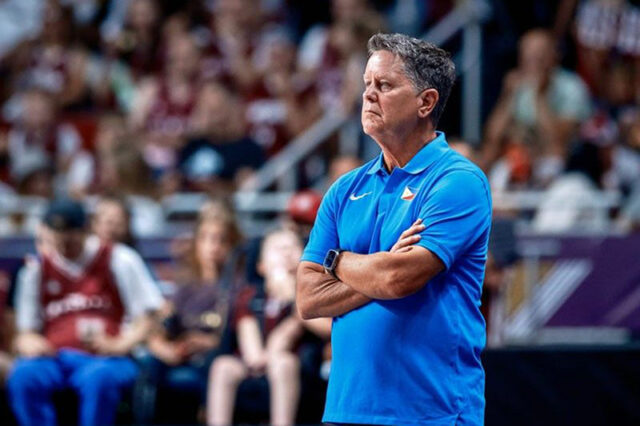
Cone, Gilas Pilipinas eye historic payback against NZ Tall Blacks

TIM CONE — FIBA

Game on Thursday
(MOA Arena)
7:30 p.m. – Philippines vs New Zealand

GILAS PILIPINAS doesn’t need much pep talk to get fired up for Thursday’s FIBA Asia Cup Qualifiers duel with New Zealand (NZ).

The fact that the Nationals are playing in front of adoring home supporters in an official FIBA game for the first time since February is enough to make them motivated.

Then there’s the one-sidedness of their history with the Tall Blacks marred by four lopsided losses since 2016, making payback an additional driving force in the 7:30 p.m. gig at the MOA Arena.

“We want to certainly protect our home court, and we want to show ourselves to the Gilas fans around the country. These are all very, very important to us. So, I really expect us to be ready and motivated to play,” Mr. Cone said.

Against an opposition ranked 12 places higher in the global totem pole, the No. 34 Nationals look to replicate their giant-killing effort in their previous campaign in Olympic Qualifying Tournament (OQT) last July.

In that qualifying meet for the Paris Olympiad, Mr. Cone’s gutsy crew took down world No. 6 and host Latvia, 89-80, en route to a semifinal stint. That, plus the tough stands against Georgia and eventual winner Brazil in the semis have proven Gilas’ mettle as one team that higher-ranked rivals like the Kiwis can’t afford to underestimate.

“New Zealand has handled us over the last few years and they’ve beaten us pretty badly when we played them. But I really, really feel there’s a sense that we can beat them this time around and there’s a certain confidence in the players and it’s deserving,” Mr. Cone said on One Sports.

“Just believe. If we can come in with the belief that we can do it, I think we will do it,” he added.

According to Mr. Cone, AJ Edu (knee issues) will join Jamie Malonzo (calf) in the sidelines, leaving Justin Brownlee, June Mar Fajardo, Calvin Oftana, Scottie Thompson, Dwight Ramos, Chris Newsome, CJ Perez, Kai Sotto, Carl Tamayo, Kevin Quiambao and alternates Japeth Aguilar and Mason Amos with the job.

“AJ will not play, as well as Jamie. We couldn’t get clearance from the doctors,” Mr. Cone told The STAR yesterday.

“Calvin (Oftana) has a calf problem but will try to play through it, the same with Chris (Newsome) with his hamstring. We’re a little dinged up but the guys are digging in and ready to play,” he added.

It will be a battle for the Group B lead and a step closer to the 2025 Asia Cup proper in Saudi for the Nationals and the Kiwis, who have both swept their two-game assignments back in the first window.

The Tall Blacks, under new coach Judd Flavell, are fielding a mix of veterans like Corey Webster and former Converge import Tom Vodanovich and promising youngsters like 17-year-old FIBA U17 World Cup standout Oscar Goodman in their bid to extend their dominance of the Filipinos. — Olmin Leyba

Cignal, Chery Tiggo clash for share of PVL lead

CIGNAL HD SPIKERS — PVL

Games on Thursday
(Filoil EcoOil Arena)
4 p.m. – Cignal vs Chery Tiggo
6:30 p.m. – Capital1 vs Choco Mucho

CIGNAL and Chery Tiggo try to stay unbeaten and at the helm as they battle each other in Thursday’s Premier Volleyball League (PVL) All-Filipino Conference at the Filoil EcoOil Arena.

The HD Spikers walloped the Farm Fresh Foxies, 25-15, 25-18, 25-21, on Saturday while the Crossovers survived the Capital1 Solar Spikers, 20-25, 25-23, 22-25, 25-18; 15-11, last week that launched their respective campaigns.

The winner in their 4 p.m. encounter would propel it straight to top alongside PLDT and Akari, who are both unscathed with 2-0 slates.

Ces Molina was Cignal’s beacon of hope last game after firing a team-best 14 points in a swift win that their coach, Shaq delos Santos, believed should help them preserve their energy in this long conference.

“Although we’re prepared to go the full five sets, we gained with this win and we need more recovery time,” said Delos Santos on their straight-set win last time.

The Crossovers, for their part, did well in giving new mentor Norman Miguel a solid debut.

Mr. Miguel was quick to mention that his team showed character in that five-set thriller over Capital1.

Meanwhile, Choco Mucho (1-1 ) collides with Capital1 (0-1) in the other game at 6:30 p.m., hoping to bolster their respective bids. — Joey Villar

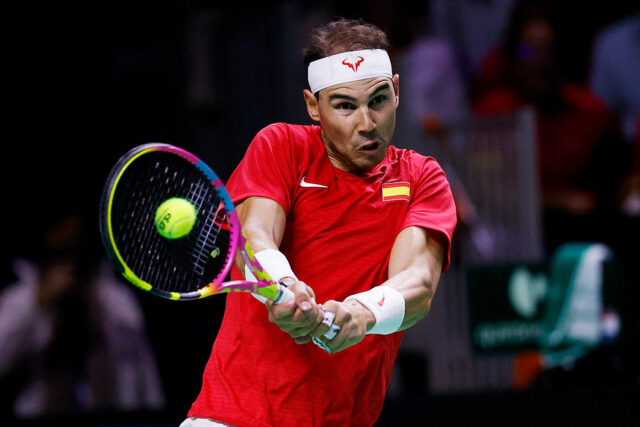
No fairytale ending as Rafael Nadal’s career ends in defeat

RAFAEL NADAL — REUTERS

MALAGA, Spain — Rafael Nadal could not conjure the fairytale ending his career deserved as the Spanish 22-time Grand Slam champion bowed out with defeat in the Davis Cup on an emotionally-charged and tearful night in Malaga on Tuesday.

The 38-year-old’s legs and mind were as willing as ever but the magic was missing as he lost 6-4 6-4 to Dutchman Botic van de Zandschulp in what proved to be his final competitive match.

Spain’s new tennis king Carlos Alcaraz leveled the quarterfinal tie beating Tallon Griekspoor 7-6(0) 6-3 and had Alcaraz and Marcel Granollers then beaten Wesley Koolhof and Van de Zandschulp, Nadal would have got another chance in a semifinal on Friday against Germany or Canada.

But it was not to be as Koolhof, also playing the last event of his career, played out of his skin to rip up the script and inspire the Dutch to a 7-6(4) 7-6(3) victory.

Nadal willed the Spanish duo on from the sidelines, barely sitting down, but looked crestfallen as the reality that it was all over began to sink in.

The Mallorcan, who featured in four Davis Cup winning teams for Spain, was tearful as the anthem was played before the tie.

And after a long speech on court in front of his adoring fans, family, friends and teammates, the tears flowed again as video montage of his stupendous career was played.

Last month he announced he was ending his career at the Davis Cup Final Eight, raising the possibility of one last addition to a career that was etched on the Parisian clay on which he won a record 14 French Open titles.

Selected for the singles by captain David Ferrer, Nadal showed flashes of his former brilliance but in what was only his 24th match since the start of 2023, the rust showed and he struggled to hold off the powerful Dutchman who admitted afterwards he would have been cheering for Nadal had he not been required to face him on the court.

When French Open and Wimbledon champion Alcaraz leveled the tie by defeating Griekspoor he said he had “done it for Rafa”. But he could not inspire a Spanish win in the doubles as the Dutch duo proved party poopers.Nadal had been philosophical after his singles defeat — his first in the event since losing to Jiri Novak in 2004.

“In some ways it is good, maybe, if that was my last match because I lost my first match in the Davis Cup and I lost my last one. We close the circle,” he said. — Reuters

JRU beats AU to earn last slot in NCAA 100 chess final four

JOSE RIZAL University (JRU) turned back Arellano University (AU), 2.5-1.5, yesterday to continue to fuel its dream of a historic title in NCAA Season 100 chess at the Ayala Malls Manila Bay in Parañaque.

Joseph Lawrence Rivera and John Andrew Garcia provided the match-saving victories on boards two and three to carve out the win that punched it the last ticket to the Final Four bus.

There, the Bombers will try to slay the top-seeded San Beda University Red Lions, who downed the College of St. Benilde Blazers, 2.5-1.5, to end up with a league-high 28 points, or a full three points ahead of No. 2, the Lyceum of the Philippines University (LPU) Pirates with 25.

LPU squares off with No. 3 University of Perpetual Help, the reigning titlist.

The Altas made it that far by smashing the San Sebastian College-Recoletos Stags, 4-0, and wound up with 23.5 points, one point ahead of the Bombers.

JRU coach, FIDE Master Nelson Mariano III, said they have a legitimate shot in pulling the rug from under San Beda.

The Final Four was being played yesterday while the finals are scheduled either Thursday or Friday. — Joey Villar

Ogawa double moves Japan to cusp of World Cup qualification as rivals falter; Indonesia stuns Saudi

HONG KONG — Japan moved to the cusp of qualifying for the 2026 World Cup on Tuesday as a 3-1 win over hosts China coupled with Australia’s 2-2 draw in Bahrain took Hajime Moriyasu’s side nine points clear in Group C of the third round of Asia’s preliminaries.

Koki Ogawa’s double in Xiamen earned Japan a fifth win in six games and allowed the four-time Asian champions to extend their lead over the chasing pack with four games remaining as Australia and Saudi Arabia both faltered.

Kusini Yengi’s stoppage-time goal salvaged a point for the Socceroos in Riffa while the Saudis fell to a surprise 2-0 loss against Indonesia in Jakarta on a night of unpredictable results across the continent.

Group B leaders South Korea were frustrated in Amman as Hong Myung-bo’s side were held to a 1-1 draw by Palestine while Iran needed a late Sardar Azmoun goal to consolidate their grip on first place in Group A with a 3-2 win over Kyrgyzstan.

The top two in each of the continent’s three preliminary groups qualify for the World Cup and Japan are now on the verge of confirming their place at their eighth consecutive finals.

Moriyasu’s outfit had thrashed China 7-0 in their previous meeting in September and went ahead in the 39th minute when Ogawa powered his header past Wang Dalei.

Six minutes into stoppage time Ko Itakura doubled Japan’s lead after Koki Machida had flicked on Junya Ito’s corner from the right.

Lin Liangming pulled one back for China three minutes into the second half but a 54th-minute header from Ogawa sealed the win for the Japanese.

Australia needed Yengi’s late equalizer to claim a point having seen Mahdi Abduljabbar score in the 75th and 77th minutes — the first from 40 yards — to cancel out Portsmouth striker Yengi’s first-minute opener for Tony Popovic’s side.

The Socceroos remain second in the standings, one point ahead of Indonesia, who pulled themselves into contention in Group C with victory over Saudi Arabia.

Marselino Ferdinan scored twice to give the home side their first win of the campaign, which moves them level on six points with the Saudis, Bahrain and China.

In Group A, Uzbekistan secured a 1-0 win over North Korea in Vientiane with Abbosbek Fayzullaev’s deflected 44th-minute shotgiving his side the lead before Umarbek Eshmurodov was sent off and Utkir Yusupov saved Jong Il Gwan’s late penalty.

Iran retained their three-point advantage with Azmoun rescuing his team with a 76th-minute header after a Joel Kojo double had pulled Kyrgyzstan level following first-half goals from Mehdi Taremi and Saleh Hardani.

The United Arab Emirates thrashed Qatar 5-0 with Brazil-born striker Fabio Lima scoring four, including two from the penalty spot, as Paulo Bento’s team took sole possession of third place ahead of the reigning Asian champions.

In Group B, leaders South Korea failed to win for the first time in five matches with Hong’s side needing Son’s 16th-minute strike to cancel out an early Zeid Qunbar opener.

Iraq downed Oman 1-0 in Muscat thanks to Youssef Amyn’s 36th-minute goal to move onto 11 points with Jordan in third after their 1-1 draw with hosts Kuwait. — Reuters

Guardians’ Stephen Vogt, Brewers’ Pat Murphy win MLB Manager of the Year

STEPHEN VOGT of the Cleveland Guardians won the American League (AL) Manager of the Year (MOY) while the Milwaukee Brewers’ Pat Murphy was the winner in the National League (NL), as announced by Major League Baseball Tuesday evening.

“The players did this,” Vogt said. “If the players don’t do what they’re capable of, this wouldn’t be possible.”

The AL Central champion Guardians had a highly successful season under Vogt in his first year managing the club, winning 92 games and defeating the Detroit Tigers to make their first AL Championship Series since 2016. They lost in five games to the New York Yankees.

Vogt, 40, is a unique winner of the award, having only just completed his playing career in 2022.

He becomes the fastest to win the award following a playing career, the fifth-youngest winner overall and one of just 10 to win the award in his first year of managing.

The former two-time All-Star improved a young roster from 76 wins to 92 wins in a single year, showing an immediate impact in taking the reins from three-time Manager of the Year Terry Francona (2013, 2016, 2022).

“I needed to come in and be myself,” Vogt said. “I knew I’d never replace Tito (Francona) and fill his shoes, but I just wanted to be me and help our players be the best they can be.”

The Guardians have tied the Chicago White Sox for the most MOY awards all-time (five). In addition to Vogt and Francona, Eric Wedge took home the honors in 2007.

Earning 27 first-place votes of a possible 30, Vogt won the award over fellow AL Central managers Matt Quatraro of the Kansas City Royals and A.J. Hinch of the Tigers, both of whom also led turnarounds and landed postseason appearances.

Much like Vogt, the 65-year-old Murphy was also in his first full year as a manager and earned 27 first-place votes. However, the wealth of experience Murphy brought to the table in Milwaukee was in stark contrast to Vogt.

From 2016 to 2023, Murphy served as a top assistant of Craig Counsell — who he once coached at Notre Dame (1988-94) — in Milwaukee until Counsell departed for the Chicago Cubs last offseason.

In addition, he was a longtime coach of Arizona State (1995-2009) and filled in as an interim manager for the San Diego Padres in 2015, coaching that team to a 42-54 mark during his tenure.

In 2024, Murphy led a 93-69 team that won the NL Central (ahead of the Cubs) and reached the postseason despite significant challenges faced along the way, including the departure of Corbin Burnes and injuries to fellow top right-handers Brandon Woodruff and Devin Williams. — Reuters

ANI accuses OpenAI of using content without permission

REUTERS/DADO RUVIC/ILLUSTRATION

NEW DELHI — Indian news agency ANI has sued OpenAI in a New Delhi court, accusing the ChatGPT creator of using its published content without permission to help train the artificial intelligence (AI) chatbot, something that OpenAI says it has stopped doing.

ANI is the latest news organization globally to take OpenAI to court following lawsuits in the US by newspapers including the New York Times and the Chicago Tribune.

The first hearing in the case took place in the New Delhi High Court on Tuesday, where the judge issued a notice to OpenAI to provide a detailed response to ANI’s accusations.

In a statement, ANI said “the court is required to decide the legitimacy of the use of publicly available proprietary content by AI platforms.”

ANI also accused OpenAI’s ChatGPT of attributing fabricated news stories to the publication, according to its court submission dated Monday, a copy of which was reviewed by Reuters.

The court filing contained e-mails sent by OpenAI’s lawyers in India to ANI saying the Indian news agency’s website had been placed on an internal block list since September, ceasing usage of its content in future training of AI models.

ANI, however, argues that its published works are “permanently stored in the memory of ChatGPT” and “there is no programmed deletion.”

Asked about the ANI lawsuit, a spokesperson for OpenAI said in a statement: “We build our AI models using publicly available data, in a manner protected by fair use and related principles, and supported by long-standing and widely accepted legal precedents.”

OpenAI and other tech companies have faced a wave of lawsuits by authors, visual artists, music publishers and other copyright owners for allegedly exploiting their work without permission. OpenAI has denied copyright infringement.

ANI in its filing said that OpenAI had “refused to obtain a lawful license or permission” for the use of original works by ANI.

The media firm is concerned about unfair competition as OpenAI has commercial partnerships with other news organizations to distribute their content, ANI said in its statement. 

The AI firm has entered into licensing arrangements with news organizations such as the Financial Times and Associated Press for similar use of copyrighted content, it said.

A spokesperson for Reuters, which holds a 26% interest in ANI, said it was not involved in ANI’s business practices or operations.

In its statement, OpenAI said that it was engaged in partnerships with many news organizations around the world and was holding talks to explore more, similar opportunities, including in India.

The court is set to next hear the case on Jan. 28. — Reuters