
How PSEi member stocks performed — March 12, 2026

Here’s a quick glance at how PSEi stocks fared on Thursday, March 12, 2026.


Here’s a quick glance at how PSEi stocks fared on Thursday, March 12, 2026.

By Katherine K. Chan, Reporter
TARGETED ASSISTANCE for the segments of society deemed vulnerable to oil price volatility will likely be more beneficial for the Philippines than suspending or reducing excise taxes on fuel, the Asian Development Bank (ADB) said.
“I imagine that greater targeting of the assistance would be better than a blanket reduction in excise tax, because if you reduce the excise tax, rich people with lots of cars would benefit more, whereas you could have provided, say, income or food subsidies for the more vulnerable,” ADB Lead Economist for Southeast Asia James P. Villafuerte said at a briefing on Thursday.
He added that effectively reading the cost of fuel sends the “wrong signal” because “gasoline pollutes.”
The government said it will release P5,000 worth of fuel subsidies for the public transport sector starting next week.
A measure seeking to grant President Ferdinand R. Marcos, Jr. the authority to reduce or suspend the excise tax on fuel is awaiting third reading at the House of Representatives.
Fuel prices have spiked after the US and Israel attacked Iran, which sits on the north shore of the Strait of Hormuz, a waterway in heavy use by tankers carrying Middle Eastern crude oil.
On Tuesday, Philippine fuel retailers raised gasoline prices by between P7 and P13 per liter, diesel by between P17.50 and P23, and kerosene by between P32 and P36.
The Department of Energy has said that pump prices are expected to climb further due to the uncertainty that continues to hang over the supply of Persian Gulf oil.
Mr. Villafuerte also noted that the high price of petroleum-based fuel may drive demand for electric vehicles (EV) in the Philippines.
“I think… most people will probably begin to really think about either hybrid or EV because of the price of gasoline,” he said, adding that the Iran crisis may end up conditioning the public to “get comfortable (with crude prices of) $200 per barrel,” he said.
Mr. Villafuerte noted that the shift to EVs or hybrid cars has lagged adoption rates in Thailand, Singapore and Indonesia.
Separately, the ADB called the “green transition” a “moral imperative” and “strategic opportunity” for Association of Southeast Asian Nations (ASEAN) members, especially those vulnerable to climate risks.
“By aligning economic growth with environmental sustainability and social equity, ASEAN can transform its development model to one that is future-proof, resilient, and inclusive,” the ADB said in a report published on Thursday.
“The green economy transition is not only a moral imperative but a strategic opportunity to drive innovation, build climate-resilient economies, and reduce systemic inequalities,” it added.
According to the ADB, the green transition could also help the region’s green economy generate up to $1 trillion in revenue by 2030 and create 30 million jobs.
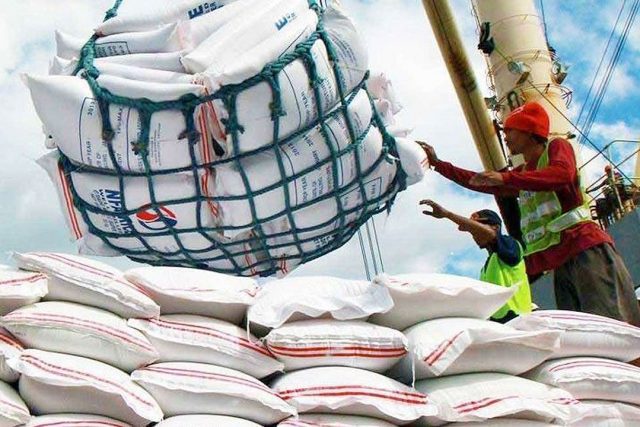
THE DEFICIT in the agricultural goods trade in January widened 2.2% year on year to $1.03 billion, according to preliminary data from the Philippine Statistics Authority (PSA).
The PSA said that the year-earlier deficit had contracted by 1.4%.
Agricultural exports in January declined 1.3% year on year to $706.41 million, accounting for 10% of total exports. As a share of the $2.44 billion in two-way trade in farm products, exports accounted for 28.91%.
Imports of agricultural commodities in January rose 0.7% year on year to $1.74 billion, accounting for 15.6% of overall farm imports.
Two-way agricultural trade in January grew 0.2% year on year.
The PSA said exports of edible fruit and nuts, including peels of citrus fruit and melons, grew 21% year on year to $235.02 million in January, accounting for 33.3% of agricultural exports.
Exports of animal, vegetable, or microbial fats and oils and their cleavage products; prepared edible fats; and animal or vegetable waxes declined 16.4% year on year to $220.63 million in January, accounting for 31.23% of agricultural exports.
Agricultural shipments to the Association of Southeast Asian Nations (ASEAN) in January hit $57.43 million, with top buyer Malaysia accounting for $16.88 million or 29.39% of the total.
Exports to the Netherlands, the Philippines’ top destination for agricultural commodities in the European Union (EU), amounted to $118.07 million or 75.07% of Philippine agricultural exports to the region.
Among the major commodity groups, cereals accounted for the largest share of agricultural imports in January, totaling $412.69 million or 23.8%.
The value of cereal imports surged 25.5% in January, following the resumption of rice imports after a four-month ban that started in September.
Vietnam was the leading supplier of agricultural products to the Philippines within ASEAN, accounting for $211.39 million or 33.32% of farm imports from the region.
The top agricultural goods imported from ASEAN were cereals and animal, vegetable, or microbial fats and oils, and their cleavage products; prepared edible fats; and animal or vegetable waxes.
Within the EU, Spain remains the Philippines’ top supplier of agricultural commodities, with imports valued at $40.27 million, or 25.94% of shipments from the region.
The top agricultural commodities from the EU were meat and edible meat offal. — Vonn Andrei E. Villamiel
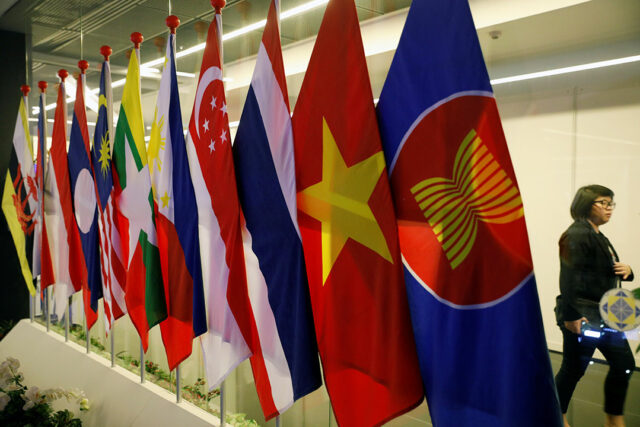
THE upcoming Association of Southeast Asian Nations (ASEAN) Economic Ministers Retreat will tackle minimizing trade barriers as a response to the ongoing fuel crisis and the uncertain global trade environment, the Department of Trade and Industry (DTI) said.
“It is important that our actions, responses to the ongoing conflicts must be synchronized so that we work together to address these challenges,” Trade Undersecretary Allan B. Gepty said at a briefing late Thursday.
“We cannot afford to have a separate approach in addressing this conflict.”
The 32nd ASEAN Economic Ministers Retreat will take place on March 13 in Taguig City.
The meetings will focus on ensuring that the ASEAN supply chain remains free of disruption and open for trade and investment.
Mr. Gepty noted that policy measures that ASEAN will adopt should align with the regional economic integration agenda.
ASEAN states “must avoid measures that will be considered… non-tariff or trade barriers,” he added.
Mr. Gepty noted that geopolitical uncertainty or international emergencies often push countries to adopt measures that prioritize their domestic needs.
“As much as possible, we have to refrain from adopting and implementing measures that will restrict trade in the process,” he said. “We have to make sure that the supply chain, particularly for energy, food, and other vital sectors, remains intact.”
The Philippine Statistics Authority reported that Philippine exports to ASEAN grew 1.2% year on year in January to P966 million.
Over that period, imports from elsewhere in the bloc declined 8.9% to P2.77 billion.
The regional bloc’s core principles point to the need to take a common stance to crises like the war in Iran, Mr. Gepty said. — Beatriz Marie D. Cruz

THE International Monetary Fund (IMF) said it will continue to assist the Philippines in deepening its integration within the Association of Southeast Asian Nations (ASEAN).
At a meeting with the Department of Finance (DoF), IMF Managing Director Kristalina Georgieva said it will continue to provide policy insights and technical assistance to strengthen economic cooperation with the rest of ASEAN.
The DoF said in a social media post on Thursday that at the meeting, Finance Secretary Frederick D. Go highlighted the government efforts in improving the business environment to enable private-sector growth.
He also discussed the continued digitalization of government services, noting that the national digital ID system has now registered around 95 million citizens. — Aaron Michael C. Sy
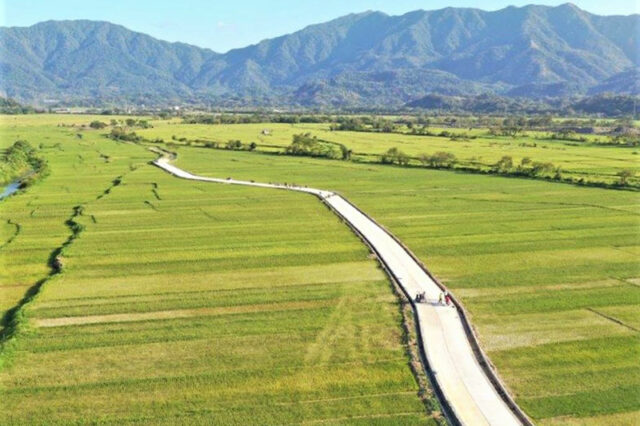
THE PHILIPPINES can tap the equivalent of P182.06 billion in grants and loans over the short term from foreign governments and multilateral organizations, the Department of Agriculture (DA) said.
The DA said currently available assistance includes P177.61 billion in loans and P4.44 billion in grants, covering 19 projects.
Agriculture Assistant Secretary Arnel V. de Mesa said that while the DA has long been receiving foreign assistance, the current packages are among the largest it has obtained in recent years.
“The good thing is that the international community is really supportive of the agriculture agenda, and they are building their trust in the Philippine government,” he said at a briefing.
Mr. De Mesa said most of the projects will commence this year, with some expected to start in 2027.
Among the major items is the Philippines Sustainable Agri-Transformation (PSAT) project, funded through a $1-billion loan from the World Bank. PSAT also has a grant component of $24.5 million for the Transformation Agricultural Support Project.
PSAT is a series of programs intended to support farm productivity, crop diversification, climate resilience, and efficiency in the use of public resources, according to the World Bank.
“The project has already received special authority from the President and is set for World Bank Board approval on March 27,” Mr. De Mesa said.
The DA said farming will also benefit from the Philippine Solar-Powered Irrigation Project, funded by $500 million in loans from the Asian Development Bank (ADB) and additional support from the International Fund for Agricultural Development.
The DA also recently announced that the Philippines and France are set to sign a €350-million loan agreement to finance the construction of 300 modular bridges.
The DA said the project will improve agricultural logistics and complement the ongoing construction of farm-to-market roads nationwide.
Another major project is the Improving MSME Access to Finance and Resilience to Climate Shock (PRIME) initiative, supported by a $350-million World Bank loan and a $7.5-million grant from the Global Shield Financing Facility.
The World Bank’s PRIME project aims to expand credit facilities for agri-micro, small and medium enterprises (MSMEs), farmers, and fisherfolk. It also aims to support the establishment of the Philippines’ first agricultural co-insurance pool.
Other projects include the Agricultural Investment Preparation Facility, a $140-million loan from the ADB.
“The $140 million will help us prepare three big projects involving ports, pipe irrigation system, and aquaculture support infrastructure,” Mr. De Mesa said.
The DA also obtained in February a ¥1.7-billion grant from the Japan International Cooperation Agency (JICA) for a rice processing system to be constructed this year in Cauayan, Isabela.
The DA also received a $1.5-million grant from the Asian Infrastructure Investment Bank for the Transport Connectivity and Logistics Improvement Project, for which aid will later expand to a $500-million project that will include ports, warehouses, and cold storage facilities.
Mr. De Mesa said the inflow of foreign grants and loans reflects strong confidence in the government’s agricultural policies.
“The administration has announced that agriculture is important to the overall economy. International partners have also seen that the agenda of the Agriculture Secretary and the President is aligned with the priorities of the global community,” he added. — Vonn Andrei E. Villamiel

THE Department of Trade and Industry (DTI) said its flagship National Trade Fair in February generated P129.68 million in actual sales and sales leads for the fair’s small-business exhibitors.
In a statement on Thursday, DTI said the tally covers direct cash purchases, booked orders, and ongoing business deals negotiated during the event, which drew 15,103 visitors.
The exhibitors totaled 335 micro, small and medium enterprises (MSMEs), which showcased eco-friendly, design-driven, and high-value products.
“For many participating MSMEs, the fair served as a vital testing ground for new ideas before they expand to larger markets,” the DTI said.
The fair also held workshops on digital tools, shipping for export, and eco-friendly production.
Its “Show & Tell” product demonstrations and fashion showcases also provided entrepreneurs an opportunity to receive direct feedback to help increase the competitiveness of their products.
The Business Connect Lounge also hosted meetings between sellers and large corporate buyers.
“These talks focused on long-term supply deals that will help small businesses stay active even after the fair ends,” the DTI said.
The Trade department has said it is planning 15 trade fairs in Metro Manila this year.
The DTI’s Bureau of Market Development, Promotions, and OTOP will hold a series of regional and themed fairs this year, it said.
OTOP refers to the One Town, One Project program, a bid to get municipalities to specialize in products distinctive to their areas.
In 2025, DTI trade fairs generated over P660-million cash sales, confirmed orders, and ongoing negotiations. — Beatriz Marie D. Cruz

THE Department of Trade and Industry (DTI) said a tax treaty with Cambodia is expected to boost the competitiveness of the service sector by removing the burden double taxation.
“This agreement establishes a stable, rules-based framework that encourages market entry and strengthens business confidence abroad,” Bianca Pearl R. Sykimte, the export marketing bureau director, told a Senate hearing.
The Senate Foreign Relations Committee is evaluating the Philippines and Cambodia Double Taxation Agreement (DTA), which seeks to eliminate double taxation on income, ease tax burdens, and increase investment.
“This makes our service fees and contracts more affordable, boosting the competitiveness of our service providers,” she added.
Senator Erwin T. Tulfo, who heads the committee, said the chamber must first determine the potential benefits for the agreement before sponsoring the treaty at the Senate Plenary level.
“I want to know, what exactly, we get out of this,” he said.
Ms. Sykimte said the agreement means Philippine information technology outsourcing companies providing software support to Cambodian clients will now have to pay only a 10% withholding tax on technical services.
She added that engineering and construction companies will not be considered a taxable permanent establishment unless the project lasts for more than six months, “reducing tax exposure for short-term projects.”
Creative industries and franchises licensing or expanding to Cambodia would have to pay only 15% on their royalties.
(This will make) our intellectual property licensing and brand expansion more financially viable,” Ms. Sykimte added.
Finance Assistant Secretary Euvimil Nina R. Asuncion said the agreement will also ease the income tax burden of overseas Filipino workers stationed in Cambodia.
“Instead of Cambodia taxing them up to 20%, they can now only tax them up to 10%,” she added noting that tax breaks also include Filipinos rendering technical services.
There are about 7,000 Filipino workers in Cambodia, and at least 13 companies operating there.
Manila and Phnom Penh signed the agreement in February last year to reduce fiscal barriers and stimulate bilateral trade and investment. — Adrian H. Halili
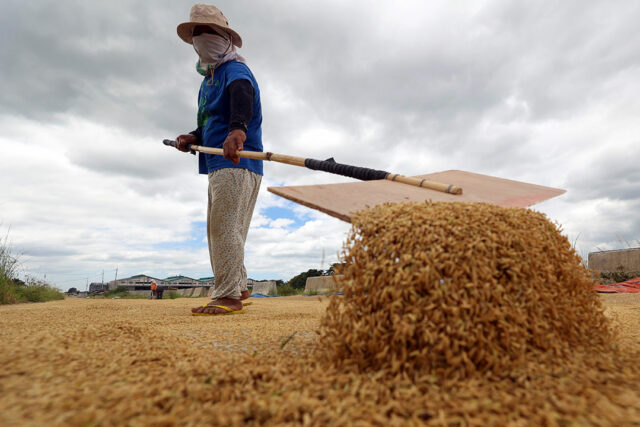
THE farmgate price of dry palay (unmilled rice) rose 10.4% year on year in February to a national average of P22.47 per kilo, according to the Philippine Statistics Authority (PSA), citing preliminary data.
The highest farmgate price for dry palay in February was reported in the Cagayan Valley at P28.12 per kilo, up 44.3% from a year earlier. The year-on-year growth in palay prices in the region was also the fastest on record for February.
The lowest average farmgate price in February was recorded in the Caraga region at P17.96, down 13.2% from a year earlier. The decline in the region’s average palay price was the fastest on record for the month.
In Central Luzon, the country’s top rice-producing region, the average farmgate price of dry palay was P25.86 per kilo, up 32.9% from a year earlier.
In a separate report, the PSA said palay production is projected to fall 7.1% year-on-year to 4.36 million metric tons (MT) in the first quarter, based on standing crops as of Feb. 1.
This projection for palay would represent a 1.9% downgrade from its January estimate of 4.45 million MT.
Corn output is also projected to decrease 3.4% year on year to 2.32 million MT in the first quarter, based on standing crops as of Feb. 1.
The corn projection is a 1.7% downgrade from the January estimate of 2.36 million MT. — Vonn Andrei E. Villamiel
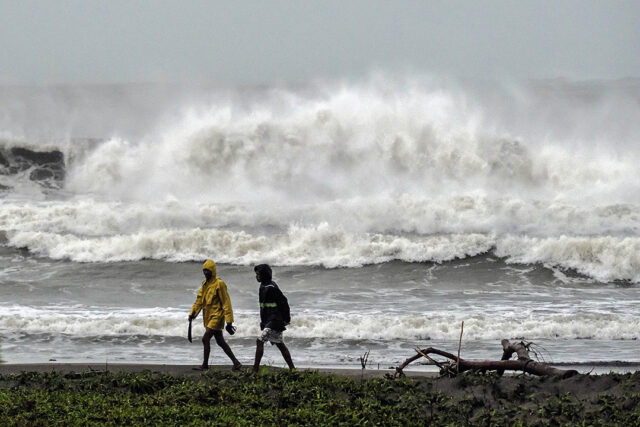
THE Philippine Crop Insurance Corp. (PCIC) said it enrolled more than 11,000 municipal fisherfolk in its weather index-based parametric insurance program and is looking to expand the initiative to more coastal communities after its first year.
The program, launched in November in partnership with the Bureau of Fisheries and Aquatic Resources (BFAR) and Rare Philippines, provides insurance protection to small-scale fishers whose livelihoods are often disrupted by hazardous weather conditions.
Parametric insurance releases payouts to policyholders once weather indicators reach agreed-upon triggers, with claims not delayed by the traditional damage inspection process.
Arvin Jasper R. Adan, acting manager of PCIC’s Actuarial Research and Product Valuation Department, said the program’s initial rollout has a target of 14,000 sign-ups.
“The policyholders are between 11,000 and 12,000 fisherfolk registered under BFAR’s FishR system,” Mr. Adan told reporters. “The program is currently available in Occidental Mindoro, Antique, Cebu, Surigao del Norte, and Negros Oriental.”
The PCIC said insurance premiums are paid for by BFAR, making the coverage effectively free for participating fisherfolk. Mr. Adan said the bureau allocated around P10 million for the program.
“Each insured fisher is entitled to an indemnity of about $100, or roughly P5,000, per policy cycle. The coverage period for the insurance is one year,” he said.
“For the project, we have three parameters — wind speed, wave height, and rainfall. It was determined using 30 years of historical data,” Mr. Adan said.
PCIC said the parametric design enables faster and more transparent compensation when hazardous weather prevents sea voyages.
“Payments are released to digital wallets or checks, allowing immediate relief without lengthy claims investigations,” the PCIC has said.
It said no payouts have been triggered since the program’s launch, as recent weather events have not met the thresholds required for indemnity.
“All three parameters must reach the trigger level. It cannot be just high waves — the payout requires a combination of all three indicators. That is why, as of now, there have still been no payouts,” Mr. Adan said.
The PCIC said the program has only been running for a few months, and severe storms have yet to occur during the period.
The PCIC also said it is open to reviewing and possibly adjusting the trigger levels based on the results of the program’s initial run. — Vonn Andrei E. Villamiel

By Kenneth Christiane L. Basilio, Reporter
A COALITION of Philippine activist groups plans to sail to Thitu Island in the disputed South China Sea to deliver food and fuel to residents, part of a campaign to assert Manila’s presence amid rising Chinese activity in the region.
The Atin Ito (This Is Ours) coalition is finalizing plans for an April trip, with volunteers expected to stay on Thitu Island, also called Pag-asa by the Philippines, for a day before returning to the mainland.
“This sail is a response to a major crisis we are facing,” Rafaela David, co-convener of the South China Sea interest group, told reporters in Filipino.
Thitu is the biggest of the Philippine-occupied islands in the Spratlys and the only one with a permanent civilian population.
It lies roughly 12 nautical miles (22 kilometers) from China’s Subi Reef, a militarized outpost with an airstrip and naval facilities.
Edicio dela Torre, another Atin Ito co-convener, said the mission aims to reinforce the Philippines’ claim over the Kalayaan Island Group.
“Our mission will firmly assert to the world, and especially to China and its local enablers, that the Kalayaan Island Group is an integral part of the Philippines,” he told the same briefing in Filipino.
The Chinese Embassy in Manila did not immediately reply to a Viber message seeking comment.
China claims nearly the entire South China Sea under its nine-dash line, overlapping the exclusive economic zones of the Philippines, Vietnam and Malaysia despite a 2016 ruling by the Permanent Court of Arbitration in The Hague that voided those claims.
The upcoming sail will be Atin Ito’s fourth to Thitu since 2023 and is part of a broader effort to “civilianize” the waters, Mr. dela Torre said.
“This is one of the most powerful ways to respond to China’s militarization of the area,” he said.
Frequent encounters between Philippine and Chinese vessels have included water cannon use and sideswiping maneuvers.
Beijing has built man-made islands across the Spratlys with runways, ports and radar systems to extend its naval reach in the resource-rich waterway.
Ms. David told BusinessWorld the group is coordinating with “relevant agencies” to ensure safety during the voyage.
“Those who need to know about the mission are well aware, and they can also prepare safety measures to ensure our volunteers can peacefully reach the destination,” she said.
The mission will carry fuel and food packs for local fishermen living on Thitu Island.
The group said the trip is a statement of support for residents who face isolation and logistical challenges amid regional tensions.
The South China Sea, a vital global trade route, remains a flashpoint as competing claims and military developments heighten regional risks.
Civilian-led efforts like Atin Ito’s sail are unusual but reflect growing public concern in the Philippines about maintaining a presence in contested areas and supporting local communities.
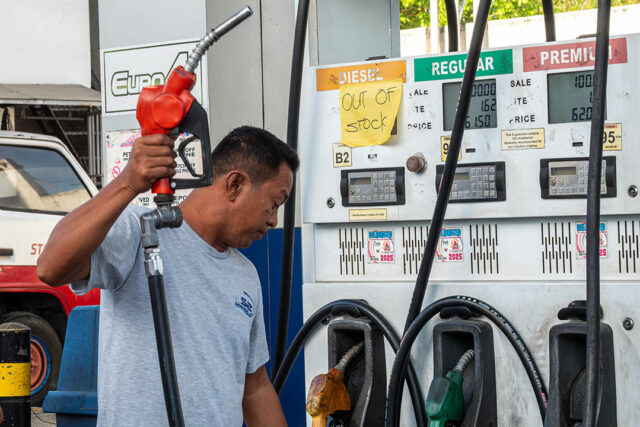
THE Philippine government has sufficient funds to support its economic response to the Middle East war and has no immediate plans to borrow from international lenders, the Presidential Palace said on Thursday.
“As of now, there are no plans yet [to borrow],” Palace Press Officer Clarissa A. Castro told a news briefing, citing Finance Secretary Frederick D. Go.
The conflict, now approaching two weeks, has sharply increased oil prices after Tehran halted shipments through the Strait of Hormuz, a crucial route handling about a fifth of global oil and gas supplies. Fuel prices in the Philippines, a net oil importer, have risen by as much as P38.50 per liter.
To ease the impact, the government is deploying targeted subsidies. The Department of Transportation has allotted P3.5 billion to fund free rides for commuters and cover fuel costs for public utility vehicles.
The Department of Agriculture is exploring additional funding to expand fuel subsidies for farmers and fisherfolk.
Agriculture Undersecretary Drusila Esther E. Bayate said the agency would prioritize fifth-class municipalities and coordinate with the Department of Budget and Management to tap unused funds from last year’s program.
About P150 million is available, while the P10-billion Presidential Assistance for Farmers and Fisherfolk program could be tapped if prices remain high.
The Bureau of Fisheries and Aquatic Resources (BFAR) has earmarked P50 million for fuel subsidies targeting roughly 200,000 fishers with motorized boats.
BFAR Assistant Director Zaldy P. Perez said an additional request for P25 million could raise support per fisher to P5,000.
Fishermen are losing P500 daily due to surging diesel prices.
Surging diesel prices have hit fishermen hard, said Jayson H. Cainglet, executive director of the Samahang Industriya ng Agrikultura.
Diesel prices jumped P24 per liter in one week, with daily losses reaching P500 per fisher, threatening to halt some fishing activities, he told senators.
In the capital region, the Department of Social Welfare and Development will roll out P5,000 fuel subsidies for public utility drivers starting on March 17.
Tricycle operators will receive payments first, followed by jeepney, taxi and transport network vehicle service drivers.
The program will draw on P30 billion from the P60-billion fund for people in crisis situations.
The conflict began on Feb. 28 when the US and Israel launched coordinated airstrikes on Tehran’s military infrastructure, causing thousands of casualties and widespread regional disruption.
About 300 Filipino workers have been repatriated so far, with additional chartered flights planned in the coming days.
President Ferdinand R. Marcos, Jr. said the government is actively exploring alternative oil suppliers while monitoring logistics to prevent shortages.
Analysts warn that continued instability around the Strait of Hormuz could drive prices even higher, worsening inflation, eroding household purchasing power and straining transport, industrial and consumer sectors. — Chloe Mari A. Hufana and Adrian H. Halili
