Home Blog Page 1783

International Dance Day to showcase different styles of dance

MORE THAN 1,200 artists from various dance companies and styles will take over the stage of the Samsung Performing Arts Theater in a week-long celebration of International Dance Day (IDD). This will be the IDD Festival’s 2nd iteration, set for April 23 to 27 in Circuit, Makati.

The event aims to showcase “the best of Filipino and international dance talents, from traditional folkloric dances to urban beats, classical ballet, contemporary movement, and even paradance,” Samsung Performing Arts Theater Managing Director Christopher Mohnani said at a March 27 press conference.

“It’s a powerful reminder of how dance connects us all, transcending boundaries and uniting us through shared expression,” he added.

IDD, held annually on April 29, started in 1982 in tribute to French ballet master Jean-George Noverre. Its celebration in the Philippines, with the theme “Dance for All,” will span performances, workshops, and gatherings underscoring the accessibility of dance in all its forms.

NEW INCLUSIONS
On April 23, at 7:30 p.m., the festival will kick off with an opening night gala featuring the multi-award-winning British choreographer Sir Wayne McGregor and his acclaimed Company Wayne McGregor.

The company will present the Philippine premiere of “Autobiography (v105),” a dance portrait inspired by the sequencing of Mr. McGregor’s own genetic code. They will also conduct a special workshop and masterclass on contemporary dance. 

A portion of the proceeds from the opening night gala will benefit the Artists Welfare Project Inc. fund, which provides healthcare support for dancers. It is co-organized by the British Embassy Manila, the British Council, and Ayala Corporation.

The festival also marks a special focus on paradance, an inclusive form of dance that integrates dancers with disabilities. The Philippine Para Dancesport Team, which has won in various competitions abroad, will represent this scene.

VARIOUS GALAS
On April 24, a tapestry of Filipino folk dance will be unveiled. It will showcase 10 community-based traditional dance groups from the regions and from various schools. Two of the groups are from the Cultural Center of the Philippines.

On April 25, it will be street dance’s turn. There will be 8 teams representing it, three of which are world champions who have consistently conquered the world stage.

The ballet segment on April 26 will bring together the four biggest ballet companies in the Philippines, alongside guest artists from Hong Kong Ballet and American Ballet Theatre.

Finally, contemporary dance will end the festival with a flourish on April 27, spotlighting some of the country’s finest contemporary dancers. There will be a special focus on artists from the regions.

In addition to the live performances, Fifth Wall Fest, the country’s only multidisciplinary movement group, will showcase site-specific works, demonstrating that dance can transcend the confines of traditional performance spaces. A dance market and bazaar will also be open throughout the festival, offering merchandise.

Tickets to the various performances and workshops are available via TicketWorld. — Brontë H. Lacsamana

Mochi eyes small firms outside Metro Manila

MOCHI.PH

By Beatriz Marie D. Cruz, Reporter

MOCHI SOLUTIONS, a local billing and collection platform, is looking to quintuple its users this year as it focuses on underserved companies, according to its chief executive officer (CEO).

“So far, we have over a hundred live users, mostly in service sectors like travel, training and education, marketing and creatives,” Yroen Guaya Melgar, co-founder and CEO at Mochi Solutions, told BusinessWorld. “We’ve found that these businesses are often underserved, since most electronic commerce solutions are built for selling goods.”

“This year, we’re hoping to grow five times to 500 live users, focusing on underserved businesses outside Metro Manila,” she said in an e-mailed reply to questions.

Established in 2023, Mochi caters mainly to micro, small and medium enterprises (MSMEs). It offers invoices, payment links, payment reminders, workflow automation, customer engagement and billing and collection reports.

Users can access as many as five user accounts and unlimited invoices under a 60-day free trial. Its standard plan, which costs P1,899 a month, offers as many as 300 invoices a month.

To expand its reach, Mochi is focused on building partnerships with platforms and service providers that complement its billing and collection services.

“Gone are the days of building on your own,” Ms. Melgar said. “Now, we have to strengthen our ability to connect and be more interoperable.”

The platform is also eyeing partnerships with banks and other financial service providers since many of its users need access to capital and other financial services, she pointed out.

About 99% of business establishments in the Philippines are MSMEs, contributing 40% to economic output. But many smaller firms, especially in the countryside, are hampered by limited capital and access to digital platforms.

Majority of Mochi’s users use social media to interact with customers and manage orders. Hence, being tech-savvy is not the issue.

Smaller firms struggle with complicated onboarding and high transaction fees, particularly in payment platforms, Ms. Melgar said. “Based on our own experience, more than 50% of users drop off during onboarding with payment gateways because they can’t complete the requirements.”

The Philippines generally has higher payment fees, especially for cards, compared with Indonesia, Malaysia and Vietnam. This is a disadvantage for businesses operating on thin margins and customers doing larger transactions, she added.

Mochi’s recent partnership with financial technology firm PayMongo, Inc. is expected to help streamline businesses’ financial operations.

“So far, we’ve focused on payments, but MSMEs also need other types of support such as access to capital, the ability to accept foreign payments and tools for handling multicurrency transactions,” Ms. Melgar said.

“The good news is that PayMongo is already developing or piloting solutions in these areas, and we’re excited to explore how Mochi can be part of that.”

The platform is looking to raise a seed fund by the end of the year and is in talks with local and regional investors, she said.

“We’re also strengthening our integration with platforms that support the full business workflow, like enterprise resource planning, so billing and payments are connected to how people actually run their operations,” Ms. Melgar said.

Mochi is also working with local governments and business groups to help promote digital tools.

“For us, billing and payments are just the starting point,” she said. “Our goal is to make sure small businesses have access to a full ecosystem of digital tools that support how they work and grow.”

Playcare centers for poor kids

KIDSLIFEPH.ODOO.COM

Here in Cebu, there is an interesting model in multisectoral cooperation to help poor children get a good start in life. About 100 children aged three to six years, many of them homeless, get to spend up to three hours at what its founders call Balay Amuma (home for playcare).

In 2021, Grace Cabaero Ferreros, founder of KidsLIFE Foundation, obtained a multimillion-peso grant from Ramon Aboitiz Foundation, Inc. (RAFI) to operate a “playcare center” near the harbor, where homeless kids and poor families abound. RAFI President Amaya Aboitiz-Fansler is very interested in early childhood education. She is the daughter of the late Bobby Aboitiz, former president of RAFI, and Maria Cristina Cabarrus-Aboitiz, who was into microfinance.

The choice of area to serve was made by KidsLIFE founders in consultation with the local government of Cebu City and the Department of Social Welfare and Development (DSWD) to ensure that the Balay Amuma would fill a need. DSWD operates daycare centers that serve eligible children around the country. So, Balay Amuma operates in an area not currently served with daycare centers by DSWD. The local government provides funding support for two teachers.

Additional funds for operations are provided by Wadah (Bahasa for “Women”) Foundation whose Chair, Anie Djodjohadikusumo has been providing support for many projects in Indonesia, the Philippines, India, and Nepal. Anie’s brother in law, Prabowo Subianto is the current president of Indonesia.

Presently, the Balay Amuma is rent-free at a building constructed by the Young Ladies Association for Charity (YLAC)) on land owned by the archdiocese of Cebu. Ownership of the building has recently been turned over by YLAC to the archdiocese under the terms of their contract. The archdiocese has authorized Balay Amuma to use the facilities for free until 2026.

Grace Ferreros, who holds a doctorate in education, explains that Balay Amuma is really a model for an approach referred to as Waldorf, which emphasizes creative play for numeracy and literacy rather than the standard approach now used in schools. Music appreciation, carpentry, cooking, arts and crafts and gardening are some of the processes. Children have the right to play. The kids have fun while they learn and develop themselves as persons. This right is exercised more creatively than when the kids are glued to their electronic gadgets.

KidsLIFE takes its playcare approach seriously. Care is something the teachers are oriented on because the kids are either homeless, or the parents are so focused on survival from day to day, that the kids do not get much attention, if any. The care they get at Balay Amuma has turned them into self-confident and happy persons.

KidsLIFE Foundation has begun to promote the Waldorf approach in DSWD-operated daycare centers, notably in Barangay Mambaling, Cebu City where they send a teacher once a week to practice the playcare approach. In San Roque, another barangay, one of the teachers works full time at Balay Amuma whence she will return to her own barangay to use her learnings.

Balay Amuma also provides food for the children, half of them (ages three to four) in the morning, and the older half (ages four to six) in the afternoon. It seems that for many of the children, it is their only meal for the day. Probably why the kids are hardly ever absent from “class.” The food is a complete meal, with carbohydrates, vegetables and protein. YLAC provides P10,000 a month for the food. Simply Share Foundation donates rice. Some of the food is funded by Tina Ferreros, Grace Ferreros’ sister-in-law through her Wadah Foundation Philippines.

Sometimes, volunteers from overseas such as Germany, as well as the US Peace Corps, assist as teachers’ aides.

At present, KidsLIFE Foundation is concerned about its physical facilities after 2026 when the lease-free arrangement ends. Jose Palma, the archbishop of Cebu, explains that as he is retiring this year, he does not want to preempt his successor who may have other plans for the facilities.

Wadah Chairperson Anie Djojohadikusumo has indicated willingness to fund construction of a building for Balay Amuma and its offices; but only on land that they will not fund. So KidsLIFE founders are now seeking donations for the land.


Teresa S. Abesamis is a former professor at the Asian Institute of Management and fellow of the Development Academy of the Philippines.

tsabesamis0114@yahoo.com

Domestic trade by region in 2024

DOMESTIC TRADE in goods grew by 23.1% to P1.31 trillion in 2024, reflecting the uptick in overall economic activity, analysts said. Read the full story.

Domestic trade by region in 2024

PBoC seen deploying stimulus on tariff risks, cash shortage

GLOBAL LENDERS like JPMorgan Chase & Co. expect China to deliver its long-awaited monetary stimulus as soon as in April, with timing likely dictated by the double threat of US tariff hikes and a seasonal cash shortage.

Economists are almost unanimous the People’s Bank of China (PBoC) will cut the reserve requirement ratio (RRR) in the second quarter, according to the latest Bloomberg poll, a decision that would unshackle hundreds of billions of yuan for lending and investing. It’s one of several tools available for officials to pump up liquidity in the weeks ahead.

Policy is near a turning point amid an April 1 deadline for the US to review Beijing’s compliance with the so-called Phase One trade deal struck during Donald J. Trump’s first term. The following day, the US president plans to impose sweeping reciprocal duties on trading partners around the world, which is among expected announcements that could lead to potential tariff hikes on China.

“If the tariffs announced on April 2 are quite large, it will be necessary for monetary policy to stabilize market sentiment and offset worries over the economy,” said Qin Yong, chief economist at the treasury department of Sumitomo Mitsui Banking Corp. “April could be a good window for an RRR cut.”

A reduction in the amount of cash lenders must keep in reserve would be the first such move since September. Analysts at banks including JPMorgan and Macquarie are among the majority predicting a decrease of 50 basis points this quarter.

Control over the reserve requirement ratio is one of the most potent tools in the PBoC’s arsenal, meaning a cut would send a strong easing signal that indicates a readiness to help the economy weather US tariffs.

It would also mark a shift in the central bank’s relatively hawkish approach to managing liquidity since the beginning of this year — an attitude motivated by its heightened focus on defending the yuan and efforts to curb speculation in the bond market.

But that rationale may now be changing. Besides the risk of further levies on Chinese exports, the PBoC is also having to contend with rising market demand for financing, as strong government bond sales soak up cash and a wall of central bank loans mature this month.

In April, at least 1.8 trillion yuan ($248 billion) of outright reverse repo and medium-term lending facility loans are coming due, which will withdraw funds from the financial system. Net government bond issuance could reach 1 trillion yuan, according to Cinda Securities, in what would be a record high for the month of April.

As part of an effort to maintain the flow of liquidity, the PBoC announced on Monday it sold 800 billion yuan worth of outright reverse repo contracts in March. That exceeded the amount that matured during the month, resulting in a net injection of 100 billion yuan, according to Bloomberg calculations.

More pressure may come during the peak of the corporate tax payment season this month, when demand for cash is typically at its highest.

Still, the timing of any move will hinge on the PBoC’s assessment of China’s economy and the possibility of a more aggressive round of easing by the US Federal Reserve this year.

Despite signs of resilience in Chinese consumption, investment and production, industrial profits contracted at the start of the year and consumer inflation dropped far more than forecast to fall below zero. Expectations for future business in the manufacturing industry weakened for a second month in March to the lowest level this year.

While markets have been anticipating an RRR cut since the final months of 2024, the PBoC has instead leaned on tools such as outright reverse repurchase agreements that carry a weaker signaling effect.

As a result, it’s allowed a rise in market borrowing costs and government bond yields that alleviated downward pressure on the Chinese currency.

“Tight liquidity hasn’t really created big problems right now and they can afford to hold on a little longer until there is more clarity on trade and when the Fed eases further,” said Michelle Lam, Greater China economist at Societe Generale SA.

Absent an RRR tweak, other options for adding liquidity include the resumption of the central bank’s purchases of government bonds, which have been on pause since mid-January.

For now, lowering the reserve requirement ratio is more likely than an outright decrease of interest rates, which risks more depreciation pressure for the yuan, according to analysts.

The consensus forecast is for a 10-basis-point cut in the policy rate of seven-day reverse repo to take place in the second quarter, according to Bloomberg’s survey.

Looking ahead, cash conditions in China are set to remain tight without further liquidity support from the PBoC. In a sign of increasing demand, the seven-day repo rate, a gauge of funding cost among banks, exceeded 2% to reach the highest since March 2023. 

“With bond supply picking up, the PBoC can become more proactive on liquidity injections via a combination of monetary tools,” Nomura Holdings Inc. strategists Clair Gao and Albert Leung said in a report. “So watch for a potential resumption of PBoC government bond purchases or an RRR cut.” — Bloomberg

PNOC eyes small-scale LNG development in BARMM

PHILSTAR FILE PHOTO

STATE-RUN Philippine National Oil Co. (PNOC) is targeting the development of small-scale liquefied natural gas (ssLNG) projects in the Bangsamoro Autonomous Region in Muslim Mindanao (BARMM) to supply energy to remote areas.

“This initiative will provide cleaner, more reliable, and cost-effective energy to key industries and communities while ensuring environmental sustainability,” PNOC said in its terms of reference.

This, however, requires the deployment of modular and scalable ssLNG infrastructure tailored to remote and off-grid locations.

“By integrating ssLNG facilities into existing and prospective power plant facilities, PNOC can develop the ssLNG market demand in the BARMM region. PNOC will focus on gas supplies and making gas available to marginal and peripheral markets using ssLNG,” the firm said.

PNOC is looking at Tawi-Tawi, Basilan, Jolo, and Polloc as pilot locations due to their economic potential, logistical significance, and urgent energy needs.

“These areas will test ssLNG applications for industries like fisheries, manufacturing, and trade, aligning with regional development strategies, including the Brunei Darussalam–Indonesia–Malaysia–Philippines East ASEAN Growth Area (BIMP-EAGA) framework,” PNOC said.

Asked for further details, PNOC President and Chief Executive Officer Oliver B. Butalid said that the company would not invest in LNG-generating units but will focus on logistics to bring ssLNG to Mindanao.

PNOC will undertake a study to determine the costs and returns for the project, he said in a Viber message.

“We hope to replace NPC (National Power Corp.) diesel power plants with LNG in off-grid areas to reduce generating costs and lower subsidies shouldered by all Filipino electricity users,” Mr. Butalid said.

The state-run firm wants to engage a consultant for a pre-feasibility study to assess the technical, financial, regulatory, and environmental aspects of ssLNG deployment and to guide investment decisions. — Sheldeen Joy Talavera

Arts & Culture (04/02/25)


Dear Evan Hansen arrives in Manila in September

THE critically acclaimed, Tony award-winning musical Dear Evan Hansen is finally making its way to the Philippines. GMG Productions has confirmed the run of the UK touring production of Dear Evan Hansen, set for September 2025 at The Theatre at Solaire. It tells the story of Evan, an anxious high school student longing for a sense of belonging. When a misunderstanding spirals into something far bigger than he ever imagined, he faces an impossible decision: tell the truth and lose everything or embrace a lie that brings him closer to the life he has always dreamed of. Tickets will officially go on sale on April 15 exclusively via TicketWorld.


CCP holds Papet Pasyon 2025

THE Cultural Center of the Philippines (CCP), in partnership with Teatrong Mu, will have a special Lenten presentation that brings the Passion of Christ to life through the art of puppetry. The performance will take place on April 6, at 2:30 p.m. and 6 p.m., at the Tanghalang Ignacio Gimenez (CCP Blackbox Theater) in Pasay City. Written by National Artist Amelia Lapeña-Bonifacio, “Papet Pasyon” is a Semana Santa tradition that creatively retells the story of Christ’s suffering, death, and resurrection, inspiring reflection and devotion. Tickets are available via Ticket2Me.


Benilde takes on Shakespeare’s All’s Well That Ends Well

WILLIAM SHAKESPEARE’S All’s Well That Ends Well, a tale of love, obsession, and deceit, is set to be staged at the De La Salle-College of Saint Benilde (DLS-CSB) Design + Arts Theater starting April 4.  Directed by Palanca awardee Baby Jay Crisostomo, the play will be presented by the Aninag Theater, a student-run production company. The plot revolves around the unrequited romance of the heroine Helena, a woman of low rank who is madly in love with Bertram, the Count of Rosillion’s son. It features performances by Rianne Ang, Lindsey Corral, and Alex Cruz as Helena, Kiefer Jet Francisco as Bertram, Heleynah Galan as the Countess, Luis Bordallo as Elder Dumaine, Dave Palomo as Younger Dumaine, Gero Rojas as Parolles, Joaquinito Ventura as Lafeu, and Andre De Luna as the King. The show runs from April 4 to 12. Tickets cost P350 for DLS-CSB students and P400 for the general public. Interested viewers can register via tinyurl.com/CSBAllsWellThatEndsWell.


Andrea O. Veneracion choral festival open to submissions

THE Andrea O. Veneracion International Choral Festival (AOVICF) Manila 2025 is accepting applications, with the deadline for submissions set for April 30. Choirs from around the world are encouraged to take part in the competition, which will be held from August 20 to 24 in Metro Manila. Now in its sixth edition, AOVICF features six competition categories: Children’s Choir, Equal Voices, Folk Song and Indigenous Music, Mixed Choir, Musica Sacra, and Popular Music. Winners in each category will receive cash prizes of P150,000 upwards. Accepted applicants must pay a registration fee of $400 for non-Filipino choirs and P15,000 for Filipino choirs. For full details, visit www.aovchoralfestph.com/guidelines.

DTI, TikTok Shop launch digital training for MSMEs

NEWSROOM.TIKTOK.COM

By Edg Adrian A. Eva, Reporter

NEWSROOM.TIKTOK.COM

THE Department of Trade and Industry (DTI) and TikTok Shop Philippines last week launched a program that seeks to empower micro, small and medium enterprises (MSMEs) in digital commerce.

Trade Secretary Maria Cristina A. Roque and TikTok Shop marketing lead Franco S. Aligaen signed a memorandum of understanding at the launch on March 28 to formalize the public-private partnership.

In a speech, Ms. Roque said the nationwide training program would deliver structured digital learning in four key areas — the National Capital Region, Luzon, Visayas and Mindanao, ensuring no MSME is left behind.

She said program, called Unlad Lokal, is an expanded initiative built on the success of their previous collaboration, Camp Asenso, which aimed to equip MSMEs with the necessary tools and skills for digital commerce.

Under the program, MSMEs will undergo a two-day training session covering key e-commerce and digital marketing topics, including TikTok Shop 101, product listing optimization, live selling strategies, category-specific insights and regulatory compliance.

More than 350 MSMEs will be trained, with the initial launch in Metro Manila, followed by Pampanga, Cebu and Davao, Mr. Aligaen told BusinessWorld.

“For businesses that are not yet acquainted with digital commerce and e-commerce, this serves as their stepping stone to transforming their business and creating new, innovative ways to market themselves,” he added.

The first leg of the program in Metro Manila helped Navotas-based business SeaKid, known for its ready-to-eat seafood delicacies, navigate social media regulations and develop strategies to stay relevant online.

Despite being in business for more than 20 years, the company is still relatively new to TikTok Shop and is now learning how to leverage the platform for growth.

“This is the trend now,” Chie T. Pamparo, Seakid marketing lead, said in an interview. “If you want to boost sales, you need to get involved in this so people don’t forget your product.”

Ms. Roque encouraged MSMEs, which make up 99% of the country’s businesses, to take advantage of the training program.

“I encourage everyone to try it and make sure that TikTok guides you along the way,” she said at the launch. “We need to aggressively promote Philippine products and use social media platforms as a key strategy.”

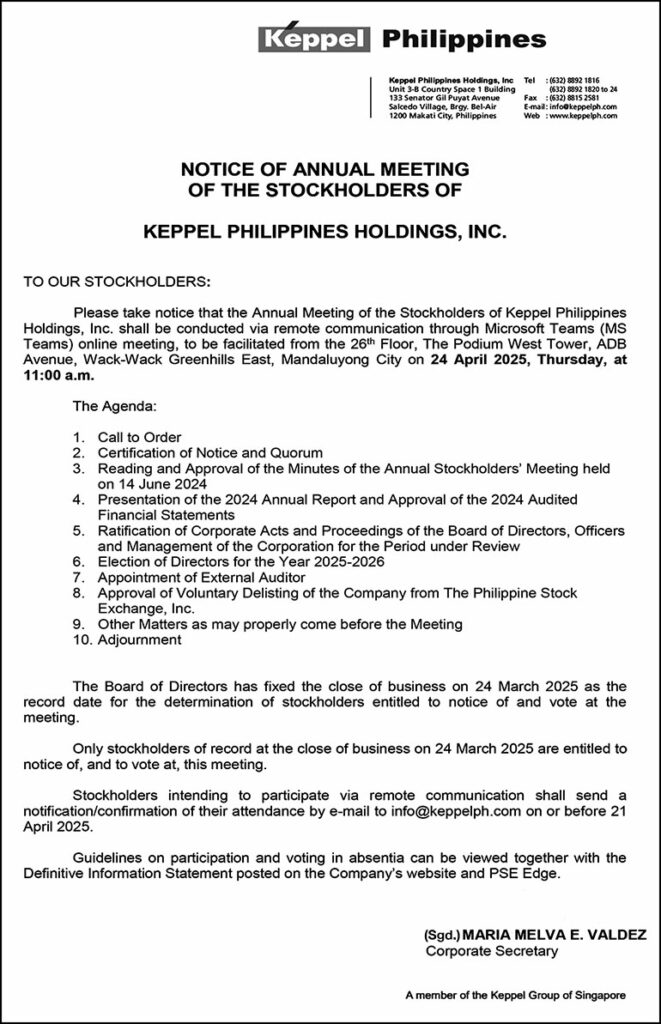
Keppel Philippines Holdings, Inc. to conduct Annual Stockholders’ Meeting on April 24 via remote communication


Spotlight is BusinessWorld’s sponsored section that allows advertisers to amplify their brand and connect with BusinessWorld’s audience by publishing their stories on the BusinessWorld Web site. For more information, send an email to online@bworldonline.com.

Join us on Viber at https://bit.ly/3hv6bLA to get more updates and subscribe to BusinessWorld’s titles and get exclusive content through www.bworld-x.com.

Australia central bank holds rates as it frets over trade war risk

REUTERS

SYDNEY — Australia’s central bank on Tuesday left its cash rate steady as widely expected but took a small step towards further easing in a policy meeting dominated by risks of a global trade war.

Wrapping up its April policy meeting, the Reserve Bank of Australia (RBA) held interest rates steady at 4.1%, having just cut them by a quarter point in February for the first time in over four years.

Markets had seen scant chance of a further easing this week given policy makers had emphasized that they needed to be certain core inflation was under control before acting again.

“Monetary policy is well placed to respond to international developments if they were to have material implications for Australian activity and inflation,” the board said in a statement.

The statement also dropped an explicit reference to being cautious about cutting rates again, in a slightly dovish tone. It also omitted a sentence that upside risks to inflation remain.

Governor Michele Bullock, in the post-decision press conference, said the board did not discuss a rate cut this time, and the slightly dovish turn in the statement did not open the door to an easing in May.

“We still think there is tightness in the labor market, so at the moment it seems prudent to wait and get a bit more data, a bit more information about labor market and inflation to make sure.”

The Australian dollar perked up 0.3% at $0.6262, while the three-year bond futures held steady at 96.31. Swaps moved around after the RBA decision and implied a 60% probability of a rate cut at the next policy meeting in May.

The recent flow of data has printed largely in line or slightly weaker than expected. A benign inflation reading for February has raised hopes that the quarterly price data due at the end of the month would be tame enough for the RBA to move in May.

There are two monthly job reports due before the May meeting.

“We view the statement as providing the Board a degree of optionality regarding future monetary policy moves,” said Adam Boyton, head of Australian economics at ANZ, who is forecasting just one more rate cut in August.

“However, greater market instability and global policy uncertainty could see additional (and earlier) RBA easing.”

Earlier in the day, data showed retail sales rose a modest 0.2% in February, underscoring consumer demand remained tepid.

The steady decision means the center-left Labor government won’t get a rate cut boost in polling ahead of a general election on May 3. Prime Minister Anthony Albanese is struggling in polls over the high costs of living and housing.

The central bank has pushed back against easing expectations after the rate cut in February, which already lifted housing prices to a record last month.

GLOBAL UNCERTAINTIES
Australia’s economy has moved past its worst, with consumer spending picking up amid lavish government tax cuts. However, the outlook has been clouded by the specter of a global trade war as US President Donald J. Trump imposes a blitz of tariffs on trading partners and is set to announce reciprocal tariffs imminently.

Australia is a major exporter of resources to China and tariffs on the world’s second-biggest economy’s goods could hinder growth there and its demand for commodities.

The Federal Reserve has taken a cautious approach to further rate cuts due to concerns Mr. Trump’s policies will stoke inflation, though investor anxiety over a possible US recession has also risen in recent months.

Ms. Bullock said the central bank is speaking to its peers in other central banks, particularly small and open economies to make sense of what’s going on and what can be expected over the next year.

“There is a lot more uncertainty introduced in the international context. What it means for us is not 100% clear. We’re cautious. We are going to wait,” said Ms. Bullock.

The RBA added the overseas developments will have an adverse effect on global activity and Australia is vulnerable given its reliance on world trade. Much will depend on China’s response to the US tariffs, Ms. Bullock said.

However, the implications on prices is less clear, with the RBA saying that inflation “could move in either direction.” — Reuters

Reevaluating a decade of competition law

It has been almost a decade since the passage of Republic Act No. 10667 or the Philippine Competition Act, the country’s primary competition law regulating anti-competitive practices aimed at upholding the constitutional prohibition against monopolies and combinations in restraint of trade.

Since its establishment in 2016, the Philippine Competition Commission has reviewed over 293 M&A transactions with an aggregate value of more than P5.49 trillion. Despite several years of enforcement and the hundreds of transactions reviewed, whether upon notification or motu proprio, the Philippine’s antitrust authority continues to face challenges.

NEED FOR UNIFIED IMPLEMENTING MERGER GUIDELINES
Over the years, the PCC has issued various guidelines and notes seeking to clarify transactions not covered by the PCA, assessment of merger control, computation of thresholds, process for filling out and filing notifications and merger review process of the Mergers and Acquisitions Office, among others. While these efforts have been crucial in addressing the gaps in the PCA and its implementing rules and regulations, there remains a need for unified implementing guidelines codifying the PCC’s issuances to streamline efficiencies and facilitate mandatory notifications and/or requests for confirmation of noncoverage therefrom.

LIMITED CAPACITY OF THE PCC
The PCC may have limitations in its capacity to effectively investigate and resolve complex competition cases. For example, the PCC recently released a market study that emphasizes the need for stronger domestic capacities involving competition issues in digital markets. Having only been established nine years ago, and with big and startup tech companies tapping into the Philippine market, comprehensive guidelines regulating competition concerns involving the digital economy and addressing abuse of market dominance issues will ensure that the Philippines’ primary antitrust authority keeps up with the challenges brought by modern technology.

CHALLENGES IN ENFORCEMENT
It is said that one cannot escape the long arm of the law. Section 3 of the PCA provides that the PCA applies not only to persons or entities engaged in any trade, industry and commerce within the Philippines, but also to “international trade having direct, substantial and reasonably foreseeable effects on trade, industry, or commerce in the Philippines, including those that result from acts done outside the Republic of the Philippines.” As such, offshore transactions may fall within the PCC’s ambit if such transaction has direct, substantial and reasonably foreseeable effects on trade, industry, or commerce in the Philippines.

It is well settled that any decision issued without jurisdiction is void and can never become final, and “any writ of execution based on it is likewise void.” Under the 2017 PCC Rules of Procedure, the PCC may acquire jurisdiction over a person by service of summons and voluntary appearance. For foreign corporations not registered in the Philippines, a summons may be served: “(1) on its officers or agents in the Philippines; (2) through the appropriate court in the foreign country with the assistance of the Department of Foreign Affairs; (3) by publication once in a newspaper of general circulation in the country where the respondent may be found and in such places as the PCC may order, posting the summons on the PCC website, and serving a copy thereof by registered mail at the last known address of the respondent; (4) by facsimile or any recognized electronic means that could generate proof of service; or (5) by such other means as the PCC may, in its discretion, direct.”

In principle, the foregoing provisions on service of summons should allow the PCC to catch those who violate the PCA and relevant issuances, but this may require local presence, sophisticated systems, or close coordination with the pertinent government agencies. Nevertheless, while the PCC may acquire jurisdiction over entities overseas through service of summons following the modes provided under its rules and regulations, enforcement, including imposition of penalties, if any, is a different matter and may prove difficult, especially if the parties do not have a local presence.

While the country has come a long way in leveling the playing field for market players in the country, efforts are needed to ensure effective implementation of a framework envisioned to promote competition and achieve the objectives of the PCA. n

The views and opinions expressed in this article are those of the author. This article is for general informational and educational purposes only and not offered as and does not constitute legal advice or opinion.


Justine A. Navarro is a senior associate of the Corporate and Special Projects Department of the Angara Abello Concepcion Regala & Cruz Law Offices (ACCRALAW).

janavarro@accralaw.com

(632) 8830 8000

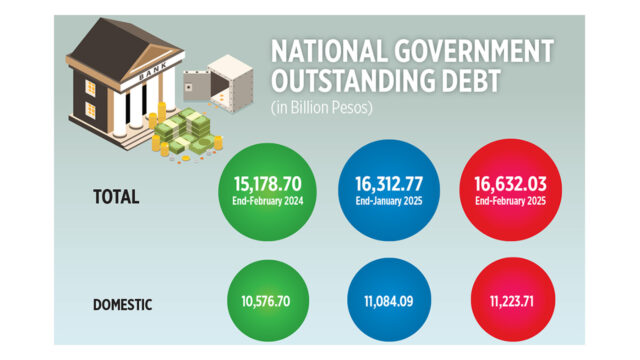
National Government outstanding debt

THE NATIONAL Government’s (NG) outstanding debt rose to a fresh high of P16.63 trillion as of end-February, the Bureau of the Treasury (BTr) reported. Read the full story.

National Government outstanding debt