Home Blog Page 1777

SecureLink plans tech lab in Makati

SECURELINKNETWORKS.COM

SECURELINK NETWORKS, Inc., a joint venture between PT&T Corp. and Australia’s Netlinkz Ltd., plans to establish a multimillion-dollar technology facility in the Philippines to enhance the country’s connectivity and cybersecurity, the company’s top official said.

“We are establishing a lab that will be a multimillion-dollar investment for us. We are engaging with local development firms to establish that lab here in order to license the technology for the Philippines,” SecureLink Networks Chairman James Tsiolis told reporters on the sidelines of an event on Tuesday night.

SecureLink Networks Co-founder and Chief Executive Officer James G. Velasquez said the company is working to further develop and deploy a solution to strengthen the country’s connectivity and cybersecurity infrastructure.

“We are actually looking at bringing the solution from a development standpoint to the Philippines to open up a lot of opportunities — not just in resources that we need in the Philippines but also in further technology development. As you know, software can always be improved. So, we’re bringing a strong product from Australia and porting it over to the Philippines,” Mr. Velasquez said.

He said the planned technology lab, set to be built within the year, will be located in Makati.

The company launched the Virtual Secure Network Plus (VSN+) on Tuesday, offering an advanced cybersecurity and networking solution.

“SecureLink’s entry into the Philippine market isn’t just about launching a product — it’s about changing the way cybersecurity and connectivity are delivered,” the company said in a media release.

SecureLink said it plans to leverage PT&T’s infrastructure and expertise while integrating Netlinkz’s advanced technology to set new standards for a secure digital environment.

“VSN+ is our way of safeguarding digital infrastructure across Southeast Asia. With PT&T as our partner, we aim to transform how cybersecurity is delivered in the region,” Mr. Tsiolis said.

PT&T’s partnership with Australia’s Netlinkz aims to enhance the country’s connectivity through fiber broadband and wireless solutions while integrating Netlinkz’s technology to strengthen cybersecurity networks.

“The idea behind the collaboration is not only to provide connectivity but to extend a secure network built on that connectivity. What we do is connect all points and encrypt all data traffic. So, PT&T provides the connection, we provide the security, and together we deliver the network,” Mr. Tsiolis said. — Ashley Erika O. Jose

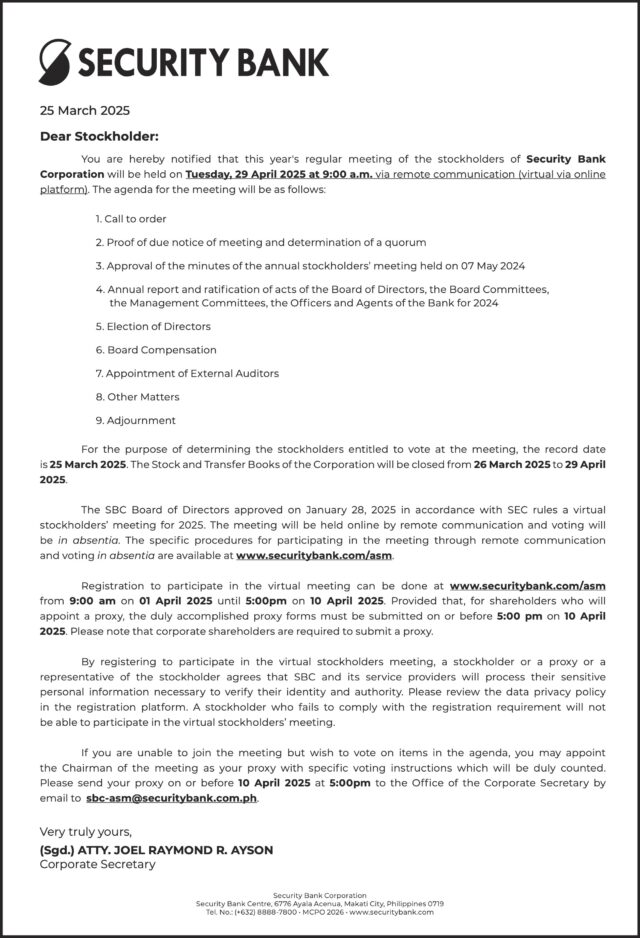
Security Bank Corp. to hold 2025 regular meeting of stockholders via remote communication on April 29


Spotlight is BusinessWorld’s sponsored section that allows advertisers to amplify their brand and connect with BusinessWorld’s audience by publishing their stories on the BusinessWorld Web site. For more information, send an email to online@bworldonline.com.

Join us on Viber at https://bit.ly/3hv6bLA to get more updates and subscribe to BusinessWorld’s titles and get exclusive content through www.bworld-x.com.

China’s Xiaomi raises $5.5 billion in share sale as EV plans ramped up

CHINA’S Xiaomi Corp. said on Tuesday it had raised $5.5 billion in an upsized share sale as the company pushes forward with its ambitious electric vehicle (EV) manufacturing plans.

The company sold 800 million shares at HK$53.25 each, it said in a statement to the Hong Kong Stock Exchange. The world’s third-largest smartphone maker has seen its share price surge by nearly 150% from HK$21.5 in the past six months, buoyed by investor enthusiasm for its EV plans.

Xiaomi, which moved into electric vehicle manufacturing last year, had planned to sell 750 million shares but increased the size of the deal while the bookbuilding process was underway.

The final price was towards the bottom end of the HK$52.80 to HK$54.60 price range flagged to investors when the deal launched on Monday.

Xiaomi shares were down 5.3% in Hong Kong on Tuesday as the Hang Seng Index was off 2.1%.

There were more than 200 investors who placed orders during the bookbuilding process and the book was multiple times oversubscribed, said a person familiar with the matter.

The top 20 investors took about 66% of the stock sold in the share sale, the person added.

Xiaomi did not immediately respond to a request for comment on the deal statistics.

The price was a 6.6% discount to Xiaomi’s closing price of HK$57 on Monday. Xiaomi said the money raised would be used to fund the acceleration of its business expansion, research and technology development.

Xiaomi began manufacturing EVs last year with the launch of the SU7 sedan after selling smartphones, household appliances and smart gadgets for most of its 15-year history.

It reported an almost 50% jump in fourth-quarter revenue last week and raised its target for EV deliveries this year to 350,000 from 300,000.

The company reported 32.1 billion yuan ($4.4 billion) in revenue for its EV business in 2024, delivering more than 135,000 SU7 sedans. Xiaomi said it aimed to start shipping cars overseas in 2027.

The tech firm has purchased a new land plot of 52 hectares (128.5 acres) in Beijing’s south, where it would build the third phase of its auto factory as it ramps up its annual shipment target, Chinese media has reported.

Xiaomi will invest a quarter, about 7-8 billion yuan, out of its 2025 total research and development budget of 30 billion yuan into AI, President Lu Weibing said last week.

Xiaomi’s deal extends a rush of tech-focused capital raisings from Chinese firms in Hong Kong, as companies take advantage of positive sentiment towards the tech sector.

A summit led by Chinese President Xi Jinping with top tech leaders last month was widely seen as a sign that strict government scrutiny of the sector which began in 2020 was easing.

Before Xiaomi’s share sale, Chinese firms had carried out $16.8 billion worth of equity capital market activity in the first quarter, according to LSEG data, more than double the same period last year. Reuters

Ticketmaster may have misled UK Oasis fans, watchdog says

LONDON — Ticketmaster may have misled music fans into paying more for tickets than they had planned last year to see British band Oasis, the UK’s competition watchdog said on Tuesday, urging the company to change how it labels tickets and informs customers.

Thousands of fans waited for hours online to get their hands on highly coveted tickets for the band’s 2025 reunion shows, only to find prices had jumped by the time they got to the front of the queue.

“We’re concerned that Oasis fans didn’t get the information they needed or may have been misled into buying tickets they thought were better than they were,” said Hayley Fletcher, interim senior director of consumer protection at the Competition and Markets Authority (CMA).

The watchdog said it was concerned that Ticketmaster may have breached consumer law. CMA does not currently have power to levy fines for breaching consumer laws, which are enforced through the court system.

A Ticketmaster statement said that it aimed to provide a “simple, transparent and consumer-friendly experience” and welcomed the CMA’s input.

The CMA launched an investigation into Ticketmaster in September to examine if it had engaged in “unfair commercial practices,” and if they were pressured to buy tickets within a short period of time.

The CMA originally said it was also looking at how dynamic pricing models — a form of surge pricing — may have been used, but Ticketmaster has said it did not use dynamic pricing models.

The outcry over the way the ticket sale process was managed became a hot political topic, spurring Prime Minister Keir Starmer to promise to get a grip on the wider issue of event tickets being sold at inflated prices.

The government has since announced proposals to cap resale prices and hold reselling websites more accountable.

The CMA issued an update on its findings on Tuesday outlining two main concerns.

One was that seats labeled as “platinum” were sold at a premium without consumers being made fully aware that they didn’t come with any extra benefits.

Another was insufficient information provided to buyers at the start of the queue on different ticket categories and their prices if cheaper tickets were sold out before their turn to buy.

The CMA said Ticketmaster had made some changes since the investigation began, but that more work was still needed.

“We now expect Ticketmaster to work with us to address these concerns so, in future, fans can make well-informed decisions when buying tickets,” the CMA’s Ms. Fletcher said. — Reuters

Charmed and dangerous

FREEPIK

EVERY TIME there is an election, like the one coming up soon, the pundits bemoan the lack of relevant qualifications among the top contenders in the polls. They cite the illustrious line-up of experienced and academically qualified icons of the past. (The same names always come up.) Sure, there were actors in the mix even then, but they were a minority. And they were concentrated on the broadcast industry and media.

Is charm currently all it takes to get into the winning column in an electoral contest?

Charm deals with popularity which gives a big boost in surveys as the smoothie has probably enjoyed the spotlight in entertainment or media. The charmer projects compassion for the masses in his predictable denunciation of corruption and the need for helping the poor.

When asked a specific question like what an actor plans to do if elected in the upper house, he admits his ignorance. (I’ll know what when I get there.) He turns the question around to the one from the press impertinent enough to bring up this matter — what would you do? (I want to know your priorities.) He needs a script at this point.

The charmer glories in his high position in the survey, owing to his pleasing personality. The attitude is reminiscent of the song, “I Feel Pretty” from West Side Story — “it’s alarming how charming I feel.”

The brazenness of ambition in the charmer is packaged as a self-sacrificing willingness to give up malling and summer outings to serve the country even at a young age. He may even point to the dynasty he belongs to — our family has served the community for generations.

Those who question the charmer’s chutzpah to parlay a short stint in the public spotlight are dismissed as part of the elitist jeering squad that must be rejected — we need to embrace change.

Is a proclaimed modesty considered charming? (I know I’m not qualified. I just want to serve.) The incumbent charmer with the highest absentee rate while in office may parlay that inadequacy with a shrug — I’m out there with the people surveying what they want. (There are OFWs in Paris too, you know.) She may have a lot of unfinished projects and unliquidated advances, but she refuses to answer any questions on those. (Let’s change the topic.)

The emotions that the charmer targets involve the following: 1.) Here is a fresh and untainted personality in this dirty game of traditional politics; 2.) This novice appeals to the masses with his clean slate of achievements; and, 3.) Let’s throw out the old fogies by voting for inexperienced celebrities.

Charm is visceral. It seduces the emotion and shuns too much analysis. (Is there really a need for a debate?) It is difficult to be too critical of somebody who seems so reasonable and appealing. He is not picking a fight. He avoids issues and questions on which side of the political feud he is on. (I can only side with the people.)

What role does charisma play in the political contest?

Is it possible to be competent and qualified and still be charming? Does it have to be one or the other? This is the challenge for those who feel that their qualifications alone speak for themselves. They need to get off their high horse and try to relate to the voters. The default position for the qualified candidates seems to be a disappointment with the voters for their gullibility and lack of education.

Instead of bewailing the demand side of the voting equation, the candidate should try to understand the voters and their indifference if not outright animosity for elitist pretensions.

As any marketing practitioner understands, it’s not the customer who needs to justify her choice of which products to buy. It’s the seller of the product that needs to adjust and appeal to the consumer. Yes, the product on the shelf needs effective branding to charm the buyer to put it in her shopping cart, even impulsively.

It is a failure of marketing when a company explains poor sales by blaming the consumer for having poor judgment in making decisions. Certainly, it’s not all about charisma. But even a good product needs to project some charm to the buyer… even with a celebrity endorser on the stage.


Tony Samson is chairman and CEO of TOUCH xda

ar.samson@yahoo.com

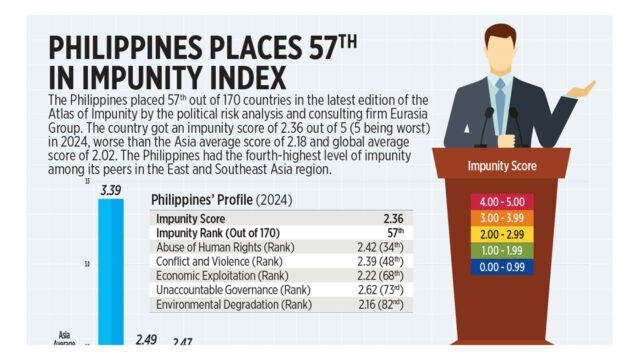
Philippines places 57th in Impunity Index

The Philippines placed 57th out of 170 countries in the latest edition of the Atlas of Impunity by the political risk analysis and consulting firm Eurasia Group. The country got an impunity score of 2.36 out of 5 (5 being worst) in 2024, worse than the Asia average score of 2.18 and global average score of 2.02. The Philippines had the fourth-highest level of impunity among its peers in the East and Southeast Asia region.

Philippines places 57<sup>th</sup> in Impunity Index

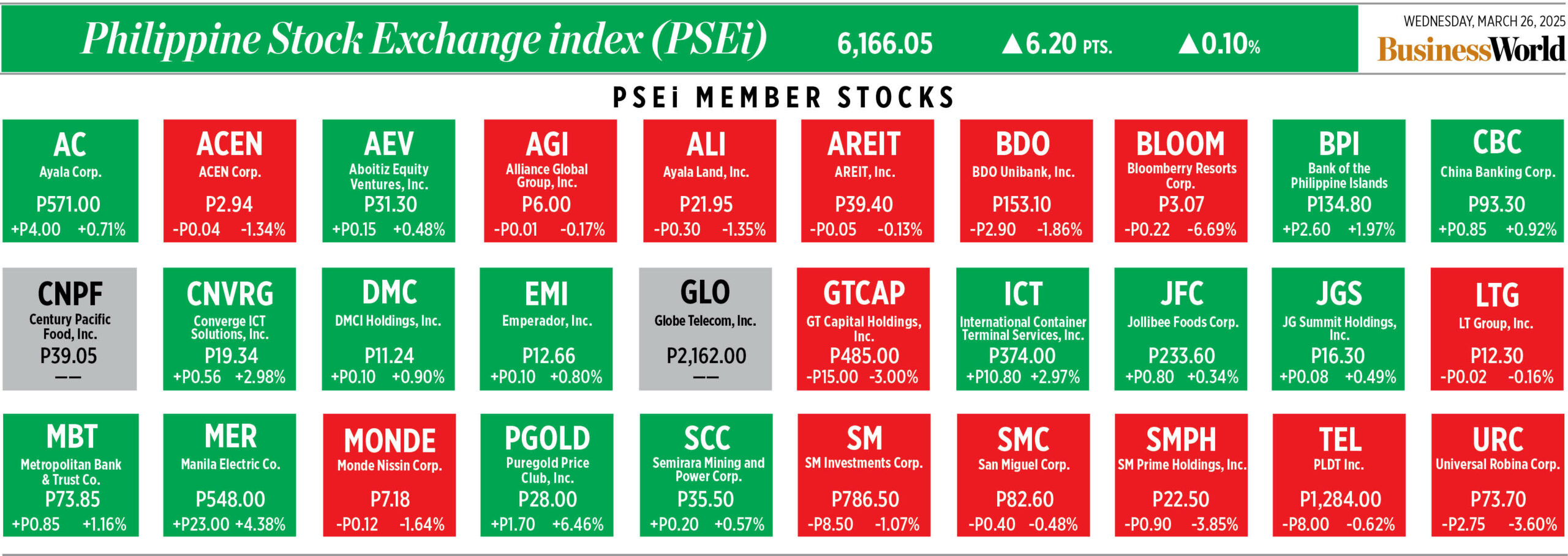
How PSEi member stocks performed — March 26, 2025

Here’s a quick glance at how PSEi stocks fared on Wednesday, March 26, 2025.


Peso tumbles to three-week low as tariff worries drag sentiment

BW FILE PHOTO

THE PESO sank to a three-week low against the dollar on Wednesday as the market remained worried over the potential economic impact of the Trump administration’s plan to impose reciprocal tariffs starting next week.

The local unit closed at P57.69 per dollar on Wednesday, weakening by nine centavos from its P57.60 finish on Tuesday, Bankers Association of the Philippines data showed.

This was the peso’s worst finish in over three weeks or since it ended at P57.753 on March 4.

The peso opened Wednesday’s session a tad stronger at P57.58 against the dollar. It dropped to as low as P57.74 intraday, while its best showing was at P57.57 versus the greenback.

Dollars exchanged declined to $1.34 billion from $1.54 billion on Tuesday.

“The dollar-peso closed lower on risk-off sentiment and due to momentum from yesterday’s announcement by the Bangko Sentral ng Pilipinas (BSP) on a possible rate cut in April,” a trader said in a text message, noting that this could result in a narrower rate differential with the US Federal Reserve.

The US dollar was slightly higher on Wednesday as nervy traders awaited clarity on President Donald J. Trump’s trade policy ahead of a new round of tariffs next week, Reuters reported.

Traders clung on to hopes of flexibility from the White House after Mr. Trump said on Monday that not all trade levies would come on the April 2 deadline, and some countries would get breaks, without providing further details.

At the same time, Mr. Trump opened a new front in his trade war with a directive for 25% secondary tariffs on any country that buys oil or gas from Venezuela. In turn, oil prices rose, although the impact was offset by relief from Black Sea maritime security deals struck by the US in the war in Ukraine.

The US dollar index, which measures the currency against a basket of six major peers, inched higher after slipping 0.1% on Tuesday, its first losing session in about a week.

The index plumbed a five-month low last week, weighed down by worries that Mr. Trump’s trade war could trigger a US recession. Data overnight showed consumer confidence plunged to the lowest level in more than four years this month.

Meanwhile, BSP Governor Eli M. Remolona, Jr. said in an interview with Bloomberg Television on the sidelines of the HSBC Global Investment Summit in Hong Kong on Tuesday that there is a “good chance” that the Monetary Board will cut rates by 25 basis points (bps) at their April 10 meeting, Bloomberg reported.

Mr. Remolona said the BSP remains on an easing cycle and could bring down borrowing costs by as much as 75 bps this year depending on data.

The central bank has reduced benchmark interest rates by a cumulative 75 bps since it began its rate-cut cycle in August last year, with its policy rate currently at 5.75%.

For its part, the US central bank last week reiterated its cautious policy stance, with Fed Chair Jerome H. Powell signaling that they are in no rush to cut rates.

The US central bank left interest rates unchanged last week, though policy makers indicated they expected to reduce borrowing costs twice this year.

Rizal Commercial Banking Corp. Chief Economist Michael L. Ricafort said in a Viber message that the peso could have been dragged down by the rupiah reaching near all-time lows.

The rupiah was flat at 16,580 per US dollar at 0645 GMT, hovering near the all-time low of 16,800 touched in June 1998, during the Asian Financial Crisis and just after the fall of Indonesia’s authoritarian leader, General Suharto, Reuters reported.

On Tuesday, the rupiah hit a post-crisis low of 16,640, before the central bank intervened to defend the currency.

For Thursday, the trader expects the peso to move between P57.50 and P57.80 per dollar, while Mr. Ricafort sees it ranging from P57.60 to P57.80. — A.M.C. Sy with Reuters

PSEi climbs on BSP easing bets, bargain hunting

BW FILE PHOTO

PHILIPPINE SHARES edged higher on Wednesday, buoyed by last-minute bargain hunting and growing expectations of a Bangko Sentral ng Pilipinas (BSP) rate cut next month.

The benchmark Philippine Stock Exchange index (PSEi) went up by 0.10% or 6.20 points to close at 6,166.05, while the broader all shares index increased by 0.53% or 19.53 points to 3,676.71.

“Last-minute bargain hunting brought the local market higher this Wednesday. Rising hopes that the Bangko Sentral ng Pilipinas will ease their policy in their April meeting helped in lifting sentiment,” Philstocks Financial, Inc. Senior Research Analyst Japhet Louis O. Tantiangco said in a Viber message.

BSP Governor Eli M. Remolona, Jr. said in an interview with Bloomberg Television on the sidelines of the HSBC Global Investment Summit in Hong Kong on Tuesday that there is a “good chance” that the Monetary Board will cut rates by 25 basis points (bps) at their April 10 meeting, Bloomberg reported.

Mr. Remolona said the BSP remains on an easing cycle and could bring down borrowing costs by as much as 75 bps this year depending on data.

The central bank has reduced benchmark interest rates by a cumulative 75 bps since it began its rate-cut cycle in August last year, with its policy rate currently at 5.75%.

The Monetary Board in February unexpectedly kept rates unchanged amid uncertainties stemming from the Trump administration’s policies.

“Philippine shares made a modest recovery as Wall Street also closed higher on Tuesday, extending gains as investors bet on narrower US tariffs,” Regina Capital Development Corp. Head of Sales Luis A. Limlingan said in a Viber message.

On Tuesday, the Dow Jones Industrial Average rose by 0.01% or 4.18 points to 42,587.50; the S&P 500 gained by 0.16% or 9.08 points to end at 5,776.65; and the Nasdaq Composite climbed by 0.46% or 83.27 points to 18,271.86.

Majority of sectoral indices posted gains on Wednesday. Services increased by 1.7% or 34.05 points to 2,032.03; mining and oil went up by 1.42% or 130.12 points to 9,291.43; financials climbed by 0.36% or 8.59 points to 2,397.42; and industrials rose by 0.29% or 25.41 points to 8,752.70.

Meanwhile, property declined by 2.13% or 47.11 points to 2,162.55 and holding firms shed 0.47% or 24.17 points to end at 5,031.71.

“Puregold Price Club, Inc. was the day’s index leader, jumping 6.46% to P28. Bloomberry Resorts Corp. was at the tail end, falling 6.69% to P3.07,” Mr. Tantiangco said.

Value turnover went up to P4.91 billion on Wednesday with 1.06 billion shares exchanged from the P4.75 billion with 520.59 million issues traded on Tuesday.

Decliners bested advancers, 111 versus 92, while 46 names were unchanged.

Net foreign selling surged to P1 billion on Wednesday from P604.51 million on Tuesday. — Revin Mikhael D. Ochave

Nine Marcos-backed candidates for Senate make it to top 13 in SWS poll

SENATOR BONG GO AND ERWIN TULFO FACEBOOK PAGE

By Chloe Mari A. Hufana, Reporter

NINE of the 12 senatorial candidates endorsed by President Ferdinand R. Marcos, Jr., made it to the top 13 of the midterm election race, according to a Social Weather Stations (SWS) poll conducted just days after the arrest of former President Rodrigo R. Duterte.

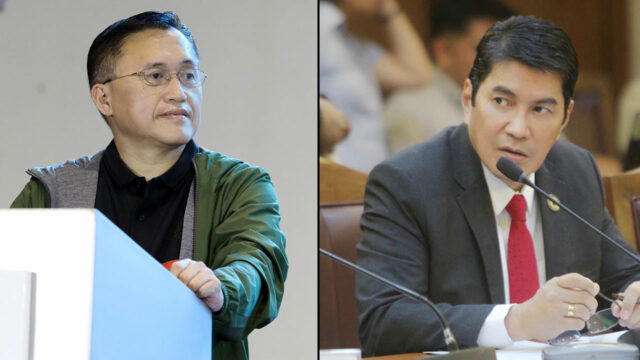
Re-electionist Senator Christopher Lawrence T. Go, who is not part of the administration slate, and Party-list Rep. Erwin T. Tulfo were tied at the top.

Only 12 senators will win in the May 12 elections, but three candidates were tied for No. 11, 12 and 13.

Mr. Go, a former aide of Mr. Duterte, increased four percentage points from the February poll, while Mr. Tulfo declined three points, Stratbase Group, which commissioned the poll, said in a statement on Wednesday.

The Marcos-Duterte alliance, which delivered a landslide victory in the 2022 presidential and vice-presidential elections, was fractured last year due to policy disagreements and competing political ambitions.

The tension between the two political camps culminated in the arrest of Mr. Duterte by Philippine police on March 11 so he could be tried by the International Criminal Court for crimes against humanity in connection with his deadly drug war.

A month earlier, his daughter, Vice-President Sara Duterte-Carpio, was impeached by the President’s allies at the House of Representatives.

“The Malasakit Center machinery reinforced his clientelist credit with the voter base, and much like politicians who performed during the pandemic — either good governance- or patronage-based — they’re still reaping the dividends off that,” Hansley A. Juliano, a political science lecturer at the Ateneo de Manila University, told BusinessWorld in a Facebook Messenger chat.

The centers, which provide medical and financial assistance to poor Filipinos, are Mr. Go’s flagship program as a senator.

The March 15 to 20 SWS poll showed a competitive race from third to 13th place, with margins between candidates falling within the ±2.31-percentage-point error margin.

Broadcaster and independent candidate Bienvenido T. Tulfo and former Senate President Vicente C. Sotto III were tied at third and 4th place with 34%, while Senator Manuel “Lito” M. Lapid slipped to fifth place with 33%, down three points from February.

Senator Ramon “Bong” B. Revilla, Jr., held the sixth spot with 32%, while Senator Pilar Juliana S. Cayetano and former Senator Panfilo M. Lacson, Sr., shared the seventh and eighth spots with 31% each.

Senator Ronald M. Dela Rosa, Mr. Duterte’s former police chief who is not backed by the government, was No. 9 with 30%, down two points from February.

Another independent candidate, television host Wilfredo B. Revillame, remained in 10th place with 28%, followed by Makati Mayor Mar-len Abigail S. Binay, former Senator Emmanuel D. Pacquiao, Sr. and Las Piñas Rep. Camille A. Villar, who were tied for 11th to 13th place with 27% each.

Just outside the top 12 were former Senator Francis Pancratius N. Pangilinan (24%) and former Senator Paolo Benigno A. Aquino IV (21%).

One of the biggest falls came from presidential sister Senator Maria Imelda Josefa Remedios “Imee” R. Marcos, who fell to 16th place with 19%, down five points from February.

On Wednesday, she said she had withdrawn from administration-backed Alyansa Para sa Bagong Pilipinas.

“I cannot stand on the same campaign platform as the rest of the Alyansa,” Ms. Marcos, a close friend of the Dutertes, said in a statement. “As I have stated from the outset of the election period, I will continue to maintain my independence.”

‘STRONG COALITION’
Of the original 12-member slate, only Ms. Marcos, Senator Francis N. Tolentino (No. 20) and Benjamin “Benhur” Abalos, Jr. (No. 18) failed to make it.

Stratbase President Victor Andres C. Manhit noted that while the unity between the Marcos and Duterte factions might have dissolved, Mr. Marcos has built a strong coalition that includes five major political parties that could win in May.

“Right now, it’s safe to say that the Marcos administration and the coalition they have built, which includes five major political parties, can win big in the May 2025 election,” he said in a statement. “Beyond the incumbency advantage, the President has fostered unity among various political forces.”

“While the unity between Marcos and Duterte may have dissolved, we’re now seeing strong alignment among traditional political parties and their allies,” he added, noting the Marcos-Duterte battle cry in the 2022 presidential race.

He added that the strong standing of Alyansa candidates was driven by their popularity, further bolstered by the President’s endorsement.

He expects support for many of these candidates to continue rising, especially as the local campaign period starts on March 28.

“These candidates already have a degree of popularity and existing support. When you add the President’s endorsement and the administration and its allies’ political machinery, it creates a powerful force heading into May 2025,” he added.

He said candidate visibility across traditional and digital media platforms remains a significant factor in maintaining their rankings.

“What we are witnessing now reflects the continued impact of media exposure, political advertising and social media engagement on voter preferences,” he added.

Mr. Juliano said the strong standing of Marcos-backed candidates shows the administration reinforcing its bases.

“The Marcoses want more in the Senate to reinforce their policies — most likely economic Charter change again — plus [they want to] ensure they don’t become a lame duck for preferred successors come 2028,” he added.

The Philippine midterm elections on May 12, 2025, will determine 12 of the 24 seats in the Senate, along with positions in the House of Representatives and local government units.

The SWS interviewed 1,800 voters nationwide for the poll, which had an error margin of ±2.31 points.


Senate rejects House plea to summon VP over ouster raps

VICE PRESIDENT SARA DUTERTE — PHILIPINE STAR/RYAN BALDEMOR

THE Philippine Senate has rejected a plea by congressmen who will act as prosecutors in Vice-President (VP)Sara Duterte-Carpio’s impeachment trial to compel her to comment on her impeachment charges.

The Senate could not act on the motion since Congress is on a break and the Senate had yet to convene as an impeachment court, Senate President Francis G. Escudero told reporters on Wednesday.

“It cannot legally be done,” he said. “It is not allowed because the Senate is not in session.”

On Tuesday, the congressmen urged the Senate president summon the Vice-President and inform her of the charges.

“When the Senate is in session, only then can they present articles of impeachment and only then can the impeachment court be convened to mediate the impeachment,” Mr. Escudero said.

According to a proposed impeachment schedule, the prosecution’s presentation and the approval of updated impeachment trial rules are set for June 2 or once congress resumes from its four-month break.

Congress went on a four-month break for the 2025 midterm elections and will reconvene for a two-week session on June 2.

The proposed start of the trial is scheduled on July 30 once newly elected Senators take oath as impeachment judges on July 29.

The House impeached the Vice-President on Feb. 5, alleging secret fund misuse, unexplained wealth, acts of destabilization and plotting the assassination of President Ferdinand R. Marcos, Jr. and his family. Ms. Duterte has denied any wrongdoing.

The impeachment complaint was filed and signed by more than 200 congressmen, more than the one-third legal requirement before it could be sent to the Senate.

Congress has been on a four-month break since February for the midterm elections. Filipinos will pick a new set of congressmen, 12 of the 24-member Senate and other local government officials on May 12.

Based on the proposed impeachment trial schedule, the prosecution’s presentation and the approval of updated impeachment trial rules were set for June 2. The Senate is expected to convene as an impeachment court the day after. The issuance of summonses was set for June 4.

The proposed start of the trial was scheduled for July 30, once newly elected senators take their oath as impeachment judges on July 29.

Mr. Escudero said earlier that the impeachment trial would likely be concluded before the October recess.

Meanwhile, Batangas Rep. Gerville R. Luistro insists Congress need not be in session for the Senate to be able to convene as an impeachment court “because impeachment is entirely different from legislative functions.”

“Our legal standing is rooted on the fact that the impeachment process is different from the legislative process,” she told a virtual news briefing.

Mr. Escudero has repeatedly said the Senate could not act on the impeachment complaints until Congress resumes sessions after the midterm elections.

He had also rejected calls for a special session to start the impeachment trial. He urged congressmen not to rush the impeachment process since this give Ms. Duterte the leverage.

“They might just be giving the accused… more reasons and weapons to question the process at the Supreme Court,” he said. “I would rather be more prudent and stay faithful to the law.”

Ms. Luistro said the House prosecution team had split-up into smaller groups to tackle each article of impeachment against the Vice-President. — A.H. Halili

Former Solicitor General and Erap lawyer Estelito Mendoza dies at 95

ESTELITO MENDOZA — U.P COLLEGE OF LAW

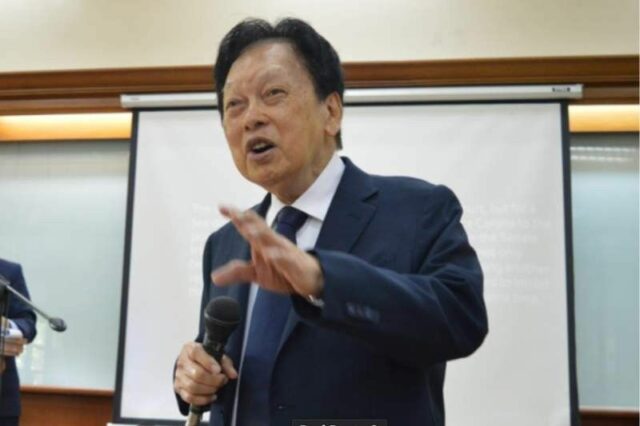
ESTELITO P. MENDOZA, who gained a reputation of defending high-profile and controversial clients including convicted former President Joseph E. Estrada, has died. He was 95.

His death was announced by Philippine National Bank, where he had been a director since 2009, in a disclosure to the Philippine Stock Exchange on Wednesday.

Mr. Mendoza served under the late dictator Ferdinand E. Marcos, Sr. as solicitor general from 1972 to 1986 and was his Justice minister from 1984 to 1986 before the strongman’s ouster by a popular street uprising.

Mr. Mendoza, who was called the “Attorney of Last Resort” during his long career as a defense lawyer, had been tapped to represent Vice-President Sara Duterte-Carpio in her three lawsuits before the Supreme Court over P125 million in confidential funds she received in 2022.

“Estelito Mendoza can be considered as the archetype of the classic Filipino lawyer,” Jeremy Benigno Gatdula, dean of the University of Asia and the Pacific College of Law, told BusinessWorld via Facebook Messenger.

“He has served his clients and his country to a level of excellence difficult to match in any other era or circumstance,” he said. “Estelito Mendoza was a gentleman of high personality, wit and true love for the law, which I believe is something that all Filipino lawyers should aspire to.”

Mr. Mendoza served as chief lawyer for Joseph “Erap” Estrada during his impeachment trial, which culminated in his ouster by a popular street uprising in 2001.

He also lawyered for the dictator, his wife Imelda and their business associates Lucio C. Tan and the late Roberto V. Ongpin and Eduardo “Danding” M. Cojuangco, Jr. in various cases for sequestered assets.

Mr. Mendoza also advocated for the late Fernando Poe, Jr., who run for President in 2004, when his citizenship was questioned before the Supreme Court. He also successfully defended ex-President Gloria Macapagal Arroyo in her plunder case before the High Court.

Mr. Mendoza also got before the Supreme Court a bail for plunder defendant former Senator Juan Ponce Enrile in connection with a multibillion-peso pork barrel scam. At the anti-graft court Sandiganbayan, the lawyer got Senator Ramon “Bong” Revilla, Jr. acquitted of plunder for the same pork barrel case.

“He was one of the seasoned lawyers,” National Union of People’s Lawyers President Ephraim B. Cortez said in a Viber message. “Of course, we cannot but remember that he was part of the martial law government of Marcos, and that he never severed that relationship.”

“He defended Imelda Marcos and the other members of the Marcos family, and his choices of clients showed that human rights were far from his radar. He was never involved in human rights advocacy. He represented clients with a questionable human rights record.” — Norman P. Aquino and Chloe Mari A. Hufana