Home Blog Page 1765

San Jose del Monte city gov’t approves new site of MRT stop

PHILSTAR FILE PHOTO

THE Department of Transportation (DoTr) said the city government of San Jose del Monte, Bulacan agreed last month to the new location of the Metro Rail Transit Line-7 (MRT-7) station in that city.

“The alignment agreed in September 2024 has also been reaffirmed by the San Jose del Monte government in March 2025,” Michelle De Vera, assistant secretary for communications and commuter affairs at the DoTr, said via Viber on Wednesday.

Ms. De Vera said the realignment will not impact the projected start of MRT-7 operations.

The San Jose del Monte stop will now be located near the boundary of San Jose del Monte and north Caloocan, instead of the initial site, which was near the Muzon-Tungkong Mangga Road intersection, according to Philippine Information Agency.

According to the NEDA Central Luzon office website, the project is now 78.63% complete and is targeted for partial operations by 2026 and full operations by 2027.

Last year, the DoTr said the MRT-7, a project of San Miguel Corp. (SMC), is experiencing delays due to the right-of-way (RoW) issues in San Jose del Monte.

MRT-7, which will have 14 stops, will run from Quezon City to San Jose del Monte, and is expected to carry 300,000 passengers daily in its first year, and up to 850,000 passengers a day by the 12th year.

SMC is financing the construction and will operate the 23-kilometer commuter rail system under a 25-year concession agreement.

The commuter rail line’s stations are Quezon/North Avenue Joint Station, Quezon Memorial Circle, University Avenue, Tandang Sora, Don Antonio, Batasan, Manggahan, Doña Carmen, Regalado, Mindanao Avenue, Quirino, Sacred Heart, Tala, and San Jose del Monte.

In 2024, the DoTr said it is looking at operating the Quezon City leg or the Quezon/North Avenue Joint Station up to Tandang Sora station. — Ashley Erika O. Jose

Pork MAV set for overhaul to make allocations more fair, DA says

PHILSTAR FILE PHOTO

THE Department of Agriculture (DA) on Wednesday said it is looking to overhaul the minimum access volume (MAV) allocation system for pork to make the process more fair.

MAV rules were formulated almost three decades ago and have been “exploited by a small number of accredited importers,” it said in a statement.

The DA’s Policy and Planning Office will come up with a recommendation by October, the department said.

“Our MAV rules were written in 1996 and when I read them, I found a lot of room for improvement. So, we have to revise the MAV,” Agriculture Secretary Francisco Tiu Laurel, Jr. was quoted as saying.

The MAV is a feature of the World Trade Organization system. Members must commit to open their markets to a minimum quantity of imports that are charged reduced tariffs.

Pork imports falling within the MAV quota are subject to a tariff of 15%, against the regular rate of 25%. The MAV allocation for pork is 55,000 metric tons (MT), with 30,000 MT going to meat processors.

Mr. Laurel said of the 130 quota holders, 47 account for 80% of the total; of the 47, 22 have cornered 70% of the volume of the top importers.

“In reality, 22 MAV quota holders account for 55% of the total volume,” he said.

“The sad part about this is that consumers don’t benefit from the reduced tariff,” he said.

Asked to comment, Meat Importers and Traders Association (MITA) President Jess C. Cham said via Viber: “The licensees who have retained their allocations have all done so in accordance with MAV guidelines. We should not fault them for that.”

Mr. Cham said to accommodate more importers, the MAV volume should be increased.

“It has been 30 years after all.”

Mr. Cham said the DA “refuses to see the main problem” which is the lack of hogs, noting that due to the African Swine Fever outbreak in 2019, pork production dropped to 1 million MT in 2024.

Pork production pre-MAV was 1 million MT in 1995. It peaked at 1.9 million MT in 2019, he noted.

“With a production drop of 900,000 tons, MITA proposed to increase the MAV to 500,000 tons,” Mr. Cham said. “This is still not enough to cover the deficit.”

The DA is projecting pork production in 2025 to increase to 1.15 million MT.

National Federation of Hog Farmers, Inc. Vice-President Alfred Ng said giving a big part of the MAV to processors may benefit consumers more.

“Traditional MAV importers which are traders will not (pass on the) benefits to consumers,” he said via Viber.

The DA said as initially planned, it is considering increasing allocation to meat processors to 40,000 MT.

It said Food Terminal, Inc. will also be given an allocation — initially set at 15,000 MT — to allow it to intervene in the market should pork prices increase.

MITA has been calling on the DA to issue the MAV allocation as soon as possible to avoid trade disruptions that could lead to a spike in pork prices.

Mr. Laurel in February said meat processors will be allowed to import 35,000 MT of pork. — Kyle Aristophere T. Atienza

RE industry frets about rates should Trump stoke inflation

By Sheldeen Joy Talavera, Reporter

THE Trump administration’s policies could cause inflation to remain elevated, which would have a major impact on the renewable energy (RE) industry because it depends heavily on borrowed capital, ACEN President and Chief Executive Officer Eric T. Francia said.

“Ninety percent of our capex (capital expenditure) is cost of capital and that remains elevated and more than offsets the low solar panel prices,” Mr. Francia said.

Mr. Francia said President Donald J. Trump’s preference that the US exploit its own fossil fuels to minimize dependence on foreign energy “is causing a lot of uncertainty with regard to mid- to long-term global supply and demand… There is a risk of stranded assets if you overbuild gas resources.”

Mr. Trump withdrew the US from the Paris Agreement, which has been taken as a declaration of intent to lean more on fossil fuels. The resulting resistance by the US to the clean-energy transition has raised concerns that the industry’s progress could stall.

Mr. Francia said in response, the Philippines should explore regional opportunities.

“These global policies are driven by US… (they are) only part of the equation. You need to look at the impact of local and regional policies. And that is where we have a great silver lining, to unlock opportunities in these challenges,” he said.

Mr. Francia added that opportunities also lie in greater efficiency and falling prices of RE equipment, making renewables more competitive.

Energy Undersecretary Rowena Cristina L. Guevara, speaking at the Renewable Energy Forum 2025 on Wednesday, said the US reluctance to pursue RE aggressively means the Philippines can turn to regional partners to achieve its RE goals.

“We can have partnerships among us. And we do have leaders in Asia, like China, Japan, South Korea, and India leading the renewable energy market.”

Citicore Renewable Energy Corp. President and CEO Oliver Tan said investment in energy transition has been “flattish” even before the return of Mr. Trump to office.

“At the end of the day, smart money will eventually find its way to areas where there’s compelling investment (propositions). And the Philippines today is a very compelling investment for funds that will eventually come,” Mr. Tan said.

The Philippines is seeking to increase the share of renewable energy in the power mix to 35% by 2030 and 50% by 2040.

Ms. Guevara expressed optimism in achieving the end-of-decade goal.

“We saw that with the developments happening in the Philippines, we will actually hit 35% by 2030,” she said.

WB approves $800-M energy transition loan

REUTERS

THE WORLD BANK (WB) on Wednesday said it approved an $800-million financing package to support the adoption of clean energy technology and the enhancement of water management in the Philippines.

“Focusing on renewable energy sources and using energy more efficiently can help the country reduce electricity costs, improve energy security, and cut down on pollution,” Zafer Mustafaoğlu, World Bank division director for the Philippines, Malaysia, and Brunei, said in a statement on Wednesday.

“Using more affordable renewable energy in the energy and transport sectors is crucial for the Philippines to build a strong economy,” he added.

This First Energy Transition and Climate Resilience Development Policy Loan aims to bolster efforts to scale up clean energy technologies, enhance the security and flexibility of electricity markets, and improve water management.

The bank said the project will increase the share of renewable energy in installed generation capacity from 30% in 2023 to 42% by 2027.

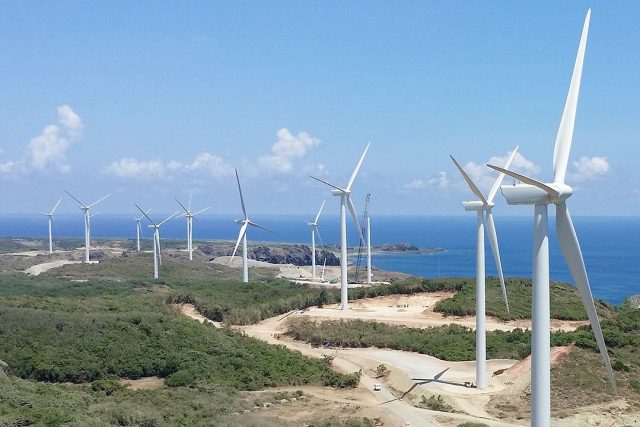
It will also fund the procurement of 1,000 megawatts of new offshore wind capacity and implement energy efficiency measures saving five gigawatt hours annually.

“By strengthening RE markets, and unlocking private sector investment, the program will contribute to scalable, transformative impact beyond 2030, placing the Philippines on a sustainable trajectory,” the World Bank said.

Additionally, the project will introduce policy reforms to improve governance and cohesiveness in the water sector, aiming to enhance water resources management and water supply and sanitation services.

“These reforms in the water sector are expected to increase access to safely managed water supply and sanitation services; raise funding and financing for water and sanitation projects; and improve the financial sustainability of local government-run water service providers,” World Bank Senior Water Supply and Sanitation Specialist Maria Fiorella Fabella said.

Ms. Fabella noted that such support is a first for the Philippine water sector, and will promote more effective coordination, planning and management across sectors and governments. — Aubrey Rose A. Inosante

Researchers cite carbon sink potential of Philippine Rise

OCEANA/UPLB/PHILSTAR FILE PHOTO

THE Philippine Rise is a natural carbon sink that could contribute to climate-change mitigation, according to a study led by scientists from the World Maritime University, IRD in France, Technical University of Denmark, and the Gulf of Maine Research Institute and Blue Green Future.

The researchers said 50-year carbon sequestration rates are highest in the tropics, making the Philippines and the broader Coral Triangle region “significant in this global picture.”

Carbon sinks are reservoirs that store more carbon than they release. Natural carbon sinks include oceans, forests, and soil.

The researchers said 27% of carbon sequestration happens in Ecologically and Biologically Significant Areas, of which the Philippines has three.

In Southeast Asia, the Philippines has the most marine protected areas, where 7% of sequestration occurs, they added.

The study found that the ocean’s biological carbon pump (BCP), the natural process by which the ocean removes and stores carbon from the atmosphere, sequesters approximately 2.81 giga tons of carbon annually, equivalent to $1 trillion per year in climate-related economic value over 50 years.

The researchers valued the carbon storage provided by this ecosystem service at $545 billion per year in international waters and $383 billion per year within national exclusive economic zones, with the total value projected to exceed $2.2 trillion by 2030.

Despite its vital role in mitigating climate change, the BCP remains largely unprotected from human activities such as industrial fishing, pollution, and deep-sea mining, the study said.

“Sequestration time should be clearly stated and scientifically estimated to provide more transparency and confidence in investments in carbon sequestration projects,” lead author Fabio Berzaghi said.

The authors called for stronger conservation policy, enhanced financial incentives for lower-income countries, and increased international cooperation to protect carbon sinks.

“Strengthening protections and aligning ocean-based carbon storage with national and global frameworks will be key to enhancing climate adaptation while fostering sustainable economic growth,” according to Charina Lyn Amedo-Repollo, assistant professor and physical oceanographer at the Marine Science Institute – University of the Philippines Diliman. — Kyle Aristophere T. Atienza

Swiss Embassy: ICC trial matters

FORMER PRESIDENT RODRIGO R. DUTERTE — REUTERS

THE UPCOMING trial of former President Rodrigo R. Duterte before the International Criminal Court (ICC) will be important to prove the effectiveness of international law, the Embassy of Switzerland in Manila said.

“As Swiss and for our government, international public law is extremely important and, in this sense, we will watch (the proceedings) closely, what’s going on, and in which direction this case will go.” Swiss Ambassador to Manila Nicolas Brühl told reporters in a briefing late Tuesday.

He added that the ICC remains an “important” instrument or tool in enforcing international laws.

“The ICC is an important part, it’s an instrument, it’s a tool. And now we have this case,” Mr. Brühl said that Mr. Duterte’s upcoming trial could be proof of the effectiveness of the international tribunal in defending human rights.

“This decision was done by (your) government, but in the end, I think for the ICC, it’s a success,” he added.

Local police arrested Mr. Duterte after the ICC ordered his arrest and sought the help of the International Criminal Police Organization (Interpol). He was arrested for his alleged crimes against humanity.

The international tribunal has been looking into allegations of systematic extrajudicial killings from the ex-president’s war on drugs.

The ICC has scheduled the confirmation of charges hearing on Sept. 23. — Adrian H. Halili

PHL not harassing Chinese — PCO

Police raided a suspected Philippine offshore gaming operator hub in a building in Parañaque City. — PHILIPPINE STAR/EDD GUMBAN

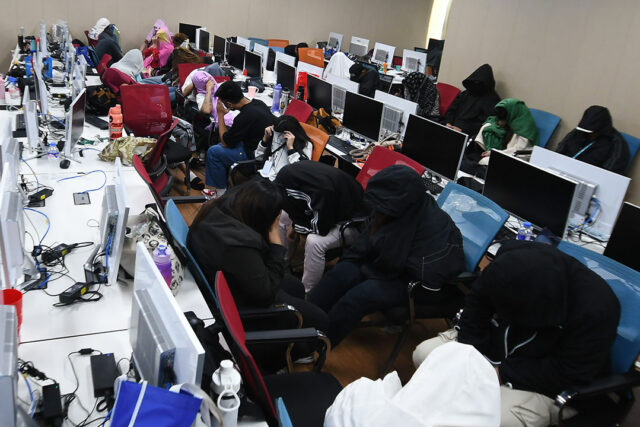
THE PRESIDENTIAL Palace on Wednesday assured China that the government is not harassing Chinese nationals amid the state’s crackdown on Philippine offshore gaming operators (POGOs) after Beijing’s embassy in Manila warned Chinese citizens of “unstable public security” in the country.

“We can assure China that we are not targeting any particular nationality or individual for harassment,” Presidential Communications Office (PCO) Undersecretary Clarissa A. Castro told a Palace briefing.

“Let us remember that everyone is welcome here, except, of course, those who are committing crimes. We will enforce the law accordingly.”

Based on the advisory posted on its website, the embassy said Chinese citizens and businesses experience being frequently interrogated and harassed by Philippine authorities.

“Public security in the Philippines has been unstable, with frequent incidents of law enforcement authorities harassing and inspecting Chinese citizens and enterprises,” it said in the advisory, which was published in Chinese.

The Philippine immigration bureau has said it has arrested over 500 foreign nationals since January who were linked to illegal POGO activities in various operations across Parañaque, Pasay, and Cavite.

Last year, President Ferdinand R. Marcos, Jr. signed an executive order, banning POGOs due to their links to organized crime, such as human trafficking. This is in line with his policy directives during his third State of the Nation Address to shut down POGOs by the end of 2024. — John Victor D. Ordoñez

MAP says LRT-1 fare hike necessary

PHILIPPINE STAR/JOHN RYAN BALDEMOR

THE approval of fare adjustment for Light Rail Transit Line 1 (LRT-1) would help the private operator manage its operations and implement improvements for the rail line, according to the Management Association of the Philippines (MAP).

“The MAP stands for the sanctity of contract and the rule of law,” MAP said in a statement on Wednesday. “The agreed terms of the contract on the fare adjustment must be complied with by the government in order to protect the level of service required of the operator and prevent deterioration of service to the commuters.”

To recall, the Department of Transportation (DoTr) said the fare adjustment is necessary to extend the rail line to Cavite while also allowing the operator to implement the necessary upgrades for LRT-1.

“This rate increase is needed to not only ensure smooth and timely maintenance of LRT-1 but also the extension of the line all the way to Cavite under the present PPP (public-private partnership) contract,” DoTr said in a separate statement.

Starting April 2, the boarding fare at LRT-1 will be raised to P16.25 from P13.29, while the distance per kilometer fare will be increased to P1.47 from P1.21.

Based on the approved fare matrix, the maximum fare for a single-journey end-to-end trip will increase by P10 to P55. This will cover the trip from FPJ Station (formerly Roosevelt) in Quezon City to Baclaran Station in Pasay City, including the last station of the Cavite extension Phase 1.

Meanwhile, stored value card holders will pay P9 more for the end-to-end trip, bringing the fare to P52.

Light Rail Manila Corp. (LRMC), the private operator of LRT-1, has said that the fare adjustment is necessary to maintain the rail system and especially after it has made substantial operational improvements and system upgrades.

Under its concession agreement, the private operator may seek a fare adjustment once every two years.

LRMC is a joint venture of Ayala Corp., Metro Pacific Light Rail Corp. and Macquarie Infrastructure Holdings (Philippines) Pte. Ltd.

Metro Pacific Light Rail is a unit of Metro Pacific Investments Corp., which is one of three Philippine subsidiaries of Hong Kong’s First Pacific Co. Ltd., the others being PLDT Inc. and Philex Mining Corp. Hastings Holdings, Inc., a unit of PLDT Beneficial Trust Fund subsidiary MediaQuest Holdings, Inc., has an interest in BusinessWorld through the Philippine Star Group, which it controls. — Ashley Erika O. Jose

Don’t spread fake news — Romualdez

PHILIPPINE STAR/KRIZ JOHN ROSALES

FILIPINO social media influencers should be more responsible in creating content for their online audience, House of Representatives Speaker Ferdinand Martin G. Romualdez said on Wednesday as he urged them not to spread falsehoods.

He said that some internet content creators have been spreading false information about the country’s crime rates online, which could cause mass panic and threaten the country’s stability.

“Social media is a powerful tool. But when it’s used to manufacture lies and sow panic, it becomes a threat to national stability,” Mr. Romualdez said in a statement. “Freedom of speech does not mean freedom to mislead and deceive.”

“Let us not be spokespeople for lies. While real crime is decreasing, fabricated stories and scripted videos are spreading rapidly online,” he added.

Mr. Romualdez has accused some social media content creators of spreading fabricated crime videos, which he claims distort the true state of the country’s crime situation.

“When people stage crimes just to go viral, they’re not just misleading the public — they’re mocking real victims and sabotaging police work,” he said. — Kenneth Christiane L. Basilio

BI warns vs crypto scam

PHILSTAR FILE PHOTO

THE Bureau of Immigration (BI) warned that a new scam involving cryptocurrency investments is targeting Filipino migrants in the United States after trafficking victims recently repatriated to Myanmar, revealed details of the scheme.

BI Commissioner Joel Anthony M. Viado, in a statement on Wednesday, said the fraud involved scammers luring overseas Filipinos into bogus cryptocurrency investments with promises of high returns and minimal risk.

Victims were often contacted through social media and persuaded to transfer funds into fake trading platforms.

The scammers manipulated account balances to show false profits, convincing victims to invest further before eventually disappearing with the money.

The revelation followed the March 26 repatriation of multiple trafficking victims, including an individual known as “Jon Jon.”

Initially believed to be a victim, he was later identified by fellow repatriates as the recruiter who facilitated the illegal transport of Filipinos to Myanmar, where they were forced into scam operations.

Witnesses claimed that “Jon Jon” played a key role in developing the new fraud model specifically targeting Filipino-Americans.

“We wish to send this warning to our countrymen abroad not to fall prey to this new modus,” said Mr. Viado. “The IACAT (inter-agency council against trafficking) is working to ensure that those who continue to victimize Filipinos face the harshest penalties of the law.” — Chloe Mari A. Hufana

PHL records higher scam calls in Q1

GLOBE.COM.PH

GOGOLOOK, a global TrustTech company has recorded a decline in scam text messages but cautioned the public over the rising number of scam calls in the first quarter.

According to its report, SMS or short message service scams declined to 648,238 in the first quarter of 2025, marking a decrease of 43.2% from the 1.14 million SMS scams recorded in the same period last year.

Majority of the SMS scams logged in the January-to-March period this year were mainly loan availment-related scams making up for the 55% of the SMS scams recorded in the period; followed by VIP rewards; collections related; transaction verification, job application and delivery related scams.

Further, although the company saw a steep decline in SMS scams, it noted that scam calls rose in the first quarter of 2025.

For the three months to March, Whoscall recorded a total of 351,699 scam calls, more than triple the 108,157 scam calls logged in the comparable period in 2024.

The decreasing scam messages and risky links sent via text messages represent a positive step forward against combating scams, the company said, adding that the public should still need to be vigilant and cautious against scams as scammers are becoming more sophisticated by changing their tactics.

“The increase in scam calls clearly demonstrates a shift in scammers’ tactics,”  Gogolook Philippines Country Head Mel Migriño said.

“While the significant decline in scam messages and risky URLs represents a positive step forward, the concurrent rise in scam calls underscores the need for ongoing vigilance and collaborative efforts.”

System software company Gogolook is the developer of Whoscall. The application offers caller identification, distinguishing between safe contacts and potential scammers.

Headquartered in Taiwan, Gogolook utilizes its database and advanced artificial intelligence technology to provide services in communication fraud prevention and financial technology. — Ashley Erika O. Jose

Traders elated over new mall in BARMM’s capital

COTABATO CITY — Traders in Central Mindanao were elated with the formal launching of the multi-billion KCC Mall in Cotabato City on Tuesday.

Cotabato City is the regional capital of the Bangsamoro Autonomous Region in Muslim Mindanao (BARMM), whose territory also encompasses the provinces of Maguindanao del Sur, Maguindanao del Norte, Lanao del Sur, Basilan and Tawi-Tawi and two other southern cities, Lamitan and Marawi.

The lawyer-entrepreneur Ronald Hallid Torres, chairman of the Bangsamoro Business Council (BBC), told reporters on Wednesday that the launching of the KCC Mall augurs well with their efforts of proving to their counterparts in other regions and abroad that it is safe now to put up capital-intensive businesses in Cotabato City.

“The setting up of this very big mall in Cotabato City will create the impression among our friends in the business communities outside of the autonomous region and abroad that it is safe now to put up big businesses in barangays around,”  said Mr. Torres, a resident of Cotabato City and spokesperson of their large organization.

More than 300 guests attended Tuesday’s symbolic launching and blessing by a Catholic priest of the mall.   

“This new KCC Mall in Cotabato City is, for us and our client traders, a very powerful magnet that can attract more outsider traders to come into the Bangsamoro region and put up capital-intensive business ventures,” said Mohammad Omar Pasigan, chairman of the Regional Board of Investments. — John Felix M. Unson

ADVERTISEMENT
ADVERTISEMENT