Home Blog Page 1752

More funding sought for farm soil rehab

PHILSTAR FILE PHOTO

THE Department of Agriculture (DA) said it is seeking more funding to support the rehabilitation of farm soil.

“We really need to step up our organic fertilizer, soil ameliorants, and bio-fertilizer (treatments) in order for us to rehabilitate and rejuvenate our soil,” Agriculture Undersecretary Roger V. Navarro told reporters on Thursday.

He added that the DA’s programs include expanding soil ameliorant tests in crop production areas.

Mr. Navarro said that the DA is looking to test soil additives across 100 hectares of farmland to evaluate their effectiveness in boosting production and rejuvenating deteriorated soil.

He added that the continued use of inorganic fertilizer has degradated soil quality in farmed areas.

“We need to let (farmers) understand that the degradation of soil is through abuse of inorganic fertilizer… if the soil is no longer healthy it cannot absorb any more. (Fertilizer) will just evaporate and leach in the streams and waterways,” he said.

He added that the DA is now pushing for the adoption of organic fertilizer to reduce soil deterioration.

“The problem is our interventions are only good for a number of hectares,” he said.

In a speech delivered by Mr. Navarro, Agriculture Secretary Francisco P. Tiu Laurel, Jr. said that the DA is raising funds for loans and subsidies to support “the adoption of sustainable practices for both smallholder and commercial farmers.”

The DA has said that it is planning to establish composting facilities to reduce the dependence of farmers on inorganic fertilizers.

It said this would also reduce the vulnerability of marginal farmers to the high cost of chemical fertilizers. — Adrian H. Halili

ERC allows collection of P3-B deferred payments to reserve market suppliers 

PHILSTAR FILE PHOTO

THE Energy Regulatory Commission (ERC) said it allowed the collection of the remaining P3.05 billion owed by consumers to power generators that supplied the power reserve market in February and March.

In a statement, the ERC said that it approved the recovery of the 70% recalculated reserve trading amounts which will be collected starting with the January billing period.

Trading participants in the Luzon and Mindanao Wholesale Electricity Spot Market (WESM) stand to recover P0.124 per kilowatt-hour (kWh) over a three-month period.

WESM trading participants in Mindanao will collect P0.033 per kWh over six months.

The reserve market allows the system operator to procure power reserves from the WESM to meet the reserve requirements of the energy system.

In March, the ERC suspended billing and settlement at the reserve market after significant price increases in reserve power for the month, compared to February.

The regulator ordered the settlement of 30% of the amounts in May to allow power generators to partially recover their costs.

The ERC then lifted the suspension in July and allowed the resumption of full operations of trading of reserves in the WESM for contracted and merchant plants.

It, however, ordered the Independent Electricity Market Operator of the Philippines (IEMOP), which operates the WESM, to recalculate the resulting reserve trading amounts for the billing periods of February and March.

The IEMOP was also told to adjust the value for the remaining 70% for the March billing period. The ERC then reviewed the recalculation submitted by the operator.

“As a result, the reserve trading amounts were further recalculated and, after deducting for non-compliance, was reduced by P725 million,” the ERC said.

Lawrence S. Fernandez, vice-president and head of utility economics of Manila Electric Co., said that the power distributor is estimating an increase of around P0.40 per kWh in the transmission charge.

“Considering that total transmission charge right now is around P0.90 per kWh, (the increase) is almost half. Impact is mitigated by spreading recovery over three months,” he said via Viber. — Sheldeen Joy Talavera

PHL, EU agree on green economy, digitalization as joint priorities

REUTERS

THE PHILIPPINES and the European Union (EU) said the green economy, digital transformation, peace, and good governance remain their key areas of cooperation in 2025-2027.

“The Philippines showcased its strategic priorities and commitment to development, highlighting the country’s economic performance and growth outlook,” the Department of Finance (DoF) said in a statement on Thursday.

In turn, the EU discussed updates to its program following the mid-term review of the EU’s Multiannual Financial Framework (MFF) for 2021-2027.

The MFF is the long-term budget plan of the EU spanning at least five years of its own resources.

“Both parties reaffirmed that the green economy, digital transformation, peace, and good governance remain key priority areas for cooperation,” it said.

The DoF said key ongoing cooperation programs were reviewed — the Mindanao peace process, and the development of the green and digital economy.

“Ongoing investment operations on Disaster Risk Reduction and Water/Waste facilities were also reviewed,” it said.

“Possible new investments in the green economy were mentioned as a priority area for prospective loan financing with EU grants (blended finance) and guarantees.”

In addition, the meeting also tackled possible future cooperation in the sustainable use of critical raw materials and green finance. — Aubrey Rose A. Inosante

Rice inventory up 24% in November

PHILIPPINE STAR/KRIZ JOHN ROSALES

THE national rice inventory rose to 2.46 million metric tons (MMT) in November, up 24.4% year on year, according to preliminary data from the Philippine Statistics Authority (PSA).

Rice stocks consisted of 57.6% held by commercial traders, 36.6% by households, and 5.8% by the National Food Authority (NFA).

NFA and commercial warehouses grew their holdings, while household rice stocks fell during the month.

Rice held by commercial establishments in November amounted to 1.42 MMT, up 57.4%.

NFA reserves more than doubled to 141,680 MT from 60,230 MT a year earlier.

Rice held by households declined 11.4% year on year to 901,210 MT.

Month on month, rice stocks rose 7.9% from October.

“Increments were noted from the commercial sector by 17.2% and in the households by 0.3%. Meanwhile, rice stocks held by NFA depositories decreased 17.9%,” it added.

The Department of Agriculture has said it is targeting a year-end national rice inventory of 3.83 MMT, despite the projected drop in rice production. This is equivalent to about 100 days’ demand.

The PSA reported that corn stocks fell 20.6% year on year to 619,160 MT.

Corn held by commercial establishments accounted for 87.3% of the total, while households held the rest.

“Corn stocks recorded annual decreases of 21.3% in the commercial sector and 14.7% in households. — Adrian H. Halili

Spot prices up slightly in November

ELECTRICITY PRICES at the Wholesale Electricity Spot Market (WESM) rose in November as margins narrowed between supply and demand, the Independent Electricity Market Operator of the Philippines (IEMOP) said.

Citing preliminary data, IEMOP said WESM prices system wide rose 0.6% month on month to P4.42 per kilowatt-hour (kWh).

Between Oct. 26 and Nov. 25, available supply fell 2% to 19,492 megawatts (MW). Demand, on the other hand, fell 2.2% to 13,659 MW.

“Although both the system supply and demand decreased this month, its margin remained a factor in the price’s slight increase as the supply margin for the November billing period is lower than October,” according to Arjon B. Valencia, corporate planning and communications manager for IEMOP.

“This is driven by the supply-demand situation in Luzon which has an effect in the system collectively,” he added.

On Luzon, spot prices increased 8.9% month on month to P4.24 per kWh.

The grid’s supply dropped 2.4% month on month to 13,645 MW. Demand likewise decreased 2.5% to 9,663 MW.

WESM prices in the Visayas fell 18.6% month on month to P4.82 per kWh.

Available supply dipped 4.6% month on month to 2,394 MW. Demand fell 1.6% to 1,971 MW.

Spot prices in Mindanao during the period averaged P4.85 per kWh, down 6.6% from a month earlier.

Power supply increased 1.3% month on month to 3,453 MW while demand declined 1.2% to 2,030 MW.

IEMOP operates the WESM, where energy companies can buy power when their long-term contracted power supply is insufficient for customer needs. — Sheldeen Joy Talavera

Manila to file protest vs Beijing over latest water cannon incident

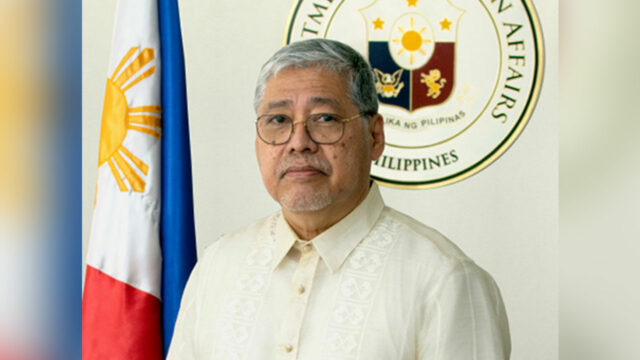
ENRIQUE A. MANALO — DFA.GOV.PH

THE PHILIPPINES will file a diplomatic protest against China over the latest incident in the South China Sea that involved a Chinese Coast Guard vessel firing water cannons at a Philippine boat around Scarborough Shoal, according to the Philippine Foreign Affairs secretary.

“We will be submitting our protest,” Philippine Foreign Affairs Secretary Enrique A. Manalo told reporters on the sidelines of the exchange of notes for Japan’s pledge of P611-million official security assistance to the Philippines in Pasay City, based on a transcript sent to reporters via WhatsApp.

“Certainly, we don’t understand why China again is repeating these actions which are clearly illegal,” citing Wednesday’s incident in Scarborough Shoal.

The Chinese Embassy in Manila did not immediately reply to a Viber message seeking comment.

In a joint statement on Wednesday, the Philippine Coast Guard and the Bureau of Fisheries and Aquatic Resources said the Chinese Coast Guard vessel fired a cannon at the BRP Datu Pagbuaya, “aiming directly at the vessel’s navigational antennas” while it was located 16 nautical miles south of Scarborough Shoal.

The Philippines under President Ferdinand R. Marcos, Jr. has so far filed 193 diplomatic protests over China’s actions in the South China Sea, 60 of which being filed this year, Philippine Foreign Affairs Spokesperson Ma. Teresita C. Daza told reporters in a WhatsApp message on Thursday.

Chinese Foreign Ministry Spokesperson Lin Jian in a news briefing in Beijing late Wednesday, reiterated China’s claim that Scarborough Shoal was within its territory and that its coast guard did “what was necessary” to protect Chinese maritime rights.

“China calls on the Philippines to stop those infringement activities and provocations at once and not to challenge China’s firm resolve to defend our lawful rights and interests,” he said.

A 2016 arbitral ruling that invalidated China’s expansive claims in the South China Sea said Scarborough Shoal, which Beijing has effectively controlled since 2012, is a traditional fishing ground for Filipino, Chinese, and Vietnamese fishermen.

China and the Philippines have sparred repeatedly this year over disputed areas of the South China Sea, including the Scarborough Shoal, one of Asia’s most contested features.

About $3 trillion worth of trade passes through the South China Sea annually, and it is believed to be rich in oil and natural gas deposits, apart from fish stocks.

Meanwhile, France has expressed concern over Wednesday’s water cannoning incident, citing the need for countries to abide by international law, according to the French Embassy in Manila.

“France renews its call for the respect of the United Nations Convention on the Law of the Sea (UNCLOS) and freedom of navigation,” it said in a statement late Wednesday.

“We oppose any threat or use of force contrary to international law and recall the importance of resolving disputes through dialogue.”

France also reaffirmed the 2016 ruling by the Hague-based Permanent Court of Arbitration’s ruling that voided China’s expansive claim of more than 80% of the waterway.

The European Union (EU) is looking to work with the Philippines on maritime routes awareness, cybersecurity, among other efforts to ensure stability in the Indo-Pacific region, EU External Action Service Managing Director Niclas Kvarnström told a news briefing in Manila on Wednesday.

“Any escalation, here you are talking about the Philippines, which of course has a Mutual Defense treaty… the two largest militaries (China and US) in the world, goes without saying that that’s dangerous to have escalation so we would not like to see that,” he said.

The United States has also condemned China for its “unlawful use of water cannons and dangerous maneuvers” in the South China Sea, its top envoy to Manila said on Wednesday.

China’s actions disrupted Philippine maritime operations and put lives at risk, Ambassador MaryKay Carlson said on social media platform X, adding that the US stands with likeminded allies in support of a free and open Pacific. — John Victor D. Ordoñez

PHL’s military pact with Japan likely to be ratified next week — Escudero

ARMED FORCES OF THE PHILIPPINES

By John Victor D. Ordoñez, Reporter

THE PHILIPPINE Senate is likely to approve and ratify Manila’s Reciprocal Access Agreement (RAA) with Tokyo next week even as lawmakers try to reconcile their respective budget versions, according to the Senate president.

At news briefing on Thursday, Senate President Francis “Chiz” G. Escudero said the Senate can do away with the three-day rule in approving measures since the pact is a treaty.

“The RAA has been sponsored (before the floor) by Senator Maria Imelda R. Marcos and we are expecting to approve it on second reading next week… and if we really need to, we can approve it on final reading on the same day or the next day,” he said in Filipino.

“This is a treaty ratification, and you can argue that you do not treat this as passing a law, but so that there won’t be any issues, we usually treat these like how we pass bills.”

The Senate president his colleagues cannot propose amendments to treaties.

Congress is in the middle of harmonizing their versions of the P6.352-trillion national budget for 2025, in time for their self-imposed Dec. 9 target. Senate Finance Committee Chairperson Mary Grace Natividad S. Poe-Llamanzares earlier said lawmakers aim to submit the budget to the Palace by Dec. 19 for the President’s signature.

The Senate’s final version of the national budget restored a previously slashed P10-billion funding from the P50-billion allocation for the Revised Armed Forces of the Philippines Modernization Plan in 2025. The Department of National Defense will also get a P266.28-billion budget amid the continuing tensions in the South China Sea.

Both countries signed the deal in July to ease the entry of military equipment and troops for combat training from Japan. Mr. Escudero earlier said the Senate aims to ratify the RAA before the year ends.

The agreement is the first of its kind to be signed by Japan in Asia and coincides with increased Chinese assertiveness in the South China Sea, where Beijing’s expansive claims conflict with those of several Southeast Asian nations.

A United Nations-backed tribunal based in the Hague in 2016 voided China’s expansive claims in the sea for being illegal. Beijing has ignored the ruling.

The Philippines has a visiting forces agreement with the US and Australia. Tokyo, which hosts the biggest concentration of US forces abroad, has a similar deal with Australia and Britain, and is negotiating another with France.

Japanese Foreign Minister Yoko Kamikawa has said her country’s partnership with Manila is not targeted against any country but aims to boost efforts towards peace and stability in the region.

P611-M SECURITY ASSISTANCE
Meanwhile, Manila and Tokyo on Thursday finalized Tokyo’s official security assistance (OSA) worth about P611 million in radar systems, inflatable boats and other maritime equipment to boost Manila’s capacity to patrol its waters, according to the Japanese Embassy in Manila.

In a statement, the embassy said Japanese Ambassador to the Philippines Endo Kazuya and Philippine Foreign Affairs Secretary Enrique A. Manalo on Thursday signed and exchanged diplomatic notes on the security assistance, which comes amid rising tensions with China in the South China Sea.

“It will support the Department of National Defense, and Armed Forces of the Philippines (AFP) efforts in securing the Philippines and improving the country’s capabilities to deter threats to peace, stability and security in the Indo-Pacific region,” the Philippine Department of Foreign Affairs (DFA) said in a statement.

In separate statement, the Embassy of Japan in the Philippines said the Philippine Air Force would receive an Air Surveillance Radar System to improve the surveillance capabilities of the Philippines.

The aid is in the form of OSA, which provides equipment and supplies to the armed forces of the recipient country, according to the embassy.

“OSA aims to strengthen our security cooperation with the recipient countries, to create a desirable security environment for Japan, and to contribute to maintaining and strengthening international peace and security,” it said.

Japan, which last year announced its biggest military build-up since World War II in a step away from its post-war pacifism, does not have any claims to the South China Sea, but has a separate maritime dispute with China in the East China Sea, where they have repeatedly faced off.

It has supported the Philippines’ position in the South China Sea and has expressed serious concern over China’s actions.

“The assistance reflects the two countries’ shared commitment to maritime stability and regional peace,” the DFA said.

Cordillera, Mimaropa regional boards grant wage hikes by yearend

PHILIPPINE STAR/KRIZ JOHN ROSALES

By Chloe Mari A. Hufana, Reporter

THE Cordillera Administrative Region (CAR) and Region IV-B  or Mimaropa approved daily minimum wage increases of P40 and P35, respectively, on Dec. 5.

CAR’s Regional Tripartite Wages and Productivity Board (RTWPB) issued Wage Order No. CAR-23, granting a P40 hike for workers across all sectors. This brings their entry-level pay to P470 from P430.

It also approved a P1,100 monthly increase for domestic workers in the region through Wage Order No. CAR-DW-06, bringing their minimum monthly compensation to P6,000 from P4,900.

It issued Wage Order No. CAR-23 on Nov. 13, but the National Wages and Productivity Commission (NWPC) only affirmed the hike on Thursday.

Both wage orders will be published on Dec. 8, 2024, and will take effect 15 days after publication, or on Dec. 24, 2024.

Meanwhile, Mimaropa (Mindoro, Marinduque, Romblon and Palawan) also granted a minimum wage increase of P35 for all sectors through Wage Order No. RB-MIMAROPA-12 last Nov. 27. The NWPC affirmed the order only on Dec. 5.

This brings the entry-level wages of firms with ten workers and above to P430 from P395. While those in establishments with less than ten workers will now receive P404 as the daily minimum pay from P369.

MIMAROPA’s RTWPB also issued Wage Order No. RB-MIMAROPA-DW-05, granting an additional P1,000 for the monthly entry-level pay of domestic workers. This brings their pay to P6,500 from P5,500.

Both wage orders for Region IV-B will be published on Dec. 7, 2024, and will take effect 15 days after publication or on Dec. 23, 2024.

“In affirming the wage orders, the NWPC found that both regions complied with the criteria for determining wage increases under Republic Act Nos. 6727 and 10361, which include the needs of workers and their families, capacity of employers/industry to pay, and the requirements of economic and social development in the region,” the Department of Labor and Employment (DoLE) said in a statement.

Jointly, the wage orders are expected to directly benefit 74,961 minimum wage earners.

Over 252,000 full-time wage and salary workers earning above the entry-level pay may also indirectly benefit due to wage distortion.

DoLE said 40,116 domestic workers will also benefit from the increases, with 10,002 of them on live-in arrangements.

“To further support wage growth, the RTWPBs were likewise ordered to implement productivity improvement programs and gainsharing schemes, especially in areas that may have low productivity,” it added.

It reminded that under the NWPC Omnibus Rules on Minimum Wage Determination, firms regularly employing not more than ten workers and firms affected by natural calamities and/or human-induced disasters may appeal to the RTWPB for an exemption of the wage hike.

Registered Barangay Micro Business Enterprises are not covered by the hike under Republic Act No. 9178.

Twelve regions have already issued wage orders (Regions NCR, CAR, I, II, III, IVA, MIMAROPA, VI, VII, VIII, IX and XII).

While six wage orders (Regions CAR, I, II, MIMAROPA, VI and VIII) have been issued for domestic workers.

Regions X (Northern Mindanao) and XIII (Caraga) are in the final stages of the minimum wage determination process after completing their November and December 2024 public hearings.

While Region XI (Davao Region) is scheduled to start in January 2025. Region V (Bicol Region) is still assessing its conditions and recovery after the devastating effects of typhoons on communities and businesses.

“The wage increases of P40 in CAR and P35 in MIMAROPA are welcome developments, as it will help ease some of the daily burdens faced by workers,” Federation of Free Workers (FFW) President Jose Sonny G. Matula told BusinessWorld in a Viber message.

He noted the hikes still fall short of the P150 wage recovery bill the group is advocating.

“The increases given by the two RTWPBs represent only 26.7% (P40/P150) and 23.3% (P35/P150) of the proposed legislative amount, highlighting the need for more substantial measures to address workers’ economic struggles,” he said.

“Even with this increase, the salary in CAR is 72.9% and in MIMAROPA only 66.7% compared to the P645 minimum wage in the National Capital Region. Discrimination against workers in the province has not yet been resolved,” he added in Filipino, noting gasoline and canned food are more expensive in provinces due to transport costs.

The labor group leader said electricity rates in Palawan are higher than the residential electricity rates in Manila.


Philippines’ middle-income goals achievable — CPBRD

PHILIPPINE STAR/WALTER BOLLOZOS

THE PHILIPPINE government’s goal of becoming an upper-middle income country and having a predominantly middle-class society in the following years remains achievable, a congressional think-tank, noting this will require the government to improve fiscal consolidation efforts while upskilling Filipino workers to prevent economic backsliding.

“Scanning present socio-economic variables indicates that, although the country is not far from attaining these goals — especially becoming an upper middle-income economy — current headwinds could easily derail progress,” the Congressional Policy and Budget Research Department (CPBRD) stated in a December report by Elsie C. Gutierrez.

President Ferdinand R. Marcos, Jr.’s government has set its eyes on the Philippines becoming an upper-middle country by 2025, gearing towards a predominantly middle-class society by 2040.

An upper middle-income status means having an income per capita range of $4,466 and $13,845, while becoming a middle-class society requires the creation of better-quality jobs, controlled inflation levels, and stimulated economic growth.

Supporting sustained economic growth requires the government to achieve manageable debt levels while improving tax revenue collections, CPBRD said. Improving the country’s fiscal space would allow more funding for “productive and high-impact projects.”

Reforms to the country’s tax structure have been a priority for the Marcos administration amid a tight fiscal space due to borrowings made at the height of the coronavirus pandemic.

The country’s outstanding debt inched up to a fresh high of P16.02 trillion in end-October due to peso depreciation against the US dollar, with it expected to hit P16.06 trillion by yearend. The debt-to-GDP (gross domestic product) stood at 61.3%, above the 60% threshold by multilateral lenders.

The government aims to lower the debt-to-GDP ratio to 60.6% by the end of 2024.

Allowing the private sector to participate in more infrastructure projects should also be considered to reduce the country’s reliance on bilateral and multilateral loans, helping cut the national debt stock, the think-tank added.

“Instead of pursuing the passage of measures that would impose additional taxes on the people or resorting to borrowing to augment its resources, [the] government could perhaps focus on improving its tax collection efforts and maximizing the utilization of its budget,” it said.

The Department of Finance in August said the Bureau of Internal Revenue’s end-July collection stood at P1.68 trillion, missing its P1.83-trillion target by 8.2%.

The bureau reported in October that it expects to collect P332.17 billion during the month, P254.56 billion in November, and P210.89 billion in December. The agency has set a P3.05-trillion total collection goal during the year.

The government should also look at facilitating investments into vital agricultural infrastructures, such as irrigation, roads and innovative food technologies, to help mitigate inflationary risks, which the think-tank attributed to the price instability of rice products.

“The current high inflation that Filipinos are facing today stems from the current rice shortages,” it said. “Managing inflation would therefore necessitate the aggressive use of non-monetary measures that would address structural problems in the agriculture sector.”

Inflation rate accelerated by to 2.5% in November, faster than the 2.3% in October, according to the Philippine Statistics Authority, with rice inflation slowing to 5.1% from 9.6% during the same period.

Government policies should also focus on improving the country’s health and education systems and building a “well-functioning” labor market for the Philippines to reap the benefits of human capital investments, the CPBRD said.

Efforts must also center on boosting national productivity by supporting the industrialization efforts of local manufacturers, it added.

“Apart from developing human capital, productivity, especially within MSMEs (micro, small, medium enterprises), may be enhanced through the provision of appropriate machinery, equipment, tools, as well as skills and knowledge,” the report stated. — Kenneth Christiane L. Basilio

More impeachment raps vs VP eyed

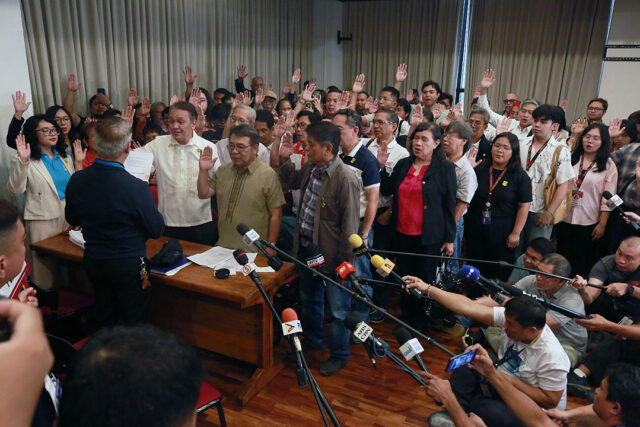
At least 75 representatives from various organizations and progressive groups take oath during notarization of the second impeachment complaint against Vice President Sara Duterte before filing at the House of Representatives in Quezon City on Wednesday. — PHILIPPINE STAR/MIGUEL DE GUZMAN

MORE IMPEACHMENT complaints are being considered against Philippine Vice-President (VP) Sara Z. Duterte-Carpio at the House of Representatives, its head official said on Thursday, citing that some lawmakers have floated the possibility of filing more ouster charges against her.

“Some congressmen have spoken to me, saying they are considering filing or endorsing [an impeachment complaint],” House Secretary-General Reginald S. Velasco told reporters in a phone call.

“We were just informed to remain on standby. That they might file another complaint,” he added.

Ms. Duterte faces two impeachment complaints filed this week by civil society groups, alleging graft, corruption, bribery, and betrayal of public trust, among other charges. Critics of Ms. Duterte said her failure to account for public fund spending has paved the way for moves seeking her removal from office.

Mr. Velasco said they would wait until next week for the anticipated filing of more impeachment raps against Ms. Duterte before transmitting it to the office of House Speaker Ferdinand Martin G. Romualdez.

Meanwhile, a bloc of minority House lawmakers started efforts to gather support from fellow congressmen for their impeachment complaint against Ms. Duterte.

“We, the Makabayan bloc in Congress, have initiated efforts to gather the required one-third of signatures from House members to sign the Resolution of Impeachment against Vice-President Sara Duterte,” a joint statement by the House minority faction stated.

Also on Thursday, Deputy Majority Leader and La Union Rep. Francisco Paolo P. Ortega V said the majority caucus is yet to discuss the filed impeachment complaints as most congressmen are focused on lawmaking and ongoing congressional investigations.

“There have been no moves from the majority yet, and nothing has been discussed by the majority,” he said in a media briefing on Thursday. — Kenneth Christiane L. Basilio

EO forms Marawi rehab office

MARAWI TENT CITY — UNHCR.ORG

PRESIDENT Ferdinand R. Marcos, Jr. on Thursday created an office to speed up the rehabilitation of Marawi City and boost its economic development.

The Office of the Presidential Adviser for Marawi Rehabilitation and Development will integrate, coordinate, and accelerate the implementation of all government projects “related to the rehabilitation, development, and restoration of peace and order in Marawi City and other affected localities,” Executive Order (EO) No. 78 read.

The body will be headed by the Presidential Adviser for Marawi Rehabilitation under the control and supervision of the Office of the Special Assistant to the President.

The new office’s functions include advising the President on all matters regarding rehabilitation, development, and restoration of peace in Marawi City.

It will oversee and harmonize all strategies and projects — at the local and national levels — related to Marawi City rehabilitation and development.

The office is mandated to submit status reports twice a year to the President through the Office of the Executive Secretary and the Special Assistant to the President.

The office was created almost a year after the termination of the operations of Task Force Bangon Marawi in December last year, amid the completion of several projects under the Bangon Marawi Comprehensive Rehabilitation and Recovery Program.

Marawi City was pulverized in 2017 due to a five-month-long battle between state forces and an Islamic State-inspired group.

Tirmizy E. Abdullah, convener of the Marawi Advocacy Accompaniment, said last year that about 80,000 people or 16,000 families have yet to return to their homes in the destructed city. — Kyle Aristophere T. Atienza

CoA flags DAR land distribution to ineligible beneficiaries

KIRIL DOBREV-UNSPLASH

THE Commission on Audit (CoA) has flagged the Department of Agrarian Reform (DAR) for distributing lands to ineligible individuals under a landmark land distribution law due to the lack of a monitoring system, leaving hundreds of redistributed farmlands idle or abandoned.

In a December report, state auditors said that DAR gave 235 unqualified individuals with ownership of farmlands nationwide, with 117 beneficiaries receiving lots spanning over three hectares, both contrary to the 1998 Comprehensive Agrarian Reform Program (CARP).

DAR did not immediately respond to an e-mail seeking comment.

“The lack of effective monitoring system by the DARPOs (Department of Agrarian Reform Provincial Office) on the performance of each ARB (Agrarian Reform Beneficiary) has led to the unproductive or untilled lands awarded to the beneficiaries,” a part of the CoA report stated.

“To wit: 235 ARBs recipients of the Certificate of Land Ownership Award (CLOA) in 18 provinces did not meet the eligibility requirement… [while] 117 ARBs in 16 provinces received land in excess of the established three-hectare limit or a total of 72.50 hectares,” it added.

Signed into law during the administration of late former President Maria Corazon S. Cojuangco-Aquino, CARP paved the way for the state to redistribute agricultural lands to landless farmers.

Agricultural land set for distribution could also be granted to farmworkers, tillers and cooperatives, according to the land law.

“A basic qualification of a beneficiary shall be his willingness, aptitude, and ability to cultivate and make the land as productive as possible,” Sec 7. of the 26-year-old law stated.

“The DAR shall adopt a system of monitoring the record or performance of each beneficiary, so that any beneficiary guilty of negligence or misuse of the land or any support extended to him shall forfeit his right to continue as such beneficiary,” it added.

CoA observed that the 235 unfit beneficiaries were not residents of the barangays or municipalities of the distributed lands; neither were they willing to make the farm lots agriculturally productive.

This led to some of the lands being sold for non-agricultural purposes, resulting in the construction of houses or buildings.

“The inaction or failure to resolve said issues by the DARPOs defeated the purpose for which the CARP was implemented,” CoA stated. — Kenneth Christiane L. Basilio