Home Blog Page 1620

Comic book takes battle for the West Philippine Sea to children

THE Philippines launched a comic book on Friday in its fight against what it called distorted narratives about maritime rights in the West Philippine Sea, a disputed area in the South China Sea, a move which drew criticism from China.

The 40-page comic book titled The Stories of Teacher Jun follows Teacher Jun and his students as they learn about maritime zones, international laws, and the need to safeguard Philippine marine resources.

National Security Adviser Eduardo Año said the comic book complemented government efforts to expose China’s “aggression” in the South China Sea, serving as a tool to educate Filipinos about complex maritime issues and their sovereign rights under international law.

Philippine Coast Guard Chief Ronnie Gavan said he hoped the book would inspire young Filipinos “to protect what is rightfully ours.”

The Chinese Embassy in Manila criticized the initiative, describing it as “political manipulation.”

One of the six chapters of the comic book highlighted the significance of the landmark 2016 ruling by the Permanent Court of Arbitration in favor of the Philippines which invalidated China’s sweeping claim of sovereignty over most of the South China Sea.

China rejects the ruling and has doubled down on its efforts to assert its sovereignty claim with an armada of coast guard and fishing militia, hundreds of kilometers off its mainland.

“Chinese officials, along with state-sponsored media and individuals, continue to spread distorted and twisted narratives to malign our efforts and justify their unilateral claims,” Mr. Año said. — Reuters

Family Matters: Supreme Court’s new rule on family mediation

FREEPIK

The family is the most fundamental social institution and the foundation of the nation. The Constitution mandates that the State shall strengthen its solidarity and actively promote its total development. To uphold this mandate, the Family Code requires that earnest efforts to reach a compromise be made before a lawsuit between family members can proceed. This is known as the “Earnest Effort Rule.” The wisdom behind this provision is to maintain the sacred ties of the family and avoid the breeding of hate and bitterness that arise in litigations among its members.

This notwithstanding, members of the family are not precluded from initiating suits among themselves. A suit may be commenced when they fail to reach an amicable settlement. Hence, the need for family mediation continues to emerge.

To address this, the Supreme Court En Banc approved the Rule on Family Mediation in its resolution dated Nov. 4, 2024, in A.M. No. 24-02-06-SC. The Rule aims to increase the effectiveness of family courts, unclog court dockets, and promote the best interests of the child by introducing innovations in dealing with family cases.

The Rule shall apply to suits between husband and wife, between parents and children, among other ascendants and descendants, among brothers and sisters, whether of full or half-blood, and among relatives within the fourth degree of consanguinity or affinity. Unlike the Earnest Effort Rule which limited its application to members of the family, the Rule on Family Mediation expanded its application to cover parties in a common-law, dating, or sexual relationship, whether former or current.

Among the cases where the Rule shall apply are those involving child support and custody, guardianship, settlement of intestate estates, and other civil cases where mediation is allowed by law. In these cases, courts are enjoined to refer the parties to undergo a mandatory 30-day family mediation. Family mediation is a process in which a family mediator, functioning as an impartial third party, facilitates the resolution of family disputes and supports the parties’ voluntary agreements. If a settlement is reached in the process, the parties shall execute a compromise agreement to be submitted to the court for approval. If no settlement is reached, the court may refer the case for Judicial Dispute Resolution if convinced that settlement is still possible.

To bolster its effectiveness, the Rule mentions the effects of refusal of the parties to undergo family mediation. If both the plaintiff/petitioner and counsel fail to appear at the mediation, despite notice and without justifiable reason, the case shall be dismissed. If it is the defendant/respondent and counsel who fail to appear, the plaintiff/petitioner shall be allowed to present evidence ex parte.

As pointed out by the Family Code Commission, there is nothing sadder and more tragic than litigation between members of the same family. The family is supposed to be a refuge, a space for support, understanding, and unconditional love. For these reasons, the State continues to adopt measures to protect its sanctity. With the promulgation of the Rule on Family Mediation, members of the family are provided with an out-of-court process of resolving family disputes, decreasing the emotional costs brought by litigation.

The views and opinions expressed in this article are those of the author. This article is for general informational and educational purposes only and not offered as and does not constitute legal advice or legal opinion.


Raya B. Villacorta is an associate of the Litigation and Dispute Resolution Department of the Angara Abello Concepcion Regala & Cruz Law Offices (ACCRALAW).

(632) 8830-8000

rbvillacorta@accralaw.com

Central bank sets application guidelines for OPS’ merchant acquisition licenses

THE BANGKO SENTRAL ng Pilipinas (BSP) has released guidelines for operators of payment systems’ (OPS) application for merchant acquisition licenses (MAL).

All OPS engaged in or intending to engage in merchant acquisition activities are required to obtain authority to do so from the BSP in line with Republic Act No. 11127 or the National Payment Systems Act and BSP Circular No. 1198 released in July last year, which implements the regulatory framework for merchant payment acceptance activities.

Meanwhile, banks and electronic money issuers-nonbank financial institutions that intend to engage in merchant acquisition as part of their normal or allowed business operations need not apply for a separate license.

Under the guidelines outlined in BSP Memorandum No. M-2025-002 dated Jan. 14, all MAL applications and related communications should be done via e-mail with the BSP Payments Supervision and Licensing Department (PSLD).

The guidelines include the prescribed formats for MAL application submissions of OPS, including the related documentary requirements.

The application period has three phases, starting from the determination of the applicant’s eligibility for a MAL, and then the evaluation of the license application, and lastly, the license issuance.

Among the minimum documentary requirements for MAL applications are a business plan, which should include: an overview of the company, including its business model and operational network; profile of the firm’s target markets or clients; proposed products or services and details on the systems supporting these, as well as transaction or process flows; pricing mechanisms and fees; and implementation plans, among others. 

Companies should also provide proof of financial capacity, the BSP said. If the average monthly value of collected funds transferred to merchants in the applicable period is less than P100 million, the minimum required capital is at P5 million. For funds worth P100 million and above, firms must put up at least P10 million in capital.

For the evaluation phase, the BSP said firms must submit documents on their compliance with fitness and propriety requirements; risk management policies and procedures covering critical areas like information technology and security, business continuity and operational risk management; and merchant management and protection policies and procedures, including redress mechanisms.

“To arrive at an informed decision, the PSLD may have several requests for information and/or documents/clarifications aside from the abovementioned requirements depending on the completeness and clarity of the responses submitted by the applicant,” the BSP said. “It may also conduct onsite verification of the documents and/or representations submitted.”

“The applicant shall report to PSLD if there are material changes on the information provided during the application process (e.g., organizational restructuring, substantial changes in key management personnel, material variations in the business model/activities),” it added.

Once the MAL is approved, an OPS must pay a licensing fee ranging from P25,000 to P60,000  and submit proof of payment to the BSP. — L.M.J.C. Jocson

Hotel101 says app surpasses 1 million users

HOTEL101 Global Pte. Ltd., a subsidiary of property developer DoubleDragon Corp. (DD), announced that its app has exceeded one million registered users, as the company looks to grow its customer base with upcoming overseas projects.

DD Chairman Edgar “Injap” J. Sia II said in a regulatory filing on Tuesday that the goal is for the Hotel101 Global App to have more than one million registered users in every country where the hotel company has a presence.

He added that the app will benefit from the upcoming completion of the 680-unit Hotel101-Madrid in Spain by 2026.

“We would start to build up HBNB App users towards another one million from the citizens of Spain, to be followed by another million users from Japan in 2026, then the US,” Mr. Sia said.

Hotel101 previously stated that the 482-unit Hotel101-Niseko in Hokkaido, Japan, is set for completion by 2026, while the land for the 622-unit Hotel101-Los Angeles in California, United States, was secured in November 2023.

The three overseas projects are expected to generate $471 million (P27.2 billion) in foreign currency revenues for DD.

Hotel101 Global Chief Executive Officer Hannah Yulo-Luccini said the HBNB App provides a seamless hotel experience for customers through its self-check-in capabilities.

“The HBNB App is expected to become the most efficient and easiest-to-use hotel app globally. The Hotel101 Global hotel chain seeks to delight its customers by providing them with a completely predictable and consistent one-room concept anywhere it locates around the world,” she said.

Over the medium term, Hotel101 seeks to have 25 million registered app users across 25 countries.

The company aims to have 100 million registered app users from 100 countries as part of its long-term plan.

“Eventually, we target a million each from the citizens of the United Kingdom, United Arab Emirates, India, China, Thailand, Malaysia, Vietnam, Indonesia, Singapore, Cambodia, Bangladesh, Mexico, South Korea, Australia, Canada, Switzerland, Turkey, Italy, Germany, France, and Saudi Arabia,” Mr. Sia said.

Hotel101 aims to have one million operating hotel rooms across the world by 2050, of which 50,000 will be in the Philippines.

DD shares fell by 0.6% or six centavos to P9.92 per share on Tuesday. — Revin Mikhael D. Ochave

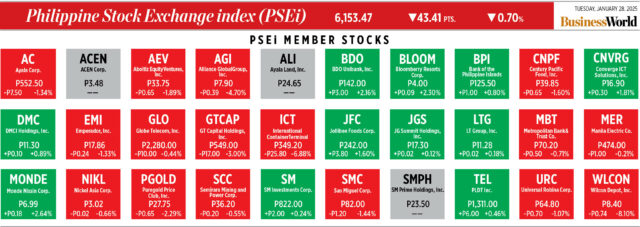
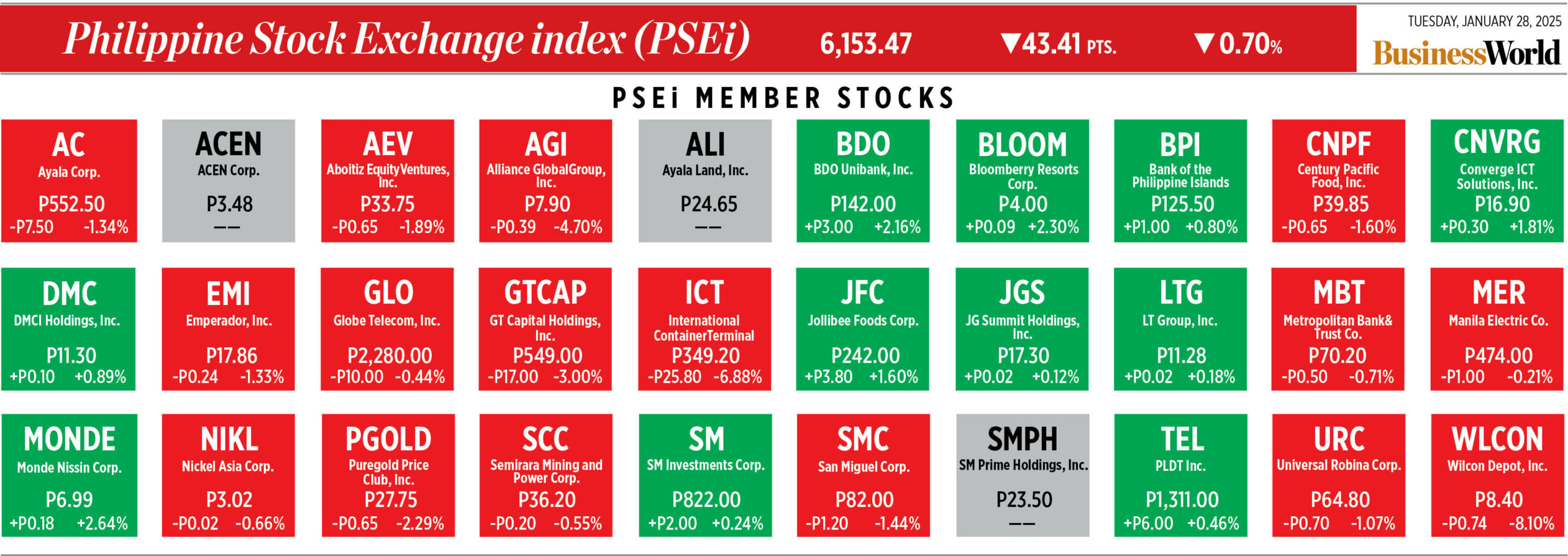
How PSEi member stocks performed — January 28, 2025

Here’s a quick glance at how PSEi stocks fared on Tuesday, January 28, 2025.


Performance of Philippine Agriculture Q4 and Full-Year 2024

THE PHILIPPINES’ agricultural output contracted by a record 2.2% in 2024, as farm production continued to decline in the fourth quarter. Read the full story.

Performance of Philippine Agriculture Q4 and Full-Year 2024

Peso flat before Fed meeting

BW FILE PHOTO

THE PESO was up against the dollar on Tuesday as the US Federal Reserve was set to begin its two-day policy meeting overnight.

The local unit closed at P58.425 per dollar on Tuesday, strengthening by a centavo from its P58.435 finish on Monday, Bankers Association of the Philippines data showed.

The peso opened Tuesday’s session weaker at P58.48 against the dollar. It climbed to as high as P58.40, while its worst showing was at P58.56 versus the greenback.

Dollars traded increased to $1.66 billion on Tuesday from $1.53 billion on Monday.

The peso inched lower as the dollar was stronger on Tuesday with the Fed scheduled to start its two-day review later in the day, Rizal Commercial Banking Corp. Chief Economist Michael L. Ricafort said in a Viber message.

The dollar was initially weaker but rallied as focus turned to the Fed meeting, a trader likewise said in a phone interview.

For Thursday, the trader expects the peso to move between P58.20 and P58.70 per dollar, while Mr. Ricafort said it could range from P58.35 to P58.55.

Philippine financial markets are closed on Jan. 29 (Wednesday) for the Lunar New Year holiday.

The dollar firmed against the yen and euro on Tuesday on new US tariff threats, giving traders little time to catch their breath after Monday’s big risk-off moves on concerns that US dominance in artificial intelligence (AI) technology may be wavering, Reuters reported.

Any market relief that US President Donald J. Trump stopped short of hiking tariffs on US trading partners immediately after taking office last week has quickly faded.

Mr. Trump said he planned to impose tariffs on imported computer chips, pharmaceuticals and steel in an effort to get the producers to make them in the United States.

That verbal salvo came a day after the US and Colombia pulled back from the brink of a trade war when the White House said the South American nation had agreed to accept military aircraft carrying deported migrants.

Mr. Trump has flagged possible 25% duties on imports from Canada and Mexico on Feb. 1, and has threatened to hit the European Union and China with tariffs as well.

The dollar index, which measures the US currency against six rivals, rose 0.08% to 107.89, after dropping to its lowest level since mid-December at 107.68 the previous day.

The focus on tariffs had traders reversing some of the large risk-off moves made on Monday as Chinese startup DeepSeek’s free open-source AI model raised questions about the sky-high valuation and dominance of US AI bellwethers like Nvidia.

The yen slid back within its recent trading range against the greenback, after safe-haven bids sent the Japanese currency to its highest level since mid-December at 153.715 on Monday.

Against the yen, the dollar traded up 0.84% at 155.79 yen.

The Federal Reserve’s two-day meeting begins on Tuesday where it is expected to keep interest rates steady. Investors will look for any hints on whether a rate cut could happen soon if inflation eases closer to the US central bank’s 2% annual target.

For the Fed, the focus will be on Mr. Trump’s early moves on broader policy that are likely to shape the economy this year.

Fed officials have already nodded to potential effects from Mr. Trump’s trade, immigration and other policies, with staff at the December meeting penciling in assumptions for slightly slower growth, higher unemployment and little further progress on inflation for the coming year. — Aaron Michael C. Sy with Reuters

PSEi slumps to worst close since November 2023

BW FILE PHOTO

THE Philippine Stock Exchange index (PSEi) closed at its lowest level since November 2023 on Tuesday as investors preferred to stay on the sidelines before the US Federal Reserve’s policy decision and the release of Philippine gross domestic product (GDP) data.

The PSEi slumped by 0.70% or 43.41 points to end at 6,153.47 on Tuesday, while the broader all shares index declined by 0.44% or 16.33 points to end at 3,623.52.

Tuesday’s close was the PSEi’s worst in over 14 months or since it finished at 6,110.88 on Nov. 14, 2023. The main index is nearing bear territory as it is now down by 19% from its latest intraday high of 7,604.61 recorded on Oct. 7, 2024.

Philippine financial markets are closed on Jan. 29 (Wednesday) for Lunar New Year.

“The local market gave up more ground as investors maintained a cautious stance while waiting for catalysts. Investors are still looking forward to the Philippines’ 2024 GDP data as well as the Federal Reserve’s policy meeting,” Philstocks Financial, Inc. Senior Research Analyst Japhet Louis O. Tantiangco said in a Viber message.

The Fed was set to begin its two-day review overnight, while the Philippine Statistics Authority will release fourth quarter and full-year 2024 GDP data on Jan. 30.

“We’re still seeing a sell-off in big caps ahead of the index recomposition on Friday, where we expect a down weight across the board for existing index issues to make room for the entry of AREIT, Inc. and China Banking Corp. (Chinabank),” AP Securities, Inc. Research Head Alfred Benjamin R. Garcia said in a Viber message. “A lot of investors are also on the sidelines ahead of the Federal Reserve meeting and GDP reports from the Philippines and the US on Thursday.”

Effective Feb. 3, the 30-member PSEi will include AREIT and Chinabank to replace Nickel Asia Corp. and Wilcon Depot, Inc., which will now be part of the PSE MidCap index.

Majority of sectoral indices closed lower on Tuesday. Services retreated by 3.66% or 74.30 points to 1,955.38; mining and oil declined by 0.94% or 72.51 points to 7,614.48; holding firms went down by 0.56% or 29.62 points to 5,205.4; and property dropped by 0.15% or 3.5 points to 2,274.26.

Meanwhile, financials rose by 1.55% or 33.26 points to 2,173.45 and industrials climbed by 0.12% or 11.06 points to 8,690.60.

“Monde Nissin Corp. was the top index gainer, climbing 2.64% to P6.99. Outgoing index member Wilcon Depot, Inc. was at the bottom, plunging 8.10% to P8.40,” Mr. Tantiangco said.

Value turnover rose to P5.64 billion on Tuesday with 1.53 billion issues changing hands from the P5.44 billion with 1.14 billion shares traded on Monday.

Decliners outnumbered advancers, 112 versus 66, while 61 names were unchanged.

Net foreign buying stood at P199.32 million on Tuesday, a turnaround from the P322.39 million in net selling recorded on Monday. — Revin Mikhael D. Ochave

Slight infra delays expected as poll spending ban looms

Workers are seen mixing cement at a construction site in Quezon City, May 19, 2020. — PHILIPPINE STAR/ MICHAEL VARCAS

By Beatriz Marie D. Cruz, Reporter

SOME public works projects are expected to experience minor delays due to the spending ban leading up to the midterm elections in May, government contractors said.

“The progress of government construction projects is hinged on funding from the government. Hence, we expect slight delays in the completion of these ongoing projects,” Jason C. Valderrama, founder and president of construction consultancy JCV & Associates, said via Viber.

“There will also be a temporary dip in revenue of government-focused contractors in April and May,” Mr. Valderrama noted.

Ahead of the May 12 elections, the Commission on Elections (Comelec) will impose a ban on public works spending starting March 28, which will run for 45 days. 

The Comelec has exempted from the ban 48 public infrastructure projects being pursued as public-private partnerships.

The case is different for projects that are wholly government-funded, Mr. Valderrama said, adding: “The temporary cessation of disbursement during the election ban will certainly affect their cash flow.”

EEI Corp. Senior Vice-President Earl Jason R. Vistro said the impact of the election spending ban varies by market segment.

“We normally see poll spending bans to impose delays on local-level government projects that have not yet started, which would consequently affect construction activity and revenue for contractors primarily engaged in such type of projects,” Mr. Vistro said in an e-mail.

Mr. Vistro also noted that such projects that have not yet started may be affected in jurisdictions that experience a change in leadership and priorities.

“New projects in both the private and public works sector may also experience some potential delays with permits and processing when there is a change of administration at the local level,” he also said. 

Major infrastructure projects under the Philippine Development Plan, such as the Metro Manila Subway or North-South Commuter Railway, will likely be unaffected, added Mr. Vistro, who is also EEI’s head of government relations, external affairs, safety and security.

Eduardo A. Sahagun, PHINMA Corp. director and executive vice-president for construction materials, said the spending ban will likely pose minimal effects on government projects if contracts were entered into early.

“Normally, the Public Works (department) will award the contracts before the construction ban,” he said via telephone, allowing much of the critical work to have been carried out by the time the ban sets in.

Budget Undersecretary Goddes Hope O. Libiran has said that about 12,900 projects worth P707 billion will be affected by the spending ban. The bulk of these projects are overseen by the Department of Public Works and Highways.

The government hopes to spend the equivalent of 5-6% of gross domestic product annually for infrastructure through 2028.

SC asked to rule on 2025 budget blank items, PhilHealth defunding

PHILSTAR FILE PHOTO

A COURT challenge to the 2025 budget has been filed, with the Supreme Court (SC) asked to rule on the spending plan’s legality by the Marcos administration’s first Executive Secretary.

Former Secretary Victor D. Rodriguez, who is running for the Senate, filed the petition on Monday, alleging before the tribunal that the 2025 General Appropriations Act (GAA), is “illegal” and “criminal.” He named President Ferdinand R. Marcos, Jr. and Congress as respondents.

“It’s a challenge to the constitutionality of the illegal, unlawful, immoral, and unconstitutional 2025 budget… about the Bicameral Conference Committee report containing 28 line items in blank consisting of more or less 13 pages,” Mr. Rodriguez told reporters in a video conference on Tuesday.

“You don’t pass an unenrolled bill blank,” he said, claiming that the 2025 GAA “violated Article VI, Section 27 of the 1987 Constitution of the Philippines when the members of the Bicameral Conference Committee signed and submitted a Report on the 2025 General Appropriations Bill with blanks.”

Asked to comment, Solicitor General Menardo I. Guevarra, who represents the government in legal proceedings, told reporters via Viber: “We shall comment on the petition if directed by the Supreme Court to do so. In the meantime the validity, regularity, and constitutionality of the 2025 GAA is legally presumed.”

The blank line items contained in the budget pertain to projects of the Department of Agriculture, such as irrigation and farm-to-market roads, according to a copy of the budget’s bicameral conference committee report obtained by BusinessWorld.

The petition further claims that the GAA violates the Universal Health Care Act (UHCA) by allocating “not a single centavo” to the Philippine Health Insurance Corp. (PhilHealth).

Legislators have justified the zero subsidy for PhilHealth, citing the health insurer’s P600 billion or so in reserve funds.

“Instead of allocating said excess funds to decrease the amount of member’s contributions and to increase the program’s benefits in accordance with Section 1 of the UHCA, which would have alleviated the latter’s burden of paying premiums to PhilHealth, said excess funds would now be utilized for the operating budget of PhilHealth, thereby deviating from the law’s goals,” according to the petition.

The petition also claims that the 2025 GAA violated Article VI, Section 25(1) of the 1987 Constitution when members of Congress re-aligned the proposed appropriations per the 2025 National Expenditure Program (NEP), which had the effect of increasing the allocation for Congress.

“While the realignment process adopted by the Respondent House of Representatives and Senate maintained the 2025 NEP total proposed budget in the amount of P6.352 trillion, the allotments for some line agencies were modified by the Respondents to accommodate a steep increase in the appropriations for Congress,” it added.

It noted that Mr. Marcos had failed to veto the budget appropriations for Congress.

“The President merely vetoed minute line items in the aforesaid bill specifically proposed programs and projects of the Department of Public Works and Highways (DPWH) amounting to P26.065 billion and Unprogrammed Appropriations amounting to P168.24 billion,” it said.

The petition also alleged the 2025 GAA violated Article XIV, Section 5(5) of the Constitution by not giving education top priority for funding.

Republic Act 12116 reclassified funding for the Philippine Military Academy, the Philippine National Policy Academy and the National Defense College of the Philippines as education funds. These bodies had previously been part of the defense budget, it added.

Funding for the Local Government Academy, Philippine Public Safety College, Philippine Science High School System, and Science Education Institute were also previously classified in other non-education budgets but were included as education items in the 2025 budget.

“In effect, the 2025 GAA was carefully crafted to superficially adhere to the mandate of the 1987 Constitution that ‘The State shall assign the highest budgetary priority to education and ensure that teaching will attract and retain its rightful share of the best available talents through adequate remuneration and other means of job satisfaction and fulfillment,”’ it said.

Stripping out the reclassified education items, the DPWH has the top budget allocation in the 2025 budget with P1.034 trillion.

Mr. Marcos signed into law the 2025 GAA on Dec. 30 but vetoed P194 billion worth of line items that he said were inconsistent with his government’s priorities.

Former President Rodrigo R. Duterte first called attention to the blank items in the Budget in mid-January. — Chloe Mari A. Hufana

Nestlé announces P6-B PHL factory upgrade plan

By Justine Irish D. Tabile, Reporter

NESTLÉ Philippines, Inc. said it set aside P6 billion to expand factory capacity and improve their efficiency.

At a media event on Tuesday, Nestlé Philippines Chief Executive Officer Kais Marzouki said that the investment plans are part of the P18.1 billion earmarked for the Philippines for the 2019-2027 period.

“What you see here over the last few years and a few years going forward is really a constant investment of P2 billion every year,” Mr. Marzouki said.

“This is to increase our capacities, to improve our technologies, to make our factories more efficient, and to respond to increasing demand,” he added.

He said the investments are geared toward better addressing the Philippine market’s nutrition, health, and wellness needs.

Citing issues like child nutrition, Mr. Marzouki said: “60% of what we sell addresses micronutrient deficiencies because many of our products are fortified.”

“All our factories need to be upgraded constantly, and that’s really what our investments are about,” he added.

On Monday, Nestlé was at the Taguig Integrated School for its Nestlé Wellness Campus experience.

Since 2012, the company has been staging Nestlé Wellness Campus events with the Department of Education (DepEd) to teach public school children and parents the importance of sound nutrition and proper health habits.

“Today we cover 26,000 schools. We cover half of all the children from Grade 1 to Grade 6… Every year we increase (the scope of the program) in partnership with the DepEd,” he said.

“We are already in eight regions. The idea is to eventually cover all the regions in the Philippines,” he added.

The investment plan also addresses major sustainability problems in the Philippines.

Laurent Freixe, Nestlé’s global chief executive officer, said that the company has been helping coffee farmers apply regenerative practices, using renewable electricity in their manufacturing facilities, and collecting plastic packaging to promote circularity.

“I think (the Philippines is) one of the best markets we have in terms of engagement end-to-end,” he added.

According to Mr. Marzouki, Nestlé was the first FMCG (fast-moving consumer goods) company to become plastic-neutral in the Philippines.

“That means that we take back as much as we put out in packaging. That’s 24,000 tons every year,” he added.

Mr. Freixe described the Philippines as a big market population-wise, comparable to Mexico and exceeding any European country.

“It’s one of the most promising countries in terms of economic growth… with the population growing, it’s one of the most promising markets we’ve got in the world,” he said.

“(The Philippines) is the sixth biggest market for the group in terms of turnover,” he added.

In 2023, Nestlé Philippines booked P169 billion in revenue. The company has yet to release results for 2024.

Mr. Marzouki said that the average annual revenue growth for Nestlé Philippines’ is around 5%.

According to Mr. Freixe, in the Philippines, “we believe in the cold coffee space… And I think there is a know-how there and many initiatives.”

“We also believe in the potential of pet food, which is still a relatively small category but has huge potential,” he added. The group controls the Purina brand of pet food.

The top 4 Nestlé brands in the Philippines are Nescafé, Bear Brand, Milo, and Maggi, Mr. Marzouki said.

“All our products are specially formulated for Filipino consumers and made in the Philippines. All of them have a different profiles than any other product in the rest of the world because they’re made specifically for the Filipino taste,” he said.

“Our ambition is to grow more big brands and to go into more consumer occasions to better serve our consumers. So our existing categories would have innovation, and we’ll also go into new categories,” he added.


BIR estimates 2024 tobacco revenue at $7.3B

BW FILE PHOTO

BUREAU of Internal Revenue (BIR) Commissioner Romeo D. Lumagui, Jr. on Tuesday gave a preliminary estimate for Philippine tobacco revenue at $7.3 billion in 2024.

“The Philippines, as one of Asia’s developing economies, is home to an active tobacco industry, whose revenues are projected to reach $7.3 billion in 2024,” Mr. Lumagui said in a speech during the 2nd International Tobacco Agricultural Summit.

The tobacco industry itself is projected to grow 2.67% annually between 2024 and 2029, he added.

He said the “strong potential” for revenue has attracted illicit industry entrants.

“Such exploitation is behind the illicit trade in tobacco products, which has been exposed as a major scourge of the economy,” he said.

Illicit tobacco products are substandard and threaten the public’s well-being while unfairly competing with legitimate enterprises.

He cited operations that led to the confiscation of illicit cigarettes valued at P252 million and P17.9 million in separate Davao City raids.

Mr. Lumagui noted the dramatic rise in popularity of vaping, “due in part to the glamor attached to this new form of smoking by its prevalence among celebrities.” — Aubrey Rose A. Inosante