Home Blog Page 1577

US government begins wave of mass firings as Trump, Musk purge federal workers

STOCK IMAGE | Image by Mohamed Hassan from Pixabay

 – The U.S. government began firing hundreds of people at multiple agencies on Thursday as President Donald Trump and Elon Musk accelerate their purge of America’s federal bureaucracy, union sources and employees familiar with the moves told Reuters.

Termination emails have been sent in the past 48 hours to government workers, mostly recently hired employees still on probation, at the Department of Education, the Small Business Administration, the Consumer Financial Protection Bureau, and the General Services Administration, which manages many federal buildings.

It was not immediately clear how many domestic federal workers stood to lose their jobs in the first wave of layoffs. According to government data, about 280,000 civilian government workers were hired less than two years ago with most still on probation, which makes them easier to fire.

Firings at the U.S. Consumer Financial Protection Bureau appeared to be going beyond probationary employees.

Notices went to dozens of term employees, full-time workers who have contracts with end dates, said sources who requested anonymity to avoid any reprisal.

Reuters could not immediately ascertain the extent of the firings. The new round of firings comes after the consumer protection agency on Tuesday terminated as many as 70 probationary staff members.

Meanwhile, all probationary staff at the Office of Personnel Management, the human resources arm for the U.S. government, were fired in a group call on Thursday and told to leave the agency’s headquarters in Washington, two sources said.

OPM officials also met with other government agencies on Thursday and advised them to lay off their probationary employees, with some exceptions, according to a person familiar with the matter.


LEGAL CHALLENGES

Even as the firings commenced, a group of 14 states filed a federal lawsuit in Washington alleging that Mr. Trump appointed Mr. Musk illegally, giving him “unchecked legal authority” without authorization from the U.S. Congress.

Most civil service employees can be fired legally only for bad performance or misconduct, and they have a host of due process and appeal rights if they are let go arbitrarily. The probationary employees targeted in Thursday’s wave have fewer legal protections.

Mr. Trump and Mr. Musk’s overhaul of the federal government appeared to be widening as Mr. Musk aides arrived for the first time at the federal tax-collecting agency, the Internal Revenue Service, and U.S. embassies were told to prepare for staff cuts.

Mr. Trump has defended the effort, saying the federal government is too bloated and that too much money is lost to waste and fraud. The federal government has some $36 trillion in debt and ran a $1.8 trillion deficit last year, and there is bipartisan agreement on the need for government reform. But critics have questioned the blunt force approach of Mr. Musk, who has amassed extraordinary influence in Trump’s presidency.


‘YOU ARE NOT FIT’

Thursday’s moves fulfill Mr. Trump’s vow to reduce the size of the federal government and root out the “deep state,” a reference to bureaucrats he views as not sufficiently loyal to him.

“The Agency finds that you are not fit for continued employment because your ability, knowledge and skills do not fit the current needs, and your performance has not been adequate to justify further employment with the Agency,” letters sent to at least 45 probationers at the SBA stated.

Reuters has seen a copy of the termination letter.

Letters to at least 160 recent hires at the Department of Education, also seen by Reuters, told them that their continued employment “would not be in the public interest.”

Mr. Trump, a Republican serving his second term, on Wednesday reiterated his desire to close the Department of Education.

About 100 probationary employees received termination letters on Wednesday at the GSA, according to two people familiar with the firings.

One GSA employee, who said he had one month left until his probation period ended and had been receiving excellent performance reviews, was told this week he will be fired on Friday.

“Up until two weeks ago, this was an absolute dream job. Now it’s become an absolute nightmare because of what is going on. I have small children and a mortgage to pay,” the worker told Reuters.

Mr. Musk’s cost-cutting Department of Government Efficiency, or DOGE, did not respond to a request for comment, but a spokesperson for OPM said the firings were in line with new government policy.

“The Trump administration is encouraging agencies to use the probationary period as it was intended: as a continuation of the job application process, not an entitlement for permanent employment,” the spokesperson said.

About 75,000 workers have signed up for the buyout, White House press secretary Karoline Leavitt told reporters. That is equal to 3% of the civilian workforce.

Mr. Trump has tasked the South Africa-born Musk and his team at DOGE, a temporary government agency, to undertake a massive downsizing of the 2.3 million-strong civilian federal workforce.

Mr. Musk, the world’s richest person, has sent DOGE members into at least 16 government agencies, where they have gained access to computer systems with sensitive personnel and financial information, and sent workers home.

Gavin Kliger, a top staffer in DOGE, arrived at a new agency, the IRS, on Thursday, people familiar with the matter said.

It was the first time a Musk aide has entered the IRS, a longtime target of Republicans who claim without evidence that the Biden administration weaponized the agency to target small businesses and middle-class Americans with unnecessary audits. – Reuters

TikTok returns on Apple, Google app stores as Trump delays ban

STOCK PHOTO | Image by amrothman from Pixabay

TikTok returned on the U.S. app stores of Apple and Google on Thursday, as President Donald Trump delayed its ban until April 5 and assured the companies they would not be fined for distributing or maintaining the Chinese app.

The popular short video app, used by 170 million American users, started restoring its services, weeks after the app went dark, as Trump assured to revive its access prior to his inauguration.

Tiktok did not immediately respond to a Reuters request for comment.

Mr. Trump’s executive order last month delayed the ban of TikTok for 75 days, allowing China’s ByteDance-owned company to continue its operations in the U.S. temporarily.

The companies, which run mobile application stores or digital marketplaces where users can browse, download and update apps, would not face penalties for keeping the TikTok app up and running, the directive said.

TikTok was the second most downloaded app in the U.S., with more than 52 million downloads in 2024, according to market intelligence firm Sensor Tower.

About 52% of TikTok’s total downloads were from Apple App Store, while 48% were from Google Play in the U.S. last year, Sensor Tower said. – Reuters

Taiwan president to meet senior officials on US tariffs, sources say

TAIWAN President-elect Lai Ching-te, of Democratic Progressive Party (DPP), holds a press conference, following his victory in the presidential elections, in Taipei, Taiwan, Jan. 13, 2023. — REUTERS

 – Taiwan President Lai Ching-te will hold a meeting of the National Security Council on Friday to discuss possible new U.S. tariffs as well as broader relations with the United States, two sources familiar with matter told Reuters.

The presidential office declined to comment. The council is composed of senior ministers and other officials and is convened to discuss major issues.

U.S. President Donald Trump tasked his economics team on Thursday with devising plans for reciprocal tariffs on every country taxing U.S. imports, ramping up prospects for a global trade war with American friends and foes.

Mr. Trump has threatened specifically to put tariffs on imported semiconductors, which could threaten Taiwan’s economy given the island’s major role in producing chips used in everything from cars to AI servers.

Mr. Trump spoke critically about Taiwan on Thursday, telling reporters at the White House he aimed to restore U.S. manufacturing of semiconductor chips.

“We have to have chips made in this country. Right now, everything’s made in Taiwan practically, almost all of it. A little bit in South Korea,” he said.

Mr. Trump said U.S. companies had made semiconductors before moving overseas.

“Taiwan took our chip business away. We had Intel. We have these great companies that did so well and it was taken from us. And we want that business back. We want it back in the United States. And if they don’t bring it back, we’re not going to be very happy.”

Taiwan is home to the world’s largest contract chipmaker, TSMC, a major supplier to companies including Apple and Nvidia.

Taiwan also runs a large trade surplus with the United States, which surged 83% last year, with the island’s exports to the U.S. hitting a record $111.4 billion, driven by demand for high-tech products such as semiconductors. – Reuters

China ready to continue improving ties, deepen cooperation with UK

FILE PHOTO: Chinese Foreign Minister Wang Yi speaks during the 10th trilateral foreign ministers' meeting in Busan, South Korea, Sunday, Nov. 26, 2023. -- Ahn Young-joon/Pool via REUTERS/File Photo

 – China is ready to work with the United Kingdom towards stable and improving bilateral ties, and to further cooperate in infrastructure, trade and investment, the Chinese foreign ministry said in a statement on Friday, citing its minister.

Wang Yi made his first official visit to Britain on Thursday for the first time in a decade where he held talks with the prime minister, foreign minister and national security adviser.

In his meeting with Prime Minister Keir Starmer, Wang said China and the UK need to strengthen strategic communication, enhance mutual trust and demonstrate responsibility as major countries.

“The recent China-UK financial dialogue has achieved fruitful results, and exchanges at all levels have been resumed, demonstrating the great potential of practical cooperation between the two countries,” Wang said, referring to an economic and financial dialogue between the two nations in Beijing last month.

The Labour government, in power in Britain since July, has made improving ties with China one of its main foreign policy goals, after a period when relations plunged to their lowest level in decades under successive Conservative governments.

Mr. Starmer told Mr. Wang he wanted “consistent and respectful” relations between their countries, when he dropped in on the planned meeting between Wang and his National Security Adviser Jonathan Powell, Mr. Starmer’s spokesman told reporters.

“He underlined his intention to build a consistent and respectful relationship between the UK and China … including deepening cooperation on trade, investment and other areas of mutual benefit,” the spokesman said.

“He reiterated that the UK will always engage frankly on areas where our views differ, as part of the stable and regular engagement this government is committed to maintaining with China.”

They also discussed strengthening cooperation in dealing with climate change, artificial intelligence and clean energy, according to the Chinese readout.

Both nations agreed on next-step bilateral exchanges and cooperation, and will speed up preparations for institutional dialogues on the economy and trade, health and industrial cooperation, the Chinese ministry said.

British foreign minister David Lammy said he discussed with Wang international security, the war in Ukraine and Middle East.

But Mr. Lammy said he would continue to challenge China on the imprisonment of pro-democracy Hong Kong tycoon Jimmy Lai, human rights and the sanctioning of British parliamentarians.

Wang “comprehensively” explained China’s position on the Ukraine war, and called for “no expansion of the battlefields, no escalation of hostilities, and no fanning flames”, according to official news agency Xinhua.

It cited Mr. Wang as saying China welcomes all efforts committed to peace talks and supports building a “balanced, effective and sustainable European security architecture”. – Reuters

Philippines held rates steady to hedge against uncertainty – Remolona

BANGKO SENTRAL ng Pilipinas Governor Eli M. Remolona, Jr. — COURTESY OF BANGKO SENTRAL NG PILIPINAS

MANILA (UPDATE) – The Philippine central bank’s decision to keep its key policy rate steady was its way of hedging against global uncertainties, its governor said on Friday.

The Bangko Sentral ng Pilipinas unexpectedly kept its key interest rate steady on Thursday, citing uncertainties over global trade policies, but said rate cuts of at least 50 basis points were still likely this year.
Speaking to CNBC, Governor Eli Remolona said the central bank did not want to put itself in a situation where it would have to reverse itself.

“The uncertainty itself about what’s going on is a factor. And so we thought we needed more time to deepen our analysis,” Mr. Remolona said.

“We’re hedging so that we don’t find ourselves in a situation where we have to reverse ourselves. We want to stay on an easing trajectory,” he said.

In a separate interview with Cathy Yang on One News TV, Mr. Remolona said pausing now would be “less disruptive to the markets” than easing and making a U-turn later. “It was a complicated decision,” he said.

US President Donald Trump tasked his economics team on Thursday with devising plans for reciprocal tariffs on every country taxing U.S. imports, escalating the risk of a multi-front trade war, and fuelling inflation concerns that could influence global policymakers’ rate decisions.

“We’re going to be comparing notes with other central banks, but we should have a better understanding of what’s going on by the time of the next policy meeting,” Mr. Remolona said.

While shifts in U.S. trade policy will have only a “fairly modest” direct impact on the Philippine economy, the central bank is more concerned about the “indirect spillover effects” from global economic disruptions, Mr. Remolona said.

The Philippines, which remains largely dependent on domestic consumption to fuel economic growth, expanded less than expected in the last quarter of last year. It has widened its growth target for 2025 to a range of 6.0% to 8.0%, from 6.5% to 7.5% to account for what it said were evolving global uncertainties.

The BSP will again review monetary policy on April 3. — Reuters

Trump outlines reciprocal tariff plan in latest bid to reshape trade on his terms

A “tariff” sign is displayed on a laptop screen and an American flag displayed on a phone screen are seen in this illustration photo taken in Krakow, Poland on Feb. 1, 2025. — JAKUB PORZYCKI/NURPHOTO VIA REUTERS CONNECT

WASHINGTON – U.S. President Donald Trump tasked his economics team on Thursday with devising plans for reciprocal tariffs on every country taxing U.S. imports, ramping up prospects for a global trade war with American friends and foes.

“On trade, I have decided for purposes of fairness, that I will charge a reciprocal tariff, meaning whatever countries charge the United States of America, we will charge them. No more, no less,” Trump told reporters in the Oval Office.

Trump signed a memo ordering his team to start calculating duties to match those other countries charge and to counteract non-tariff barriers such as vehicle safety rules that exclude U.S. autos and value-added taxes that increase their cost.

Thursday’s directive stopped short of imposing fresh tariffs, instead kicking off what could be weeks or months of investigation into the levies imposed on U.S. goods by other trading partners and then devising a response.

Targets include China, Japan, South Korea and the European Union. The Republican president’s latest round of market-rattling tariffs has ratcheted up fears of a widening global trade war and threatened to accelerate U.S. inflation.

Wall Street – anxious that tariffs may add to inflation and keep the Federal Reserve from cutting interest rates further – breathed a sigh of relief, for the moment, with U.S. stocks adding to the day’s gains. A gauge of global stocks touched a record high, and yields on U.S. Treasury securities fell.

Howard Lutnick, Trump’s pick for Commerce secretary, said the administration would address each affected country one by one and said studies on the issue would be completed by April 1. That is also the deadline Trump set on his first day in office for Lutnick and other economic advisers to report to him with plans to reduce the chronic trade imbalances that Trump sees as a U.S. subsidy to other countries.

Trump, who campaigned on a pledge to bring down consumer prices, said prices could go up in the short term as a result of the moves. “Tariffs are great,” he said.

A White House official, who spoke to reporters before Trump’s event in the Oval Office, said the administration would study countries with the biggest trade surpluses and highest tariff rates first.

Trump’s tariffs would match the higher duties charged by other countries, he said, and would aim to counteract burdensome regulations, value-added taxes, government subsidies and exchange rate policies that can erect barriers to the flow of U.S. products to foreign markets.

“They effectively don’t let us do business. So we’re going to put a number on that that is a fair number. We’re able to accurately determine the cost of these non-monetary trade barriers,” Trump said.

OPEN TO TALKS
The broad announcement appeared designed at least in part to trigger talks with other countries. The White House official said Trump would gladly lower tariffs if other countries lowered theirs. The new tariffs would avoid a “one size fits all” approach for more customized levies, he said, though he did not rule out a flat global tariff.

“It’s a relief that the administration isn’t rushing to impose new tariffs, and we welcome the president taking a more nuanced, inter-agency approach,” said Tiffany Smith, vice president for global trade at the National Foreign Trade Council. “Ideally, this process will result in us working with our trading partners to lower their tariffs and trade barriers as opposed to increasing our own.”

Trump, who took office on Jan. 20, has already announced tariffs on all steel and aluminum imports beginning on March 12, imposed 10% tariffs on goods from China, and put a 30-day hold on planned tariffs on goods from neighboring Canada and Mexico.

Trump said on Monday he was also looking at separate tariffs on cars, semiconductors and pharmaceuticals. On Thursday he said car tariffs would be coming soon.

“This is beyond negotiation. It’s to be taken very seriously,” said Josh Lipsky, director of the Atlantic Council’s GeoEconomics Center and a former adviser to the International Monetary Fund who also served in the Obama White House.

“I do think every country has been put on notice. And if you were going to implement reciprocal tariffs on the scale he’s talking about, this is actually how you would go about it,” he said.

Indian Prime Minister Narendra Modi, who was in Washington to meet with Trump, oversees a government that imposes the highest tariffs on U.S. exports of any major U.S. trading partner. Trump acknowledged as much on Thursday.

Trade experts say structuring the reciprocal tariffs that Trump wants poses big challenges for his team, which may explain why the latest duties were not announced earlier in the week.

Experts say Trump could turn to several statutes, including Section 122 of the Trade Act of 1974, which would only allow a flat rate maximum of 15% for six months, or Section 338 of the Tariff Act of 1930, which provides authority to act against trade discrimination that disadvantages U.S. commerce, but has never been used.

Trump also could use the same International Emergency Economic Powers Act used to justify the tariffs imposed on China and pending for Canada and Mexico.

The White House official said that measure and others could be used.

“Absent IEEPA, there would need to be some kind of agency action first before any trade remedy tariffs can be imposed … but everything seems to be on the fast track,” said Damon Pike, a trade specialist and principal with the U.S. division of accounting firm BDO International, adding that normally tariffs would be done by Congress. — Reuters

Setting the standard in the infrastructure industry: Quantity Solutions, Inc. achieves ISO 37001 certification

Quantity Solutions, Inc. has set a benchmark for the infrastructure industry by achieving the esteemed ISO 37001:2016 certification for its Anti-Bribery Management System. Granted by SGS Philippines on Dec. 10, 2024, this certification exemplifies the company’s steadfast dedication to maintaining the highest ethical standards across all facets of its operations.

Accomplishing this milestone was a key focus for Quantity Solutions, Inc., over the past year, reflecting their dedication in fostering a culture of integrity and transparency within their organization. Quantity Solutions, Inc.’s rigorous preparation and determination to meet the stringent requirements of ISO 37001:2016 demonstrate the firm’s commitment to ethical excellence and their resolve to lead by example in the industry.

At Quantity Solutions, Inc., trust is the cornerstone of every successful partnership. In an industry, where collaboration and mutual confidence are essential, they recognize that maintaining the highest ethical standards is not just a responsibility but a commitment to their clients, partners, and the communities they serve.

Achieving ISO 37001:2016 certification is a significant milestone that underscores unwavering dedication to ethical business practices. This certification is more than just a recognition; it is a testament to a proactive approach in preventing, detecting, and addressing any form of bribery or corruption within its operations by adhering to the global standard, they ensure that their business practices are transparent, accountable, and aligned with the best practices in corporate governance.

This milestone is a reminder of Quantity Solutions, Inc.’s pledge to deliver, not only exceptional engineering solutions, but also to uphold the principles of fairness and integrity throughout its organization.

Learn more: www.quantitysolution.com.


Spotlight is BusinessWorld’s sponsored section that allows advertisers to amplify their brand and connect with BusinessWorld’s audience by publishing their stories on the BusinessWorld Web site. For more information, send an email to online@bworldonline.com.

Join us on Viber at https://bit.ly/3hv6bLA to get more updates and subscribe to BusinessWorld’s titles and get exclusive content through www.bworld-x.com.

BSP surprises by keeping rates steady

A CUSTOMER buys food items at a market in Quezon City, Nov. 22, 2024. — PHILIPPINE STAR/MIGUEL DE GUZMAN

By Luisa Maria Jacinta C. Jocson, Reporter

THE BANGKO SENTRAL ng Pilipinas (BSP) unexpectedly held interest rates steady on Thursday as global uncertainties threaten the outlook for inflation and growth, although signaled that the easing cycle is still underway.

At its first policy meeting of the year, the Monetary Board left the target reverse repurchase rate unchanged at 5.75%.

Rates on the overnight deposit and lending facilities were also kept at 5.25% and 6.25%, respectively.

The central bank had cut rates by 25 basis points (bps) at each of its last three meetings since August 2024.

“On balance, uncertainty about the outlook for inflation and growth warrant keeping monetary policy settings steady,” BSP Governor Eli M. Remolona, Jr. said.

“Before deciding on the timing and magnitude of further reductions in the policy interest rate, the Monetary Board deems it prudent to await further assessments of the impact of global policy uncertainty and the potential effects of the actual policies.”

The BSP’s decision came as a surprise after 19 out of 20 analysts polled by BusinessWorld had anticipated a 25-bp cut at Thursday’s meeting. Only one analyst expected the BSP to keep rates steady.

“Normally, we would have cut further, but something has changed. The thing that has changed is the uncertainty over what’s going on globally, especially the uncertainty over trade policy,” Mr. Remolona said.

US President Donald J. Trump’s plan to impose reciprocal tariffs on every country that charges duties on US imports has raised fears of a wider global trade war.

Since taking office in January, Mr. Trump has slapped tariffs on Chinese imports and a 25% tariff on steel and aluminum imports, while putting on hold duties on imports from Mexico and Canada.

“But there are other sources of uncertainty, and we are not quite comfortable with evaluating the impact of that, the uncertainty itself. We don’t quite know what the policies will be,” Mr. Remolona added.

The BSP chief said they are looking at recalibrating their models to better account for these uncertainties.

“We are facing an unusual phenomenon in terms of the uncertainty of policies that will be put in place and our models don’t capture those things very well,” he said.

‘STILL IN EASING CYCLE’
Meanwhile, Mr. Remolona said that despite the policy pause, the central bank is “still in the easing cycle” and is not considering raising borrowing costs.

“Looking ahead, the BSP anticipates continuing its measured shift to less restrictive monetary policy settings, even as previous policy adjustments further work their way through the economy,” he said.

“For now, the issue is when do we actually ease in terms of moving the policy rate down. I think we have five more meetings this year, so in some of those meetings we will probably be easing (but) not all of those meetings.”

The central bank will likely continue reducing interest rates by 25 bps at a time, he said.

“It doesn’t mean 25 bps each time, each policy meeting. It just means when we do cut, it will just be 25 bps. At least we hope so, I hope we don’t need to cut by more than that.”

Mr. Remolona earlier said they could cut by up to 50 bps this year. Asked about this outlook again, he said: “That’s what it looks like.”

The BSP will also continue to consider keeping rates steady, depending on the data, Mr. Remolona said, but added that a rate cut is still “on the table” for the next Monetary Board meeting on April 3.

INFLATION OUTLOOK
The central bank said the risks to the inflation outlook have become “broadly balanced” for this year and the next.

The central bank raised its risk-adjusted forecast for this year to 3.5% from 3.4% previously. However, it kept its projection for 2026 at 3.7%.

The BSP’s baseline forecasts are also close to its risk-adjusted projections.

“As we said, because the risks are now more broadly balanced, they’re not much different from the risk-adjusted forecasts,” BSP Deputy Governor Francisco G. Dakila, Jr. said.

Mr. Dakila said there could be a lag in the impact of the minimum wage adjustments implemented last year.

“It can be noted that taking an average of the adjustments in nominal minimum wages in 2024 across the regional wage boards would amount to about 8.1% on the average, so that has an impact on inflation for this year, in particular towards the latter half of 2025,” he said.

Positive base effects from easing commodity price pressures in 2024 could also exert some impact in the second half of this year, he added.

“Because of those two factors, there can be some moderate uptick of inflation in the second half of 2025, but we are seeing that inflation will go back to the midpoint of the target band in 2026, and that comes on the back of a decline in oil prices as the market remains in backwardation,” Mr. Dakila said.

“On the risks… there can be some upside pressures coming from utilities, but that is counterbalanced by the moderation of inflation in rice,” he added.

Meanwhile, Mr. Remolona said domestic growth prospects “continue to be firm.”

“However, uncertainty over global economic policies and their impact on the domestic economy has increased significantly,” he added.

Economic managers are targeting 6-8% gross domestic product (GDP) growth this year.

While inflation concerns have a “bigger weight” in the BSP’s policy making, Mr. Remolona said they still take account of economic growth.

“We don’t want to lose output unnecessarily. If we can manage, we want to reduce inflation without reducing output. That’s a balancing act. This time, the balancing act is more difficult than usual.”

‘SHORT-LIVED’ PAUSE?
Meanwhile, analysts expect the central bank to resume its rate-cutting cycle soon.

“We think this represents a pause, rather than a halt to the easing cycle,” Capital Economics Senior Asia Economist Gareth Leather said.

“We reckon that (Thursday’s) rate hold, following three consecutive cuts, will prove to be short-lived,” Pantheon Macroeconomics Chief Emerging Asia Economist Miguel Chanco said.

Mr. Chanco said sluggish GDP growth and within-target inflation provides “ample policy space for rate reductions without losing the credibility of its ‘less restrictive’ posture.”

“Provided inflation remains under control, then further cuts are likely over the coming months,” Mr. Leather added.

Both Capital Economics and Pantheon expect the BSP to deliver up to 100 bps worth of rate cuts this year.

“With inflation as moderate as it is, the real policy rate in the country is still some 250 bps over its historical average. All told, we’re sticking to our baseline view and expect to see 100 bps in additional cuts before yearend,” Mr. Chanco added.

The Philippines is also unlikely to be significantly impacted by Mr. Trump’s proposed tariffs.

“While we think US trade policy will remain uncertain for some time, the central bank clearly needs some time before it decides on its response. Our assumption is that the Philippines will be hit by a 10% universal tariff, but that the impact will be relatively small (on the currency, inflation and growth),” Mr. Leather said.

RRR CUTS ‘FAIRLY SOON’
Meanwhile, Mr. Remolona said that reserve requirement ratio (RRR) cuts are still in the pipeline for this year.

“What I can say is we will likely reduce it from 7% to 5%. The timing is still under discussion, but I think it will be fairly soon. Maybe sooner than the middle of the year,” he said.

The BSP reduced the RRR for universal and commercial banks and nonbank financial institutions with quasi-banking functions by 250 bps to 7% from 9.5%, which took effect last October.

Meanwhile, the central bank is also seeking to develop a “playbook” to guide foreign exchange intervention.

“We’re developing a playbook for intervention in the foreign exchange market. We have been intervening based on our judgment and our experience, but we haven’t codified this experience,” Mr. Remolona said.

This would not result in further regulation, he said, but will be based on “better economic analysis and better market intelligence.”

“We’re worried about the pass-through to exchange rate because, you know, global trade is often invoiced in dollars…even when the story behind the depreciation is really a stronger dollar,” he said.

“But when the peso seems to depreciate against the dollar, then at some point it causes inflation. We worry about that. By the way, for most of the year, it hasn’t been a peso depreciation. It’s been more of a strong dollar that’s been moving the exchange rate,” he added.

PHL banks’ bad loan ratio falls to one-year low

BW FILE PHOTO

THE PHILIPPINE banking system’s gross nonperforming loan (NPL) ratio fell to a one-year low in December, preliminary data from the Bangko Sentral ng Pilipinas (BSP) showed.

The industry’s gross NPL ratio slid to 3.27% in December from 3.54% in November. This was the lowest NPL ratio since the 3.24% posted in December 2023.

BSP data showed the amount of bad loans declined by 3.9% to P500.3 billion as of end-December from P520.5 billion a month earlier.

Year on year, soured loans rose by 11.4% from P449 billion.

Loans are considered nonperforming once they remain unpaid for at least 90 days after the due date. These are deemed as risk assets since borrowers are unlikely to pay.

The total loan portfolio of Philippine banks increased by 4.1% to P15.3 trillion as of end-December from P14.7 trillion at end-November. Year on year, it jumped by 10.6% from P13.9 trillion in the same period in 2023.

Past due loans dropped by 4.8% to P604.9 billion as of December from P635.5 billion a month ago. However, it climbed by 10.2% from P548.9 billion a year earlier.

This brought the past due ratio to 3.95% in December, lower than 4.32% in November and 3.96% a year prior.

Restructured loans accounted for 2.03% of the industry’s loan portfolio, a tad higher than the 2% in November but lower than the 2.18% in the same month in 2023.

Banks’ loan loss reserves inched up by 0.9% to P480.7 billion in December from P485.2 billion in November. Year on year, it rose by 5.2% from P456.9 billion.

This brought the loan loss reserve ratio to 3.14% as of end-December, higher than 3.3% at both end-November and end-December 2023.

Lenders’ NPL coverage ratio, which gauges the allowance for potential losses due to bad loans, rose to 96.08% in December from 93.21% in November but was lower than 101.74% in the same month in 2023.

Jonathan L. Ravelas, senior adviser at professional service firm Reyes Tacandong & Co., said lower interest rates and easing inflation last year helped bring down NPLs.

“Note that the BSP has cut policy rates by 75 bps in 2024 and falling inflation helps stem the rise in NPL,” he said.

The central bank reduced borrowing costs by a total of 75 bps since it began its easing cycle in August 2024. This brought the key rate to 5.75% by yearend.

Headline inflation averaged 3.2% last year, in line with the BSP’s forecast. This was the first time that full-year inflation fell within the central bank’s 2-4% target since 2021, when inflation averaged 3.9%.

“Furthermore, banks’ loan growth at the fastest in two years also widened the loans base, thereby mathematically reducing the NPL ratio,” Rizal Commercial Banking Corp. Chief Economist Michael L. Ricafort said in a Viber message.

Separate BSP data showed bank lending jumped by 12.2% year on year to P13.1 trillion in December. This was the fastest lending growth in two years.

For the coming months, the NPL ratio could ease further if the central bank is able to continue cutting policy rates and reserve requirements, Mr. Ricafort said.

“With sticky inflation and challenges of Trump 2.0, it would be a herculean feat to bring it down back pre-pandemic levels,” Mr. Ravelas said.

Markets are pricing in the impact of US President Donald J. Trump’s latest policies, such as tighter tariffs, on inflation and interest rates. 

“Prospects of rate cuts are challenging, at best we could see 50 bps this year and inflation risks remain,” he added. — Luisa Maria Jacinta C. Jocson

Palace taps Dizon to head Transportation department after Bautista resigns

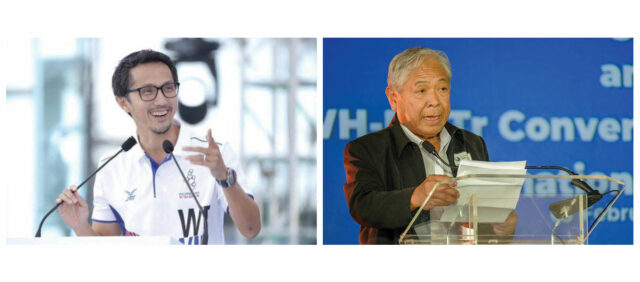
MALACAÑANG named Vivencio “Vince” B. Dizon (left) as the new Transportation chief, replacing Jaime J. Bautista who resigned due to “health reasons.”

By John Victor D. Ordoñez and Ashley Erika O. Jose, Reporters

PHILIPPINE President Ferdinand R. Marcos, Jr. has tapped former Bases Conversion and Development Authority (BCDA) Chief Executive Officer (CEO) Vivencio “Vince” B. Dizon to head the Department of Transportation (DoTr).

“He (Mr. Dizon) is already authorized by the Office of the President to start the transition at the Department of Transportation in coordination with the team of Secretary Jaime J.  Bautista, who has resigned due to health reasons,” Executive Secretary Lucas P. Bersamin said in a statement on Thursday.

Mr. Bautista’s resignation will take effect on Feb. 21.

Mr. Dizon, 50, is the chief regulatory officer of the Razon-led Prime Infrastructure Holdings. He served as president and CEO of BCDA from 2016 to 2021.

Under the Duterte administration, Mr. Dizon was the presidential adviser on flagship programs and projects, as well as deputy chief implementer of the National Action Plan against the coronavirus disease 2019 (COVID-19).

In a DoTr statement, Mr. Bautista thanked the President for the opportunity to work in government, calling it “his most challenging stint.”

Mr. Bautista said he looks forward to a “smooth transition” and a “much-needed vacation” after having worked as DoTr chief since 2022.

Mr. Bautista previously served as the president and chief operating officer of flag carrier Philippines Airlines where he retired in 2019.

The newly appointed Transportation secretary is set to inherit big-ticket and long-delayed infrastructure projects such as the construction of the Metro Rail Transit Line 7 (MRT-7), North-South Commuter Railway, and Mindanao Railway Project.

“He has to assess all projects in the pipeline. He can’t shift course immediately, because of the budget approved by Congress,” Rene S. Santiago, a founding member of the Transportation Science Society of the Philippines, told BusinessWorld in a Viber message.

“The previous obsession with railways needs to be dialed down and he needs to focus on the crisis of the dwindling supply of buses and jeepneys.”

In August last year, Mr. Marcos rejected a proposal to suspend the government’s Public Utility Vehicle Modernization Program (PUVMP), defending it from criticisms that the plan had been rushed.

The modernization program started in 2017, aiming to replace traditional jeepneys with units that have at least a Euro 4-compliant engine to cut pollution.

Transport group Manibela Chairman Mar S. Valbuena said the group is hoping that the DoTr will revisit the implementation of PUVMP now that it will be under a new leadership.

“We are hoping that the new Secretary will listen to our suggestions and proposed transport solutions. We will remain vigilant, particularly, on the policies he will pursue,” Mr. Valbuena said.

Meanwhile, Mr. Santiago said Mr. Dizon had a good track record at the BCDA, citing his work in overseeing the construction of the Athlete’s Village in the New Clark City Sports Complex in Tarlac.

Nigel Paul C. Villarete, senior adviser on PPP (public-private partnership) at Libra Konsult, Inc., welcomed the appointment of Mr. Dizon, but said he should ensure all existing programs and projects continue unhampered and proceed smoothly.

“DoTr is tricky because it requires a good balance across planning, implementation and operations, and its numerous sub departments and attached agencies would need varied expertise and experience to get a good grasp of this very essential department,” Mr. Villarete said in a Viber message.

Mr. Villarete said the DoTr should also continue the public-private partnerships program, particularly for aviation projects.

“Of course, the other one on my list would be airports… We need to fast-track airport development in order to keep ahead. Transportation, especially air travel, is foremost in economic development,” he said.

Last year, the government privatized the Ninoy Aquino International Airport (NAIA), with San Miguel-led New NAIA Infra Corp. taking over its operations.

Two more regional airports have been awarded to the private sector in 2024, the Laguindingan International Airport and New Bohol-Panglao International Airport. These two regional airports were both awarded to Aboitiz InfraCapital, Inc.

“Vince Dizon provides the agility and dynamism of youth to the Transportation department, which had been unfortunately absent in the previous leadership,” Terry L. Ridon, a public investment analyst and convenor of think tank InfraWatch PH, said in a Facebook Messenger chat,

He said his experience in handling infrastructure projects and his time as the presidential projects adviser will help him deal with issues in the transportation sector.

“We trust that the new secretary will continue to prioritize the movement of people, especially the most vulnerable, and pursue more people-centric transportation policies,” said AltMobility PH Spokesperson Patrick R. Jalasco.

Meanwhile, Transportation Undersecretary for Railways Jeremy S. Regino said in a text message that he submitted his irrevocable resignation on Jan. 22.

A steadfast quest for adequate housing

Marking six years today in delivering housing solutions to Filipinos, especially in marginalized communities, the Department of Human Settlements and Urban Development (DHSUD) has been instrumental in developing strong shelters that build up thriving communities in the Philippines.

Established in 2019, the DHSUD has the mission to develop and regulate housing projects across the country. It is specifically tasked with ensuring that the basic housing needs of all Filipino families are met. It oversees housing policies, housing programs, urban planning and development.

The DHSUD has emerged from the Housing and Urban Development Coordinating Council (HUDCC), a government agency that coordinates government shelter activities; and the Housing and Land Use Regulatory Board (HLURB), which regulates housing and development. The department also oversees the country’s key shelter agencies, such as the National Housing Authority, Pag-IBIG Fund, Social Housing Financing Corp., and the National Home Mortgage Finance Corp.

As it contributes to preparing an environment for a thriving economy, the DHSUD works to advance housing and urban development by providing quality, affordable housing that revitalizes communities and supports sustainable, healthy, and safe living environments for Filipino families.

The previous year marked another significant chapter for the department as it continues to implement successful initiatives for further strengthening housing in the country. Among these efforts, the DHSUD is actively pushing the national housing program more effectively. Also known as the Pambansang Pabahay Para sa Pilipino Housing Program, or 4PH, this initiative is aimed at delivering socialized housing solutions to low-income families.

According to the DHSUD secretary, the 4PH Program is designed to address housing backlogs by providing decent, safe, and affordable housing units for Filipinos. Launched in 2022, 4PH is a flagship program that includes the DHSUD, the local government units (LGUs), government financial institutions (GFIs), housing stakeholders, private banks, developers, and contractors.

“4PH is the formula we have developed to solve our housing backlog. We just need to find a way to speed up the process and maximize government resources,” DHSUD Secretary Jose Rizalino L. Acuzar previously said in mixed English and Filipino.

“Our government is focused on providing Filipinos with good housing, which are now right within our reach. The construction of such housing is expected to be completed in two-and-a-half years, and you will be able to see it all over the country,” the secretary added.

Last year, the department kicked off the distribution of 4PH Program’s first batch of housing units under the 4PH Program to overseas Filipino workers (OFWs) in Palayan City, Nueva Ecija. According to the DHSUD, this initiative is centered on building vertical housing or condominium developments on government-owned land to benefit a large number of Filipinos.

Additionally, the agency has also partnered with the University of the Philippines (UP) in efforts to provide affordable housing in sustainable communities. This partnership enables the DHSUD to build housing for the university’s faculty and staff in UP Diliman.

Furthermore, a total of 56 projects are currently under development in various locations, including Pampanga, Nueva Ecija, Quezon City, Caloocan, and in other parts of the country.

Strengthening disaster response

The department has also been steadfast on providing shelter as a disaster response by means of cash assistance, loan payment moratorium, and assistance in relocating from danger zones.

The DHSUD’s Integrated Disaster Shelter Assistance Program (IDSAP) is a prime example that addresses the housing needs of Filipinos during calamity disasters. Launched last year, this program supports victims by providing them with cash assistance for those with damaged shelters: P30,000 for homes that are completely destroyed and P10,000 for those with partially damaged homes.

Moreover, when Tropical Kristine hit last year, the agency utilized P130 million to give assistance to disaster victims. It has also distributed housing materials and essentials to thousands of families and instructed their key shelter agencies to become lenient and pause monthly housing loan payments for its members in the affected areas.

“We want a dependable government under Bagong Pilipinas, and this program will ensure that the assistance we will be providing is holistic, from the disaster’s onset up to rehabilitation and recovery,” Mr. Acuzar said. “We want our disaster-affected kababayans to immediately receive the government’s assistance. They already suffered from typhoons, earthquakes… We want to alleviate that by fast-tracking the delivery of our services.”

Rehabilitating the Pasig River

The DHSUD was also tasked to lead the rehabilitation of the Pasig River. Aside from transforming the river towards improving its water quality and make it a vital part of Metro Manila once again, the rehabilitation project also aims for improving housing among informal settlers that are residing along the riverbank.

The first phase of the Pasig River Urban Development Project started in 2024, which includes a 500-meter showcase area, stretching from Manila Central Office to Intramuros.

With the DHSUD leading the Inter-Agency Council for the Pasig River Urban Development (IAC-PRUD), the project seeks to significantly improve housing, transportation, and tourism in the area. This project will include pedestrian-friendly infrastructures, commercial zones, green spaces, bike lanes, and water transportation like water taxis.

Other agencies also involved in the Pasig River Urban Development Project are the Department of Environment and Natural Resources (DENR), Department of Public Works and Highways (DPWH), and the Metropolitan Manila Development Authority (MMDA).

“Housing for squatters and informal settlers are currently being built. Take a look at the poor living under the Pasig River, it’s not a pretty sight. As they work on revitalizing the Pasig River, housing developments for those that will be affected are in the works, with at least 40,000 to 50,000 housing units. This initiative aims to ensure those living under the bridge and along the river won’t be neglected,” Mr. Acuzar said. — Angela Kiara S. Brillantes

Charting the course towards digital finance excellence

The digital shift has transformed our lives, affecting how we consume content, purchase goods, and manage finances. The rise of e-wallets and digital finance tools exemplifies this change, benefitting both consumers and businesses. Thus, businesses need to meet consumers in the digital world through digital transformation.

Almost all businesses have started this journey in one form or another, and several solutions have been made to help businesses serve customers better in the digital landscape. However, the path to digital transformation is different for every business, as each has its own needs and priorities. With a reliable partner, businesses can successfully navigate digitalization and integrate it into their growth strategies.

Globe Business, with its suite of solutions and expertise in technology, has been guiding businesses in understanding and optimizing this digital shift. Recently, Globe Business launched Mindhive Year 2, the company’s innovation series and hackathon, to help companies navigate the complexity of digital transformation. Mindhive doubles down on featuring insights, sandboxing sessions, and conducting workshops that highlight the importance of innovation and developing digital strategies — all to future-proof the financial services sector.

“Globe Business is dedicated to supporting businesses in navigating their digital transformation journey. We help them plot their roadmap to achieve greater digital proficiency and a stronger digital stance. We offer guidance and expertise through our business solution consultants,” KD Dizon, Vice-President and Head of Globe Business, said in a special edition of the BusinessWorld Insights forum.

“We help them plot their roadmap to achieve greater digital proficiency and a stronger digital stance. We offer guidance and expertise through our business solution consultants.”

— KD Dizon, Vice-President and Head of Globe Business

The recent Mindhive Innovation Series focused on the banking and financial sectors, featuring the latest trends, technologies, and expertise to guide them through their digital transformation.

“The Mindhive Innovation Series revolves around a holistic approach to digital advancement. It’s about prioritizing both growth and robust security, empowering businesses to stay ahead of the curve in the digital age,” Jonathan Cristobal, Marketing Head of Globe Business, said.

This emphasis is reflected in Mindhive Year 2’s programs. First, the Application Programming Interface (API) workshop promotes building holistic knowledge through API infrastructure. As companies are rapidly adopting digital technologies, this workshop enabled large enterprises to refine their API infrastructure for maximum performance, efficiency, and scalability, and also empowered MSMEs to build roadmaps and participate in the digital ecosystem. Meanwhile, the Design Thinking workshop helped participants identify each company’s biggest challenge and create effective solutions to hurdle those challenges.

Globe Business views Mindhive not only as an innovation hub but also as a means to cultivate a digital mindset within financial institutions and make them future-proof. A prime example is Asia Link Finance Corp., a leading finance company in the Philippines that successfully tapped into Mindhive. The insights the company’s representatives learned from the program  have helped the financial institution navigate the evolving landscape and remain competitive in a tech-driven market. 

On top of these programs at Mindhive, business solutions consultants provide tailored expertise to each client. This begins with a thorough assessment of the company’s current technological landscape, identifying potential risks such as security vulnerabilities, outdated systems, and missed opportunities for innovation. Based on this assessment, consultants provide strategic insights and recommend digital solutions to address these challenges, ultimately helping businesses navigate their digital transformation and achieve sustainable growth.

“Business solutions consultants become the guiding experts in digital transformation. Business solutions consultation is crucial in guiding businesses through the complexities of the digital journey. We serve as trusted advisors, working closely with each business to understand its unique needs and challenges. We help them set realistic expectations and advance their digital development,” Marlon Cruz, Senior Director for Business Solutions Consulting, Globe Business, shared.

Watch the entire BusinessWorld Insights forum on BusinessWorld’s YouTube and Facebook pages.


Spotlight is BusinessWorld’s sponsored section that allows advertisers to amplify their brand and connect with BusinessWorld’s audience by publishing their stories on the BusinessWorld Web site. For more information, send an email to online@bworldonline.com.

Join us on Viber at https://bit.ly/3hv6bLA to get more updates and subscribe to BusinessWorld’s titles and get exclusive content through www.bworld-x.com.