Home Blog Page 1493

PHL stocks may climb with BSP likely to cut rates

PHILIPPINE STAR/KRIZ JOHN ROSALES

PHILIPPINE SHARES may rise this week as the Bangko Sentral ng Pilipinas (BSP) is expected to cut benchmark interest rates for a fourth straight meeting.

On Friday, the benchmark Philippine Stock Exchange index (PSEi) fell by 1.39% or 86.98 points to close at 6,154.99, while the broader all shares index dropped by 0.63% or 23.41 points to 3,663.64.

Week on week, however, the PSEi went up by 5% or 292.4 points from its 5,862.59 close on Jan. 31.

“The PSEi managed to bounce back to the 6,000 zone the week after a reconstitution of the main index,” online brokerage 2TradeAsia.com said in a market note.

Changes to the 30-member PSEi took effect on Feb. 3. The market operator added AREIT, Inc. and China Banking Corp., replacing Nickel Asia Corp. and Wilcon Depot, Inc. after the 2024 index review.

Bargain hunting following the market’s decline to bear market territory on Jan. 31 also boosted the PSEi last week.

For this week, the market’s focus will be on the BSP’s first policy meeting of the year on Feb. 13 (Thursday), Philstocks Financial, Inc. Senior Research Analyst Japhet Louis O. Tantiangco said in a Viber message.

“A cut in policy rates together with a dovish outlook is expected to give the market a boost,” Mr. Tantiangco said.

Recent dovish signals from BSP Governor Eli M. Remolona, Jr. have fanned expectations of another rate cut as early as this week’s policy review, Rizal Commercial Banking Corp. Chief Economist Michael L. Ricafort said in an e-mail.

A BusinessWorld poll showed that 19 out of 20 analysts expect the Monetary Board to reduce benchmark rates by 25 basis points (bp) this week, which would bring the policy rate to 5.5% from the current 5.75%.

Mr. Remolona earlier said that a rate cut is “on the table” at the Monetary Board’s Feb. 13 meeting.

He said they may slash benchmark interest rates by a cumulative 50 bps this year as “policy insurance” against risks, with the reductions likely to be done in 25-bp increments each in the first and second half.

The BSP has cut borrowing costs by 75 bps since kicking off its easing cycle in August last year, bringing the policy rate to 5.75%.

Mr. Tantiangco added that the peso’s recent rebound could also help boost the local bourse.

“This past week, we saw an appreciation of the peso against the dollar as well as a decline in our long-term Treasury yields. A continuation of this is expected to help the local market in advancing further,” he said.

On Friday, the peso closed at an over one-month high of P58.03 per dollar. Week on week, it climbed by 33.5 centavos from its P58.365 close on Jan. 31.

Mr. Tantiangco put the PSEi’s support at 6,150 and resistance at 6,400, while Mr. Ricafort pegged support at 6,000 and resistance at 6,275-6,530.

For its part, 2TradeAsia.com placed the market’s immediate support at 6,000 and resistance at 6,300-6,400. — R.M.D. Ochave

Peso may trade sideways amid fresh concerns over US tariffs

BW FILE PHOTO

THE PESO may continue to trade at the P57 to P58 levels this week as markets await clarity regarding US President Donald J. Trump’s tariff policies.

The local unit closed at P58.03 per dollar on Friday, strengthening by 15 centavos from its P58.18 finish on Thursday, Bankers Association of the Philippines data showed.

This was the peso’s best close in more than a month or since its P57.91-per-dollar finish on Jan. 2.

Week on week, the local unit rose by 33.5 centavos from its P58.365 close on Jan. 31.

“The peso closed stronger on higher jobless rate data from the US… The dollar weakened against most currencies, which was tracked by the local market. However, there was some market caution ahead of the US manufacturing data. Trading volume was also lower,” a trader said by phone on Friday.

Hawkish signals from the Bank of Japan also dragged the dollar down against most Asian currencies on Friday, Rizal Commercial Banking Corp. Chief Economist Michael L. Ricafort said in a Viber message.

For this week, the trader said markets will continue to monitor developments in the Trump administration’s trade policies.

The trader sees the peso moving between P57.80 and P58.30 against the dollar this week, while Mr. Ricafort expects it to range from P57.70 to P58.20.

The dollar rose in choppy trading on Friday after data showed that US job growth slowed in January but that the unemployment rate edged down to 4%, giving the US Federal Reserve cover to hold off cutting interest rates until at least June, Reuters reported.

The US currency was also boosted by comments from Mr. Trump that he plans to announce reciprocal tariffs on many countries this week, without specifying which countries.

The dollar index, which measures the US currency against the yen, sterling and other peers, was last up 0.353% at 108.04. It was on track for a weekly fall after investor fears about a global trade war receded.

Nonfarm payrolls increased by 143,000 jobs last month after rising by an upwardly revised 307,000 in December, the Labor department’s Bureau of Labor Statistics said in its closely watched employment report.

Economists had expected the survey to show 170,000 jobs added.

Investor nerves about global trade wars returned on Friday after Mr. Trump pledged to impose more tariffs as part of a broad effort that he said could also help solve US budget problems.

Mr. Trump made the announcement during a meeting with visiting Japanese Prime Minister Shigeru Ishiba. He said auto tariffs remained on the table amid reports that the White House was weighing potential exemptions.

The dollar fell 0.09% against the yen to 151.365 after falling below 151 yen for the first time since Dec. 10 in early Asian trade on bets that the Bank of Japan will raise rates more than previously expected this year, supported by wage data earlier last week.

Adding to the higher rate expectations were comments by Bank of Japan board member Naoki Tamura, one of the board’s most hawkish members, who said on Thursday the central bank must raise rates to at least 1% in the latter half of fiscal 2025.

The early days of the Trump administration have kept investors on edge. Mr. Trump last week suspended planned tariff measures against Mexico and Canada at the last minute, but imposed additional 10% levies on imports from China, which quickly announced measures of its own on US imports. — AMCS with Reuters

Trump’s aid freeze keeps life-saving programs shut, sparks ‘mayhem’

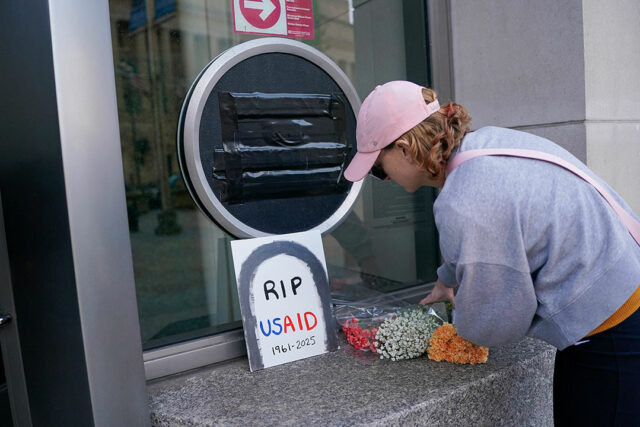
A PERSON leaves flowers, next to a covered United States Agency for International Development (USAID) sign, at the agency’s headquarters in Washington, US on Feb. 7, 2025. — REUTERS

IN GHANA and Kenya, insecticide and mosquito nets sit in warehouses because US officials haven’t approved urgent anti-malaria campaigns.

In Haiti, a group treating HIV patients awaits US permission to dispense medicines that prevent mothers from giving the disease to their children.

In Myanmar, where famine looms and the US is the single largest aid donor, one humanitarian worker described the situation as “mayhem.”

Nearly three weeks into US President Donald Trump’s sweeping freeze on foreign aid, life-saving programs across the globe remain shut as humanitarian workers struggle to secure US government waivers meant to keep them open, dozens of aid workers and United Nations (UN) staff told Reuters.

After Mr. Trump announced the 90-day freeze on Jan. 20, US Secretary of State Marco Rubio issued waivers for what he called “life-saving humanitarian assistance,” which included “core life-saving medicine, medical services, food, shelter, and subsistence assistance.”

But aid workers and UN officials said the waivers had sparked widespread confusion, along with fears that their US funding would never be restored.

They said they couldn’t restart work without first confirming with their US counterparts whether specific programs qualified for exemption. This was proving nearly impossible, they said, due to a communication breakdown with US officials, some of whom had been fired or barred from talking.

The breakdown appeared partly by design. On Jan. 31, staff at the United States Agency for International Development (USAID), once the main delivery mechanism for American largesse, were told not to communicate externally about the waiver and what it may or may not include, according to a previously unreported recording of the meeting reviewed by Reuters.

The US State Department and White House did not respond to requests for comment.

The spiraling consequences of the aid freeze in developing countries underline the real-world harms from Mr. Trump’s upending of decades-old US initiatives designed to build global alliances by making America the world’s most generous superpower and largest single aid donor.

Aid workers had a list of urgent questions going unanswered. Among them: Which programs could continue? What qualifies as life-saving aid? Food? Shelter? Medicine? And how do they keep people from dying when almost every aid service has been shut at once?

With little guidance from US officials, aid workers said their organizations erred on the side of caution and closed programs rather than incur expenses that the US government might not reimburse, the aid workers said. Some described how US partners — often people they had worked with for years — no longer answered their phones or e-mails.

One Geneva-based aid official who reached US officials was stunned by their response. “We asked: Can you tell us exactly which programs we need to stop? Then we got a message saying ‘no more guidance is forthcoming’. This leaves us in a situation where you have to make a choice of which program is ‘life-saving’,” the official said. “We don’t have money to pay for it ourselves. We can’t spend money we don’t know if we have.”

The turmoil was particularly acute at USAID, now in disarray and targeted for closure as a “criminal organization” by Mr. Trump’s government efficiency tsar, the billionaire Elon Musk.

In his executive order, Mr. Trump said the US “foreign aid industry and bureaucracy” were “in many cases antithetical to American values.” He ordered the 90-day pause pending a review on whether aid was consistent with his “America First” foreign policy.

Most of those who spoke to Reuters requested anonymity, fearful of antagonizing the Trump administration and jeopardizing the possible restoration of aid.

Two workers with aid organizations in Myanmar told Reuters they didn’t know whether US-funded food distribution in the country was covered by a waiver and would continue. One of the workers described the situation as “mayhem.” Myanmar faces a severe food crisis due to natural disasters and a spiraling civil war. An estimated two million people in the country are on the brink of famine, according to the UN.

In Africa, humanitarian workers were due to start anti-malaria spraying campaigns this month in Ghana and Kenya before mosquito populations explode during the rainy season, but insecticide and mosquito nets are stuck in warehouses, said a USAID contractor.

A USAID memo, dated Feb. 4 and seen by Reuters on Saturday, said “life-saving activities” to address malaria, tuberculosis and other diseases and conditions would be exempt from the freeze. But campaigns to protect millions of people appeared on hold as aid workers sought clarification on when funding would resume and specific malaria programs in Africa could restart, the contractor said.

Malaria, a preventable disease, is caused by parasites transmitted to people by the bites of infected mosquitoes. The vast majority of the world’s 597,000 malaria deaths in 2023 were African children aged under five years old, the World Health Organization said in December.

“There is a small window to do those campaigns which is going to close rapidly,” said the USAID contractor.

Millions of US taxpayer dollars already spent on supplies to fight malaria in Africa could go to waste, aid workers said. Malaria No More, a global nonprofit based in Washington, said the freeze could prevent the distribution of 15.6 million life-saving treatments, nine million nets and 48 million doses of preventative medicine.

The US is the top donor in the global fight against malaria, mostly through the President’s Malaria Initiative, known as PMI, set up under former President George W. Bush in 2005. PMI’s website — which included information on populations at risk of malaria — has been taken down and replaced with a brief statement: “In order to be consistent with the President’s Executive Orders, this website is currently undergoing maintenance as we expeditiously and thoroughly review all of the content.”

“It’s as if all the work . . . has just been erased,” said Anne Linn, a USAID staffer who worked remotely from Montana as a technical advisor and was fired on Jan. 28. “It’s so cruel and senseless,” she said. “The wastefulness of it is staggering to me.”

TURMOIL AT USAID
The problems were exacerbated by turmoil at USAID, whose leaders Mr. Trump has described as “radical left lunatics.”

Mr. Trump’s administration plans to keep 611 staff at USAID out of its worldwide total of more than 10,000, according to a notice sent to the agency on Feb. 5 and reviewed by Reuters.

Washington’s primary humanitarian aid agency has been a target of a government reorganization program spearheaded by Mr. Musk, a close Trump ally, since the Republican president took office on Jan. 20. Staff have been shut out of the agency’s headquarters in Washington. Mr. Rubio has appointed himself the agency’s acting administrator.

An expert in water and sanitation spoke of “mass confusion” at the USAID’s global health bureau after she and dozens of others were fired on Jan. 28. “It happened so quickly that I had no way of saving e-mails, contacts,” she said. “We were all just thrown away and bulldozed over.”

In Thailand, the aid freeze forced the International Rescue Committee (IRC), which funds health clinics with US support, to quickly shut down the hospital and clinics it ran in seven refugee camps on the Myanmar-Thai border. IRC was told by US officials they couldn’t reopen before receiving another notification, which hasn’t arrived, said an aid worker.

Many were discharged from the IRC facilities, leaving people including pregnant women and children unable to access medication or medical equipment, said Francois Nosten, director of the Shoklo Malaria Research Unit, a field station in the border camps run by Bangkok’s Mahidol University.

An elderly woman, who had been hospitalized with lung problems and was dependent on oxygen, died four days after being discharged, according to her family. Reuters couldn’t independently confirm her cause of death.

An IRC spokesperson said some refugees had “self-organized” to provide critical services for themselves until aid support was “transitioned” to Thai authorities.

If “you cut all the activities then some people are going to die,” said Mr. Nosten. — Reuters

Japan PM Ishiba, after meeting Trump, voices optimism over averting tariffs

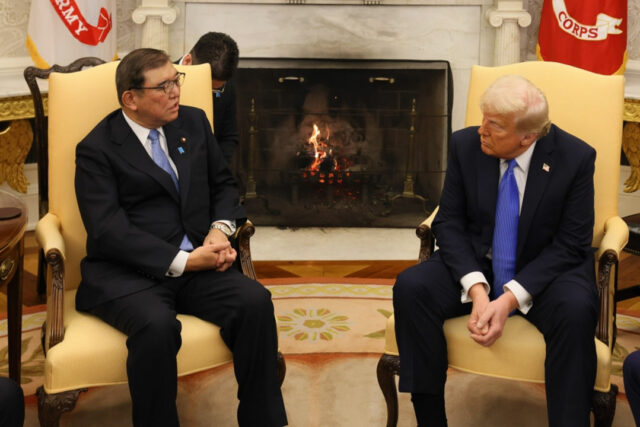
JAPANESE Prime Minister Shigeru Ishiba (L) with US President Donald Trump. — MOFA.GO.JP-CABINET PUBLIC AFFAIRS OFFICE

TOKYO — Japanese Prime Minister (PM) Shigeru Ishiba expressed optimism on Sunday that his country could avoid higher US tariffs, saying President Donald Trump had “recognized” Japan’s huge investment in the US and the American jobs that it creates.

At his first White House summit on Friday, Mr. Ishiba told public broadcaster NHK, he explained to Mr. Trump how many Japanese automakers were creating jobs in the United States.

The two did not specifically discuss auto tariffs, Mr. Ishiba said, although he said he did not know whether Japan would be subject to the reciprocal tariffs that Mr. Trump has said he plans to impose on imports.

Tokyo has so far escaped the trade war Mr. Trump unleashed in his first weeks in office. He has announced tariffs on goods from Canada, Mexico and China, although he postponed the 25% duties on his North American neighbors to allow for talks.

The escalating trade tensions since Mr. Trump returned to the White House on Jan. 20 threaten to rupture the global economy.

Mr. Ishiba said he believes Mr. Trump “recognized the fact Japan has been the world’s largest investor in the United States for five straight years, and is therefore different from other countries.”

“Japan is creating many US jobs. I believe (Washington) won’t go straight to the idea of higher tariffs,” he said.

Mr. Ishiba voiced optimism that Japan and the US can avoid a tit-for-tat tariff war, stressing that tariffs should be put in place in a way that “benefits both sides.”

“Any action that exploits or excludes the other side won’t last,” Mr. Ishiba said. “The question is whether there is any problem between Japan and the United States that warrants imposing higher tariffs,” he added.

Japan had the highest foreign direct investment in the United States in 2023 at $783.3 billion, followed by Canada and Germany, according to the most recent US Commerce Department data.

Mr. Trump pressed Mr. Ishiba to close Japan’s $68.5-billion annual trade surplus with Washington but expressed optimism this could be done quickly, given a promise by Mr. Ishiba to bring Japanese investment in the US to $1 trillion.

On Sunday, Mr. Ishiba identified liquefied natural gas, steel, AI and autos as areas that Japanese companies could invest in.

He also touched on Mr. Trump’s promise to look at Nippon Steel investing in US Steel, as opposed to buying the storied American company — a planned purchase opposed by Mr. Trump and blocked by his predecessor, Joseph Biden.

“Investment is being made to ensure that it remains an American company. It will continue to operate under American management, with American employees,” Mr. Ishiba said. “The key point is how to ensure it remains an American company. From President Trump’s perspective, this is of utmost importance.”

On military spending, another area where Mr. Trump has pressed allies for increases, Mr. Ishiba said Japan would not increase its defense budget without first winning public backing. “It is crucial to ensure that what is deemed necessary is something the taxpayers can understand and support,” he said. — Reuters

Far-right leaders hold rally to ‘Make Europe Great Again’

A European Union flag is seen in Stockholm, Sweden, July 17, 2023. — REUTERS

MADRID — Leaders of far-right parties in the European Parliament’s third-largest voting bloc, Patriots for Europe, praised Donald Trump’s return to power at a gathering in Madrid on Saturday held under the slogan “Make Europe Great Again.”

The event featured Hungarian Prime Minister Viktor Orban and Italian deputy premier Matteo Salvini, as well as the leaders of France’s National Rally  Marine Le Pen, and the Netherlands’ PVV party, Geert Wilders.

“The Trump tornado has changed the world in just a few weeks … yesterday we were heretics, today we’re mainstream,” Mr. Orban told around 2,000 supporters, most of whom waved Spanish flags.

All the speakers railed against immigration and most called for a new “Reconquista,” a reference to the Medieval re-conquest of Muslim-controlled parts of the Iberian Peninsula by Christian kingdoms.

Earlier, former Estonian Finance Minister Martin Helme kicked off the rally following a video message by Venezuelan opposition leader Maria Corina Machado. His speech excoriating what he called “leftists” was interrupted by a topless activist from feminist group Femen chanting “Not one step back against fascism” in Spanish before she was ejected.

Other themes included frequent right-wing targets such as “wokism” — a term used pejoratively by some to describe left-leaning political views on race, gender and sexuality — migrant rescue NGOs, European Commission’s Ursula von der Leyen and Spanish Prime Minister Pedro Sanchez, whose names were met with loud jeers.

Patriots was formed after the May 2024 European election and consists of 86 MEPs from 14 countries, representing a combined 19 million votes. Madrid was chosen as venue for their first official summit so that Patriots’ president Santiago Abascal, who leads Spain’s Vox party, could host.

Spain’s ruling Socialist Party said in a statement it rejected what it described as a “coven of ultras”, adding: “They won’t succeed in making their black-and-white world view prevail in this country.”

Vox has steadily gained ground in several polls over the past months. According to the Centre for Sociological Studies, it garners the strongest support among young men, members of the military and law enforcement.

Despite Patriots’ stated goal of unifying Europe’s nationalist conservatives, some of the EU’s most influential parties in that camp — such as Italian Prime Minister Giorgia Meloni’s Brothers of Italy, Alternative for Germany and Poland’s Law and Justice — have refused to join. — Reuters

New Zealand to loosen visa rules to lure foreign investors

SULTHAN AULIYA-UNSPLASH

SYDNEY — New Zealand will relax visa rules to attract more foreign investors, in efforts to stimulate economic growth, its center-right government said on Sunday.

Immigration Minister Erica Stanford said the country’s investor visa category would be made “simpler and more flexible” to encourage investors to choose New Zealand for their “capital, skills and international connections.”

“These changes will turbocharge our economic growth, bringing brighter days ahead for all Kiwis,” Ms. Stanford said in a statement announcing that two new visa categories — for “higher-risk investments” and “mixed investments” — would be created.

The changes, to take effect from April 1, follow the government’s recent relaxation of visa rules allowing holidaymakers to work remotely while visiting the country, aimed at boosting its tourism sector.

After slipping into a technical recession in the third quarter of 2024, the New Zealand government is seeking ways to bolster growth. In January, it announced plans to set up Invest New Zealand, part of the government’s international economic development agency, to serve as a one-stop-shop for overseas investment. — Reuters

Trump says he has spoken to Putin about ending war in Ukraine — New York Post

RAWPIXEL.COM

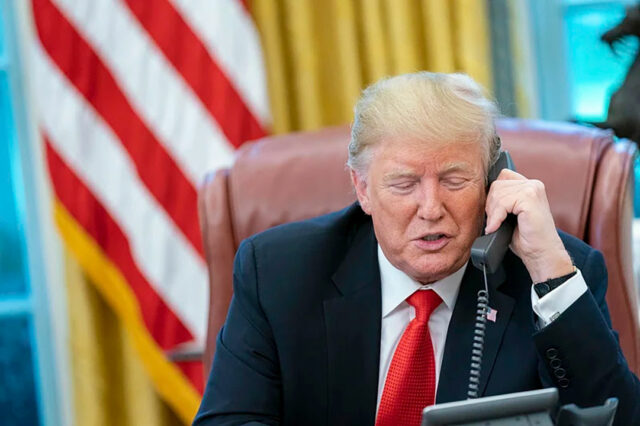
US PRESIDENT Donald Trump said that he has talked to Russian President Vladimir Putin on the phone to discuss an end to the war in Ukraine, the New York Post reported late on Saturday.

In an interview aboard Air Force One on Friday Mr. Trump said that he had “better not say,” when asked how many times the two leaders have spoken.

“He (Putin) wants to see people stop dying,” Mr. Trump told the New York Post.

Neither the Kremlin nor the White House immediately responded to Reuters’ request for comment outside business hours.

In late January, Kremlin spokesperson Dmitry Peskov said that Mr. Putin is ready to hold a phone call with Mr. Trump and Moscow is waiting for word from Washington that it is ready too.

On Friday, Mr. Trump said he would probably meet Ukrainian President Volodymyr Zelensky next week to discuss the end of the war.

The war, which began with Russia’s full-scale invasion of Ukraine, will mark its third anniversary on Feb. 24. Thousands of people, the vast majority of them Ukrainian, have been killed during the conflict.

Mr. Trump told the New York Post that he has “always had a good relationship with Putin” and that he has a concrete plan to end the war. But he did not disclose further details.

“I hope it’s fast,” Mr. Trump said. “Every day people are dying. This war is so bad in Ukraine. I want to end this damn thing.” — Reuters

UK’s tougher immigration policy risks trapping victims in modern slavery

REUTERS

LONDON — Thousands of victims of modern slavery are being denied support because of Britain’s crackdown on illegal migration, according to more than a dozen sources, a decade after the approval of legislation that put the country at the forefront of the global fight against human trafficking.

Britain’s Modern Slavery Act of 2015 forced large businesses to tackle slavery in their supply chains and strengthened existing protections for victims.

But those protections have been eroded by rules introduced in 2023 to curb illegal migration, as the political priority switched to dealing with the tens of thousands of migrants arriving in Britain each year aboard small boats.

Reuters interviewed more than a dozen individuals in government, law enforcement, the judiciary and charities who said the tougher laws were leaving thousands of victims trapped in modern slavery, both by denying requests for support and by stopping others from coming forward for fear of being deported.

“Modern slavery is not an immigration issue; it’s a human rights issue,” said Kathy Betteridge, a director at the Salvation Army, which has operated the government contract to support victims for the last 14 years.

After new legislation required victims to present greater proof of exploitation to qualify for state support, the share of rejections in slavery cases leaped to 45% in 2023, from just 11% in 2022, official data show. In the first nine months of 2024, the figure was 46%.

In 2023, the Home Office — Britain’s Interior ministry — identified around 17,000 people as potential victims of modern slavery, and a further 13,587 in the first nine months of last year. The bulk of the referrals were migrants, often brought to Britain to work in nail salons, car washes, sex work and the illicit drug trade, according to police.

That may only be the tip of the iceberg. A report by a House of Lords committee, published in October, said there were an estimated 130,000 victims of modern slavery in Britain.

“When the Modern Slavery Act was passed in 2015, the UK was said to be world leading. That is no longer the case,” said the report, published in October. It urged the government to amend the immigration rules.

Britain’s Labour government, which came to power in July, has not altered the legislation, despite saying while in opposition that the rules were unfair.

Last week, Prime Minister Keir Starmer’s government retained a Conservative ban on asylum seekers being able to claim modern slavery protections despite Mr. Starmer having said in the past it drove “a coach and horses” through protections for trafficked women.

A Home Office spokesperson said the government was working to clear the backlog of those waiting for final decisions on their claims for modern slavery support and would toughen legislation against criminal gangs responsible for exploitation.

“It is unacceptable in today’s Britain that thousands of vulnerable people — mostly women and children — are being forced to work against their will, often while facing regular physical and sexual abuse,” the spokesperson said.

NO PROOF SYSTEM IS MISUSED
Conservative former-prime minister Theresa May, who launched the Modern Slavery Act while interior minister, described it then as “the great human rights issue of our time.”

The law strengthened the National Referral Mechanism (NRM), the United Kingdom’s  (UK) system for identifying and protecting victims created in 2009 in accordance with an international anti-trafficking treaty.

Under the NRM, a small number of charities and public bodies — such as the Border Force, police or the Home Office — can refer someone to receive support.

After Ms. May’s premiership ended in 2019, Conservative governments argued that illegal migrants were using the system to evade deportation. The rules introduced in 2023 demanded a higher threshold of proof for modern slavery.

Elizabeth Butler-Sloss, a retired judge who sat on the House of Lords committee that examined the Modern Slavery Act, said the previous Conservative government was “frantic” about immigration and had failed to present proof there was widespread misuse of the system.

In May, her committee interviewed Laura Farris, who was victims and safeguarding minister at the time, and asked if the government possessed such evidence.

“Well, no. We do not,” Ms. Farris answered. “The Home Office will make some decisions in the affirmative and some in the negative, but the Home Office cannot be totally sure that those decisions are always good ones.”

For the first nine months of 2024, the number of people removed from the NRM process for posing as a victim, known as a bad faith disqualification, was eight, compared to the thousands of referrals into the system that year. For 2023, the figure was zero.

LACK OF INFORMATION
Reuters spoke to a suspected victim of modern slavery who was rejected last year from the NRM at the first stage of the review process.

In that stage, a suspected victim’s claim is assessed by a Home Office unit to determine whether there are reasonable grounds to believe they are a victim. The second stage, which can take months or years, considers whether there are conclusive grounds.

The Filipino woman, who asked not to be named for fear of retaliation, said she was employed as a housekeeper and live-in nanny for a family in Qatar. She said she was made to work from morning until night, suffering physical and sexual abuse.

Reuters was unable to reach the family for comment.

Because the father of the family was a senior police officer, she was afraid to approach authorities in Qatar. But when the family brought her on a trip to London, she escaped.

When she sought to apply for asylum, she was referred into the NRM by the Home Office, but officials rejected her claim, citing a lack of information. Part of the issue was, according to an April 2024 letter reviewed by Reuters, that officials in another Home Office department had not responded to messages asking for more information about her claim.

Data released by the Home Office in November showed that through 2020 to 2022, insufficient information accounted for just 3%-4% of first-stage rejections. But that jumped to 54% in 2023 and stood at 53% for the first nine months of 2024.

Charities say it is nearly impossible for victims in vulnerable situations to provide comprehensive evidence, especially when they are on the run from perpetrators.

FOREIGNERS TREATED MORE HARSHLY?
Data from the United Nations’ International Organization for Migration (IOM) suggests the NRM, since the regulations were tightened, may have started to treat foreign applicants more harshly.

In analysis shared with Reuters, the IOM said around 85% of British people received positive first-stage decisions in 2023 and the first nine months of 2024, versus only around 44% for foreigners, a much wider gap than in previous years.

Additionally, in the first nine months of 2024, around 68% of reconsideration requests for rejected applications were successful, raising questions about the quality of initial Home Office decision-making, IOM UK anti-trafficking specialist Patrick Burland said.

The Filipino woman, who has three children in the Philippines, overturned her first-round rejection through a reconsideration request filed with the help of a charity, according to a decision seen by Reuters.

She is now awaiting a second-stage, or conclusive grounds, decision, which if positive, would formally identify her as a victim and could entitle her to apply for permission to remain in the UK for a set period.

More than 20,000 people were waiting for a conclusive grounds decision at the end of September, official data show.

HIDDEN CRIME
A former director of the government agency tackling labor exploitation and modern slavery, the Gangmasters and Labour Abuse Authority (GLAA), said the agency had warned the Home Office that the tougher rules would have a “chilling effect” on victim engagement and make it a lot harder to catch criminals.

The ex-director, who asked not to be named to talk more freely, said the agency sometimes refused to refer people into the NRM because of the tightened rules, even when their “gut instinct” told them they were a victim.

A positive initial, or reasonable grounds, decision provides a weekly financial allowance of around 75 pounds ($93) and accommodation if necessary. Many migrant victims with a positive initial decision don’t have the right to work while they await a conclusive grounds decision.

The Home Office spent a total of 124.6 million pounds ($154 million) in 2023/2024 on identifying and supporting victims of modern slavery, it said in response to a Reuters freedom of information request. The figure does not include costs related to certain programs for child victims, it added.

Britain’s Independent Anti-Slavery Commissioner Eleanor Lyons told Reuters that she did not think the NRM provided enough of an incentive to motivate criminals to misuse it.

She also said other efforts to reduce migration, such as the former policy to deport illegal migrants to Rwanda, had deterred potential victims from coming forward.

“We spoke to a victim. They thought that if they came forward and reported their exploitation, that that would automatically mean they were being sent to Rwanda,” Ms. Lyons said. — Reuters


Geothermal de-risking loan from ADB sought

EDC

THE Department of Energy (DoE) said it is hoping to finalize a loan from the Asian Development Bank (ADB) this year to launch a project that seeks to de-risk geothermal power investments.

“We’ve said we need geothermal de-risking, meaning to say the government and the private sector will share in the risks of exploration for geothermal,” Energy Undersecretary Rowena Cristina L. Guevara said at a forum on Friday.

“And we’re very happy to tell you that finally maybe we’ll have a loan from the Asian Development Bank just to do that,” she added. 

The DoE has tapped the ADB for technical assistance to develop and implement a geothermal de-risking facility.

“Geothermal cost is very high at the beginning but after the 20-year period when the loan has been paid for the capital, it will become very cheap,” Ms. Guevara said.

Energy Assistant Secretary Mylene C. Capongcol said in September that the Philippines may need to obtain an initial $250 million to de-risk projects for potential geothermal developers.

The Philippines’ installed geothermal energy capacity was 1,952 megawatts (MW) in 2023, making it the third-biggest geothermal producer.

The DoE is monitoring 35 geothermal service contracts as of July 2024. Of the total, 20 are in the pre-development stage and 15 are in the development or commercial stage.

The government is scheduled to conduct the auction proper for the third round of the Green Energy Auction Program (GEAP) on Tuesday, Feb. 11, for which it has identified 12 qualified bidders.

It is set to offer geothermal, impounding hydro, and pumped-storage hydro capacities totalling 4,650 MW.

GEAP aims to promote renewable energy as a primary source of energy through competitive selection. It is designed to help the government increase the share of renewable energy in the power mix to 35% by 2030 and to 50% by 2040. — Sheldeen Joy Talavera

Exports to US seen ‘robust’ even with trade war looming — Philexport

A worker uses a microscope at an electronics manufacturing assembly plant in Biñan, Laguna, April 20, 2016. — REUTERS

EXPORTS to the US are expected to remain robust, unaffected by a possible US-China trade war, the Philippine Exporters Confederation, Inc. (Philexport) said.

“I don’t see the 10% imposed on China having an effect on the Philippines because Chinese prices are low. Even adding the 10% will not stop the US from buying from China,” Philexport President Sergio Ortiz-Luis, Jr. said in a statement over the weekend.

Adding that he expects the “Philippine exports to the US, the country’s biggest export market, to remain robust, largely unaffected by the trade war between the two powerhouse economies.”

The US was the Philippines’ top export destination last year, accounting for $12.12 billion, or 16.6% of total exports. It was followed by Japan, China, Hong Kong, and Singapore.

In December, the Philippines exported $94 million worth of goods to the US, or 16.8% of total exports for the month.

“US President Donald J. Trump imposed broad tariffs on China that took effect on Feb. 4, while his tariff threats hang over other major trading partners, including Canada and Mexico,” Philexport said.

However, Mr. Trump has agreed to hold off levying 25% tariffs on Canada and Mexico for 30 days, while China responded with retaliatory tariffs on American products, including 15% on coal and liquefied natural gas and 10% on crude oil and agricultural machinery.

“It doesn’t look like he’s really serious because they know it would be harder if China engages in a trade war with the US,” said Mr. Ortiz-Luis.

He said Philexport is more concerned with Mr. Trump helping ease geopolitical tensions between the Philippines and China.

“We hope Trump can lower the temperature so we can recover the market we lost with our neighbors and China. Also, tourism and investment were also affected by geopolitics,” he added. — Justine Irish D. Tabile

Davao’s Cacao Culture to broaden sourcing via farm-management deals

CACAOCULTURE.PH

By Adrian H. Halili, Reporter

DAVAO-BASED chocolate brand Cacao Culture said it is taking a “farm adoption” approach to supporting farmers in the region and growing its bean-sourcing network.

“We’re not trying to be the biggest. We want to be (possibly be) the most collaborative,” Kenneth Reyes-Lao, founder and owner of Cacao Culture, told BusinessWorld.

Mr. Reyes-Lao and his family currently own a three-hectare cacao farm in Calinan, Davao City. It also supplements its cacao supply from small-holder farmers and cooperatives in Davao City.

He said that one of Cacao Culture’s long-term plans is to further expand its sourcing from the area.

“We need to grow the supply side which is the farms. So, through the Adopt-a-Farm program, we’re hoping to, under our care, manage around 20,000 to 50,000 trees,” he added.

“On other farms, there are trees that are unproductive or neglected. So, we move in to manage the farm, and then also be the ones to take up the beans. We’ll be buying from the farms that we adopt,” he said.

The company started in 2016 selling cacao seedlings, while the farm was established in 2017.

Mr. Reyes-Lao said that the business has since evolved from agriculture to selling chocolate products both made in-house or by other brands. It sells its products at its physical store in Davao and via e-commerce platforms.

“When we started in 2017, it was just the three hectares we planted, and then lately we realized that we were growing and the company needed supply,” he said. “Then we saw an opportunity to adopt a certain farm where we could apply our practices.”

“So far, this has worked (and) right now we have two farms under the program,” he added.

Among Cacao Culture Farms’ practices is the use of biochar in the growing process. This method enhances soil health and improves plant growth and crop nutrition.

He said that the husks of discarded cacao pods are burned and reused as biocharcoal.

“We were able to work with WasteX, a Singapore-based startup, that… provides equipment that can convert agricultural waste into biocharcoal,” Mr. Reyes-Lao added.

He said that the farm employs a 50-50 ratio of biocharcoal and traditional fertilizer.

Mr. Reyes-Lao added that its other sustainability practice is avoiding the use of plastic sleeves to cover cacao pods.

Cacao pods are typically covered in plastic sleeves to protect them from pests like cocoa pod borers, which lay eggs in the pods.

Additionally, he said that the company is looking to expand its physical store network over the next three to five years, mainly focusing on the Davao area.

“The land area of Davao is large, so we maybe need to create three to five shops just to service Davao City. Then maybe airports in Cagayan de Oro or Cebu,” he added.

Mr. Reyes-Lao said that expansion to Luzon will likely be pursued through e-commerce platforms or a commissary to service Metro Manila.

“We could set up a commissary or warehouses, because e-commerce wise, I think we can expand in Manila,” he added.

The Davao Region is the Philippines’ top producer of cacao, accounting for about 80% of the total production.

DBM backs calls for transparency in bicameral budget negotiations 

BUDGET SECRETARY AMENAH F. PANGANDAMAN — PHILIPPINE STAR/KRIZ JOHN ROSALES

DEPARTMENT of Budget and Management (DBM) Secretary Amenah F. Pangandaman has joined calls for more transparency and public participation in the private bicameral committee meetings to harmonize the two Congressional budget bills.

In a television appearance on Money Talks with Cathy Yang, asked if she would gather support among cabinet secretaries to publicize bicam meetings, Ms. Pangandaman said: “Yes! That’s what transparency is all about.”

Her remarks follow the emergence of legal challenges to the P6.326-trillion national budget for 2025.

The bicam committee meetings seek to harmonize the Senate and House versions of a bill such as the signed national budget for 2025. These are held behind closed doors, with the release of a report afterwards the only official public disclosure on the proceedings.

“Maybe we can (disclose more), during our Legislative-Executive Development Advisory Council (meetings). Also, we can probably make representations to the leadership in both houses if that’s possible. But, you know, it’s a constitutional mandate. It’s part of the budget process. You have to give it to them. It is a powerful force,” Ms. Pangandaman said.

Civil Society Organizations (CSO), the Makabayan bloc, former senator Panfilo M. Lacson, and Ako Bicol Rep. Elizaldy S. Co have proposed making bicam meetings on the national budget accessible to the public.

“While we want to push for the President’s budget to be the exact one, once it’s presented to the President, we also have to respect (the Congressional) mandate,” Ms. Pangandaman said.

President Ferdinand R. Marcos, Jr. called the 2025 national budget “suboptimal” in the form passed by Congress, citing the reduction in appropriations for vulnerable sectors.

On Feb. 8, criminal complaints were filed against Speaker Martin G. Romualdez and other legislators over the alleged P241 billion worth of insertions in the budget.

Ms. Pangandaman noted the ways in which the government has sought to make the budget transparent and accessible to the public. 

“Our website is very much comprehensive. Once we release our National Expenditure Program, the President’s budget, and even the General Appropriations Act, the next day it’s already there. We have a people’s budget,” she said.

She also said that the GAA report is written in layman’s terms despite its technical nature and is readily available on the DBM website.

“We’re top in the open budget survey for transparency. Because the DBM has always been open in terms of providing information. It was always out there. We even have a CSO desk in DBM. Any CSO or any organization can just go to us and ask for information,” she said.

Ms. Pangandaman was referring to the 2023 Open Budget Survey (OBS), in which the Philippines ranked 15th out of 125th countries with an open budget index score of 75. This was higher than the global average of 45 and put the Philippines first in Asia.

In the same report, the Philippines placed 13th worldwide for public participation, with a score of 33 out of 100, which is significantly higher than the global average score of 15. 

In addition, the government said the implementing rules and regulations of the New Government Procurement Act, which it described as the country’s “biggest anti-corruption measure,” is set to be released on Feb. 10.

“In the new government procurement plan, there is a provision there for civil society, POs (people’s organizations,) and NGOs (non-governmental organizations), to be observers in the procurement process at all stages.” — Aubrey Rose A. Inosante

Money Talks with Cathy Yang premieres on Feb. 10 at 9:30 a.m. from Monday to Friday on ONE News.

Tune in to Cignal TV Ch. 250 HD and Ch. 8 SD. Also available on Cignal Play.