Home Blog Page 1485

Carbon Sync pushes faster shift by providing comprehensive platform for carbon credit projects

CARBON SYNC Chief Executive Officer Wesley Quek

By Sheldeen Joy Talavera, Reporter

SINGAPORE-BASED Carbon Sync Ventures hopes to help grow the carbon credit market in the Philippines by using digital platforms to track, certify, and trade carbon credits, while also supporting the development of local emissions-reduction projects.

“The primary aim… first one was always to improve integrity, transparency, as well as the data availability and the efficiency of the carbon markets and sustainability markets overall,” Carbon Sync Chief Executive Officer Wesley Quek said in an interview with BusinessWorld.

Mr. Quek said the company has worked with Google and other partners to build a digital platform that helps record, verify, and manage carbon credit projects, particularly those involving the protection or restoration of natural ecosystems. Registries are used to issue, monitor, and eventually retire carbon credits.

Carbon Sync is also proposing to directly develop projects in the Philippines, he said, after engaging with local governments in Sorsogon, Bohol, and Mindoro to present community-based initiatives.

One such project involves biochar, a type of charcoal made by heating organic materials in low-oxygen conditions.

The process prevents carbon from being released into the atmosphere and allows the carbon savings to be converted into credits that can be traded.

A carbon credit is a certificate that represents one ton of carbon dioxide that has been avoided or removed from the atmosphere. These credits can be bought by companies or governments to offset their own emissions, often as part of their sustainability targets.

Recently, asset manager Farosson invested in Carbon Sync Ventures and launched Farosson Digital & AI Technologies, a digital platform powered by artificial intelligence to manage carbon credit transactions.

The system includes tools for tracking, verifying, and retiring carbon credits, and uses blockchain technology to secure records.

Mr. Quek said the company sees the Philippines as a launchpad for its expansion in the region due to the country’s growing renewable energy potential and strong digital infrastructure.

Using its platform, developers of environmental projects can upload data and documentation, while buyers can monitor the progress and results of the projects they are supporting.

“If we are going to commercialize or let the carbon credit industry gain widespread adoption, it has to be accessible to the everyday user,” Mr. Quek said.

“If someone isn’t technical on some level or keeping up with the hundreds of methodologies coming out every year, you would not be able to keep up with the terminology, the trends or even the metrics to which you measure some of these projects,” he added.

Mr. Quek said the Philippine government could help support the market’s growth by creating clearer rules to promote transparency and access to data.

DTI launches creative industry directory during food festival

ONE of the stalls from the DTI Food Festival 2025 at SM Megamall’s Megatrade Halls 1–3. The event showcases over 250 regional delicacies nationwide, a vibrant celebration of Filipino culinary heritage, creativity, and entrepreneurship.

WHILE the DTI (Department of Trade and Industry) Food Festival may have ended its May 30 to June 1 run last week at SM Megamall, its impacts will be long-felt. While the DTI gave their booths for free to 250 micro, small and medium enterprises (MSMEs), the department also launched the Malikhaing Pinoy website, which aims to connect members of the creative industries to their potential customers faster.

The fair attracted participation from the National Capital Region, Western Visayas (particularly Iloilo City), and other regions such as Cagayan Valley, Central Luzon, and Calabarzon (Cavite, Laguna, Batangas, Rizal, and Quezon).

On May 30, at the opening ceremonies at the Megatrade Hall of SM Megamall, DTI Secretary Cristina Aldeguer-Roque said, “This festival highlights the vast potential of our regional flavors and showcases the ingenuity of our local entrepreneurs. It is a powerful testament to how food can be both a cultural expression and economic opportunity. We must support the products of the Philippines. Let’s all have an aggressive approach in really buying Filipino.”

And aggressive we were: we scored tisanes and herbal brews from Brayden’s Food Products (braydensfoodproduct21@gmail.com), featuring herbal teas like turmeric, ginger, and mangosteen from Nueva Vizcaya. We also found novel hot sauce flavors from Dimebag 13 through their brand Pepper ng Ina Mo (instagram.com/PepperNgInaMo), and conveniently bottled and foil-packed tuyo (dried fish, but theirs were preserved in oil) from Pio’s Gourmet Tuyo (instagram.com/piosgourmettuyo). Finally, we found a sugarcane juice stand (open for franchising opportunities) from Unas Naimas (facebook.com/unasnaimasph).

“Our trade shows have already more than doubled, and our sales have really gone up, by 49%,” the trade secretary said in a speech.

WEBSITE
Meanwhile, Ms. Aldeguer-Roque also launched the DTI Malikhaing Pinoy website (malikhaingpinoy.ph). “President Ferdinand R. Marcos’ mandate is to strengthen the creative industry at all costs, both locally and globally.”

The website aims to connect creatives to customers through a networking directory but also create a space for learning and business through e-commerce and master classes. “Over 900 creatives are already on this platform, and we look forward to welcoming more,” she said.

Nylah Bautista, supervising head of the competitiveness and innovation group of the DTI said in an interview that the website currently supports creatives in publishing, music, performing arts, and cultural expressions (among other industries). “Anyone who needs a graphic artist, a designer; they can access that,” said Ms. Bautista. Soon, they will also develop an app.

“The creative industry is booming. That’s the industry that’s contributing about 8% of our GDP (gross domestic product),” she said. — JL Garcia

Term deposit yields extend drop with inflation seen easing further

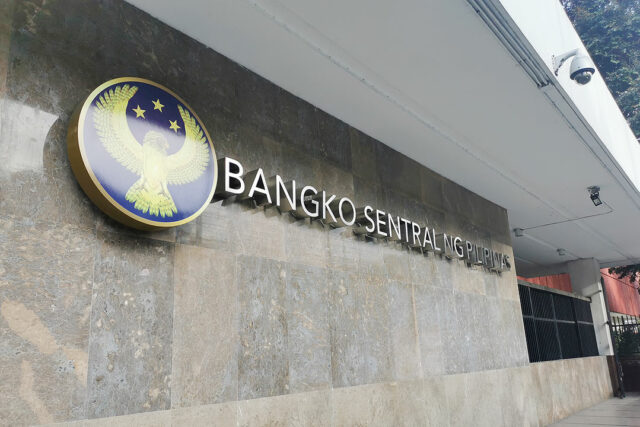
Bangko Sentral ng Pilipinas main office in Manila. — BW FILE PHOTO

YIELDS on the Bangko Sentral ng Pilipinas’ (BSP) term deposits dropped on Wednesday ahead of the release of May inflation data, which could have eased further from the April level to strengthen the case for another rate cut as early as this month.

The central bank’s term deposit facility (TDF) fetched bids amounting to P169.771 billion on Wednesday, higher than the P140 billion placed on the auction block and the P154.854 billion for the P110-billion offer a week ago. This allowed the BSP to make a full award of both tenors.

Broken down, tenders for the seven-day papers reached P90.668 billion, above the P70 billion auctioned off by the central bank and the P78.28 billion in bids for the P60 billion on offer the previous week. The BSP fully awarded the one-week deposits.

Accepted yields were from 5.05% to 5.5185%, wider than the 5.49% to 5.5255% band seen a week ago. This caused the average rate of the one-week deposits to slip by 0.75 basis point (bp) to 5.5083% from 5.5158% previously.

Meanwhile, bids for the 14-day term deposits amounted to P79.103 billion, also higher than the P70-billion offering and the P76.574 billion in tenders for the P50 billion auctioned off the week prior. The central bank likewise made a full P70-billion award of the two-week tenor.

Banks asked for yields ranging from 5.4% to 5.545%, a tad wider than the 5.5% to 5.545% margin seen a week ago. With this, the average rate for the two-week deposits fell by 1.26 bps to 5.5173% from 5.5299% logged in the prior auction.

The BSP has not auctioned off 28-day term deposits for more than four years to give way to its weekly offerings of securities with the same tenor.

Both the TDF and BSP bills are used by the central bank to mop up excess liquidity in the financial system and to better guide market rates closer to the policy rate.

The central bank said it made a full award of the TDF offer as the auction was met with “good demand,” with both tenors going oversubscribed.

Term deposit yields went down on expectations of slower May inflation, Rizal Commercial Banking Corp. Chief Economist Michael L. Ricafort said in a Viber message.

A BusinessWorld poll of 17 analysts conducted last week yielded a median estimate of 1.3% for the May consumer price index (CPI), slower than the 1.4% in April and 3.9% in the same month a year ago. This is also within the central bank’s 0.9%-1.7% forecast for the month. 

If realized, this would be the lowest clip in more than five years or since the 1.2% in November 2019.

The Philippine Statistics Authority is scheduled to release May inflation data on Thursday (June 5).

The slower inflation print would justify another BSP rate cut this month, Mr. Ricafort said.

BSP Governor Eli M. Remolona, Jr. earlier said cooling inflation has given them “plenty of room” to continue their easing cycle.

He said they could deliver two more rate cuts this year in “baby steps” of 25 bps.

A rate cut is also on the table at the Monetary Board’s next rate-setting meeting on June 19, he added.

The central bank slashed benchmark borrowing costs by 25 bps in April, bringing the policy rate to 5.5%.

It has now cut interest rates by 100 bps since it kicked off its easing cycle in August last year. — Luisa Maria Jacinta C. Jocson

VistaREIT, Inc. to conduct 2025 Annual Meeting of Stockholders online on July 7


Spotlight is BusinessWorld’s sponsored section that allows advertisers to amplify their brand and connect with BusinessWorld’s audience by publishing their stories on the BusinessWorld Web site. For more information, send an email to online@bworldonline.com.

Join us on Viber at https://bit.ly/3hv6bLA to get more updates and subscribe to BusinessWorld’s titles and get exclusive content through www.bworld-x.com.

MGen, Saudi firm team up for solar development

STOCK PHOTO | Image by Michael Wilson from Unsplash

MERALCO POWERGEN CORP. (MGen), the power generation subsidiary of Manila Electric Co. (Meralco), has entered into a partnership with Saudi Arabia-based energy developer ACWA Power to jointly explore solar power development opportunities in the Philippines and across Southeast Asia.

“This partnership marks a notable step forward in our goal to expand MGen’s renewable energy footprint by leveraging ACWA Power’s global expertise and cost leadership in solar PV (photovoltaic) development,” MGen President and Chief Executive Officer Emmanuel V. Rubio said in a media release on Wednesday.

The partnership was formalized on the sidelines of the ASEAN Summit in Kuala Lumpur, Malaysia, reinforcing both companies’ commitment to advancing clean and sustainable energy solutions.

Under the agreement, ACWA Power and MGen plan to jointly develop renewable energy projects, particularly solar.

“This agreement represents our entry into the Philippines, in partnership with MGen, which marks a major milestone in ACWA Power’s expansion across Southeast Asia,” ACWA Power Chief Investment Officer Thomas Brostrom said.

“This collaboration combines our global expertise in renewable energy with MGen’s local knowledge, enabling us to deliver reliable, affordable, and sustainable power solutions that support the country’s shift towards a low-carbon future,” he added.

ACWA Power operates as a developer, investor, and operator in renewable energy and green hydrogen, and is also the world’s largest private water desalination company.

As of 2025, the company’s portfolio includes 78.8 gigawatts (GW) of capacity, including projects with record-low solar tariffs.

MGen, for its part, has a combined net sellable capacity of 4,953 megawatts from both conventional and renewable energy sources as of March 2025.

Meralco’s controlling shareholder, Beacon Electric Asset Holdings, Inc., is partially owned by PLDT Inc. Hastings Holdings, Inc., a unit of PLDT Beneficial Trust Fund subsidiary MediaQuest Holdings, Inc., has an interest in BusinessWorld through the Philippine Star Group, which it controls. — Sheldeen Joy Talavera

AI-driven transformation must be human-centric

Boomi Chief Executive Officer Steve Lucas — BOOMI

By Cathy Rose A. Garcia, Editor-in-Chief

DALLAS, Texas — Artificial intelligence (AI) is changing the way businesses operate around the world, but Boomi Chief Executive Officer Steve Lucas says real digital transformation must be human-centric to be truly successful.

At last month’s Boomi World, Mr. Lucas said it is important to make sure that people are still at the center of AI-driven transformation.

“I believe it would be the most profound and productive decade in the next 10 years. I believe humans truly will live longer, healthier lives thanks to AI. All of us will benefit from that. But we have to stop and contemplate what societal, what business impacts AI will have,” he said.

In his best-selling book “Digital Impact: The Human Element of AI-driven Transformation,” Mr. Lucas said it would be a mistake to focus on AI without considering how it affects people.

“AI and automation are powerful but their success hinges on one thing: The people who use them. Without a human-centric approach, even the most advanced technology will fail,” he added.

A self-described AI optimist, Mr. Lucas said AI will unlock more opportunities for businesses and the world.

However, he warned that those who lack a strategy for taking advantage of the technology will not be able to compete.

“For every one Blockbuster Video, that one cautionary tale, there will be 100,000 Blockbusters thanks to AI… I know that that may not be the most popular opinion, but it’s true. AI will create such incredibly productive environments that organizations that are relying on humans alone or deterministic process alone, you won’t be able to compete… We’re not talking 10 years from now, we’re talking five,” he said.

Integration and automation are essential for businesses to get the most out of AI, he added.

HUGE OPPORTUNITY
Executives at Boomi, a leading integration and automation company, said they want to make AI more practical for businesses.

Matt McLarty, chief technology officer (CTO) at Boomi, said AI will help augment human capabilities, not replace humans.

“I’m definitely in the camp of yes, AI is a huge, huge opportunity but it’s here to help us, not replace us,” he told BusinessWorld in an interview.

The Boomi platform can be a good entryway for companies that are hesitant to adopt AI, he said, noting it provides a practical and intuitive way to experiment with AI without requiring a significant investment.

“This whole velocity of innovation around AI is so crazy. Trying to keep pace with it is challenging. At the same time, our customers and organizations are still back here saying, wait for us, what do we do,” Mr. McLarty said.

Markus Mueller, global field CTO for application programming interface (API) management at Boomi, said the company is taking the lead in making sure that enterprises make use of AI through the platform.

“Where we lead is practical AI — bringing AI into the enterprise and making it usable — because a lot of the other companies that you find in the AI space, they do great stuff, they do great research, but they don’t excel in making it usable in the companies today,” he told BusinessWorld.

At Boomi World, the company unveiled new product innovations such as the general availability of Agentstudio, new AI agents, the addition of Boomi Data Integration to the enterprise platform, as well as support for Model Context Protocol.

For instance, users can design, govern and orchestrate AI agents at scale within a no-code environment on Boomi Agentstudio. AI agents are software entities that use AI to perform tasks or services autonomously or semi-autonomously, based on programming, learned behavior and data.

Mr. McLarty said they expect it to be a “very common thing” to have Boomi customers build their own agents.

“Because of the pace of change that’s going on out there, every organization needs to be fairly experimental with things… I think just by the democratized nature of our platform, it makes it easy to experiment… Like, you can try things out, you can experiment with this new technology in a way that’s intuitive, but also you don’t feel like you just had to invest in a whole data science team,” he added.

DIGITAL FRAGMENTATION
However, one of the biggest challenges facing enterprises in their transformation journey is digital fragmentation.

Mani Gill, vice-president for product management at Boomi, said data management has always been a critical issue for organizations, and more important than ever with the rise of AI agents.

“Organizations rely on data to make decisions, run their businesses, and operate their businesses. And now AI agents are thirsty for data, otherwise, these agents are not going to operate properly,” Mr. Gill told BusinessWorld, noting agents will need context for the data.

Boomi last month announced the general availability of Boomi DataHub Command Center, a new module within the Boomi DataHub, that consolidates data management tools, simplifies governance and presents real-time data views.

“Data and AI go hand in hand. Data foundation is super important to successful AI projects, and AI is super important to automate and integrate organizations and businesses… That is partly why we want to democratize the use of building agents and make it available to all of our customers,” Mr. Gill said.

Another challenge for organizations is dealing with the “sprawl problem” when handling significant amounts of data and applications.

“Being able to deal effectively with complexity is probably the main thing that organizations need to do… We have embraced the complexity, so it does make us a natural platform for that,” Mr. McLarty said.

“But the underlying message is there’s no silver bullet. It is a lot of work to deal with the complexity that’s there. But that’s where the opportunity is.”

Hong Kong’s Jean-Pierre nails the Paris ambiance with bistro favorites

PÂTÉ, onion soup, and steak tartare. — BLOOMBERG

By Balazs Penz

I WANTED TO TRY Jean-Pierre as soon as the signs went up on Bridges Street. My excitement grew when the back story emerged about Black Sheep Restaurants’ Marc Hofmann looking to create a “jubilant homage” to the bistros of Paris at one of Hong Kong’s emerging gastro hot spots. Recreating the vibe seemed like a challenge, so I went in expecting clunky replica decor, courageous cooking, and mildly hostile service. I was wrong about everything.

Everyone wants to be a bit Parisian, from Cincinnati in the US to Tromso in Norway and Pondicherry in India and, well, results will vary. It’s even a bit of a self-deprecating joke in my hometown. So how close can Hong Kong get, under the scrutiny of its lively French community?

Jean-Pierre, named after Mr. Hofmann’s father, gives itself a massive head start. The bistro greets you with wide smiles, authentic accents, and shards of laughter drifting over a blast of music — the playlist is a mix of pop classics and chanson, perhaps something you might have heard on Paris radio circa 1979. Fans of Baccara and Kiki Dee will be bopping. The dining room is just the right kind of dim and just the right amount of frenzied, with white-aproned servers gliding precariously between the tables and somehow always turning up in time. It’s casual. Saturday is definitely date night, with huddled couples at the small tables in the middle and raucous groups of friends on the dark red couches around the perimeter. As chaotic as the place seems at first, it’s cozy and welcoming. It feels like a neighborhood eatery you’ve been frequenting for years, where your waitress knows you’ll take your water sparkling and your espresso before the dessert.

The amuse-bouche materializes just as we finish squinting at the menu, which is barely legible behind a plastic sheet in a nice touch of authenticity. It’s promising: crunchy cheese buns and a surprising clutch of crisp radishes, conjuring up the image of a chef spending the morning at the local market to find the best-looking fresh produce. We go for the classics: pâté, onion soup, escargot (HK$128 each), and later find a plate of steak tartare that somehow ends up among our order (HK$198, we weren’t charged for it). For mains, I picked the boeuf bourguignon (HK$308) as the duck confit was out, and my guest chose the gnocchi Parisienne (HK$268). We were undecided on the dessert just yet, but there’s baba au rhum (yeast-risen cake soaked in hot rum) on the menu, noted.

Unfortunately, we find that the radishes were the last bit of culinary excitement. The rest of the fare is well made but avoids any risk; the spices and textures are dialed way back. The onion soup is the highlight, its initial thinness slowly giving way to a satisfying, cheesy depth. The pâté is fine, if a bit salty, but it comes with chewy, tough toast. The escargot is scintillatingly buttery, but the herbs fall flat. Both mains are lacking conviction and an extra kick of flavor. They do the basics, but don’t scream passion project. Maybe the desserts will get us over the hump? Can’t avoid the baba au rhum (HK$188) at this point and let’s throw in a mille-feuille (HK$158). Both are immediately forgettable beyond the sugar high and their intimidating size.

It’s fine. A night of old-time favorites done competently at your neighborhood bistro is fine. Perfect for a weeknight bite or in a supporting role to your dazzling conversation, your blistering romance. The ambiance is special, which goes a long way. It’s in the eye of the beholder whether that’s enough to justify very nearly HK$3,000 for two people, including four glasses of wine — even if the Chablis (HK$288 a glass) was spectacular.

The vibe: Cozy chaos. It’s a neighborhood bistro, gregarious and relaxed, it feels well lived-in even after such a short time. The main dining room was full on a Saturday night, there were people milling about at the bar and hanging out on the terrace.

Can you conduct a meeting here? Definitely, it’s dark and loud, with a lot happening everywhere. Nobody will pay attention to your murmurings, whether you’re trading the latest M&A buzz, workplace gossip, or engaged in a more intimate liaison.

What we’d order again: The onion soup certainly hit the spot. I had a nagging feeling about the duck confit and wouldn’t mind a go at a couple of the signatures we skipped: the steak au poivre and the three-yellow chicken.

How’s the food? Utilitarian. It’s a lot more Makélélé than Zidane and could use a spin move or two. The portions are generous, especially the desserts, and the menu has all the bistro favorites.

Need to know: Jean-Pierre is on 9 Bridges Street. It takes reservations online and it’s worth planning a few weeks ahead for Friday or Saturday evenings. The restaurant is open Monday to Wednesday 6 p.m. to 11 p.m., Thursday to Saturday 6 p.m. to 11:30 p.m. and closed on Sundays. — Bloomberg

UnionBank looks to raise at least P10B from dual-tenor bond offer

UNION BANK of the Philippines, Inc. (UnionBank) is looking to raise at least P10 billion from its dual-tenor bond offer, eyeing P5 billion from each tranche.

The listed bank on Wednesday began its public offering of 1.5-year senior fixed-rate Series H bonds due 2026 and three-year senior fixed-rate Series I bonds due 2028, it said in a disclosure to the stock exchange.

The offer is set to run until June 19, unless ended earlier by the bank. The papers are set to be issued, settled, and listed on the Philippine Dealing and Exchange Corp. on June 26.

“The bonds will be offered with a minimum aggregate principal amount of P5 billion per tranche, with an oversubscription option,” UnionBank said.

The papers will be issued out of the bank’s expanded P100-billion peso bond program approved by its board of directors on Feb. 28.

UnionBank priced the 1.5-year notes at 5.88% per annum, while the three-year bonds carry a rate of 6.02% per annum.

The papers are being sold for a minimum investment amount of P100,000 and in multiples of P50,000 thereafter.

ING Bank N.V. Manila Branch, Philippine Commercial Capital, Inc., and Standard Chartered Bank have been appointed as the joint lead arrangers and bookrunners for the transaction.

They will also act as selling agents together with UnionBank.

UnionBank last tapped the domestic bond market through an offering of 1.5-year and three-year senior bonds in December 2023 from which it raised P18.168 billion. This was higher than the initial combined issue size of at least P2 billion, or P1 billion for each tenor.

Broken down, it raised P10.34 billion via the 1.5-year senior fixed-rate Series F bonds due in 2025 with an interest rate of 6.5625% per annum and P7.8295 billion through the senior fixed-rate three-year Series G bonds due in 2026 with an annual yield of 6.68%.

UnionBank saw its attributable net income decline by 28.93% year on year to P1.4 billion in the first quarter due to one-time write-offs from a subsidiary and front-loaded non-recurring costs.

Its shares climbed by five centavos or 0.15% to close at P33.20 apiece on Wednesday. — A.M.C. Sy

SFA Semicon Philippines Corporation notifies the public and stockholders of its petition filed with the SEC


Spotlight is BusinessWorld’s sponsored section that allows advertisers to amplify their brand and connect with BusinessWorld’s audience by publishing their stories on the BusinessWorld Web site. For more information, send an email to online@bworldonline.com.

Join us on Viber at https://bit.ly/3hv6bLA to get more updates and subscribe to BusinessWorld’s titles and get exclusive content through www.bworld-x.com.

Jollibee Foods Corporation to hold virtual Annual Stockholders’ Meeting on June 27


Spotlight is BusinessWorld’s sponsored section that allows advertisers to amplify their brand and connect with BusinessWorld’s audience by publishing their stories on the BusinessWorld Web site. For more information, send an email to online@bworldonline.com.

Join us on Viber at https://bit.ly/3hv6bLA to get more updates and subscribe to BusinessWorld’s titles and get exclusive content through www.bworld-x.com.

Enterprises keen on Boomi’s AI-powered offerings

Boomi sign — BOOMI

DALLAS, Texas — Enterprises are turning to Boomi to tackle integration and data management issues, as well as automate business processes using artificial intelligence (AI).

At Boomi World, the company’s top executives announced a major push into AI development that strengthens its core business. It unveiled its Agentstudio that allows enterprises to design their own AI agents, which would help streamline business processes.

“As organizations accelerate AI adoption, the complexity of developing, auditing and managing AI agents will continue to grow, creating governance, security and integration challenges across industries,” Boomi Chief Technology Officer Ed Macosky said.

He said the priority is to provide its customers with a platform that simplifies AI agent deployment and management.

Several Boomi customers shared with BusinessWorld how the Boomi enterprise platform has helped address issues related to data management and integration, and how the company’s new agentic AI offerings will figure into their plans.

NFI INDUSTRIES
Rodney Lucas, senior director of application services at third-party logistics company NFI Industries, said they faced significant integration issues as the company’s volume grew in recent years.

“It even got to the point where our own CEO (chief executive officer) had said that our integration keeps him all that late. And that’s not a good place to be,” he said in an interview.

Started in 1932 by Israel Brown, NFI Industries is a nearly $4-billion company with 18,000 employees, 5,000 trucks and over 73 million square feet of customer warehouse space.

“Prior to moving to Boomi, we had on average 100 tickets that were created in our system regarding integration issues. On average, it was about 100 a month. There were spikes up to 400 a month at times,” Mr. Lucas said.

Since using Boomi, he noticed the tickets have dropped to about 30 a month.

“With the end-to-end monitoring that we put in place, we’re able to get ahead of the issues… Probably the biggest benefit to the company is just that nobody even sees when there’s a failure. We’re taking care of it,” Mr. Lucas said.

“And next step is we want to use AI to help out with that, figure out where the ticket is supposed to route.”

NFI also saw a reduction in integration build times to just 12-16 hours from 40 hours previously.

Mr. Lucas said he is excited about the announcements about new innovations and products at Boomi World.

“We’re trying to get tools in the hands of both our client services teams and our operations teams so that they can self-support. And one of the biggest things that we look at using AI for in the near term is enriching the data,” he added.

HEB CONSTRUCTION
Auckland-based HEB Construction has extended its use of the Boomi Enterprise platform “to maximize the effectiveness of an existing third-party AI-powered road monitoring tool.”

HEB uses Boomi to integrate the AI tool with its geographic information system and central and local government work and asset management platform. This allows the delivery of timely and accurate insights to its maintenance team and clients.

Mircel van der Walt, solutions and architecture manager at HEB Construction, said they have made progress in collecting data, with 25 million records now available for training their AI model.

“It’s a happy coincidence that Boomi started releasing its offerings of how AI can be delivered, maintained, monitored, governed. So that works out great. We don’t have to undo anything,” he said in an interview.

“Our future plan is to use all the new Boomi offerings around the AI space to go build an agent for this specific topic and use it as our fundamental use case to venture into the AI game.”

Mr. Van der Walt said they are planning to use the road maintenance data to build an agent that could predict where faults might exist with a certainty percentage above 80-90%.

“It would be nice to get 95% accuracy on where a pothole would be in the next week. That would be like a superpower. But if we were realistic, it would take us some time to get to that. We’ll reach it but just not tomorrow,” he said.

Having been a Boomi customer for years, Mr. Van der Walt said he is impressed with the company’s continual innovation.

Boomi is also good at listening to customer feedback and incorporating it into their offerings, he said.

“For us, it’s great being part of this family because one, we get the power of the platform and all the very smart people that build it. (Two,) Boomi is very good at listening to us as the customer,” he added.

LEXITAS
Lexitas, a leading provider of technology-enabled litigation services, had acquired around 40 companies since 2020 but soon discovered issues in data management. There were duplicated and inconsistent customer data stored in siloed systems.

Sherry Bourque, chief accounting officer at Lexitas, said they turned to Boomi Data Hub for master data management so it could “tame” all of the customer data from these acquisitions.

It created a unified “golden record” that consolidated disparate data sources. This involved applying a single identifier to a customer.

“We collapsed the number of customers because now there’s one single identifier for that. We are able to do integrations faster because of it. The books get closed faster because once you do the integration you don’t have to go to the manual system to get the sales data and book it,” she said.

This gave Lexitas a 360-degree view of customer information which could be used by the sales and marketing teams. It also gave better financial data from the acquisitions.

“(We are) closing the books faster, getting rid of the noise of all the systems,” she added.

Moving forward, Ms. Bourque said they are looking at using some of Boomi’s AI products.

“We’re going to entertain the idea of some AI and those new AI products that they’re talking about that we can use,” she said.

Lexitas and NFI were also named the winners of the 2025 Boomi Customer Innovation Awards, recognizing enterprises that use Boomi Enterprise Platform to lead digital change. — Cathy Rose A. Garcia

The rise and rise of Avocadoria: How can foodie entrepreneurs replicate their success?

AVOCADORIA.COM.PH

Among Filipino entrepreneurs, food and beverage businesses have long been a perennial favorite. Who hasn’t dreamt of owning a cafe and bakery? Or their own chain of popular food stalls? Even with the impressive growth of the F&B industry today, entrepreneurs in the food biz need to ask themselves important questions: What does it take to start a 230+ branch chain like Avocadoria? What is the recipe for success when putting up their own cafe and bakery?

I recently spoke to chef Czarina Sevilla, or Chef Cza, the entrepreneur behind Avocadoria and The Taste of Czaczacza, who is living the Pinoy entrepreneurial dream. The Mansmith Innovation awardee established Avocadoria in 2019, starting with one small, 20-square-meter branch. In just a few years, Avocadoria has spread across the country with more than 200 branches and become a lifeline for Filipino avocado farmers. At the same time, Chef Cza has pursued a dream of hers to build her own cafe and bakery, The Taste of Czaczacza, as well as an upcoming restaurant called Czarina’s.

If you’re a foodie entrepreneur, this story provides a wealth of insight and inspiration into setting up your own food business.

FROM ONE TO 230
So, how did Avocadoria grow from one to 230+ branches? Before Avocadoria, Chef Cza, a hotel and restaurant management graduate, worked in the industry, gaining valuable experience. Initially, she worked in Crowne Plaza where she found mentorship with the chefs there, and a vocation to become a pastry chef. Then she worked for various restaurants, rising to the position of Chef de Partie. Crucially, it was during this time that she created the menu for Avocadoria.

Fast forward to 2019. Deciding to finally establish Avocadoria, Chef Cza began her entrepreneurial work with a loan from her sister, and a 20-square-meter space borrowed from her brother.

Despite founding the company just before the COVID-19 pandemic, she sees the circumstances as an advantage for Avocadoria.

“During the COVID times, you really need to boost your immune system so that you won’t get sick,” she explained. “The number one fruit that can boost your immune system is avocado.”

As 2020 began and lockdown was imposed, many food and restaurant businesses shut down. But Avocadoria kept opening branches on the strength, at the time, of its cake business. In fact, almost two months after opening her first branch, Chef Cza turned Avocadoria into a franchising company.

Taking advice from her sister, she recalled, “[My sister] said, let’s open it as a franchise. She said, there’s nothing like this.” Without hesitation, Chef Cza agreed, despite admittedly not knowing much about franchising. In just three months, she had 111 franchisees.

“If there’s an opportunity, grab it,” she said. “Because if the opportunity comes to you, then you reject it, maybe tomorrow you won’t have that opportunity.”

To entrepreneurs looking to replicate her success, she advises two things: “Number one, your concept needs to be unique. It needs to be impossible to be replicated. And then number two, choose your franchisees. Because it’s going to be a long-term partnership.”

LEARNING FROM FAILURE
Despite the successful run Avocadoria has experienced from the pandemic years to the present, Chef Cza wasn’t always blessed with entrepreneurial success. In fact, her first business failed.

“I wanted to teach,” she said. “I wanted to have my own pastry workshop. Because when I attended workshops, I met different classmates who came from faraway places to do workshops.”

Leaving her work in the restaurant industry, she fulfilled her dream to put up the business. But ultimately the journey wasn’t successful.

“Not everything you want is for you,” she said. And yet, in that failed business venture was the seed for Avocadoria. “Everything happens for a reason,” she said. “Because if it didn’t happen, I wouldn’t be able to do Avocadoria.”

Initially, there were few who believed in Chef Cza’s business idea for Avocadoria. But she insisted on working to make the business a reality.

“If I really want it, I work hard for it,” she said. “Until I prove it’s impossible. That’s how I am. That’s the personality I have. Wala sa dictionary ko ang giving up. (Giving up is not in my dictionary.)”

The first hurdle Avocadoria needed to clear was the perception that avocados were a seasonal fruit. Chef Cza said, “We met a supplier and he said, ‘No, avocado is all year round.’ And then, from that one person, my avocado dream started.”

Today, Avocadoria’s 230+ branches have had a positive effect on not just the food industry but also for avocado farmers. “I saw that we have a lot of avocados here in the Philippines, but there’s no demand,” she said. “There are a lot of avocado farmers, avocado trees from the backyard, but it usually becomes rotten because there’s no demand.

“I can proudly share to all of you that because of Avocadoria, the demand for avocado fruit is good here in the Philippines.”

Moving from strength to strength, Chef Cza Sevilla has grown Avocadoria to near-ubiquitous status while establishing new businesses like The Taste of Czaczacza and Czarina’s. Yet somehow her inspirational story is only the beginning.

“You know what I want now?” she said. “To change the alphabet. So it will be A for Avocado.”


RJ Ledesma (www.rjledesma.com) is a Hall of Fame Awardee for Best Male Host at the Aliw Awards, a multi-awarded serial entrepreneur, motivational speaker, and business mentor, podcaster, an Honorary Consul, and editor-in-chief of The Business Manual. Mr. Ledesma can be found on LinkedIn, Facebook and Instagram.

The RJ Ledesma Podcast is available on Facebook, Spotify, Google and Apple Podcasts. Are there entrepreneurs you want Mr. Ledesma to interview? Let him know at ledesma.rj@gmail.com.