Home Blog Page 1448

Banks’ outstanding FCDU loans inch up at end-2024

US dollar banknotes are seen in this photo illustration taken Feb. 12, 2018. — REUTERS

OUTSTANDING LOANS granted by banks’ foreign currency deposit units (FCDU) inched up at end-2024, the Bangko Sentral ng Pilipinas (BSP) said on Monday.

Outstanding FCDU loans rose by 0.5% to $15.82 billion at end-December from $15.75 billion at end-September as disbursements exceeded principal repayments, the BSP said in a statement.

Year on year, loans granted by banks’ FCDUs climbed by 4.3% from $15.16 billion at end-2023.

FCDUs are BSP-approved bank units that perform transactions involving foreign currencies, including deposits and loans.

Gross loan disbursements declined by 54.9% to $9.81 billion in the fourth quarter of 2024 from $21.77 billion in the previous quarter, “primarily driven by a foreign bank branch’s adjustment in its funding strategy for its affiliate,” the central bank said.

Loan repayments also fell by 55.3% to $9.7 billion from $21.68 billion in the same comparable periods. These resulted in an overall net disbursement.

The majority or 77.1% of banks’ outstanding FCDU loans at end-December was made up of medium- to long-term debt, or those payable in more than a year, totaling $12.202 billion. This was up from $12.177 billion at end-September, which made up 77.6% of the period’s total.

By borrower type, outstanding FCDU loans granted to residents stood at $9.913 billion or 62.7% of the end-2024 total, up from $9.677 billion at end-September 2024 (61.5%).

“Majority went to the following sector/industries: merchandise and service exporters ($2.52 billion or 15.9%); towing, tanker, trucking, forwarding, personal and other industries ($2.24 billion or 14.1%); and power generation companies ($1.93 billion or 12.2%),” the BSP said.

FCDU loans to nonresidents stood at $5.91 billion, down from $6.07 billion the quarter prior.

Meanwhile, FCDU deposit liabilities went down by 3.5% to $55.46 billion as of end-2024 from $57.56 billion in the previous quarter.

Year on year, FCDU deposits inched up by 1.9% from $54.42 billion at end-December 2023.

“The bulk of these deposits ($54.14 billion or 97.6%) continued to be owned by residents, essentially constituting an additional buffer to the country’s gross international reserves,” the central bank said.

The overall FCDU loans-to-deposit ratio stood at 28.5% at end-2024, rising from 27.4% at end-September 2024 and 27.9% at end-2023. — A.M.C. Sy

China’s trade and their rising industrial-energy capacity

BEIJING — This is the first time I have set foot in the capital city of China. I am here to study some infrastructure, commercial, and energy facilities of China and I hope to draw new lessons based on actual observations to complement my economic and statistical research of international economics and business.

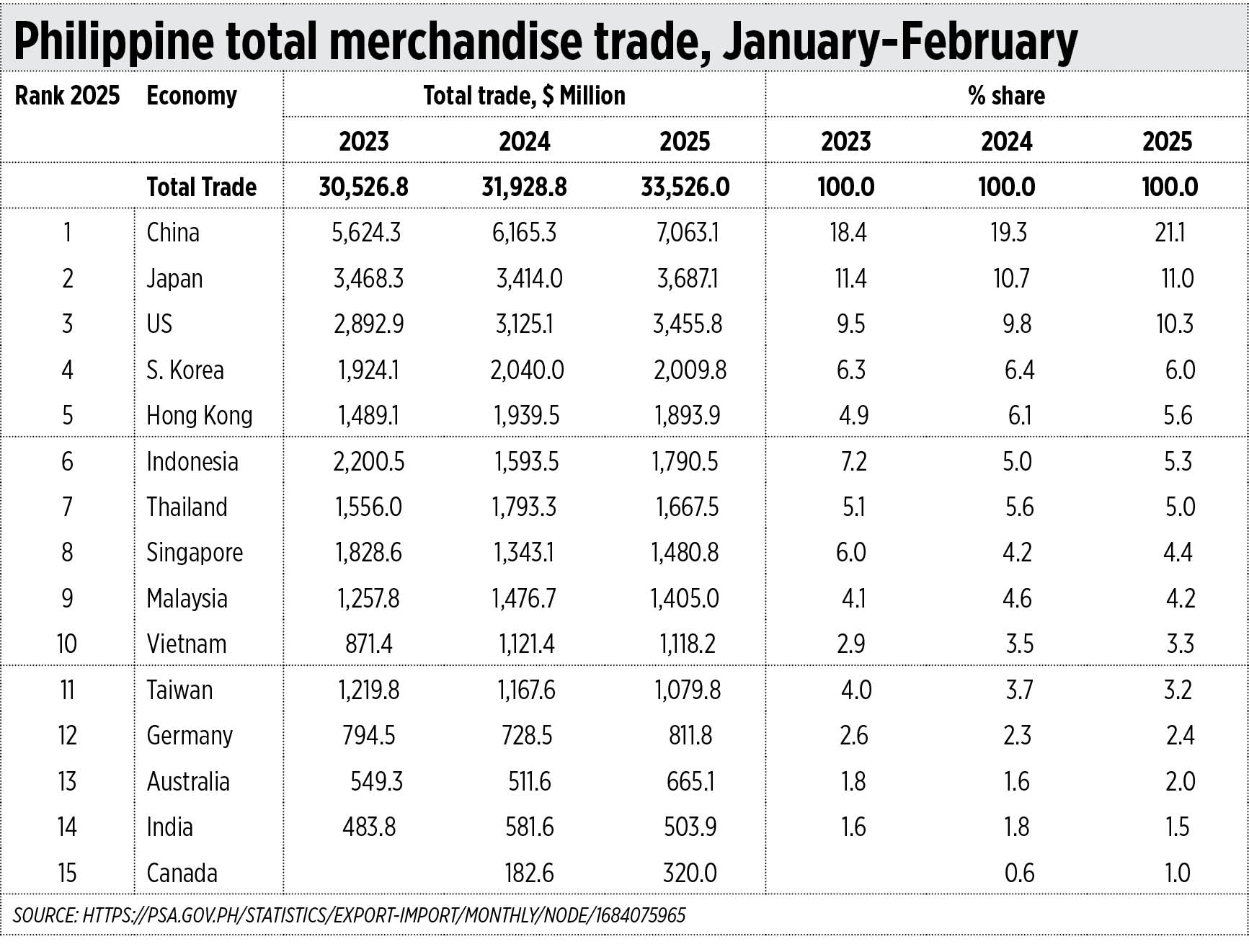
Last week, on March 28, the Philippine Statistics Authority (PSA) released the country’s merchandise trade data for February. I downloaded the excel file and went back to the February 2024 file that includes comparable data for February 2023. So, the January-February data of those three years are now available. I then added the exports plus imports to get total trade of the Philippines per major country trade partner.

Several important trends are shown. One, our total trade has been growing moderately by an average of 4.8% a year in 2024 and 2025. Two, China’s share is rising, from 18.4% of the total in 2023 to 21.1% in 2025. Three, the combined share of Japan and the US, 21.3% in 2025, is equivalent to China’s share. Four, the share of Hong Kong is rising while Taiwan’s share is falling (see the table).

This trend in our international trade should have some impact in our industrial, foreign affairs, and even defense policies. The consumption pattern of our businesses and households is towards buying products made or sourced in China and Hong Kong. Meanwhile, our foreign affairs and defense policies have somewhat antagonistic attitudes towards China. I noted this trend in a couple of recent articles: “On GDP size, exports, FDI and electricity generation” (March 18) and “Exports and life expectancy: some global trends” (March 25).

HONG KONG MODERNIZATION
I went to Hong Kong first to meet some friends in the economics and research consultancy profession. The Hong Kong airport alone still fascinates me — it is so huge, both the runways and passenger terminals. When I went to Argentina last December to attend the free market Tholos Forum 2024, my flight passed by Ethiopia, Sao Paulo in Brazil, then Buenos Aires. I noted that the space and evening lights of those three international airports combined would perhaps be smaller than Hong Kong airport.

The spacious and fast airport train, the huge, tall, long bridges that connect several islands, the underground tunnels and the subway train system, the elaborate highway interchanges, the bright lights of the streets and buildings that are open the whole night, the double-decker buses — they are all evidence of a prosperous and abundant economy and a fast-paced city life.

BEIJING MODERNIZATION
I got to see many big cities below the plane as it started its descent after a more than three-hour flight from Hong Kong to Beijing. I was surprised by the large swathes of high-rise buildings, straight and wide highways and rail systems, including long tunnels under the mountains, and elaborate electrical towers and pylons that crossed mountains and flatlands.

Beijing airport is also huge but not as modern-looking as the Hong Kong airport. There were also fewer planes and passengers than in Hong Kong. The highway from the airport to the city was wide and smooth, but the traffic was moving slowly even on a Sunday night, there were no small public transportation options like jeepneys and tricycles, and very few motorcycles.

Department of Budget and Management (DBM) Secretary Amenah F. Pangandaman would be happy if the public works department and local governments built similarly smooth and wide public roads because the DBM is releasing more than a trillion pesos a year now for these two entities alone.

My local host said that Beijing’s subway train system — all 880 kilometers of it — is elaborate and modern. That distance is farther than Manila is to Ilocos, and that is the Beijing subway system alone.

ELECTRICITY GENERATION
I noted in my March 18 piece that “the Philippines’ total generation of 119 terawatt-hour (TWh) in 2023 was equivalent to only five days of China’s generation” of 9,456 TWh. Of this, 61% is generated by coal-powered plants.

The Philippines’ largest coal plant is Bataan’s GN Power Dinginin (GNPD), owned by Aboitiz Power, which produces 1,336 megawatts (MW) of electricity. In 2024 alone, China constructed enough new coal plants to produce 94,500 MW of electricity. That means they built an equivalent of 71 GNPD-sized coal plants last year. And no more GNPD-size coal plant is forthcoming in the Philippines.

We should aspire for more economic prosperity, material and tangible wealth in the Philippines, not just psychological or sociological happiness of the people. We should aspire to have more modern airports, seaports, tollroads, train systems, huge coal and gas plants, wide and smooth public roads in both urban and rural areas, and so on. This way, growth will be sustained and be felt by everyone as people aspire to uplift their social and economic well-being.


Bienvenido S. Oplas, Jr. is the president of Bienvenido S. Oplas, Jr. Research Consultancy Services, and Minimal Government Thinkers. He is an international fellow of the Tholos Foundation.

minimalgovernment@gmail.com

Manila places 2nd in Prime International Residential Index

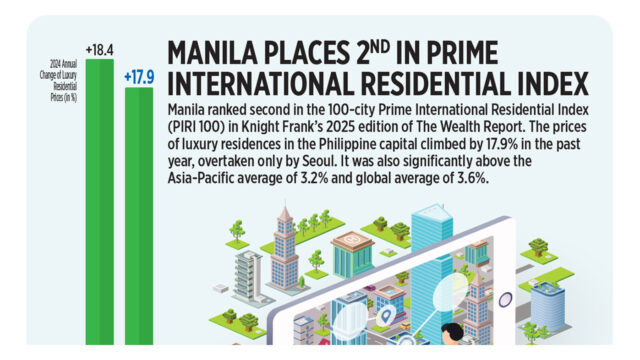
Manila ranked second in the 100-city Prime International Residential Index (PIRI 100) in Knight Frank’s 2025 edition of The Wealth Report. The prices of luxury residences in the Philippine capital climbed by 17.9% in the past year, overtaken only by Seoul. It was also significantly above the Asia-Pacific average of 3.2% and global average of 3.6%.

Manila places 2<sup>nd</sup> in Prime International Residential Index

Heartthrob actor Richard Chamberlain, star of The Thorn Birds, 90

Richard Chamberlain and Rachel Ward in a scene from the 1983 TV miniseries The Thorn Birds.

NEW YORK — Richard Chamberlain, the Emmy-nominated actor and 1960s heartthrob who rocketed to fame in the TV medical drama Dr. Kildare and starred in the mini-series Shogun and The Thorn Birds has died at the age of 90, publicist Harlan Boll said.

Mr. Chamberlain died late on Saturday in Hawaii from complications from a stroke, he said in a statement on Sunday.

Mr. Chamberlain was an instant hit, and became a teen idol, as the handsome Dr. James Kildare in the series that ran from 1961-1966. The Guardian newspaper said the then 27-year-old actor “looked like he had been sculpted by a loving god out of butter, honey and grace.”

The breakout role was the start of a six decade-career that spanned theater, films, and television.

Mr. Chamberlain was dubbed the “king of the mini-series” after appearing in several TV dramas in the 1980s and earned plaudits on stage in roles ranging from Professor Henry Higgins in My Fair Lady and Captain von Trapp in The Sound of Music to Shakespeare’s Hamlet and Richard II.

He also was the original Jason Bourne in the 1988 mini-series The Bourne Identity.

“What’s fascinating about Richard is that his range is enormous. His ability to be different each time out is what makes him such a valuable property,” producer Susan Baerwald told the New York Times in 1988.

PRETENDING TO BE SOMEONE ELSE
The versatile actor was nominated for four Emmys — as an English navigator in 17th century Japan in Shogun (1981), a love-torn priest in The Thorn Birds (1983), Swedish diplomat Raoul Wallenberg in Wallenberg: A Hero’s Story (1985) and for the title role in the 1975 TV movie The Count of Monte-Cristo.

Most of his roles were as romantic leading men, which is why he did not publicly reveal he was a homosexual until he was 68 years old. He feared it would ruin his career. For much of his life he said he pretended to be someone else.

“When you grow up in the ’30s, ’40s and ’50s being gay, it’s not only ain’t easy, it’s just impossible,” he told the New York Times in 2014. “I assumed there was something terribly wrong with me. And even becoming famous and all that, it was still there.”

Mr. Chamberlain said it was a tremendous relief after he acknowledged his sexuality in his 2003 autobiography Shattered Love: A Memoir.

“I had no fear left,” he said in a 2019 interview. “It was a wonderful experience. People were open, friendly and sweet.”

HONING HIS ACTING SKILLS
Born George Richard Chamberlain on March 31, 1934, in Los Angeles, he was the youngest of two sons. He had hoped to be an artist but switched to acting after attending Pomona College in California.

His acting career was put on hold when he was drafted into the US Army in 1956 and served in Korea. After his discharge, Mr. Chamberlain returned to Los Angeles, where he co-founded a theater group and had small parts on TV before becoming Dr. Kildare.

The success of the TV show led to a brief singing career and film roles opposite Julie Christie in Petulia (1968) and The Madwoman of Chaillot (1969) with Katherine Hepburn. He had a brief run in the musical Breakfast at Tiffany’s with Mary Tyler Moore. The show closed after four previews.

In the late 1960s, Mr. Chamberlain moved to England where he honed his acting skills in the BBC series The Portrait of a Lady and as Hamlet at the Birmingham Repertory Theater.

Dr. Kildare was a huge hit in England, and I heard that all the London reviewers were coming to rip this interloper to pieces,” he said in an interview. “But we got very good reviews.”

Mr. Chamberlain returned to the big screen as Lord Byron in the drama Lady Caroline Lamb (1972), The Three Musketeers (1973) and as a villain in the disaster film The Towering Inferno (1974).

Throughout his career he mixed roles in Broadway plays, including Tennessee Williams’ The Night of the Iguana, with musicals, TV, and films.

After coming out publicly, he played both gay and straight characters in TV shows including Brothers & Sisters, Will & Grace, and Desperate Housewives.

The actor released a book of haiku poetry in 2012 and narrated Audubon environmental television specials.

Mr. Chamberlain lived in Hawaii for many years and had a three-decade relationship with actor and writer Martin Rabbett, his co-star in the 1986 adventure film Allan Quatermain and the Lost City of Gold. The couple parted in 2010 but remained close friends.

“He is free and soaring to those loved ones before us. How blessed were we to have known such an amazing and loving soul,” Mr. Rabbett said in a statement. — Reuters

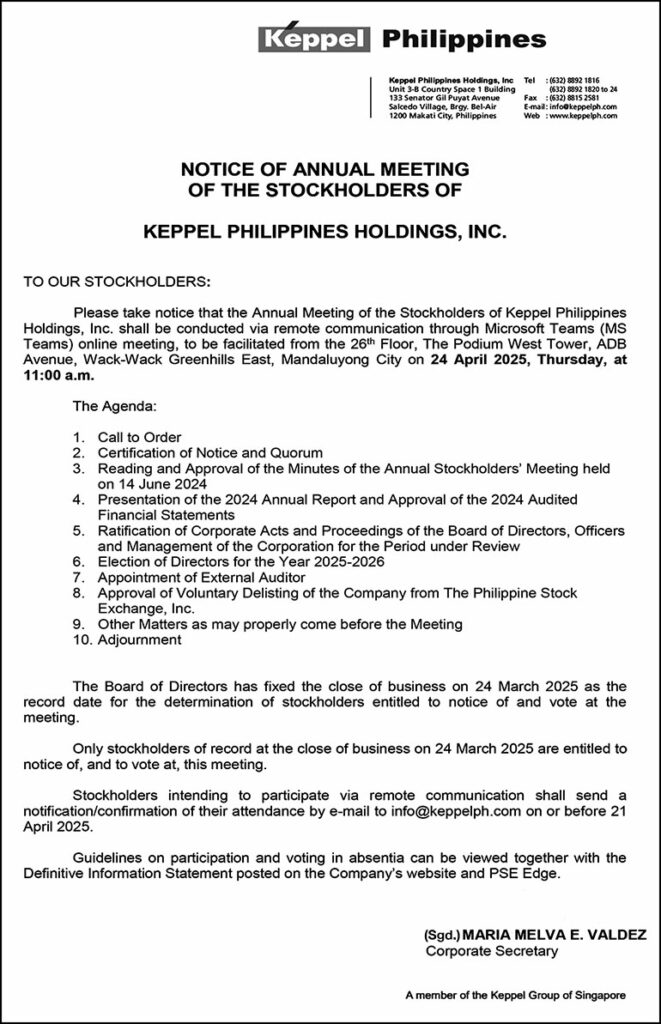
Keppel Philippines Holdings, Inc. to conduct Annual Stockholders’ Meeting on April 24 via remote communication


Spotlight is BusinessWorld’s sponsored section that allows advertisers to amplify their brand and connect with BusinessWorld’s audience by publishing their stories on the BusinessWorld Web site. For more information, send an email to online@bworldonline.com.

Join us on Viber at https://bit.ly/3hv6bLA to get more updates and subscribe to BusinessWorld’s titles and get exclusive content through www.bworld-x.com.

The truth behind Metro Manila’s condo crisis

METRO MANILA’S CONDOMINIUM OVERSUPPLY IS STRICTLY LOCALIZED, NOT MARKET-WIDE
Contrary to common narratives, Metro Manila is not experiencing a widespread condominium oversupply. This perceived glut is primarily concentrated in specific areas — most notably in select barangays of Pasay, Parañaque and Muntinlupa — likely driven by the exodus of Philippine Offshore Gaming Operators (POGO), which significantly increased condo vacancies in those neighborhoods. The situation was further compounded by pandemic-era migration, as many residents returned to their hometown provinces. The rise of virtual assistant work — now employing about a million Filipinos — has further enabled many to remain based outside Metro Manila. Outside these areas, particularly around major business districts, universities and upscale communities, absorption and occupancy remain stable. Understanding this distinction is crucial for accurately assessing risks and opportunities within the condominium market.

THREE DISTINCT MOTIVES DRIVE THE CONDOMINIUM MARKET
To better comprehend the condominium market dynamics, it’s essential to recognize the distinct buyer segments driving demand. The first segment includes end-users — students seeking proximity to educational institutions, corporate professionals looking for suitable accommodation close to employment hubs and expatriates requiring centrally located residences. The second segment consists of investors who acquire units primarily to generate rental income, typically favoring mid-to-lower-tier properties with consistent demand. Lastly, the luxury market appeals to high-net-worth individuals prioritizing capital appreciation, long-term wealth preservation and the supplementary benefits of rental returns by leasing to expats. Clearly identifying these segments provides context for the ongoing challenges in affordability and market attractiveness.

CONDOMINIUM VALUES HAVE APPRECIATED NEARLY 300%, OUTPACING FAMILY INCOME GROWTH
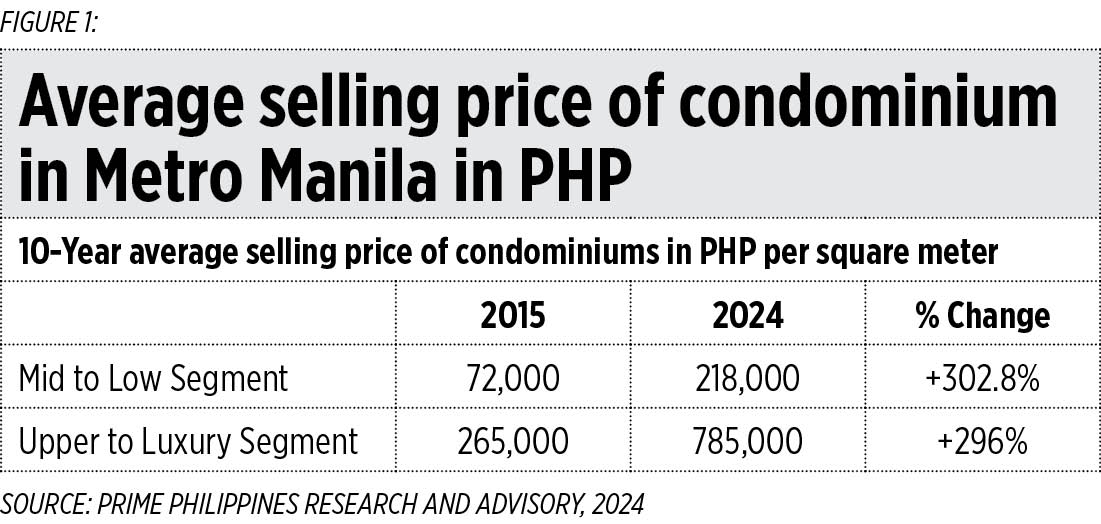
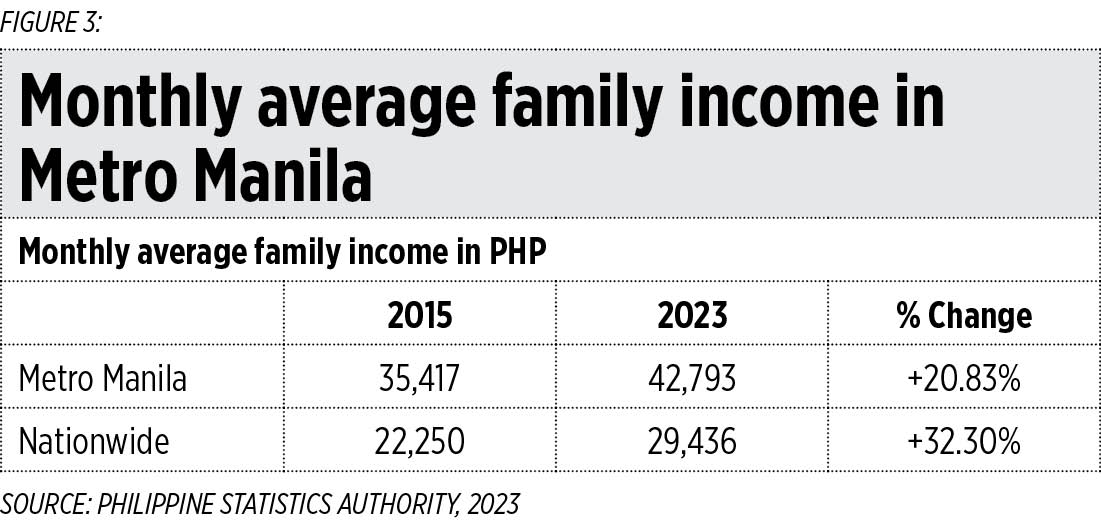
The affordability issue becomes clearer when examining condominium value appreciation versus family income growth. Between 2015 and 2024, condo prices surged 303% in mid-to-low segments and 296% in luxury segments. In stark contrast, average family incomes in Metro Manila increased by only about 21% during the same period. This disparity significantly heightens affordability barriers, preventing many prospective buyers from entering the market and exacerbating the challenge of homeownership for average families.

RENTAL YIELDS ADJUST TO 2–4%, REFLECTING NORMAL GLOBAL STANDARDS
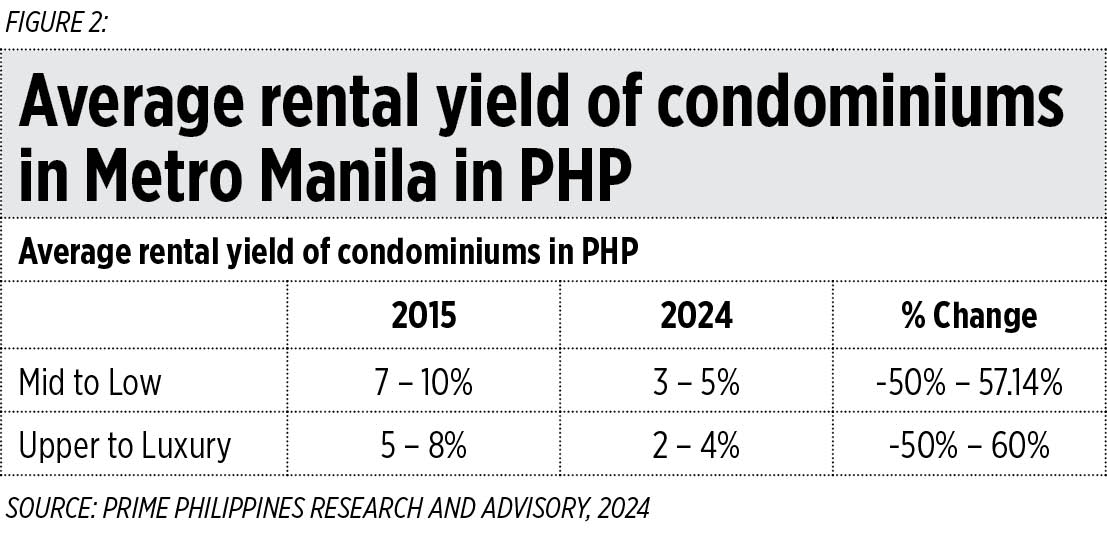
Alongside rising prices, rental yields in Metro Manila condominiums have also adjusted downward, from a high of 5–10% in 2015 to about 2–4% today. While this decline may seem alarming, it aligns with global real estate norms, where mature markets typically yield 2–4%. This adjustment represents a normalization rather than a crisis, signaling a maturing real estate environment. Consequently, investors should recalibrate expectations and adopt strategies suited to this yield context.

HIGH TRANSACTION COSTS ARE ERODING CONDO RESALE PROFITS, REDUCING NET GAINS TO AROUND 64%
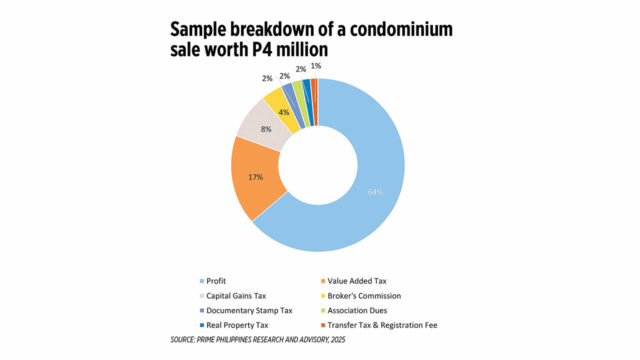
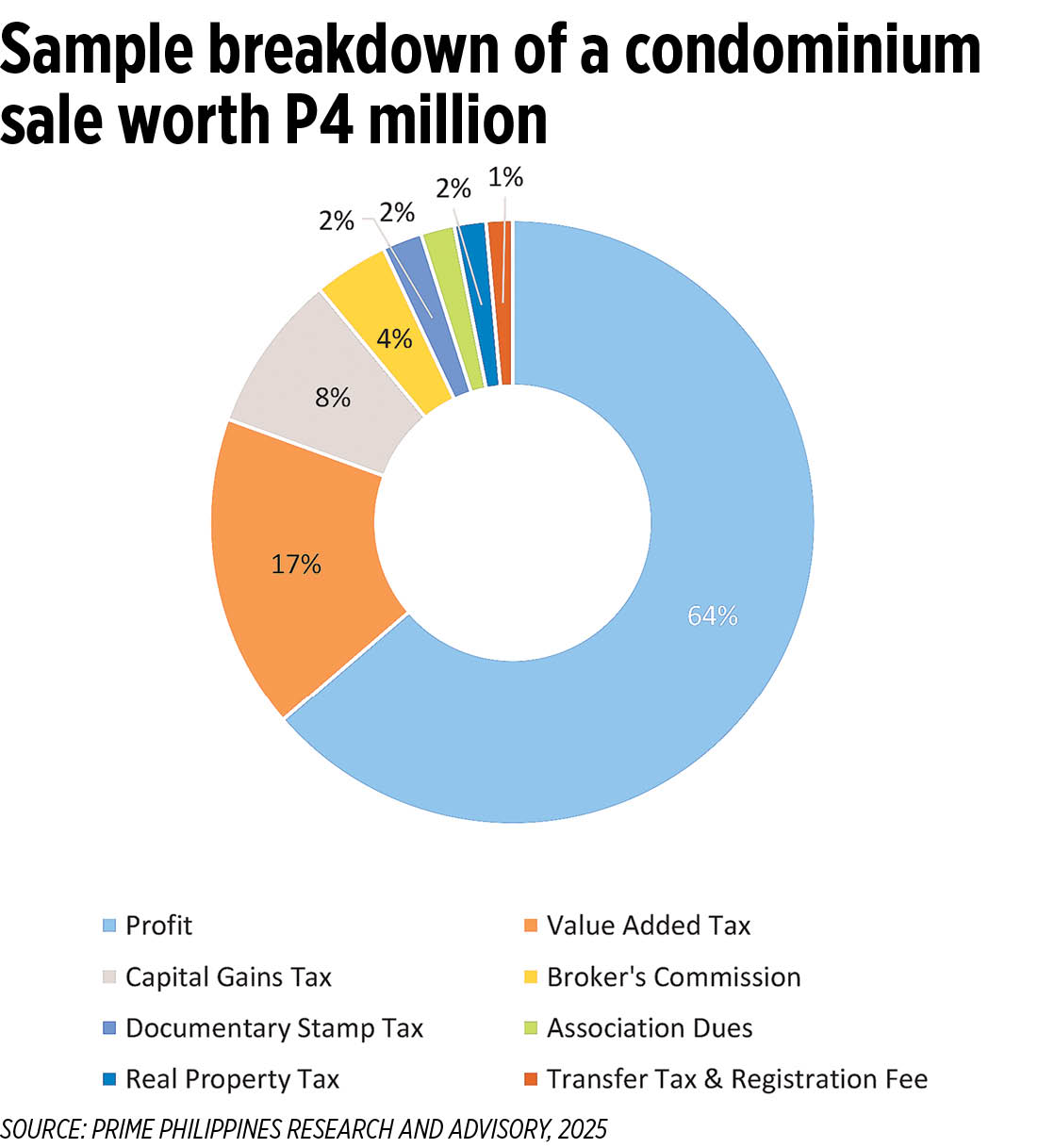
However, even with normalized rental yields, another critical issue affects condominium owners — excessive transaction costs. A significant portion of profits from resale transactions involving ordinary assets, such as previously rented condominiums, is eroded by value-added tax (VAT) and other transaction costs that are calculated based on inflated zonal valuations. These zonal valuations, which are 20–30% higher than actual market prices, disproportionately increase sellers’ costs, leaving them with only about 64% of their potential resale revenue. Such substantial erosion of profit discourages secondary market participation and restricts overall market liquidity.

RECENTLY ADJUSTED ZONAL VALUES INFLATE COSTS, REDUCING SELLER PROFITS
This issue is further intensified by historical policy shifts. Previously, condominium flipping — buying units early and reselling upon completion — was profitable. However, the introduction of the Bureau of Internal Revenue’s Memorandum Circular No. 57-2015 imposed stricter monitoring of unit inventory, recognizing and taxing two separate transfers during the flipping process. This policy dramatically reduced profitability for flippers. At present, the application of recently adjusted zonal valuations that are higher that market values compounds these challenges, underlining the urgency to align zonal values closer to market realities.

OPPORTUNITIES FOR REFORM CAN UNLOCK CONDOMINIUM AFFORDABILITY AND MARKET LIQUIDITY
Addressing transactional cost barriers presents key opportunities to improve housing affordability and reinvigorate the condominium market. Realigning zonal values to reflect true market conditions would significantly reduce transaction taxes, directly enhancing market liquidity and appeal. Removing VAT from the resale of previously rented condominiums would further improve profitability and stimulate activity in the secondary market.

There is also merit in providing targeted incentives for homebuyers. Countries like Australia have offered stamp duty concessions to reduce upfront transaction costs — similar in function to the Philippines’ documentary stamp tax — while Canada introduced tax-advantaged savings plans to help first-time buyers build up funds for downpayments. Introducing a similar tax break for first-time homebuyers in the Philippines would help lower entry barriers and encourage end-user participation, particularly among younger and working-class buyers.

Additionally, commercial banks should consider offering longer-term mortgages spanning 25 to 35 years. This financing flexibility would allow more working-class Filipinos to afford condominiums near major business districts, supporting both residential access and market demand.

TARGETED POLICY ADJUSTMENTS ARE ESSENTIAL FOR METRO MANILA’S CONDO RECOVERY
In summary, Metro Manila’s condominium market challenges primarily stem from localized oversupply, growing affordability gaps and excessive transaction costs, exacerbated by aggressively adjusted zonal values. Recognizing and addressing these nuanced realities through strategic policy adjustments — realigning zonal valuations, removing VAT on resales and introducing graduated tax incentives — can effectively mitigate the challenges. These targeted reforms promise a healthier and more vibrant condominium market, creating beneficial outcomes for buyers, sellers and investors alike.


Jet Yu is the founder and CEO at PRIME Philippines, the country’s fastest-growing and most disruptive commercial real estate advisory firm that has redefined the brokerage industry by replacing outdated practices with innovation, data intelligence and relentless execution. Jet is a multi-awarded young CEO and serial entrepreneur. He led PRIME to become the fastest-growing real estate consultancy firm in its founding year, and under his visionary leadership, it has consistently ranked among the top five local real estate consultancy firms by revenue since 2017. Beyond PRIME, Jet has founded several other ventures across real estate, coworking and importation. He also served as the youngest investor and judge on CNN Philippines’ The Final Pitch for two seasons.

Arthaland unit acquires lots for condo project

ARTHALAND.COM

LISTED property developer Arthaland Corp. said its unit Sotern Land Corp. had bought land for a residential condominium project in Quezon City.

Sotern Land bought two parcels of land totaling 1,243 square meters (sq.m.) in Barangay Loyola Heights for P266.1 million, Arthaland said in a stock exchange filing on Monday.

The first parcel of land is valued at P154.5 million and spans 618 sq.m., while the second lot is worth P111.6 million and covers 625 sq.m.

“Sotern Land will have a residential condominium development over the subject properties,” Arthaland said.

The land was bought from ASEC Development and Construction Corp. and ASEC Land, Inc., the company said.

“(The) parties agreed on the purchase price at a mutually acceptable consideration with due regard to present market values,” Arthaland said.

Christopher G. Narciso, Arthaland executive vice-president and business operations group head, last week said they seek to launch three mid- to high-end residential projects in Quezon City, Makati City and Laguna province this year.

The company is also about to complete Lucima, its high-end condominium development in Cebu, as well as Eluria in Legazpi Village, Makati.

Arthaland shares were unchanged at P0.315 each. — Revin Mikhael D. Ochave

Allianz PNB Life launches insurance plan with access to investment funds

ALLIANZ PNB Life Insurance, Inc. (Allianz PNB Life) has launched a life insurance product that offers access to global investment funds.

Allianz Wealth Builder is a variable universal life product that combines investment opportunities with insurance coverage, the company said in a statement on Monday.

The product is now available through HSBC Premier and will soon be accessible to Philippine National Bank clients, it said. Allianz PNB Life has an insurance distribution partnership with HSBC Wealth.

“The Allianz Wealth Builder plan is carefully crafted to provide our valued clients with the confidence that their financial assets are working for them. It allows them to focus on achieving their personal and professional goals while benefiting from the wealth-building potential of this innovative product,” Allianz PNB Life Chief Partnership Officer Irene M. Andas said.

“Allianz Wealth Builder helps Filipinos take control of their financial future with confidence and clarity, whether it’s for education, wealth-building, or retirement planning,” Ms. Andas said.

Allianz PNB Life said the product has flexible payment options, as customers can choose from a three-, five-, or 10-year limited-pay term to promote “disciplined savings” over a set period. Those who choose the 10-year plan will get a premium bonus, it added.

It also offers guaranteed acceptance endorsement, which means medical underwriting is not required for applications. “Allianz PNB Life is the only and first insurance company that offers Guaranteed Acceptance Endorsement for regular-pay unit-linked plan in the market, making it more accessible for customers to avail this type of plan and to easily start saving for their future,” it said.

The plan also includes access to the Allianz Healthbox suite of health benefits.

Meanwhile, for the product’s investment component, Allianz Wealth Builder lets customer access funds managed by HSBC Asset Management and Allianz Global Investors.

“The Allianz Income and Growth Fund, for example, focuses on US assets, offering reliable income and long-term growth. For those looking for high-growth potential, the Equity Power Growth Fund opens the door to global equity markets,” the insurer said.

Allianz PNB Life booked a premium income of P32.13 billion last year, data from the Insurance Commission showed. Its net income was at P981.58 million. — A.M.C. Sy

Choose competence and courage in May

PHILIPPINE STAR/EDD GUMBAN

“The tyranny of some is possible only through the cowardice of others.” — Jose Rizal

The May 2025 Philippine elections are not merely a political exercise. They are a battle for the soul of this nation. For decades, systemic rot has stifled progress, leaving millions trapped in poverty and desperation.

Our country’s most pressing issues are not accidents of fate, but symptoms of systemic failure such as corruption, political dynasties, short-term populism, and environmental neglect. In 2023 alone, the Philippines lost P1.1 trillion to graft, according to Transparency International. These funds could have built 200,000 classrooms, or subsidized healthcare for 30 million families.

A 2023 Philippine Center for Investigative Journalism (PCIJ) study reveals that 73% of congressional seats are held by 178 families, entrenching patronage networks that prioritize clan interests over public welfare. In the Senate alone, we have seen the Estrada/Ejercitos, Cayetanos, Villars, and perhaps soon the Tulfos and Binays*. We witness the proverbial game of thrones between the Marcoses and the Dutertes.

With respect to environmental neglect, for the third straight year, the Philippines has remained the most at-risk country to extreme natural events and negative climate change, according to the 2024 edition of the World Risk Report. And yet, deforestation and unregulated mining persist, led largely by blood-sucking politicians who trade permits for campaign funds or favors.

If we connect the dots, we can see that political dynasties foster patronage, corruption, and overpricing, which divert funds from healthcare, public education, and flood infrastructure, among others. This system perpetuates an impoverished, vulnerable workforce. Environmental disasters cause more poverty, dependence, and short-term populism.

Is the system ultimately rigged to fail?

“When corruption becomes the norm, democracy becomes a myth,” argues senatorial aspirant Francis “Kiko” Pangilinan, author of RA 9227, otherwise known as the Additional Judicial Compensation Act of 2003, among other landmark laws. Senator Kiko happens to be my younger brother, arguably one of the most severely trolled and attacked political opposition candidates on social media. Not surprisingly, corrupt dynasties despise uncompromising leaders of competence and courage.

As the midterm elections near, we voters must confront a stark reality: democracy cannot survive without leaders of courage, competence, and a commitment to the common good. We can have transformative change in a democracy by electing reformist leaders who are willing to dismantle systemic barriers to prioritize structural reforms over hollow, band-aid solutions.

To break the cycle, we voters must reject transactional leaders and instead, elect proven reformers who speak truth and confront power. The leadership imperative is courage over compromise, but the system frowns upon qualified aspirants. A case in point is senatorial aspirant and human rights lawyer Chel Diokno, founding dean of the De La Salle University Tañada-Diokno School of Law, who defended victims of extrajudicial killings despite receiving threats. Another is former Senator Leila de Lima, who was jailed for six years after investigating former President Duterte’s alleged drug war, which eventually led to the strongman’s arrest by the International Criminal Court. Sadly, both Diokno and De Lima backed out of the 2025 senate race, and are instead running as party-list representatives in Congress.

Such leaders of courage, competence, and commitment to the common good exemplify the antidote to systemic decay. They possess the audacity to reject dynastic alliances, prosecute the corrupt, and strengthen the weak — traits that are absent in compromise politicking.

Populist candidates peddle quick fixes: cash aid, fuel subsidies, or ayuda (assistance). They preach a false dichotomy, favoring stability over real change, and “unity over reform.” Their stop-gap non-solutions ignore root causes, and are therefore unsustainable. They say things such as, “Infrastructure will heal our divisions.” But such statements ring hollow when projects like the P23-billion Metro Manila Subway remains delayed by graft. They collapse, just like the new, substandard Cabagan-Sta. Maria Bridge in Isabela.

The Philippine government will go a long way if reformists are supported and elected instead of mocked, trolled, or persecuted. We need leaders who do not fear backlash as they pursue true reforms. These reformists will tie pork barrel funds to anti-corruption benchmarks. Their justice will be swift, but never outside the bounds of law. Billions in “confidential funds” or discretionary budgets will be redirected to build new homes, educate teachers, or finance climate-resilient farms.

The stakes are existential. Climate disasters escalate, poverty worsens, and democratic institutions crumble under dishonest dynasties. Yet, despair is not an option. The 2025 ballot offers a rare chance for us to elect leaders like farmer and fisherfolk advocates, peacebuilders for Mindanao, champions of small entrepreneurs, and patriots whose records prove that courage and competence may coexist.

The May election is not about personalities. Every ballot that is cast for a reformist weakens corrupt dynasties. Every vote against graft rebuilds trust. Every demand for accountability plants seeds of renewal.

May God bless us this May 12 with Filipino voters who will choose courage and competence over complicit silence.

*Current senators Raffy Tulfo and Nancy Binay may soon be joined (in the case of Tulfo) or replaced (in Binay’s case) by siblings in the Senate. — Ed.


Joseph Pangilinan is a professional lecturer at the Department of Management and Organization of the De La Salle University Ramon V. Del Rosario College of Business.

joseph.pangilinan@dlsu.edu.ph

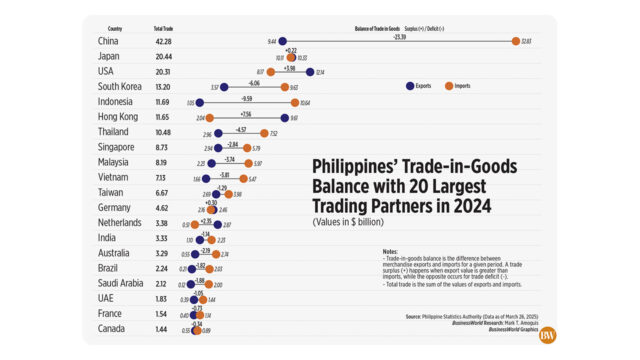
Philippines’ Trade-in-Goods Balance with 20 Largest Trading Partners in 2024

THE 2024 trade-in-goods deficit was revised to $54.33 billion from the $54.21 billion reported in January, the Philippine Statistics Authority said on Thursday. Read the full story.

Philippines’ Trade-in-Goods Balance with 20 Largest Trading Partners in 2024

Entertainment News (04/01/25)


Gulay Lang, Manong! screens at Ayala Malls Cinemas

AYALA MALLS Cinemas is screening Gulay Lang, Manong!, a 2024 Cinemalaya entry that won the Audience Choice Award at the festival. Directed by BC Amparado in his feature film debut, it follows struggling farmer Manong Pilo (Perry Dizon) who joins forces with local policeman Ariel Lacson (Cedric Juan) to rescue his grandson Ricky (BJ Forbes) and take down a marijuana cartel. It will be shown in Ayala Malls Cinemas starting April 2.


SOS releases sophomore album

THE sophomore album of Filipino band SOS, It Was A Moment, is out now. The 11-track project is a sonically expansive, experimental journey marked by synths, keys, and anthemic guitars. It follows the band’s first album from 2017 and presents a significantly lighter sound. SOS’ It Was A Moment is out now on all digital music streaming platforms nationwide.


Stephen Speaks performs at Newport World Resorts

AMERICAN pop singer Stephen Speaks will be bringing his iconic hits “Passenger Seat,” “Out of My League,” and more to Filipino audiences in Manila with a one-night-only performance on April 3, 10 p.m., at Newport World Resort’s Bar 360. There is a minimum cover charge of P2,000, consumable on food and drinks.


Drop to arrive in Philippine cinemas in April

FROM director Christopher Landon comes Drop, a mystery-thriller starring Meghann Fahy and Brandon Sklenar (It Ends with Us), centered on a peculiar first date. It follows Ms. Fahy as Violet, who goes on a date and starts receiving innocuous but annoying media drops on her phone. When her son’s life is threatened, she is directed to kill her date, played by Mr. Sklenar. Drop premieres in Philippine cinemas on April 9.


J-pop star Ado’s concert film in Philippine cinemas

GAGA Corp. has announced the global theatrical release of the concert film Ado SPECIAL LIVE “Shinzou” in Cinema. Its screenings in the Philippines will start on April 11. The concert film offers an immersive journey into Ado’s live concert Shinzou at the Japan National Stadium in 2024, narrated by Ado herself. It is a lead-up to her second world tour, Hibana, which will have a Manila stop at the SM Mall of Asia Arena in Pasay City on May 8, with tickets available via smtickets.com.


Ace Banzuelo explores love in new single

A NEW SINGLE of singer-songwriter Ace Banzuelo, titled “Kilala,” has been released under Sony Music Entertainment. The dreamy, melancholic pop track delves into romantic longing, set against a backdrop of minimal guitars, gentle synths, and electronic flourishes. “Kilala” is out now on all digital music streaming platforms.


W Express offers Korean visa packages for Filipinos

IN LINE with the strong lineup of concerts and festivals in South Korea this year — ranging from BLACKPINK’s World Tour to ZEROBASEONE’s first fan concert — W Express, in partnership with the Korea Visa Application Center, is now offering deals for Filipinos. Every visa application with the company gives travelers a chance to win American Tourister luggage. There are also discounted rates: P1,000 for the primary applicant and P500 for additional members, applicable only in Metro Manila. For more information, visit the website at https://www.wwwexpress.com.ph/


Culture Wars drops new single

AUSTIN-BASED band Culture Wars have released their brand-new single, “Typical Ways,” now available to stream worldwide. The track layers guitars and stadium vocals and talks about the cycle of addiction and falling into one’s typical ways. Vocalist Alex Dugan wrote the song as an angry letter to himself. “Typical Ways” is out now on all digital music streaming platforms.


Pinoy rising stars in RADAR Philippines program

SPOTIFY’s artist discovery and support program RADAR Philippines is back with a fresh slate of Filipino musicians poised to be the next local and global favorites. The 2025 lineup showcases a diverse mix of genres and styles, spotlighting indie artists ONE CLICK STRAIGHT, Dilaw, and JERGE, R&B sound-makers ALLMO$T and Justin Vasquez, fresh rap acts Young Blood Neet, Zae, and Costa Cashman, and pop artist ena mori. Rounding up the roster is returnee P-pop boy group BGYO. Their music is now available on the RADAR Philippines playlist.


CreaZion Studios distributes The Legend of Ochi

ON April 25, CreaZion Studios will be showing A24’s The Legend of Ochi nationwide in major cinemas. The film follows the story of Yuri, a young girl raised in a remote northern village where people caution against going outside after dark for fear of encountering an Ochi. When she meets a baby Ochi left behind by its pack, the two go on an adventure to reunite it with its family. Writer-director Isaiah Saxon Saxon was inspired by the connection between a child and a pet. The Legend of Ochi comes to Philippine cinemas in April.


KAIA and Zack Tabudlo have new single

FILIPINO girl group KAIA has released “TANGA,” a single now out via Sony Music Entertainment. Produced and composed by singer-songwriter Zack Tabudlo, the track blends pop confection with a ’90s R&B flair. It centers on a love that borders on naiveté, balancing a humorous, light vibe with a sense of introspection. “TANGA” is out now on all digital music streaming platforms.


TV5 presents ‘Summer-Saya Together’ TV lineup

TELEVISION network TV5’s “Summer-Saya Together” campaign is bringing viewers the conclusions of two drama series: Ang Himala ni Niño and Lumuhod Ka sa Lupa. Meanwhile, the reality show Sing Galing will have its first live elimination round on April 5, and Be The NEXT: 9 Dreamers shall be narrowing down its K-pop trainees from 75 to 45. ASAP will be having its 30th-anniversary celebration. Finally, the “Tara Na Sa Saya: Win A Trip Promo” shall offer two viewers a chance to win a dream trip to Japan with free airfare and accommodation, as part of the travel show Güd Morning Kapatid. The winners will be able to discover new sights, flavors, and cultures with host Maoui David for four days and three nights. More details can be found on TV5’s social media pages.

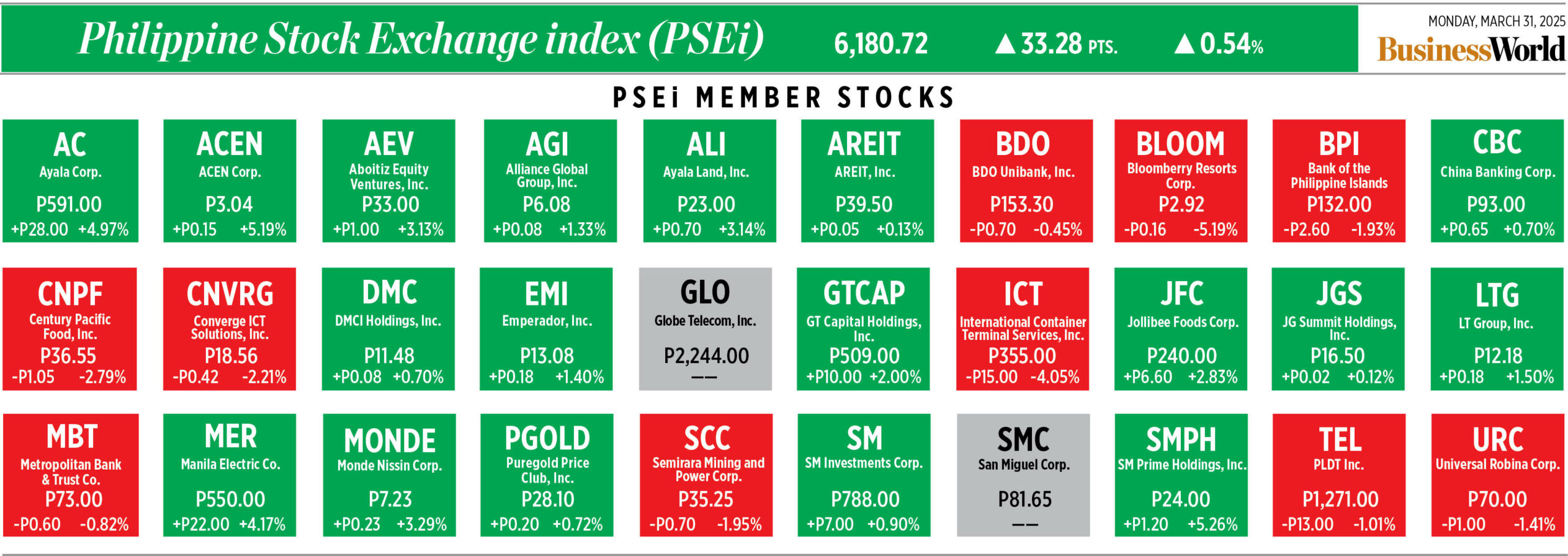
How PSEi member stocks performed — March 31, 2025

Here’s a quick glance at how PSEi stocks fared on Monday, March 31, 2025.