Home Blog Page 1433

World Bank tapped to help design offshore wind green energy auction

WORLDBANK.ORG

By Sheldeen Joy Talavera, Reporter

THE Department of Energy (DoE) said it has engaged the World Bank to help design the fifth round of the green energy auction (GEA-5) this year, which will focus on offshore wind (OSW) power projects.

“To mitigate risks and uncertainties associated with offshore wind technology, the DoE is collaborating with the World Bank Group for expert guidance and support. This collaborative approach ensures a well-structured and investor-friendly auction,” Energy Undersecretary Giovanni Carlo J. Bacordo said in an interview.

Mr. Bacordo said the department is finalizing the auction parameters including the specific OSW capacity and delivery commencement date.

“These details are being meticulously determined to align with the Philippine Energy Plan 2023-2050, and crucially, after thorough consultations with stakeholders regarding port and grid readiness,” he said.

While the capacities to be offered are still not set, the DoE is on track to launch GEA-5 by the third quarter, according to Energy Undersecretary Rowena Cristina L. Guevara.

“We are checking the transmission assets needed by the front runner OSW projects, as well as the potential port (to support) their construction,” she said.

Ms. Guevara said that the terms of reference for GEA-5 will be different from those of the previous auctions.

The DoE is currently assisting 16 OSW proponents who are projected to deliver more than 16 gigawatts (GW) of new capacity from offshore wind power projects.

GEA-5 is expected to facilitate market access for OSW developers, ensuring long-term demand for their generation capacities and keep them on track to generate the first kilowatts by 2028.

To date, the government has awarded 92 OSW contracts with a potential capacity of around 69 GW.

Mr. Bacordo said that the DoE and the Philippine Ports Authority (PPA) and the Department of Transportation (DoTr), are “actively progressing” on port repurposing.

He said that a memorandum of agreement is being finalized to clarify that the DoE will handle developer queuing, while PPA will manage port upgrades and tariffs.

“The DoE’s role in queuing OSW developers directly facilitates private sector participation in utilizing these soon to be developed ports,” he said.

Meanwhile, the DoTr is supporting OSW initiative through the Asian Development Bank’s Infrastructure Preparation and Innovation Facility (ADB-IPIF) for two ports.

“The Negros Occidental port is exploring ADB’s Project Readiness Fund (PRF) for detailed engineering design, and Southern Mindoro port will proceed under a design-build approach within the IPIF,” Mr. Bacordo said.

In other development, the Energy Regulatory Commission (ERC) has deferred some of the transmission projects of the National Grid Corp. of the Philippines (NGCP) as further deliberations are needed.

“Given the pending issues that needed to be addressed, the resolution of the matter was deferred for further deliberation with instructions/directives issued to the relevant units,” the ERC said in a notice.

Among the projects applied for by NGCP in 2021, those that are still pending approval are the P13.30-billion Nagsaag-Santiago 500-kilovolt (kV) Transmission Line Project, the P18.96-billion Western Luzon 500-kV Backbone Project Stage 2, the P6.83-billion Cabanatuan-Sampaloc-Nagsaag 230-kV Transmission Line Project, and the P2.39-billion Buang-La Trinidad 230-kV Transmission Line Upgrading Project.

The ERC has yet to decide on the P3.57-billion Nivel Hills 230-kV Substation Project in the Visayas.

In Mindanao, approvals are still being sought for the P610-million Agus 6-Kiwalan-Lugait 69-kV Transmission Line Upgrading Project, the P1.03-billion Maco-Tagum 69-kV Transmission Line Project, the P5.89-billion Sultan Kudarat-Tacurong 230-kV Transmission Line Project, and the P885.40-million Opol Substation Bus-In Project.

“We just need some items verified and updated because this set is tied to other ongoing projects. Then, it will be submitted for deliberation again,” ERC Chairperson Monalisa C. Dimalanta said when asked for further details on the deferral.


Metro Pacific Agro targets milk output of 10 million liters

REUTERS

METRO PACIFIC Agro Ventures, Inc. (MPAV), a subsidiary of Metro Pacific Investment Corp. (MPIC), said its dairy business is targeting to produce 10 million liters over the next two years.

Milk production of Metro Pacific Dairy Farms breached 1 million liters last year, MPAV President and CEO Jovy I. Hernandez told reporters.

The dairy business is expected to produce about two million liters of raw fresh milk this year, he noted.

“By 2027, we should be delivering 10 million liters,” he said.

Mr. Hernandez said Metro Pacific Dairy Farms, which has partnered with Israel’s LR Group on a P2-billion integrated dairy facility, is on track to be fully operational this year.

Currently, the dairy business has a herd of about 1,000 cows.

The dairy unit was producing 500,000 liters of raw fresh milk when it started.

Mr. Hernandez said the dairy business is awaiting the arrival of 220 dairy cattle from Australia by May.

“We’re now moving some of the non-milking herd to become milking.”

In 2022, MPIC bought a controlling stake in The Laguna Creamery, Inc., which sells products under the brand name Carmen’s Best, for about P200 million.

The Philippines currently imports about 99% of its dairy requirements.

The government aims to boost local production to 80 million liters per year by 2028, to increase the share of domestic product to about 5% of demand. — Kyle Aristophere T. Atienza

Building resilience in the financial sector

Second of two parts

IN BRIEF:

• ​Firms should leverage innovative technologies to improve their ESG reporting processes and enhance their oversight and understanding of risks within less transparent markets, networks and ecosystems.

• ​Regulators have recently expressed heightened concerns about the concentration of risk within non-bank financial institutions (NBFIs), fearing that it could spill over into the regulated sector and threaten the stability of systemically important institutions.

The financial industry’s growing reliance on technology is heightening the risk of failure points linked to unregulated third-party connections. These weaknesses can be targeted by malicious entities, or as evidenced by a major IT outage in July 2024, can also occur from non-malicious factors.

This article explores comprehensive strategies for enhancing resilience against vulnerabilities and external threats based on insights from the 2025 EY Global Financial Services Regulatory Outlook. It serves as the last article in a series addressing the key issues facing the banking and financial sector in 2025 and beyond.

The first part of this article discussed the increasing regulatory focus on operational resilience in the financial sector due to recent disruptions, including conflicts and IT failures, prompting firms to enhance their risk management practices. This second part discusses the growing emphasis on nature-related risks and the need for firms to understand these implications for their business strategies, while also addressing the rise of non-bank financial institutions (NBFIs) and the associated regulatory challenges.

SUSTAINABLE FINANCE
Environmental, social, and governance (ESG) reporting related to emissions, climate risks, and sustainability is increasingly becoming standard practice among major corporations. Globally, various markets, including Australia, Switzerland, and Hong Kong, are set to adopt IFRS sustainability standards beginning in 2025, with over 20 countries expressing interest in aligning with the International Sustainability Standards Board (ISSB) standards over time.

There is a growing focus on nature-related risks, biodiversity and human capital, although regulatory frameworks addressing these risks are still in their infancy. Initiatives such as the Network for Greening the Financial System’s (NGFS) preparatory work on nature-related financial risks through a conceptual framework for central banks and supervisors, the Taskforce on Nature-related Financial Disclosures’ (TNFD) efforts to align with the Global Reporting Initiative (GRI) through an interoperability mapping resource, the European Financial Reporting Advisory Group’s (EFRAG) contributions, and the ISSB’s plan to incorporate biodiversity risks into their 2024-26 work agenda all signal an expanding emphasis on environmental factors beyond climate change. This shift aims to better understand the implications for financial stability and inform future regulatory measures. However, it may take time before firms are subject to specific requirements regarding biodiversity and nature-related risks. The ISSB has also included in its research and standard-setting projects the risks and opportunities related to human capital.

The voluntary carbon market is gaining traction as an alternative approach to achieving net-zero transition goals. While regulatory gaps present reputational and operational challenges, initiatives like The Core Carbon Principles and the issuance of the International Organization of Securities Commissions (IOSCO) final report on Voluntary Carbon Markets (VCMs) seek to enhance credit quality and transparency in this space.

The Core Carbon Principles provides a set of 21 Good Practices aimed at ensuring financial integrity in this space, ranging from regulatory treatment, market participants skills and competencies, standardization, transparency and disclosure, to secondary market trading, integrity, reports, derivatives standards, risk management, market surveillance and monitoring, as well as disclosure of use of carbon credits. On the other hand, the IOSCO’s final report on VCMs focuses on promoting financial integrity on VCMs, offering “Good Practices” to guide regulators and market participants.

As the emphasis on biodiversity and natural capital increases, firms must prioritize understanding the associated risks and opportunities to evaluate potential implications for their business strategies. Organizations should explore how innovative technologies, such as artificial intelligence, can facilitate accurate and timely reporting to comply with regulatory requirements. By leveraging these advancements, firms can enhance their reporting processes and better align with the evolving landscape of sustainability expectations.

NON-BANK FINANCE
According to the Financial Stability Board (FSB), NBFIs, often referred to as “shadow banks,” represented over 47% of the assets in the global financial system in 2022, a rise from 42% in 2008. NBFIs encompass both regulated and unregulated entities that provide “bank-like” products and services, such as credit and payments, but without the same prudential oversight as traditional banks. In the US, NBFIs are responsible for originating and servicing most residential mortgages. While their role in facilitating capital markets is acknowledged, regulators have recently expressed heightened concerns about the concentration of risk within NBFIs, fearing that it could spill over into the regulated sector and threaten the stability of systemically important institutions.

Supranational organizations and domestic regulators continue to express their concerns, yet achieving international coordination remains a challenge. The FSB has urged countries to advance reforms aimed at mitigating threats to financial stability posed by NBFIs and has released a consultation report addressing “leverage-related vulnerabilities” within these institutions by the end of 2024. Recently, prudential authorities in the UK and EU have pointed out that some banks exhibit a poor understanding of and inadequate risk management regarding their exposures to the private finance segment.

Firms must prepare for increased supervisory scrutiny targeting risk management procedures and exposures to less transparent markets, such as private finance, where regulators are typically concerned about counterparty risk, concentration risk, and liquidity risk. By enhancing data analytics and aggregation capabilities, organizations can better identify and monitor significant exposures and concentrations, including established and emerging nonfinancial risks related to digitalization and technology adoption within institutions, ecosystems and networks.

During the 2024 Regional Systemic Risk Dialogue co-hosted by the BSP and the International Monetary Fund, BSP Governor Eli Remolona noted that the organizers took the “the road less traveled” by focusing on the non-bank financial sector and technology innovations. He cited the multi-dimensional nature of systemic risks and the case of the non-bank financial sector, in which he recognized that “there is much diversity within (this) sector, just as there are interlinkages between non-banks and banks.” He described technology as “an enabler for the non-bank financial market… something that banks have embraced, and… is redefining the demands of the consumer.”

BUILDING RESILIENCE
In light of the evolving regulatory environment, financial institutions must proactively enhance their operational resilience and risk management practices, both within the institution and ecosystems of customers and service providers. As the focus on sustainability and biodiversity intensifies, firms should leverage innovative technologies such as AI to improve their ESG reporting processes as well as manage risks and identify opportunities. With the growing prominence of NBFIs, organizations must also enhance their oversight and understanding of risks within less transparent markets and ecosystems to ensure financial stability and compliance in an increasingly complex and interdependent landscape.

By embracing these challenges, the financial sector can emerge stronger and more resilient, paving the way for a sustainable and secure future.

This article is for general information only and is not a substitute for professional advice where the facts and circumstances warrant. The views and opinions expressed above are those of the author and do not necessarily represent the views of SGV & Co.


Christian G. Lauron is the financial services organization (FSO) leader of SGV & Co.

Aid rushes into Myanmar after quake ravages cities

A pagoda is damaged during a strong earthquake in Mandalay, Myanmar, March 29, 2025. — REUTERS

BANGKOK — Myanmar’s neighbors sent warships and aircraft laden with relief materials and rescue personnel on Sunday, as international aid gained steam after a massive earthquake ravaged much of the poor Southeast Asian nation.

At least 1,600 people have been killed and 3,400 injured by Friday’s 7.7-magnitude quake, one of Myanmar’s strongest in a century, its military government said.

“All military and civilian hospitals, as well as healthcare workers, must work together in a coordinated and efficient manner to ensure effective medical response,” said the junta chief, Senior General Min Aung Hlaing, according to state-run media.

The US Geological Service’s predictive modeling estimated Myanmar’s death toll could top 10,000 and losses could exceed the country’s annual economic output.

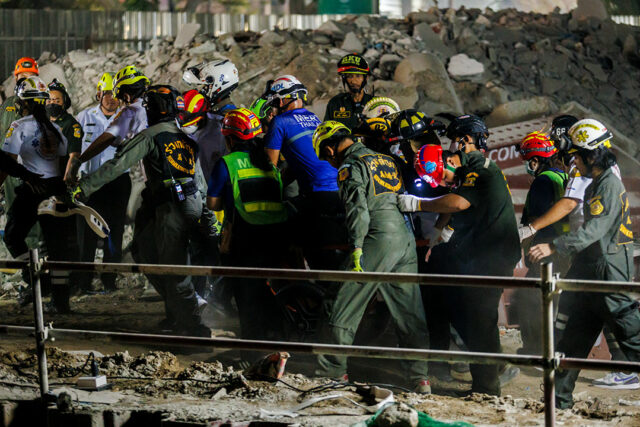
The quake jolted parts of neighboring Thailand, bringing down an under-construction skyscraper and killing 17 people across the capital, according to Thai authorities. At least 78 people remained trapped under the debris of the collapsed building.

The deadliest natural disaster to hit Myanmar in years damaged critical infrastructure, including an airport, highways and bridges, slowing humanitarian operations, according to the United Nations (UN).

‘NO AID’
The quake hit a nation already in chaos with a civil war that has escalated since the 2021 military coup, which ousted the elected government of Nobel laureate Aung San Suu Kyi and sparked a nationwide armed uprising.

The fighting has battered the largely agrarian economy of Myanmar, formerly called Burma, displaced over 3.5 million people and left essential services, such as healthcare, in tatters.

The opposition National Unity Government (NUG), which includes remnants of the previous administration, said anti-junta militias under its command would pause all offensive military actions for two weeks from Sunday.

“The NUG, together with resistance forces, allied organizations and civil society groups, will carry out rescue operations,” it said in a statement.

In some of the country’s hardest hit areas, residents told Reuters that government assistance was scarce so far, leaving people to fend for themselves.

The entire town of Sagaing near the quake’s epicenter was devastated, said resident Han Zin.

“What we are seeing here is widespread destruction — many buildings have collapsed into the ground,” he said by phone, adding that much of the town had been without electricity since the disaster hit and drinking water was running out.

“We have received no aid, and there are no rescue workers in sight.”

Across the Irrawaddy river in Mandalay, a rescue worker said most operations in the country’s second-largest city were being conducted by small, self-organized resident groups that lack the required equipment.

“We have been approaching collapsed buildings, but some structures remain unstable while we work,” he said, asking not to be named because of security concerns.

FIELD HOSPITAL
Scores of people were feared trapped under collapsed buildings across Mandalay but most could not be reached or pulled out without heavy machinery, another humanitarian worker and two residents said.

“People are still stuck in the buildings, they can’t take people out,” said a resident who asked not to be named.

Hospitals in parts of central and northwestern Myanmar, including Mandalay and Sagaing, were struggling to cope with the influx of injured people, according to the UN Office for the Coordination of Humanitarian Affairs.

India, China and Thailand are among the neighbors that have sent relief materials and teams, along with aid and personnel from Malaysia, Singapore and Russia. — Reuters

Massive quake is latest blow to Thai tourism hit by safety woes

EMERGENCY WORKERS carry one of the trapped construction workers on a stretcher at the site of a collapsed building in Bangkok on March 28. — ANDRE MALERBA/BLOOMBERG

THE DEADLY Myanmar earthquake is set to hurt foreign tourist arrivals to Thailand in the coming weeks, the latest blow to an industry already reeling from dwindling Chinese visitors worried about travel safety.

International tourist arrivals are expected to drop by 10%-15% or even more in the next two weeks as Friday’s 7.7 earthquake shook buildings in Bangkok and other Thai tourist hot spots, spooking prospective travelers, the Thai Hotels Association said.

About 10% of foreign tourists checked out early after the quake, said Thienprasit Chaiyapatranun, president of the association,  citing an initial survey among the group’s members. Some tourists, however, later returned to their hotels as they had no other options, he said.

“A short-term impact is expected for the tourism industry because of safety concerns,” Thienprasit said by phone on Saturday.

Even a short-lived impact on tourist arrivals will hurt an economy where the industry employs one in five of the country’s workforce and accounts for about 13% of gross domestic product. Thai authorities are betting on an improved tourism performance to propel growth to 3% this year as merchandise exports, another key driver of growth, faces headwinds from the Trump administration’s trade tariffs.

Thai authorities have in the meantime reassured foreign tourists. The country is safe for tourists, Minister of Tourism and Sports Sorawong Thienthong said Saturday, adding that the government has ordered a safety audit of hotels and major tourist attractions.

While the earthquake rattled buildings across Bangkok, leading to mass evacuations and suspension of public transport for a day, the city emerged largely unscathed in contrast to the massive destruction in Myanmar. The collapse of a high-rise building under construction in Bangkok was the biggest hit from the temblor, killing 10 workers and trapping dozens under its debris.

To be sure, tourist arrivals were already on the decline due to safety concerns in recent months. A series of high-profile human trafficking to scam centers in Myanmar via Thailand prompted some travelers from China, Thailand’s largest source for tourists, to shun the Southeast Asian nation.

Hotel bookings during the water-splashing Songkran festival next month haven’t been as good compared with two years ago, and post-tremor safety concerns could further hurt confidence among foreign visitors, Mr. Thienprasit from the hotel group said.

Foreign tourist arrivals have been falling on a weekly basis since the end of the Lunar New Year rush in early February. Bank of America economists expect downside risk to its forecast of 38.1 million tourist arrivals this year with the country moving into the low season when European tourists subside and Chinese tourist arrivals still showing no sign of recovery.

Thailand, popular among tourists for its pristine beaches, a vibrant nightlife and Buddhist temples, has welcomed 8.9 million tourists since the start of the year, up 2.9% from year earlier, according to latest official data.

Foreign visitors traveling in groups aren’t as concerned about safety as seen from the normal flight schedules at key Thai airports, said Adith Chairattananon, secretary-general of the Association of Thai Travel Agents.

“But tourists, who haven’t made bookings to Thailand, may decide to halt travel plans,” Adith says. “The impact could surface in the next two weeks.” — Bloomberg

No longer ‘poor but sexy?’ Berlin’s economic rise comes at a price

The Brandenburg Gate is illuminated during the Festival of Lights, in Berlin, Germany Oct. 4, 2024. — REUTERS/LISI NIESNER/FILE PHOTO

BERLIN — The Art House Tacheles used to be the epicenter of the alternative art and culture scene in Berlin, an impressive five-storey building in the heart of the capital dating back to 1908 and occupied by artists after the fall of the Berlin Wall.

But in 2012 the raves were over and the artists were kicked out when the building was sold to a New York investor and renovated to make room for apartments, offices, stores, a supermarket and a Swedish photography museum.

For Oliver Putzbach, a 52-year-old Berlin native who used to live nearby, Tacheles’ transformation symbolizes that of the capital itself.

While its economy grows and investment capital pours in, long-time residents like Mr. Putzbach fear it is losing its edgy character and bohemian charm that had its former mayor famously declaring over two decades ago that Berlin was “poor but sexy.”

“It looks the same as a typical train station in Germany… just like a mall,” Mr. Putzbach said about the building he remembers as a multicultural village where he used to perform with his band Beat Organization three times a week.

“Berlin has sold its soul,” he said.

For decades, Berlin stood out among European capitals, poorer than the rest of the country because of its unique history as a divided city and its costly reunification.

For the past 10 years, however, the capital’s growth has outpaced the sluggish overall performance of Europe’s largest economy.

Last year, Berlin’s economy grew by 0.8% while the national one contracted for the second year in a row, data showed on Friday. As a result, Berlin’s economic output per capita, which long lagged that of Germany, moved further above the national average, with 54,607 euros and 50,819 euros, respectively.

“Berlin was not wealthy, but that became the foundation for getting richer: Berlin attracted young talent who came here to reshape their lives and make their ideas reality,” said Martin Gornig, researcher at the German Institute for Economic Research DIW Berlin.

The city has become Germany’s startup capital, overtaking Munich with around 500 companies founded each year, and digital consumer services companies, such as e-commerce group Zalando or fintech N-26, calling Berlin home.

Tesla’s gigafactory about an hour away and the city’s new airport that opened in 2020 after multiple delays, also brought thousands of new jobs to the area.

Berlin’s unique blend of high culture, counterculture and history has also made it a major tourism destination, Europe’s third behind London and Paris in terms of overnight stays.

NOW RICH AND EXPENSIVE?
Now, however, Berlin is becoming a victim of its economic success.

Rising costs are threatening livelihoods of artists and bohemians who after the fall of the Berlin Wall flocked here, drawn by low rents and many abandoned buildings.

Rising prices are also now starting squeezing the budgets of those who followed the startup boom decades later.

Rents have been rising faster than the German average, soaring food and drink prices have spurred calls for a doner kebab price cap and Berlin’s techno clubs have begun charging costly entry fees, with some, such as Watergate, forced to shut down.

“Prices are getting very high and if you go to Berghain or Kitkat, now it’s not sexy,” said Sergei Egorchenko about two of its most iconic clubs. “Now it’s like commercial sexy, you know?”

Mr. Egorchenko, a cloud engineer, who moved to Germany in 2016, has lived in Berlin since 2021 and is now sharing with his partner, Claudia Marti, a 70 square meter (753 square ft) three-bedroom apartment in the Mitte neighborhood. They sublet one of the rooms to be able to cover 1,800 euros ($1,950) in rent.

“We are sharing but it is fine,” said Ms. Marti, who works as a cancer researcher at the Charite hospital.

Berlin’s notoriously tight housing market meant it would be hard to find another place they could afford on their own, she said.

Prices and rents in the capital had stayed low for years after Germany’s reunification in 1990 because most jobs there were relatively low-paying ones in the public sector. The global resurgence of inflation but also the influx of private capital and foreign professionals, like Ms. Marti and Mr. Egorchenko, changed that.

While Berlin rents remain below those in some other major German cities, they have risen about 32% since 2021, data from housing portal ImmoScout24 showed, well above the national 20% average.

Despite its transformation, the capital is still catching up with Germany’s traditional business centers in the west and south.

Last year, local unemployment of 9.7% still well exceeded the national 6.0% average. Berlin’s gross average monthly earnings of 4,634 euros also remain below wages in Munich, Hamburg, Stuttgart or Germany’s finance hub Frankfurt.

Yet Berlin has already made big strides over the past decades, Mr. Gornig said.

“If you look back 20 years, Berlin has already developed from a pure seat of government into an economically strong center, which is quite a remarkable development.”

And while long-time Berliners say they miss its edgier, subversive side, recent transplants say there is still much to admire about the city. Mr. Egorchenko, for example, says street events, such as Love Parade or Rave the Planet continue to reflect the openness Berlin stands for.

“Some places are losing sexiness, but in general, I would say Berlin is still sexy, it’s still cool, it’s still like… wow.” — Reuters

US orders French firms to comply with diversity ban

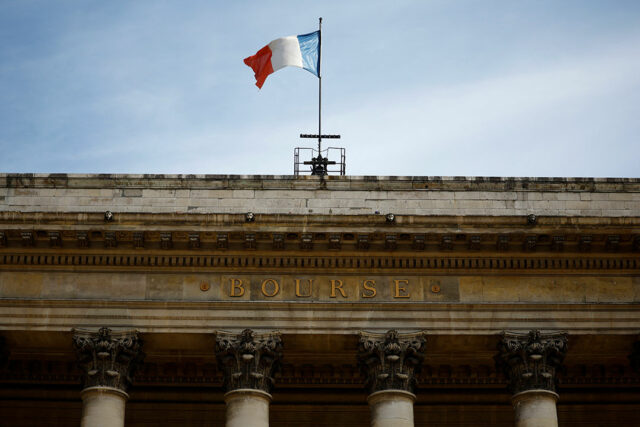
A French national flag is seen at the Palais Brongniart in Paris, France, March 25, 2024. — REUTERS

PARIS — The Trump administration has ordered some French companies with US government contracts to comply with his executive order banning diversity, equity, and inclusion (DEI) programs, highlighting the extraterritorial reach of US policies and their potential impact on European corporate practices.

The companies have been told to confirm their compliance in a questionnaire entitled “Certification Regarding Compliance With Applicable Federal Anti-Discrimination Law.” Reuters has seen a copy of the questionnaire.

President Donald J. Trump’s “America First” policies have stoked economic and political tensions between the US and Europe since his Jan. 20 inauguration.

The US questionnaire raises questions about the practical changes targeted companies may need to implement, given the differing approaches between the US and France.

US companies have embraced Diversity, Equity, and Inclusion policies, tracking race and ethnicity data and setting diversity targets. In France, a secular approach limits such practices, with laws restricting data collection and corporate efforts focusing more on gender and socioeconomic background.

The questionnaire will also spark concerns in European boardrooms that the Trump administration is widening its fight against DEI policies overseas, at a time when Mr. Trump’s actions on tariffs and security ties have upended transatlantic relations.

French business daily Les Echos, which first reported the US demand late on Friday, said it had been sent out to firms by the US embassy in Paris.

“We inform you that Executive Order 14173, Ending Illegal Discrimination and Restoring Merit-based Opportunities, signed by President Trump, applies to all suppliers and service providers of the US Government, regardless of their nationality and the country in which they operate,” reads the letter, according to a copy that French newspaper Le Figaro published on its website.

“We would be grateful if you could complete and sign the document in English within five days and return it to us by e-mail. If you do not agree to sign this document, we would appreciate if you could provide detailed reasons, which we will forward to our legal services,” the letter added, with reference to the certification seen by Reuters.

An embassy spokesperson did not immediately respond to a request for comment.

‘UNACCEPTABLE’
There was no indication that the companies receiving the letter were selected based on their presence in the US. A source close to the matter confirmed that France’s state-controlled telecoms group Orange, which has no US presence, received the letter.

Meanwhile, defense electronics firm Thales and oil major TotalEnergies, both with operations in the US, did not receive it, according to spokespeople for the companies. Orange declined to comment.

“American interference in the inclusion policies of French companies, along with threats of unjustified tariffs, is unacceptable,” France’s Ministry of Foreign Trade said in a statement sent to Reuters.

“France and Europe will defend their businesses, their consumers, and also their values,” the ministry, which is under the authority of the country’s Ministry of Foreign Affairs, added.

It was not immediately clear if similar letters and questionnaires had been sent to foreign companies in other European countries. — Reuters

South Korea police say rite at family grave led to deadly wildfire

A DAMAGED temple bell lies amidst debris at Gounsa temple after a wildfire devastated the area in Uiseong, South Korea on March 27, 2025. — REUTERS

SEOUL — South Korean police said on Sunday they booked a man suspected of starting what grew into the country’s largest wildfire, killing at least 26 people and razing thousands of buildings including historic temples.

Authorities believe the man, who is in his 50s, began the fire in southeastern Uiseong County when he performed an ancestral rite by a family grave on March 22, an official from Gyeongbuk Provincial Police said.

“We are in the process of verifying evidence,” the official added.

In South Korea’s legal system, booking involves registering a suspect but may not coincide immediately with arrest or charges.

Yonhap news agency said the man had denied the allegations.

The fire burned about 48,000 hectares (119,000 acres), destroyed an estimated 4,000 structures, and forced tens of thousands of people to evacuate. By Friday the blaze was largely contained although firefighters were still battling small hotspots that had sprung up on Saturday.

The Uiseong fire as well as separate blazes across the country last week left at least 30 people dead and sparked calls for national reforms to better tackle such disasters, which experts say are being exacerbated by climate change.

The forest service said on Sunday another wildfire broke out in a southern area near Suncheonsi, and authorities had deployed 23 firetrucks, four helicopters and 123 firefighters. — Reuters

Trump says he ‘couldn’t care less’ if carmakers hike prices due to tariffs

REUTERS

WASHINGTON — US President Donald J. Trump said on Saturday he did not warn car industry executives against raising prices as tariffs on foreign-made autos come into force, telling NBC News he “couldn’t care less” if they do.

The White House has been preparing to impose new tariffs on a range of consumer goods on April 2, a move that has drawn criticism from international leaders and concerns about potential price increases for consumers.

In the NBC News interview, Mr. Trump said his permanent tariffs on foreign-made automobiles would be a boost to US-domiciled factories and was confident the move would lead to increased sales of American-made cars. “I hope they raise their prices, because if they do, people are gonna buy American-made cars,” Mr. Trump said.

Mr. Trump maintained that he would only consider negotiating on the tariffs “if people are willing to give us something of great value.”

The tariffs are part of Mr. Trump’s efforts to promote American manufacturing and reduce the country’s trade deficit.

Mr. Trump’s trade policies have been a key focus of his presidency, with ongoing tensions with major trading partners. — Reuters

Petro Gazz brace for tougher Choco Mucho and Akari games

JONAH SABETE — PVL.PH

JONAH SABETE knew they would need to be tougher to get that shot at Petro Gazz’s breakthrough Premier Volleyball League All-Filipino Conference championship.

“We have to really work harder, not just in scoring, but also in defense to have a chance at winning,” said Ms. Sabete moments after her Angels swooped down on the mighty Creamline Cool Smashers, 25-23, 25-22, 21-25, 25-16, in critical semifinal duel on Saturday night at the Ynares Center Antipolo.

True enough, Petro Gazz was more than resilient and showed incredible composure in that mammoth victory over the 10-time league champion.

And because of it, the Angels are on the verge of making it to the best-of-three finals where they will have a crack at claiming the one championship that has eluded the franchise since joining the league seven years ago.

“That’s our main goal,” said Ms. Sabete, whose squad has won two Reinforced Conference crowns but none outside it.

Ms. Sabete, along with a juggernaut in Brooke Van Sickle, was the key to Petro Gazz’s emphatic win over Creamline.

The high-leaping Ms. Sabete proved she isn’t just all talk after unloading a 19-point performance including a match-high five blocks while the mercurial Ms. Van Sickle unleashed the hammer by leading all hitters with 26 points.

“I knew I needed to contribute not just by scoring, but also blocking in this game. I’m glad to have contributed in those departments,” she said.

Petro Gazz will tackle Choco Mucho next Tuesday at the PhilSports Arena and Akari on Thursday at the Smart Araneta Coliseum. — Joey Villar

Nambatac earns his stripes in changing of the guard

REY NAMBATAC — PBA.PH

JAYSON CASTRO may have just found his heir apparent in leading the great revival of the TNT Tropang Giga kingdom in the PBA.

And his name is Rey Nambatac, a former Letran “Knight” rising through the ranks in only less than a year since his arrival to the TNT stable.

Colegio de San Juan de Letran stalwart Mr. Nambatac, the newly-crowned Finals MVP in the just-concluded PBA Commissioners’ Cup and the seventh overall pick in the 2017 draft by Rain or Shine who had a short gig for Blackwater before finding his way to TNT, got the blessing from Mr. Castro in the semifinals when the latter went down with a season-ending knee injury.

The bona fide Letran Knight didn’t disappoint his guru, embracing the challenge and the responsibility by registering 17.85 points, 3.1 rebounds and 3.4 assists in seven games as the Tropang Giga escaped with a thrilling 87-83 overtime win in Game 7 against Barangay Ginebra.

He saved his best for last, tallying 22 points, two rebounds, four assists in three steals to back up three-time Best Import Rondae Hollis-Jefferson, who hobbled through the extra session due to a leg injury, with more than 21,000 fans in attendance at the Smart Araneta Coliseum.

Mr. Nambatac’s Finals MVP citation mirrored Mr. Castro’s feat in the Governors’ Cup for TNT, a 4-2 series winner also against Ginebra to make it two straight titles in Season 49 — with now a clear sight for a rare Grand Slam conquest in the forthcoming Philippine Cup.

Mr. Castro, who’s coming off a successful operation to repair his full thickness patellar tendon tear on his right knee but still showed support in Game 6 and 7, refused to own the credits to Mr. Nambatac’s birth as the new lead star in TNT.

For the 10-time champion, five-time Best Player of the Conference and three-time Finals MVP Mr. Castro, Mr. Nambatac earned his stripes in this smooth changing of the guard and it’s only a matter of when he would finally and fully assume the throne in the TNT realm. — John Bryan Ulanday

Tropang Giga deserves Commissioner’s Cup title as they made big plays down the stretch, Tim Cone says

TIM CONE — FIBA

HEAD COACH Tim Cone, Justin Brownlee and the entire Barangay Ginebra offer no excuses in yet another defeat to the TNT Tropang Giga.

Though still no answers on what could have gone right this time around, the Gin Kings gave credit where credit is due as the Tropang Giga got the better of them once again for the second straight conference and third overall since last year.

“They made the big plays down the stretch, we didn’t. What else can I say? They deserved it, more than we did,” chimed Mr. Cone in a short talk at the Smart Araneta Coliseum tunnel just beside the TNT dugout blaring in celebration.

“It was a classic finals that went to overtime and seven games. I don’t remember that happening before.”

Ginebra, a 2-4 series loser to TNT in the 2023 and 2024 Governors’ Cup, was on the verge of a sweet vengeance this conference after snatching a 3-2 lead with two straight wins but to no avail.

The Gin Kings lost two in a row, none bigger than a tough 83-87 defeat in overtime (OT) of Game 7, where they bled for just four points as Calvin Oftana’s heroics in the last six seconds lifted TNT nearer to a Grand Slam.

“It could have gone either way and it went to them. I don’t think much about it right now because we lost. I’m not going to be thrilled about anything at this point. I’m not a really good loser, to put it this way. The bottomline is we lost and they deserve it and they deserve the celebration,” Mr. Cone added.

Mr. Cone and Ginebra last ruled the PBA in the 2023 Commissioner’s Cup against guest team Bay Area in front of a record-breaking crowd of 54,589 fans at the Philippine Arena, losing the three finals they went through since then — all against the Tropang Giga.

Mr. Brownlee, too, as he now sports a 0-3 head-to-head finals record against now three-time Best Import and three-time champion Rondae Hollis-Jefferson after an unbeaten run in his first six PBA finals.

“It’s definitely heartbreaking. Man, it was tough for the team. We were up 3-2. We really felt like we could win it. TNT is a great team and they showed over and over why they deserve to be champions,” sighed Mr. Brownlee, also the naturalized player for Mr. Cone and Gilas Pilipinas.

Still, it’s not the end of the road for the Gin Kings as Mr. Brownlee and company promise to bounce back with hopes of finally getting one on the Tropang Giga in the much-awaited 50th season of Asia’s oldest professional league.

“The loss is definitely hitting hard. But we still got the never say die spirit. It’s a tough loss for us and we’ll be down in a while but we’re going to get back up and we’re going to come back better,” vowed Mr. Brownlee, whose iconic top-of-the-key triple like his buzzer-beater in 2016 against Meralco sent the game to OT.

But for now, Ginebra has to do it alone without Mr. Brownlee in the forthcoming Philippine Cup as one of the challengers to TNT’s bid for a rare Grand Slam feat. — John Bryan Ulanday