Home Blog Page 1428

Learning due diligence

FREEPIK

EVEN ordinary decisions can take a page from investors. Thought and care form what analysts call due diligence.

This is a process that assures an investor that care has been taken in determining the true value of an acquisition, and hence the price offered for it. Aside from the usual financial analysis like profitability, growth, liquidity ratios, debt burden, and aging of payables, there is the inquiry into hidden risks, like possible off-book transactions or pending litigations that can affect the valuation.

Due diligence for an acquisition is conducted not just by accountants but also lawyers and auditors so that a valuation can be arrived at which may include the goodwill (or its opposite) from the company’s reputation, management, and market standing.

Should an investor who puts money on a stock (sometimes a lot of money) simply rely on some “hot tip” from a parent or a friend? Is there also a need for due diligence and some research in making personal investment decisions?

First time investors, like those coming into sudden wealth with early retirement or the achievement of an Olympic feat attracting tons of cash, need to pause before plunging into an investment like opening a car repair shop near a road widening project.

The way people decide on investments can seem even more casual than looking for a portable wheelchair. (Can this fit in the trunk of the car?) And investments are not limited to listed stocks. One reads too often about yet another scam featuring high returns every month that has taken in supposedly wealthy (and presumably financially savvy) investors to appreciate the need for due diligence. A simple investment rule states that “if it’s too good to be true, it isn’t.”

The rise of “private banking” (or wealth management) in the big banks as well as investment companies and mutual funds has allowed investors to tap financial advisers that provide due diligence as part of their skills set.

A report (complete with pie charts) on how the investment client’s placement or its net asset value stands, even daily. The client is asked about his investment goals, whether growth, high risk, or a conservative fixed income stream. The risk appetite of the client is the first to be determined.

Doing away with basic financial information is a recipe for buyer’s remorse. Why did I get into that investment? What was I thinking? The company has no assets, only business plans which consist of a wish list of favorable events taking place.

Here are some things to note.

Do you just leave it to the experts? While this seems to be sound advice, it begs the question of which experts do you leave your money with. Experts managing funds have track records and these must be examined. (Still part of research.) How well did the fund do against the PSEI? They have records stretching back over 15 years. The simple test of performance can be requested from the fund being considered.

Listed companies have a full-time Investor Relations (IR) unit which deals with researchers and provides statistics on earnings, competition, market share, and changes in management. While only investment research groups, business media, and stockholders (sometimes) are invited to these briefings, the results (including “our take”) are made available to the investors. Usually, these statistics are posted on the company’s website.

News items in the business papers, interviews of the CEO, and company reports of the stockbrokers provide many insights into the company that can allow the investor to make intelligent decisions. In fact, the absence of information, or the frequent postponement of stockholders’ meetings, delayed releases of financial performance are warning signs on the company’s prospects.

There is no such thing as having too much information on an investment or stock that one wants to buy. Even if the information is negative, the investor discovers when to sell and cut their losses.

It should be back to basics and taking a healthy long-term view on good companies with a good reputation and a competitive business model. Due diligence goes beyond numbers. It looks for a good narrative with a consistent plot. As in all investments, when it sounds too good to be true, it probably is. No amount of money, however small, can be written off as lost from the start.


Tony Samson is chairman and CEO of TOUCH xda

ar.samson@yahoo.com

How a once-hot fintech’s AI bet led to bankruptcy

STOCK PHOTO | Image by Snowing from Freepik

BENCH ACCOUNTING, like many financial technology (fintech) startups, had ambitions to shake up a boring but important corner of finance — in this case, bookkeeping for small businesses.

It racked up more than 10,000 clients in a little over a decade, and seemed well on its way. Yet that wasn’t fast enough to make it the hot fintech it aspired to be when it raised over $100 million in venture capital (VC) financing. In a final push to improve its business, Bench turned to tech’s favorite new go-to: AI. It laid off staff and introduced new automation programs, including a bot named BenchGPT.

It all culminated in nothing short of a disaster, punctuated by a troubled 2023 tax season when the company needed to request extensions for many of its clients, according to former employees. The next year was no better. As 2024 ended, Bench told clients it couldn’t handle their books. This January, the company filed for bankruptcy, hammering investors including Contour Venture Partners, Bain Capital Ventures and Inovia Capital. Its customers were temporarily left in limbo until an acquirer agreed to buy its assets and revive the business.

“It’s literally days before yearend and I don’t know what my books look like,” former Bench client Sam Plester, chief executive officer (CEO) and founder of Mission Brands Consulting in Madison, Wisconsin, said during an interview in December, adding that he had to pay a different firm to redo his books.

Bench’s downfall is a cautionary tale for companies in a hurry to use AI to transform their business. The episode capped a year of ugly headlines for once-promising fintechs that were VC standouts — and are now learning that there’s virtually no margin for error when dealing with financial services. As the bankruptcy works its way through a Vancouver court, KSV Restructuring Inc., the trustee retained to oversee the proceedings, expects almost all investors to be wiped out. Bench’s most senior creditor, National Bank of Canada, is expected to get only a fraction of what it lent back, according to court filings.

One serial acquirer saw Bench’s closure as an opportunity. Jesse Tinsley, co-founder and CEO of Employer.com, reached out to the Bench team on the day of the closure announcement to place his bid for the company’s assets. He won the deal and promised to honor all customer contracts by rehiring bookkeepers and taking a back-to-basics approach. “If you just look at the simple nuts and bolts of it, you can run this business well, especially if you don’t have the financial pressure of VC or private equity funding,” said Gary Levin, co-founder and chief strategy officer of Employer.com. The deal, terms of which weren’t disclosed, is expected to close this quarter pending court approval.

This account of Bench’s challenges is based on interviews with more than a dozen current and former executives, employees and investors in the company who asked not to be named discussing its internal affairs, as well as documents provided by them.

INTERNAL CHALLENGES
By late 2021, former Bench executives say the company was garnering $35 million in revenue and growing 40% annually. Yet, it still wasn’t profitable; its automation efforts required investment, and the small business segment is marked by notoriously high turnover rates, meaning it lost clients from closures. Bench wasn’t demonstrating the traits of a venture success story. It wasn’t a hypergrowth, high-margin software business, the type of metrics that hold the potential for a public stock listing.

Despite this, Ian Crosby, co-founder and former CEO of Bench, was in talks that year to receive an acquisition offer valued between $200 million and $300 million from business banking startup Brex, technology publication Newcomer reported. He used the offer as an opportunity to pitch his board on a new path forward: He would conduct another fundraise and use the money to take a bigger bet — an expansion into banking services. The board agreed and in June 2021 Bench announced it had raised $60 million of blended equity and debt financing in a round led by Contour Venture Partners with participation from Altos Ventures, Inovia Capital, Shopify and Bank of Montreal.

With fresh cash in the bank, Bench tripled the size of its engineering, product and design team to build the next iteration of the business. It began burning through that cash — spending about $1.5 million per month at its peak, according to a former executive. A few months after the 2021 funding round closed, board members approached Mr. Crosby with concerns, according to people familiar with the discussions. Instead of straying too far from the core bookkeeping business by expanding into banking services, board members thought Bench should use the new funding to focus on achieving profitability. The board insisted the goal should be slashing one of the company’s biggest expenses: bookkeepers, the same people said.

In the months following the June funding round, Mr. Crosby and board members clashed over whether to continue gradually automating processes, bet big on automation or move ahead with the expansion into banking services, according to former executives. On Dec. 1, 2021, Mr. Crosby was removed as the company’s CEO, according to people close to the discussions. He declined offers to stay on the board or take a different executive position and exited the company, they said.

In August 2022, Bench Chief Financial Officer Jean-Philippe Durrios was promoted to CEO. By this point, a significant portion of the $30 million in series C equity funding had been spent, according to people familiar with the company’s operations. Mr. Durrios did not respond to requests for comment.

AI ROLLOUT
Mr. Durrios’ tenure was defined by an intense focus on profitability, according to former executives. In the first two years under his leadership, Bench’s 613-person staff underwent multiple rounds of layoffs. By the time it filed for bankruptcy, Bench had 413 employees.

In mid-2023, Mr. Durrios implemented a strategy designed to increase the efficiency of the bookkeepers by splitting them into specialized teams and arming them with AI tools. Under the new model, associates took over client communications despite no longer performing the bulk of the bookkeeping services themselves. The number of clients they were responsible for swelled from the 70 or so they handled completely, to roughly 200 for which they only fielded questions, according to former employees. Shortly after the reorganization, about 40 bookkeepers were laid off, a former executive said, adding strain to the implementation.

Bench hired outsourcing firm HJS Accountants and promised that upcoming AI product launches would make everything run smoothly. One of these new programs was called BenchGPT, an internal tool for employees to ask questions about client needs. The tool proved to be unreliable, according to a former employee. Bench launched a similar chatbot tool for clients designed to help with expense categorization, but it was often inaccurate and its entries needed to be manually fixed, two employees said. HJS Accountants did not respond to a request for comment.

As with most AI product launches, the tools gradually improved, but weren’t live in time to support the pared-down bookkeeping team for the 2023 tax season, according to former employees. For that year, Bench was unable to meet filing deadlines and requested extensions for a significant portion of its clients, the same people said. The company needed to rehire bookkeepers, adding additional financial pressure.

Meanwhile, people familiar with the company’s operations say Bench was frequently facing cash shortages and leaned on bridge rounds of venture funding and debt to continue operating. During Mr. Durrios’ tenure, Bench paid off its debt from Bank of Montreal and obtained an increased credit line from National Bank of Canada, the same people said.

Last fall, Mr. Durrios told the board that the business needed money again. They responded with additional funding and sent Adam Schlesinger from Inovia Capital to evaluate the state of the business. In October, Mr. Schlesinger was appointed to replace Mr. Durrios as CEO while the board searched for a buyer for Bench. However, Bench had breached terms attached to its line of credit, according to people who were present and asked not to be named discussing confidential information.

On Dec. 27, Bench posted to its website that it was closed for business and recommended clients turn to a competitor, Kick. In January, Bench Accounting Inc. and 10Sheet Services Inc., which operated as a consolidated business, filed for bankruptcy with an accumulated deficit of $135 million, according to a report by the trustee, KSV. National Bank of Canada did not respond to requests for comment. Bank of Montreal declined to comment. — Bloomberg


Philippines still ‘partly free’ in Global Freedom Report

THE PHILIPPINES maintained its “partly free” status for the second consecutive year in the 2025 Freedom in the World report by US-based Freedom House, as inequalities in its justice system remain. Read the full story.

Philippines still ‘partly free’ in Global Freedom Report

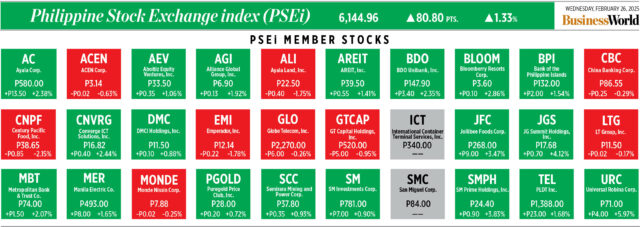
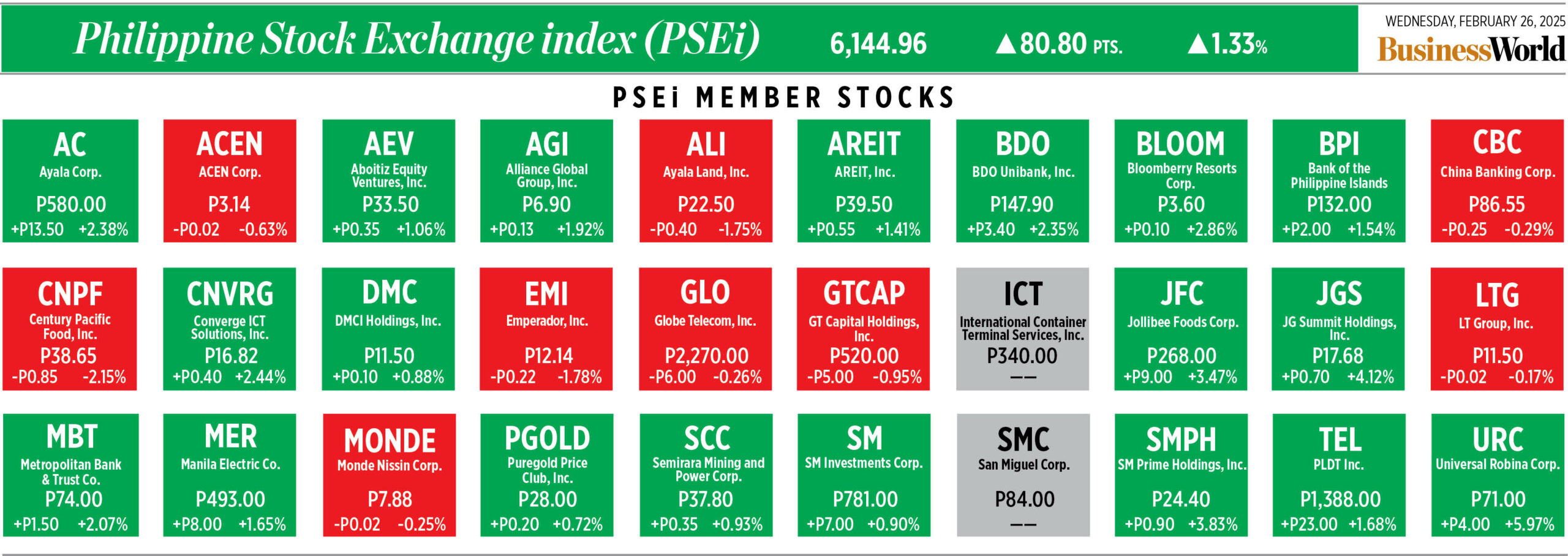
How PSEi member stocks performed — February 26, 2025

Here’s a quick glance at how PSEi stocks fared on Wednesday, February 26, 2025.


DoF sees FDI exceeding pre-2019 levels this year

PHILIPPINE STAR/ MICHAEL VARCAS

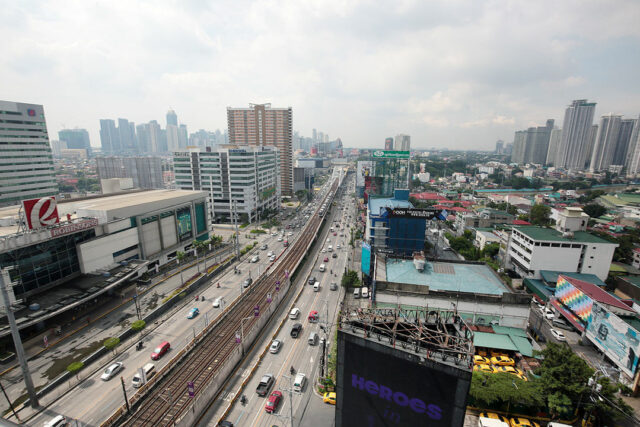
FOREIGN direct investment (FDI) is on track to exceed 2019 levels this year, with investors drawn in by reforms that have made the Philippines a more attractive investment destination, the Department of Finance (DoF) said.

“FDI levels are seen to be on track to exceed pre-pandemic levels. In order to further expand this promising growth story, we have carefully designed strategic initiatives that maintain a fiscal sector that is supportive of this goal,” Finance Assistant Secretary Neil Adrian S. Cabiles said at the BusinessWorld Insights: Stock Market Outlook 2025 conference.

In the first 11 months of 2024, FDI net inflows rose 4.4% to $8.58 billion, the DoF said, accounting for 95.3% of the BSP’s full-year forecast of $9 billion.

In 2019, the last year before the pandemic, FDI net inflows amounted to $8.671 billion.

In November, FDI net inflows fell 19.8% year on year to $901 million.

Mr. Cabiles said reforms like the Corporate Recovery and Tax Incentives for Enterprises to Maximize Opportunities for Reinvigorating the Economy (CREATE MORE) Act will improve ease of doing business, upgrade the tax code, and clarify the value-added tax refund rules.

“This would mean streamlined compliance, reducing the administrative burdens and making transactions more efficient. CREATE MORE also enhances tax incentive competitiveness and strengthens governance and accountability in the granting and monitoring of these tax incentives, creating greater transparency and a more predictable investment environment. We expect that the CREATE MORE will particularly draw investments in infrastructure, heavy industry, the export-oriented manufacturing sector, and services,” he said.

The Real Property Evaluation and Assessment Reform Act and the rationalization of the mining fiscal regime will also enhance transparency and accountability in the real estate and mining industries, respectively, he added.

The passage of the Capital Markets Efficiency Promotion Act is also expected to boost FDI net inflows by increasing the competitiveness of the capital markets.

“We anticipate greater financial market activity through streamlined taxes on passive income and reduced taxes on stock transactions and financial intermediaries,” Mr. Cabiles said.

The Philippines’ recent exit from the Financial Action Task Force’s (FATF) grey list also improves its’ profile and could boost its credit rating.

The FATF on Friday removed the Philippines from the category of jurisdictions requiring increased monitoring for “dirty money” on Friday following a “successful” on-site visit. The Philippines had been on the list since June 2021. — Aaron Michael C. Sy

Global instant-noodle demand seen at 120 billion servings this year

DEMAND for instant noodles is projected at 120 billion servings at least in 2025, according to the World Instant Noodle Association (WINA).

“We are in the process of putting together the statistics for 2024 as we speak, but we are expecting the number to exceed that of 2023 — not significantly, but that is just our estimate,” WINA Chairman Koki Ando said at the WINA Summit on Wednesday.

“With regard to 2025 … we are expecting it to reach at least 120 billion servings, but in terms of prices, they have increased, so we are expecting the value to go up compared to 2023,” he added.

The 2025 instant-noodle forecast is little changed from the 2023 serving total of 120.21 billion.

The Philippines is expected to maintain its spot as the seventh-largest instant-noodle market according to 2023 totals, when its consumption was 4.39 billion servings.

Monde Nissin Corp. Chief Executive Officer and Executive Vice-President Henry Soesanto said in the Philippines, instant noodles are treated as snacks.

“In a year, people in the Philippines consume only 40 packs per capita,” Mr. Soesanto said, lagging many other countries.

WINA said its top market is China and Hong Kong, which accounts for 42.21 billion servings, followed by Indonesia (14.54 billion servings), India (8.68 billion), Vietnam (8.13 billion), Japan (5.84 billion), and the US (5.1 billion).

Mr. Soesanto described growth in the Philippines as “slow” due to negative perceptions of the product.

On the final day of the summit, WINA issued the Manila Declaration, outlining its policy direction and targets related to nutrition and health, environmental sustainability, food safety, and addressing social issues. — Justine Irish D. Tabile

Sustainable fisheries, aquaculture to support coastal livelihoods — ADB

A FAMILY of siganids fishers in Eastern Samar. — MARCIAL VILLANIA BOLEN

THE Asian Development Bank (ADB) said sustainable fisheries and aquaculture are crucial to supporting coastal livelihoods and food security in the Philippines.

“These key blue-economy sectors are vital for supporting coastal livelihoods and ensuring food security, especially in countries like Bangladesh, Indonesia, the Maldives, the Philippines, Vietnam and Pacific small-island developing states,” the ADB said in its 2025 Asia-Pacific Sustainable Development Goals (SDGs) Partnership report.

The ADB projected that with sustainable management, the economic value of coastal tourism in the Asia-Pacific region could more than double by 2030.

“This growth underscores the sector’s dynamism, especially as an engine of job growth, and highlights the critical need for targeted investment in workforce training. However, many jobs in the sector are seasonal or informal, with issues ranging from variable working hours and low wages to limited social protection.”

The ADB estimates that the Philippine coastal destinations accounted for 4 million tourism-related jobs, against India’s 9.6 million and Indonesia’s 10.7 million.

The bank said coastal tourism has become “indispensable” for these economies, providing a critical source of income and fostering service-oriented skills at the community level.

“As such, the blue economy, a subset of the green economy, requires specific attention. Sustainable fisheries are projected to grow rapidly, with the region’s fish farms anticipated to produce over 60% of global fish supplies by 2030,” it said. 

The region’s renewable energy industry, which leads job creation in key sectors driving the green and blue transition, is estimated to support 10.5 million jobs, with “upward potential.”

The ADB noted the launch of 380 electric buses in Davao City which have helped reduce emissions and spurred employment.

Overall, the Asia-Pacific region has made insufficient progress with none of the 17 SDGs on track to be achieved by 2030, it said. — Aubrey Rose A. Inosante

Sugar regulator to set up soil lab in Bukidnon to help drive production

PHILSTAR FILE PHOTO

THE Sugar Regulatory Administration (SRA) said it will sign an agreement to establish a 40-hectare soil laboratory at Central Mindanao University  (CMU) in Bukidnon.

The memorandum of agreement for the proposed soil laboratory at CMU, a state university, could be signed by March, Director Pablo Luis S. Azcona told BusinessWorld late Tuesday.

“We are still waiting on a counter-offer,” he said.

The soil laboratory will help Bukidnon, which accounts for 20% of Philippine sugar production, plant a wider range of cane varieties that are higher-yielding than current varieties.

The SRA is positioning Bukidnon as another possible center for sugar production alongside Negros, where sugarland is rapidly being converted by developers. — Kyle Aristophere T. Atienza

Honda sees growing PHL market for high-powered outboard engines 

MARINE.HONDA.COM

DEMAND for high-powered outboard motors in the Philippines is expected to grow alongside sustained growth in the economy, Honda Philippines, Inc. (HPI) said.

HPI estimates the current market for high-powered outboard motors in the Philippines at around 2,000 units.

“Given the economic growth and the country being an island nation, demand for outboard (motors) in the Philippines is expected to increase year by year,” it said.

On Wednesday, HPI, in partnership with Propmech Corp., launched its flagship marine outboard engine, the Honda BF350.

“As boats become larger, global demand for high-power outboard engines is increasing. Here in the Philippines, we also see the market growth in the high-powered range,” HPI President Sayaka Arai said.

According to Ms. Arai, demand for such engines has more than doubled in the last few years.

The target customers for the Honda BF350 include resort owners, private users, and the government. The unit cost is between P2 million and P2.5 million.

The Honda BF350 is a V8, making for smoother running, Honda said.

“HPI’s partnership with Propmech began over a decade ago with a distributorship agreement, and since then, we have delivered close to 1,000 outboard engines to the commercial market and key government agencies,” Ms. Arai said.

These agencies include the Bureau of Fisheries and Aquatic Resources, the Philippine Coast Guard, and the Philippine National Police.

“Honda and Propmech have built a strong partnership to deliver reliable marine solutions to the Philippine market. The BF350 provides advanced marine technology suited for the country’s waters and climate, ensuring performance and value for vessel owners,” Propmech President Glenn Tong said.

HPI hopes to sell at least 100 units of the BF350 in the Philippines this year.

Last year, Honda sold 1,000 BF350 units worldwide. It is available in Japan, North America, Europe, other Asia-Oceania countries, and the Middle East. — Justine Irish D. Tabile

Imported rice SRP to be cut to P49 per kilo starting next month

PHILIPPINE STAR/EDD GUMBAN

THE Department of Agriculture (DA) is lowering the maximum suggested retail price (MSRP) for imported rice to P49 per kilo starting in March in selected cities.

Agriculture Secretary Francisco P. Tiu Laurel, Jr. said that the new MSRP will apply to Metro Manila and other urban centers.

“In many provincial areas, we’ve seen prices of imported rice already lower than the MSRP.  So we will apply it more selectively,” Mr. Laurel said in a statement on Wednesday.

March will mark the first time for the MSRP for imported rice to fall below P50 since the price cap was introduced on Jan. 20.

The MSRP was initially set at P58 per kilo. Prior to its introduction, imported rice consisting of 5% broken grains sold for between P62 and P64 per kilo.

“We will review the numbers in the coming days to determine if there is room to lower the MSRP further. As of now, there could be scope for additional reductions, but we will have to see,” he said.

In January, the DA projected the price of imported rice to fall below P50 per kilo, as long as world market prices remain stable. This assumed a maximum landed cost of $550 per metric ton (MT) for 5% broken rice.

“The landed cost of 5% broken rice was quoted at $490 per metric ton on Friday,” the DA said.

Samahang Industriya ng Agrikultura (SINAG) Executive Director Jayson H. Cainglet said the lowering of the MSRP is a step closer to the ideal price of P40-P45 per kilo for imported rice.

“At the current price of $380 per metric ton of 5% broken Vietnam rice, imported rice should further go below P40/kilo,” Mr. Cainglet said in a statement on Wednesday.

Federation of Free Farmers (FFF) National Manager Raul Q. Montemayor said that the new MSRP starting in March can still allow all parts of the supply chain to recover their costs.

“Our computations show that, even if the tariff is reinstated to 35%, an MSRP of P49 per kilo for rice with 5% brokens would still be feasible and provide cost recovery and decent profits for all market players,” Mr. Montemayor said via Viber.

The MSRP on imported rice is among the DA’s plans to lower rice prices alongside the declaration of a food security emergency on rice on Feb. 3, which allows the release of rice inventories held by the National Food Authority (NFA).

The emergency allows the release of NFA rice stocks to government agencies, local government units (LGUs), and the KADIWA ng Pangulo subsidized-market network.

Mr. Cainglet said the MSRP and the declaration of the food security emergency indicated the “dismal failure” of Executive Order (EO) No. 62 in taming rice prices.

“It is the right time to call for the repeal of EO 62 and generate revenue from imported rice that is earmarked to directly support our rice farmers,” he added.

President Ferdinand R. Marcos, Jr. last year issued EO 62 slashing tariffs on rice imports to 15% from 35% previously until 2028.

The FFF has blamed the tariff reduction along with the lack of restrictions on rice imports for the severe drop in the farmgate price of palay, or unmilled rice.

Citing Bureau of Customs data, the FFF said nearly 4.8 million tons of rice arrived in the country last year, while another 331,000 tons entered the country in January.

“Farmers in Mangaldan, Pangasinan have reportedly postponed selling their palay due to low buying prices of traders. In San Jose, Occidental Mindoro, prices for newly harvested palay have dipped to as low as P13 per kilo,” it said.

“Clean and dry palay is at P19 per kilo, with traders reportedly hesitating to buy stocks due to the influx of imported rice in the market,” it added.

The FFF said that it is seeking the restoration of the 35% tariff on imported rice to induce traders to buy palay at better prices.

“The landed cost of rice with 5% brokens from Vietnam will rise to P33 per kilo if we reinstate the 35% tariff,” Mr. Montemayor said.

“If we add P15 for other costs and trading margins all the way to retailers, imported rice could still be sold at P48,” he added. — Justine Irish D. Tabile

NGCP sees ‘vindication’ in Singapore arbitration

NATIONAL GRID Corp. of the Philippines (NGCP) said its successful outcome of its Singapore arbitration case serves as “vindication,” with a neutral third party affirming it has honored the terms of its concession agreement, specifically the restrictions on foreign ownership.

“How will that affect us moving forward? Operationally, siguro wala (maybe there will be no impact). I hope, however, that the weight of the disinterested third party’s ruling will clear the clouds surrounding NGCP and how we run the transmission system,” Cynthia P. Alabanza, NGCP assistant vice-president for public relations, told reporters on Wednesday.

The Arbitral Tribunal of the Singapore International Arbitration Centre ruled in favor of NGCP in a final decision dated Feb. 19 in its dispute with the Power Sector Assets & Liabilities Management Corp. (PSALM) and National Transmission Corp. (TransCo).

The arbitrator declared that the grid operator did not violate the nationality restrictions in the Philippine Constitution and the Anti-Dummy Law — which restricts foreign ownership in public services companies.

“It’s clear that there was no violation of the prohibition, among other things… That is the biggest win for NGCP,” Ms. Alabanza said.

Domestic corporations Monte Oro Grid Resources Corp. and Calaca High Power Corp. each hold 30% of the outstanding capital stock of the NGCP. State Grid Corp. of China holds the remaining 40%.

In 2018, the NGCP filed an arbitration case against PSALM and TransCo over the interpretation of the parties’ concession agreement.

The grid operator had sought, among other things, a declaration that a payment made on July 15, 2013 amounting to P57.88 billion was valid, as well as the payment of a further P4 billion “which should have been borne by TransCo under the concession agreement, but was advanced by NGCP.”

PSALM and TransCo argued that NGCP was in “concession default” for having allegedly violated the national restrictions for public utilities under Philippine law and the concession agreement.

The NGCP obtained a 25-year concession in 2007 to operate the power transmission network after an open, public and competitive bidding process. It officially started operations as a power transmission service provider in 2009.

“So, vindication ‘yun na sumusunod lang kami sa mga batas na naipasa at mga kontratang inihain ng gobyerno nang isinapribado nila ang transmission at NGCP ang nabigyan ng concession (It’s a vindication for us, signifying that we followed the law and the contract with the government when the transmission grid was privatized and NGCP was awarded the concession),” Ms. Alabanza said.

PSALM and TransCo said on Monday that they referred the matter to the Office of the Government Corporate Counsel for appropriate action. — Sheldeen Joy Talavera

PAGCOR sees up to P480B in 2025 gross gaming revenue

PAGCOR

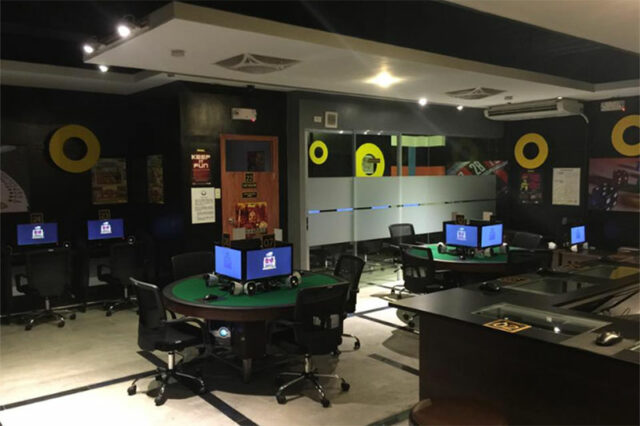
THE Philippine Amusement and Gaming Corp. (PAGCOR) said it expects to generate up to P480 billion in gross gaming revenue (GGR) this year, led by the growing electronic games segment.

In a briefing on Wednesday, PAGCOR Chairman and Chief Executive Officer Alejandro H. Tengco said GGR could range from P450 billion to P480 billion in 2025.

“I believe it will come from e-gaming and the trend in January and February will continue, land-based (operations) will grow, though not as significantly,” Mr. Tengco said on Wednesday.

Mr. Tengco said the full-year target is based on the estimated P40 billion GGR generated in January, up from P28.5 billion a year earlier.

Citing preliminary data, PAGCOR said if the full-year target is met, GGR would be 16.94% higher than the record P410.48 billion in 2024.

These GGR levels suggest that the Philippines is generating the second-largest gaming revenue in Asia after Macau, and exceeding that of Singapore, PAGCOR said.

In 2024, the integrated resorts (IR) segment was the largest contributor to GGR, accounting for 49%, followed by e-games (38%), the now-banned Philippine Offshore Gaming Operators (9.21%), and PAGCOR-owned casinos (3.9%). 

In 2025, Mr. Tengco expects the IR segment to account for 50% of GGR, with the share of e-games expected to account for 45% and PAGCOR casinos 5%, as the share of POGOs falls to 0%.

During his State of the Nation Address in July, President Ferdinand R. Marcos, Jr. ordered that all POGOs be shuttered by end-2024.

“We will continue to accept unregistered e-games operators to register, so that is where growth will come from. The IRs are gaining momentum again, especially the one in Quezon City,” he said.

E-game registration will be made more attractive by reduced rates, he said.

PAGCOR further reduced the rates it charges e-games operators to 30% from 35% starting Jan. 1, calling on unregistered entities to become legitimate operators.

It estimates gross revenue for 2025 at P125 billion, powered by the performance of Solaire Resort North in Quezon City.

In 2024, PAGCOR revenue rose 41% to a record P112 billion.

“There are new (IR) licensees opening in Cebu and Boracay. So I see an increase and then in e-gaming as well,” Mr. Tengco said, adding that he expects e-games to equal the performance of physical casinos “maybe in the next two or three years .”

Mr. Tengco said the regulator’s divestment from the 41 casinos it owns is expected to begin by 2026. — Aubrey Rose A. Inosante