Home Blog Page 1348

Tariff woes depress US manufacturing, erode labor demand

REUTERS

WASHINGTON – US manufacturing contracted in March after growing for two straight months, while a measure of inflation at the factory gate jumped to the highest level in nearly three years amid rising anxiety over tariffs on imported goods.

Anecdotes from the Institute for Supply Management survey on Tuesday offered a gloomy assessment of business conditions, with tariffs cited as a major factor by manufacturers. President Donald Trump’s wave of tariffs has eroded business and consumer confidence.

The survey added to data, including tepid consumer spending, that have raised the specter of lackluster economic growth and higher inflation. That could put the Federal Reserve, which paused its easing cycle in January to allow its policymakers to monitor the impact of the tariffs, in an uncomfortable position.

“Rising prices while business activity slows imply the economy could be heading into stagflation,” said Jeffrey Roach, chief economist at LPL Financial. “The Fed finds themselves in a tough spot because shaky corporate and consumer confidence could slow spending, leading to more than just a slowdown.”

The ISM said its manufacturing PMI dropped to 49.0 last month from 50.3 in February. A PMI reading below 50 indicates contraction in the manufacturing sector, which accounts for 10.2% of the economy. Economists polled by Reuters had forecast the PMI would slip to 49.5.

Manufacturing started turning around at the beginning of the year after a lengthy recession triggered by the US central bank’s aggressive interest rate hikes in 2022 and 2023 to tame inflation. But the nascent recovery appears to have been snuffed out by Trump’s tariffs.

“Demand and production retreated and destaffing continued, as panelists’ companies responded to demand confusion,” said Timothy Fiore, who chairs the ISM’s Manufacturing Business Survey Committee.

Trump, since returning to the White House in January, has announced and delayed tariffs on Canada and Mexico over what he alleges is their role in allowing the opioid fentanyl into the US, set import taxes on goods from China for the same reason, launched hefty duties on imports of steel and aluminum and slapped a 25% levy on imported cars and light trucks.

Trump promised to announce global reciprocal tariffs on Wednesday, which he has dubbed “Liberation Day.” He sees tariffs as a tool to raise revenue to offset his promised tax cuts and to revive a long-declining US industrial base.

But economists have criticized the import duties as inflationary and detrimental to the economy.

Nine industries including textile mills, primary metals, computer and electronic products as well as transportation equipment and electrical equipment, appliances and components grew last month. Among the seven industries reporting a contraction were machinery, wood, paper and chemical products.

Some makers of electrical equipment, appliances and components said there was “no evidence of growing demand,” adding that “tariff impacts and mitigation strategies are a daily conversation.” Machinery manufacturers said “business condition is deteriorating at a fast pace.”

While some makers of fabricated metal products reported better-than-expected orders growth, they noted that customers could be “trying to build inventory at current prices to get ahead of expected tariff and related cost increases.”

Computer and electronic products manufacturers said “customers are pulling in orders due to anxiety about continued tariffs and pricing pressures.” Producers of food and beverages reported they were “starting to see slower-than-normal sales in Canada, and concerns of Canadians boycotting US products could become a reality.”

Stocks on Wall Street were higher. The dollar was steady against a basket of currencies. US Treasury yields fell.

RECESSION ODDS RISING
Economists at Goldman Sachs now see a 35% probability of a recession over the next 12 months, up from 20% previously, reflecting the sharp deterioration in consumer and business confidence as well as “statements from White House officials indicating greater willingness to tolerate near-term economic weakness in pursuit of their policies.”

Domestic manufacturers rely heavily on imported raw materials and could experience a severe disruption in supply chains, economists warned.

The ISM survey’s forward-looking new orders sub-index sagged to 45.2, the lowest reading since May 2023, from 48.6 in February. Production at factories declined. The survey’s measure of prices paid by manufacturers for inputs jumped to 69.4, the highest level since June 2022, from 62.4 in February.

That data suggest goods inflation could continue rising and contribute to elevated price pressures. A measure of underlying inflation increased by the most in 13 months in February.

Suppliers’ delivery performance remained slow last month. The survey’s supplier deliveries index edged down to 53.5 from 54.5 in February. A reading above 50 indicates slower deliveries.

The flow of imports slowed considerably, suggesting the front-loading of raw materials by businesses seeking to avoid higher prices from tariffs was waning. This front-loading had likely accounted for some of the rise in the manufacturing PMI in the prior two months.

Factories continued to shed jobs, which could accelerate as import duties start to bite. The survey’s measure of manufacturing employment fell to 44.7 from 47.6 in February.

The ebbing demand for labor was underscored by a separate report from the Labor Department showing job openings, a measure of labor demand, dropped 194,000 to 7.568 million by the last day of February. The job openings rate fell to 4.5% from 4.7% in January. The retail sector had 126,000 fewer vacancies while unfilled jobs in wholesale trade decreased by 56,000.

There were also fewer job openings in financial activities, healthcare and social assistance, accommodation and food services as well as manufacturing.

But federal government job openings increased by 6,000 despite a hiring freeze imposed by the Trump administration as part of an unprecedented campaign to slash spending.

Layoffs increased 116,000 to a still-low 1.790 million. They were concentrated in the retail and professional and business services sectors. Federal government layoffs rose by 18,000.

The hires rate was 3.4% for a third straight month. With the economy’s outlook shaky and hiring tepid, workers are staying put. Resignations declined by 61,000 to 3.195 million, keeping the quits rate at 2.0%.

“The jobs market remains the economy’s bulwark, and while it’s eroding slowly, it’s not showing cracks that foreshadow recession,” said Robert Frick, corporate economist with Navy Federal Credit Union. “How it holds up to assaults from tariffs’ effects on consumers and businesses is the crucial question.” — Reuters


All local workers, US diplomats to be fired from USAID, sources say

Visitors walk up a stair during the opening of the restoration project at the historic Bimaristan Al-Muayyad Sheikh, one of the oldest hospitals following extensive renovations carried out in partnership between Egypt’s Tourism and Antiquities Ministry and the United States Agency for International Development (USAID) in Old Cairo, Egypt Aug. 18, 2024. — REUTERS

WASHINGTON – Elon Musk’s cost-cutting team is finalizing the dismantlement of the US Agency for International Development, ordering the firing of thousands of local workers and American diplomats and civil servants assigned to the agency overseas, two former top USAID officials and a source with knowledge of the situation said on Tuesday.

On Friday, Congress was notified that almost all of USAID’s own employees are being fired by September, all of its overseas offices shut, and some functions absorbed into the State Department.

The latest move by Musk’s Department of Government Efficiency effectively will eliminate what is left of the agency’s workforce.

“This is definitely the final closing out,” said one of the former senior USAID officials.

President Donald Trump and Musk, his hand-picked adviser to oversee government cost-cutting, in February began the process of shuttering USAID and merging its operations into the State Department to ensure they conformed with Trump’s “America First” policies. The State Department did not immediately respond to a request for comment.

The former officials and source familiar with the situation, speaking on condition of anonymity, said that USAID’s human resources office told regional bureaus in a conference call that layoff notices were going to all of the more than 10,000 locally hired foreign nationals, effective in August.

The first former official said the call took place on Monday, adding that the local staff terminations could run afoul of labor laws in the countries where the fired workers are employed.

Notices also will be sent to US diplomats and civil servants assigned to work abroad for what has been the leading US foreign aid provider for more than 60 years, the former officials and the source said.

Trump has claimed without evidence that the agency was rife with fraud and run by “radical left lunatics,” while Musk falsely accused it of being a “criminal” organization.

Thousands of USAID’s own staff were placed on administrative leave – they received layoff notices on Friday – hundreds of contractors fired and more than 5,000 programs terminated, disrupting global humanitarian aid efforts on which millions depend.

According to the non-partisan Congressional Research Service, USAID maintains missions in more than 60 countries, with most of its funds going to humanitarian aid and health programs.

Top recipients included war-torn Ukraine and Democratic Republic of Congo, US ally Jordan, and the Israeli-occupied West Bank and the combat-shattered Gaza Strip.

A summary of the conference call circulated by one regional bureau and reviewed by Reuters confirmed the terminations of all locally hired foreign nationals and American diplomats and civil servants on assignment with USAID abroad.

It said more than 600 US diplomats are on secondment to USAID overseas, but provided no figure for the number of US civil service members. Most are to be terminated in July, when the intent is to close “all programmatic work.”

“Every position eliminated; 100 percent of the agency is rif’d (Reduction in Force) or will be,” the summary said, and advised personnel that no one would be retained and to “focus on things to make sure you’re getting the right benefits.” — Reuters

NG debt hits record P16.63 trillion

PHILSTAR FILE PHOTO

By Aubrey Rose A. Inosante, Reporter

THE NATIONAL Government’s (NG) outstanding debt rose to a fresh high of P16.63 trillion as of end-February, the Bureau of the Treasury (BTr) reported.

Latest data from the BTr showed that the debt jumped by 1.96% from P16.31 trillion at the end of January.

Year on year, outstanding debt went up by 9.57% from P15.18 trillion as of end-February 2024.

National Government outstanding debt

“The rise was primarily driven by the net issuance of new domestic and external debt to support more public programs and projects,” the BTr said in a statement on Tuesday.

Despite hitting another record high, the Treasury said the outstanding debt “remains manageable.”

NG debt is the total amount owed by the Philippine government to creditors such as international financial institutions, development partner-countries, banks, global bondholders and other investors.

“Nevertheless, the increase was partially offset by the strengthening of the peso against the US dollar, which appreciated from P58.375 at the end of January to P57.99 at the end of February, helping manage foreign debt obligations,” it added.

The bulk or 67.5% of the total debt was owed to domestic creditors, while the rest was owed to foreign creditors.

“This financing mix reflects a prudent approach to debt management to help mitigate exposure to external risks while taking advantage of the country’s liquid domestic market,” the BTr said.

Domestic debt, which was composed of government securities, increased by 1.26% to P11.22 trillion as of end-February from P11.08 trillion as of end-January.

Year on year, it also rose by 6.12% from P10.58 trillion in February 2024.

“This was mainly due to P140.72 billion in net domestic financing, as the P268.25-billion gross issuance of government securities exceeded redemptions of P127.53 billion for the month,” the BTr said.

However, the rise in domestic debt was tempered by the peso appreciation against the US dollar, which reduced the overall valuation by P1.1 billion.

Meanwhile, external debt rose by 3.44% to P5.41 trillion from P5.23 trillion in the previous month.

Year on year, foreign debt climbed by 17.52% from P4.6 trillion.

“This was attributed to the net availment of foreign borrowing amounting to P193.71 billion and the P20.41-billion net appreciation effect on third currency-denominated debt,” the BTr said.

“However, these factors were partially offset by a P34.48-billion reduction due to the peso appreciation against the US dollar,” it added.

External debt was composed mainly of P2.53 trillion in loans, and P2.88 trillion in government securities.

“For the month, the NG secured a total of P197.3 billion in external financing, including P190.82 billion through a triple-tranche global bond issuance comprised of 10- and 25-year USD bonds ($2.25 billion), and 25-year EUR bonds (1 billion euros) and P6.48 billion in project loans,” the Treasury said.

The BTr said the project loans will fund rail projects through the Japan International Cooperation Agency (P3.86 billion) as well as physical connectivity and health sector efforts with the Asian Development Bank (P1.71 billion).

For February, NG-guaranteed obligations slipped by 1.49% to P341.11 billion as of end-February from the end-January level of P346.27 billion.

Year on year, it fell by 1.11% from P344.93 billion.

“The decrease resulted from the net repayment of both domestic and external guarantees, amounting to P5.83 billion and P0.15 billion, respectively,” the BTr said.

However, this was partially offset by the P1.43-billion net appreciation effect on third currency-denominated guarantees, it added.

Oikonomia Advisory and Research, Inc. Economist Reinielle Matt M. Erece said the increase in the debt level reflected new government borrowings.

“This trend may continue this year as the government plans to borrow again, mainly from domestic sources, to support their programs,” he said.

“Moreover, the forecasted peso depreciation against the US dollar may inflate the dollar value of foreign debt,” Mr. Erece added.

He also said the debt is still manageable “as long as the government continues to enhance its revenue generation, and (economic) growth exceeds the growth in expenditures.”

Rizal Commercial Banking Corp. Chief Economist Michael L. Ricafort said the higher NG debt level is due to the need to finance the budget deficit.

“There is a need to bring down the share of debt servicing costs as a percentage of the total national budget as a test of the need for more tax reform and other fiscal reform measures to structurally narrow the budget deficit and curb the growth in overall debt in view of the large borrowings/debt since the COVID-19 pandemic,” he said.

Mr. Ricafort said there is a need to bring the NG debt-to-gross domestic product (GDP) ratio below the international threshold of 60%.

Outstanding debt as a share of GDP inched up to 60.7% as of end-2024 from 60.1% a year earlier.

The NG’s outstanding debt is projected to reach P17.35 trillion by end-2025.

Bank lending growth slows in February

PJCOMP-FREEPIK

By Aaron Michael C. Sy, Reporter

BANK LENDING growth slowed in February, preliminary data from the Bangko Sentral ng Pilipinas (BSP) showed.

Outstanding loans of universal and commercial banks rose by 12.2% year on year to P13.03 trillion in February from P11.61 trillion in the same period in 2024. This was slower than the 12.8% expansion in January, which was the fastest in two years.

Year on year, the growth in lending was faster than the 8.7% increase in February 2024.

On a seasonally adjusted basis, big banks’ outstanding loans inched up by 0.6% month on month.

Central bank data showed outstanding loans to residents climbed by 12.6% to P12.7 trillion in February, slower than the 13.3% growth in January.

Meanwhile, loans to nonresidents declined by 3.2% to P324.82 billion in February, slightly better than the 3.5% decline in the previous month.

Outstanding loans to residents for production activities expanded by 11.2% to P11.08 trillion last month, slower than 11.8% in January.

“The growth was driven largely by increased lending to key industries such as electricity, gas, steam and air-conditioning supply (21.5%); wholesale and retail trade, repair of motor vehicles and motorcycles (13.7%); manufacturing (0.9%); construction (12.7 %); and transportation and storage (20.6%),” the BSP said.

On the other hand, consumer loans jumped by 24.1% in February to P1.62 trillion, slightly slower than 24.4% in the previous month.

BSP data showed credit card loans rose by an annual 28.9% to P950.97 billion in February.

Loans for motor vehicles went up by 19.2% to P470.13 billion in February, while salary-based general purpose consumption loans rose by 11.5% to P158.16 billion.

“Loan growth still grew on a month-on-month basis. The year-on-year growth is still among the fastest in more than two years and also more than twice faster than GDP (gross domestic product) growth,” Rizal Commercial Banking Corp. Chief Economist Michael L. Ricafort said in a Viber message.

Bank lending’s continued expansion in February was also supported by lower borrowing costs, he added.

Since August last year, the central bank has brought down benchmark interest rates by a total of 75 basis points (bps) to 5.75%.

The Monetary Board kept benchmark rates unchanged at its Feb. 13 meeting.

For the next few months, Mr. Ricafort said the BSP’s further easing could lift demand for loans.

BSP Governor Eli M. Remolona, Jr. said last week that there is a “good chance” that the Monetary Board will cut rates by 25 bps at their April 10 review.

He said the BSP remains on an easing cycle and could reduce borrowing costs by as much as 75 bps this year, depending on data.

MONEY SUPPLY
Meanwhile, domestic liquidity (M3) grew by 6.3% in February, slower than the 6.8% expansion in January, preliminary BSP data showed.

M3 — which is considered as the broadest measure of liquidity in an economy — increased to P17.98 trillion from P16.92 trillion a year earlier.

Month on month, M3 dipped by 0.3% on a seasonally adjusted basis.

Data from the BSP showed domestic claims increased by 10.1% during the month, slower than 10.9% in January.

“Claims on the private sector grew by 12.3% in February from 13.1% in the previous month, driven by continued expansion in bank lending to nonfinancial private corporations and households,” the BSP said.

The growth in net claims on the central government eased to 5.9% in February from 7.4% in the previous month due to lower National Government borrowings.

Meanwhile, growth in net foreign assets (NFA) in peso terms quickened to 5.8% last month from 2.6% in January.

“The BSP’s NFA expanded by 8.9%, reflecting the increase in gross international reserves. Meanwhile, the NFA of banks declined, largely due to higher foreign currency-denominated bills and bonds payable,” it added.

Real estate lending to require closer monitoring amid rising risks — BSP

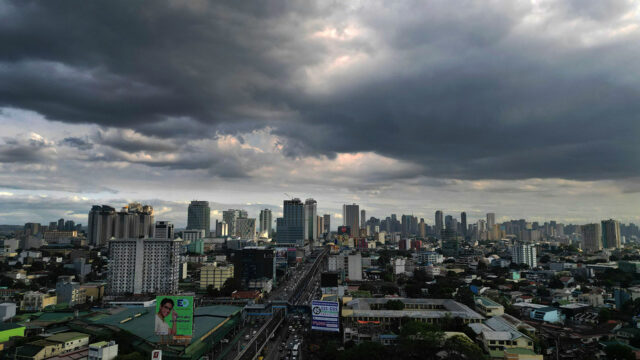
Dark clouds hover over Metro Manila, March 18, 2025. — PHILIPPINE STAR/MIGUEL DE GUZMAN

By Luisa Maria Jacinta C. Jocson, Senior Reporter

LENDING to the real estate sector will need tighter supervision amid emerging risks that could impact the financial system, a Philippine central bank report showed.

“Real estate loan (REL) exposures need closer monitoring amid evolving market conditions,” the Bangko Sentral ng Pilipinas (BSP) said in its latest financial stability report.

“The high-interest rate environment, shifting consumer preferences, remote work arrangements and recent government pronouncements banning Philippine offshore gaming operators (POGO) have implications on the sector’s loan quality.”

Latest data from the BSP showed Philippine banks and trust entities’ real estate exposure ratio rose to 19.75% as of end-December from 19.55% at end-September.

The central bank monitors lenders’ exposure to the real estate industry as part of its mandate to maintain financial stability.

Broken down, real estate loans increased by 7.9% year on year to P2.95 trillion at end-December. This as residential real estate loans climbed by an annual 9.6% to P1.1 trillion, while commercial real estate loans went up by 6.9% to P1.85 trillion.

The BSP also noted the rise in nonperforming loans in the real estate sector. Data showed the bulk or 62.5% of the NPL portfolio consists of commercial real estate.

“However, majority of the nonperforming RELs are residential RELs at 65.2% against commercial RELs at 34.8% as of September 2024,” it added.

The BSP also said that the rise in bad loans was driven by the mid- and low-cost housing segments as they account for a large share in residential loans.

“What does not show up as higher NPLs for commercial real estate are likely to be seen in the financial statements of real estate developers,” it added.

Joey Roi H. Bondoc, director and head of research at Colliers Philippines, said consumers could be struggling to pay back their loans, which is why developers are finding ways to offer more flexible payment terms.

“Based on anecdotes that we have been getting, a lot of buyers right now are scouting and looking for the most attractive payment terms or incentives, especially in the ready-for-occupancy (RFO) market,” he said in a phone call.

Mr. Bondoc said there is a “pretty substantial” number of unsold RFO units in the market, especially in the mid-income segment, which covers nearly 60% of unsold RFO units.

“Essentially, six out of 10 unsold RFO (units) are from the mid-income segment, which is heavily dependent on bank mortgages,” he added.

He noted some developers are extending downpayment terms among other measures to make financing more accessible.

“Banks should also be more cautious moving forward because the ready-for-occupancy (RFO) promos are getting sweeter, they’re getting extended, but you don’t want to see the market falling into that trap again,” Mr. Bondoc said.

The BSP noted the oversupply in the property market, especially in the condominium segment. It noted it would take 34 months for the current condominium supply to be sold.

“Despite recovery in prices, vacancies remain elevated amid the increase in residential real estate supply,” the central bank said.

The rise in new units is outpacing net take-ups in the secondary market, it added.

“It will be very interesting this first quarter because we’re seeing tepid launches. Developers are almost not launching new projects at this point,” Mr. Bondoc said.

OTHER RISKS
Meanwhile, the BSP also flagged other risks to the real estate sector.

“A potential risk is the buildup of in-house financing as reflected in the installment contract receivables of real estate developers. These contribute to revenues but also expose developers to credit risk.”

“Past due and impaired receivables remain elevated including in real estate developers exposed to POGOs,” it added.

While property developers are seeking ways to provide more enticing payment terms, Mr. Bondoc noted it is unlikely that there will be significant price reductions.

However, he noted that once the central bank continues cutting interest rates, this would result in lower mortgage rates.

“Probably that’s when we might start seeing low interest rates having a positive impact, kicking in and resulting in lower mortgage rates. Therefore, perhaps chipping in to greater take-up in the pre-selling sector.”

Housing prices rose by 6.7% year on year in the fourth quarter, according to the latest Residential Real Estate Price Index. This was a turnaround from the 2.3% decline in the previous quarter.

The Monetary Board cut the key rate by a total of 75 basis points last year.

While the central bank delivered a pause at its first meeting in 2025, BSP Governor Eli M. Remolona, Jr. has said it is still on an easing trajectory and has signaled further rate cuts this year.

Apart from lower interest rates, real estate loan demand could also be impacted by remittance flows, Mr. Bondoc said.

“I think that will be crucial because data from the central bank would also show that more remittance-receiving households are in fact allocating money for real estate requirements,” he said.

The BSP’s latest Consumer Expectations Survey also showed that 5% of households plan to buy or acquire real property in the next 12 months, up from 4.8% a year ago.

Domestic trade in goods jumps by 23% in 2024 as economy picks up

Trucks are seen along the South Luzon Expressway. — PHILIPPINE STAR/MIGUEL DE GUZMAN

DOMESTIC TRADE in goods grew by 23.1% to P1.31 trillion in 2024, reflecting the uptick in overall economic activity, analysts said.

According to the Philippine Statistics Authority’s (PSA) Commodity Flow in the Philippines report, the value of goods traded rose to P1.31 trillion in 2024 from the revised P1.07 trillion in 2023.

This was a turnaround from the 3.1% contraction in 2023.

Domestic trade by region in 2024

By volume, domestic trade likewise rose by 8.4% to 30 million tons from the revised 27.66 million tons in 2023.

The PSA reported that the majority of the commodities that flowed within the country in terms of value were traded through water.

Domestic trade by value is the outflow value of commodities transported from the place of origin to the destination.

Philippine Chamber of Commerce and Industry (PCCI) Chairman George T. Barcelon attributed the increase in domestic trade in 2024 to the economy’s performance.

In 2024, the Philippine economy expanded by 5.6% from 5.5% a year earlier.

Mr. Barcelon said the improved domestic trade data reflect the government’s investments in infrastructure projects and increased foreign direct investments.

In 2024, seven out of 10 traded commodity groups monitored by the PSA grew by value.

Food and live animals, which accounted for the largest share of trade in terms of value at 35.6%, rose by 96.6% to P466.65 billion in 2024. By volume, it climbed by 48.8% to 8.55 million tons.

The value of machinery and transport equipment fell by 15% to P308.23 billion in 2024, accounting for 23.5% of domestic trade. By volume, it declined by 46.5% to 2.89 million tons.

Manufactured goods rose by 12.5% to P175.5 billion. In terms of volume, it grew by 15.6% to 3.95 million tons.

“Food items are still the primary driver of growth of domestic trade, especially as foreign exchange concerns and global supply-chain uncertainty make locally sourced food items more attractive,” Reinielle Matt M. Erece, an economist at Oikonomia Advisory and Research, Inc. said in an e-mail.

Mr. Erece also noted that the National Capital Region continues to be the primary hub for higher value-added items, particularly manufactured goods, contributing to the high value of outflows from the region.

Among regions, Metro Manila posted the largest value of traded commodities with total outflows amounting to P451.41 billion for a trade surplus of P225.11 billion.

The National Capital Region (NCR) accounted for 34.4% of the total value of domestic trade in 2024.

This was followed by Western Visayas with traded commodities reaching P313.07 billion for a trade surplus of P134.15 billion. The region accounted for 23.9% of domestic trade.

Central Visayas followed with P135.02 billion, bringing the trade deficit to P101.43 billion.

Meanwhile, in terms of favorable trade balance among the regions, NCR led the regions with P225.11 billion. Western Visayas trailed with P134.15 billion and Central Luzon with P51.69 billion.

On the other hand, regions with the most unfavorable trade balances were Central Visayas (P101.43-billion trade deficit), Calabarzon (P93.69-billion trade deficit) and Caraga (P83.27-billion trade deficit).

According to the PSA, the trade balance is the difference between the outflow value and inflow value.

Mr. Erece said low inflation, especially for food items, may have increased demand for locally sourced goods in the first quarter.

“The increasing international trade tensions and foreign exchange worries can also make local sources a viable alternative to imports,” Mr. Erece said in a Viber message.

He said the ongoing election season will likely boost domestic trade.

“The growth brought by the election season may materialize during the second quarter,” Mr. Erece said. — Abigail Marie P. Yraola

East West Banking Corp. to hold virtual Annual Stockholders’ Meeting on April 24


Spotlight is BusinessWorld’s sponsored section that allows advertisers to amplify their brand and connect with BusinessWorld’s audience by publishing their stories on the BusinessWorld Web site. For more information, send an email to online@bworldonline.com.

Join us on Viber at https://bit.ly/3hv6bLA to get more updates and subscribe to BusinessWorld’s titles and get exclusive content through www.bworld-x.com.

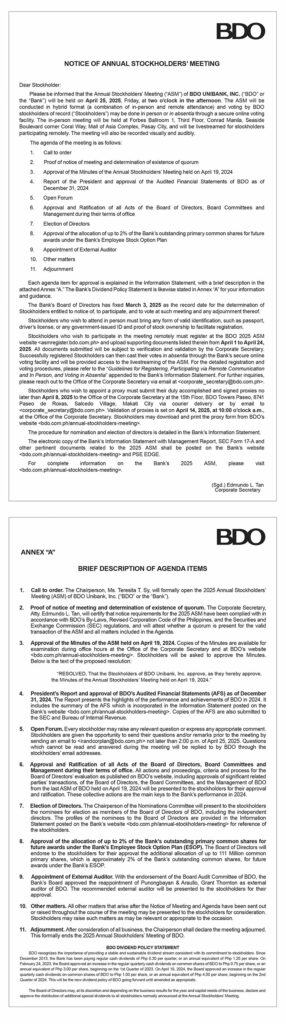
BDO Unibank, Inc.: Notice of 2025 Annual Stockholders’ Meeting (Second Publication)

BDO Unibank, Inc. will hold its Annual Stockholders’ Meeting on April 25, 2025, Friday, at 2:00 p.m., at the Forbes Ballroom 1, Third Floor, Conrad Manila, and will be livestreamed for stockholders participating remotely.


Spotlight is BusinessWorld’s sponsored section that allows advertisers to amplify their brand and connect with BusinessWorld’s audience by publishing their stories on the BusinessWorld Web site. For more information, send an email to online@bworldonline.com.

Join us on Viber at https://bit.ly/3hv6bLA to get more updates and subscribe to BusinessWorld’s titles and get exclusive content through www.bworld-x.com.

Manila Water moves forward with P95-B capex through 2027

MANILAWATER.COM

EAST ZONE concessionaire Manila Water Co., Inc. said it is continuing its P95-billion capital expenditure (capex) program for water and wastewater projects, which began in 2023 and will run until 2027.

“Manila Water will be undertaking considerable fundraising activities to support its substantial operating and capital expenditures from 2023 to 2047, intended primarily for water security, service accessibility, service continuity, and environmental sustainability programs,” the company said in its approved 2023 rate rebasing service improvement plan (RR23SIP).

For water supply projects, Manila Water’s proposed investments include the Wawa-Kaysakat-Pasig Water Supply System and Long-Term East Line Projects, based on its RR23SIP.

Among the major projects expected to be completed is the second phase of the East Bay Water Treatment Plant, which has a capacity of 200 million liters per day (MLD) of water.

“This system project is expected to result in an increase in water service coverage, serving Pasig, Pateros, Taguig, and Talim Island after its target completion. This new water source shall also de-load the Angat water system and serve as an augmentation source for Metro Manila,” said Manila Water.

For wastewater projects, the company is anticipating the completion of the Hinulugang Taktak Sewage Treatment Plant (STP) by the third quarter of 2025.

The facility will treat used water generated within the catchment area before discharging to Hinulugang Taktak Falls, meeting the priority requirement of the local government of Antipolo concerning the preservation of the falls.

Another project is the Mandaluyong West STP, which is designed to treat domestic wastewater generated from the western area of Mandaluyong, south of San Juan South, and south of Quezon City.

The STP is slated for completion by the third quarter of 2025.

Manila Water serves the east zone network of Metro Manila, covering parts of Marikina, Pasig, Makati, Taguig, Pateros, Mandaluyong, San Juan, portions of Quezon City and Manila, and several towns in Rizal province. — Sheldeen Joy Talavera

SM Prime sets sights on premium residential development

JOSE JUAN Z. JUGO

By Revin Mikhael D. Ochave, Reporter

REAL ESTATE company SM Prime Holdings, Inc. is entering the country’s premium residential market.

“The premium segment is shock-resistant,” SM Prime Holdings Executive Vice-President and Premium Residential Line Head Jose Juan Z. Jugo said in an interview with BusinessWorld.

“It can weather storms better than the broader market. It is more resilient. SM is seeing the opportunity to move to a wider spectrum of residential products with the premium market. There is enough space in this segment for another large player,” he added.

In November last year, SM Prime announced the expansion of its residential portfolio into the high-end horizontal and vertical principal homes, bolstering its current economic, mid-range, and leisure residential offerings.

The company is aiming to launch its first upscale residential project this year. It is a master-planned subdivision designed with a strong focus on sustainability, convenience, and community.

“We’re ready to work hard. We already are working hard. Definitely, this first project will make a significant impact in the high-end segment,” Mr. Jugo said.

“SM Prime is so big. When a company is this big, you have to start thinking about where you are going to get the growth. What an organization this large needs is a new engine. Hopefully, this will provide that to a certain extent,” he added.

He noted that the new venture aims to leverage the company’s expertise in creating upscale, large-scale developments, similar to its success in the mall sector.

“These new SM malls, they’re beautiful and very upscale. However, they also have not left behind the broader segment in the retail market. They’ve been able to adapt from being a very broad-based market leader to now entering and succeeding in high-end retail,” he said.

“If we do what we’re expected to do, we now become a full-line residential developer, from economic all the way to ultra-luxury. We’re trying our best to move the needle toward the upper spectrum,” he added.

Mr. Jugo brings over 23 years of real estate experience to SM’s new venture. He previously served as the executive vice-president of listed luxury property developer Shang Properties, Inc. until July 2023.

He was also the managing director of Ayala Land Premier, Inc., vice-president of Ayala Land, Inc., and director, chief executive officer, and non-independent executive director of Malaysian real estate developer MCT Bhd., now known as Avaland Bhd.

Mr. Jugo has a graduate degree from Escuela Superior de Estudios de Marketing de Madrid and an undergraduate degree from De La Salle University.

“What can be expected is that, because we’re a very large company, it will be a continuing thing. We do not expect to do just one premium project and then call it a day. It will be a succeeding series of high-end projects if we do things right,” Mr. Jugo said.

“The land is there. The resources are there. The commitment of the principals is there. We are being given leeway to grow our own organization the way we think we should to succeed. It will be a long-term thing,” he added.

Real estate consultancy firm Colliers Philippines said that demand for premium residential units is recovering, led by a cash-rich market.

It also advised property developers to prioritize the upscale and luxury segments due to steady demand amid market challenges.

“We’re creating our own brand. Right now, we are all SM Development Corp. (SMDC). However, we will eventually have our own brand, logo, and even our own legal entity. It is a development company for the premium segment. SMDC will be mid-market. We will be upper market,” Mr. Jugo said.

“It’s a startup. I tell my team members that this is a startup. Even our mindset has to be different. We’re building the organization,” he added.

SM Prime has earmarked P100 billion in capital expenditure for its malls, residences, and integrated property developments this year.

For 2024, the company posted a 14% increase in its consolidated net income to P45.6 billion as revenue climbed by 10% to P140.4 billion.

SM Prime’s portfolio consists of 87 local malls, 22 office towers, and more than 185,000 residential units launched. It is the real estate subsidiary of Sy-led conglomerate SM Investments Corp.

MPH plans to acquire at least 4 hospitals this year

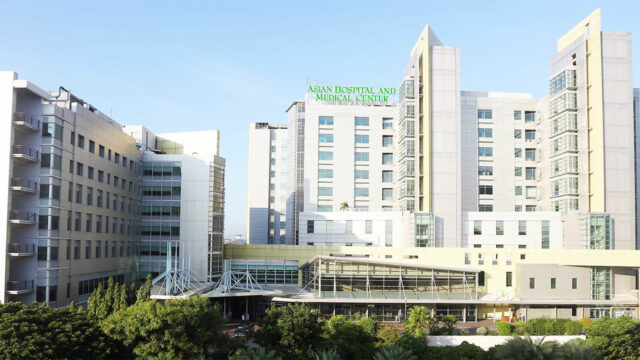
Asian Hospital and Medical Center — ASIANHOSPITAL.COM

METRO PACIFIC Health Corp. (MPH) is aiming to acquire at least four hospitals this year, the company’s president said.

“The last two years were rather good, with four transactions made in 2023 and 2024… I’m hoping we can do the same, if not more, this year,” MPH President and Vice-Chair Augusto P. Palisoc, Jr. said during a recent briefing.

Mr. Palisoc said that MPH has been in talks with many hospitals for possible acquisitions.

“That’s what we do every day. We talk to all the hospital owners and try to find the deals that are more imminent and are already ripe,” he said.

MPH currently has 27 hospitals in its portfolio. The company’s latest acquisition took place in November last year with the addition of the City of General Trias Doctors Medical Center, Inc. in Cavite.

MPH is the healthcare arm of the Pangilinan-led conglomerate Metro Pacific Investments Corp. (MPIC).

MPIC Chief Finance, Risk, and Sustainability Officer June Cheryl Cabal-Revilla said MPH experienced double-digit growth in both revenue and net profit last year.

“The (profit) contribution is P560 million (in 2024) versus P330 million (in 2023), increasing by 50%. We actually added more hospitals. There is a plan to add more,” she said.

“From an organic standpoint, on a same-facility basis, we’re seeing growth even without the added hospitals. Our healthcare group is doing very well. Double-digit growth across all financial metrics, from revenues down to core income. This is due to increases in inpatient and outpatient census,” she added.

Some of the other hospitals under the MPH network include Makati Medical Center, Asian Hospital and Medical Center, Cardinal Santos Medical Center, Davao Doctors Hospital, and Riverside Medical Center.

For 2024, MPIC recorded a 41% jump in its attributable net income to P28.2 billion due to non-recurring gains from its real estate business and a lower interest bill.

MPIC is one of three key Philippine units of Hong Kong-based First Pacific Co. Ltd., the others being Philex Mining Corp. and PLDT Inc.

Hastings Holdings Inc., a unit of the PLDT Beneficial Trust Fund subsidiary MediaQuest Holdings, Inc., has a majority stake in BusinessWorld through the Philippine Star Group, which it controls. — Revin Mikhael D. Ochave

BPI sees double-digit consumer loan growth

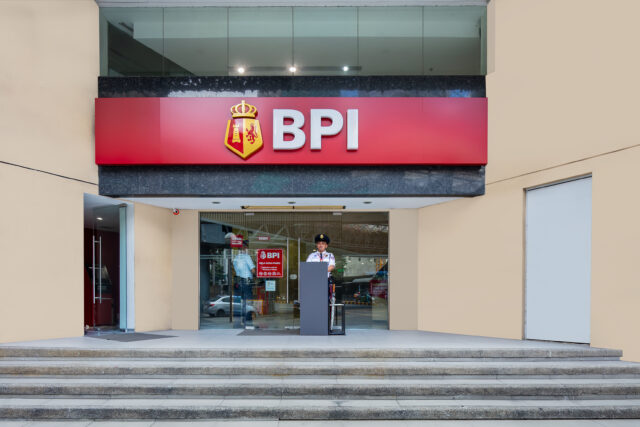
BPI/BW FILE PHOTO

BANK of the Philippine Islands (BPI) expects its consumer loans to grow by 10% to 12% this year as it continues to expand its customer base and with its auto and home lending businesses staying strong.

“We’ve crossed the P100-billion mark in auto loans and crossed the P200-billion mark in housing loans. 10 to 12% would be growth in our total consumer loan portfolio,” BPI Head of Consumer Banking and Executive Vice-President Maria Cristina “Ginbee” L. Go said on the sidelines of an event last month.

BPI is targeting about 20 million customers for its consumer banking business this year, she said. “We’re already at about 15 million. We never thought it’s even possible to grow double our customer base three years ago, but we have.”

“We have more appetite for risk because we believe that our penetration of consumer lending is still very low,” Ms. Go said. “Our consumer loan growth has been extremely impressive, but of course we want to make sure that we’re also able to manage the risks.”

The bank’s nonperforming loan (NPL) ratios for the consumer segment remain “well managed,” the official said.

“We are way below industry. Housing loans were 200 bps (basis points) lower than industry [in 2024]. Auto loans were 80 bps lower than industry. We have room to grow, definitely.”

BPI’s overall NPL ratio stood at 2.13% in 2024, while its NPL coverage ratio was at 106.2%.

Ms. Go added that the bank has “a lot of room to grow” in terms of microfinance lending, teachers’ loans through its subsidiary Legazpi Savings Bank, which became part of BPI following its acquisition of Robinsons Bank Corp. (RBC) in 2024, as well as personal loans.

BPI expects customer acquisition via online channels to continue as it continues to streamline its application process, she said.

Currently, more than half or 55% of BPI’s new-to-bank clients are acquired through digital channels, while the remaining 45% is on-boarded through branches, Ms. Go added.

The bank is also working to digitize all its branches and is looking at adding 80 more reformatted or digitalized branches this year, she said.

“We have 858 branches now, which is the combination of BPI and RBC branches. We will continue on branch transformation and optimization because part of the branch transformation is to make sure that we have the optimal branch footprint and that we’re able to provide the customer experience in-branch in light of all the digital capabilities that we already have, and make sure that we have an omni-channel experience,” Ms. Go said. “The digital format leverages on our digital capabilities and improves the customer experience because we shouldn’t be just transacting centers — we are advisory centers.”

BPI is also consolidating its branch network, the official said.

“There are areas wherein we’re saturated, particularly in Metro Manila. So, we will continue to consolidate branches, particularly since Robinsons Bank branches are also in the same areas where we are… We will retain the ex-Robinsons Bank branches in Robinson’s malls, where, of course, they have strategic locations.”

BPI’s attributable net income rose by 20.04% to a record P62.05 billion last year from P51.69 billion in 2023. — Aaron Michael C. Sy