Home Blog Page 1343

Malayan Insurance meets IFRS 17 standards

STOCK PHOTO | Image by Snowing from Freepik

MALAYAN INSURANCE CO., Inc. has become the first insurer in the Philippines to achieve full readiness for the implementation of International Financial Reporting Standards (IFRS) 17, two years ahead of the Insurance Commission’s (IC) deadline.

“One of the most complex parts of the project was retrieving and preparing historic data going back to 2018,” Frederick Pineda, senior vice-president and chief financial officer at Malayan Insurance, said in a statement on Monday.

A coordinated effort across departments was essential — the actuarial team managed assumptions and cash flow modeling, the information technology team pulled usable data from legacy systems and the finance team assessed the accuracy and analyzed the outputs, he said.

Just as important was the collaboration required to identify the right data and assumptions for the system. “Doing this manually would have been near impossible,” he added.

Malayan said it used SAS’ IFRS 17 software solution, developed by data and artificial intelligence firm SAS, to meet stringent reporting requirements.

“With the implementation of a robust technology platform specially designed to meet the complex standard requirements, it allows key capabilities such as generating accurate and automated cash flow calculations, modelling of the contractual service margin and producing audit-ready reports,” the company said.

Malayan said its financial reporting cycles have “dramatically shortened” with the new system now generating IFRS 17-compliant figures in under 30 minutes with fully traceable outputs.

“We needed a system that could offer detailed traceability — from the raw data to the final figures. SAS stood out with its strong functionality, cost-effective implementation, and transparency. It gave us the confidence we needed, especially during user acceptance testing,” Mr. Pineda said.

In March, the IC extended the industry-wide deadline for the adoption of Philippine Financial Reporting Standards 17 (PFRS 17) — the local version of IFRS 17 — to Jan. 1, 2027, from the original Jan. 1, 2025 deadline, citing the industry’s need for more preparation time.

IFRS 17, issued by the International Accounting Standards Board in 2017 and adopted locally as PFRS 17 in 2018, sets updated principles for the recognition, measurement, presentation and disclosure of insurance contracts in financial statements. — Aaron Michael C. Sy
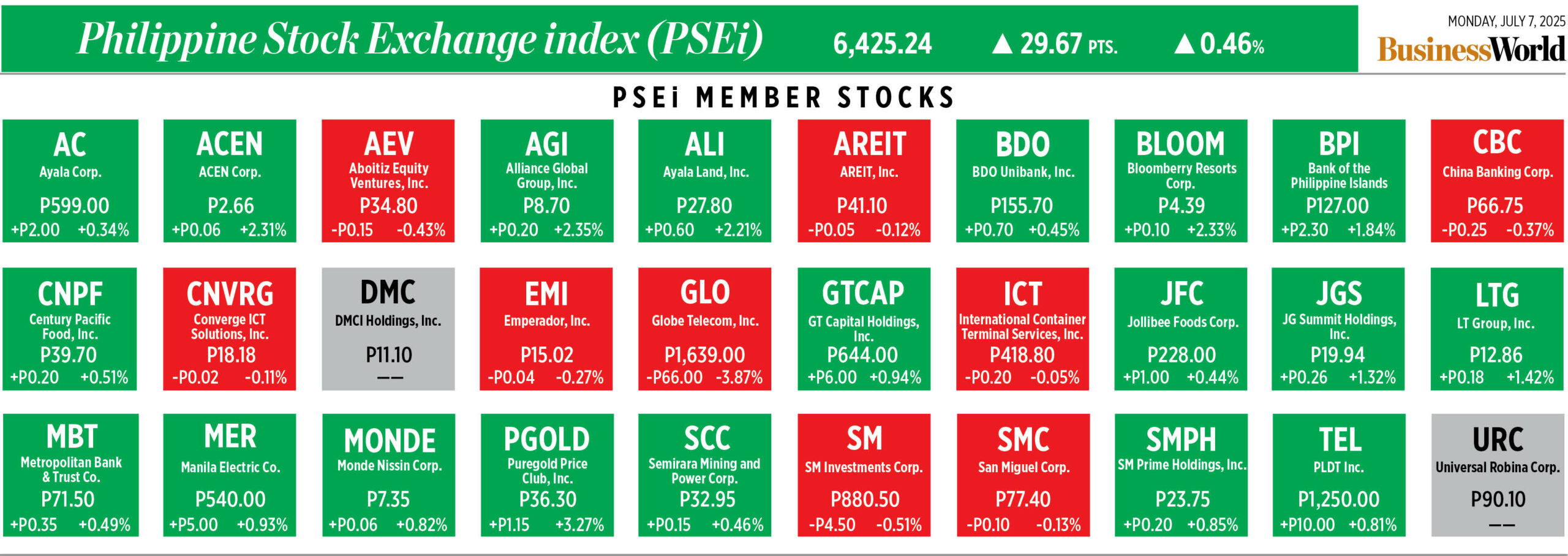
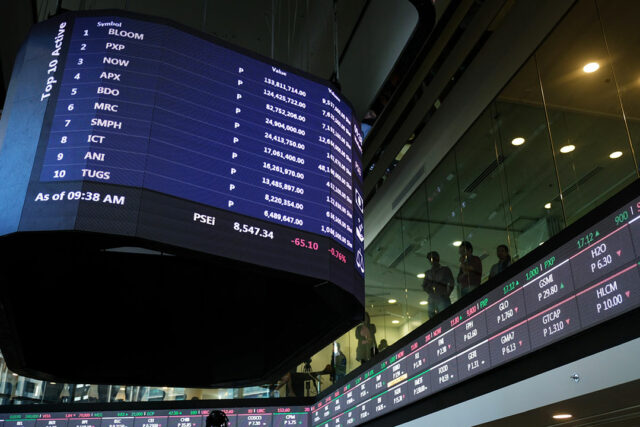
How PSEi member stocks performed — July 7, 2025

Here’s a quick glance at how PSEi stocks fared on Monday, July 7, 2025.


PSEi rises to 6,400 on rate cut bets, delayed tariffs

BW FILE PHOTO

PHILIPPINE STOCKS advanced on Monday as investor sentiment was lifted by expectations of further local interest rate cuts and after the US delayed the implementation of its planned reciprocal tariffs to Aug. 1.

The bellwether Philippine Stock Exchange Index (PSEi) rose 0.46% or 29.67 points to 6,425.24, while the broader all-share index added 0.4% or 15.22 points to 3,779.93.

“The local market closed higher, backed by dovish expectations on the Bangko Sentral ng Pilipinas’ (BSP) policy outlook following June’s weak inflation print,” Philstocks Financial Inc. Research Manager Japhet Louis O. Tantiangco said in a Viber message.

“Investors also digested the US decision to move the reciprocal tariff implementation to Aug. 1 for those who have not struck a trade deal with the country yet,” he added.

On Friday, Finance Secretary Ralph G. Recto said lower-than-expected June inflation gives the central bank more room to continue its policy easing.

Inflation rose to 1.4% in June from 1.3% in May but slowed from 3.7% a year earlier.

Last month, the BSP delivered a second straight 25-basis-point cut, bringing the policy rate to 5.25%.

US President Donald J. Trump on Sunday said the higher tariff rates would take effect on Aug. 1 as the US was nearing several trade pacts.

Mr. Trump imposed a 10% baseline tariff on all US imports effective April 1 to “level the playing field” by automatically applying tariffs equal to what US exports face abroad. On April 9, tariff rates were adjusted to 11–50% for 57 countries. On April 10, it hiked China’s tariff to 125% after retaliation.

“Philippine shares closed slightly above the 6,420 level, ahead of upcoming employment and industrial data to be released today,” Luis A. Limlingan, head of sales at Regina Capital Development Corp., said in a Viber message.

Most of the market’s sectoral indices closed higher. Financials gained 0.87% or 19.82 points to 2,274.12, while services increased 0.79% or 16.67 points to 2,113.88.

Property went up 0.74% or 17.84 points to 2,429.03, while industrials climbed 0.46% or 42.29 points to 9,118.44.

On the other hand, mining and oil dropped 2.31% or 219.30 points to 9,239.67, while holding firms slipped 0.006% or 0.31 point to 5,601.96.

Puregold Price Club, Inc. was the top index gainer, climbing 3.27% to P36.30, while Globe Telecom, Inc. was at the bottom, falling 3.87% to P1,639, Mr. Tantiangco said.

Value turnover rose to P7.8 billion with 911.7 million shares traded from P6.62 billion covering 1.12 billion issues exchanged on Friday.

Losers beat winners 100 to 96, while 66 stocks were unchanged. Net foreign buying retreated to P107.24 million from P295.82 million on Friday. — Revin Mikhael D. Ochave

PHL debt benchmark now at 70% of GDP, Malacañang claims

PRESIDENTIAL COMMUNICATIONS OFFICE/PHILSTAR FILE PHOTO

By Chloe Mari A. Hufana, Reporter

THE appropriate benchmark for sustainable debt for the Philippines is now 70% of gross domestic product (GDP), according to Malacañang.

Palace Press Officer Clarissa A. Castro told reporters on Monday at a briefing that the Department of Finance (DoF) considers 70% of GDP to be the international threshold for sustainable borrowing, as opposed to the 60% rule-of-thumb that multilateral banks often hold developing countries to.

“We are at a sustainable level (of debt) because 70% is the international threshold for debt-to-GDP ratio,” Ms. Castro said.

Philippine debt is currently at 62% of GDP. It rose to nearly P17 trillion at the end off May.

At any rate, Ms. Castro said all government borrowing is being channelled appropriately to projects that enable growth.

“These were used for growth-enhancing investments such as infrastructure, education, agriculture, health, and social services,” she said.

Asked if the Marcos administration will continue to target bringing down the debt ratio to below 60% by the end of its term in 2028, Ms. Castro said the economic team will be consulted for updated targets.

The Philippines ramped up borrowing in recent years to support pandemic relief, infrastructure works, and social protection programs, pushing the debt stock to record levels.

The National Government’s (NG) outstanding debt rose to a record P16.92 trillion at the end of May, up 0.99% from April and increasing 10.24% from a year earlier, according to the Bureau of the Treasury (BTr).

The increase was primarily driven by the net issuance of new domestic securities, which the BTr said reflected strong investor confidence in the economy.

Domestic debt, which accounts for nearly 70% of total borrowing, hit P11.78 trillion, up 1.64% compared to April and 12.8% higher year on year.

Meanwhile, external debt edged down 0.46% to P5.14 trillion, due to net repayments and peso’s appreciation.

Government‑guaranteed obligations rose 1.79% to P343.6 billion, driven by increased domestic guarantee availments and currency revaluation effects.

BTr officials described the increase as “minimal” and reaffirmed the government’s commitment to a prudent debt management strategy, aimed at aligning borrowing with fiscal objectives and macroeconomic stability.

The Treasury said the debt “remains manageable,” adding that the government is committed to prudent debt management.

NG outstanding debt is projected to hit P17.35 trillion at the end of 2025.

Bid invitation issued for P349-million upgrade of Bacon, Sorsogon airport 

SORSOGONCITY.WORDPRESS.COM

THE Department of Transportation (DoTr) posted a bid notice inviting builders to participate in the P349.20-million upgrade of Sorsogon’s Bacon Airport.

In a bid notice released on Monday, the DoTr said interested bidders must have completed a similar project to the rehabilitation of Bacon Airport, also known as Sorsogon Community Airport.

The bid deadline is July 28, it said.

Bacon Airport mainly serves general aviation, which includes private aircraft, flight schools and farm aircraft.

The DoTr is also working on airport projects in Tuguegarao, Cagayan; Loakan, Baguio; Daet, Camarines Norte; Cauayan, Isabela; and Vigan and Candon airports, both in Ilocos Sur.

Also set for upgrade are airports in Catbalogan and Calbayog, Samar; Dumaguete City; Kabankalan, Negros Occidental; Zamboanga City; Mati, Davao Oriental; M’lang, Cotabato; Jolo, Siargao, and Tandag, the DoTr said.

In May, the DoTr said it is hoping to privatize at least 15 airports by 2026 in a bid to make regional airports more economically viable.

Airports being considered for Public-Private Partnerships are Iloilo International Airport; Davao International Airport; Laoag International Airport; Bicol International Airport; Bacolod-Silay International Airport; General Santos International Airport, as well as airports in Siargao, Dumaguete and Busuanga in Coron, Palawan.

The DoTr said last year that it is studying the possibility of bundling smaller airports under a single contract to make them more attractive to private companies. — Ashley Erika O. Jose

CA rules in favor of BIR in cigarette tax evasion case

REUTERS

THE Bureau of Internal Revenue (BIR) said on Monday that it obtained a favorable ruling from the Court of Appeals (CA) in a P796.95-million tax evasion case against a large-scale illicit cigarette operation.

In a statement, the BIR said the estimated tax deficiency of P796.95 million was generated following seizures from two facilities in San Rafael, Bulacan and Valenzuela City.

The BIR said the Court of Appeals took on the case after a favorable ruling by the Department of Justice.

“We assure the public that all BIR operations against illicit trade of cigarettes and vapes will result into the filing of criminal cases against those involved. We will raid your warehouses. We will file criminal cases. You will be arrested,” BIR Commissioner Romeo D. Lumagui, Jr. said. 

In the Bulacan case, a Chinese national suspected of operating an illegal cigarette manufacturing facility in Barangay Moranquillo was found to have incurred a tax liability of about P596.23 million.

The authorities found 7,844 master cases of illicit cigarettes and manufacturing equipment in the facility.

The BIR said a separate human trafficking case was also filed by the Criminal Investigation and Detection Group after more than 100 workers were rescued from the premises.

“155 Filipinos were victims of human trafficking perpetrated by illicit cigarette businessmen. Not only were they forced to work for an illegal enterprise, they were also working under unsanitary and unhygienic conditions,” Mr. Lumagui said.

In the Valenzuela operation, the total tax liability was estimated at P200.72 million.

The BIR said it charged the lessee of a warehouse in Barangay Ugong  for possession of 600 master cases of untaxed cigarettes. — Aubrey Rose A. Inosante

DTI launches e-commerce trustmark

DTI.GOV.PH

THE Department of Trade and Industry (DTI) on Monday launched the E-Commerce Philippine Trustmark to ensure the reliability of online transactions.

An offshoot of the Internet Transactions Act of 2023, the trustmark is a digital badge that will be issued to online businesses “that comply with fair e-commerce practices.”

“Through the E-Commerce Philippine Trustmark, we are empowering consumers to shop with greater confidence while encouraging businesses to follow established standards and uphold responsible online practices,” Trade Secretary Ma. Cristina A. Roque said in a statement.

She added that the initiative follows a directive from President Ferdinand R. Marcos, Jr. “to protect consumers from deceptive and unfair trade practices.”

According to the DTI, the trustmark will help consumers distinguish which online merchants are legitimate.

“…It assures them that they are transacting with a business that follows fair, transparent, and safe online practices,” it said.

“It also gives certified businesses a competitive advantage in a marketplace where reputation matters,” it added.

The trustmark will be prominently displayed on websites, seller profiles, and product pages, and can also be displayed at the holder’s registered place of business if they have physical stores. — Justine Irish D. Tabile

PHL food retailers seen growing 7% — USDA

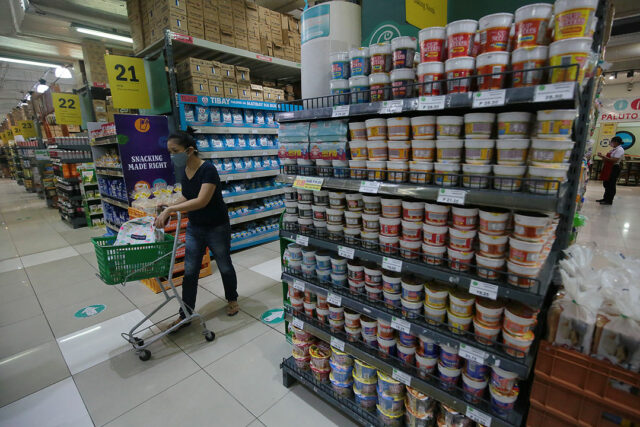
A woman buys food items at a supermarket in Quezon City, March 4, 2022. — PHILIPPINE STAR/ MICHAEL VARCAS

THE Philippine food retailing industry is expected to grow 7% this year as modern retail outlets continue to expand, according to the US Department of Agriculture (USDA).

Retailers are expanding into rural areas and introducing new food and beverages options, the USDA Foreign Agriculture Service in Manila said in a note to US exporters.

“Some retailers feature promotions of imported products to attract consumers, while others offer private-label products to deliver value for money to price-sensitive consumers.”

“Retail chains of supermarkets, hypermarkets, convenience stores, and warehouse clubs continue expanding in key cities and rural areas, further contributing to food retail sales growth,” it added.

The USDA said the food retail sector provide export opportunities for fruit and vegetable juices, tree nuts, beef, pork and poultry cuts, milk, butter, cheddar, mozzarella, cream cheese, ice cream, and soy milk.

It also cited chewing gum and candy, chocolate, tomato sauces, sausages, hotdogs, luncheon meat, meat loaf, pasta, seasoning, tomato ketchup, raisins, peas, beans, kidney beans, garlic, onions, potatoes, mushroom, cereals, bakery goods, frozen fruit and vegetables, beverages, and pet food.

The report noted that retail stores sell industrial quantities of ingredients for use by restaurants, hotels, and caterers, including dairy products, condiments, sauces, seasonings, and juices.

Popular US brands sold in warehouse clubs and supermarkets have high brand recognition and higher sales compared to competitors, the USDA said.

On the other hand, the report noted that retail chains continue to charge high fees to carry new products or feature products in promotions.

“Some US products and unknown brands sold in rural areas may have difficulty selling in stores,” it added.

Meanwhile, the USDA said sales of the food service sector are expected to grow 12%, “driven by consumer dining, event bookings, and tourist influx to hotels.”

Citing government data, it noted that consumer spending increased 15% in restaurants and hotels between 2023 and 2024 as “tourism flourishes.”

The report said restaurant and kiosk franchises continue to open more stores in key cities and rural areas to surpass last year’s sales figures.

“While many hotels and restaurants are featuring imported premium ingredients, some restaurant chains, including quick-service restaurants, explore direct importation for stable ingredient supply,” it said.

The USDA, in its note, said restaurant chains in the Philippines post volume orders for chicken leg quarters, mozzarella, and other imported ingredients used in preparing fried chicken, pizza, and burgers.

Meanwhile, coffee shops and street kiosks offer opportunities for bakery products, potato fries, processed meat, fruit beverages, and roasted coffee and bean extracts.

“As more consumers drink distilled spirits and wines at bars and fine dining restaurants, others resort to online deliveries for gatherings at home,” the report noted.

“Mobile food delivery applications such as Grab and Food Panda continue to provide convenience and augment sales,” it added.

It said restaurant groups with more than 200 stores nationwide present volume-order opportunities such as The Bistro Group, Moment Group of Restaurants, Jollibee Foods Corp., Max’s Group, Inc., Shakey’s International, Inc., and Yum! Brands, Inc.

“Opening of new hotels, increased occupancy in hotels rooms, and more event bookings (promise) volume orders of export products for dining and catering services,” it added.

It said high-end restaurants and hotels tend to highlight US ingredients in their menus such as ribeye, porterhouse, tenderloin, Kurobuta pork, duck, cheese, and wines. — Kyle Aristophere T. Atienza

DBM keeps public spending over 20% of GDP

BW FILE PHOTO

THE Department of Budget and Management (DBM) said it will maintain public spending above 20% of gross domestic product (GDP) over the medium term, with the budget expected to approach or even breach P7 trillion by 2028.

Spending “will remain above 20% of GDP over the medium term to sustain funding support for priority sectors and consolidate gains from human capital development, poverty reduction, and economic programs,” Budget Secretary Amenah F. Pangandaman said in a national budget memorandum dated July 2.

Economic managers have proposed a P6.793-trillion national budget for 2026, up 7.4% from the actual P6.326-trillion budget in 2025. This is equivalent to 22% of GDP.

The proposed 2026 National Expenditure Program is targeted for submission to Congress by August.

The DBM said the budget ceiling is set at P7.232 trillion (21.6% of GDP) in 2027 and P7.702 trillion (21.2% of GDP) in 2028.

Based on the revised program approved by the Development Budget Coordination Committee (DBCC), expenditure for this year is pegged at P6.082 trillion, from P6.182 trillion previously.

The DBCC expects expenditure of about P6.630 trillion in 2026, against the previous target of P6.540 trillion.

The expenditure estimate for 2027 was lowered to P6.970 trillion and P7.466 trillion for 2028.

“This will also help maximize the economic multiplier effects of public infrastructure investments, which will be kept at between 5% and 6% of GDP,” it said.

In the first five months, spending rose 9.71% to P2.48 trillion. — Aubrey Rose A. Inosante

Grid operator to start P28-billion cost recovery next month, ERC says

NGCP.PH

THE Energy Regulatory Commission (ERC) said the National Grid Corp. of the Philippines (NGCP) has been cleared to begin implementing the staggered cost recovery of at least P28.29 billion in the August billing month.

“I think the (increase) will take effect starting in the next billing period,” ERC Chairperson and Chief Executive Officer Monalisa C. Dimalanta said on the sidelines of an event in Pasig City on Monday.

While the decision was arrived at in April, Ms. Dimalanta said that it took some time for the Commission to write the decision.

“Understandably, something as thorough as a rate reset takes time to write. It took some time to write… the actual final determination,” she said.

In a statement in April, the ERC announced that it completed the NGCP’s fourth regulatory period rate reset covering 2016 to 2022.

In a decision by the majority composed of Commissioners Alexis M. Lumbatan, Floresinda G. Baldo-Digal, and Marko Romeo L. Fuentes, the ERC approved a maximum allowable revenue (MAR) of P335.78 billion for the NGCP for the period. MAR is the maximum amount the NGCP is allowed to take in annually to recover its operational expenses.

Ms. Dimalanta and Commissioner Catherine P. Maceda voted against the resolutions adopted by the majority.

Following the decision, the NGCP is entitled to recover an additional P28.29 billion in under-recoveries.

The majority set a seven-year recovery period for the grid operator, during which it is allowed to collect an additional P0.1013 per kilowatt-hour (kWh) in transmission charges over the next 84 months from the issuance of the decision.

The amount covers the P0.0629 per kWh average increase in the basic transmission charge and additional P0.0384 per kWh corresponding to the under-recovered portion of the increased MAR.

The ERC explained its decision in a 155-page document.

Under the Electric Power Industry Reform Act, the ERC is tasked with establishing the methodology for setting transmission and distribution wheeling rates. The rates must be set in a way that allows the recovery of “just and reasonable costs and a reasonable return on rate base” to enable the entity to operate viably.

The rate reset process is usually a “forward-looking” exercise that requires the regulated entity to submit forecast expenditures and proposed projects over a five-year regulatory period. The ERC assesses the actual performance of the entity and adjusts rates as needed.

The NGCP officially started operations as a power transmission service provider in 2009.

Under a congressionally granted 50-year franchise, the company has the right to operate and maintain the transmission system and related facilities, and to exercise the right of eminent domain as needed to construct, expand, maintain, and operate the transmission system. — Sheldeen Joy Talavera

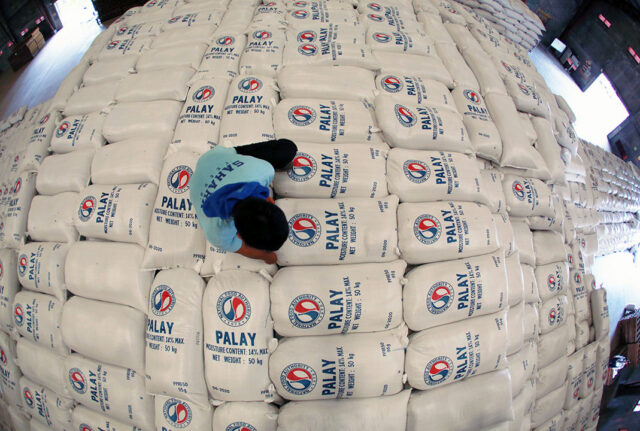
Rice inventory falls to 2.24 MMT in early June

PHILIPPINE STAR/MIGUEL DE GUZMAN

THE rice inventory fell 2.9% month on month to 2.24 million metric tons (MMT) as of June 1, according to government data.

Year on year, inventory rose 3.5% from 2.16 MMT previously.

As of June 1, 44.7% of the rice was held by households, 36.4% by commercial entities, and 18.9% by the National Food Authority (NFA).

Month on month, rice held by the NFA and the commercial sector rose 22.3% and 1.4%, respectively. Rice held by households fell by 13.5%.

Stocks held by NFA warehouses and households rose 206.4% and 43.8%, respectively, year on year, it added. Commercial rice holdings grew 38.7%.

The NFA recently said it is considering a limit of 100 bags on the amount of palay (unmilled rice) that it can buy from individual farmers every season to increase farmer access to its higher buying price.

The Department of Agriculture said in a statement that it is still expecting the palay harvest this year to hit a record 20.46 MMT. — Kyle Aristophere T. Atienza

Over 70,000 businesses register in June, down 2.7% year on year

BUSINESS NAME registrations and renewals topped 70,000 last month, bringing first-half registrations to nearly 630,000, the Department of Trade and Industry (DTI) reported.

The DTI said business name registrations totaled 71,561 in June, down 2.7% from a year earlier.

Of the total, 62,630 were new registrations, and 8,931 represented renewals.

First-half registrations totaled 629,015, down 7.4% from a year earlier.

Over the six-month period, 537,417 were new registrations while 91,598 were renewals.

In the year to date as of July 6, registrations hit 644,397, comprising 550,721 new registrations and 93,676 renewals.

Some 84.66% of the registrations were filed online, while 14.01% were performed via a combination of walk-in and online transactions.

Women-led businesses dominated the filings, accounting for 60.79% or 391,701 of the total .

Late last month, the DTI launched a P1-billion program for women-owned micro, small, and medium enterprises through its financing arm, the Small Business Corp. (SB Corp.).

Women-owned businesses can avail of between P30,000 and P20 million in SB Corp. loans under the program.

Region IV-A accounted for 118,302 of the registrations, followed by Region III and the National Capital Region with 84,240 and 84,197  respectively.

Some 320,006 of the registrations involved the retail trade, excluding motor vehicles and motorcycles.

Also among the top registrants were food and beverage service activities, real estate, other personal activities, wholesale and retail trade and the repair of motor vehicles. — Justine Irish D. Tabile