Home Blog Page 1304

Union Pacific and Norfolk Southern explore a $200-billion cross-continental railroad merger

NEW YORK — Union Pacific, the largest US freight railroad operator, is exploring a possible acquisition of Norfolk Southern to create a $200-billion coast-to-coast rail network, a person familiar with the matter said.

Talks are in early stages, the person said, with no guarantee talks will progress or that any deal would pass what would be expected to be a lengthy, detailed regulatory review. The two companies declined to comment.

Any deal to unite two of the six largest freight rail operators in North America is likely to draw intense regulatory scrutiny. Major shippers in the steel, chemical and grain industries are expected to lobby against any further concentration in an industry that has consolidated from over 100 Class I railroads in the 1950s to just six today.

Union Pacific shares fell 2.7% in Friday afternoon trading, while Norfolk Southern rose 1.52%.

A combination would mark a shift in the US freight rail landscape, creating a single-line network stretching from coast to coast, changing the current divide between western and eastern regional operators.

Norfolk is recovering from a tumultuous past couple of years that included the firing of its previous chief executive officer (CEO) amid ethics investigations, a boardroom battle with activist Ancora, and a train derailment that cost the company about $1.4 billion.

A merger between Union Pacific and Norfolk Southern would create the first modern West-to-East single-line freight railroad in the US.

Earlier this year, Union Pacific CEO Jim Vena said a transcontinental merger would be good for customers, eliminating the need for interchanges between carriers in Chicago — a long-standing bottleneck — and reducing costly delays for shippers.

But critics warn that such consolidation could reduce competition, a possible concern for regulators. With fewer major players in the market, shippers may face higher costs and diminished service options.

“We suspect certain shipper groups could get vocal on the perceived lost competition a merger would bring,” Barclays analyst Brandon R. Oglenski said.

Discussions between the two operators, first disclosed by Semafor, spurred speculation that competitors would also consider concentration.

“History teaches that mergers and acquisitions within the railroad industry will inspire and motivate additional M&A,” said Mike Steenhoek, executive director of the Soy Transportation Coalition.

That happened earlier this decade when Canadian Pacific (CP) offered to acquire Kansas City Southern, which prompted CP’s main competitor — Canadian National — to submit their own offer to acquire Kansas City Southern.

Ultimately the Canadian National offer was not allowed to proceed, and Canadian Pacific did acquire Kansas City Southern in 2023 -— creating the first railroad to link Canada, the US and Mexico.

In 2024, Union Pacific led the industry with $24.3 billion in revenue, followed by BNSF (privately held, owned by Berkshire Hathaway), CSX, Canadian National, Norfolk and Canadian Pacific Kansas City.

“The energy and momentum toward the remaining two US based Class I railroads — BNSF and CSX — pursuing a merger would be considerable,” Mr. Steenhoek said.

A regulatory decision could take 16 to 22 months, with merging carriers required to notify the Surface Transportation Board three to six months before filing an application, followed by a year-long evidentiary review and a final ruling within 90 days, Mr. Oglenski said.

A potential Union Pacific acquisition of Norfolk Southern could have material synergy, he said.

“Any deal would face serious review from regulators,” said Emily Nasseff Mitsch, equity analyst at CFRA. — Reuters

Comfortable jeans with new silhouettes from Uniqlo

BRONTË H. LACSAMANA

JEANS will remain a versatile staple in Uniqlo’s stores in the coming months — but they have been given a bit of a twist.

During a press preview last week, Uniqlo unveiled its Fall/Winter jeans collection featuring comfortable denim and thoughtful silhouettes. Its star comes from long-time Uniqlo collaborator JW Anderson: the JWA Straight Jeans, available for men and women.

Andrei de Borja, marketing head of Uniqlo Philippines, said at the preview, “Jeans have stood the test of time, and at Uniqlo, we reimagine them to fit your lifestyle, your movement, and your personal style effortlessly. This season, we’re taking denim a notch higher with thoughtful updates and new silhouettes that are designed to meet you where you are in comfort, confidence, and everyday flow.”

Mary Joy Bernardo, senior stylist from StyLIZed Studio, said during the preview, “JWA jeans have a classic silhouette. You can style them in many different ways, with a classic white T-shirt or a button-down for a relaxed fit.”

She added that layering with a jacket and a shirt is “a cute way” to dress up. Throwing on a blazer and heels can also style up an outfit. “The cut of JWA straight jeans is versatile, so you can dress up and down however you want,” she said.

The wide fit jeans, also available for men and women, are another crowd favorite given how easy it is to style on any body type, according to Mr. De Borja.

However, he emphasized a piece from the collection which has also become popular: the women’s baggy curve jeans. “It’s designed with a gently curved silhouette, perfectly complemented by a comfy high-rise waist that flatters your shape in all the right places,” he said.

Finally, the slim fit lineup with pieces for men and women offers ultra-stretch jeans that “feel like sweatpants but still look like denim.”

Ms. Bernardo told BusinessWorld that shopping for jeans is best done with an open mind. “You don’t have to box yourself in one size that you know fits you. It’s all about the way the piece falls on your body, so you should be open to trying maybe one size up,” she said.

Uniqlo’s Fall/Winter jeans collection for 2025 is already available in stores and on the Uniqlo website and app. — Brontë H. Lacsamana

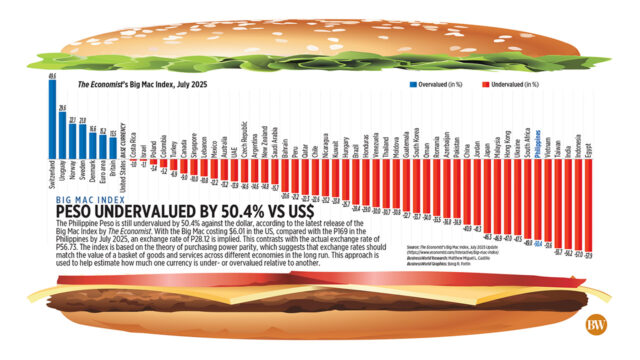
Big Mac Index: Peso undervalued by 50.4% vs US$

The Philippine Peso is still undervalued by 50.4% against the dollar, according to the latest release of the Big Mac Index by The Economist. With the Big Mac costing $6.01 in the US, compared with the P169 in the Philippines by July 2025, an exchange rate of P28.12 is implied. This contrasts with the actual exchange rate of P56.73. The index is based on the theory of purchasing power parity, which suggests that exchange rates should match the value of a basket of goods and services across different economies in the long run. This approach is used to help estimate how much one currency is under- or overvalued relative to another.

Big Mac Index: Peso undervalued by 50.4% vs US$

Lalamove highlights income boost for partner drivers

PHOTO FROM LALAMOVE

LEADING on-demand delivery platform Lalamove said it is gearing up its pool of ride-hailing partner drivers to keep up with the growing demand for its services. “Lalamove is encouraging its partner drivers to take advantage of the additional income they can get from every booking and take home 98% of their earnings every ride,” said the company in a release.

Lalamove Philippines Ride partner drivers can earn up to P3,500 daily with just five bookings, which can scale up to P24,000 weekly and up to P103,000 monthly with consistent booking, the statement added. Lalamove’s 2% commission is reportedly “one of the lowest and non-mission-based rates in the industry, meaning drivers can benefit from it with every booking.”

Aside from the low commission, Lalamove Ride partner drivers can up their income by encouraging other ride-hailing and delivery drivers to join Lalamove Ride and earn up to P4,200 in bonuses per successful referral. They can also join ride missions and earn an incentive up to P2,000 weekly to supplement earnings. There’s also a raffle where verified drivers can get P1,000, as long as the “See Ride Order First” feature is turned on. These are on top of the initial ride fares they receive from every booking.

According to Lalamove Ride driver Ronald Valdez, he was encouraged to join the platform because it extracts a much lower commission compared to other players. Lalamove Ride is available in Greater Manila, Cavite, Rizal, Pampanga, and Cebu.

Lalamove Philippines Managing Director Djon Nacario emphasized that the continued growth of Lalamove Ride in the ride-hailing space opens more income opportunities for drivers and provides an affordable option for commuters. “We have seen an impressive growth in the number of users who are using Lalamove Ride for their day-to-day commute. We want our partner drivers to enjoy the growing number of bookings and boost their income with the stackable income opportunities we offer,” Mr. Nacario said.

“We are targeting to have 20,000 drivers before the year ends, so we are inviting more drivers to join us as the 2% commission is not a promotional offer, unlike other platforms; it’s a real benefit that they can take advantage of, with no catch,” he stated, and added that Lalamove consistently provides competitive earnings and flexibility that drivers need to thrive on the platform.

Lalamove further supports its partner drivers through its Panalomove Benefits, which include fuel discounts, accident insurance, and health assistance. For interested drivers who want to join Lalamove Ride, visit https://lalamove-driver.onelink.me/zfl4/LLMRideOpportunities. For more information, visit www.lalamove.com/en-ph/ride or follow the official Lalamove Facebook page and Instagram account.

SEC cautions public against job offer scams

PHILSTAR FILE PHOTO

THE Securities and Exchange Commission (SEC) has warned job-seeking Filipinos amid a surge in reports of job offer scams.

The SEC Enforcement and Investor Protection Department (EIPD) said it had received reports of scams in which victims were contacted through messaging platforms such as Viber, Messenger, and Telegram.

“The EIPD urges the public not to engage in job offer scams and be vigilant when receiving job offers involving these scams and to immediately file reports or lodge their complaints via e-mail with the EIPD at epd@sec.gov.ph,” the SEC said in an e-mail statement over the weekend.

Victims are instructed to deposit money to access a dubious e-commerce platform that assigns paid tasks such as ordering or purchasing items, sorting orders, and clicking tasks.

Subsequently, victims are enticed to deposit more money in increasing amounts to access higher-paying tasks.

“Small deposits are initially paid the promised returns to dupe or fool the public to believe in the legitimacy and pour in more money in the platform,” the SEC said.

According to the SEC, the initial offer involves a P500 deposit for paid tasks worth P1,000. Once the job is completed and the payment is received, the victim is offered higher-paying tasks amounting to P10,000 but must deposit P5,000 to access the new workload.

“The cycle continues until the deposited amount balloons. Amounts differ depending on the mechanics of the scam,” the SEC said.

“Once the investors are hooked and have deposited big amounts, the platforms and their operators require victims to deposit more money in order to withdraw their supposed earnings for various reasons and eventually disappear,” it added.

Data from the Philippine Statistics Authority showed that the country’s unemployment rate fell to 3.9% in May from 4.1% in April.

The May unemployment rate was equivalent to 2.03 million jobless Filipinos, down from 2.06 million in April and 2.11 million a year earlier. — Revin Mikhael D. Ochave

Democratic decay: Irreversible?

CHIEF JUSTICE ALEXANDER GESMUNDO, together with Cavite Rep. Jolo Revilla, led the flag-raising ceremony at the historic Aguinaldo Shrine in Kawit, Cavite, in commemoration of the 127th Philippine Independence Day on June 12. — PHILIPPINE STAR/EDD GUMBAN

Yes “decay” as in tooth decay. The rot can begin inside or outside, slowly, and then a tipping point arrives, quickening complete tooth loss.

At the risk of annoying political scientists (who would much prefer complexity, for good reason), “decay” in this instance is a good word for gathering accurate metaphors. Tooth decay, thought decay, building decay, atomic decay, and so forth. An integrity flipping into disintegration. Typically producing pain.

Democracy, the word, is harder to pin down. There are many ways its integrity is added up. One well-regarded group, the V-Dem Institute, measures fidelity to five principles: electoral, liberal, participatory, deliberative, and egalitarian.

Through this optic, democracy degrades with any surrender of universal suffrage, self-determination, freedom of expression, inclusive practices, systems for dialogue, and equality.

Other democracy watchers look to the relative strength of public law. Fixed on the legal infrastructure, they measure outlaw behavior tolerated by the citizens.

A cultural perspective, on the other hand, looks to the mental and emotional embrace of decentralized governance. How much citizen empowerment is exercised: this is the core culture to be monitored.

Often, what’s obvious at the surface is financial and moral corruption. But the deeper corruption is the decay of a system securing human equality.

BODY BLOWS
Whatever the lens — no matter how differently observations are refracted — decay is felt physically. Forced disappearances, fear of speaking out, unjust imprisonment, and all extra-judicial violence are physical experiences.

The masked-men ICE raids on immigrant workplaces in the United States and ICE rendition of suspects to El Salvador are full-bodied abduction. So is the dehumanization of an enemy (criminals/immigrants) a repetitive tactic, e.g., the Philippine 21st Century tokhang campaign’s subhuman addict, the subhuman communist in mid-20th Century Pinochet’s Chile and Suharto’s Indonesia, and the subhuman black man in apartheid South Africa.

But even as an abstraction, democratic decay is felt as body blows. When nearly an entire Senate mangles Constitutional dicta, citizens are whacked in a collective solar plexus. Filipinos committed to democracy feel very smacked indeed, right now, by the cynical, pseudo-legal delays of the impeachment trial of the Vice-President for corruption.

The blow is compounded by a kind of body-forward experience of what can happen next. For the Philippines, what presumably follows the chipping away at Constitutional order are self-censorship of speech, avoidance of suddenly dangerous discussion spaces, and buy-in into a culture of political docility. Filipinos can see the future when democratic decay clicks in; and that future can be felt — strangely, in a physical way — now.

A Duterte 2.0 will have mortal implications for many.

INVISIBLE ROT
Not for the Americans. One strange thing the matter about Americans during Trump 2.0, viewed from the Philippines, is how seemingly undetectable democratic decay is to half the US population. Despite brutal Trumpian action on immigration, wholesale decoupling from scientific reason, and brazen alignment with the world’s dictators, the MAGA hordes appear to think they still live in a US shaped by its libertarian Constitution.

This slippery slope is more visible to most Europeans. Having already plunged into democratic wipe-out in the 20th century — the fascist interludes in Germany, Greece, Italy, Spain, Portugal, and the entire Eastern Bloc, and the conquest of France, the Netherlands, Austria, Belgium by Nazi Germany — the signals are clear in these parts.

No matter how close France, for instance, gets close to extreme Right electoral success, the actual stakes are front and center of popular discussion, which in turn drives political action. There is no blindness to what opposition leader Madame Marie Le Pen promises. Similarly, Romanians were not unaware of the stakes when they moved to annul the initial win of right-wing Calin Georgescu, on charges of Russian interference, and ratifying the election of centrist Nicușor Dan to their presidency.

On the other hand, the 248-year-old United States has not had a political and cultural experience of constitutional corrosion. Until now. Certainly not as severe as it is already happening today. A dangerous unknowing has been permeating the US experience since 2024: unacknowledged racism as the value system underpinning anti-DEI policy, unrecognized autocracy driving the criminal use of presidential powers, obscured health status of the would-be emperor.

Perhaps the greatest danger facing the US right now is its lack of “inoculation” against its transformation into a fascist state.

DEMOCRACY’S SHELF LIFE?
It is no longer uncommon to encounter discussions asking pointblank: has democracy just about exhausted itself? In familial, cross-national, intra-nation chat groups, there is a hue and cry about the erosion of democratic institutions: the academia that was to “level the playing field,” an impartial justice system, a neutral armed forces, governance as a system of checks and balances, and a fair, impartial media environment.

These have given way to autocratic decision making wherever pro-democracy fronts have so much as paused from the sheer difficulty of sustaining all these necessary institutions. And this wherever is everywhere by now. There is no clear answer, except for the experience — or memory — of life as a freely thinking individual and group, equal to all other individuals and groups.

The only clear idea is the recollection of joy in that life.


Marian Pastor Roces is an independent curator and critic of institutions. Her body of work addresses the intersection of culture and politics.

US Agriculture dep’t fires 70 foreign researchers

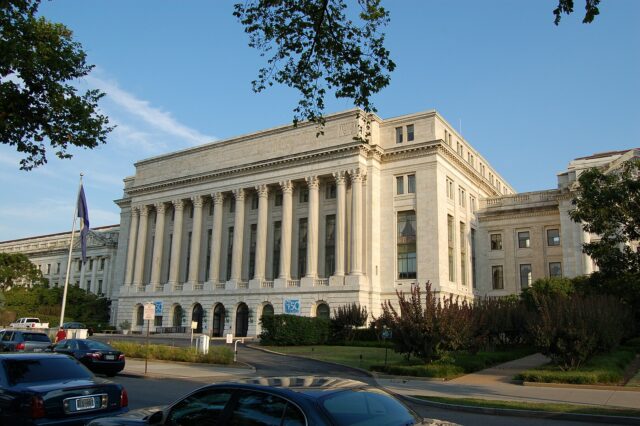
STOCK PHOTO | By Michael Kranewitter - Own work, CC BY-SA 3.0, https://commons.wikimedia.org/w/index.php?curid=21123494

WASHINGTON — The US Department of Agriculture (USDA) said it has fired 70 foreign contract researchers after a national security review intended to secure the US food supply from adversaries including China, Russia, North Korea and Iran.

“USDA has completed a thorough review of individuals authorized to work on contracts with the department and identified approximately 70 individuals from countries of concern,” a spokesperson said.

“The individuals working on these contracts from countries of concern will no longer be able to work on USDA projects.”

US Agriculture Secretary Brooke Rollins on July 8 announced a farm security plan that included efforts to bar purchases of US farmland by nationals of the four countries, and to terminate any existing research agreements with them.

Ms. Rollins said the moves were necessary to secure the US food supply.

The contractors had worked at the Agricultural Research Service (ARS), the in-house research arm of the USDA, according to Thomas Henderson, president of the American Federation of Government Employees Local 1657, which represents ARS workers in Albany, California.

Most of those dismissed were Chinese post-doctoral researchers on two-year contracts with the agency, and who were already subject to vetting before being hired, Mr. Henderson said.

Some arrived to work on July 9 to find their badges no longer worked, he said.

Because of a federal hiring freeze that has been extended through Oct. 15, the USDA will not be able to replace the fired staff and will need to halt ongoing scientific work that benefits farmers, like a project to develop a vaccine for a deadly toxin that occurs in undercooked beef, Mr. Henderson said.

“We don’t have the talent now to progress on these research projects. It’s setting us back by years, if not decades,” he said.

The USDA did not comment on the concern about lost research capacity.

The ARS conducts research on pests, food safety and climate change that are high priority to US farmers. The agency has lost about 1,200 employees, more than 17% of its 2024 staffing level, to terminations and voluntary incentives to quit offered by President Donald Trump’s administration.

In a July 8 memo, Ms. Rollins prohibited USDA staff from publishing research with foreign nationals from the four “countries of concern” without agency approval and from attending events organized by “foreign adversaries.”

Some ARS staff were further told in a meeting that all publications currently under review will be re-analyzed and those co-authored with foreign nationals from the four countries will be denied, according to Ethan Roberts, an ARS employee and president of the American Federation of Government Employees Local 3247.

Before the memo, there were already extra review processes in place to publishing research conducted with people from the four countries, Mr. Roberts said. — Reuters

Yields edge up as market turns defensive on tariffs

By Lourdes O. Pilar, Researcher

YIELDS on government securities (GS) were mixed last week as players remained defensive due to the global market volatility caused by the Trump administration’s trade policies.

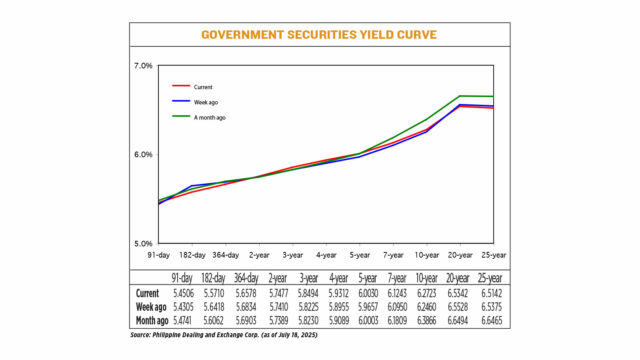
GS yields, which move opposite to prices, edged up by an average of 0.4 basis point (bp) week on week, based on the PHP Bloomberg Valuation Service Reference Rates as of Jul. 18 published on the Philippine Dealing System website.

At the short end, yields on the 182- and 364-day Treasury bills (T-bills) went down by 7.08 bps and 2.56 bps week on week to 5.5710% and 5.6578%, respectively. Meanwhile, the 91-day T-bill saw its rate go up by 2.01 bps to end at 5.4506%.

At the belly, rates rose across the board, with the two-, three-, four-, five-, and seven-year Treasury bonds (T-bond) climbing by 0.67 bp (to 5.7477%), 2.69 bps (5.8494%), 3.57 bps (5.9312%), 3.73 bps (6.0030%) and 2.93 bps (6.1243%), respectively.

At the long end, yields on the 20- and 25-year papers dropped by 1.86 bps and 2.33 bps week on week to end at 6.5342% and 6.5142%, respectively. Meanwhile, 10-year T-bond rose by 2.63 bps to fetch 6.2723%.

GS volume traded fell to P21.21 billion on Friday from P45.12 billion on July 11.

“Yields went sideways, with sentiment still driven by headlines relating to US tariff policy,” a bond trader said.

“Local bond yields, particularly in the belly of the curve, ended the week marginally higher as investors remained defensive amid global yield volatility due to rising tariff-related inflation concerns. These worries intensified after US President [Donald J.] Trump announced new trade measures with major trading partners and as the US CPI (consumer price index) came in slightly above expectations,” said Amanda Marie L. Arguelles, fixed income fund manager at Security Bank Corp.

US Treasury yields dipped on Friday as investors monitored the latest US tariff threats while they digested a mixed economic picture, Reuters reported.

US consumer sentiment improved in July and inflation expectations declined, but households still saw substantial risk of price pressures increasing, the University of Michigan’s Surveys of Consumers released on Friday showed.

On Wednesday, data showed US producer prices were unexpectedly unchanged in June as an increase in the cost of goods due to tariffs on imports was offset by weakness in services. The unchanged reading in the producer price index for final demand last month followed an upwardly revised 0.3% rise in May. This was after Tuesday’s US consumer price data for June pointed to higher costs for some goods.

On Friday, the mood dimmed after the Financial Times reported that Mr. Trump is pushing for a minimum tariff of 15% to 20% on the European Union (EU). The report said he was unmoved by the latest EU offer to reduce car tariffs and would keep those duties at 25% as planned.

In government bonds, US Treasuries prices rose, dragging their yields lower, after comments from Federal Reserve Governor Christopher Waller pushed for a rate cut later this month.

In contrast, most officials who have spoken publicly have indicated a desire to hold rates steady and traders are betting on a 95.3% probability that rates will stay where they are after the month-end meeting, according to CME Group’s FedWatch tool.

The yield on benchmark US 10-year notes fell 3.9 bps to 4.424% from 4.463% late on Thursday while the 30-year bond yield fell 1.8 bps to 4.9958% from 5.014%.

The 2-year note yield, which typically moves in step with interest rate expectations for the Federal Reserve, fell 4.4 bps to 3.873% from 3.917% late on Thursday.

“Meanwhile, demand for short-dated bonds remained robust, supported by expectations that BSP (Bangko Sentral ng Pilipinas) will still cut policy rates this year,” Ms. Arguelles said.

BSP Governor Eli M. Remolona, Jr. said earlier this month that there is room for two more rate cuts this year amid benign inflation.

In June, the central bank delivered a second straight cut, reducing benchmark borrowing costs by 25 bps to bring the key rate to 5.25%. The Monetary Board has now lowered interest rates by a total of 125 bps since it began its easing cycle in August last year.

Ms. Arguelles added that yields at the long end were partly supported by the result of the Bureau of the Treasury’s (BTr) auction of reissued 10-year bonds last week. The BTr raised P25 billion as planned via the offering of the papers, which have a remaining life of nine years and nine months, at an average rate of 6.285%, with accepted yields ranging from 6.264% to 6.295%.

“Last Tuesday’s 10-year bond auction demonstrated strong demand for the tenor despite the overall defensive tone in the market. Following the auction, yields declined by about 1-2 basis points, likely driven by follow-through buying from participants who were unable to secure allocation,” she said.

“However, yields inched back higher when the peso-dollar exchange rate breached the P57 level due to strong US inflation figures, prompting de-risking activity among market participants.”

The peso last week plunged back to the P57 level as safe-haven demand boosted the greenback amid tariff concerns.

For this week, the market could continue to monitor US yields for leads amid lingering global uncertainties, Ms. Arguelles said.

“However, the scheduled three-year bond auction on Tuesday may offer some reprieve. Despite the prevailing cautious market tone, demand for this issuance is expected to be strong, especially given the limited offer size of P20 billion,” she said.

On Tuesday, the BTr is offering P20 billion in reissued seven-year bonds that have a remaining life of two years and nine months.

“We might see sideways movement with upward bias given supply factors and still-elevated US Treasury yields and as the Federal Open Market Committee (FOMC) looks to keep policy rates unchanged,” the bond trader added.

The FOMC will hold its next policy meeting on July 29-30. — with Reuters

For new Kering CEO, offloading Valentino would be tough but smart reset

By Tassilo Hummel and Lisa Jucca

PARIS/MILAN — Luxury group Kering’s partner in Valentino was quick to rule out a newspaper report on Friday that the two were considering selling the Italian fashion label.

But that could be just the move that incoming Kering Chief Executive Officer (CEO) Luca de Meo needs to reset the debt-laden Gucci owner — even if it comes at a cost.

Under current Chairman and CEO Francois-Henri Pinault, Kering bought a 30% stake in Valentino for €1.7 billion in 2023 from Qatari fund Mayhoola to diversify away from slowing star brand Gucci, with a commitment to buy the rest by 2028.

However, the deal includes options that could force Kering to buy the remaining 70% as soon as May 2026, company filings show, potentially adding to Kering’s €10-billion plus debt pile.

In a note to clients this month, Bank of America analyst Mark Xu estimated the potential liability at €4-6 billion ($4.7-7 billion), depending on Valentino’s performance.

Revisiting the Valentino deal, which would require bringing Mayhoola back to the negotiating table, will be one of the first and biggest challenges for Mr. De Meo, industry experts and bankers say. The former Renault boss was picked in June to turn around the €24-billion French luxury conglomerate.

“With incoming CEO Luca Mr. De Meo joining in September 2025, not having to deal with the integration of Valentino may be one less thing on his already long to-do list,” RBC analysts said on Friday.

Contacted by Reuters about the report in Italian newspaper Corriere della Sera that Valentino could be put up for sale, Mayhoola CEO Rachid Mohamed Rachid said it was “untrue.”

Kering declined to comment.

Kering shares rose 3.5% after the report, outperforming the STOXX Europe 600 index, suggesting investors would welcome a sale.

POTENTIAL WRITEDOWN
Investment bankers told Reuters they expect Mr. De Meo to start reviewing Kering’s entire portfolio. Besides Gucci, the group owns brands including Bottega Veneta and Yves Saint Laurent and high-end perfume label Creed, which Pinault bought in 2023 for €3.5 billion amid a wider acquisition spree.

Pinault’s swoop on Valentino was meant to create a second flagship brand rooted in haute couture. However, shortly afterwards the luxury sector entered a prolonged slump, and the Italian label appointed former Gucci designer Alessandro Michele to replace long-serving Pierpaolo Piccioli.

Last year, Valentino’s revenue declined 2% at constant exchange rates to €1.3 billion, while its core earnings (EBITDA) — the crucial variable for any prospective buyer — fell 22% to €246 million, filings show.

The slowdown in demand for Valentino’s designs put Kering at risk of potentially having to pay an excessive price for the Italian label at a time when the conglomerate is already struggling with rising debt and lower sales, according to three industry sources.

Things at Valentino did not improve much in the first months of 2025, according to one source familiar with the label and a banking source.

Last month, Valentino said its CEO Jacopo Venturini went on sick leave. Adding to its troubles, one of the brand’s units has also been put under court administration in Italy after an investigation exposed labor exploitation in its supply chain.

Any near-term sale would therefore have to come at a hefty discount.

“Offloading the asset would make sense for De Meo, but he would have to accept a writedown,” said one of the industry sources.

Investors in Kering may swallow the hit if they believe it would allow Mr. De Meo to focus on his biggest challenge: reviving Gucci, which still makes up almost two-thirds of Kering’s core profit.

For Mayhoola, however, settling for much less than the stellar price tag it achieved in 2023 could be painful.

“The Valentino deal is the best deal Rachid ever made,” a source close to Mayhoola told Reuters after Mr. De Meo’s appointment in June. — Reuters

Style (07/21/25)


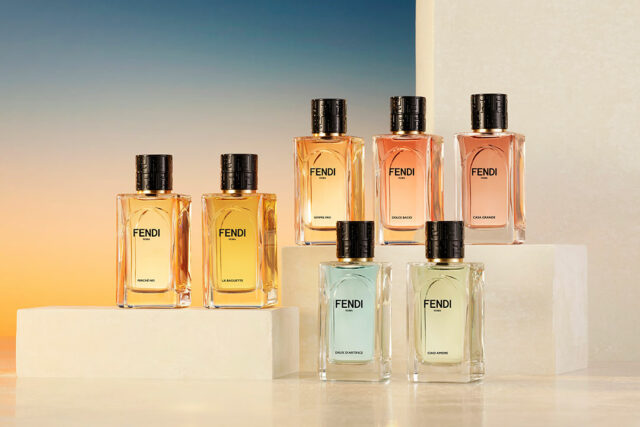
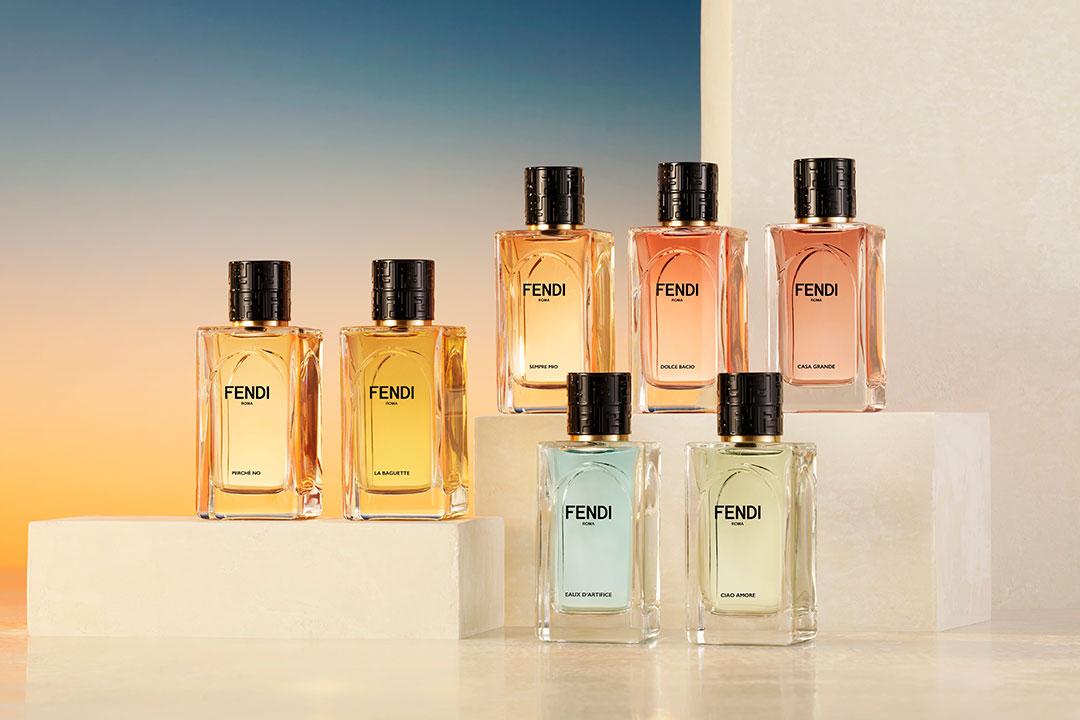
Fendi unveils Eaux d’Artifice

FENDI deepens its expression through perfumery with the launch of Eaux d’Artifice, a new fragrance inspired by Rome. Conceived by Delfina Delettrez Fendi, the maison’s artistic director of jewelry, the fragrance draws inspiration from her nighttime view of the Trevi Fountain. The scent evokes cascading water over marble, enhanced with a mineral and aquatic accord, musk, and the aromatic freshness of juniper. Hints of metallic notes echo the glint of lucky coins tossed into the fountain. “Perfume, like jewelry, is a silent accessory that sends messages about who we are or who we want to be,” said Ms. Delettrez in a statement. The fragrance is available exclusively at Fendi boutiques and at fendi.com.


Hada Labo holds first PHL pop-up

FACIAL CARE brand Hada Labo is bringing its cult-favorite Hydrating Lotion to the first-ever Mochi-Mochi Hydration Lab at Mitsukoshi BGC Mall on July 19 to Aug. 5. Featured is the brand’s Hydrating Lotion, which is powered by five types of hyaluronic acid to shield the skin against outside aggressors, let hydration penetrate deep into the skin’s layers, lock in moisture, plump up fine lines, and leave skin looking plump and soft. All of Hada Labo’s products are free of fragrance, alcohol, colorants, and mineral oils, making them appropriate for sensitive skin. Upon registration at the pop-up, guests will receive a mission card. If Mitsukoshi Beauty members and Hada Labo followers complete all three stations, they will earn freebies and unlock exclusive gifts. At the stations, beauty advisors will test the visitor’s skin moisture levels, apply the Hydrating Lotion, then test again to see the difference. Personalized product recommendations follow. The visitors can then head to the checkout counter to shop for Hada Labo and Skin Aqua products. Shoppers who hit the minimum spend get a token to try their luck at the Hada Labo Gacha machine. Hada Labo is planning to hold pop-ups across the Philippines. Follow @hadalaboph on Instagram and Hada Labo Philippines on Facebook for more information.


Pure Culture brings home prizes

HOMEGROWN skincare label Pure Culture has earned three major honors at the 2025 Global Green Beauty Awards — becoming the only Philippine-based brand to be recognized this year. The UK-based Global Green Beauty Awards, now in its sixth year, is one of the beauty industry’s most respected award platforms celebrating sustainable, vegan, and natural beauty innovations. With over 650 international entries this year, it honors brands that lead with ingredient integrity, responsible sourcing, and breakthrough formulation. Pure Culture took home three distinctions: Gold for Best Vegan Anti-Aging Product (Velvet Veil Moisturizing Matte Face Oil), Silver for Best Vegan Face Oil (Dream Drops Universal Hydro-Oil), and Bronze for Best Natural SPF Product (Dream Shield Universal Day Cream SPF50); all formulated in the Philippines and backed by microbiome science. “Winning alongside global clean beauty leaders is a powerful validation of what we stand for: gentle, intelligent, and inclusive skincare that puts microbiome health first,” Alex Gentry, formulator and innovations director of Pure Culture, was quoted as saying in a statement. “We’re proud to show that world-class formulation can thrive right here in Southeast Asia.” Pure Culture is also turning three in August — and it is celebrating with a month-long “Birthday Blowout” featuring limited edition drops, curated kits, and fan-favorite exclusives. For more information, check @purecultureph on Instagram and TikTok.


Ever Bilena launches flagship kiosk in Robinsons Ermita

EVER BILENA celebrates a new milestone with the launch of its first flagship kiosk at Robinsons Place Ermita. Located at the 2nd Floor, Pedro Gil Wing (across Lee and in front of Straightforward), the kiosk marks Ever Bilena’s expansion into experiential retail. As part of its grand opening, the brand is offering a range of exclusive promotions. Customers can get a free tote bag for a minimum P499 single-receipt purchase; a free EB Curved Eyelash Curler for a minimum P599 purchase; or a free EB Glazed Lip Booster for a minimum P699 purchase. Offers are available until July 31 or while supplies last. All Ever Bilena lipsticks (including matte lipsticks, tinted lip balms, tinted lip oils, and multipots) will be offered at a special 50% discount until July 31, exclusively at the new kiosk. A bedazzling station will be available on-site, allowing customers to personalize and decorate their products.


Blackwater launches sunscreen

SINGER-SONGWRITER Zack Tabudlo has joined Blackwater as its newest brand ambassador for the launch of the Blackwater Sun Defense Stick. Blackwater has evolved from a men’s fragrance line into a full lifestyle grooming brand. The Blackwater Sun Defense Sunscreen Stick is a mattifying, water-resistant, no-white-cast SPF stick designed to be fuss-free, oil-controlling, and filled with 19 g of product for P395. The Blackwater Sun Defense Stick is available now on Blackwater’s official TikTok shop (@blackwaterph_), as well as its flagship Shopee and Lazada stores.

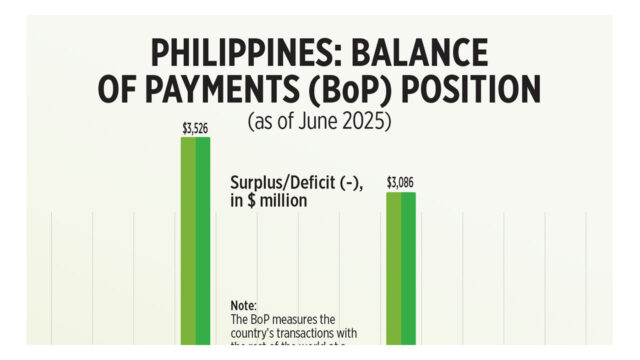
Philippines: Balance of Payments (BoP) Position

Philippines: Balance of Payments (BoP) Position

Tesla Model Y and Model 3 on display at Power Plant Mall

IMAGE FROM TESLA PHILIPPINES

TESLA PHILIPPINES is showcasing its latest product lineup — the new Model Y and the Model 3 — at the South Court of Rockwell Power Plant Mall up to July 27. Their electric vehicle (EV) technology will be on display, and various charging options will be highlighted during the showcase, “underscoring Tesla’s commitment to convenience and accessibility,” said the company in a statement.

The Model Y boasts a striking redesign that captures the essence of the Cybertruck while integrating cutting-edge technology and features designed for both excitement and safety behind the wheel. The Model Y starts with a price of P2.369 million and is available to order via Tesla Philippines’ official website. Visit https://www.tesla.com/en_PH/modely/design#overview.

Also to be displayed is the Model 3, whose Performance variant gets from a standstill to 100kph in 3.1 seconds and features a sporty aesthetic “tailored for the adventurous driver.” The Model 3 is also available to order on the Tesla Philippines official website with pricing starting from P2.109 million.

Test drives may be arranged through the event page. Tesla Philippines said the market is “embracing Tesla with enthusiasm, evidenced by over 1,500 units sold and delivered. This success encourages Tesla to expand its presence, allowing more individuals to explore their options for transitioning to electric vehicles.”

Interested parties can also visit the Tesla BGC Center at the Uptown Parade, Uptown Bonifacio, Taguig City and Opus Mall on Bridgetown Blvd. corner C5 Road in Quezon City. For more information, contact Tesla Philippines at (02) 8230-8850.