Home Blog Page 1297

‘Asia’s Queen of Songs’ Pilita Corrales, 85

BW FILE PHOTO

VETERAN SINGER Pilita Corrales passed away on April 12.

Her granddaughter, Janine Gutierrez, confirmed her death on her social media page. The cause of death was not revealed.

“It is with a heavy heart that we announce the passing of our beloved mami and mamita, Pilita Corrales,” said Ms. Gutierrez in her post.

She added that Ms. Corrales (whose full name was María del Pilar Corrales y Garrido) “touched the lives of many, not only with her songs but also with her kindness and generosity,” both within the entertainment industry and with her loved ones.

Born on Aug. 22, 1939 in Lahug, Cebu, the singer, actress, and comedienne started her career at age 16. She topped music charts in the Philippines and globally, her most well-known songs including “A Million Thanks to You,” “Kapantay ay Langit,” “Rosas Pandan,” “Usahay,” and “Matud Nila.”

She released over a hundred albums in the course of her career. She earned a Lifetime Achievement Award from the Philippine Association of the Record Industry and was honored with a Doctorate in Music by the University of Visayas for her contributions to Philippine music.

With a clear voice and powerful singing style, Ms. Corrales is regarded as one of the foremost singers of the Philippines, her signature being the dramatic bending of her back while singing. Upon winning the Tokyo Music Festival in 1972, the singer was given the moniker “Asia’s Queen of Songs.”

There was an outpouring of tributes on social media by fellow musicians. Janno Gibbs, who collaborated with the veteran singer to remake “Kapantay ay Langit” in 2002, remembered her excitement to make a music video for the song. “Your voice stayed golden till the end,” he said in his post. Raymond Lauchengco shared in his tribute: “I love you, Tita Pilita. I will forever be grateful that I got to know someone as great and as kind as you!”

For Martin Nievera, the Filipina icon’s impact is unrivaled. “Thank you for giving me my first pair of wings. Because of you I could fly into my dreams. Now I ask the entire Showbiz industry to bend the ‘Pilita bend’ with me in honor of a legend; an icon,” he said in a post.

Ms. Corrales is survived by her two children, Jackie Lou Blanco and Ramon Christopher “Monching” Gutierrez. A documentary on her life is in the early stages of development, produced by her granddaughter Ms. Gutierrez and directed by filmmaker Baby Ruth Villarama.

Her wake is ongoing until April 16 at The Heritage Park, Fort Bonifacio, Taguig. — Brontë H. Lacsamana

Concluding the PhilHealth oral arguments

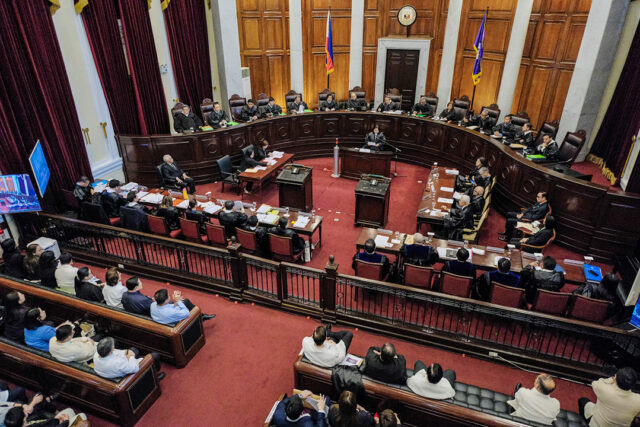
SUPREME COURT Chief Justice Alexander G. Gesmundo led the 2nd oral arguments on the proposed PhilHealth P90-billion fund transfer on Feb. 25, 2025. — PHILIPPINE STAR/JOHN RYAN BALDEMOR

Nine months after the first Supreme Court petition challenging the constitutionality of the PhilHealth (Philippine Health Insurance Corp.) fund transfer was filed, oral arguments on the petitions finally came to an end on April 3.

Petitioner groups led by Senator Koko Pimentel, the Makabayan bloc, 1SAMBAYAN Coalition, and the Federation of Free Workers (FFW) argued that Section 1(d) of the 2024 General Appropriations Act (GAA) and Department of Finance (DoF) Circular 2024-003 implementing the said provision directing PhilHealth to return P89.9 billion of its fund balance to the National Treasury violated the 1987 Constitution, the Universal Healthcare (UHC) Act of 2019, and the Sin Tax Reform Laws of 2012 and 2019 (RA 10351 and RA 11346).

Over the five oral argument hearings, the Court didn’t only tackle the legal and constitutional issues of the fund transfer, but also dwelled on the moral issues and the implications of the transfer on PhilHealth’s role as the country’s social health insurance provider and strategic purchaser of healthcare in implementing UHC.

From the very first hearing, Associate Justice Amy Lazaro-Javier went to the heart of the matter: Section 11 of the UHC Act, which clearly states that no portion of the PhilHealth reserve funds shall accrue to the general fund of the National Government, and that when the reserve fund hits its ceiling, the excess must be used to increase benefits or reduce the amount of members’ contributions.

Associate Justice Lazaro-Javier repeatedly noted that the UHC and Sin Tax Laws are clear: PhilHealth funds should be exclusively used for its programs and not for other purposes. She also noted that of the government projects funded by the PhilHealth fund transfer, some, like the Panay-Guimaras-Negros Island Bridges, were already fully funded.

For its part, the DoF, through Secretary Ralph Recto, defended its actions by arguing that the diverted PhilHealth funds that were used for infrastructure projects were still beneficial to health, given that patients badly need roads to access healthcare. The Department of Health (DoH) also noted that some of the diverted PhilHealth funds went to health programs like health facility enhancement.

But, as Associate Justice Lazaro-Javier noted, the Sin Tax Law is clear: tobacco and sweetened beverage excise taxes must go to PhilHealth (not the DoH, given that the DoH is responsible for population-based healthcare and PhilHealth is responsible for individual-based healthcare). Although 78% of the P60 billion that PhilHealth remitted to the National Treasury financed health projects, these have separate line items in the budget which should be funded by the DoH and not PhilHealth.

Secretary Recto argued that the PhilHealth fund transfer was what the country needed for fiscal responsibility. But as counsel for petitioners, Makabayan chair Neri Colmenares, argued, “Fiscal responsibility ends when it transgresses the Constitution.”

The government further justified the transfer of funds by arguing that tobacco and sweetened beverage excise tax revenues are only “soft earmarked” to PhilHealth — when sin taxes are collected, the funds form part of the general fund and do not go towards a special account in the general fund or an SAGF. Associate Justice Benjamin Caguioa contested this practice, saying: “If the sin tax laws already determine the source and use of funds to implement the UHC Act, even if the funds pass through the GAA, their character as earmarked for a special purpose remains intact… in order to preserve the special funds that are declared by law to be used only for a specific purpose, wouldn’t it be better to set them aside from the general fund? We should put guardrails so they are not used for a purpose other than the purpose they were levied for.”

Several Justices asked questions on the morality of the transfer, including Associate Justice Samuel Gaerlan, who asked questions his household help had asked him on the matter. Justice Gaerlan asked: Who does PhilHealth belong to? Why did the government take away members’ contributions? Is the country close enough to fully realizing universal healthcare to have “excess” funds to begin with?

The government, in its responses to Associate Justice Gaerlan’s questions, said that PhilHealth is hinged on social solidarity where the healthy pay for the healthcare of the poor and those with the ability to pay subsidize the healthcare of the poor. This very concept of risk sharing and resource pooling is what makes the fund transfer not only illegal, but immoral.

Petitioners highlighted that six years into UHC’s implementation, we are far from achieving the law’s aspirations as out-of-pocket spending remains high and provincial health system integration and health information systems, among others, remain a pipe dream. The immorality of the transfer was highlighted even further when Associate Justice Jhosep Lopez shared his own experience in 2022 when he was diagnosed with esophageal cancer and had to raise P7 million to pay for his surgery, only P50,000 of which was funded by PhilHealth.

PhilHealth said that it has ramped up benefit expansion in the past year, a feat that the DoH and DoF take pride in and chalk up to the pressure of the fund transfer. An improvement in efficiency, however, should not be celebrated if it came at the expense of forgone healthcare funds that could have saved the lives of the poorest of the poor.

Petitioners and respondents were asked to submit memoranda not more than a month after April 3. While we wait for the final decision of the Court, attention has to be brought to the 2025 budget, branded by advocates as “the most corrupt budget in Philippine history,” and the Supreme Court petition challenging the zero-budget given to PhilHealth in the 2025 GAA.

To quote Associate Justice Benjamin Caguioa’s closing statement during the oral arguments on April 2: “We have seen the many years, from 2003 all the way up to 2019, of discussions, staff work, interpellations, deliberations, extensive and thorough study — in order to come up with a Universal Health Care Act. A law that, in my view, has a particularly good design in establishing funding and sustainability. And all of that, all of it, gets undone by a one-sentence insertion in the 2024 GAA. Don’t you think there is something wrong [with] that?”


Pia Rodrigo is strategic communications officer at Action for Economic Reforms.

Fami-Li ties

The Li 9 is Li Auto’s flagship offering — a luxurious six-seater full-size SUV. — PHOTO BY JOYCE REYES-AGUILA

Li Auto enters Philippine market with 2 SUVs

By Joyce Reyes-Aguila

CHINESE AUTOMOTIVE manufacturer Li Auto selected the Philippines as its first Southeast Asian location for its strong family ties. “(It) aligns perfectly with our vision,” stated Stone Yu, chief executive officer of the brand’s official dealer HomeAuto, Inc., in a release. “They will appreciate the unique blend of luxury and technology that Li Auto offers. The local market presents a significant opportunity for us with its increasing awareness of electric vehicles and interest in modern technology.”

The brand is initially offering two plug-in hybrid electric vehicle (PHEV) sport utility vehicles (SUVs) locally: the five-seater Li L7 and six-seater full-size flagship model, the Li L9. “All our cars are family SUVs, and our designs have family users (in mind),” Home Auto, Inc. Marketing Director Emma Qiao told “Velocity” in an exclusive interview.

“We noticed that people here prefer larger SUVS, and ours perfectly target the premium sector. All in our product portfolio are SUVs. We’re focused on this position. Notice the halo lights in front of the vehicle? They are unbroken points, shaped like a hug for the family.”

The Li L7 reportedly has a combined driving range of 1,360km and a pure electric range of 286km, with the ability to go from zero to 100kph in 5.3 seconds. Power is rated at 330kW, torque at 620Nm.

The SUV’s spacious interior is designed to provide a “home-like experience” to passengers with features like electric footrests and a forward-moving front passenger seat that expands the second-row leg room to 1,160mm. A bed can be created by putting down and joining the first row with second row seats as well. The Li L7 comes in three models: Pro, Max, and Ultra — all equipped with the brand’s Magic Carpet Air Suspension Pro. The Pro variant will have the AD Pro Pilot assistance with 360-degree omni-directional sensing, while the Max and Ultra have the AD Max 3D digital sensor system.

The larger Li L9 has a driving range of 1,412km and a fuel tank of 65 liters. It is equipped with a 2.3-kW battery pack. Its Pro model is currently available, with an Ultra version to be offered in the future. The SUV has expansive three-row designs and a four-seat 16-point massage feature. There is a five-screen, three-dimensional interactive intelligent cockpit, and 4D immersive audio and video system. A Gen4 OLED screen is provided for the center console and the front passenger and rear seats.

Both SUVs are built on Li Auto’s advanced REEV (range-extended electric vehicles) platform that supports dual energy sources, with the range extender functioning as a generator to power up the battery without being the main power source.

According to Ms. Qiao, “Li” stands for “leading intelligence” that is experienced by passengers through its smart driving (features), technology, and comfortable interiors.

The executive added that construction is under way for its showrooms at the Bonifacio Global City and at the Mall of Asia. “We are looking for a third location. This year, we will (also) have four service centers. And we already have the spare parts (available).” And while the brand wasn’t a part of the Manila International Auto Show (MIAS), Ms. Qiao said Li Auto Philippines customers can look forward to displays in other malls in the metro.

Li Auto was founded in 2015, with sales reaching 500,508 vehicles in 2024, marking a 33.1% increase from the previous year.

Nordeco to seek legal remedies over franchise areas

JEROME CMG-UNSPLASH

NORTHERN DAVAO Electric Cooperative, Inc. (Nordeco) said it will explore all legal options to defend its franchise areas following the passage of a law allowing Davao Light and Power Co. (DLPC) to operate in additional areas.

“Nordeco strongly opposes this law and shall pursue all available legal remedies to defend the sanctity of the cooperative’s franchises, the welfare of its member-consumer-owners, and the integrity of the rural electrification program,” the cooperative said in a statement over the weekend.

Republic Act (RA) No. 12144 allows Samal Island, as well as the municipalities of Asuncion, Kapalong, New Corella, San Isidro, and Talaingod in the province of Davao del Norte, and the municipalities of Compostela, Laak, Mabini, Maco, Maragusan, Mawab, Monkayo, Montevista, Nabunturan, New Bataan, and Pantukan in Davao de Oro, to be included in DLPC’s franchise areas.

House Bill No. 11072 lapsed into law on April 6 without the signature of President Ferdinand R. Marcos, Jr.

“The enactment of this law by the inaction of the President raises significant legal concerns, particularly regarding potential violations of established franchise boundaries, as the Supreme Court has declared that franchises are property rights under the constitutionally guaranteed due process clause,” Nordeco said.

The cooperative said that the law “directly affects” its contractual obligations in the areas as mandated by Presidential Decree No. 269 and reinforced by the Electric Power Industry Reform Act and RA No. 10531, known as the National Electrification Administration Reform Act.

“We urge our member-consumer-owners to keep calm, continue your support and patronage of the cooperative as this will pass and we can all overcome this challenge as we did in decades,” the cooperative said.

“Nordeco stands firm in its position to uphold its valid and existing franchises to protect the interests of the member-consumer-owners it serves. We will not yield even an inch of Nordeco’s franchises,” it added.

Nordeco, which serves parts of Davao de Oro and Davao del Norte, was established to provide electricity to urban and remote areas, based on its website. Its franchise area is adjacent to Davao Oriental Electric Cooperative, Inc. in the western part, Agusan del Sur Electric Cooperative, Inc. in the northern part, and privately owned DLPC in the eastern part.

DLPC, one of the distribution utilities of Aboitiz Power Corp., is the country’s third-largest electric distribution utility in terms of customers and annual kilowatt-hour sales.

It holds a legislative franchise to build, operate, and maintain a power system in Davao City, Panabo City, and the municipalities of Carmen, Dujali, and Santo Tomas in Davao del Norte for 25 years or until September 2025.

The franchise term was extended for another 25 years or until September 2050 under RA No. 11515.

Sought for comment, DLPC said it has yet to receive official communication from the Office of the President or the concerned national government agencies.

“In the meantime, we are staying focused on delivering reliable and affordable electricity across all areas we serve,” the company said. — Sheldeen Joy Talavera

Inflation expectations, market jitters heighten Fed’s dilemma

REUTERS

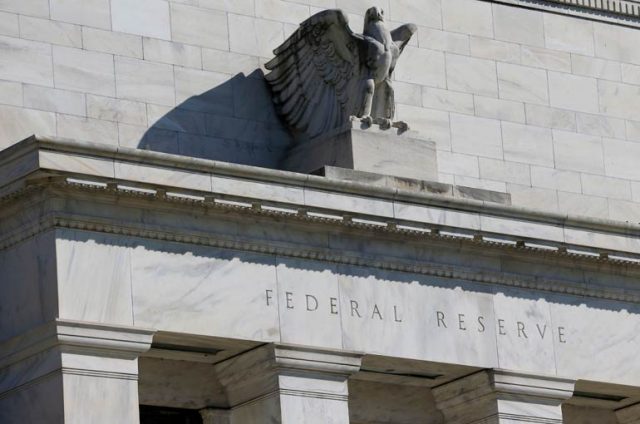
WASHINGTON — Soaring consumer inflation expectations, driven to a level not seen since the early 1980s, coupled with jittery markets and rising US Treasury yields on Friday amplified the US Federal Reserve’s dilemma in determining whether the economy is facing a new price shock or headed for a downturn.

With households, businesses, and global investors adjusting fast to the implications of President Donald J. Trump’s aggressive import tariff policies, Fed policy makers said the outlook has grown increasingly difficult to predict as they took stock of recent market moves and an unsettling surge in consumer attitudes about upcoming inflation.

“It’s hard to know with any precision how the economy will evolve,” New York Fed President John Williams said in the text of a speech to the Puerto Rico Chamber of Commerce that included estimates of growth falling under 1% this year, inflation reaccelerating to as high as 4%, and the unemployment rate rising to as much as 5% — bad outcomes for a central bank that wants to keep inflation low and employment high, and a potentially sharp blow to US households’ spending power.

“Given the uncertain effects of recently announced tariffs and other policy changes, there is an unusually wide range of outcomes that could transpire,” Mr. Williams said.

In the worst case, the spike in the short-term outlook for inflation among consumers begins to infect the long-term view, and spreads into market-based measures that have so far remained, in the view of Fed policy makers, consistent with the central bank’s 2% inflation target.

Fed policy makers put a premium on keeping long-term inflation expectations in check, but are also watching the steady rise in year-ahead expectations that new data from the University of Michigan on Friday showed had soared to 6.7% in the wake of Mr. Trump’s April 2 reciprocal tariffs announcement.

A surge in inflation expectations would threaten the progress the Fed has made in controlling a pandemic-era rise in prices, and could also sideline the central bank from providing support for an economy facing new risks, with markets struggling to find footing.

“The Fed or Treasury stepping in should be done reluctantly, should be done when it is only truly needed,” said Minneapolis Fed President Neel Kashkari, who led the Troubled Asset Relief Program as a US Treasury official during the 2007-2009 financial crisis.

“I think we should be very cautious about taking moves that could demonstrate a weakening, which I don’t think is there, to the Fed’s commitment to getting inflation down,” Mr. Kashkari told CNBC.

SHIFT IN INVESTOR PREFERENCES
The new University of Michigan data continued a four-month rise in year-ahead inflation expectations among consumers and a drop in consumer sentiment that has crossed party lines.

It was a combination of high inflation and high unemployment that led former Fed Chair Paul Volcker in the late 1970s and early 1980s to put the priority on inflation control with punishing interest rates that triggered a recession.

St. Louis Fed President Alberto Musalem said that Friday’s University of Michigan consumer survey, which showed longer-term consumer inflation expectations surging to the highest level in more than 30 years, was a “notable” exception to other data he feels indicates longer-term inflation expectations still anchored.

“But if the public begins to expect inflation will remain high over the long term, the job of restoring price stability and maximum employment would be much more difficult,” Mr. Musalem said.

The implication for monetary policy — of interest rates at least left on hold even if the economy stutters as many now expect — highlights the crossroads the Fed may be approaching at a time when there has been speculation about market intervention or even emergency rate cuts to restore eroding confidence.

Mr. Kashkari, in the most explicit comments yet from a Fed official about a possible emergency response to the volatility that has torn across markets in response to Mr. Trump’s tariff barrage, said it would take a clear emergency in the financial system for the central bank to intervene.

“If there’s a dislocation — I’m not forecasting this, but if there were a dislocation — we have the ability to smooth out that dislocation,” Mr. Kashkari said. “But I’m not seeing big dislocations yet. I’m seeing some stresses, but markets seem to be adjusting.”

Though “markets are continuing to function well,” Boston Fed President Susan Collins told the Financial Times, the central bank “does have tools to address concerns about market functioning or liquidity should they arise.” Ms. Collins noted that the Fed has brought those tools to bear quickly in past instances. “We would absolutely be prepared to do that as needed,” she said.

Since Mr. Trump’s tariff announcement on April 2, US stock and Treasury prices have plunged at the same time — a potentially worrisome sign of investors turning away from US assets more broadly.

A pause on some of Mr. Trump’s planned import taxes has done little to reverse the shock.

The yield on the benchmark 10-year Treasury bond has risen a hefty 60 basis points over the past week, and the S&P 500 index has fallen about 13% since hitting a peak in February, before the scope of the tariff plans became clear.

More typically, US Treasury yields fall in times of stress as investors seek a safe place to park cash.

Mr. Kashkari said investors might be turning away from the US, whose deficit in goods trade Mr. Trump is trying to shrink.

“There’s a lot of complexity,” the Minneapolis Fed president said, noting that the dollar also had been weakening.

“Normally when you see big tariff increases, I would have expected the dollar to go up. The fact that the dollar is going down at the same time, I think, lends some more credibility to the story of investor preferences shifting.” — Reuters

Coco farmers seeking to press US tariff advantage

CHEN MIZRACH-UNSPLASH

By Aubrey Rose A. Inosante, Reporter

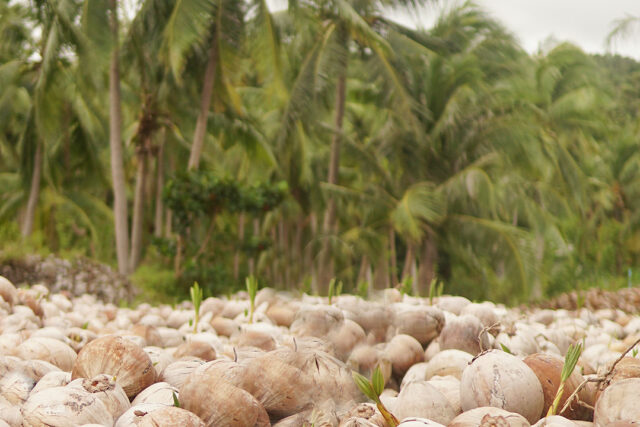
COCONUT FARMERS and exporters are gearing up to increase sales to the US, taking advantage of favorable tariffs relative to other regional producers.

In an e-mail interview with BusinessWorld, Charles R. Avila, president of the Confederation of Coconut Farmers’ Organizations of the Philippines said it will work with exporters to grab more US market share.

The organization “will welcome a possible increase in investor re-locators to the Philippines (and) cooperate with both public and private sectors on a massive coconut planting, re-planting and fertilization program,” he said.

Mr. Avila also anticipates a “dramatic rise” in coconut product prices due to the new US tariff regime.

The Philippines exported $12.14 billion to the US in 2024, of which coconut oil accounted for $558.74 million.

Other related goods exports include $74.24 million in desiccated coconut and $53.70 million in other coconut products.

Speaking on Teleradyo Serbisyo on April 12, Trade Secretary Cristina A. Roque said agricultural exports such as coconut and mangoes will now have an edge against products from neighboring countries with higher tariffs.

“We were losing out on coconut sales to Thailand because their tariffs were lower before. But now, our tariff is 17%, while theirs is 34%. So that’s a big deal,” Ms. Roque said.

Thailand, a major global producer and exporter of coconut product such as the coconut milk exported $341.11 million worth of coconut milk between January and October 2024, according to the Thai Government Public Relations Department.

It said that the US accounted for 70.5% of the country’s total coconut milk exports.

Ms. Roque noted that the tariff advantage would likely lead to increased US imports from the Philippines, despite a general rise in product prices.

“The prices of our goods will also rise but the prices of goods from other Southeast Asian Nations (ASEAN) countries will be higher,” Ms. Roque said.

The US imposed some of the highest tariffs on ASEAN countries on April 2, with the Philippines having the second-lowest tariff rate in the region.

The worst of the US tariffs were assigned to Cambodia (49%), Laos (48%), Vietnam (46%), Myanmar (44%), Thailand (36%), Indonesia (32%), Malaysia (24%), and Brunei (24%).

Mr. Avila emphasized that “tariffs are not everything” and the global competitiveness will ultimately rest on production costs.

“The Philippines might be favored with relatively low tariffs but if its production costs continue to be higher because of the proverbial government corruption and inefficiency in all that it does, then there is very little hope not only for the coconut industry but for the national economy as a whole,” he said.

Mr. Avila said Romeo I. Chan, president of Axelum Resources Corp., is currently in the US to look into the impact of the tariffs on the coconut supply chain.

Axelum is a listed integrated manufacturer and exporter of premium coconut products.

Ms. Roque and Secretary Frederick D. Go, the Special Assistant to the President for Investment and Economic Affairs, are expected to fly to Washington “toward the middle of May” for negotiations with the US Trade Representative (USTR).

“We will really discuss the close relationship between the Philippines and the US. We will also discuss our long-term trade partnerships with the US,” she added.

Ms. Roque brushed off concerns on the tariffs, saying that the Philippines is in “good position” compared to ASEAN peers.

Philippine Exporters Confederation, Inc. President Sergio R. Ortiz-Luis, Jr. the Philippines is in no position to negotiate with the US.

Napakaliit natin to be able to come up with something just for us (we’re too small for special treatment). Baka ’yung ASEAN pag ’yung may tsansa. (Maybe our chances will improve  as a bloc)… I don’t think there’s much we can offer,” he said by telephone on April 11.

Mr. Ortiz-Luis said the blanket 10% tariff imposed during the stay of implementation of the initially-announced tariff schedule levels the playing field and highlights the importance of cost competitiveness.

“We have to really look at our competitiveness and to be able to cut down our costs to be able to compete,” he said.

Former tariff commissioner George N. Manzano said the priority during the pause should finding out what the USTR’s demands are with regard to Philippine trade policy, which would lead to a lowering of the reciprocal tariffs.

“I am not sure if the US will agree to a zero for zero. They will ask for higher tariffs on certain industries such as steel, cars and ships, etc. because they want to protect those products,” Mr. Manzano said, noting that he is speculating about potential outcomes.

Mr. Go has said that the best possible outcome for the Philippine is a “free trade agreement — zero tariffs on both sides.”

BSP securities fetch lower yields

BW FILE PHOTO

YIELDS on the central bank’s short-term securities ended lower on Friday, with strong demand seen for the two-month tenors.

The Bangko Sentral ng Pilipinas’ (BSP) bills fetched bids amounting to P153.009 billion on Friday, higher than the P130-billion offer but slightly below the P155.76 billion in tenders for the P190-billion volume auctioned off the week prior.

Still, the central bank awarded just P121.684 billion in securities as the one-month tenor was undersubscribed.

Broken down, tenders for the 28-day BSP bills reached P41.684 billion, lower than the P50 billion placed on the auction block and the P59.534 billion in bids for the P70-billion volume offered in the previous week. The central bank accepted all the submitted bids.

Banks asked for rates ranging from 5.645% to 5.85%, lower than the 5.78% to 5.86% margin seen a week earlier. This caused the average rate of the one-month securities to fall by 4.39 basis points (bps) to 5.7782% from 5.8221% previously.

Meanwhile, bids for the 56-day bills amounted to P111.325 billion, well above the P80-billion offering and the P96.226 billion in tenders for the P120-billion offer by the central bank a week ago. The BSP made a full P80-billion award of the two-month papers.

Accepted yields were from 5.6125% to 5.816%, lower than the 5.773% to 5.86% band seen a week prior. With this, the average rate of the 56-day securities declined by 8.59 basis points to 5.743% from 5.8289% logged in the previous auction.

The central bank uses the BSP securities and its term deposit facility to mop up excess liquidity from the financial system and to better guide market rates.

The BSP bills were calibrated to not overlap with tenors of the Treasury bills and term deposits also being offered weekly.

Earlier data from the central bank showed that around 50% of its market operations are done through the short-term BSP bills.

Short-term instruments offer more stability and predictability, the BSP has said. These are also considered high-quality liquid assets, giving banks more flexibility.

Central bank securities can also be traded in the secondary market. — Luisa Maria Jacinta C. Jocson

Prada brings Versace home to create Italian luxury contender

MILAN — Prada’s deal to buy Versace revives hopes for a “Made in Italy” luxury champion after many other family-founded brands ended up in French, Swiss, or US hands, and comes as many Italian groups are outperforming the struggling sector.

The $1.375-billion deal brings one of fashion’s best-known Italian labels back under Italian control after it was sold to US-listed Capri Holdings, then known as Michael Kors, for $2.15 billion including debt in 2018.

Despite Italy accounting for 50% to 55% of global personal luxury goods production, according to consultancy Bain’s estimates, the country lacks a group with a scale that matches up to French players such as LVMH and Gucci-owner Kering.

Milan-based Prada, controlled by designer Miuccia Prada and husband Patrizio Bertelli and listed in Hong Kong with a market capitalization of about 14 billion ($15 billion), is the largest Italian luxury fashion group by revenue.

But the group, which also includes the fast-growing Miu Miu label, has been a relative minnow in terms of stock market valuation compared with the likes of Louis Vuitton-owner LVMH.

The Versace deal comes after Andrea Guerra became Prada’s chief executive officer in 2023 to bridge a change in generation, with Lorenzo Bertelli, the son of the company’s main owners and its chief marketing officer, regarded as the heir apparent.

“Prada’s ambition to become a leading Italian luxury conglomerate is a significant move in a market that is dominated by French groups. It’s exactly what many Italians have been hoping for,” said Achim Berg, a fashion and luxury industry adviser.

The combined revenue of the five biggest Italian-owned listed luxury groups — Prada, Moncler, Ermenegildo Zegna, Brunello Cucinelli, and Ferragamo — is still well below Kering’s roughly 17 billion, even after a big fall in sales at the French group last year.

Company founder Brunello Cucinelli summed up the difference in approach on the two sides of the Alps in typically colorful fashion.

“Our esteemed French counterparts are great financiers,” he told the Milano Fashion Global Summit 2024 last October. “But we Italians regard our ‘tiny big’ companies as if they were our little children, so we want to look after them and hand them down to a next generation,” he added.

AMBITIOUS MOVE
While LVMH and Kering have swallowed many Italian brands, even the larger Italian groups have until now been comparatively reluctant to make big acquisitions.

“This acquisition represents Prada’s serious attempt to build a group — and a much more ambitious one compared to their past ventures with Helmut Lang and Jil Sander,” Berg said.

Prada’s chairman and co-owner Patrizio Bertelli defined the acquisition of those two brands — which were bought at the turn of the century and sold a few years later — as “strategic mistakes.” The group has since focused mainly on organic growth, with the exception of acquisitions of suppliers.

Both Prada and Versace have their roots in Milan and still have headquarters there, just four kilometers apart.

Milan-based Moncler, the mountain gear brand that was bought and revived by Italian entrepreneur and current main shareholder Remo Ruffini in 2003, has also shown some interest in dealmaking, buying Italian streetwear brand Stone Island in a 1.15-billion agreement in late 2020.

Moncler’s net cash position of 1.3 billion has fueled analyst talk of more deals, but the group has denied such speculation.

Jil Sander is now part of Italian entrepreneur Renzo Rosso’s OTB Group, which also includes brands such as Diesel and Maison Margiela. But with annual sales of 1.7 billion, it remains relatively small.

The big Paris-based groups, meanwhile, have continued to make forays into Italy, underscoring the challenge an enlarged Prada would face to compete with them.

In the latest deals, Kering bought a 30% stake in Italian maison Valentino in 2023, and LVMH last year helped to take Tod’s private and took a 10% stake in Moncler’s top shareholder.

In the longer term, eyes are on companies such as Milan-based Armani and Dolce & Gabbana, among the few in Italy that are still fully family-owned and unlisted.

Their ultimate fates could be decisive in any effort to create a true Italian powerhouse in global fashion. — Reuters

Chevron Philippines signs new lease deals for BLC-owned terminal sites

CHEVRON.COM

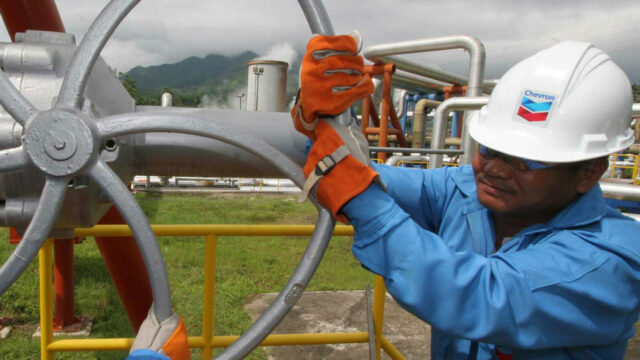
CHEVRON PHILIPPINES, INC. (CPI), a downstream oil company and marketer of the Caltex brand of fuels and lubricants, has renewed its lease agreements with Batangas Land Company, Inc. (BLC) for four properties that house its terminals.

The companies signed new lease contracts covering BLC-owned sites in San Pascual, Batangas; Lapu-Lapu, Cebu; San Fernando (Poro), La Union; and Sasa, Davao City, Chevron said in a statement on Friday.

“This lease renewal not only solidifies Chevron’s presence in the Philippines, but it also provides a solid foundation that allows Chevron to confidently invest in our growth and expansion,” said Yu Lee Toh, CPI’s vice-president for Asia Pacific sales.

In 2023, CPI and BLC signed a memorandum of understanding for the renewal of leases on the properties that host the oil company’s terminals serving the country’s fuel requirements.

“These four terminals that we are leasing from BLC in Batangas, Cebu, Sasa, and Poro serve as the backbone of our operations. This seal of renewed partnership enables CPI to continue serving our customers and ultimately providing for the growing energy needs of the country,” said CPI Chairman Billy Liu.

CPI is engaged in the importation of crude oil and natural gas and in the manufacture of transportation fuels, lubricants, petrochemicals, and additives.

“This ongoing relationship between Chevron and BLC is more than just a business transaction. It is proof of what can be achieved when both sectors unite with a shared vision, an example of how working together can create lasting impact,” said BLC President Lilia Arce.

BLC is a joint venture between CPI and the National Development Company, the government’s investment arm. — Sheldeen Joy Talavera

Playing God with tariffs

FREEPIK

“I’m telling you, these countries are calling us up, kissing my ass,” Donald Trump, US President, told his fellow Republicans at a dinner on Tuesday, April 2 (according to the Philippine Star on April 10).

What’s the crass “ass-licking” braggadocio all about?

At his inaugural address on Jan. 20, Trump pledged to “immediately begin the overhaul of our trade system to protect American workers and families. Instead of taxing our citizens to enrich other countries, we will tariff and tax foreign countries to enrich our citizens,” he said (whitehouse.gov/, retrieved Feb. 4, 2025).

On April 2, Trump declared a national emergency to address what he described as a “large and persistent US trade deficit,” enabling him to invoke presidential powers in an emergency, to impose the initial 10% tariff on all imports to the US, and then the additional reciprocal tariffs based on the US trade deficits per country to be imposed starting April 9. (Politico, retrieved April 3, 2025).

These tariff-increase announcements prompted retaliation from trade partners and triggered a stock market crash. The Wall Street Journal pointed out that across April 3 and 4, US stocks lost $6.6 trillion in value, their largest two-day loss in history by a margin of $2.2 trillion. Of course, the tumble in the capital and financial markets frightened not only the 57 countries charged with increased tariffs, but the global market players as well as the small developing countries that wrongly, seemed unaffected.

Politico reported that Treasury Secretary Scott Bessent tried to change Trump’s mind about the tariffs, warning him that the stock market would continue to decline unless he changed course. On April 9, Trump turned 180 degrees and announced that reciprocal tariffs above the base 10%, which had gone into effect that morning, would be paused for 90 days for all countries except China. China’s minimum tariff rate was increased to 145%, while imports from all other countries were sustained at the 10% baseline tariff (Wall Street Journal, April 9). Other global tariffs on products like cars, steel, and aluminum remained in effect.

And indeed, the affected countries (some, at least), came calling on Trump to “kiss-ass,” and try to negotiate for solutions to their increased tariffs for trading with the US. Time Magazine (“Nothing Is Certain but Uncertainty: How the World Is Reacting to Trump’s Tariff Reversal,” April 11) describes “how countries around the world have begun responding to the whiplash”:

Bangladesh. The US is the biggest export market for Bangladesh, which had been hit hard by a 37% tariff. “We will continue to work with your administration in support of your trade agenda,” Interim leader Muhammad Yunus said.

Brazil. The US is among Brazil’s biggest trading partners, second only to China. Trump imposed a 25% tariff on steel — a key export for Brazil, and 10% on other products. Brazil will negotiate with the US on the increased tariffs, at the same time, the country plans to expand its trade partnerships with other countries.

Cambodia. Faced with a 49% “reciprocal” tariff, Cambodia offered to reduce its tariff on 19 categories of US imports from 35% to 5%. Last year, Cambodia exported $9.9 billion in goods to the US, around 38% of the country’s total exports.

European Union. The EU had voted in favor of retaliatory tariffs on $23 billion in goods in response to Trump’s previously announced 25% tariffs on steel and aluminum — which remain in effect. The EU faced a 20% “reciprocal” tariff — which is now a baseline 10% tariff during the pause — on top of the metals tariff and a separate 25% tariff on cars and car parts. “If negotiations are not satisfactory, our countermeasures will kick in,” EU President Ursula von der Leyen said.

Germany. Will be united with the stand of the EU.

Greece. Prime Minister Kyriakos Mitsotakis hopes for a “win-win” solution between the EU and the US, as Greece is a member of the EU. “(But) as far as Greece is concerned, we have a strategic partnership with the US. I have worked with President Trump before and I can work very well with him again addressing regional challenges,” he said.

India. Wants to move swiftly on a trade deal with the US, after Trump temporarily reduced a 27% “reciprocal” tariff on the country to 10%.

Ireland. As a member of the EU, Ireland hopes for a group negotiated solution to the Trump tariffs, but “direct bilateral engagement with the United States is one of my priorities,” Simon Harris, the Tánaiste or second-ranking government leader of Ireland said.

Italy. Economy Minister Giancarlo Giorgetti said, “Within the G7 all of us outside the US spoke to try to calm the situation and find a way to bring the Trump administration to the table and to a reasonable position.”

Japan. Ryosei Akazawa, Japan’s Minister for Economic Revitalization, said about the tariffs on Japan’s metals and automobiles, key exports for the country: “We continue to express our strong concerns and strongly request that they be reviewed.” Finance Minister Katsunobu Kato ruled out using Japan’s US Treasury holdings as a bargaining chip in negotiations with the US.

Lesotho. Hit by a 50% “reciprocal” US tariff, the textile industry is the biggest private employer in the country, with around 30,000 people — nearly half of whom produce apparel for American brands. Lesotho hopes to negotiate for lower tariffs.

Malaysia. Has been hit with a 24% “reciprocal” US tariff, along with other members of ASEAN, including Vietnam and Thailand, among others. The 10 ASEAN member states and Timor-Leste agreed not to retaliate against Trump’s tariffs, and will “find a pragmatic and mutually advantageous solution for ASEAN in a strategic and tactful manner.”

Poland. Prime Minister Donald Tusk of Poland, an EU member, said, “The reaction to the tariff war was predictable. The stock market earthquake from Japan through Europe to America must be survived without nervous decisions.

Saudi Arabia. Commerce Minister Majid bin Abdullah al-Qasabi spoke with his Chinese counterpart on Thursday about strengthening bilateral trade, according to a statement by the Chinese ministry. Saudi Arabia faced a 10% “reciprocal” tariff on exports to the US.

Singapore. Singapore’s Monetary Authority said that it is “ready to work constructively with all partners, including the United States.” Singapore was hit with a 10% “reciprocal” tariff.

South Africa. Faced a 31% “reciprocal” tariff, it previously said it had no plans to retaliate against the US and will instead seek negotiations.

South Korea. Trade envoy Cheong In-kyo met with US Trade Representative Jamieson Greer last week about lowering tariff rates on South Korea. The US had imposed a 26% “reciprocal” tariff plus 25% tariffs on the auto industry, a key export.

Spain. Spain is a member of the EU, which was subject to a 20% tariff on exports to the US before the pause. “Expanding the trade relations that we have with other countries, including a partner as important as China, does not go against anyone,” Spanish Agriculture Minister Luis Planas said.

Taiwan. The bulk of Taiwan’s trade surplus with the US is in its export of semiconductors, which accounts for around 40% of its total exports. Taiwan is willing to cut its tariff rate on US products from an average nominal rate of 6% to 0% to counter and lower the US 32% “reciprocal” tariff on Taiwan.

Thailand. As Thailand faced a 36% “reciprocal” tariff, Prime Minister Paetongtarn Shinawatra offered to increase imports of energy, aircraft and agricultural products from the US. Surplus American farm products would be processed in Thailand, and then re-exported as higher-value products.

United Arab Emirates. The UAE, who is one of the world’s top 10 oil producers, will consider a bilateral free-trade agreement with the EU after the 10% “reciprocal” tariff imposed by the US.

United Kingdom. The UK will continue to “coolly and calmly” approach negotiations with the US, a spokesperson for Downing Street said last week.

Vietnam. The two countries exchanged nearly $150 billion in goods last year. The US is the biggest export market for Vietnam. Trump claims that Vietnam had earlier offered to cut its tariff rates on US goods to 0%, but he said the offer was not enough.

But no ass-kissing, no begging to negotiate, for China.

US tariffs on China total 145% — the 125% rate announced last week on top of an existing 20% tariff. China “firmly opposes” the US tariffs and vows to continue with countermeasures. “There is no winner in a trade war, and that China does not want a trade war,” He Yongqian, a commerce ministry spokesperson, said. “China is open to dialogue with the US but it must be conducted on an equal basis with mutual respect. We do not provoke trouble, nor do we fear trouble,” he said.

China has also filed a complaint against the US with the World Trade Organization (WTO), according to the People’s Daily. At a meeting of the WTO’s Council for Trade in Goods on Wednesday, China said US tariff policy violates WTO rules and called it a “typical act of unilateralism, protectionism, and economic bullying.”

Yes, it is only China, of its active trade partners, that has no fear of Trump’s bullying and threatening. China knows its own strength and consistency, and its firm focus on objectives for the good of the nation and its people.

The China Economic Journal brags that China is the world’s largest manufacturing industrial economy and exporter of goods. Manufacturing has been transitioning toward high-tech industries such as electric vehicles, renewable energy, telecommunications and IT equipment, and services have also grown as a percentage of GDP. China is the world’s largest high technology exporter. With 791 million workers, the Chinese labor force was the world’s largest as of 2021, according to The World Factbook.

And Trump thinks that with the imposition of higher tariffs on imported goods and services, the US will replace local demand for these items that an instant US manufacturing industrial economy would produce for whatever Americans and the world would need or want? Make America great again (MAGA)! But the entire world has been spoiled and abetted by cheaper, easily accessible goods made in China, Vietnam, Thailand, India, Bangladesh — by any country other than America.

Trump, playing God with his onerous tariffs on foreign goods and services, has alienated himself and the US from most of the world.


Amelia H. C. Ylagan is a doctor of Business Administration from the University of the Philippines.

ahcylagan@yahoo.com

MEGA mindset

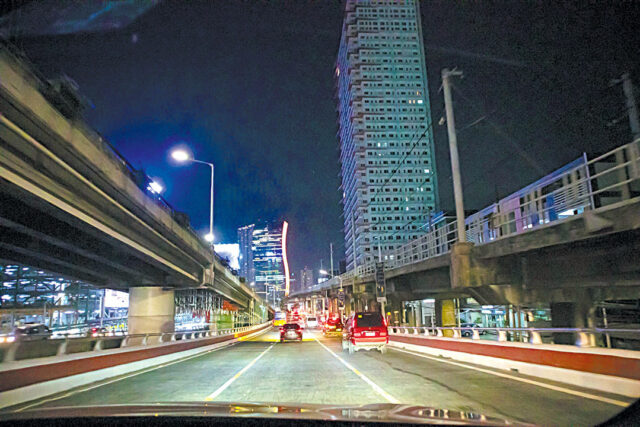
EDSA at night on a holiday is welcome sight for traffic-weary commuters and motorists. — PHOTO BY JOYCE REYES-AGUILA

Make EDSA Great Again

LOOMING ROAD repairs along Epifanio delos Santos Avenue (EDSA) are already causing a lot of motorists to gnash their teeth and have nightmares of a traffic meltdown in Metro Manila.

EDSA, of course, is the main thoroughfare traversing the north and south axes of the metropolis. A report by ABS-CBN last December placed the number of vehicles passing through EDSA every day at 464,000. The clincher, according to the same report: This volume of traffic is nearly double EDSA’s carrying capacity of 250,000 vehicles — and has exceeded it since 2012.

EDSA used to be called Highway 54 before it was subsequently renamed MacArthur Boulevard in 1945. The year after, it became known as Avenida 19 de Junio — commemorating the birth date of national hero, Jose Rizal. It was only in 1959 that it received its present name to honor the Rizaleño historian, jurist, and scholar: Epifanio de los Santos y Cristobal.

Road construction started back in 1939 and the main artery was partially opened in 1940 just before World War II. In the 1950s, the northern end of EDSA was designated as the Bonifacio Monument in Caloocan. Work continued, expanding it from two lanes to four. It was only in the 1960s that the Guadalupe Bridge was constructed to connect the northern and southern segments of EDSA. In the south, the end point is the EDSA Extension that crosses Roxas Boulevard and terminates at the rotunda in front of the Mall of Asia.

EDSA is the longest and, unfortunately, the most congested highway in the Metro Manila area. It runs 23.8 kilometers and passes six of the 17 local government units in the metropolis. Traffic crawls especially during the rush hours. Last December, the Metropolitan Manila Development Authority (MMDA) reported that the average speed along EDSA was expected to slow from 21kph to 15kph at the peak of the yearend holiday season.

I travel on EDSA every day to and from work. I live in Mandaluyong and my office is in Makati. Actually, I have walked along EDSA to the office a few times as part of my cardio workouts on weekends. It’s not that far — it took my legs about an hour and a half to cover eight kilometers or so. On the other hand, when I take the car to work in the mornings, it takes me about 20 minutes if leaving my place of residence at around 6:30 a.m. Going home, however, is a whole other story — taking about 40 to 60 minutes. If I leave the office at the peak rush hour of around 5 to 6 p.m., getting home can take as long as 90 to 120 minutes. It would be faster, require less patience, and even be healthier (minus the smog) if I just walked the distance.

Probably the most dreadful part of the scheduled road repairs will be work done on the aforementioned Guadalupe Bridge. It is, even now, already a choke point in the daily drive or commute. In fact, repair of the bridge was initially reported to start late last year but was deferred in consideration of the usual Christmas “car-mageddon.” The latest report from the Department of Public Works and Highways (DPWH) is that repairs will have to start this month. Roadworks on the northbound lanes will precede those of the southbound ones.

One hopes that the worry might be misplaced. I had a similar sense of dread last year when work on the Kamuning flyover was announced. As it turned out, there were some disruptions as a result of rerouting, but it seemed that the MMDA and local police units managed to keep things under control. They did an extensive communication campaign preceding the closure of lanes so motorists could identify alternative routes. I believe that maximum tolerance was also practiced in consideration of possible confusion among drivers. This will be even more critical this time around. I urge calm and think we should wait for official announcements rather than let our imagination get ahead of us.

Clearly, there is a way of managing road use so that maintenance work can proceed smoothly. In the first place, motorists need to accept that there is no avoiding the work that needs to be done. Due to age and heavy use, EDSA has, indeed, deteriorated. As I pointed out at the start, the number of vehicles plying the highway is twice its carrying capacity. Driving along its breadth, one is sure to notice that it is full of patchwork — much like a heavily injured person covered with Band-Aids. As is wont to happen, the “Band-Aids” peel off and the road sores reappear. Any vehicle operator knows to step on the brakes or take the foot off the gas when manuevering around potholes or unevenly paved roads. In turn, this causes traffic to slow down, leading to unnecessary and inordinate delays.

With acceptance comes patience and perseverance — from both motorists and traffic enforcers. One thing we can be sure of is that repairs will be completed at some point. In fact, I noted that the repaving of the northbound lanes between Kalayaan and Guadalupe was done with minimal disruption. If we follow alternate traffic instructions, we allow the road crews to do their job quicker and complete their repairs sooner. Hopefully, work can be hastened during the summer.

I am encouraged by the resolve of the government to take on the repair and upgrade of EDSA now. There really is no putting it off. It is necessary to protect the driving and riding public. The mantra should be “safety first, always.” Then, of course, the elimination of potholes, uneven road surfaces and other impediments should — nay, must — result to a smoother traffic flow, getting us from point to point in greater comfort and less time. Let us be a part of the solution by following directions of traffic enforcers, keeping out of the way of road repair crews, and allowing them to get the job done sooner rather than later.

ADB pushes for Blue Economy Act

THE Asian Development Bank (ADB) said the Philippines needs to sign the proposed Blue Economy Act to improve marine-based livelihoods and ensure the long-term sustainability of the ocean economy.

In the Asian Development Outlook released April 10, the ADB said: “The pending legislation provides a comprehensive policy framework to integrate marine spatial planning, environmental-economic accounting, industry development, and climate action into national and regional development plans.”

Senate Bill No. 2450 seeks to guide the use and development of marine wealth within the coastal and maritime domain.

It passed on final reading in August. The House counterpart legislation passed in December 2023.

“Swift passage and implementation of this bill are crucial to achieving a coherent and well-coordinated blue economy strategy,” the ADB said.

The bank said ocean-based industries accounted for an average 4% of Philippine GDP in 2018–2023.

Output of the ocean-based industries consisted of fisheries at nearly 30% in 2023, followed by the manufacture of ocean-based products (20.9%), maritime transport (15.0%), and ocean-based power generation (10.3%).

“Marine renewable energy — offshore wind, solar, wave, and tidal energy — can help the country reach the target of increasing renewable energy’s share in power generation to 35% by 2030 and 50% by 2040,” it said.

The ADB also called for stricter enforcement of the Extended Producer Responsibility Act.

This law requires producers, manufacturers and other companies to move away from single-use plastics and establish their own waste recovery schemes in partnership with communities, local governments, and other stakeholders.

Rose-Liza Eisma-Osorio, acting vice-president of Oceana, said the Blue Economy Bill also covers reclamation and other coastal development activities.

“There’s something wrong with how they view the blue economy,” she said, citing reclamation along Manila Bay, which has “permanently or irreversibly destroyed coastal resources and marine resources,” she said by phone.

Ms. Osorio instead called for the bill to be “reframed” and highlight economic drivers from the oceans without engaging in destruction of resources.

Ms. Osorio also noted the need for immediate release of the implementing rules and regulations of the Philippine Ecosystem and Natural Capital Accounting System Act. — Aubrey Rose A. Inosante