Home Blog Page 1287

Hotel industry urges traveler-safety focus in promoting PHL destinations

FACEBOOK.COM/PHILIPPINEHOTELOWNERSASSOCIATION/

THE HOTEL industry said the Philippines needs to be actively positioned as a safe destination, noting the negative impact of safety rankings that portray the Philippines as unsafe.

“I think we also need to work with the government on a concerted effort in reintroducing the Philippines to all of our key markets, reminding everybody why we are different from Thailand, from Indonesia, and from the rest,” Francis Nathaniel C. Gotianun, senior vice-president at Filinvest Hospitality Corp., said during Philippine Hotel Connect 2025, organized by the Philippine Hotel Owners Association, Inc.  on Thursday.

HelloSafe released findings based on travel insurance data designating the Philippines as “the latest safe country on the planet,” but later withdrew the results of its study pending a review of its methodology.

Mr. Gotianun noted that the report negatively affected the hospitality industry.

“Of course we want to tell people, ‘Yes, you have to be careful but we need to put things in perspective,’ and we have a duty as you know leaders in our various areas to take that up and make sure that the right messages get out,” he added.

To attract more visitors, the hospitality industry must put the spotlight on the uniqueness of the Philippines, according to Ayala Land Hospitality Creative Director Paloma Urquijo Zobel De Ayala.

“Instead of… always chasing world-class, let’s just be exceptionally Filipino,” she said at a panel discussion during the event.

She also cited the need for more visitor options within driving distance from Manila. — Beatriz Marie D. Cruz

Employers warned against coercing workers to show up despite flooding

PHILIPPINE STAR/EDD GUMBAN

By Adrian H. Halili, Reporter

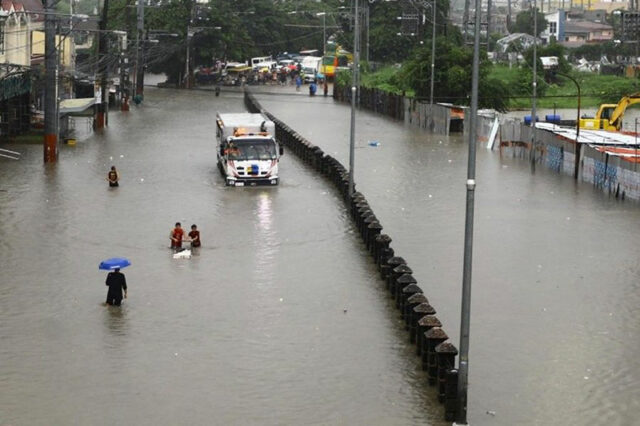
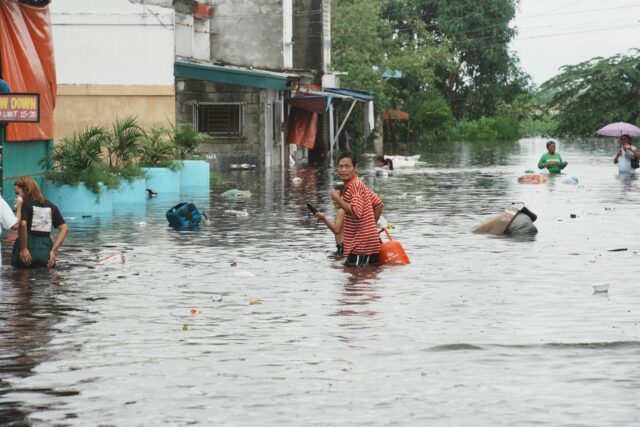
LABOR analysts said extreme weather events are a threat to safety and warned employers not to pressure staff to show up during episodes of flooding.

“The recent floods are more than a weather crisis — they are a workers’ crisis. Flooding disrupts livelihoods, threatens physical safety, and exacerbates health risks. Government workers and private employees alike should not be coerced into unsafe work conditions,” Sentro ng mga Nagkakaisa at Progresibong Manggagawa Secretary-General Josua T. Mata said via Viber.

Mr. Mata proposed that the government adopt a protocol that designates certain events as hazardous, setting in motion a process that authorizes paid leave or remote work.

“Workers must not be forced to risk their lives getting to work. Having the capacity to issue timely warnings would need the government resuming full support for systems like Project NOAH’s hazard mapping,” he said.

He cited the need for hazard pay to be expanded and institutionalized.

“The government response for workers should not be about emergency relief alone — but about building systems that prioritize worker safety, decent work conditions, and climate-resilient communities,” Mr. Mata said.

The southwest monsoon, in conjunction with storms entering the Philippine Area of Responsibility brought heavy rains that flooded large portions of the Philippines this week, including the capital region.

Maria Ella Calaor-Oplas, an economics professor specializing in human capital development research at De La Salle University, said via Messenger chat that the government must enhance the system of worker protections during weather disturbances.

She added that industries must resort to work from home arrangements during extreme weather disturbances.

“In order for online or WFH set up to be effective, government should heavily invest in infrastructure… ensuring that everyone is reached with quality internet,” Ms. Oplas said.

Benjamin Velasco, assistant professor at the UP Diliman School of Labor and Industrial Relations called on Department of Labor and Employment (DoLE) to enforce Republic Act 11058 or the Occupational Safety and Health Standards Law, which grants workers the right to reject unsafe work conditions.

DoLE’s Labor Advisory No. 17 of 2022 allows employers and business establishments to keep workers home “not only due to imminent danger in the workplace, but also during weather disturbances.”

“It seems not to apply to hazardous journeys to work. Since the government gives private sector employers the right to suspend work, the government must encourage them to be liberal and allow workers not to report for work if the latter deem it unsafe,” Mr. Velasco said via Messenger chat.

“Otherwise, employers can provide accommodations like shuttles or places to stay and/or sleep in the workplace,” he added.

SES in talks to bring satellite telco coverage to rural areas

SES.COM

SATELLITE communications provider SES said it is in talks with telecommunications firms in the Philippines to bring direct-to-device services to close the connectivity gaps in rural areas.

“We’re now understanding where we could deploy this service, maybe in the Mindanao region where there are internet connectivity gaps,” Harsh Verma, vice-president of sales for the Asia-Pacific, said at a virtual media briefing on Thursday.

Mr. Verma said that the company is in talks with PLDT Inc.’s Smart Communications, Inc. unit; Globe, Inc.; and DITO Telecommunity Corp.

“We’re trying to get into the mainstream of 4G and 5G deployments in rural areas, bring direct-to-device capability into Philippines,” he said.

Instead of carriers putting up infrastructure, Mr. Verma said SES can use satellites in Medium Earth Orbit (MEO), a region of space that allows sufficiently high enough data transmission rates.

“So they basically send the traffic to our O3b mPower satellite, and we just have one O3b mPower Gateway doing not only Medium Earth Orbit but also bringing the direct-to-device capability using the same infrastructure,” he said.

SES recently launched its ninth and tenth O3b mPower satellites using a SpaceX Falcon 9 rocket.

In 2023, SES conducted a test of its MEO satellite system with the Department of Information and Communications Technology (DICT), which delivered connectivity speeds of 500 Mbps (download) and 80 Mbps (upload).

“We have deployed this commercially for six months and now we’re looking with working with DICT for a long-term deployment,” Mr. Verma said. — Sheldeen Joy Talavera

PHL corn output seen rising on improved pest controls

REUTERS

PHILIPPINE CORN production was projected at 8.30 million metric tons (MMT) in marketing year (MY) 2025/26 due to improved containment measures against the fall armyworm (FAW) pest and stable demand from the feed sector, according to the US Department of Agriculture (USDA).

Citing its Foreign Agriculture Service post in Manila, the USDA said its forecast for MY 2025/26, if realized, would exceed its 8.20-MMT corn output projection for MY 2024/25.It also noted the impact of a less intense dry season in 2025 and “increased technical knowledge of farmers in handling the fall armyworm.”

“Farmer contacts report that compared to the previous calendar year, they have gained technical expertise in handling FAW, specifically by using corn varieties which were identified to be more FAW-resistant,” it added.

The USDA also forecast an increase in the area to be harvested of 2% to 2.55 million hectares in MY 2025/26, against the adjusted estimate for MY 2024/25 of 2.50 million has.

The Philippine Statistics Agency reported that corn production in the first quarter of the calendar year hit 2.40 MMT, against the year-earlier output of 2.53 MMT.

The USDA said corn consumption in the Philippines will hit 10 MMT due to increased demand for feed corn from the poultry, pet food, and aquaculture industry, alongside continuous demand for corn-based snacks.

Meanwhile, the USDA also increased its consumption estimate for MY 2024/25 by 1% to 9.90 MMT.

“Industry contacts report that the African Swine Fever (ASF) remains a challenge in the country, affecting total feed demand,” the USDA said.

“However, those involved in feed milling report that the increased feed requirements from the expanding poultry and layer industries, along with pet food and aquaculture, are outpacing the decline in feed corn demand from the swine industry,” it added.

It said most farmers still prefer producing yellow corn over white corn due to its higher marketability for feed use.

It also noted a gradual increase in the use of white corn by snack manufacturers.— Kyle Aristophere T. Atienza

2024 healthcare spending rises to 5.9% of GDP

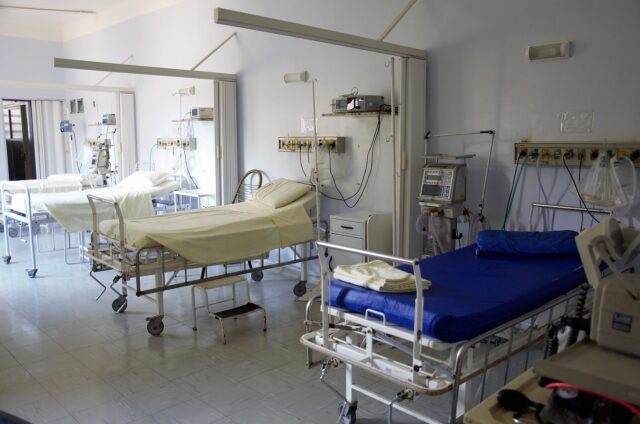
STOCK PHOTO | Image by Silas Camargo Silão from Pixabay

HEALTH spending as a proportion of the economy rose to 5.9% in 2024 as overall spending rose to its highest level in three years, the Philippine Statistics Authority (PSA) reported on Thursday.

Citing preliminary data, the PSA said the share of national health expenditure to GDP had been revised 5.5% in 2023.

The 2024 reading was the highest since the 6.4% posted in 2021.

The increase in health expenditure was driven by higher household incomes, improved employment conditions, and increased prices of medical goods and services, Michael L. Ricafort, chief economist at Rizal Commercial Banking Corp., said via e-mail.

Also, factors were the modernization of medical facilities in more parts of the country by both the private sector and by the government, he said.

He added that public health programs benefited from increased funding to support indigent patients.

In 2024, health expenditures rose nearly 19% to P1.44 trillion, against the revised P1.21 trillion in 2023.

Gross health capital formation expenditure rose 1.7% to P121.47 billion in 2024.

This brought total health spending growth to 17.1%, the highest since the 22% posted in 2021.

Government schemes and compulsory healthcare financing schemes accounted for 44.7% of expenditure in 2024, or P643.12 billion. This was 29.5% higher year on year.

Households accounted for 42.7% of the overall spending bill at P615.16 billion, up nearly 12%.

Voluntary healthcare schemes accounted for 12.6% of the health bill in 2024 at P181.12 billion, up 8.9%.

On a per capita basis, health expenditure rose 17.6% to P12,751 in 2024.

Hospitals received 39.2% of healthcare expenditure or P564.43 billion. Retailers and other providers of medical goods accounted for 31.5% at P453.88 billion, while providers of healthcare system administration and financing took in 9.2% or P132.60 billion.

Mr. Ricafort said that growth trends in healthcare expenditure has been consistent in recent periods and will extend to the coming years “as healthcare is one of the priority expenditures by individuals, households, government, and other institutions.” — Matthew Miguel L. Castillo

Chairman Lee, other officers take charge at FPI

THE Federation of Philippine Industries (FPI) said on Thursday a new set of officers has taken charge of the group, led by new chairman Elizabeth H. Lee. In a statement, the FPI said Ms. Lee is “a pioneering figure in automotive and advanced manufacturing, known for her commitment to sustainability, innovation, and inclusive growth.” She becomes the first female FPI chairman.

It said former chairman Jesus L. Arranza has been appointed chairman emeritus.

The group also announced the election of John Reinier Dizon as the organization’s president.

“(He is) a respected industry leader dedicated to local manufacturing and close collaboration with both government and business sectors,” the FPI said.

The FPI will be convening Business Summit 2025 on Oct. 8 at the Manila Polo Club. Among the expected guests at the event are Trade Secretary Ma. Cristina A. Roque and Finance Secretary Ralph G. Recto.

“This year’s summit will… push forward a bold agenda for reindustrialization — one that is fair, green, and future-ready,” Ms. Lee said. — Justine Irish D. Tabile

Nano Forge registers Cavite ecozone manufacturing plant

WIKIMEDIA.ORG

THE Philippine Economic Zone Authority (PEZA) said it signed a registration agreement with Nano Forge Solutions, Inc. for a manufacturing facility at the Golden Mile Business Park-Special Economic Zone in Carmona, Cavite.

“We are confident this industry-aligned venture will strengthen local manufacturing, elevate export potential, and generate new employment opportunities in Cavite,” PEZA Director General Tereso O. Panga said.

Estimated to cost over P30 million, Nano Forge’s facility is set to enter commercial operations next month and is expected to generate more than 100 jobs.

“The agreement officially recognizes Nano Forge Solutions, Inc. as an ecozone export enterprise,” PEZA said.

The facility will make high-efficiency air filters for air purifiers and will “further innovation in sustainable, clean-air technology in the Philippines,” it added.

Nano Forge offers product development and engineering outsourcing for electronics.

In a separate statement, PEZA said its network of 132 ecozones in Regions I, II, and III and the Cordillera Administrative Region accounted for over P500 billion in approved investments between 1995 and mid-2025.

“These zones generated more than $5 billion in exports in 2024 alone and provided employment to above 110,000 workers as of May 2025, clear evidence of their economic and social impact,” it added.

PEZA Ecozone Development Department Manager Ludwig O. Daza said newly approved and proclaimed ecozones in Tarlac will expand strategic investment hubs to emerging areas.

He said the Luzon Economic Corridor “will strengthen infrastructure development within the Subic, Clark, Batangas, and Manila areas.”

“This will link closer ecozones within the corridor, creating one big economic hub. In time, such an initiative should lead to the creation of a new economic corridor down south of Luzon, making ecozone development a viable platform for stimulating economic growth in that area,” he added. — Justine Irish D. Tabile

Prices frozen in 4 cities, 10 municipalities

PAMPANGA PIO VIA FACEBOOK/PHILSTAR FILE PHOTO

THE Department of Trade and Industry (DTI) said price freezes are in effect for basic necessities and prime commodities (BNPCs) in four cities and 10 municipalities following state-of-calamity declarations in connection with the widespread flooding in many parts of the country.

In an advisory, the DTI said calamities have been declared in response to the southwest monsoon and Tropical Storm Wipha, designated Crising by the government weather service. The state-of-calamity declarations have triggered inspections, with DTI teams in Roxas, Palawan reporting adequate BNPC supplies and no instances of undue price hikes.

Similar inspections were conducted in the Cordillera Administrative Region, with inspectors in Baguio City reporting that supplies of BNPCs are adequate for up to one month.

“Other capital towns in the Cordillera, such as Bangued, Luna, Lagawe, Bontoc, and Tabuk City, also have a stable stockpiles,” it added.

The inspectors said delivery and replenishment of BNPCs in retail stores have not been disrupted.

Similar findings were issued for Abra province.

“There are no (findings of) demand fluctuations, transportation delays, supplier issues, all of which have an impact on supply consistency and price stability,” the DTI said.

The DTI is also inspecting groceries and supermarkets in Lucena City. — Justine Irish D. Tabile

PSEi down on weaker Philippine growth outlook

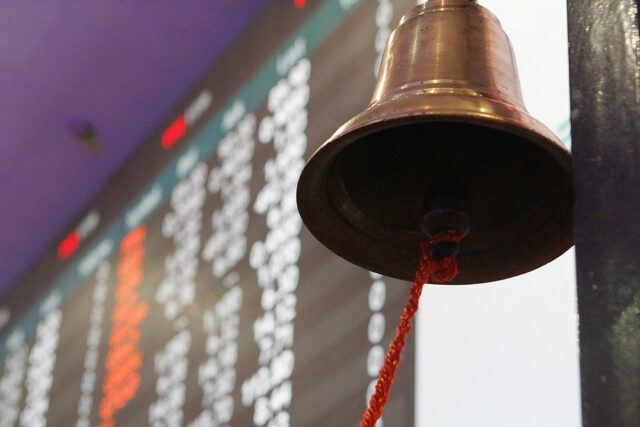
BW FILE PHOTO

THE MAIN INDEX snapped its four-day climb on Thursday as market sentiment was dampened by weaker economic prospects due to global trade uncertainties.

The bellwether Philippine Stock Exchange index (PSEi) declined by 0.28% or 18.09 points to close at 6,444.16, while the broader all shares index edged up by 0.02% or 1.04 points to 3,808.39.

“The Asian Development Bank (ADB) and ASEAN+3 Macroeconomic Research Office’s (AMRO) downgrade of their 2025 and 2026 Philippine economic growth forecasts weighed on investor sentiment,” Philstocks Financial Inc. Research Manager Japhet Louis O. Tantiangco said in a Viber message.

“The PSEi declined as, by the looks of it, the market is still wary of the possible effects of global trade developments here in the country as the Philippine government said that the tariff negotiations with the United States are not finished yet,” Regina Capital Development Corp. Head of Sales Luis A. Limlingan said in a Viber message.

In its latest Asian Development Outlook report, the ADB trimmed its Philippine gross domestic product growth forecast to 5.6% for 2025 from the previous 6% and to 5.8% from 6.1% for next year.

AMRO also cut its growth projections for the country to 5.6% for this year and 5.5% for next year from its previous estimate of 6.3% for both 2025 and 2026, based on its latest ASEAN+3 Regional Economic Outlook report.

The US lowered its reciprocal tariff rate on Philippine goods to 19% from 20% following a meeting between US President Donald J. Trump and President Ferdinand R. Marcos, Jr. at the White House this week.

Secretary Frederick D. Go, who heads the Office of the Special Assistant to the President for Investment and Economic Affairs, said on Thursday that negotiations between the Philippines and the US are not yet done as details are still being finalized.

“The local market dropped mainly due to profit taking on index heavyweights International Container Terminal Services, Inc. (ICTSI) and Manila Electric Co.,” Mr. Tantiangco added.

Almost all sectoral indices closed higher. Mining and oil increased by 1.35% or 127.35 points to 9,518.54; financials rose by 0.4% or 9.11 points to 2,268.74; property went up by 0.28% or 6.88 points to 2,406.75; holding firms climbed by 0.05% or 2.81 points to 5,472.32; and industrials edged up by 0.24 point to 9,180.17.

Meanwhile, services retreated by 1.13% or 25.67 points to 2,238.68.

“Puregold Price Club, Inc. was the top index gainer, climbing 3.08% to P40.10. ICTSI was the main index laggard, falling 2.87% to P460,” Mr. Tantiangco said.

Value turnover declined to P6.35 billion on Thursday with 1.1 billion issues exchanged from the P10.18 billion with 1.94 billion issues traded on Wednesday.

Decliners narrowly beat advancers, 99 versus 97, while 56 names were unchanged.

Net foreign buying dropped to P96.22 million from P181.16 million. — Revin Mikhael D. Ochave

Classes remain suspended as Emong intensifies; storm surge alerts raised

PAGASA.DOST.GOV.PH

By Kyle Aristophere T. Atienza, Reporter

CLASSES at all levels in Metro Manila and several provinces have been suspended on July 25 due to the effects of Typhoon Emong, the Department of the Interior and Local Government (DILG) said on Thursday.

The suspension, in effect since Monday, also applies to students under the Technical Education and Skills Development Authority (TESDA). Government work in the affected areas was likewise suspended, except for essential personnel and emergency responders.

Areas placed under red rainfall warning, where more than 200 millimeters of rain are expected, include Ilocos Sur, La Union, Benguet, Pangasinan, Zambales, Bataan and Occidental Mindoro, the DILG said.

Areas under orange rainfall warning, where 150 to 200 millimeters of rainfall are expected, include Ilocos Norte, Abra, Mountain Province, Ifugao, Tarlac, Pampanga, Cavite, Laguna and Batangas.

Meanwhile, the yellow warning, which indicates rainfall between 50 to 150 millimeters, covers Apayao, Cagayan, Kalinga, Isabela, Quirino, Nueva Vizcaya, Aurora, Nueva Ecija, Bulacan, Metro Manila, Rizal, Quezon, Camarines Sur, Camarines Norte, Albay, Marinduque, Romblon, Oriental Mindoro and Palawan.

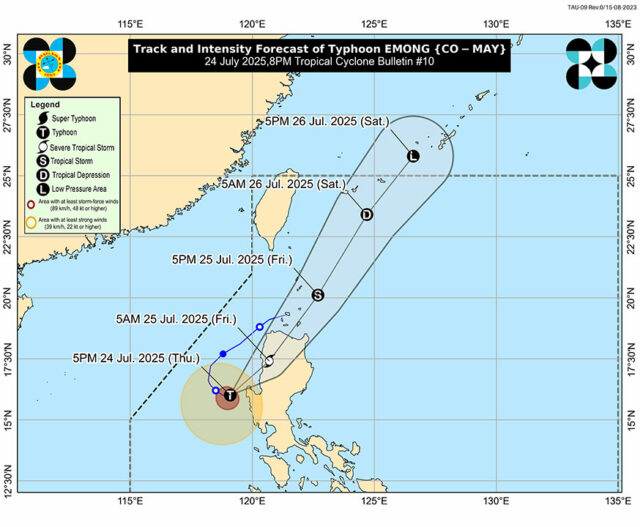
The Philippine Atmospheric, Geophysical and Astronomical Services Administration (PAGASA) said Emong might continue to intensify as it moves closer to northern Luzon. The typhoon was forecast to accelerate northeastward on Thursday night and make landfall in either La Union, Ilocos Sur or Ilocos Norte by Friday morning.

Emong was expected to directly affect parts of Northern and Central Luzon, while the enhanced southwest monsoon would bring significant rainfall to the rest of Luzon through midday Sunday, it said.

It said Tropical Storm Dante had exited the Philippine landmass. A new tropical storm outside the Philippine area of responsibility had developed with international name Krosa.

PAGASA warned that serious threats of flooding and landslides remained likely in many parts of Luzon. Local government units should remain on alert and activate emergency measures in response to severe weather conditions.

PAGASA raised storm surge warnings for northern Luzon as Typhoon Emong intensified from a severe tropical storm, bringing widespread rainfall and floods across the country.

STORM SURGES
In a 4 p.m. weather bulletin, it said Emong was spotted 145 kilometers west of Dagupan City and was slowly moving east-southeast. The weather bureau earlier reported that the typhoon’s maximum sustained winds had increased to 120 kilometers per hour (kph) as of 11 a.m. from 45 kph the day before.

PAGASA warned of a moderate to high risk of storm surges in the next 24 hours, possibly inundating low-lying coastal communities with rising seawater and large waves.

Residents in those areas were advised to stay away from coastal zones and suspend all marine activities.

Authorities also reported at least 12 deaths due to recent heavy rains and flooding triggered by the southwest monsoon and a series of cyclones.

The National Disaster Risk Reduction and Management Council (NDRRMC), in its morning report, said two of the deaths — recorded in Northern Mindanao and Caraga — have been validated.

Three deaths were reported in Calabarzon, two each in Northern Mindanao and Western Visayas, and one each in Metro Manila, Mimaropa, and the Davao region. The agency also recorded eight missing persons, with two in Western Visayas confirmed.

The remaining six — three in Metro Manila, two in Calabarzon, and one more in Western Visayas — were still being validated.

The NDRRMC said about 2.73 million people from 765,000 families have been affected by the recent weather disturbances.

Earlier in the week, intense monsoon rains enhanced by Severe Tropical Storm Crising caused the Marikina River to reach its third and highest alarm level, prompting the evacuation of more than 23,000 residents to temporary shelters in schools and village centers.

“One year after the devastating effects of Carina and the enhanced southwest monsoon, we are again forced to endure the same perennial problem of inadequate disaster response and management,” Cleng Julve, secretary general of the scientist group AGHAM, said in a statement.

“Despite P680.2 billion allocated for flood management from 2023 to 2025, including P249.8 billion this year alone, massive flooding continues to devastate communities,” the group said.

From July 19 to 22, the combined effects of Crising and the southwest monsoon dumped 573 millimeters of rain over Metro Manila — exceeding the monthly average rainfall for July based on PAGASA’s climatological norms, AGHAM said.

“More than a month’s worth of rain fell in four days’ time, but rainfall alone is not to blame,” it said. “Metro Manila’s infrastructure is not built for extreme weather events. The projects being done do not respond to our country’s reality as susceptible to typhoons, what more with the changes brought about by the climate crisis.”

The Department of Agriculture (DA) said farm damage from the rains and floods had reached P454 million, up from P323.15 million the day before. It said 20,413 hectares of farmland and 20,959 farmers and fisherfolk were affected.

The agency said it had begun distributing P596.5 million worth of assistance including rice, corn and vegetable seeds, seedlings, pesticides, forage seeds, free-range chickens and fingerlings. Additionally, 2,100 bags of rice from the National Food Authority were delivered to local governments in Palawan and Albay.

The Agricultural Credit Policy Council has allotted P400 million in interest-free loans, while the Philippine Crop Insurance Corp. has been ordered to expedite indemnity payments.

Hours after returning from the US, President Ferdinand R. Marcos, Jr. visited Maly Elementary School in San Mateo, Rizal province, where families displaced by recent flooding have taken temporary shelter.

The President was met by evacuees and residents upon his arrival at the school, which has been serving as an evacuation center.

Evacuees chanted “BBM” (Bongbong Marcos) as the President walked through the premises and interacted with families affected by the floods. He also led the distribution of government aid to displaced residents. — with Chloe Mari A. Hufana


Romualdez set to retain House speakership with supermajority backing

House Speaker Ferdinand Martin G. Romualdez — PHILIPPINE STAR/KRIZ JOHN ROSALES

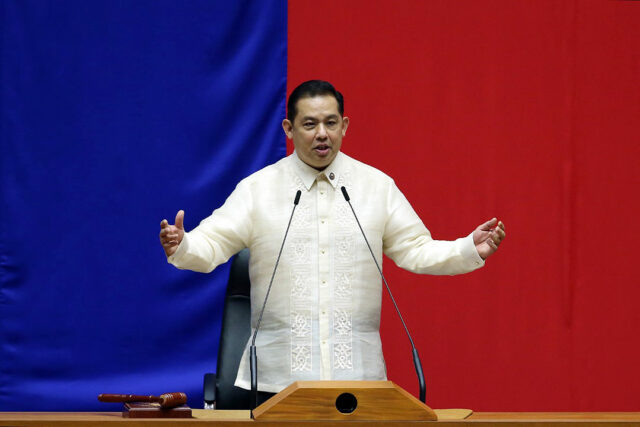
LEYTE REP. Ferdinand Martin G. Romualdez is expected to retain his position as Speaker after receiving near-unanimous support from fellow lawmakers ahead of the opening of the 20th Congress on July 28, a congresswoman said on Thursday.

A total of 291 lawmakers have signed a manifesto supporting his continued leadership at the House of Representatives, according to a list of signatories shared with reporters. With over 300 members in the House, the endorsement signals a supermajority backing for President Ferdinand R. Marcos Jr.’s cousin.

“Considering that there are just over 300 of us, the show of support is quite overwhelming,” Iloilo Rep. Janet L. Garin told an online news briefing in Filipino.

The Speaker post holds significant clout and is typically occupied by an ally of the sitting President. It wields political influence and sway on 316 lawmakers representing congressional districts and sectors in the legislative chamber, where tax measures and the yearly national budget emanate.

The 20th Congress will convene on July 28, with elections for key leadership posts scheduled earlier in the day ahead of the President’s annual State of the Nation Address (SONA).

“Of course, the election hasn’t happened yet,” Ms. Garin said. “But based on how things are going… it’s very evident that congressman Martin Romualdez will be the next speaker.”

She attributed this to his “inclusive” and “consultative” leadership style, which she said resonated with many legislators.

“Being able to respond to and hear the grievances of the people, those are among the key factors that led many congressmen to support his continued leadership in the House,” she added.

As he prepares for a new term, Mr. Romualdez has outlined his legislative priorities for the second half of the Marcos administration. He cited the need to pass measures aimed at curbing inflation and boosting economic growth.

“The 20th Congress should prioritize passing laws that will further lower prices and ensure the production of affordable and sufficient food for everyone,” he said in a statement.

He also vowed to support legislation that improves job quality and reduces underemployment. This includes expanding access to trade schools, investing in digital upskilling and giving businesses incentives to generate jobs outside Metro Manila.

Mr. Romualdez also expressed support for more public-private partnerships and measures that simplify business processes and improve access to financing for small and medium enterprises.

Meanwhile, he called for a toned-down SONA this year in light of the severe flooding caused by Tropical Storm Wipha (Crising), the enhanced southwest monsoon and Tropical Storms Francisco (Dante) and Co-may (Emong).

He has asked the Office of the House Secretary-General to keep the event modest by skipping the usual red-carpet arrivals and fashion coverage.

“It would be out of touch to maintain a show of pageantry while our people are still in recovery,” Mr. Romualdez said. “We will still observe decorum and tradition, but without the spectacle.” — Kenneth Christiane L. Basilio

PHL told to address political dynasties, election disinformation, transparency

PHILIPPINE STAR/ RUSSELL A. PALMA

THE ASIAN Network for Free Elections (ANFREL) on Thursday called on the Philippines to tackle gaps in the electoral process, including banning political dynasties, curbing disinformation in social media, and promoting transparency.

In its final report, the election watchdog called on Congress to enact laws that will respond to long-standing gaps in the Philippines’ electoral process.

“While the elections were marked by high voter turnout, improved transparency, and better engagement with stakeholders, serious challenges remain,” the watchdog group said in their report.

Among its key recommendations is for lawmakers to operationalize the ban on political dynasties.

“Enact enabling legislation to enforce a constitutional ban with clear definitions and enforcement mechanisms to curb dynasty control, and to reform the party-list to address the same problems,” ANFREL Executive Director Brizza Rosales said during the report’s launch event.

The May election was pivotal to two of the country’s most powerful political families, the Marcoses and the Dutertes, whose feud has worsened since the impeachment of the Vice-President Sara Duterte-Carpio in February and the arrest of her father upon order of the International Criminal Court in March.

The watchdog group also said that the government must reform the party-list system to protect it from “political capture of traditional political families,” which could ensure better sector-based representation.

The Philippine party-list system was introduced in the 1987 constitution to give marginalized groups representation at the House of Representatives.

It also called for the Commission on Elections (Comelec) to disclose the criteria for party-list accreditation and disqualify “co-opted or dynastic groups.”

The election watchdog also suggested an institutionalized social media monitoring mechanism within Comelec to track and address election-related disinformation.

“Hopefully they would institutionalize their own social media monitoring unit as amplified by civil society organizations, and to strengthen the engagement with platforms and civil society organization,” Ms. Rosales said, pushing for strengthened programs against vote buying and abuse of state resources for election use.

ANFREL called on the Philippine Congress to enact laws that would plug loopholes that enable premature campaigning and early vote buying, and overhaul of the Omnibus Election Code to update and eliminate outdated provisions.

Moreover, it recommends the promotion of better transparency and confidence in the election results through the timely publishing of precinct results and machine transmission logs, while also ensuring independent monitoring of the random manual audit

The Philippines should also improve polling place logistics and crowd management by enforcing a queue system of expanding the use of mall-based voting, ANFREL said.

The group further called for the institutionalization of vulnerable sector offices by dedicating proper funding, personnel, and mechanisms for marginalized sector participation in reform efforts.

Comelec should expand Local Absentee Voting, increase the number of automated counting machines, and additional electoral board personnel in high-turnout areas, it added. — Adrian H. Halili

ADVERTISEMENT
ADVERTISEMENT