Home Blog Page 1248

Filinvest Land bags global recognition as Employer of the Year at 2025 Stevie® Awards

Filinvest Land, Inc. (FLI), one of the country’s trusted real estate developers, proudly joins global giants like IBM and DHL Global Forwarding as a distinguished winner at the 2025 Stevie® Awards for Great Employers. Securing the Bronze Stevie® Award in the Employer of the Year category for Real Estate, FLI uniquely represents the Philippines among renowned global corporations. This global recognition complements Filinvest Land’s recent acknowledgment as one of the Philippines’ Best Employers for 2025 by the Philippine Daily Inquirer and Statista, solidifying its reputation as a company genuinely built by people, for people.

The Stevie Awards for Great Employers recognize the world’s best employers, human resources professionals, teams, and HR-related achievements and solutions that create exceptional workplaces. Filinvest Land stands out among nominees across 35 nations for its robust, data-driven, people-first HR strategy. FLI’s comprehensive approach significantly enhances every stage of the employee journey — from talent acquisition and professional development to employee engagement, recognition, and retention. These focused efforts have solidified FLI’s reputation as an outstanding employer where individuals not only advance professionally but also feel genuinely valued.

“We grow because our people grow,” emphasized Tristan Las Marias, President and CEO of Filinvest Land. “This recognition reaffirms that our greatest assets are our employees. Their passion drives our continued success in building lasting dreams for Filipinos.”

Where Talent Grows, Wellness Matters, and Loyalty is Celebrated

Filinvest Land’s exceptional recruitment approach resulted in outstanding hiring efficiency in 2024, achieving a remarkable 95% on-time hiring rate and an impressive 97% job offer acceptance rate, empowering its workforce to lead, innovate, and excel. Beyond recruitment, FLI invests significantly in employee development, providing more than 45 training hours annually per employee in partnership with esteemed institutions such as the Asian Institute of Management. Gender inclusivity is deeply embedded in its leadership succession planning, with women comprising over half of its future leadership pipeline.

Further distinguishing its employer brand, Filinvest Land prioritizes holistic employee wellness through comprehensive health initiatives, including free mental health counseling and full HMO coverage utilization. Programs such as Filinvest Listens, an employee feedback initiative with a remarkable 100% participation rate, underline the company’s commitment to transparency, responsiveness, and trust. Celebrating employee loyalty is also integral to FLI’s culture, demonstrated by honoring 56 long-standing employees last year, some marking over three decades of dedicated service. This focus on retention and career advancement transforms Filinvest Land into a nurturing community, deeply invested in each employee’s career journey and personal fulfillment, continually shaping a promising future for its people.

A Company Built by People, for People

Filinvest Land’s achievements stand out not only for their scale and impact but for their deep alignment with the company’s mission. Each initiative, from strategic hiring to wellness and recognition, reflects FLI’s belief that its people are the true drivers of its success.

“For us, this award isn’t just a win; it’s a resounding echo of our core belief,” states Bing Paraguas, Group Head of HR Strategy and COE and First Vice President. “It’s a powerful validation that our people-first strategy isn’t just a philosophy — it’s the very foundation of our ambition in building a world-class organization. This honor fuels our relentless dedication to ensuring every individual in our team discovers genuine growth, unlocks continuous development, and creates a lasting impact within an environment where inclusion isn’t just a word, but how we thrive.”

This win forms part of a larger milestone for the Filinvest Group with FLI’s parent company, Filinvest Development Corporation (FDC), also garnering multiple honors at the 2025 Stevie Awards for Great Employers. FDC was recognized with two Bronze Stevie® Awards for Achievement in Recruitment and Talent Acquisition and Achievement in Organizational Culture, as well as a Silver Stevie® Award for Achievement in Leadership Development. These accolades underscore the group’s collective commitment to building empowered teams and sustaining a strong, value-driven culture across all its companies.

As Filinvest Land continues to grow its nationwide footprint and pursue excellence, its commitment remains clear: to Build the Filipino Dream not only through homes and communities, but through every career it shapes and every life it helps uplift.


Spotlight is BusinessWorld’s sponsored section that allows advertisers to amplify their brand and connect with BusinessWorld’s audience by publishing their stories on the BusinessWorld Web site. For more information, send an email to online@bworldonline.com.

Join us on Viber at https://bit.ly/3hv6bLA to get more updates and subscribe to BusinessWorld’s titles and get exclusive content through www.bworld-x.com.

Hulk Hogan, who helped turn pro wrestling into billion-dollar spectacle, dies at 71

NOTE: This photo was enhanced using AI | Source of original photo: https://commons.m.wikimedia.org/wiki/File:Hulk_Hogan,_circa_1985.jpg

Hulk Hogan, the American sports and entertainment star who made professional wrestling a global phenomenon and loudly supported Donald Trump for president, has died at the age of 71, World Wrestling Entertainment said on Thursday.

“WWE is saddened to learn WWE Hall of Famer Hulk Hogan has passed away. One of pop culture’s most recognizable figures, Hogan helped WWE achieve global recognition in the 1980s,” WWE said in a statement.

Police in Clearwater, Florida, said authorities had responded to a medical call for a cardiac arrest at Hogan’s residence on Thursday morning. Hogan was taken to a hospital, where he was pronounced dead, they said.

The bleach-blond, mahogany-tanned behemoth became the face of professional wrestling in the 1980s, helping transform the mock combat from a seedy spectacle into family-friendly entertainment worth billions of dollars.

A key moment in that evolution came at the WrestleMania III extravaganza in 1987, when Mr. Hogan, billed at 6’8″, hoisted fellow wrestler André the Giant before a sold-out Pontiac Silverdome in Michigan for a thunderous body slam of the 7’4″ Frenchman.

Mr. Hogan parlayed his wrestling fame into a less successful career in Hollywood, starring in films like “Rocky III” and “Santa With Muscles,” but kept returning to the ring as long as his body would allow.

In 2024, he appeared at the Republican National Convention to endorse the presidential bid of Trump, who in the 1980s had played host to Hulk-headlined WrestleManias. Hogan said he made the decision to support the Republican candidate after seeing his combative, fist-pumping reaction to an attempted assassination on the campaign trail.

“Let Trumpamania run wild, brother!” Hogan bellowed to a cheering crowd, ripping off his shirt to reveal a Trump tank top. “Let Trumpamania rule again!”

BECOMING ‘HULK’
Born Terry Gene Bollea in Augusta, Georgia, on August 11, 1953, the future Hulk and his family soon moved to the Tampa, Florida area. After high school, he played bass guitar for area rock bands, but felt a pull to the red-hot wrestling scene in Florida in the 1970s.

Many of the details of his career were showbusiness exaggerations, representative of the blurred lines between fact and fiction in wrestling.

His first trainer reportedly broke Hogan’s leg to dissuade him from entering the business, but he kept at wrestling, weight training, and – he later admitted – anabolic steroids. He gained in notoriety as his biceps turned into what he dubbed the “24-inch pythons.”

The “Hulk” moniker came from comparisons to the comic-book hero portrayed on TV at the time. He would end up paying royalties to Marvel Comics for years. “Hogan” was the invention of promoter Vincent J. McMahon, the owner of the World Wrestling Federation (WWF), who wanted Irish representation among his stable of stars.

His appearance as wrestler Thunderlips in “Rocky III,” where he dwarfed leading man Sylvester Stallone, rocketed Hogan to the mainstream. Upon a return to the WWF, now controlled by Mr. McMahon’s son Vincent K., he defeated the Iron Sheik in 1984 to claim the world championship, a belt he would hold for four years.

Hogan became a household name, appearing on the cover of magazine Sports Illustrated and performing alongside pop culture stars like Mr. T. The WWF came to dominate wrestling, anchored by its annual WrestleMania pay-per-view events.

“He drew more people to professional wrestling over the course of a career than anyone,” said Dave Meltzer, a wrestling journalist and historian. “He paid the price in health for all of that stuff, being so big.”

FACING ‘THE ROCK’
Later, he joined competitor World Championship Wrestling, swapping his trademark yellow tights for black and taking on a persona as the villainous “Hollywood” Hogan, the head of a gang of rulebreakers known as the New World Order. The gimmick reinvigorated his career.

Mr. Hogan eventually returned to the WWF, now known as WWE, and faced Dwayne “The Rock” Johnson at WrestleMania in 2002.

“I’m in better shape than him,” Mr. Hogan told Reuters at the time, five months shy of his 50th birthday. “I’ll stand next to The Rock and pose down with him if he wants to.” The Rock ultimately won the match.

Mr. Hogan was inducted twice into the WWE Hall of Fame, and referred to himself as the “Babe Ruth” of wrestling – after the New York Yankees’ famed baseball player.

But Mr. Hogan’s support of Mr. Trump in 2024 did not go down well with all wrestling fans, and he also faced other controversies. Gossip website Gawker was shuttered after it posted parts of a sex tape between him and a friend’s wife and Mr. Hogan sued on privacy grounds, winning a $140 million judgment.

In 2015, he was suspended by the WWE after another surreptitious recording revealed that Hogan had used a racial slur. He was reinstated in 2018.

He was married three times and had two children, who starred alongside him and first wife Linda in a 2005-2007 reality TV show, “Hogan Knows Best.”

Condolences for the Hulkster poured in across social media, including from Vince K. McMahon, his partner in the 1980s wrestling boom and the former executive chairman of TKO Group that absorbed WWE in 2023.

“He was a trailblazer,” Mr. McMahon wrote in a post on X. “He leaves us with one of his favorite expressions, ‘Train, take your vitamins and say your prayers.'”

“Today, we pray for him.” — Reuters

Trump signs order aimed at curbing big-money college sports payouts

STOCK PHOTO | Image by Vlad Vasnetsov from Pixabay

WASHINGTON – President Donald Trump waded into a debate over the influence of big-money payouts in college sports on Thursday, signing an executive order adding federal government scrutiny to the practice.

The order, which is expected to face legal challenges, seeks to block some recruiting payments by third parties like donors to college athletes in big-dollar sports like football and men’s basketball in order to preserve funds available for women’s and non-revenue sports.

Though the practice is already forbidden by the National Collegiate Athletic Association, some donors have found ways to bypass the rules to recruit top talent with lucrative offers.

The policy is not aimed at fair-market compensation to athletes for brand endorsements, the White House said.

The order also pushes colleges to raise scholarship payments for non-revenue sports and directs U.S. officials to start “clarifying” the legal status of student-athletes.

Mr. Trump’s directive could lead to changes in school budgets as well as the multimillion-dollar market for U.S. college athletes, and it could lead to limitations on payouts or employment rights for those athletes.

Yet how exactly the policy will be enforced is still to be determined.

Under the order, federal officials will develop a plan to deliver on Mr. Trump’s order using “all available and appropriate regulatory, enforcement, and litigation mechanisms,” including their funding power over states, colleges and universities.

Since taking office in January, Mr. Trump has repeatedly tried to intervene in actions by sports leagues, colleges and universities.

A February executive order aimed to bar transgender women from competing in women’s sports. The United States Olympic & Paralympic Committee implemented such a ban this week, citing the order.

Mr. Trump has also targeted elite universities’ federal funding over topics including pro-Palestinian student protests. Columbia University on Wednesday said it would pay over $200 million in a settlement to resolve federal probes and have most of its suspended federal funding restored.

PAY FOR PLAY
The NCAA, which governs U.S. sports in higher education, had long prohibited student-athletes from receiving compensation for athletics outside of scholarships in a bid to preserve the amateurism of college sports and keep the playing field fair for recruiting.

But in June 2021, the organization approved an interim policy allowing college athletes to make money by selling their name, image and likeness (NIL) rights.

The policy allowed student athletes to make money through activities such as signing autographs, endorsing products or businesses, and making personal appearances so long as the activities were legal in the state where the school was located.

In March 2025, the NCAA agreed to permanently eliminate its rule that prohibited student athletes from negotiating NIL deals before enrolling in a school.

The change came a day after a legal settlement between the NCAA and a group of state attorneys general who had sued the organization, arguing that the restriction violated federal antitrust law.

The changes in recent years on NIL payments, the White House said, “has created a chaotic environment that threatens the financial and structural viability of college athletics.”

Michael LeRoy, a University of Illinois labor and employment relations professor, said the order would likely be challenged as unconstitutional.

“The fact that players want to have the same rights under antitrust law that everybody else has is not a problem,” he said.

The problem, he said, is that the NCAA and athletic conferences that govern top sports “have stubbornly refused to grant employment status and collective bargaining to athletes.”

In a statement, NCAA President Charlie Baker said it was grateful for the administration’s focus on the issue and said that new legislation may be necessary to address problems facing college sports.

“There are some threats to college sports that federal legislation can effectively address and the Association is advocating with student-athletes and their schools for a bipartisan solution with Congress and the Administration,” he said. — Reuters

IMF reaches staff-level agreement for $2 billion disbursement to Argentina

A participant stands near a logo of the International Monetary Fund at the annual meeting in Nusa Dua, Bali, Indonesia, Oct. 12, 2018. — REUTERS/JOHANNES P. CHRISTO/FILE PHOTO

The International Monetary Fund said on Thursday it has reached a staff-level agreement on the first review of its extended fund facility with Argentina, potentially unlocking about $2 billion for the economically embattled Latin American nation.

The executive board meeting for the review, part of Argentina’s $20 billion loan program with the lender, is expected to take place later this month, the IMF said in a statement.

The IMF said the program had started off strongly “despite a more challenging external backdrop,” with Argentina’s inflation and poverty coming down while growth has ticked up.

“Notably, Argentina has re-accessed international capital markets earlier than anticipated,” the IMF added.

The lender said agreements had been reached with Argentina on safeguarding its fiscal anchor, building up reserves and making the drop in inflation last.

In the wake of the $20 billion, 48-month deal Argentina reached with the IMF in April, the country has loosened years-long controls that restricted access to foreign currency and has let the peso fluctuate within a moving band.

Analysts say the country’s economic growth is expected to moderate in the coming months due to the uncertainty around Argentina’s upcoming midterm elections.

The agreement with the IMF came with metrics to unlock funds, including on inflation and building up depleted central bank foreign currency reserves, something Argentina has struggled with.

“With the fund we have no problem,” said Economy Minister Luis Caputo in remarks to the press earlier on Thursday. “Of course, we’re working to reconstruct the level of reserves.” — Reuters

Elon Musk’s Starlink network suffers rare global outage

STARLINK.COM

SpaceX’s Starlink suffered one of its biggest international outages on Thursday when an internal software failure knocked tens of thousands of users offline, a rare disruption for Elon Musk’s powerful satellite internet system.

Users in the U.S. and Europe began experiencing the outage at around 3 p.m. EDT (1900 GMT), according to Downdetector, a crowdsourced outage tracker that said as many as 61,000 user reports to the site were made.

Starlink, which has more than 6 million users across roughly 140 countries and territories, later acknowledged the outage on its X account and said “we are actively implementing a solution.”

Starlink service mostly resumed after 2.5 hours, Michael Nicolls, Starlink vice president of Starlink Engineering, wrote on X.

“The outage was due to failure of key internal software services that operate the core network,” Mr. Nicolls said, apologizing for the disruption and vowing to find its root cause.

Mr. Musk had also apologized: “Sorry for the outage. SpaceX will remedy root cause to ensure it doesn’t happen again,” the SpaceX CEO wrote on X.

The outage was a rare hiccup for SpaceX’s most commercially sensitive business that had experts speculating whether the service, known for its resilience and rapid growth, was beset by a glitch, a botched software update or even a cyberattack.

Doug Madory, an expert at the internet analysis firm Kentik, said the outage was global and that such a sweeping interruption was unusual.

“This is likely the longest outage ever for Starlink, at least while it became a major service provider,” Mr. Madory said.

As Starlink gained more users, SpaceX has focused heavily in recent months on updating its network to accommodate demands for higher speed and bandwidth.

The company in a partnership with T-Mobile is also expanding the constellation with larger, more powerful satellites to offer direct-to-cell text messaging services, a line of business in which mobile phone users can send emergency text messages through the network in rural areas.

SpaceX has launched more than 8,000 Starlink satellites since 2020, building a uniquely distributed network in low-Earth orbit that has attracted intense demand from militaries, transportation industries and consumers in rural areas with poor access to traditional, fiber-based internet.

“I’d speculate this is a bad software update, not entirely dissimilar to the CrowdStrike mess with Windows last year, or a cyberattack,” said Gregory Falco, director of a space and cybersecurity laboratory at Cornell University.

An update to CrowdStrike’s widely used cybersecurity software led to worldwide flight cancellations and impacted industries around the globe in July last year. The outage disrupted internet services, affecting 8.5 million Microsoft Windows devices.

It was unclear whether Thursday’s outage affected SpaceX’s other satellite-based services that rely on the Starlink network. Starshield, the company’s military satellite business unit, has billions of dollars’ worth of contracts with the Pentagon and U.S. intelligence agencies. — Reuters

NG budget deficit balloons in June

EMPLOYEES of the Department of Public Works and Highways are seen working on a road in Manila, Feb. 8. — PHILIPPINE STAR/NOEL B. PABALATE

THE NATIONAL Government’s (NG) budget deficit ballooned to P241.6 billion in June as state spending outpaced revenue collections, the Bureau of the Treasury (BTr) said on Thursday.

Data from the Treasury showed the Philippines’ budget deficit widened by 15.56% to P241.6 billion in June from P209.1 billion in the same month a year ago.

Month on month, the budget deficit widened by 66.46% from P145.2 billion in May.

National Government fiscal performanceIn June, state spending jumped by 8.49% to P548.5 billion from P505.6 billion in June 2024.

The BTr attributed the faster spending to higher National Tax Allotment shares of local government units, the annual block grant to the Bangsamoro Autonomous Region in Muslim Mindanao, personnel services, and interest payments.

Primary spending — which refers to total expenditures minus interest payments — grew by 9.14% to P491.1 billion in June from P450 billion a year earlier. This accounted for 89.53% of the total June disbursements.

Interest payments increased by 3.19% to P57.4 billion in June this year from P55.6 billion in the same month in 2024.

NG’s primary deficit stood at P184.2 billion in June, up by 20.04% from P153.4 billion in the same month last year.

Meanwhile, revenue collections went up by 3.5% to P306.9 billion in June from P296.5 billion in the same month last year.

“The sustained double-digit growth in tax collections offset the high base effect of the one-off remittances under nontax revenues last year,” the BTr said.

Tax revenues increased by 12.35% to P280.1 billion in June from P249.3 billion in the same month in 2024.

The bulk came from the Bureau of Internal Revenue (BIR), which collected P200.5 billion in June, up by 16.24% from P172.5 billion a year ago.

Collections by the Bureau of Customs (BoC) rose by 3.23% to P77 billion, while other offices’ revenues rose by 16.71% to P2.6 billion.

On the other hand, nontax revenue slumped by 43.25% year on year to P26.8 billion in June “due to the high base effect of one-off remittances in 2024.”

The BTr’s revenues surged by 116.49% to P16.1 billion in June from P7.4 billion a year ago, thanks to the NG’s bigger share in profits of the Philippine Amusement and Gaming Corp. as well as dividend remittance from the Power Sector Assets and Liabilities Management Corp.

Income from other offices also dropped by 73.04% to P10.7 billion in June.

Rizal Commercial Banking Corp. Chief Economist Michael L. Ricafort said the budget deficit in June was the widest in three months since March.

“Budget deficits could increase the need for additional borrowings from a cash flow perspective,” he said.

FIRST-HALF GAP
In the first six months of the year, the NG budget deficit widened by 24.69% to P765.5 billion from the P613.9-billion gap last year.

The BTr said the budget deficit remained relatively within target as it was 0.63% above the programmed P760.7 billion for the first half.

Revenue collection in the first half increased by 5.15% to P2.26 trillion from P2.15 trillion in the same period in 2024. This was 0.89% lower than the programmed P2.28 trillion for the six-month period.

Tax revenues rose by 10.74% to P2.03 trillion as of end-June, 1.3% below the P2.06 trillion program.

BIR collections increased by 14.11% to P1.55 trillion as of end-June, driven mainly by increases in corporate income tax, value-added tax, and personal income tax. However, this was 1.52% below the P1.58-trillion program.

“Additional sources of higher revenue came from increased excise tax collections on tobacco, including electronic cigarettes, through the Bureau’s continued efforts to intensify the crackdown on the illicit tobacco trade and the strict implementation of the mandatory excise tax stamps on vapor products,” it said.

Higher percentage tax collections from banks and financial institutions also helped boost BIR revenues.

The BoC collection inched up by 0.71% to P458.8 billion as of end-June, but 0.58% below the P461.4-billion program.

Nontax revenues slumped by 27.53% to P227.7 billion in the January-to-June period. It exceeded the P221.4 billion program by 2.87% amid better-than-expected income of the BTr.

Treasury income slipped by 11.37% to P145.3 billion in the first half, while other offices’ income fell by 45.14% to P82.5 billion.

Meanwhile, state spending rose by 9.49% to P3.03 trillion as of end-June, from P2.76 trillion a year ago. It was just 0.51% below the P3.04-trillion disbursement program for the period.

Primary expenditures rose by 9.41% to P2.61 trillion as of end-June, while interest payments increased by 9.97% to P414.8 billion.

In the first half, the NG’s primary deficit widened by 48.16% to P350.7 billion. It exceeded the first-half program of P343.7 billion by 2.04%.

“Although interest payments grew, the bulk of the deficit growth can be attributed to higher expenses due to government projects and disbursement to local government units,” Reinielle Matt M. Erece, an economist at Oikonomia Advisory and Research, Inc., said.

“The budget deficit can still be managed as revenue collection is still strong and debt obligations are growing at a modest pace. As long as each expenditure results in better productivity then the deficit may still be manageable,” he said.

For this year, the NG’s deficit ceiling is capped at P1.56 trillion or 5.5% of gross domestic product. — Aubrey Rose A. Inosante

Marcos secures $21B in investment pledges

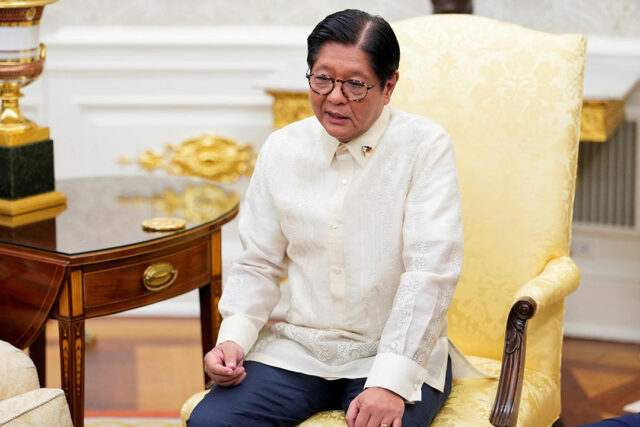
Philippine President Ferdinand Marcos Jr. meets with US President Donald Trump (not pictured), in the Oval Office at the White House in Washington, DC, July 22, 2025. — REUTERS/KENT NISHIMURA

PRESIDENT Ferdinand R. Marcos, Jr. secured over $21 billion in investment pledges from US companies during his official visit to Washington.

“We return to the Philippines with over $21 billion in investment pledges that have the potential to create thousands of direct and indirect jobs for Filipinos within our country,” Mr. Marcos said in his arrival statement on Wednesday evening.

During his US trip, Mr. Marcos said he met with business leaders and top executives of top companies involved in healthcare, infrastructure, semiconductor, renewable energy and digital technology sectors.

The President said US companies expressed strong interest in expanding operations in the Philippines, particularly in infrastructure, logistics, clean energy, and advanced manufacturing. US firms are also exploring partnerships in healthcare, digital transformation, and workforce development.

Mr. Marcos also said new investments in semiconductor and electronics manufacturing would strengthen the Philippines’ position in global value chains.

In addition to private sector pledges, the US government committed additional funding for the Luzon Economic Corridor and other projects.

“We welcome the US government’s pledge of an additional $15 million for private sector development under the Luzon Economic Corridor initiative and an additional $48 million in foreign assisted projects. We will continue to work with the State department as well as with the US Congress for the implementation of these programs,” Mr. Marcos said.

The Luzon Economic Corridor is being undertaken via a trilateral commitment among the Philippines, US and Japan. The initiative aims to enhance the connectivity of Luzon’s key economic areas — Subic Bay, Clark, Metro Manila and Batangas.

In a separate virtual briefing on Thursday, Special Assistant to the President for Investment and Economic Affairs Frederick D. Go said the Philippines is poised to receive a $500-million investment from a major hospital group to build a world-class medical facility in the country.

Mr. Go, who was part of the Philippine delegation to Washington, told reporters that the hospital project is among several investment pledges secured during Mr. Marcos’ recent trip.

He said US private equity firm Cerberus Capital, which owns the Subic shipyard where Hyundai is building a shipbuilding facility, is also planning to invest between P10 billion and P15 billion ($172 and $258 million) in the Philippines.

Originally set to open in 2026, Hyundai’s facility could begin operations as early as the fourth quarter of this year, Mr. Go added.

Meanwhile, infrastructure investor I Squared Capital, which already has significant operations in the country, plans to expand into liquefied natural gas and cold storage.

Mr. Go and Trade Secretary Ma. Cristina A. Roque also met with top global investment firms Cerberus Capital, I Squared Capital, and KKR & Co., Inc. that are looking at pursuing expansion opportunities in the Philippines.

Another firm, Global Infrastructure Partners (GIP), is also looking at a “very large” investment in Philippine infrastructure, Mr. Go said.

In a disclosure to the stock exchange, Aboitiz Equity Ventures, Inc. said it is now finalizing a strategic partnership with GIP that involves the acquisition of a 40% stake in its infrastructure arm Aboitiz InfraCapital, Inc.

Mr. Marcos reaffirmed his administration’s commitment to a stable, transparent, and rules-based business environment, assuring investors of continued reforms to streamline processes and improve ease of doing business.

Oikonomia Advisory and Research, Inc. economist Reinielle Matt M. Erece said the investments, if realized, are expected to boost economic growth by creating more jobs, raising incomes, and increasing productivity.

“If they do (materialize), they will greatly help in providing more job opportunities for Filipinos, increase income growth, and overall be good for economic growth,” he said via Viber.

Mr. Erece said that to maximize these pledges, the government must improve the efficiency of government processes, including the reduction of red tape and provide reliable government platforms and offices.

“If investors see that the country has a good business environment and they feel welcome, they are more likely to set up shop within the Philippines.”

Meanwhile, Mr. Marcos invited Mr. Trump to visit Manila in 2026 when the country hosts the Association of Southeast Asian Nations (ASEAN) Summit as its chairman.

“I look forward to hosting President Trump next year to attend the ASEAN meetings under the Philippines’ chair, which also coincides with the commemoration of our 80th year of diplomatic ties and 75 years of the Mutual Defense Treaty,” Mr. Marcos said in his arrival statement after a three-day official visit to the US.

Mr. Marcos underscored the significance of his meeting with Mr. Trump to the US, saying Washington remains Manila’s “oldest and only treaty ally.” He described their alliance as crucial to regional stability and said his trip reaffirmed both nations’ “ironclad commitment” to their security pact. — C.M.A. Hufana

Gov’t vows to protect local industries as it finalizes US trade deal

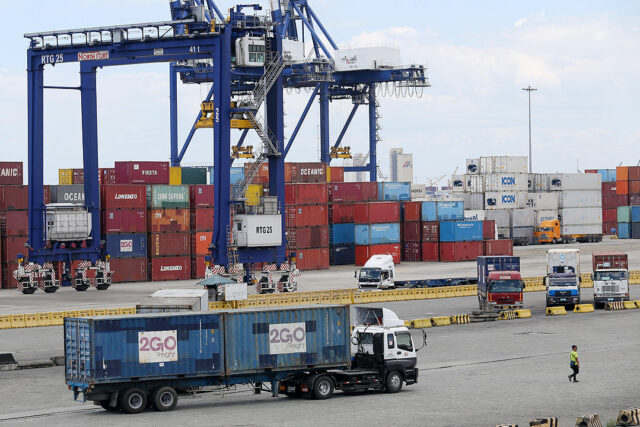
Trucks enter the port area in Manila. — PHILIPPINE STAR/EDD GUMBAN

THE GOVERNMENT on Thursday said that the details of the US-Philippines deal concerning the US reciprocal tariff are still being finalized but noted that the government will protect the interest of Philippine domestic industries.

“The details are not yet final. The Philippines and the US will still have to negotiate the details of the agreement, including products that are covered by market access commitments on both sides,” Trade Secretary Ma. Cristina A. Roque said in a statement.

The statement was jointly issued by the Department of Trade and Industry (DTI) and the Office of the Special Assistant to the President for Investment and Economic Affairs (OSAPIEA).

The government will be working closely with stakeholders in finalizing the trade deal with the US.

“We are mindful of the sensitivities of our domestic stakeholders, and the same will be duly considered in the negotiations,” Ms. Roque said.

Special Assistant to the President for Investment and Economic Affairs Frederick D. Go said that the “concessions we will extend are strategic to the Philippines.”

“These are products that we do not locally produce and are critical inputs to reducing the cost of healthcare, for example,” he said.

The two officials had accompanied Philippine President Ferdinand R. Marcos, Jr. during his meeting with US President Donald J. Trump at the White House.

After the meeting, Mr. Trump announced a 19% tariff would be imposed on Philippine goods, while the Philippines will open its markets to US goods.

The 19% tariff rate is slightly lower than the threatened 20% but is higher than the 17% “reciprocal tariff” announced by Mr. Trump in April. The new tariff will be implemented starting Aug. 1.

“This revised tariff rate places the Philippines among the most competitive Southeast Asian economies trading with the US,” the DTI and OSAPIEA said.

The Philippines’ new US tariff rate is now the same as Indonesia, and slightly lower than Vietnam’s 20%. Singapore faces the lowest US tariff rate of 10%.

“Enhanced market access will enable the Philippines to become a more attractive destination for export-oriented investments — opportunities that might have otherwise gone to our neighbors,” Mr. Go said.

Since the US imposed a “relatively mild” tariff on Philippine goods, the Philippines could attract more foreign investments while its exports gain a “competitive edge” as a manufacturing hub focused on the US market.

“This encourages foreign companies targeting the US to consider relocating their operations here, creating more investment and job opportunities for Filipinos,” the DTI and OSAPIEA said.

The trade deal with the US is not just limited to tariffs but also includes other trade-related matters which will be finalized by negotiators.

“Our objective is to ensure that this bilateral deal will complement our existing international trade commitments as well as the capabilities and needs of our domestic industries,” the DTI and OSAPIEA said.

AGRI SECTOR
At a briefing in Malacañang, Mr. Go said the negotiating team sought to protect the agricultural sector during tariff negotiations with the US.

Mr. Go dismissed criticisms that the Philippines gave up too much in the deal, emphasizing that the government focused on protecting sectors where local production is strong.

While the Philippines is opening its market for US automobiles, wheat, soy and pharmaceuticals, Mr. Go said they preserved tariff protections on key sectors such as rice, corn, sugar, pork, chicken, and fisheries.

“I can guarantee you that we thoroughly studied all of our major industries in the Philippines, where we are a significant producer, and we did not include them in what we gave to America,” he said in Filipino. “The DTI carefully reviewed which products we need to protect and which of our farmers we need to protect, and we protected all of them.”

Mr. Go said that zero tariffs on US pharmaceuticals would lower the cost of medicines in the country.

He said zero tariffs on US-made vehicles would not hurt the domestic industry since there is minimal vehicle manufacturing in the country.

“By opening the automotive sector, we are not hurting any local producers,” he said.

He noted lifting tariffs on imports of US wheat and soy would help reduce overall food prices.

In a separate statement, the Federation of Philippine Industries expressed its readiness to collaborate with the government in making sure that the deal will not “compromise national industrial resilience.”

However, the group stressed the need for structured consultations with industry stakeholders and transparency in the disclosure of products covered by the agreement in mitigating the potential adverse impact.

“These measures may also support the timely activation of appropriate safeguard mechanisms for sectors at risk,” it said.

‘TREATED SHABBILY’
With the Philippines losing its advantage of a lower tariff rate compared to its neighbors, the economy could face headwinds and struggle to attract foreign direct investments, HSBC Global Research economist for ASEAN Aris D. Dacanay said.

Mr. Dacanay said the reciprocal tariff of 19% would erase the Philippines’ competitive advantage, and “risks putting Philippine exports at a disadvantage in the US market.”

“In contrast to Indonesia and Vietnam, which succeeded in lowering their respective tariff impositions without their heads of state physically making a state or official visit to the US capital, the initial diplomatic efforts of the Philippines yielded disappointing results,” GlobalSource Partners Country Analyst Diwa C. Guinigundo said in a report.

“So, the Philippines thought that at the initial round of tariff imposition, it was a winner. It was not. It was instead treated shabbily by the US government.”

Mr. Guinigundo said it is now “imperative for the Philippines to capture relocation and supply-chain shifts as the US and China trade war intensifies.”

“Manila should prepare, and prepare seriously, to host all the companies fleeing from China and other high-tariff countries in electronics, semiconductor packaging, production of converters, power supplies and telecom devices.”

Mr. Dacanay said the Philippines will likely continue negotiating with the US to secure a lower tariff rate.

“Based on the trade deals Vietnam and Indonesia have had with Washington, finding ways to open domestic markets to the US seems to be a useful bargaining chip,” he said.

“In the meantime, without the relative advantage of a lower tariff rate, the Philippines will likely rely on its old (but effective) playbook of maintaining a robust reform narrative to attract investments and technologies from abroad.”

On the other hand, University of Asia and the Pacific professor emeritus Bernardo M. Villegas said there is no need to pursue a lower tariff rate.

“It’s not worth the effort. Because we are not really oriented towards exports. If it just prolongs and prolongs the discussion, it’s not worth it,” he told BusinessWorld on the sidelines of a forum. “Trade is not a very important part of GDP. So, I wouldn’t worry about the differences,” he added.

Fitch Solutions’ CreditSights in a separate report likewise said the tariff will not significantly impact Philippine economic growth.

“We anticipate the US tariffs to have a limited impact on the Philippines’ economy, given the Philippines’ low export exposure to the US, and relatively low export contribution to its total GDP,” it said.

The US goods trade deficit with the Philippines reached nearly $5 billion in 2024, up by 21.8% from 2023. This as US goods trade with the Philippines amounted to around $23.5 billion while US goods exports stood at $9.3 billion.

The US is the top export destination for Philippine goods, accounting for about 16% of total exports in the first five months of the year. — Justine Irish D. Tabile, Luisa Maria Jacinta C. Jocson and Chloe Mari A. Hufana

Philippines to tap GCash to sell bite-sized bonds to attract more investors

Commercial and residential buildings in Manila, Philippines, Dec. 16, 2022. — SEONGJOON CHO/BLOOMBERG

THE PHILIPPINES is tapping mobile wallet GCash to sell small-denominated government securities, according to the Bureau of the Treasury (BTr), seeking to broaden the investor base as it raises more money to refinance debt and fund the growing economy.

The government will sell Treasury bills for a minimum P500 ($8.80) net of fees, and retail Treasury bonds for a minimum P5,000, National Treasurer Sharon P. Almanza said on Thursday.

“Investing in government bonds is about to get easier,” the BTr said in a post on its Facebook account, highlighting that the offering of what it calls GBonds is “coming soon.”

The Philippine central bank is working with the Treasury bureau on widening the nation’s capital markets, Bangko Sentral ng Pilipinas (BSP) Governor Eli M. Remolona, Jr. said on Thursday. “This initiative of GBonds is part of that, extending the deepening of capital markets to the retail level,” he said.

Virtual asset company Philippine Digital Asset Exchange, or PDAX, is providing the technology for the bond registry while its wholly owned unit Bond.PH will act as the licensed broker-dealer, according to PDAX founder and Chief Executive Officer Nichel Gaba. The bite-sized bonds will be available to users of GCash, he said.

“T-bills are already accessible to some GCash users,” Mr. Gaba said by phone. “It’s a small set of users meant mainly for testing,” he said, adding that GBonds this time around will be marketed broadly.

A unit of Globe Telecom, Inc., GCash has around 94 million users.

Bond sales to retail investors are a big source of financing for the Philippine government, which faces an estimated budget deficit equivalent to 5.5% of gross domestic product for this year. The government’s reliance on the funding source has seen robust demand in the past. — Bloomberg

Aboitiz finalizing 40% infra arm stake sale to BlackRock’s GIP

ABOITIZ INFRACAPITAL operates the Mactan-Cebu International Airport (MCIA), the largest international aviation hub outside of Metro Manila. — ABOITIZINFRACAPITAL.COM

LISTED conglomerate Aboitiz Equity Ventures, Inc. (AEV) said it is finalizing a strategic partnership with Global Infrastructure Partners (GIP), a US-based infrastructure fund manager owned by global asset management giant BlackRock, Inc., for the acquisition of a 40% stake in its infrastructure arm, Aboitiz InfraCapital, Inc.

“We are honored to explore this opportunity with Global Infrastructure Partners,” AEV President and Chief Executive Officer (CEO) Sabin M. Aboitiz said in a statement to the stock exchange on Thursday. “Our shared vision of modern, world-class infrastructure aligns with the country’s ambitions for progress,” he added.

GIP, which manages over $183 billion in infrastructure assets across sectors such as energy, transport, digital infrastructure, and water, has stakes in major assets including London’s Gatwick Airport and Australia’s Port of Melbourne. Its parent firm, BlackRock, is the world’s largest asset manager and is listed on the New York Stock Exchange under the ticker symbol BLK.

AEV said its executives, along with President Ferdinand R. Marcos, Jr., met with GIP Chairman and CEO Bayo Ogunlesi during a recent high-level meeting in the United States.

“This collaboration marks a strong vote of confidence in the Philippines’ future. With global partners like GIP working alongside respected Filipino firms such as Aboitiz, we can build infrastructure that is more resilient, inclusive, and forward-looking,” Mr. Marcos said.

“GIP’s entry signifies the remarkable potential for infrastructure investments in the Philippines. The choice of Aboitiz is very strategic,” China Bank Capital Corp. Managing Director Juan Paolo E. Colet said in a Viber message to BusinessWorld.

AEV said the parties are “in the process of finalizing” the transaction, which it described as potentially one of the most significant foreign equity investments in Philippine infrastructure in recent years.

“This collaboration underscores growing global investor confidence in the Philippine market and reinforces the country’s standing as a prime investment destination in Asia,” the company added.

Aboitiz InfraCapital is the Aboitiz group’s infrastructure arm and the private operator of several airport assets in the Philippines, including the Mactan-Cebu International Airport (through Aboitiz InfraCapital Cebu Airport Corp.), the Laguindingan International Airport, and the New Bohol-Panglao International Airport.

The company also has interests in water infrastructure, data centers, and telecommunications.

According to Mr. Colet, GIP is not only acquiring a stake in a strong infrastructure portfolio but is also forming a flexible partnership platform for future expansion.

“It is also creating a formidable partnership that can expand aggressively in the local infrastructure space. There is ample liquidity and appetite among the leading domestic banks to back the investment plans of the Aboitiz-GIP tandem,” he said.

He added that infrastructure investment has significant multiplier effects on the broader economy, making the deal strategically important.

“We are pleased to have the opportunity to become a strategic partner of the Aboitiz group… The Philippines has compelling growth prospects, which can be further enhanced by developing world-class infrastructure,” GIP’s Mr. Ogunlesi said.

BDO Capital President Eduardo V. Francisco said the partnership would boost AEV’s capital and expand its pipeline of infrastructure projects.

“This would provide positive signals on the Philippine economy and financial markets with the possible investment by one of the biggest global investors,” Rizal Commercial Banking Corp. Chief Economist Michael L. Ricafort said, describing the deal as a vote of confidence in the country and a potential catalyst for attracting other global fund managers to Philippine infrastructure.

Shares in AEV rose by 75 centavos or 2.29% to close at P33.50 each on Thursday. — Ashley Erika O. Jose

SEC offers 30% discount on public offering fees until yearend

BW FILE PHOTO

THE Securities and Exchange Commission (SEC) said it is offering discounted registration fees to companies conducting public offerings until the end of the year to encourage greater participation in the capital market.

The corporate regulator said in Memorandum Circular (MC) No. 9 issued Thursday that all registration statement applications submitted until Dec. 31 will be entitled to a 30% discount on assessed registration fees.

MC No. 9 also streamlines the evaluation and approval process for registration statements by integrating the clearance processes across the SEC’s departments within the 45-day processing timeline under the Securities Regulation Code.

The 45-day calendar period will begin from the date the Markets and Securities Regulation Department receives proof of payment for the first tranche of the registration fee and full payment of clearance-related fees.

The guidelines cover all registration statement applications of firms looking to do initial public offerings or follow-on offerings, as well as those issuing investment contracts, certificates of participation, profit-sharing agreements, bonds, and debt securities.

Also covered are other forms of securities being registered by power generation companies, distribution utility companies, real estate developers, and managers in relation to rental pool arrangements.

Agri-business corporations and hospitals, which are subject to a 28-day processing period, are excluded from the 45-day review timeline.

“Our goal for the Philippine capital market is clear — increase market participation to bring it up to par with our peers in the Southeast Asian region,” SEC Chairperson Francisco Ed. Lim said in a statement.

“The SEC will streamline processes and provide discounts or incentives where possible, in order to encourage more businesses to tap into the capital market, enabling them to unlock their full growth potential through diverse financing options,” he added. — Revin Mikhael D. Ochave

Top stars and directors head to Venice for high-powered 2025 festival

LABIENNALE.ORG

HOLLYWOOD STARS, Oscar-winning directors, Asian heavyweights and European auteurs will vie for top honors at this year’s stellar Venice Film Festival, all looking to make a splash at the start of the awards season.

Running from Aug. 27 to Sept. 6, the 82nd edition of the world’s oldest film festival will showcase a rich array of movies that span psychological thrillers, art-house dramas, genre-bending experiments, documentaries, and buzzy studio-backed productions.

Among the leading A-listers expected to walk the Venice Lido’s red carpet are Julia Roberts, Emma Stone, George Clooney, Dwayne Johnson, Emily Blunt, Andrew Garfield, Oscar Isaac, Cate Blanchett, and Amanda Seyfried.

NETFLIX RETURNS
A who’s-who of global directors will also be premiering their latest pictures at the 11-day event, including US filmmakers Kathryn Bigelow, Jim Jarmusch, Noah Baumbach, and Benny Safdie, alongside top Europeans Yorgos Lanthimos, Paolo Sorrentino, and Laszlo Nemes, and Asia’s Park Chan-wook and Shu Qi.

Netflix, which skipped Venice last year, returns in full force in 2025 with a trio of headline-grabbing titles, including Guillermo del Toro’s Frankenstein, a new take on the classic horror tale starring Mr. Isaac, Jacob Elordi, and Mia Goth.

Mr. Baumbach’s comedy-drama Jay Kelly, starring Mr. Clooney, Adam Sandler, and Laura Dern, is also in the main competition and on the Netflix slate, alongside the geopolitical thriller A House of Dynamite, with Idris Elba and Rebecca Ferguson, and directed by Ms. Bigelow, who won an Oscar in 2010 for The Hurt Locker.

Venice fires the starting gun for the awards season, with films premiering on the Lido in the last four years collecting more than 90 Oscar nominations and winning almost 20, making it the place to be seen for actors, producers, and directors alike.

In the past nine editions of the Oscars, the award for Best Actress or Best Actor has gone eight times to the protagonists of films first seen in Venice, including Ms. Stone for her role in Poor Things in 2024.

FIGHTERS AND FAMILIES
Ms. Stone returns to Venice this year, teaming up again with Poor Things director Mr. Lanthimos in an offbeat satire, Bugonia.

The indie icon of US cinema, Jim Jarmusch, will be showing his Father Mother Sister Brother, a three-part tale exploring fractured families with a cast that includes Ms. Blanchett, Vicky Krieps, Adam Driver, and Tom Waits.

Another US film getting its first outing at Venice is the MMA fighter biopic The Smashing Machine, starring Mr. Johnson and Ms. Blunt, and directed by Benny Safdie.

A very different biopic is The Testament of Ann Lee — a musical take on the life of the radical 18th century Shaker leader, which stars Ms. Seyfried and is directed by Norway’s Mona Fastvold.

European auteurs are well-represented, with Paolo Sorrentino’s La Grazia, starring Toni Servillo, selected as the festival’s opening film, while Hungary’s Nemes presents the family drama Orphan and France’s Francois Ozon showcases his retelling of Albert Camus’ celebrated novel The Stranger.

Another French director, Olivier Assayas, will premiere The Wizard of the Kremlin — a political thriller about the rise of Vladimir Putin, starring Paul Dano and Alicia Vikander, with Jude Law playing the Russian leader.

TRAGIC STORY OF PALESTINIAN GIRL
One film that looks certain to raise emotions is Kaouther Ben Hania’s The Voice of Hind Rajab, which uses original emergency service recordings to tell the story of a five-year-old Palestinian girl who was killed in Gaza in 2024 after being trapped for hours in a vehicle targeted by Israeli forces.

“I think it is one of the films that will make the greatest impression, and hopefully (won’t be) controversial,” said the festival’s artistic director, Alberto Barbera, his voice trembling as he recalled the movie.

Among the battery of films being shown out of competition is Luca Guadagnino’s MeToo-themed psychological drama After The Hunt, starring Ayo Edebiri, Mr. Garfield, and Julia Roberts, who will be making her red carpet debut at Venice, Mr. Barbera said.

The jury for the main competition will be chaired by US director Alexander Payne. He will be joined by fellow directors Stephane Brize, Maura Delpero, Cristian Mungiu, Mohammad Rasoulof, and the actresses Fernanda Torres and Zhao Tao. — Reuters

ADVERTISEMENT
ADVERTISEMENT