Home Blog Page 1237

Beyoncé’s Cowboy Carter becomes highest-grossing country tour ever

X.COM-BEYONCE

LOS ANGELES — Beyoncé’s Cowboy Carter tour is now the highest-grossing country tour of all time with over $400 million in revenue, Live Nation said in a statement on Monday, citing a Billboard story.

The “Cuff It” singer has also become the highest-grossing Black artist of all time and the highest-grossing R&B artist of all time, Live Nation added.

Additionally, the 43-year-old performer has made history as the first woman and American act to have two different tours earn over $400 million.

In late April, the singer launched the Cowboy Carter Tour in Los Angeles, rolling through “Texas Hold ’Em” and other country hits while sharing the stage with her two daughters.

Last Saturday, Beyoncé finished the record-breaking tour in Las Vegas with special appearances from her husband, rapper Jay-Z, her former R&B girl group, Destiny’s Child, and country singer Shaboozey.

Throughout her tour, the “16 Carriages” vocalist has paid homage to Black American contributions to country music, specifically honoring Black performers, some of whom are featured in the Cowboy Carter album.

Beyoncé has spoken candidly about not feeling welcomed in the country genre despite her Texas roots, after she became the first Black woman to win Best Country Album at the 2025 Grammy Awards.

Her performance at the Country Music Association Awards in 2016 received notable backlash, including racist comments across social media from those saying her songs were not real country music.

There were 32 sold-out stadium shows across North America, the UK, and Europe that grossed over $400 million, according to Live Nation.

By contrast, pop singer Taylor Swift earned over $2 billion for her Eras tour that spanned from March 2023 to December 2024, becoming the highest-grossing tour ever. — Reuters

Warner Bros. to get studio business after split; Discovery to house news, sports brands

WARNER BROS. DISCOVERY said the two companies created by the separation of its studio, streaming, and cable TV units would be named Warner Bros. and Discovery Global, unwinding a merger in less than four years due to seismic shifts in the entertainment industry.

Warner Bros. will house the crown jewels of Warner Bros. Discovery’s entertainment library, including Warner Bros. and DC Studios as well as the HBO Max streaming service, the company said in a statement.

The global networks division will include its cable networks, CNN and TNT Sports as well as the Discovery+ streaming service, which will be called Discovery Global.

The split, which would create two publicly traded companies, was announced in June and is expected to be completed by mid-2026. It demerges WarnerMedia and Discovery, with an aim to grow the streaming and studios business without the drag of the declining networks unit.

Like other entertainment companies, Warner Bros. Discovery is struggling with declining ratings and revenue at its cable networks. Consumers have been dropping pay-television subscriptions in favor of streaming services.

The breakup is the latest unraveling of decades of media consolidation that created global conglomerates spanning content creation, distribution and in some cases, telecommunications.

Comcast is spinning off most of its NBCUniversal cable networks portfolio into a separate company, Versant. Lionsgate Entertainment completed the separation of its Starz cable network from its film and television studio in May. — Reuters

BeepXTRA targets more MSME partners in expansion push

BXTRA PH
BXTRA PH

BEEPXTRA Philippines, Inc. (bXTRA), a cloud-based platform that integrates loyalty, delivery and sustainability services, is looking to onboard more than 160 partner merchants each month as it scales its operations to support micro, small and medium enterprises (MSMEs) in the country.

“From the looks of it, from 75 [partner stores], we are aiming to onboard 160 stores and above per month,” bXTRA President and Managing Director Jan Vincent P. Mercado told a news briefing last week.

The company, which positions itself as the Philippines’ first unified digital ecosystem for commerce and sustainability, aims to break even on operating expenses this year.

“[Based on] our projection, for this year alone, we just want to break even for our operating expense,” Mr. Mercado said.

BeepXTRA offers a digital platform that allows businesses — especially MSMEs — to set up online stores, provide customer rewards through a cashback loyalty system and access concierge delivery services through its Pasuyo feature.

“Other platforms offer pieces of the puzzle — we built the whole system,” the company said.

Mr. Mercado said bXTRA enables merchants to reward customers directly using their own loyalty programs. “We provide the system, and it’s really a store system. The stores are the ones who give cashback for as little as 2.5%,” he added.

The platform supports in-store, online and delivery transactions and offers free delivery for orders within a 10-kilometer radius. A key part of bXTRA’s strategy this year is integrating both large and small businesses within its ecosystem.

“Those large businesses already have a customer base,” he said on the sidelines of the event. “So, that can help support MSMEs because our system is an ecosystem.”

Within that system, bigger enterprises are linked to smaller firms to foster mutual support and shared customer reach. “The cashback does not go out of the system… It can only be used by merchant members within [bXTRA’s] ecosystem,” said Jonathan Mangundayao, bXTRA’s legal and corporate secretary.

Cashback programs have gained popularity in the Philippines alongside the growth of e-commerce and digital payment platforms, especially as consumers seek savings amid rising costs.

In line with its commitment to sustainability, bXTRA also runs the Trash-to-Cashback initiative, which rewards users for recycling household waste. Operated on a separate platform, the program is supported through a partnership with Basic Environmental Systems & Technologies, Inc.

“So, whatever gets collected gets brought there to be sorted, prepared, packed and then sent to recycling companies to be recycled,” Mr. Mercado said.

Under this initiative, consumers earn environmental points for their recyclables, which are then converted into cashback credits. The program operates through 160 collection centers and three warehouses nationwide.

With both digital and environmental components, bXTRA aims to redefine how Filipino consumers and businesses interact with e-commerce, rewards and sustainability on a single platform. — Beatriz Marie D. Cruz

Peso slumps to 1-month low on BSP cut hints

BW FILE PHOTO

THE PESO slumped to an over one-month low against the dollar on Tuesday after Bangko Sentral ng Pilipinas (BSP) Governor Eli M. Remolona, Jr. said another rate cut is possible as early as next month.

The local unit closed at P57.31 per dollar, weakening by 11 centavos from its P57.20 finish on Monday, Bankers Association of the Philippines data showed.

This was the peso’s weakest close in more than a month or since its P57.58 finish on June 23.

The peso opened Tuesday’s session weaker at P57.25 against the dollar. Its intraday best was at P57.20, while its worst showing was at P57.38 against the greenback.

Dollars exchanged increased to $1.73 billion on Tuesday from $1.699 billion on Monday.

The peso declined following dovish signals from the BSP chief, Rizal Commercial Banking Corp. Chief Economist Michael L. Ricafort said in a Viber message.

“The peso weakened after BSP Governor Remolona reiterated the possibility of an August rate cut from the local central bank,” a trader likewise said in an e-mail.

Mr. Remolona said on Wednesday that a rate cut is “on the table” at the Monetary Board’s Aug. 28 review. If realized, this would mark the BSP’s third straight easing move since April.

The BSP has so far reduced borrowing costs by a total of 125 basis points since it began its easing cycle in August last year.

Mr. Remolona added that he is keeping his outlook for two more rate cuts this year. After August, the Monetary Board has two remaining meetings scheduled in October and December.

The dollar was also broadly stronger against major currencies on Tuesday, Mr. Ricafort added.

The euro struggled to recoup its steep losses on Tuesday as investors sobered up to the fact that terms of the trade deal between the US and the European Union favored the former and hardly lifted the economic outlook of the bloc, Reuters reported.

The euro slid 1.3% in the previous session, its sharpest one-day percentage fall in over two months, on worries about growth and as euro-area government bond yields fell.

The common currency failed to recoup its losses and last traded 0.02% lower at $1.1584.

The slide in the euro in turn boosted the dollar, which jumped 1% against a basket of currencies overnight.

The dollar held on to gains on Tuesday and knocked sterling to a two-month low of $1.3338. The yen edged 0.2% higher to 148.22 per dollar.

The dollar index steadied at 98.66.

US President Donald J. Trump said on Monday most trading partners that do not negotiate separate trade deals would soon face tariffs of 15% to 20% on their exports to the United States, well above the broad 10% tariff he set in April.

For Wednesday, the trader and Mr. Ricafort see the peso moving between P57.20 and P57.45 per dollar. — Aaron Michael C. Sy with Reuters

Validity of SEC payment assessment forms trimmed to 10 days from 45

BW FILE PHOTO

THE Securities and Exchange Commission (SEC) is further accelerating the processing time for transactions after it shortened the validity of payment assessment forms.

In a notice on its website, the corporate regulator said payment assessment forms will now be valid for ten calendar days instead of the previous 45, effective Monday.

According to the SEC, the ten-day validity is applicable to payment assessment forms for all SEC transactions except those issued for the payment of fines and penalties.

Payment assessment forms issued before July 28 are still valid for a 45-day period after being issued.

“(This is) in line with the efforts of the SEC to expedite the processing of transactions with the commission,” the notice said.

“The public is advised to settle their payment assessment forms within the ten-day period to ensure the speedy processing of their applications,” it added.

The shortened validity of payment assessment forms came after President Ferdinand R. Marcos, Jr. told the SEC earlier this month to streamline its procedures, remove bureaucratic bottlenecks, and reduce transaction costs.

Last week, the corporate regulator issued Memorandum Circular (MC) No. 9 that provided a 30% discount on the registration fees of companies looking to do initial public offerings or follow-on offerings, as well as those issuing investment contracts, certificates of participation, profit-sharing agreements, bonds, and debt securities.

The discount also covers other forms of securities being registered by power generation companies, distribution utility companies, real estate developers, and managers in relation to rental pool arrangements.

MC No. 9 also integrated the clearance processes across the SEC’s departments into the 45-day processing timeline under the Securities Regulation Code.

On July 16, the SEC released MC No. 8 that issued a 20% to 50% discount on certain filing fees for transactions involving micro, small, and medium enterprises.

The commission also implemented a 50% reduction in the fees and charges for corporate data requests since July 1 to increase investor protection and data access. — Revin Mikhael D. Ochave

Nothing more than a representative: On unit ownership and condo boards

STOCK PHOTO | Image by Charles Forerunner from Unsplash

Does a person have to be a unit-owner in order to be qualified to serve as a member of the board of directors of a condominium corporation?

The answer was clarified in the recent case of Rodriguez v. Pastorfide (G.R. No. 256648, Feb. 24, 2025).

Republic Act No. 11232, or the Revised Corporation Code, is clear that directors of a corporation shall be elected from among the holders of stocks registered in the corporation’s books (Sec. 22). Furthermore, Republic Act No. 4726 or the Condominium Act provides that one shall automatically cease to be a stockholder of a condominium corporation when they cease to own a unit in the project in which the condominium corporation owns or holds the common areas (Sec. 10). Rodriguez further discussed the qualification to serve as a member of the board of directors of a condominium corporation.

Aside from the requirements laid down under the Revised Corporation Code and the Condominium Act, the by-laws of Medical Plaza Makati Condominium Corp. (MPMCC) — which was the condominium corporation involved in Rodriguez — further provides that a person must be a member of MPMCC to be eligible for election as a director. Additionally, MPMCC’s by-laws provide that only registered owners of condominium units of Medical Plaza Makati Condominium (MPMC) may be considered members of the condominium corporation.

A group, which were listed as authorized representatives of different corporations that owned condominium units in MPMC, were candidates in the election of the members of the Board of Directors of MPMCC. Over the objections raised against their qualification, the election of the group was upheld since the different corporations that they represented were member-corporations of MPMCC in good standing, having no delinquencies in their dues and assessments. A member of and unit owner in MPMCC eventually filed an Election Contest before the Regional Trial Court.

The Regional Trial Court (RTC) ruled that the group should not have been elected as members of the Board of Directors since they were not members in their own right. The RTC cited Lim v. Moldex Land, Inc. (G.R. No. 206038, Jan. 25, 2017) wherein the Supreme Court ruled that while Moldex Land, Inc. had the right to appoint representatives to exercise its membership rights and privileges in the condominium corporation, the representatives of Moldex Land, Inc. may not be elected as directors and officers of the condominium corporation.

On further appeal, the Supreme Court clarified in Rodriguez that the ruling in Lim was inapplicable. The Supreme Court explained that the basis for its conclusion in Lim was the fact that the representatives therein were merely appointed as proxies, with limited powers to vote in meetings on behalf of a stockholder or member vis-à-vis the requirement under the Corporation Code that a trustee of a non-stock corporation must be a member thereof.

Conversely, the group elected in Rodriguez were not merely proxies but had broader authority. The Supreme Court held that “by authorizing [the group] to sit on the Board on its behalf, the member-corporations are merely exercising their right to be nominated and elected in MPMCC’s Board as members in good standing of the corporation.” The Supreme Court added that “[t]he member-corporations are themselves deemed to be the actual members sitting on the board of MPMCC, with their representatives merely acting on their behalf.” Since the corporations represented by the group are members of the MPMCC, the condominium corporation, then they can exercise their right to be elected to MPMCC’s Board of Directors.

The Supreme Court clarified that the duties and obligations of Board Members may only be exercised by natural persons. In exercising its right to be elected to the Board, a member-corporation must necessarily appoint a natural person to act on its behalf. A member-corporation may appoint only one natural person to act as its representative for purposes of election to the board of directors. Such natural person, however, need not be a unit-owner.

With Rodriguez, it is now clear that a member-corporation, which is a unit owner in a condominium corporation, can appoint a natural person to act on its behalf and be delegated with powers beyond those of a proxy (as in Lim) and be elected as a member of the board of the condominium corporation even if the representative is not a unit-owner

The views and opinions expressed in this article are those of the author. This article is for general informational and educational purposes only and not offered as and does not constitute legal advice or legal opinion.


Lara Sophia R. Andrada is an associate of the Litigation and Dispute Resolution department of the Angara Abello Concepcion Regala & Cruz Law Offices (ACCRALAW).

(632) 8830-8000

lrandrada @accralaw.com

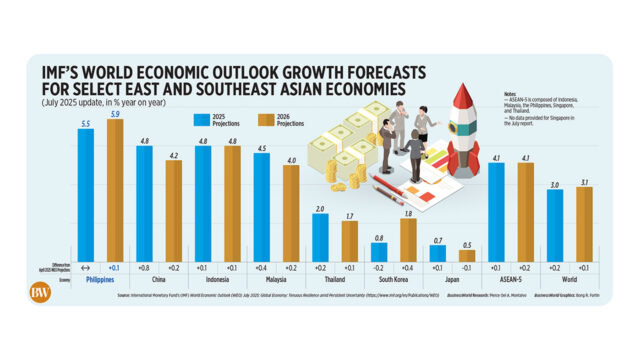
IMF’s World Economic Outlook Growth Forecasts for Select East and Southeast Asian Economies

THE INTERNATIONAL Monetary Fund (IMF) raised its gross domestic product (GDP) growth forecast for the Philippines for 2026 but kept its projection for this year amid heightened global uncertainty. Read the full story.

IMF’s World Economic Outlook Growth Forecasts for Select East and Southeast Asian Economies

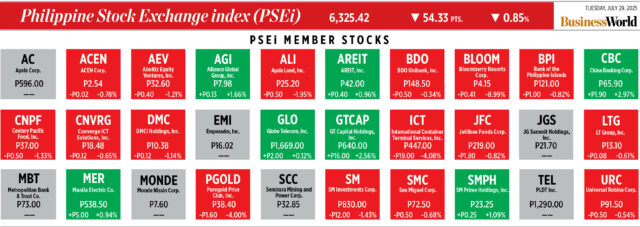
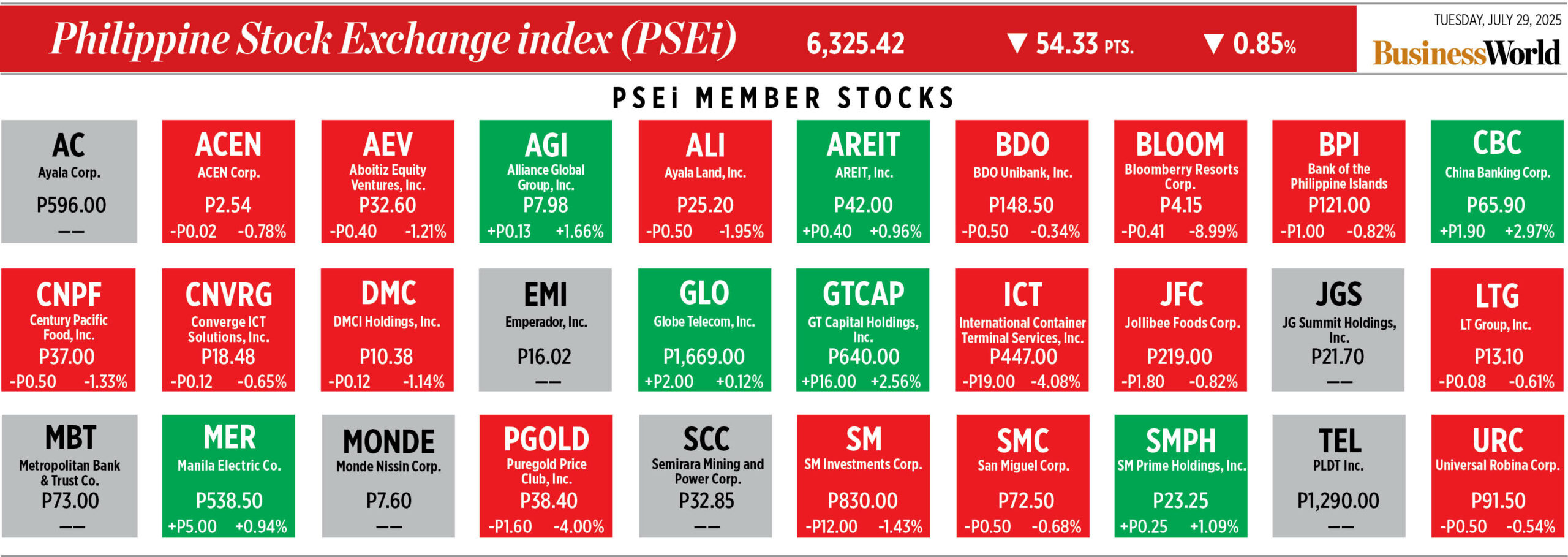
How PSEi member stocks performed — July 29, 2025

Here’s a quick glance at how PSEi stocks fared on Tuesday, July 29, 2025.


Local shares drop further as market digests SONA

REUTERS

PHILIPPINE STOCKS closed lower for a fourth straight day on Tuesday as the market reacted to President Ferdinand R. Marcos, Jr.’s State of the Nation Address (SONA).

The benchmark Philippine Stock Exchange index (PSEi) dropped by 0.85% or 54.33 points to close at 6,325.42, while the broader all shares index fell by 0.35% or 13.41 points to 3,780.08.

“The local market extended its decline as investors digested Mr. Marcos’ latest SONA,” Philstocks Financial Inc. Research Manager Japhet Louis O. Tantiangco said in a Viber message. “Investors expressed dismay as some of the most pressing issues currently were not mentioned in the SONA including online gaming regulations, US-Philippines trade relations, and fiscal consolidation plans.”

In his fourth SONA, Mr. Marcos talked about economic growth, food security, energy reforms, and social services, but left out topics such as online gambling as well as the 19% tariff on Philippine exports to the US that will take effect on Aug. 1.

“The PSEi declined as the market is still digesting the news that Bangko Sentral ng Pilipinas (BSP) is set for two more rate cuts for this year. Also, prices are already reflecting the sentiments of the investors regarding the earnings of various companies,” Regina Capital Development Corp. Head of Sales Luis A. Limlingan said in a Viber message.

The Philippine central bank is committed to maintaining its easing bias and is on course to cut policy rates twice this year, its governor said on Monday, though the timing will depend on economic growth and inflation, Reuters reported.

“We’re still on that same easing cycle,” BSP Governor Eli M. Remolona, Jr. told Reuters. “We’re doing baby steps. That’s a good sign, that means we’re on track.”

The Bangko Sentral ng Pilipinas is closely monitoring economic indicators to guide its decisions, including whether to implement a rate cut at its upcoming Aug. 28 policy meeting. He emphasized that weaker-than-expected growth and better-than-projected inflation would be key triggers for further easing.

Almost all sectoral indices closed lower on Tuesday. Services sank by 2.01% or 45.77 points to 2,224.39; mining and oil decreased by 1.72% or 159.41 points to 9,093.87; holding firms went down by 0.69% or 38.05 points to 5,403.78; financials retreated by 0.07% or 1.65 points to 2,236.31; and industrials declined by 0.79 point to 9,096.97.

Meanwhile, property inched up by 0.04% or 1 point to 2,359.42.

Value turnover rose to P6.86 billion on Tuesday with 1.04 billion shares exchanged from P6.61 billion with 1.11 billion shares traded on Monday.

Decliners outnumbered advancers, 117 versus 70, while 62 names were unchanged.

Net foreign selling increased to P429.15 million on Tuesday from P156 million on Monday. — Revin Mikhael D. Ochave with Reuters

Recto considers reenacted 2026 budget to be unlikely

FINANCE SECRETARY RALPH G. RECTO — PCO

THE GOVERNMENT is unlikely to operate under a reenacted budget next year, with Congress expected to heed the President’s warning not to deviate significantly from the Executive branch’s spending plan, Finance Secretary Ralph G. Recto said on Tuesday. 

“I don’t expect a reenacted budget. I expect cooperation from Congress. In effect that’s what the President is saying. As much as possible you can amend the budget but let’s make sure we have the same priorities,” he told reporters on the sidelines of the Post-State of the Nation Address (SONA) briefing.

President Ferdinand R. Marcos, Jr. in his fourth SONA warned legislators he would not sign a general appropriations bill that is not aligned with the National Expenditure Program (NEP).

Budget bills, if left unsigned, trigger a process in which the previous year’s budget is “reenacted,” meaning that the old budget’s spending items will be authorized, to the detriment of any new projects.

Speaker Martin G. Romualdez and other legislators in February faced legal challenges over the alleged P241 billion worth of insertions in the 2025 budget.

Budget Secretary Amenah F. Pangandaman cautioned that a budget out of line with government priorities would disrupt the project pipeline.

“If new projects are introduced that are not consistent with our existing programs, we will have difficulty implementing them. Projects will be delayed if the budget is not aligned with what was approved by the Executive,” she said at the same event.

The P6.793-trillion NEP for 2026 was completed on July 17 and must be submitted to Congress within 30 days after the opening of the regular session.

Ms. Pangandaman said the DBM hopes to submit the NEP — a document prepared by the Executive branch that serves as the basis for budget legislation — to Congress by the second week of August.

The 2026 NEP was equivalent to 22% of gross domestic product (GDP) and 7.4% higher than P6.326-trillion spending plan in 2025. 

“We appeal to our lawmakers to follow President Marcos’s directive and adhere to the NEP as closely as possible,” she said. 

Department of Economy, Planning, and Development Undersecretary Rosemarie G. Edillon told reporters that “our priorities remain clear — social development is still the top priority, which includes education, health, nutrition, food security, and infrastructure,” she said. — Aubrey Rose A. Inosante

PCCI flags SONA silence on government legislative program

By Justine Irish D. Tabile, Reporter

THE Philippine Chamber of Commerce and Industry (PCCI) said the government needs to follow through on pending reforms after President Ferdinand R. Marcos, Jr., left out the government’s legislative agenda in his fourth State of the Nation Address (SONA).

“We would have wanted to hear progress updates on the removal of regulatory barriers, the streamlining of business processes, and the modernization of government services,” PCCI President Enunina V. Mangio said in a statement on Tuesday. 

“These are major pain points for businesses,” she added.

According to the PCCI, red tape remains an issue despite the Ease of Doing Business law, adding that agencies have overlapping mandates, digitalization is proceeding slowly, and compliance costs remain high.

“The Chamber also stressed the importance of expanding MSME (micro-, small-, and medium-sized enterprises) access to credit and technology and introducing more advanced technical and digital training, including artificial intelligence, in the education system,” it added.

The PCCI nevertheless noted that the SONA established the President’s sincere concern about the effectivity of flood control projects as well as his firm intention to pursue his infrastructure goals.

Ms. Mangio welcomed the President’s warning to legislators not to divert the budget to items not deemed administrative priorities as well as his instructions to adopt zero-balance billing in public hospitals.

Ms. Mangio said the SONA focused on the right issues like education, infrastructure, and agriculture, “But we now need decisive action, sustained policy reforms, and implementation to turn these intentions into outcomes.”

“The Chamber remains hopeful that both the executive and legislative branches will act swiftly to enact long-needed policy reforms and legislation that enable investments, create jobs, and improve the overall competitiveness of the Philippine business environment,” she added.

In a separate statement, the IT and Business Process Association of the Philippines (IBPAP) said that although the SONA did not directly mention the industry, the areas emphasized by the President can significantly support its growth.

“Several of the areas that President Marcos Jr. emphasized, such as education, digital infrastructure, ease of doing business, and investor confidence, are top priorities for the sector and can significantly support its continued growth and global competitiveness,” the IBPAP said.

“The IBPAP remains committed to working with the government, the private sector, and academic institutions to translate these priorities into actionable outcomes that attract more investments, create more jobs, develop future-ready talent, and strengthen the role of the IT-BPM sector,” it added.

Federation of Philippine Industries (FPI) Chairman Elizabeth H. Lee described the SONA as “well delivered.”

“While the President may have wished to address a broader range of pressing concerns, the decision to spotlight core issues — such as food security, flooding, electricity supply, public health, and education — was both strategic and reassuring,” Ms. Lee said via Viber. 

“These fundamental areas speak directly to the everyday fears and hopes of the Filipino people, and addressing them strengthens his goal for a more resilient citizenry and workforce that is key to businesses,” she added.

The German-Philippine Chamber of Commerce and Industry (GPCCI) also welcomed the President’s focus on ease of doing business, skills development, and climate action.

“These are shared priorities where German businesses are eager to contribute, through sustainable investments, technical cooperation, and long-term partnerships that support a more competitive and climate-resilient Philippines,” GPCCI President Marie Antoniette Mariano said.

“As we deepen our engagement, we also emphasize the importance of transparency and good governance in fostering a stable and attractive investment climate,” she added.

The Federation of Filipino Chinese Chambers of Commerce and Industry, Inc. (FFCCCII) has called for “rigorous, systemic, periodic and transparent audits and performance reviews across all government agencies and projects.”

FFCCCII President Victor Lim said “ghost projects” amount to unconscionable theft from the Filipino people.

“The FFCCCII urgently calls upon the Administration and the Legislature to enact profound, systemic anti-corruption reforms,” he said in a statement.

“We need strengthened institutions, unimpeded transparency, robust accountability mechanisms, certainty of punishments and unwavering enforcement of the rule of law,” he added.

He said such reforms can help restore public trust and ensure efficient use of public funds.

Laurel sees NFA powers facilitating P20 rice rollout

PHILSTAR FILE PHOTO

THE Department of Agriculture (DA) said on Tuesday that restoring the National Food Authority’s (NFA) power to sell rice directly to the public will go hand-in-hand with expanding the reach of the P20-per-kilo subsidized rice program.

Agriculture Secretary Francisco Tiu Laurel, Jr. added that the NFA hopes to increase its procurement of rice from farmers and sell about 80% of its stock at a markup to generate earnings. These earnings which then be tapped to fund the subsidy.

Mr. Laurel said the plan will rely on the passage of a bill seeking to restore the NFA’s powers, including the power to intervene in the market.

The Rice Industry and Consumer Empowerment Act, backed by Speaker Martin G. Romualdez, seeks to amend the Rice Tariffication Law, which had taken away much of the NFA’s powers, leaving it with maintaining the government’s rice reserve.

“I really feel that the Rice Tariffication Law, as written, will kill our rice industry if it is not amended,” Mr. Laurel said.

Starting Aug. 13, farmers will be entitled to purchase P20 rice with the DA eventually planning to make lower middle-income families eligible, Mr. Laurel said.

By October, the DA plans to launch an app to register households for the program. It will also verify their eligibility to join the program.

Current beneficiaries are senior citizens, persons with disabilities, solo parents, minimum wage earners, and beneficiaries of the government’s flagship conditional cash transfer program.

Mr. Laurel said the DA is also considering tapping public schools as additional outlets for rice distribution.

The P20-per-kilo rice program seeks to reach up to 15 million households, equivalent to about 60 million persons.

The DA plans to allocate P18 billion next year to sustain the program.

Separately, Mr. Laurel said a floor pricing scheme for palay (unmilled rice) needs an enabling law, which is not likely to be passed before the next harvest.

The Integrated Rural Development Foundation is urging Congress to pass a Comprehensive New Rice Industry Law that would establish a minimum farmgate price of P25 per kilogram (kg) for palay.

The proposal, which would ensure farmers earn at least P50,000 per hectare per crop or about P16,000 per month, would incentivize continued planting and increase yields, it said.

It noted that palay farmgate prices have plummeted to as low as P10 per kilo in some areas, below the average production cost of P14.52 per kg estimated in 2024 by the Philippine Statistics Authority. — Kyle Aristophere T. Atienza