Home Blog Page 1230

Mercury Drug President Vivian Que-Azcona, 69, passes away

VIVIAN QUE-AZCONA — FACEBOOK.COM/MERCURYDRUGPH.TIF

VIVIAN QUE-AZCONA, president of Mercury Drug Corp., passed away on April 5 at the age of 69.

In a Facebook post on Thursday, pharmaceutical company Unilab Group extended its condolences on the passing of Ms. Que-Azcona.

“She was a visionary leader and a dedicated partner who has left an indelible mark on the Mercury Group of Companies, the healthcare industry, and the country,” it said.

“We believe her meaningful work uplifted millions of lives through the years, leaving a legacy that will be remembered for generations to come.”

As the largest shareholder of Mercury Drug Corp., a drugstore chain established in 1945, Ms. Que-Azcona was instrumental in the company’s growth and success.

Under her leadership, Mercury Drug expanded its presence across the Philippines, with a network of over 1,200 stores nationwide and more than 15,000 employees. — Justine Irish D. Tabile

Universal to open first European theme park near London

UNIVERSALDESTINATIONSANDEXPERIENCES.COM

LONDON — US media giant Comcast Corp. has chosen an area north of London for its first Universal theme park and resort in Europe, pledging to build rides and attractions based on its movie franchises that it hopes will rival Disneyland Paris.

The group, which owns the Jurassic Park and Back to the Future movie franchises and the Harry Potter theme park license, said the park in Bedford would create 20,000 jobs during construction and a further 8,000 across the hospitality and creative industries when it opens in 2031.

It is expected to attract 8.5 million visitors in its first year, a number currently only exceeded in Europe by Disneyland Paris to the east of the French capital.

British Prime Minister Keir Starmer and finance minister Rachel Reeves joined Comcast bosses to announce the theme park on Wednesday.

“This will drive growth here and across the country,” Mr. Starmer said.

The Labor government has pledged to boost investment in infrastructure since it was elected last year, and Britain’s economy needs fresh momentum after the highest tax-raising budget since 1993 in October dented business confidence.

The government has pledged to speed up planning decisions and the announcement comes after it approved the expansion of Luton Airport, which is about 32 kilometers from the Universal site, boosting the area’s international connectivity.

“This (theme park) is our ‘Plan for Change’ in action, bringing investment, bringing opportunity, growth, jobs and, of course, joy to Britain,” Mr. Starmer said.

Universal has five resorts and parks, in the US states of California and Florida as well as in Singapore, Japan, and China, offering rides and attractions based on its movie franchises.

Plans for the new site include a park, featuring several themed lands, a 500-room hotel, and a retail, dining and entertainment complex.

Comcast President Mike Cavanagh showed Mr. Starmer the plan in London on Tuesday, saying he “could not be more excited” to create a Universal theme park and resort in the heart of the United Kingdom.

Comcast bought a 500-acre former brickworks in Bedfordshire, about 55 miles north of London, in 2023 and had been in talks with the government since last year. It already owns Sky, which is Europe’s biggest pay-TV business.

The theme park and resort are subject to planning permission, the government said. — Reuters

Healthy soil as carbon sink: a solution to climate change?

Many of us enjoy the outdoors, gardening or even tending to a small farm. But today, we feel the heat — literally — of climate change. It’s a global problem, and we often wonder how we can make a difference. Surprisingly, the answer might be right beneath our feet: the soil.

What is soil, really? Soil is the top layer of the earth where plants grow, often called the “skin of the Earth.” But it’s not just dirt — soil is alive! Just one teaspoon of healthy soil contains more microorganisms than there are people on Earth. These tiny organisms help break down organic matter and make nutrients available to plants.

About 95% of our food, directly or indirectly, comes from soil. Even 95% of antibiotics are derived from soil bacteria. Truly, soil is life.

What is healthy soil made of? Healthy soil is composed of 45% minerals (sand, silt, clay, pebbles, rocks, 25% air, 25% water, and 5% organic matter (plants, animals, and microorganisms).

The most fertile part of soil is the topsoil, especially when it contains humus, which is a dark, rich substance formed from decomposed leaves, twigs, insects, and other organisms. Humus is about 60% carbon, and it’s essential for water retention, nutrient balance, and soil structure.

THE ROLE OF SOIL IN CLIMATE CHANGE
Carbon in the atmosphere contributes to global warming. But when plants photosynthesize, they pull carbon dioxide from the air and send some of that carbon into the soil through their roots. When the soil is rich in organic matter and microorganisms, it stores or “sequesters” this carbon. This process turns soil into a carbon sink.

Unfortunately, many farming and land use practices destroy this process, including slash-and-burn agriculture, the use of chemical fertilizers and pesticides, tilling and plowing, illegal logging, and overgrazing by livestock. These activities kill beneficial microbes and release stored carbon back into the atmosphere.

So how do we restore soil health? These are some simple, powerful ways through which we can support healthy soil, and, in doing so, have healthy plants and even store carbon in the soil and help against climate change:

1. Compost — Kitchen scraps and yard waste can be turned into compost. This adds organic matter to soil, feeds microbes, and reduces landfill waste. Even simple segregation — separating biodegradable (nabubulok) from non-biodegradable (hindi nabubulok) waste —makes a difference. Composting also feeds earthworms, whose castings or vermicast are excellent fertilizers.

2. Mulch — A “blanket” of dried leaves or wood chips protects the soil from heat and erosion. It keeps moisture in, regulates temperature, and slowly releases nutrients as it decomposes.

3. Cover crops — Planting nitrogen-fixing crops like monggo or mung beans between growing seasons keeps soil covered, adds organic matter, and prevents erosion. Cut these crops before flowering and mix into the soil as green manure — this works like a spa treatment for soil!

4. Well-rotted manure — Animal manure from chickens, pigs, cows, goats, or rabbits, when properly composted, is a natural way to enrich the soil with nutrients and organic material.

These are some practices of what’s called regenerative farming or carbon farming — farming in a way that follows nature’s cycles and heals the land.

I used to rely on synthetic fertilizers. But since discovering natural farming — which cares for the microorganisms in the soil — in the mid-2000s, I’ve been hooked. Most of the materials are free and abundant, such as leaves, kitchen waste, animal manure. I also learned about JADAM, an ultra-low-cost organic farming system using leaf mold, or decomposed leaves, which makes one of the best soil conditioners. Nature wastes nothing.

Did you know that humans need more vitamins now than they did decades ago? That’s because our soil has lost nutrients. It’s time to put these nutrients back — and not with chemicals, but with organic matter.

Climate change is real. Carbon in the air is a problem. But carbon in the soil? That’s the solution.

Healthy soil pulls carbon from the air and locks it underground. It feeds our plants. It gives us nutrient-rich food. It holds water, prevents erosion, and helps us fight floods and drought.

Let’s respect the soil. Let’s heal it. What can you do today? Here are some examples:

– Start composting.

– Cover exposed soil with mulch and cover cropping.

– Avoid chemical fertilizers and pesticides.

– Reduce, reuse, and recycle water and electricity.

– Plant, plant, plant! Plant native trees like bamboos.

So, the next time you look down at the ground, don’t just see dirt — see hope. See a solution. See life. Healthy soil makes plants healthy. It leads to healthy people and a healthy planet!


Flor G. Tarriela is a banker by profession and an environmentalist/ gardener.

Is campus recruitment still effective?

We hire a lot of people using social media and sometimes, print media depending on the position that we’d like to hire. Unfortunately, we don’t get many qualified applicants from those channels. Can we do campus recruitment instead? – Wind Flow.

There are many possible approaches to advertising job vacancies. We don’t want to exclude one in favor of another. Every approach is useful, including a referral program where you pay current employees a bonus if their recommended candidates are hired.

Much depends on the organization’s size, the significance of vacant posts, the urgency, budget limits, and media channels. Everything is useful as long as they are easy, cheap, and fast.

Prudence dictates that we not discount the other approaches, like campus recruitment. First and foremost, you must understand the objective. College recruitment is suitable only for finding entry-level candidates. You don’t hire fresh graduates to fill jobs that require years of experience.

If you intend to hire people with unique talent, or are looking for line supervisors or managers, try other solutions like job ads, in addition to your announcements on social media. But a holistic approach would require that you start with considering promotions from within.

That means giving priority to your current employees for promotion, if they’re qualified. Start by announcing the vacancies through company bulletin boards and intranet. To avoid any issues when hiring internal candidates, you should spell out in advance the job specifications, performance standards, and qualifications required of applicants.

If you’re successful in promoting someone from within the organization, the entry-level or junior posts should be easy to fill from the pool of fresh college graduates.

CAMPUS RECRUITMENT
We do college recruitment for entry-level positions, on-the-job training, and other roles that require basic knowledge, like those in information technology, mass media, accountancy, and many more.

One caveat though. If you focus on recruiting from prestigious universities, prepare to compete for applicants with major organizations. That could happen if you as a potential employer don’t possess the brand or image that people want. You must also manage the preferences of their parents.

This may not be obvious at first glance, but given the fact that social media is all around us, there’s a chance that your organization may have received negative comments from job applicants, even disgruntled employees who may have resigned out of frustration.

Aside from campus recruitment, there are many approaches you can take in hiring entry-level candidates. These include:

One, job and career festivals. Usually, these are organized by the Department of Labor and Employment during Labor Day celebrations in May. There are also occasional job fairs organized by local government units in partnership with manpower agencies and consumer goods companies.

Two, campus visits. You must be in touch with alumni associations to improve your organization’s chances of being invited to campus job fairs. Arrange for an attractive booth and marketing peripherals to catch the eye during fairs.

Three, apprenticeship programs. Many companies use this program to provide structured training and employment platform for young individuals, including graduating students, to learn a trade or profession through a combination of on-the-job experience and related instruction.

Four, social media. Employers use Facebook and other social media platforms to connect with students for possible employment opportunities. They also use the same platform to improve the company’s image by publishing employee activities and milestones.

MANPOWER AGENCIES
Some organizations rely on hiring from employment agencies or labor cooperatives. It’s advisable to do this for temporary workers to fill positions when regular employees are on maternity leave, prolonged sick leave, or sabbaticals.

It’s an excellent avenue for filling seasonal needs for manpower services. However, the qualifications and experience of such hires can be uneven. If so, it’s easy to find replacements without violating the Labor Code.

I’ve seen and interacted with a lot of working students. Many of them are temps at major firms and business processing organizations. They are a different breed. If you have the chance to hire them for regular, entry-level jobs, you don’t need graduates from prestigious universities. They’re a lot better, with none of the arrogance.


Bring Elbo’s leadership program called “Superior Subordinate Supervision” to your management team. Learn through a unique teaching methodology. For details, e-mail elbonomics@gmail.com or via https://reyelbo.com

Sansó: A story on art collectors

JUVENAL SANSÓ at the Fundacion Sansó’s inaugural exhibit in November 2014. — FUNDACIONSANSO.PH/JUVENAL-SANSO

The great Spanish artist with a Filipino heart Juvenal Sansó, has passed to eternity. He takes his place among the pantheon of stars with his artist-friends and the art collectors who have gone before him.

There have been many wonderful tributes to his genius and his art, his many awards and achievements in the international art world.

As a friend, Sansó was always kind, affectionate, thoughtful, generous, and supportive. He was brilliant and had a sense of humor that was infectious. He clowned around during pictorials with photographers. He was always modest and self-effacing about his own accomplishments.

The witty raconteur was a good writer who shared his impressions on life and art collectors. He showed his keen observation of people and the process of authentication.

Here are excerpts from a personal letter (1990) he wrote that was first published in this column in 2015.

Maestro Sansó (or “Juvi” as close friends called him) had graciously accepted the invitation to mount a solo exhibit at the Artist’s Corner of the Hotel InterContinental Manila. This writer-artist was then the hotel’s PR director who managed the gallery. It was an honor to have worked closely with him. His spontaneous comments are still relevant in today’s environment.

He remarked, “I think that you will agree on what the painter feels about before and during the presentation of one’s works to the very wide variety of collectors, pseudo-collectors and studio wanderers.”

He wrote: “I must tell you a story that illustrates this purpose… Highly knowledgeable psychologists placed a monkey in a room filled with mirrors and all kinds of things used in a house to see what this animal would do in such circumstances.

“When the scientists put their eye in the keyhole to observe… Guess what they saw? They saw the monkey’s eye observing THEM!

“This happens to all artists who show paintings to prospective buyers in any place around the world. The Philippines in not an exception.”

He wrote an aside: “(I must underline the fact that I am not speaking of Filipino collectors exclusively… for someone might be offended if he or she thinks I am talking about him or her. My observations are a result of long years of practicing my vocation and its complement: that of presenting the works to the art — lover.)

“There are basic characters in the attitudes and strategies used by both sides that have a most interesting interplay of psychologies. I shall be underlining the most atypical of cases for they will allow us to understand that [there] are, in between the extremes, the kind and normal persons who only leave a happy aura behind when they leave.

“A very interesting case is the boyfriend of a wealthy business lady who was buying some of my works and who told him to do likewise. The poor fellow was in such a tight fix that he was sweating like a squeezed sponge all over the place… The perfect case of the napasubo. I could not release him from his predicament for I didn’t know what the intentions of the lady friend were; what kind of test he was going through. When confronted with another solution, classical.

“First, he was only going to like the ‘reserved’ or ‘sold’ items in the studio. When similar works were presented, he would want them in a different size. His perspiring was getting so bountiful that I had to take my books and drawings away from this human fountain. Seeing the poor fellow suffer so much and seeing how the lady seemed to push this torture, I kept on the fence, waiting for some release. I wonder what the score at the end was! He left without buying but maybe not earning his stripes with Lady Love, of course, he promised to come back… promises, promises!

“There are many ways that I use to judge if people in the studio are seriously interested in my works or simply taking a cultural paseo with his friends either to show how they know painting or the painter. If I hear too much chatting among my visitors, I may put a painting upside down to test their attention. If the second time I do this, they still have not reacted, then I terminate the presentation saying I don’t have any finished works to show. It’s best for everyone.

“Life is too short for me to devote time to indifference…

“In the studio, more than three or four viewers at a time are to be avoided because they form sub-groups chatting among themselves or try to impress one another with their knowledge and their culture. This verbal smarty-pants ping-pong never profits the artist for he or she rarely learns anything from the show-offs except how ignorant they are and how pedantic are the ones who know a bit.

“There is, sometimes, the decoration-oriented buyer who would rather choose a mediocre artwork that goes well with the curtains and wallpaper rather than a strong piece by a better painter…”

“I have relaxed and let each collector react according to his or her cultural capacity. What is important is that he or she makes the first step and feels motivated enough to spend hard-earned money on a painting.

“If the first step was the curtain, after a while, the painting dominates and projects its inner message. Eventually the curtain is changed. The curtain has no inner message from a sensitive human being. The kids grow up with art around them and this second generation will have seen the painting ‘first’ and forgotten the curtains.

“Authenticating by the artist himself is not a problem at all… I have a dozen elephants’ memory for my own works for they are a result of emotional, technical, stylistic factors that, at a glance, they come back to me…

“The immediate members of the family may be the second choice if the artist is dead; experts, assuming that the word expert is truly legitimate, may guide the collector to select the right (authentic) pieces. A reputable gallery is a very good base too… There are some, really!

“Buying directly from the artist (an honest artist, of course) is still the best guaranty of authenticity… straight from the carabao’s mouth: or the Monkey’s eye?”

Sansó was one of the most prolific, well-loved artists. His artworks are in the major collections of international museums and distinguished families around the world. He inspired a generation of artists.

Sansó was Catalan, born in Barcelona 95 years ago. He came with his parents and sister to Manila at age four. They founded the well-known Arte Español wrought iron furniture business.

A graduate of the University of the Philippines College of Fine Arts, he lived and worked in Paris for more than six decades. He traveled often but Manila was always his home. He spoke Spanish, French, and English. He used to startle people (with his piercing blue eyes) whenever he suddenly spoke in fluent Filipino!

The artist lives on in his exquisite artworks and in the hearts of the people who love him.

A blessed Easter to all!


Maria Victoria Rufino is an artist, writer and businesswoman. She is president and executive producer of Maverick Productions.

mavrufino@gmail.com

Del Monte Pacific absorbs $20-M loan to settle lawsuit involving US units

Bugo cannery workers in Cagayan de Oro — DELMONTEPACIFIC.COM

DEL MONTE PACIFIC Ltd. (DMPL) incurred a $20-million increase in its debt as part of a settlement with the lenders of its US subsidiaries, the listed food and beverage manufacturer said on Thursday.

DMPL, along with certain lenders, negotiated a settlement following an alleged default of Del Monte Foods, Inc.’s (DMFI) facility agreement signed in May 2022, the company said in a stock exchange disclosure.

“The settlement loan increases the Del Monte Pacific Group’s interest expense by about $4 million annually and raises the group’s debts by $20 million,” the company said.

“The company agreed to contribute either by equity or a subordinated loan to the subsidiary by May 5, 2025,” it added.

In October 2024, a group of lenders under the term loan agreement of DMFI signed in 2022 sued DMFI, two other Del Monte Foods Holdings Ltd. (DMFHL) subsidiaries, and certain directors in the State of Delaware Court of Chancery.

The group of lenders did not participate in the new term facility agreement completed in August 2024. DMFHL is the immediate parent company of DMFI, which is the US subsidiary of DMPL.

“The complaint alleged that certain defaults and events of default had occurred under the 2022 DMFI Facility Agreement and that as a result of such defaults and events of default, plaintiffs were entitled to remove the current directors of DMFI and two other DMFHL subsidiaries and replace those directors with the plaintiffs’ own appointees,” DMPL said.

“The defendants denied that any defaults or events of default had occurred under the 2022 DMFI Facility Agreement and vigorously contested the plaintiffs’ allegations and purported exercise of remedies,” it added.

A trial was held in mid-February, and a post-trial hearing was set for April 9. The settlement was negotiated in advance of the post-trial hearing.

“The lawsuit has now been dismissed with finality. In connection with the settlement, all indebtedness under the 2022 DMFI Facility Agreement will be retired,” DMPL said.

“In case the company decides not to provide any monetary contribution, a majority of directors on the boards of DMFHL and each of its subsidiaries would be appointed by the lenders, and certain governance changes would be put in place, and a portion of the company’s equity in DMFHL would be applied to partially pay the settlement loan,” it added. 

For the first nine months of its fiscal year 2025 ending in April, DMPL widened its net loss to $92.2 million due to weaker US operations. Sales rose by 3% to $1.9 billion on higher exports of fresh pineapples and packaged products.

Nine-month net debt fell by 6.9% to $2.27 billion due to better inventory management.

DMPL shares rose by 3.21% or nine centavos to P2.89 per share on Thursday. — Revin Mikhael D. Ochave

Stuff to Do (04/11/25)


Watch a horror film at Ayala Malls

AYALA MALLS Cinemas will host the exclusive theatrical release of the horror film The Demon Disorder. It is the directorial debut of special effects master Steven Boyle. The Australian horror movie follows three brothers who are reunited after the youngest is possessed by their deceased father. Originally premiered on the horror movie platform Shudder, it is now showing only at Ayala Malls.


Listen to Dylan Menor’s debut single

BRANCHING out from his career as an actor is Dylan Menor, who has just released his debut single, “Maghapon,” under Universal Records. Written by Alvin Serito of the band SunKissed Lola, the track is a serenade that starts calm and slow as it tells the story of someone drawn to another’s presence. Mr. Menor, managed by Stages Talents, has previously teased the song on fan meets and TV shows. “Maghapon” is out now on all digital music streaming platforms.


Watch action thriller G20 on Prime Video

ACADEMY Award-winning actress Viola Davis is the lead in a brand-new action thriller, where she plays US President Danielle Sutton who becomes the world’s last line of defense in an international crisis. G20, now streaming exclusively on Prime Video, centers on the former military veteran as she is thrust into a deadly siege by terrorists during a global summit in Cape Town. Directed by Patricia Riggen, the thriller is out now on Prime Video.


Listen to XG’s reworked single

HIP-HOP/R&B girl group XG has announced the release of their reworked single “IN THE RAIN” from their second mini album AWE. It is accompanied by a music video featuring the members dressed in sleek suits. The alternate take of the R&B-inspired track — which fuses the delicate sound of falling rain with gentle guitar melodies — injects electronic dance music elements. It is out now on all digital music streaming platforms.

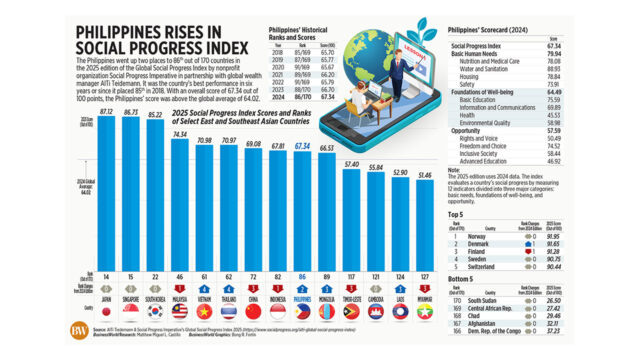
Philippines rises in Social Progress Index

The Philippines went up two places to 86th out of 170 countries in the 2025 edition of the Global Social Progress Index by nonprofit organization Social Progress Imperative in partnership with global wealth manager AlTi Teidemann. It was the country’s best performance in six years or since it placed 85th in 2018. With an overall score of 67.34 out of 100 points, the Philippines’ score was above the global average of 64.02.

Philippines rises in Social Progress Index

How PSEi member stocks performed — April 10, 2025

Here’s a quick glance at how PSEi stocks fared on Thursday, April 10, 2025.


SWS: Voters will back champions of workers, food security, and healthcare

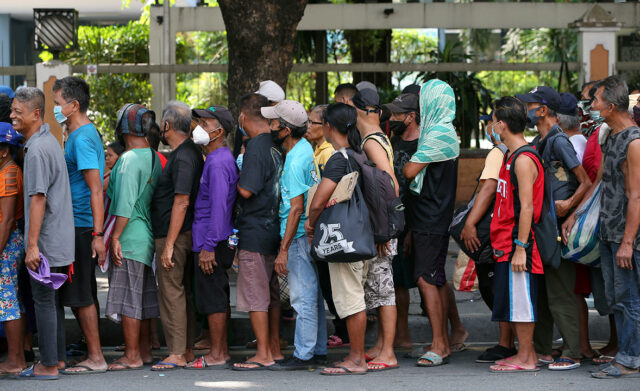
FILIPINOS line up for free food in Manila. — PHILIPPINE STAR/KRIZ JOHN ROSALES

NINE OF 10 Filipinos are likely to support candidates with a platform for jobs, healthcare, food security and education, according to a Social Weather Stations (SWS) survey.

The survey, which was commissioned by Stratbase ADR Institute, found that 92% of Filipinos would vote for candidates who would push for job creation, while 91% would support those who seek to improve the country’s healthcare system.

Filipino voters would also vote for candidates who seek to revitalize the agriculture industry to bolster food security (91%) and those committed to promoting equal access to education (90%).

“Many Filipinos still struggle with everyday needs,” Stratbase President Victor Andres C. Manhit said in a statement on Thursday. “People want jobs because having work means having income to support their families.”

“Healthcare remains a priority because getting sick is expensive, and many still can’t afford proper treatment,” he added.

He also said food security is a top concern because food prices keep going up, and families want to be sure that there is always food on the table. “Education is seen as the key to a better future, especially for the younger generation.”

Millions of Filipinos will pick a new set of congressmen, 12 of the 24-member Senate and thousands of local officials on May 12.

“With just over a month left before the May elections, candidates should take this survey seriously,” Mr. Manhit said. “They must show they understand the real needs of the people.”

Meanwhile, 89% of Filipinos said they would vote for candidates who advocate workers’ rights including migrant workers, while 86% would back political aspirants with plans to reduce poverty.

A good number of Filipinos (85%) said they would vote for candidates batting for cheaper basic goods and services. “When prices of goods and services rise, it affects everyone,” Mr. Manhit said.

Climate change mitigation, disaster preparedness and national security concerns in the South China Sea also ranked high in the survey, with 82% of Filipinos expressing support for candidates with concrete plans to address these issues.

About 79% of Filipinos would support political aspirants that advocate for stable electricity and green energy, according to the survey.

“Interestingly, traditional campaign issues such as the fight against illegal drugs and corruption did not rank among the top 10 advocacies that influence voter preference,” Stratbase said.

Meanwhile, 79% of Filipinos said they favor politicians opposed to illegal drugs, while 71% would back candidates with a strong anti-corruption stance.

Mr. Manhit said voters should press candidates to reveal their plans for solving the issues highlighted by the SWS survey. “It’s not enough to make promises.”

SWS interviewed 1,800 Filipinos on March 15 to 20 for the poll, which had a 2% error margin. — Kenneth Christiane L. Basilio

BI to send more workers during Holy Week break

PHILIPPINE STAR/EDD GUMBAN

THE Bureau of Immigration (BI) will deploy 40 more workers to international airports nationwide amid an expected travel surge during the Holy Week, according to its spokesperson.

“We will be deploying an additional 40-plus immigration officers to augment our existing personnel and ensure that all our counters are fully staffed to serve the public,” Immigration spokesperson Dana Krizia M. Sandoval told a news briefing in Filipino on Thursday.

She also said the bureau had opened a dedicated wing for overseas Filipino workers (OFWs) at the Ninoy Aquino International Airport (NAIA) Terminal 3 to streamline and expedite immigration processing. The new OFW wing can accommodate about 3,000 OFWs daily.

She advised passengers to arrive at the airport three to four hours before their flights to avoid delays.

Meanwhile, Metropolitan Manila Development Authority (MMDA) Chairman Romando S. Artes will inspect bus terminals along the Epifanio De Los Santos Avenue (EDSA) from Cubao to the north in preparation for the Holy Week.

He will also check the readiness of agency personnel in traffic management and in providing assistance to commuters, the agency said in a statement.

The MMDA would likewise conduct random drug tests among drivers and conductors to ensure passenger safety.

Philippine President Ferdinand R. Marcos, Jr., earlier this week ordered the Department of Transportation and its attached agencies to carry out strict inspections of terminals, ports and airports to cut travel delays during the Lenten break next week.

He also ordered law enforcement agencies to tighten their watch on crime during the holiday break.

The Philippine National Police (PNP) on April 3 said more than 40,000 cops would be deployed nationwide to maintain peace and order on April 13 to 20.

Police regional offices were also ordered to conduct regular inspections and boost police presence in crowded places such as terminals, ports and transport hubs.

In a separate statement on Tuesday, the Philippine Ports Authority (PPA) said it expects passenger volume at the country’s seaports to increase 3.5% to 1.73 million next week from a year earlier.

The port regulator noted that for the first three weeks of March, it had logged 3.03 million passengers, or an average of 1.01 million passengers per week. This year, PPA expects passenger volume to increase 9.5% to 85.41 million from a year earlier.

The Holy Week, which commemorates the passion, death and resurrection of Jesus Christ, is one of the most significant religious observances in the predominantly Catholic Philippines. It will start on April 13 during Palm Sunday and end on April 20 during Easter Sunday. — Chloe Mari A. Hufana

Nutrition institute says 39% of Filipino adults are obese

STOCK PHOTO | Image by Michal Jarmoluk from Pixabay

By Kenneth Christiane L. Basilio, Reporter

ABOUT four of 10 Filipinos aged 20 to 59 are obese, with obesity rates likely influenced by location and wealth, according to the Food and Nutrition Research Institute.

“Obesity and overweight are higher in urban areas and tend to increase in relation with wealth,” Mildred O. Guirindola, chief science research specialist at the institute, an agency attached to the Department of Science and Technology, told a stakeholder meeting in Mandaluyong City on Thursday.

She said 35% of Filipino male adults are grossly overweight, compared with 45% of their female counterparts.

Obesity is a medical condition characterized by excessive fat accumulation that poses a health risk, according to the World Health Organization.

Government data showed that 44% of Filipinos in urban areas are obese compared with 35% of those in the countryside.

The institute said 53% of the wealthiest adult Filipinos are obese, with obesity rates steadily declining among lower income groups — down to 25% among the poorest. It added that 35% of poor Filipinos are obese, compared with 40% from the middle class and 44% from the wealthy.

Filipinos in urban communities are more obese likely due to their easy access to junk food and fast-food restaurants, with rich people having the resources to spend more on cholesterol-rich foods and alcoholic beverages, Vicente Y. Belizario, Jr., former dean of the University of the Philippines College of Public Health, said in an interview.

Obesity contributes to 0.7% to 2.8% of nation’s total healthcare spending, according to a separate presentation by the Epidemiological Burden and Cost of Obesity project, which is studying the costs of obesity in the Philippines.

The Philippine government may be spending about P200 billion yearly to address obesity and obesity-linked diseases such as heart disease and diabetes, Madeleine de Rosas-Valera, project leader of the obesity research group, said in an interview.