Home Blog Page 1195

PHILSME Business Expo unveils powerhouse speaker lineup and exclusive activities for 2025 edition

The 16th Philippine SME Business Expo (PHILSME), happening on May 9-10, 2025, at the SMX Convention Center in Pasay City, is setting the stage for an inspiring two-day business event. This year’s edition features an exceptional lineup of speakers, new business activities, and unrivaled networking opportunities designed to help small and medium enterprises scale and thrive.

Under the banner theme “Driving Momentum: Pursuing Ingenuity, Resiliency, and Customer-Centricity,” PHILSME Business Expo 2025 brings together over 120 multi-sector exhibitors, thousands of industry professionals, and over 10,000 pre-registered attendees — and growing by the day.

Learn from the Best in Business: Powerhouse Conference Lineup

This year’s PHILSME Business Conference takes center stage at the heart of the expo floor, making learning accessible to all attendees. While the talks are open for public viewing, upgraded ticket holders will enjoy reserved priority seating (first-come, first-served basis) for a more immersive experience, plus exclusive access perks.

The conference features some of the most influential voices in business and entrepreneurship:

  • Jayson Lo – Leadership Motivational Speaker
  • RJ Ledesma – Business Manual Editor-in-Chief & Serial Entrepreneur
  • Cristalle Belo-Pitt – Managing Director, Belo Essentials
  • Kim Lato – CEO, Kimstore & E-Commerce Expert
  • Darlyn Ty-Nilo – Product Innovator and Belle de Jour Founder
  • Miko David – Digital Strategist, David & Golyat
  • Rowen Untivero – Entrepreneurial Solutions Consultant
  • Ric Gindap – Design for Tomorrow CEO

Trixie Esguerra-Abrenilla, CEO of PHILSME, emphasized the value of learning from real success stories.

“This year’s conference brings together entrepreneurs who don’t just talk business — they’ve lived it. Our goal is to inspire, equip, and empower SMEs with knowledge they can immediately use to grow, scale, and lead in today’s ever-changing landscape.”

Spotlight on Entrepreneurs: Business Network Ceremony

Among the event’s highlights is the PHILSME Business Network Oath-Taking Ceremony, which recognizes the growing community of entrepreneurs who are making meaningful impacts in their fields.

Top Industry Sponsors Powering the Event

A growing roster of prestigious sponsors proudly supports the 16th PHILSME Business Expo:

PLATINUM

  • JRS Dynamics Info Solutions Corp.
  • GCash for Business
  • Cignal TV, Inc.
  • USA Poultry & Egg Export Council
  • Benchmark

GOLD

  • IWG International Workplace Group
  • DSOURCE, Inc.
  • ZOHO
  • Malaysia External Trade Development Corp. (MATRADE)
  • Cebuana Lhuillier, Inc.
  • Finest Media PH

SILVER

  • Security Bank
  • LANDI
  • Skyro
  • Sterling International Consulting
  • Pru Life UK
  • SPX
  • Design for Tomorrow
  • Sine Haraya
  • PHILSME Business Network

Register Now: Free & Upgraded Tickets Available!

Registration is FREE via https://ticket.philsme.com/. Attendees can also upgrade their tickets for premium access, which includes:

  • Priority seating at the business conference
  • Official visitor ID
  • A stylish PHILSME tote bag

Walk-ins will be charged P200 at the venue, so early registration is strongly encouraged.

Don’t miss this chance to spark growth, gain expert insights, and connect with the movers of Philippine business. Get your tickets now at https://ticket.philsme.com/.

For more information, email sunshine@philsme.com or call +63968-569-8358.


Spotlight is BusinessWorld’s sponsored section that allows advertisers to amplify their brand and connect with BusinessWorld’s audience by publishing their stories on the BusinessWorld Web site. For more information, send an email to online@bworldonline.com.

Join us on Viber at https://bit.ly/3hv6bLA to get more updates and subscribe to BusinessWorld’s titles and get exclusive content through www.bworld-x.com.

Philippine Blockchain Week 2025: A game-changer for the future of technology and innovation

The future of blockchain technology takes center stage at the much-anticipated Philippine Blockchain Week (PBW), set to take place from June 10 to 11, 2025 in Manila. This landmark event promises to showcase cutting-edge innovations, bring together leading experts, and explore the limitless potential of blockchain in transforming industries worldwide.

As blockchain technology continues to disrupt various sectors — finance, healthcare, supply chain, governance, and beyond — PBW positions itself as a key event for the region’s blockchain ecosystem. Whether you are an industry professional, entrepreneur, developer, or enthusiast, PBW is set to deliver a diverse program packed with valuable insights, networking opportunities, and the chance to learn about the latest developments in this rapidly evolving space.

Philippine Blockchain Week: Aiming to Be the Global Blockchain Hub

With the Philippines rapidly establishing itself as a regional leader in blockchain innovation, Philippine Blockchain Week is striving to position Manila as the global blockchain hub. The event brings together a dynamic mix of local talent, international experts, and global leaders in blockchain technology. As one of Southeast Asia’s fastest-growing blockchain ecosystems, the Philippines offers an ideal environment for the exchange of ideas, the development of new blockchain solutions, and the fostering of global partnerships.

PBW’s mission is clear: to create a thriving blockchain ecosystem that fosters collaboration, promotes innovation, and drives adoption across industries. By attracting key players from across the globe, the event aims to solidify the Philippines’ place on the map as a hub for blockchain technology, further supporting its digital transformation and fostering a culture of innovation.

What to Expect at Philippine Blockchain Week 2025:

    1. Keynote Presentations by Industry Leaders: PBW will feature talks from some of the biggest names in blockchain, crypto, and fintech. Expect engaging keynote speeches from thought leaders, innovators, and policymakers who are shaping the future of blockchain technology globally. Topics will cover everything from the latest advancements in decentralized finance (DeFi) to use cases of blockchain in industries.
    2. Interactive Workshops and Panel Discussions: The 2-day event will host hands-on workshops and insightful panel discussions that cater to professionals and newcomers alike. Experts will guide attendees through practical blockchain applications and real-world case studies, while also discussing the latest trends and regulatory challenges that blockchain faces.
    3. Networking Opportunities and Business Matchmaking: PBW offers unparalleled opportunities for professionals and startups to connect with key stakeholders in the blockchain and tech industries. Entrepreneurs, investors, and innovators will have the chance to meet, collaborate, and form partnerships that could shape the future of blockchain adoption in the Philippines and beyond. Audiences new to blockchain will also have the opportunity to learn the basics of blockchain.
    4. Exhibitions and Startup Showcases: The event will feature an exhibition hall where leading blockchain companies, startups, and projects will showcase their products, solutions, and technologies. Whether it’s new DeFi platforms, blockchain-enabled platforms for agriculture, or cutting-edge NFT applications, attendees will be able to experience firsthand how blockchain is being leveraged across industries.
    5. Blockchain Changing the Face In Finance: One of the standout features of PBW will be its focus on how blockchain can be harnessed to create positive societal change. With discussions on Tracing, Fraud Detection, and Governance, PBW seeks to highlight the technology’s potential in driving social impact.
    6. VC Start-Up Matchmaking (Founders’ Arena): A unique VC-Startup matchmaking event where startups pitch, VCs choose, and the crowd decides–creating real opportunities for funding, mentorship, and strategic partnerships to accelerate innovation and growth in the blockchain space.
    7. Government Collaboration: Discover how strategic government partnerships are shaping the future of blockchain applications. By involving regulators, policymakers, and public sector leaders, the event promotes open dialogue around blockchain regulation, digital infrastructure, and national strategies for technology adoption — strengthening the Philippines’ position as a forward-thinking digital economy.

Co-Events at Philippine Blockchain Week 2025:

Nexus Academia by Tier One Entertainment Group: Nexus Academia, hosted by Tier One Entertainment Group, isn’t just a community — it’s a top tier level experience bringing together students from different schools and universities into one epic hub of passion, creativity, and collaboration. This is an avenue where you find your people, explore new passions, and open doors to exciting opportunities. From small group meetups, workshops to gaming tournaments, industry talks, and big events, this is your place to level up in real life!

MemeCon – A Meme Coin Conference by 9Cat (Thailand): MemeCon, the meme coin conference, hosted by the Thailand-based group 9Cat, is one of the most unique co-events of the week. This event will dive into the rise of meme coins and their influence on cryptocurrency markets. Attendees will engage in lively discussions about the culture behind meme coins, their social media-driven hype, and their potential for long-term value creation. Featuring prominent meme coin projects, influencers, and crypto enthusiasts, MemeCon will provide valuable insights into one of the most unpredictable and exciting corners of the crypto world.

Chain Stars: A new talent showcase blending Filipino culture, music, dance, and Web3 innovation. Featuring two divisions — a singing contest powered by Center for Pop and a dance battle presented by World Supremacy Battlegrounds — Chain Stars aims to spotlight the next generation of Filipino artists and performers. More than just entertainment, the event bridges tradition and technology, giving participants a platform to thrive creatively while exploring the possibilities of a tech-driven and Web3 future.

How You Can Get Involved in Philippine Blockchain Week 2025

Philippine Blockchain Week offers a variety of opportunities for you to get involved, whether you are a business, organization, or individual looking to make an impact. Here’s how you can participate:

Become a Sponsor/Exhibitor: Align your brand with one of the most innovative events in the blockchain space by becoming a sponsor. As a sponsor, you’ll gain significant exposure to a global audience, build relationships with industry leaders, and support the growth of the blockchain ecosystem. Choose from a variety of sponsorship packages and ala carte options designed to suit your business goals and objectives.

Join as a Media Partner: If you represent a media outlet, PBW offers you the chance to amplify your coverage of the event. As a media affiliate, you’ll have access to exclusive content, interviews with industry experts, and the latest trends in blockchain. Gain access to thought leaders and engage with an audience eager to learn about the future of technology.

Join as a Community Partner: Blockchain communities, Web3 groups, AI Communities, and local tech collectives are encouraged to become community partners. As a partner, you’ll help spread the word about PBW to your network and, in return, enjoy co-branding opportunities, cross-promotion, and exclusive perks for your members. Gain access to free tickets when you register.

Host a Side Event: Have an idea for your own event or session? You can host a side event at PBW. From workshops to networking meetups, side events are a great way to connect with a focused audience and share your expertise. Showcase your own unique perspective on blockchain technology and engage with the PBW community.

Apply as a Speaker: Industry leaders, innovators, and thought leaders are invited to take the stage at Philippine Blockchain Week to share insights on blockchain, fintech, Web3, AI, and emerging technologies. This is a platform to connect with a global audience, shape conversations, and drive innovation in one of Southeast Asia’s fastest-growing digital ecosystems.

Exhibit Your Products or Services: Become an exhibitor at PBW and showcase your blockchain-based products, services, or solutions. This is your chance to introduce your innovations to a highly engaged and targeted audience of blockchain enthusiasts, investors, and potential clients. Don’t miss the opportunity to demonstrate how your solutions are shaping the future of industries.

Attend as a Ticketed Guest: Whether you’re a blockchain enthusiast, developer, entrepreneur, or newcomer, you can join PBW 2025 as a ticketed guest. With multiple ticketing options available, you’ll gain access to keynote speeches, workshops, panel discussions, exhibitions, and networking events. You will also gain access to the co-hosted events on June 10 and 11.

Why Participate in Philippine Blockchain Week 2025?

Philippine Blockchain Week 2025 is more than just a conference; it’s an experience that brings together the best minds in blockchain to shape the future. Whether you are looking to expand your knowledge, grow your network, or explore investment opportunities, PBW offers something for everyone. The event promises to be a launchpad for new ideas, innovative projects, and partnerships that will help drive blockchain adoption across the Philippines and the world.

Don’t miss your chance to be part of this transformative event. Join us at Philippine Blockchain Week 2025 and become part of the movement that is shaping the future of technology. Register today at www.pbw.ph and take the first step toward being at the forefront of the blockchain revolution.

Partners and Acknowledgments

Philippine Blockchain Week 2025 is made possible in partnership with Blockchain Council of the Philippines, PBW 2025 Co-Hosts 9CAT Group of Thailand, Center for Pop, Tier One Entertainment, and World Supremacy Battlegrounds for the collaboration and dedication. Event Partners: DVCode, EON, EXOAsia Innovation Hub, Center for Pop, Tony&, and World Supremacy Battlegrounds.

Lastly, we wanted to thank our Media Partners: Bitcoin.com, BitDigest, Business World, Discover MNL, Jinse Finance, Museigen.io, Newswatch Plus, The Philippine Star, WazzupPilipinas.com, and Web3TV.

For media inquiries, partnerships, or to get your tickets, head to www.pbw.ph.


Spotlight is BusinessWorld’s sponsored section that allows advertisers to amplify their brand and connect with BusinessWorld’s audience by publishing their stories on the BusinessWorld Web site. For more information, send an email to online@bworldonline.com.

Join us on Viber at https://bit.ly/3hv6bLA to get more updates and subscribe to BusinessWorld’s titles and get exclusive content through www.bworld-x.com.

Inflation further cools to 1.4% in April

VEGETABLES are on sale at a market in Quezon City. Inflation slowed to 1.4% in April from 1.8% in March and 3.8% a year ago. — PHILIPPINE STAR/MIGUEL DE GUZMAN

By Aubrey Rose A. Inosante, Reporter

HEADLINE INFLATION slowed to its lowest in over five years in April, amid a drop in food prices and transport costs, the Philippine Statistics Authority (PSA) said, giving the central bank room to further cut rates.

Preliminary data from the PSA showed the consumer price index rose to 1.4% in April, slowing from 1.8% in March and 3.8% a year ago.

The April print was at the low end of the Bangko Sentral ng Pilipinas (BSP) 1.3% to 2.1% forecast. It was also below the 1.8% median estimate in a BusinessWorld poll of 14 analysts last week.

Inflation rates in the Philippines

At 1.4%, this was the lowest inflation in 65 months or since the 1.2% in November 2019.

April also marked the ninth straight month that inflation settled within the central bank’s 2-4% target range.

For the first four months of 2025, inflation averaged 2%.

The BSP in a statement said the latest inflation outturn is “consistent with its assessment of a manageable inflation environment over the policy horizon.”

However, it noted a “more challenging external environment, which would dampen global GDP (gross domestic product) growth and pose a downside risk to domestic economic activity.”

“On balance, the more manageable inflation outlook and the downside risks to growth allow for a shift toward a more accommodative monetary policy stance,” the central bank said.

“Looking ahead, the BSP will continue to take a measured approach in deciding on further monetary easing.”

The Monetary Board resumed its easing cycle in April with a 25-basis-point rate cut, bringing the key rate to 5.5%. 

PSA data showed core inflation, which discounts volatile prices of food and fuel, stood at 2.2% in April, same as March. It slowed from 2.4% in April last year.

“The main reason for the lower inflation rate in April 2025 compared to March 2025 is the slower increase in the prices of Food and Nonalcoholic beverages at a rate of 0.9%,” National Statistician Claire Dennis S. Mapa said on Tuesday.

The food and nonalcoholic beverages index in April sharply slowed from 2.2% in March and 6% in the same month in 2024.

Food inflation further eased to 0.7% in April from 2.3% in March and 6.3% in the year prior.

Rice inflation further contracted to 10.9% in April from the 7.7% decline in March, Mr. Mapa said.

According to Mr. Mapa, the average price of a kilo of regular milled rice nationwide fell by 13.3% to P44.45 in April compared with P51.25 in the same month last year. 

The average price of a kilo of well-milled rice also dropped by 10.4% to P50.54 in April from P56.42 in April 2024.

On the other hand, the price of a kilo of special rice fell by 6.2% to P60.69 from P64.68 in the same month a year earlier.

“The slower growth in vegetable prices also helped those with higher weights [in the basket]. Of course, we saw a slow down on fish,” Mr. Mapa said.

Vegetables, tubers, plantains, cooking bananas and pulses slowed to 2.3% in April from 6.9% a month prior. 

Lower inflation was also recorded for fish and other seafood at 4.3% in April from 5.5% in March.

Pork inflation eased to 10.3% in April from 10.8% in March.

“It’s a slight drop, but the price difference is still substantial because it’s still around 10%. As I mentioned earlier, in our food basket, the prices of pork and chicken are the two items that have really contributed. The price of pork is still quite high,” Mr. Mapa said. 

He said that the average retail price of fresh pork kasim rose by 9.5% to P364.79 per kilo in April from P333.29 in the same month in 2024. 

The price of fresh pork belly (liempo) in April increased by 9.7% to P381.02 per kilo from P374.20 a year ago.

“The sustained slowdown in inflation, driven largely by the significant decline in food prices, is a positive sign that our policy interventions are working. We will continue to implement strategies to vigilantly monitor price shocks and proactively temper inflationary pressures,” said DEPDev Undersecretary for Planning and Policy Group Rosemarie G. Edillon. 

TRANSPORT COSTS
Lower transport costs were also a source of slower inflation in April, Mr. Mapa said.

The transport index declined at a faster pace to 2.1% in April from the 1.1% dip in March.

Gasoline prices declined at a quicker pace at 12.4% in April from the 7.5% drop in the month prior. Diesel costs also dropped at a faster pace to 8.3% in April from the 5% dip in March.

Asked if the recent Light Rail Transit (LRT) Line 1 fare hike affected the inflation rate, Mr. Mapa said the weight of passenger transport by train in the overall inflation basket is minimal.

Starting April 2, the boarding fare at LRT-1 was increased to P16.25 from P13.29, while the distance per kilometer fare was hiked to P1.47 from P1.21.

Meanwhile, the PSA said inflation for housing, water, electricity, gas and other fuels quickened to 2.9% in April from 1.7% increase in March. This was one of the main contributors to headline inflation as it accounted for a 39.5% share.

Manila Electric Co. raised the overall rate by P0.7226 per kilowatt-hour (kWh) to P13.0127 per kWh in April from P12.2901 per kWh in March.

PSA data showed inflation for the bottom 30% of income households further decelerated to 0.1% in April from 1.1% in March and 5.3% a year ago.

Inflation in the National Capital Region (NCR) accelerated to 2.4% in April from 2.1% in March. Outside NCR, inflation slowed to 1.2% from 1.8% in the previous month.

HSBC economist for ASEAN Aris D. Dacanay said April inflation was well below market expectations as lower food prices offset the rise in electricity rates.

“Though electricity rates and train fares were hiked during April, the decline in food prices was more than enough to bring inflation down. Not only did rice prices soften, but meat, fruits, and vegetable prices also moderated, signifying better supply conditions in the economy,” he said.

Mr. Dacanay noted the strong peso against the US dollar helped bring pump prices down.

“All in all, the weak inflation print is good news for the Philippine economy at a time when uncertainty looms over the outlook of trade and the global economy. Subdued price pressures will likely help bolster the country’s main driver of growth — consumption,” he said.

In an e-mailed report, Chinabank Research said in the coming months, it expects inflation to remain subdued and manageable due to benign price pressures, government initiatives to stabilize food prices, and favorable base effects.

Chinabank also said that the favorable domestic conditions could help to temper any potential negative effects from higher US tariffs and global policy uncertainties.

CUT IN JUNE?
Meanwhile, the BSP said the risks to the inflation outlook continue to be broadly balanced from 2025 until 2027. 

“Upside pressures come from possible increases in transport charges, meat prices, and utility rates. Meanwhile, downside risks are linked to the continuing effects of lower tariffs on rice imports and the expected impact of weaker global demand,” it added.

Finance Secretary and Monetary Board member Ralph G. Recto said the lower-than-expected inflation gives the BSP room to further cut rates “to help us further boost the spending power of Filipinos, drive in more investments, and grow the economy, especially amid rising global uncertainties.”

The BSP’s next policy meeting is on June 19. 

Nicholas Antonio T. Mapa, chief economist at Metropolitan Bank & Trust Co., said the BSP’s recent statement represents a “dovish departure” for BSP Governor Eli M. Remolona, Jr.

“We expect BSP to cut in June with RRP (reverse repurchase) rate possibly brought down to 4.75% should the inflation outlook remain manageable,” he said via Viber chat on Tuesday.

For his part, Mr. Dacanay said he expects the next policy rate cut to be in August, not June.

‘But with how much inflation has been surprising to the downside, there is a risk of the BSP cutting its policy rate earlier and, perhaps, by more, to as low as 4.75% by yearend,” he said.


PHL unlikely to issue more global bonds this year — BTr

Euro, Hong Kong dollar, US dollar, Japanese yen, pound and Chinese yuan banknotes are seen in this picture illustration in Beijing, China. — REUTERS

By Luisa Maria Jacinta C. Jocson, Senior Reporter

MILAN, Italy — The Philippine government is not likely to issue another global bond this year as it has almost completed its program for foreign borrowings, the Bureau of the Treasury (BTr) said.

On the sidelines of the 58th ADB Annual Meeting, National Treasurer Sharon P. Almanza told reporters they do not expect to launch any more sizable offshore bond issuances for the remainder of the year.

“Probably not. We were able to raise almost $3.2 billion already, we’re almost done. Almost done for the year,” she said in mixed English and Filipino.

In January, the National Government (NG) raised $3.29 billion from its sale of US dollar and euro bonds, its first global bond offer for the year.

The NG’s commercial borrowing program is pegged at $3.5 billion this year.

This year’s overall financing program is set at P2.55 trillion, of which 20% or about P500 billion will come from foreign sources.

Asked if they will issue bonds to meet the target, Ms. Almanza said “it depends” but said they are not looking at any more substantial bond offers like a Sukuk or a retail bond issuance.

Meanwhile, the Treasury is also seeking to include more of its recently launched fixed-rate Treasury notes (FXTN).

“We really want to have benchmark size ones. And one way to build size is through book building. It’s kind of like a retail treasury bond (RTB) but not exactly, in the sense that it’s an FXTN,” she said.

“Because for RTB, we cannot do a reissuance. RTB is just one time. Now, we’re shifting. We will still have RTB but maybe the size will not be the same as before. Maybe smaller,” she added.

In April, the government sold P300 billion worth of FXTN, which was 10 times the initial P30-billion offering.

Ms. Almanza said the FXTN notes will now be added to the lineup of the BTr’s bond issuances.

“Because the intention is to have more benchmark bonds. That’s what the investors want. They want big weight because right now we have so many ISINs (International Securities Identification Numbers).”

“Now, if we’re able to convert most of our issuances to bigger size, it’s better because there is liquidity, and the volume dictates liquidity,” she added.

While the government is seeking to further reduce foreign currency exposure in its overall borrowings, Ms. Almanza said the current 80:20 mix is at a good level.

“It’s a function of liquidity. If all of that is domestic, potentially rates may go up and then, we will crowd out investment… Even if you want to source 90% (domestic), our deficit is so big. If our deficit is only P1 trillion, we could possibly do 90:10,” she said.

“In 2019, the deficit was so small, so the requirements were small as well. We were only borrowing less than P1 trillion in domestic. Now, we’re borrowing P2 trillion.”

The NG’s deficit ceiling is capped at P1.54 trillion or 5.3% of economic output this year.

Ms. Almanza noted the importance of local currency conversion.

“It’s very important because we will be able to manage our FX (foreign exchange) exposure even if we cannot source majority or at least we cannot source 80% from our local market.”

“Right now, our market is very liquid. We are confident that liquidity is sufficient so that we will be able to raise substantial funding from the market. But what if there will come a time that liquidity will dry up? Maybe it still makes sense to borrow abroad.”

BOND INDEX
Meanwhile, Ms. Almanza said that efforts to re-enter JPMorgan Chase & Co.’s emerging market government bond index are still underway.

“They said most countries are able to get in the index, on average, around three years,” she said, noting they began the process in 2023.

She said participation by nonresidents in the market has been very small.

“I think the highest that we have is about less than 8%, that’s way back in 2008, during the peak of the Global Financial Crisis,” she added.

JPMorgan is scheduled to have a consultation survey in May and June, with the results likely out by October.

“They will start to have that survey and meet individual investors and hopefully they will be able to convince each of them,” Ms. Almanza said.

“They will tell the investors the updates, all these initiatives that we’re doing and hopefully, the investors are also able to really feel that somehow the liquidity has improved because we’ve seen participation starting this year.”

She noted that in the FXTN offer, more than 10% of the participants were foreign investors.

The BTr has been working on measures to encourage foreign participation, Ms. Almanza said.

‘There are several issues that we’re trying to address, one of which is liquidity. That’s one concern of nonresident investors.”

For example, the Treasury has been working on the consolidation of its issuances.

The Treasury is also working to enhance transparency and predictability in its issuances, she added.

JPMorgan’s Government Bond Index-Emerging Markets (GBI-EM) tracks the performance of sovereign and quasi-sovereign bonds issued by emerging market countries. The country’s inclusion will need to be approved by a certain percentage of investors reviewing the index.

The Philippines’ global peso notes were removed from the GBI-EM in January last year due to illiquidity.

DoF: PHL vulnerability warrants more financial support from multilaterals

Scenes from the Governors’ Business Session of the 58th Annual Meeting of the Asian Development Bank (ADB) Board of Governors in Milan, Italy. — ASIAN DEVELOPMENT BANK

By Luisa Maria Jacinta C. Jocson, Senior Reporter

MILAN, Italy — The Philippines will still need financing assistance due to its exposure to shocks like climate risks and even as it graduates to upper middle-income status, the Department of Finance (DoF) said, urging the Asian Development Bank (ADB) to continue expanding its support to the country.

“As we carry this partnership forward, we call on the bank to further deepen its commitment to our development agenda, and towards addressing global challenges,” Finance Undersecretary Joven Z. Balbosa said during the Governors’ Business Session at the 58th ADB Annual Meeting here on Monday.

Mr. Balbosa delivered the speech for the Philippines as temporary alternate governor, as Finance Secretary Ralph G. Recto, who sits on the ADB Board of Governors, was unable to attend.

“Even as the Philippines progresses towards becoming an upper middle-income country, we remain among those most vulnerable to the impacts of climate change, and we urgently require sustained support from our development partners for a united and cohesive response,” he said.

The Philippines is currently classified as a lower middle-income economy, based on the latest World Bank data. The Marcos administration is targeting to achieve upper middle-income status by 2026.

The Department of Economy, Planning, and Development (DEPDev) earlier said that the transition to a higher income level will entail a “shift in access to resources.”

The Philippines’ eligibility for concessional financing and access to traditional official development assistance (ODA) would diminish upon reaching the upper middle-income threshold.

In 2024, the Philippines was the second-biggest recipient of ADB financial assistance with $6.02 billion, just after India ($7.26 billion).

The latest data from DEPDev showed that the total active ODA in the country reached $37.29 billion as of December 2023, higher by 15% from 2022.

Meanwhile, Mr. Balbosa also called on the ADB to “ensure availability and concessionality of financing for climate resilience.”

The Philippines remains the most at-risk country globally for 16 straight years, according to the latest edition of the World Risk Index.

Earlier data from the ADB also showed that the Philippines could potentially lose 18.1% of its gross domestic product (GDP) by 2070 due to climate change under a high emissions scenario.

The ADB should also scale up its efforts to improve access to technology amid rapid digital innovation, Mr. Balbosa said.

“We trust that through ADB’s continued assistance, we can achieve a whole-of-government approach to integrate sector-specific digital solutions and initiatives with digital public infrastructure that would further contribute to our growth and fiscal targets.”

Mr. Balbosa also highlighted the Philippines’ massive infrastructure spending needs.

“We likewise look forward to the bank’s continued support in terms of financing, as well as strengthening institutional capacity, recognizing that by investing in infrastructure, we do not only provide essential services and improve connectivity, but also spur employment opportunities.”

The government is targeting to spend 5-6% of GDP on infrastructure annually.

Mr. Balbosa also pushed for the ADB to “continue collaborating with other international finance institutions in supporting vulnerable countries and finding innovative ways to finance programs and projects that contribute to global growth and development.”

“We call on the international community to deepen collaboration and urge international financial institutions like ADB to be adequately equipped and step in more decisively to support lower- and middle-income countries through timely and accessible financing, technical assistance, knowledge support, and enhanced policy dialogue.”

Mr. Balbosa also reiterated the need for economies in the region to collaborate amid the unpredictability in trade policies.

“We recognize the importance of international cooperation and multilateralism, especially in the context of a hyperglobalized world.”

He said that there is a need to “carefully consider potential unintended spillovers and spillbacks from trade measures.”

The Philippines, like the rest of Southeast Asia, was not spared by the United States’ barrage of reciprocal tariffs in early April.

The country was slapped with a 17% reciprocal tariff, though this was suspended until July, save for the 10% baseline which remains in effect.

“In terms of trade, we see the need to further strengthen regional cooperation and tap new and emerging trade partners as a means to unlock growth opportunities,” Mr. Balbosa said.

“We remain committed to an open and rules-based trading system, and in preserving the integrity of regional and global value chains,” he added.

Green investments in Philippines slide in 2024

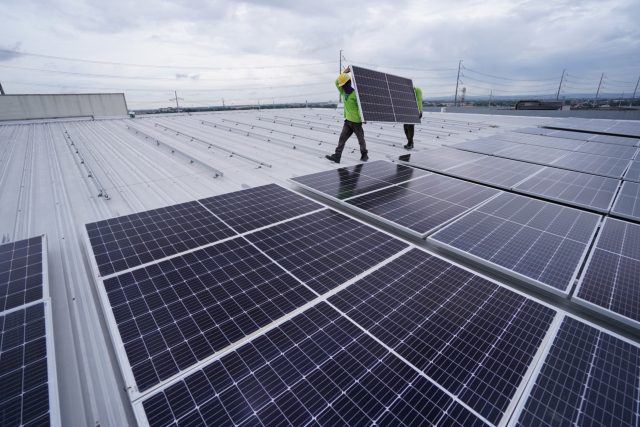
Solar panels are being installed on the roof of a mall. — GREEN HEAT HANDOUT PHOTO

THE PHILIPPINES’ private investments in green projects declined in 2024 as higher investments in solar and wind energy projects were offset by the drop in waste management and green cement projects.

Private green investments in the Philippines went down by 12% to $1.28 billion in 2024 from $1.46 billion in the previous year, according to the 2025 Southeast Asia’s Green Economy report by Bain & Company, GenZero, Standard Chartered and Temasek.

Investments in solar and wind energy projects surged 1.5 times and six times, respectively, the report showed.

However, these were offset by the reductions in investments in the waste management and green cement sectors.

The Philippines accounted for 16% of the total investments in SEA-6 (Southeast Asia-6), which is composed of Thailand, Malaysia, Singapore, Indonesia, the Philippines, and Vietnam.

Green investments in SEA-6 surged by 43% year on year to $8 billion in 2024, with Malaysia and Singapore contributing over 60% of deals, according to the report.

Power accounted for two-thirds of green investments in the region as the size of deals increased.

Investments in solar surged by 100% while waste management deals jumped by 60% year on year.

According to the report, a systems-based approach and wider collaboration in the region could drive growth in Southeast Asia’s green economy.

“(This) could drive significant regional economic impact – with SEA-6 economies potentially reaping up to $120 billion in GDP (gross domestic product) growth, 900,000 new jobs, and closing up to 50% of the emissions gap by 2030,” it said.

The report defined system-level solutions as “high-impact interventions that address systemic barriers across multiple systems to deliver transformative and amplified impact.”

It said that this approach could address cross-cutting barriers; maximize return on investment, and co-benefits; and prevent “negative, unintended spillovers” across systems.

Dale Hardcastle, co-director of Bain & Company’s Global Sustainability Innovation Center, said Southeast Asia may see an acceleration in the development of the green economy as governments and companies pivot priorities.

“By focusing on scalable, high impact systems-level solutions, Southeast Asia can rewrite the green economy playbook and turn current challenges into opportunities. The need now is to drive two key outcomes in parallel — significant emissions reduction and sustained economic growth — ensuring that the region not only meets its climate goals but also builds long-term resilience and prosperity,” he said.

While corporations in most of the six Southeast Asian countries show progress in setting targets and establishing roadmaps, there is a significant gap in green investments.

“With just five years to 2030, our window for action to avoid the worst effects of climate change is rapidly closing. We need to increase the momentum and focus on pragmatic solutions with near-term impact,” said Franziska Zimmermann, managing director for sustainability at Temasek.

“Stakeholders in this region have an opportunity to drive transformative, systems-level change that can balance energy security, sustainability, and economic growth,” she added.

The report noted the progress made in the Philippines in terms of infrastructure and technology brought by improved grid interconnectedness and electric vehicle (EV) charging stations.

There are 912 publicly accessible charging stations operational as of March 31, according to the Department of Energy.

Under the Comprehensive Roadmap for the Electric Vehicle Industry, the Philippines targets to deploy 7,300 EV charging stations by 2028.

The report said national energy plans such as the National Renewable Energy Program (NREP) and Clean Energy Finance and Investment Roadmap offer clearer direction for renewables and financing.

Under the NREP, the Philippines seeks to significantly increase the share of renewable energy in the country’s power generation mix to 35% by 2030 and 50% by 2040. — S.J.Talavera

ADB urges PHL to boost investments in agri, energy

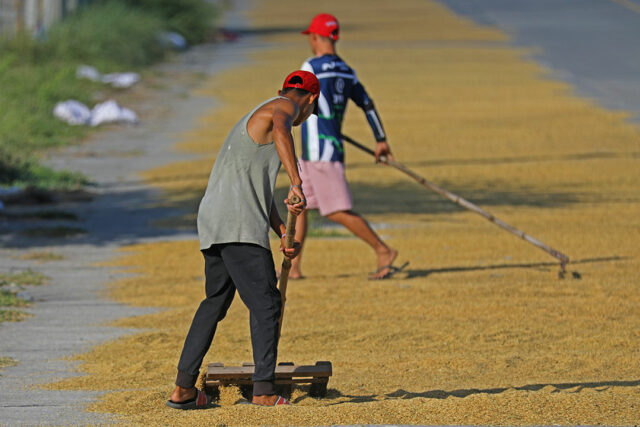
Farmers dry grains on a highway in Zambales. — PHILIPPINE STAR/WALTER BOLLOZOS

MILAN, Italy — The Asian Development Bank (ADB) said the Philippines can benefit from shifting trade dynamics if it can make bigger investments in key sectors like energy and agriculture to boost its capacity for trade.

“It’s a multi-faceted agenda, but I think there’s a lot of potential for the Philippines both in a regional market, but also globally,” ADB Vice-President for Operations in East and Southeast Asia and the Pacific Scott Morris said at a media briefing on Tuesday.

“But so much of the future ambition for the country, including increasing its overall exports within the region globally, is making the domestic investments that will better enable that.”

The Philippines is an outlier in terms of direct exposure to the tariffs, Mr. Morris said.

Compared with its neighbors, the Philippines was relatively spared from the United States’ steep reciprocal tariffs, as it was slapped with a 17% rate. This is the second-lowest tariff in the region, after Singapore’s baseline 10% duty.

These tariffs have been put on pause until July, though the baseline rate of 10% remains in effect.

“But fundamentally, on these issues of export, import, overall trade orientation, I think the Philippines government recognizes the need to be more competitive. A big part of our agenda is on core competitiveness issues,” Mr. Morris said.

“How does the Philippines, as a market, make itself more attractive for foreign direct investment? That’s been a leading priority and attached to that is a wide range of issues.”

He cited the need for the country to invest in high-quality transport infrastructure and improve the regulatory environment, especially related to the energy sector.

“How do you ensure that you have affordable and sustainable energy for a growing economy? That is a leading issue for the Philippines right now.”

Mr. Morris also highlighted the need to ramp up investments in agriculture.

“Within the agricultural sector, for example, there needs to be stronger investments in the transport side of that, so that agricultural producers can get product to market more efficiently, and that will enable more export growth overall.”

Meanwhile, Mr. Morris said the Association of Southeast Asian Nations (ASEAN) should work to secure further cooperation to cushion the impacts from these tariff policies.

“I think each country within ASEAN is seeking to engage bilaterally with the US, but our message to the region is to use this opportunity to forge greater regional integration,” he said.

“It is always, in our view, the best path forward for each country in the region to be looking for greater levels of integration that can start within ASEAN. There’s a robust agenda here, not just more trade within the region per se, but even addressing the physical infrastructure needs around a more integrated regional economy.”

He said there have been significant energy commitments in the region, such as the ASEAN Power Grid.

“There’s a wide range of these sorts of activities that ASEAN countries can be looking at. Even on the human side, a greater flow of people across the region, easier flow, fewer barriers to entry, can forge a stronger regional economy and stronger national economies within that. We’re excited to be supporting all those initiatives.”

Economies can also seek to diversify their markets not just within the region, but globally too, Mr. Morris said.

“For countries in the region, they can be thinking about other regions, other large national economies. I think all of that needs to be on the table. I think there is an orientation toward strengthening through formalized trade agreements.”

“That can always be a very constructive path. But absolutely, we think in economic terms, you have to think about where the other large regional economies are, national economies, and how those ties can be strengthened for the ASEAN countries,” he added. — Luisa Maria Jacinta C. Jocson

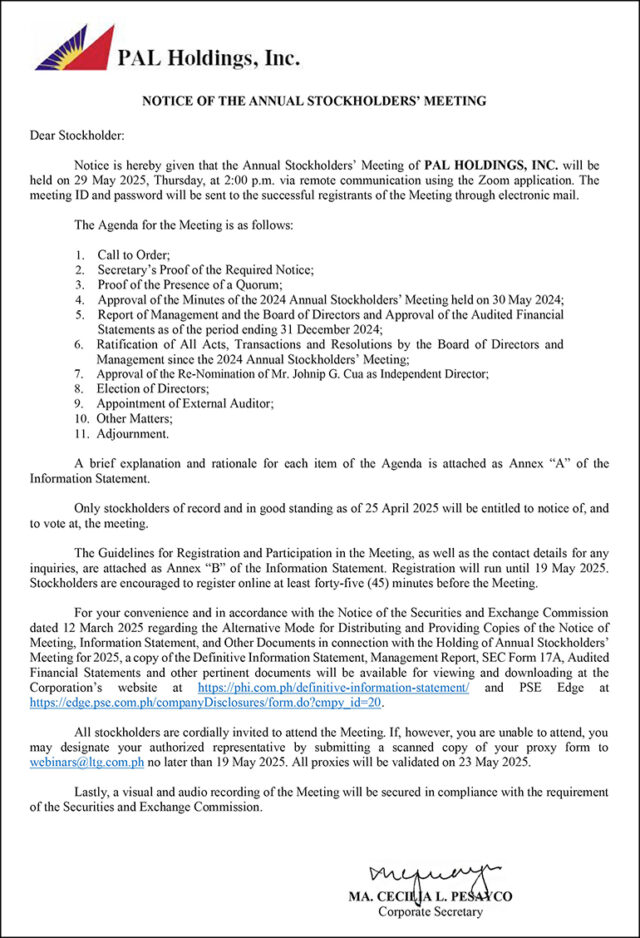
PAL Holdings, Inc. to conduct Annual Stockholders’ Meeting on May 29 via Zoom


Spotlight is BusinessWorld’s sponsored section that allows advertisers to amplify their brand and connect with BusinessWorld’s audience by publishing their stories on the BusinessWorld Web site. For more information, send an email to online@bworldonline.com.

Join us on Viber at https://bit.ly/3hv6bLA to get more updates and subscribe to BusinessWorld’s titles and get exclusive content through www.bworld-x.com.

Ginebra San Miguel, Inc. to hold Regular Stockholders’ Meeting on May 29 via remote communication

GINEBRA SAN MIGUEL INC.

NOTICE OF THE REGULAR STOCKHOLDERS’ MEETING

May 29, 2025

NOTICE is hereby given that the Regular Stockholders’ Meeting of Ginebra San Miguel Inc. (the “Company”) will be held on Thursday, May 29, 2025, at 2:00 P.M, via remote communication and livestreamed at the Company’s website:  http://www.ginebrasanmiguel.com. Only stockholders of record at the close of business hours on April 25, 2025 are entitled to vote at this meeting.

The Agenda of the Meeting is as follows:

  1. Call to Order/Certification of Notice and Quorum
  2. Approval of the Minutes of the Regular Stockholders’ Meeting held on May 30, 2024
  3. Presentation of the 2024 Annual Report
  4. Ratification of Acts and Proceedings of the Board of Directors and Corporate Officers
  5. Election of Directors
  6. Appointment of External Auditor
  7. Other Matters
  8. Adjournment

An explanation for each agenda item is shown in Appendix 1 of the Definitive Information Statement (DIS).

As approved by the Board of Directors, attendance to the meeting will be via remote communication in compliance with SEC Memorandum Circular 6, Series of 2020, and questions will be sent only through a dedicated email address.  Stockholders should access the Company’s website to access the link to view the livestream of the meeting which will be available on the day of the meeting. Stockholders of record as of April 25, 2025, who intend to attend the meeting are requested to register by notifying the Company through email at gsmirsm@ginebra.sanmiguel.com.ph, not later than May 15, 2025. The procedure and further details for attending the meeting through remote communication are set forth in Appendix 2 of the DIS. There will be a visual and audio recording of the meeting.

Votes will be cast only through ballots or proxies. Ballots and proxies may be submitted to the Corporate Secretary through email at gsmirsm@ginebra.sanmiguel.com.ph, which shall be acknowledged and validated with the assistance of the Company’s stock transfer agent, SMC Stock Transfer Service Corporation. Validated ballots and proxies will be considered for purposes of determining quorum and voting results. For your convenience, a sample of a ballot/proxy is attached as Appendix 3 of the DIS. For an individual, his ballot or proxy must be accompanied by a valid government-issued identification card with a photo. For partnerships, corporations or associations, the proxy must be accompanied by a notarized Secretary’s Certificate stating the representative’s authority to represent the corporation in the meeting.   Proxies need not be notarized. Stockholders who provide their personal information shall be deemed to agree to the collection and processing of their personal information in accordance with the Company’s privacy statement for its 2025 RSM posted on its website.

The deadline for the submission of ballots and proxies is on May 15, 2025. Validation of ballots and proxies will be on May 23, 2025 at 10:00 a.m. at the SMC Stock Transfer Service Corporation Office, 2nd Floor, SMC Head Office Complex, No. 40 San Miguel Ave., Mandaluyong City, Philippines.

A copy of the full version of the DIS together with all its annexes, including the 2024 Audited Consolidated Financial Statements and 17-Q (1st Quarter 2025) can be found in the Company’s website through the link https://www.ginebrasanmiguel.com/company-disclosures/ (In the SEC Filings tab, please Click “SEC Form 20-IS Information Statement”, then click “2025”), and in the PSE Edge, https://edge.pse.com.ph/.

 A copy of the Company’s SEC Form 17-A and 17-Q (1st Quarter 2025) can also be found in the Company’s website through the link https://www.ginebrasanmiguel.com/company-disclosures/ (In the SEC Filings tab, please click the desired report), and in the PSE Edge, https://edge.pse.com.ph/.

A stockholder may request for a copy of the full version of the DIS, SEC Form 17-A and/or SEC Form 17-Q. Any of the foregoing requests, which shall be provided by the Company free of charge, should be in writing and addressed to: SMC Stock Transfer Service Corporation, 2nd Floor, San Miguel Corporation No. 40 San Miguel Avenue, Mandaluyong City,1550 Metro Manila, Philippines.  


(Original Signed)

Virgilio S. Jacinto

Corporate Secretary


Spotlight is BusinessWorld’s sponsored section that allows advertisers to amplify their brand and connect with BusinessWorld’s audience by publishing their stories on the BusinessWorld Web site. For more information, send an email to online@bworldonline.com.

Join us on Viber at https://bit.ly/3hv6bLA to get more updates and subscribe to BusinessWorld’s titles and get exclusive content through www.bworld-x.com.

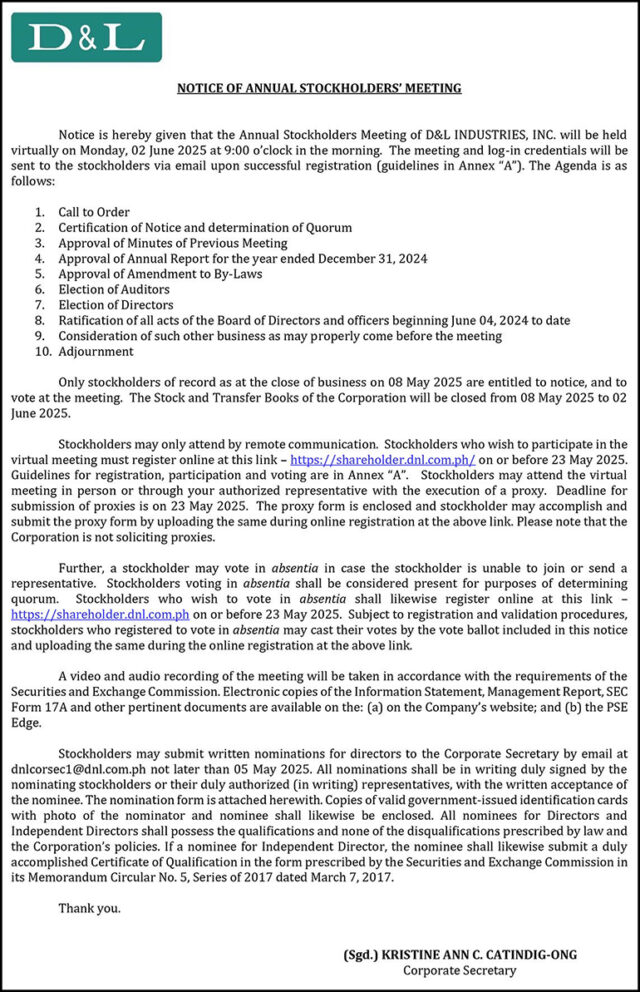
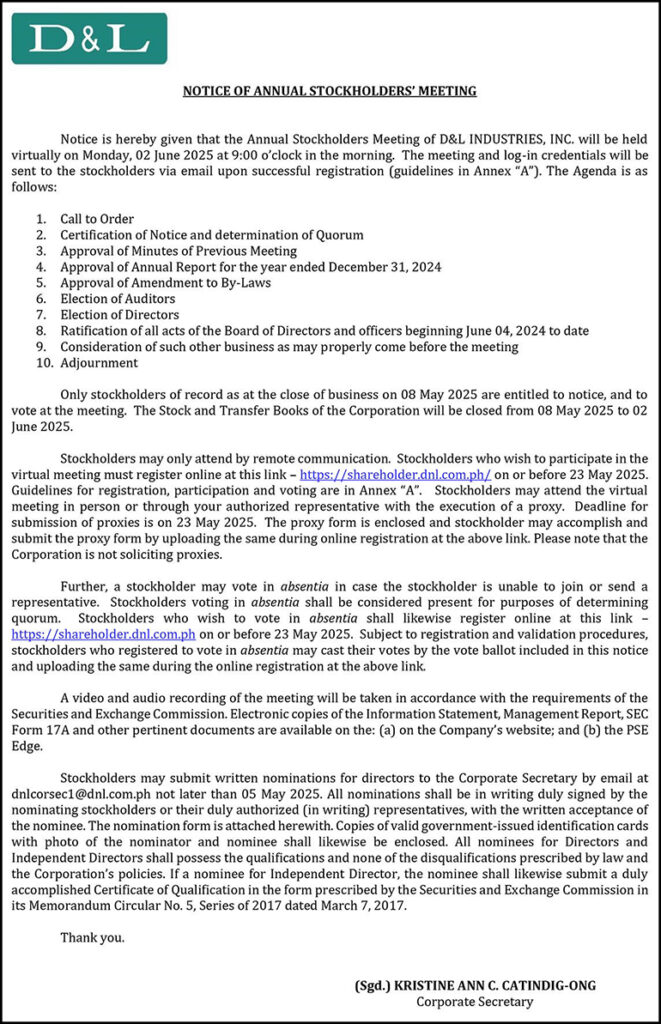
D&L Industries, Inc. to hold virtual Annual Stockholders’ Meeting on June 2


Spotlight is BusinessWorld’s sponsored section that allows advertisers to amplify their brand and connect with BusinessWorld’s audience by publishing their stories on the BusinessWorld Web site. For more information, send an email to online@bworldonline.com.

Join us on Viber at https://bit.ly/3hv6bLA to get more updates and subscribe to BusinessWorld’s titles and get exclusive content through www.bworld-x.com.

Philippine Business Bank to hold Annual Stockholders’ Meeting via Zoom on May 30


Spotlight is BusinessWorld’s sponsored section that allows advertisers to amplify their brand and connect with BusinessWorld’s audience by publishing their stories on the BusinessWorld Web site. For more information, send an email to online@bworldonline.com.

Join us on Viber at https://bit.ly/3hv6bLA to get more updates and subscribe to BusinessWorld’s titles and get exclusive content through www.bworld-x.com.

Leasing, property dev’t lift ALI’s Q1 profit to P6.9B

THE COURTYARDS at Vermosa, Dasmariñas, Cavite. — AYALALAND.COM

LISTED real estate developer Ayala Land, Inc. (ALI) posted a 10% increase in its first-quarter (Q1) net income to P6.9 billion from P6.3 billion a year earlier, led by leasing operations and property development revenue.

Consolidated revenue rose by 6% to P43.6 billion from P41 billion, ALI said in a regulatory filing on Tuesday.

Property development revenue increased by 11% to P27.8 billion on contributions from premium residential offerings and commercial and industrial lots for sale.

Residential revenue improved by 3% to P22 billion, led by the resilience of the premium segment, while commercial and industrial lot revenue more than doubled to P5.7 billion due to strong sales at Arca South in Taguig City.

Property development reservation sales rose by 4% to P36.2 billion, as premium residential sales grew by 4% to P20.7 billion, and take-up of commercial and industrial lots more than tripled to P4.9 billion.

The contribution of the core residential segment to total sales declined to P10.5 billion.

ALI launched four projects worth P12.6 billion during the quarter, comprising Ayala Land Premier’s Virendo in Toril, Davao, and sequel phases of Ayala Westgrove Heights and Amaia Scapes General Trias, both in Cavite.

Leasing revenue rose by 7% to P11.6 billion on stable occupancy amid ongoing renovations across malls and hospitality assets.

Shopping center revenue increased by 4% to P5.7 billion, led by growing contributions from core and emerging malls. Office revenue rose by 4% to P2.9 billion on higher lease rates and better-than-industry occupancy levels.

Revenue from hotels and resorts expanded by 10% to P2.6 billion due to improving occupancy and room rates, while revenue from warehouses, cold storage, and industrial land grew by 60% to P357 million.

Capital expenditures during the first quarter reached P20.6 billion, of which 46% went to the build-out of residential projects, 30% to the development of infrastructure within estates, 16% to leasing and hospitality assets, and 9% to continuing land acquisition commitments.

“As we close the first quarter of 2025, I am pleased to share that ALI remains firmly on track — guided by discipline, resilience, and long-term perspective — even as we navigate today’s complex macroeconomic landscape,” ALI President and Chief Executive Officer (CEO) Anna Ma. Margarita Bautista-Dy said.

“We are energized with what lies ahead and continue to deliver sustainable long-term value for all our stakeholders,” she added.

Meanwhile, ALI said in a separate statement that its Ayala Land Leisure Estates unit has signed a land lease agreement with Pangilinan-led Metro Pacific Agro Ventures, Inc. (MPAV), which will develop a greenhouse facility within the Lio Estate in El Nido, Palawan.

The facility, with a 100,000-kilogram capacity, will feature advanced farming technologies, including hydroponics and climate-controlled environments. It will supply vegetable produce to Lio Estate’s hospitality establishments — Seda Lio, Huni, and The El Nido Resorts — as well as locators and the El Nido community.

“This project aligns with our mission to introduce cutting-edge farming techniques across the country. By establishing a greenhouse in Lio Estate, we aim to demonstrate the viability of sustainable agriculture even in remote locations,” MPAV President and CEO Jovy I. Hernandez said.

MPAV is the agriculture unit of Metro Pacific Investments Corp. (MPIC). It has businesses in vegetable production, coconut processing and export, integrated dairy processing, and ice cream.

MPIC is one of three key Philippine units of First Pacific, the others being Philex Mining Corp. and PLDT Inc.

Hastings Holdings, Inc., a unit of PLDT Beneficial Trust Fund subsidiary MediaQuest Holdings, Inc., has a majority share in BusinessWorld through the Philippine Star Group, which it controls.

ALI shares dropped by 0.61% or 15 centavos to P24.30 apiece on Tuesday. — Revin Mikhael D. Ochave