Home Blog Page 119

BSP to pause easing as oil shock stokes inflation

PHILIPPINE STAR/ MIGUEL DE GUZMAN

THE BANGKO SENTRAL ng Pilipinas (BSP) could pause its easing cycle even as rising cost pressures due to the spike in global oil prices amid the war in Iran are expected to stoke inflation in the near term.

“Headline inflation could spike in March to April as fuel prices rise but with (average) inflation in ’26 and ’27 still within BSP’s inflation target range,” Citi Philippines said in an e-mailed note on Wednesday. “We maintain our call for a BSP pause but reserve the possibility of a shallow hiking cycle in the event oil prices turn more bullish versus Citi’s base-case.”

“The BSP Governor has indicated a rate hike possibility if oil prices reach $100 per barrel and the US dollar rallies, reversing its dovish policy stance in February… However, we maintain our base-case forecast for an extended BSP rate pause. The case for immediately hiking is not yet as compelling as during the 2022 oil shock which led to rate increases totaling multiple [percentage points].”

Last week, BSP Governor Eli M. Remolona, Jr. said headline inflation could breach 4% if oil hits $100 a barrel, adding that if fuel prices rise sharply and persistently, they could be forced to tighten their policy stance.

The Monetary Board last hiked borrowing costs in October 2023. It began its current easing cycle in August 2024 and has lowered rates by a total of 225 basis points (bps), bringing the key policy rate to its lowest in over three years at 4.25%.

Oil surged past $100 a barrel (/bbl) on Monday to the highest since mid-2022 as supply concerns due to the ongoing war in the Middle East drove up prices.

On Wednesday, Brent crude futures swung between gains and losses in volatile trade, falling 0.4% to $87.45 per barrel, while US crude was up 0.3% at $83.67 a barrel, Reuters reported.

The BSP sees inflation averaging 3.6% this year and 2.8% in 2027, according to its latest forecasts, which are based on assumptions that Dubai crude oil prices would average $64.66 and $64.08 per barrel, respectively, the February 2026 Monetary Policy Report showed.

The central bank said in the report that if oil prices average more than $65/bbl this year, this would push inflation further away from the 3% target, while if Dubai crude oil prices average $80/bbl in 2026 and 2027, headline inflation would breach the upper end of the 2%-4% tolerance band.

It added that these projections consider only direct effects and exclude potential second-round impacts.

Citi said oil prices of $80 to $90 per barrel could bring inflation closer to 4% by April, before easing in May to average 3.6% by yearend.   

“The near-term forecast change also covers expected increases in fuel and LPG (liquefied petroleum gas) prices, as well as electricity tariffs partially following higher coal prices,” the bank said. “We have yet to incorporate second-round impacts, e.g. public transport tariff hikes, nor broader core CPI (consumer price index) pressure from imported pass-through. These factors, however, could be penciled-in, along with a sharper inflation spike, if Citi’s oil bull-case scenario of Brent hitting $120/bbl in (the second quarter) draws closer.”

It said that in the event oil prices stay above $100 for multiple weeks, the BSP could deliver one or two 25-bp hikes. “Such scenario would risk de-anchoring inflation expectations thereby requiring a policy response.”

Meanwhile, Pantheon Macroeconomics said Philippine inflation may accelerate past the central bank’s “sweet spot” of 3% this month as hefty oil price hikes weigh on consumers.

In a note on Wednesday, Pantheon Macroeconomics Chief Emerging Asia Economist Miguel Chanco and Asia economist Meekita Gupta said headline inflation could pick up to 3.3% from 2.4% in February.

“We reckon the monthly average cost of petrol and diesel this month will jump by at least 23% and 24% month-to-month, respectively,… in stark contrast to the average decline of -1.4% in the three months to February,” they said.

“Transport inflation would leap comfortably above 5% in the March report if we’re right, a world away from the outright, albeit mild, deflation in January-to-February. This would push the headline to 3.3% from 2.4% previously, marking the first 3%-plus print in 19 months.”

Oil companies this week rolled out staggered fuel pump price increases amid the conflict in Iran. The Philippines is a net importer of oil and relies heavily on Middle East crude, which accounts for roughly 98% of its imports.

Meanwhile, Pantheon Macroeconomics expects inflation to average 3.2% this year, up slightly from its earlier projection of 3.1%.

“The firmer outlook for global oil prices throughout 2026 is also likely to mean that housing & utilities inflation, which responds with a slightly longer lag to global energy prices, should remain stickier for longer. In terms of monetary policy, our revised projections see inflation remaining within the BSP’s 2-to-4% target range. As a result, we reiterate our view that the target reverse repo (repurchase) rate will stay at 4.25% for the foreseeable future.”

GROWTH IMPACT
Citi added that the Middle East war could weigh on remittances and household consumption, which may affect first-quarter economic growth,

“The ongoing oil shock presents a headwind for the recovery: PH has announced a four-day workweek, which could reduce mobility and affect retail sales,” it said.

“Incoming remittances could also be impacted if PH workers from the Middle East are repatriated as result of the conflict. The resilience of household purchasing power will also be tested given the hike increase in fuel prices,” Citi added.

The economy has been in a slump since the second half of 2025 as investments, public consumption and government spending slowed amid weak sentiment due to the flood control corruption scandal.

Gross domestic product growth hit a post-pandemic low of 4.4% in 2025 as the economy only expanded by 3.9% in the third quarter and 3% in the fourth quarter — all well below the government’s 5.5%-6.5% target.

The BSP earlier said that the economy may start to rebound by the second half of the year, with growth averaging 4.6% by yearend, as they have seen signs of a tentative recovery in investor confidence. — Katherine K. Chan
First Gen starts construction of 54-MW Batangas solar farm

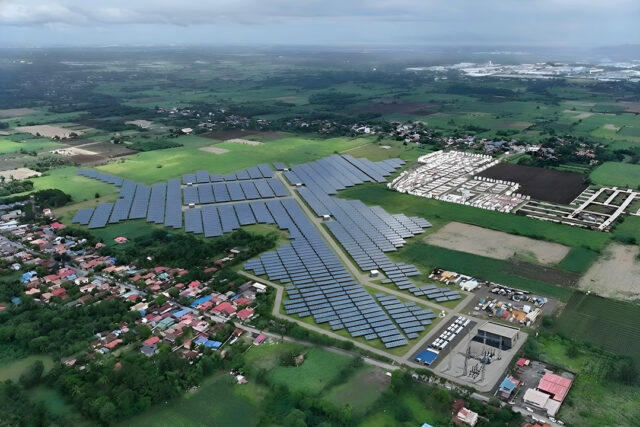
The planned solar farm in Batangas.— FIRST GEN CORP.

LOPEZ-LED power producer First Gen Corp. has started construction of a 54-megawatt (MW) solar farm in Batangas, marking the company’s entry into utility-scale solar projects.

In a statement on Wednesday, the company said it had broken ground on the Inara Solar Power Plant Project in Tanauan, with the project cost estimated at P2.1 billion.

Batangas Gov. Vilma Santos-Recto and other local government officials joined First Gen President and Chief Operating Officer Francis Giles B. Puno and other company officials at the project’s groundbreaking ceremony.

First Gen’s first utility-scale solar power project will cover a 36-hectare property, which includes space for a potential expansion to 100 MW and the possible integration of a battery energy storage system to support operational flexibility and grid stability.

“Solar brings accessibility, scalability, and abundance — allowing clean energy to be deployed more rapidly and across many locations. Through this project, we aim to expand renewable energy in a way that continues to create opportunities for both communities and industries,” Mr. Puno said.

Aside from supplying electricity to the grid, the company plans to incorporate a provision for agri-photovoltaics (agri-PV) in the facility’s design, which combines agriculture and solar power generation within the same area.

“This [agri-PV approach] means farmers can continue cultivating crops even as solar panels generate electricity above,” Mr. Puno said. “Energy production does not have to displace agriculture; the two can work together, allowing the same land to support both food production and clean energy.”

Once completed, the solar farm will supply electricity to First Philippine Industrial Park, a 520-hectare economic zone that hosts more than 150 locators.

The facility is also expected to help improve the quality and reliability of services provided by the Batangas Electric Cooperative (Batelec) II by embedding the project within its distribution system.

The Inara project is scheduled for completion by the summer of next year and forms part of the First Gen Group’s plan to expand its capacity to 13,000 MW by 2030.

First Gen currently has about 1,700 MW of generating capacity from 30 hydropower, geothermal, solar, and wind facilities across the country. — Sheldeen Joy Talavera

Term deposit yields drop as offer sees strong bids

BW FILE PHOTO

YIELDS on the Bangko Sentral ng Pilipinas’ (BSP) term deposits slipped on Wednesday as the offer was met with strong demand after it reduced the offer volume.

The central bank’s seven-day term deposit facility (TDF) attracted a total of P101.747 billion in bids, exceeding the P80-billion offer but below the P106.568 billion in tenders for the P90 billion auctioned off last week.

This was equivalent to a bid-to-cover ratio of 1.2718 times, higher than the 1.1841 ratio during the previous auction.

The BSP fully awarded P80 billion in papers.

Accepted yields ranged from 4% to 4.26%, wider and lower than the 4.05% to 4.28% band seen a week ago. With this, the average accepted rate of the one-week papers edged down by 0.43 basis point (bp) week on week to 4.2297% from 4.234% previously.

“The seven-day BSP TDF average auction yield (was) again marginally lower…, slightly lower than the key local policy rate of 4.25% despite the recent market volatility, as this could reflect excess peso liquidity in the financial system, as manifested by total demand still above P100 billion,” Rizal Commercial Banking Corp. Chief Economist Michael L. Ricafort said.

Domestic liquidity grew by 8.6% to P19.711 trillion in January from P18.149 trillion a year ago. This was the fastest growth in nearly five years or since the 9.5% in February 2021.

Mr. Ricafort added that the peso’s recovery after it hit a new all-time low at the start of the week due to the surge in global oil prices to past $100 a barrel amid the Middle East war helped ease inflation concerns.

BSP Governor Eli M. Remolona, Jr. last week said that oil climbing to $100 per barrel could drive inflation above 4%, which could prompt the central bank to end its easing cycle and hike rates for the first time in over two years.

Mr. Remolona said they aim to keep inflation between 2% and 4%, with 3% as their “sweet spot.”

The Monetary Board has lowered borrowing costs by a cumulative 225 bps since it began easing in August 2024, bringing the policy rate to an over three-year low of 4.25%.

The central bank uses the TDF and BSP bills to mop up excess liquidity in the financial system and better guide market rates towards the policy rate.

It last auctioned off both the seven-day and 14-day deposits on Oct. 29. Meanwhile, it has not offered 28-day term deposits for over five years to give way to its weekly offerings of securities with the same tenor.

BSP Deputy Governor Zeno Ronald R. Abenoja earlier said that the central bank has reduced its issuance of short-term papers to enhance monetary policy transmission and push banks to better manage their liquidity.

Based on the BSP’s latest monetary policy report, its market operations have absorbed P1.5 trillion in liquidity from the market as of mid-November 2025, with 5.4% of this being siphoned off via the term deposit facility. — Katherine K. Chan

Equinix sees data center demand staying resilient

BW FILE PHOTO

By Ashley Erika O. Jose, Reporter

GLOBAL DIGITAL infrastructure firm Equinix, Inc. expects the data center sector to remain resilient, with demand continuing to grow despite the ongoing conflict involving the United States, Israel, and Iran.

“Dramatic geopolitical change is nothing new. I think increasingly though, our global industry is understanding all the more clearly the need for resilience and redundancy in the infrastructures that we build to power the services which are so critical to our everyday lives today,” Equinix Vice-President for Growth and Emerging Markets in Asia-Pacific Max Parry said in a roundtable interview last week.

The company’s data center facilities in the Philippines are powered by renewable energy, he said, shielding them from potential price shocks as fuel costs soar, which could trigger higher electricity prices across the country.

“We are 100% covered by renewable energy, so there’s full confidence in this market from that perspective. We are continually innovating in that area to try and get our energy usage as optimal as possible.”

Oil companies this week rolled out staggered fuel pump price increases as global prices of the commodity have surged amid the conflict in Iran, which has led to the closure of the Strait of Hormuz, disrupting oil trade.

The Philippines is a net importer of oil and relies heavily on Middle East crude, which accounts for roughly 98% of its imports.

Equinix expanded its presence in the Philippines in 2025, with the opening of a total of three data centers in Cavite and Makati. The facilities were acquired a year earlier from Total Information Management Corp., marking the company’s entry into the country’s fast-growing data infrastructure market.

Mr. Parry said part of the company’s considerations for site selection is the availability of power and its ability to secure renewables to power its data center facilities as sustainable and reliable energy sources are considered crucial in their operations.

“[Power source] is important when we are looking for a site, it is also something which we focus on when we design and operate those sites,” he added.

Equinix has also expressed its optimism in the sector amid rising artificial intelligence adoption in the information technology-business process outsourcing industry, and the continued digitalization of the telecommunications and banking sectors.

The company’s facilities in the Philippines have about 35,000 square feet of colocation space, with a combined capacity of 1,000 data cabinets.

Mr. Parry said they are ready to boost the capacity of their existing facilities in the country to capture growing demand, adding that its data centers, particularly those in Cavite, are equipped for any potential expansion.

The Department of Information and Communications Technology expects that the country’s data center capacity could reach 1.5 gigawatts by 2028 from nearly 200 megawatts at present.

Maynilad eyes further investments in New Clark City

NEWCLARK.PH

WEST ZONE concessionaire Maynilad Water Services, Inc. plans to increase its investments in New Clark City over the next five years as part of its long-term expansion strategy.

“We’re operating deep wells for New Clark City for the immediate locators that are already there inside New Clark City, and I guess the main investments will come within five years,” Maynilad President and Chief Executive Officer Ramoncito S. Fernandez said on Money Talks with Cathy Yang on One News on Wednesday.

He said the company continues to focus on serving commercial and industrial consumers in its west concession area while exploring opportunities in emerging urban centers.

Maynilad and its partner, Korean Water Resources Corp., have submitted a P15-billion unsolicited proposal to the Public-Private Partnership Center to develop a water supply and management system for New Clark City.

The proposal remains subject to approval by the Bases Conversion and Development Authority (BCDA).

“It’s a medium to long-term investment that we’re putting in once the BCDA will approve our unsolicited proposal,” Mr. Fernandez said.

He also said the company is exploring partnerships with water districts that require sustainable and potable water supply within and outside the Bulacan and Cavite areas.

“These are the growth areas that we’re looking at for the future, creating long-term value for Maynilad,” Mr. Fernandez said.

Maynilad provides water and wastewater services in the West Zone, which covers 11 cities in Metro Manila, three of which have partial coverage, as well as parts of Cavite province.

Metro Pacific Investments Corp., Maynilad’s majority shareholder, is one of three Philippine subsidiaries of First Pacific Co. Ltd., alongside Philex Mining Corp. and PLDT Inc.

Hastings Holdings, Inc., a unit of PLDT Beneficial Trust Fund subsidiary MediaQuest Holdings, Inc., has an interest in BusinessWorld through the Philippine Star Group, which it controls. — Sheldeen Joy Talavera

RCBC eyes double-digit card loan growth

PHILSTAR FILE PHOTO

RIZAL COMMERCIAL Banking Corp. (RCBC) is targeting double-digit loan growth for its credit cards business as it continues to grow its consumer business.

“I think we’re constantly innovating and we’re constantly growing our business, attracting new customers, and also gaining more loyalty from our customers. The growth will be there. We want them to appreciate the product and service that we’re going to offer to our clients. I’m not going to put a particular number to it, but I’m confident that clients will be very happy,” RCBC President and Chief Executive Officer Reginaldo Anthony B. Cariaso told reporters on the sidelines of the launch of the RCBC Airmiles Visa Signature Card late on Tuesday.

The bank’s credit card receivables grew by 32% year on year in 2025, driven by the acquisition of affluent customers that also resulted in an 18% increase in issued cards, it said.

RCBC Credit Cards President and Chief Executive Officer Arniel Vincent B. Ong said at the same event that total credit cards in force stood at 1.5 million, which he expects to continue growing at a double-digit pace, contributing to the bank’s aggressive consumer expansion.

“The cards business has been one of the fastest growing portfolios of the bank. As we push more into the consumer segment, if you look at RCBC, that’s not going to change. We will continue to drive growth through our consumer business. And credit cards is one of those pillars.”

Mr. Ong said credit card loans make up close to half of the bank’s total consumer portfolio. Of the bank’s total credit card transaction value, more than half are coming from the affluent segment.

“We’ve been making a stronger position on the affluent segment for the last three to four years since the exit from the pandemic. That’s been a very conscious decision that we’ve made. A lot of our products, features, and promotions have really been trying to capture the mass affluent and the affluent segment needs.”

The RCBC Airmiles Visa Signature Card launched on Tuesday, which replaces its current travel miles card offering, also caters to the affluent segment.

The new card features 1.5% foreign exchange conversion fee, unlimited airport lounge access worldwide, up to P20 million in travel insurance coverage, and up to 36-month installments via the RCBC Pulz app.

Mr. Ong said holders of the bank’s previous miles card will be moved to the RCBC Airmiles Visa Signature Card by June.

Meanwhile, RCBC does not expect the war in the Middle East to materially affect their operations, but they will continue to monitor developments for potential risks, he added.

“Depending on how long this war happens, it can cause inflationary pressures on the prices of goods locally, which means it will eat into the disposable income of customers. At RCBC, even during the pandemic, what we have always done is to help our customers who are struggling so that if they have a problem, we can help them… Those things will continue. So, as a bank, we’re just preparing for those things,” Mr. Ong said.

“Let’s just say we are on top of it. We’re dimensioning that risk at the moment. It’s a very live discussion. So, it’s hard to say at this point. But the bank is taking a proactive stance to manage those risks.”

RCBC’s net income rose by 11% year on year to P10.6 billion in 2025.

Its shares closed at P23.90 apiece on Wednesday, down by 10 centavos or 0.42% from Tuesday’s finish. — Aaron Michael C. Sy

No fools: April is Filipino Food Month

REPRESENTATIVES of the Department of Agriculture along with Assistant Secretary Genevieve E. Velicaria-Guevarra (2nd from right).

THANKS to Presidential Proclamation No. 469, we celebrate Filipino Food Month every April, usually with a long list of activities filling the month, from food tours to festivals, conferences to cultural presentations. And due to the Philippines’ assumption of the chair for the Association of Southeast Asian Nations (ASEAN), this year’s theme, “Connected by Taste: Filipino Food in the Flavors of ASEAN” emphasizes our ties with the Southeast Asian neighborhood.

Proclaimed in 2018 by former President Rodrigo R. Duterte, it says, “The Department of Agriculture (DA) and the National Commission for Culture and the Arts (NCCA) shall lead the above celebration. All departments, bureaus and agencies of the national government, including government-owned or -controlled corporations, and state universities and colleges, are hereby directed, and local government units (LGUs) and the private sector are encouraged, to participate and assist in the activities of the celebration.”

Slated activities include the official launch and opening of this year’s Filipino Food Month in Iloilo City and Camarines Sur on April 6. Iloilo will host the national launch and major activities for the month due to its UNESCO status as first Creative City of Gastronomy in the Philippines. A DA-initiated Kadiwa Pop-Up Store will open on April 2, prior to the opening ceremonies.

The Iloilo opening ceremonies will also see a Welcome Dinner for ASEAN delegates, and a Gastronomy and Heritage Tour of Iloilo on April 8, and ending with a send-off dinner at Newport World Resorts on the same day.

CONFERENCES AND FESTIVALS
KainCon, an academic conference featuring papers on Filipino food, will be held on April 16 to 18, and Hapag ng Pamana — food festivals focusing on local delicacies — in Zamboanga and Marawi City on April 18 and April 27 to 29 respectively. There will also be a Hapag ng Pamana event in Nueva Ecija from April 22 to 24.

A series of festivals will also be celebrated during Filipino Food Month, namely the Balikutsa Festival celebrating the pulled candy, in Santa Maria, Ilocos Sur on April 25; the Halo-Halo Festival, focusing on the shaved ice dessert, in Sultan Kudarat, Mindanao on April 26; the Taraon Festival that honors the culinary and cultural traditions of Infanta, Pangasinan and the Viva Binatbatan Festival of Arts in Vigan, Ilocos Sur, which focuses on the abel Iloco weaving tradition of the area, both on April 28; and the Kanen Festival, celebrating the kakanin or rice-flour based delicacies, of Urbiztondo, Pangasinan on April 30.

Throughout the month, there will be food heritage talks, regional food fairs, academic discussions, and cultural presentations that highlight the diversity of Filipino cuisine, from indigenous food traditions to contemporary culinary innovations, from other partner agencies.

The NCCA will be holding Food Fridates at the Likhang Filipino Exhibition Halls in Pasay City, during which different LGUs take over and focus on what they have to offer, with Mabalacat, Pampanga and Samar as leader LGUs on April 17 and 24 respectively.

Filipino Food Month is set to culminate and officially close on May 2 with a turnover ceremony.

OUR NEIGHBORS AND BACKYARD
In a speech at a press conference announcing the events of Food Month on March 6 at the Metropolitan Theater, NCCA Deputy Executive Director for Administration and Support Services Marichu G. Tellano said, “We dive into the scene connected by taste, with the goal of which is to highlight and showcase Filipino cuisine, not as an isolated agenda, not as an isolated island with different flavors, but a key player in the flavors of the ASEAN.

“We look at how our shared history with our neighbors has seasoned our identity, and how we can continue to grow together, one plate at a time,” she said. “Food is not just to feed us,” she added. “From life to death, really, food serves as a common connection.”

Before concentrating on our neighbors, it’s nice to know that we’re also looking out for our own backyard (literally). Genevieve E. Velicaria-Guevarra, the Agriculture Department’s assistant secretary for agribusiness, marketing and consumers, discussed their efforts in protecting heritage crops. “We’re trying to document the gene species,” she said in a Q&A during the press conference. The idea is to try to preserve the genes and DNA of native species, “Especially for our heritage rice. Also for our mangoes,” she said.

“We’re trying to preserve as much as we can right now. Hopefully, we can expand to further crops.”

In a similar thread, NCCA Chairman and Executive Director Eric Zerrudo said that more than consumption, what the agency cares about are the practices that surround food, and therefore build a food culture. “We don’t just look at the material product of food,” he said. “Food has always been viewed by the NCCA as a practice.

“We’re trying to protect the indigenized culture of food production, but we also have to be conscious that our exchanges with our nature, with our society, with our environment, would continue to evolve new tastes and new foods.”

Jose Antonio Miguel “Jam” Melchor, founder of the Philippine Culinary Heritage Movement, told BusinessWorld what ordinary citizens can do to help preserve food culture. “I think it’s important that we support local,” he said. That isn’t just a buzzword; it’s a concrete plan. “We support chefs that support local. That is somehow creating an economy na talagang mag-produce pa ng mas maraming local ingredients (that encourages the production of more local ingredients).” — Joseph L. Garcia

PHL financial industry’s digitalization to boost market reach, revenues

STOCK PHOTO | Image by jannoon028 from Freepik

BANKS AND INSURERS in the Philippines expect emerging technologies like artificial intelligence (AI) to help boost market penetration and their revenues, while also driving financial inclusion.

Bangko Sentral ng Pilipinas Managing Director Charina B. De Vera-Yap said on Tuesday that both banks and insurers need to work on reaching the underserved beyond account ownership and building resilience to protect families from unexpected shock.

Technology can be an enabler, but building consumer trust by ensuring that they are protected from various cyberthreats is critical, she said.

“Fraud can spread quickly. Misinformation circulates widely. Products may become more complex, and sometimes technology evolves faster than consumers can truly understand. So the challenge before us is not simply how to innovate. The real challenge is this: how do we ensure that innovation builds a system that is inclusive, resilient, and trusted? Because ultimately, trust is what makes financial systems sustainable,” she said in a speech at the Asian Banking & Finance and Insurance Asia Summit held on Tuesday.

Bank of the Philippine Islands (BPI) President and Chief Executive Officer Jose Teodoro K. Limcaoco, who is also president of the Bankers Association of the Philippines, said banks can expand their market penetration by offering different avenues for consumers to be part of the financial system.

“Financial inclusion is about allowing people to participate actively and progressively in the financial system, whether it’s through payment, whether it’s through transfers, making an investment, having access to cheap insurance or other financial services. And as financial services continue to evolve, so too must the role of banks to support this kind of everyday participation.”

For BPI, Mr. Limcaoco said the bank has expanded its physical and digital touchpoints through its agency and small and medium enterprise banking businesses, as well as its e-wallet Vybe.

As fraud and scam attempts remain more sophisticated and as consumers demand faster services, Globe Business Assistant Vice-President for Business Solutions Consulting Marlon Cruz said banks and insurers are shifting to real-time data processing to meet clients’ needs.

He said industry players are shifting to data streaming from processing information by the batch, which had the disadvantage of being outdated due to having waiting times.

“The waiting time is dead. From InstaPay to online shopping, our consumer wants instant. So, real-time data is making this happen,” Mr. Cruz said.

Insular Life Assurance Co., Ltd. Chief Product and Innovation Officer Jose Eduardo O. Ang likewise said the company is leveraging AI by using it to assist its agents or for chatbots for simpler transactions. — A.M.C. Sy

Peso drops again as Middle East war continues

BW FILE PHOTO

THE PESO dropped back to the P59 level against the dollar on Wednesday as uncertainty over the Middle East war weighed on sentiment.

The local unit dropped by 27.4 centavos to close at P59.17 against the greenback from its P58.896 finish on Tuesday, data from the Bankers Association of the Philippines showed.

The peso opened Wednesday’s trading session stronger at P58.888 per dollar. It climbed to a high of P58.77 but failed to hold on to its gains, closing at its intraday low.

Dollars traded edged up to $2.057 billion from $2.027 billion on Tuesday.

“The peso reverted above the P59 level on renewed safe-haven demand as military tensions between Iran and the US intensified along the crucial Strait of Hormuz,” a trader said in an e-mail.

For Thursday, the peso could recover ahead of a potentially softer US consumer inflation report overnight.

The trader sees the peso moving between P59 and P59.25 per dollar on Thursday.

The dollar staged a rebound after an early wobble on Wednesday as fears of escalation in the Middle East war kept risk appetite in check and prompted traders to seek refuge in the safe-haven currency, Reuters reported.

While any indication of a swift resolution to the US-Israel war with Iran has tempered the currency’s gains, conflicting signals from Washington and Tehran left traders without a clear direction.

Earlier this week, US President Donald J. Trump hinted that the war could end sooner than he had initially suggested, prompting a rebound in risk assets.

Iran, however, has continued to disrupt oil shipments through the Strait of Hormuz, defying Trump and drawing Washington’s ire.

Oil prices recovered on Wednesday after dropping earlier in the session, as doubts emerged over whether the International Energy Agency’s reported plan for a reserve release would be enough to offset a supply shock.

The yen was at 158.38 per US dollar, weakening 0.2%. The dollar index, which measures the US unit against six other rivals, was flat at 98.96.

As the conflict stretched into its 12th day, the US and Israel traded air strikes with Iran’s military across the Middle East. The besieged Tehran government warned its state security forces were ready with “fingers on the trigger” to confront any revival of anti-government protests.

The fast-evolving developments have left traders grappling with how to best price the risk.

A key focus for the market will also be US inflation data for February later on Wednesday. It is expected to show core consumer prices rose 0.2% during the month while headline prices were up 0.3%, according to economists polled by Reuters. — A.M.C. Sy with Reuters

Anissa Helou on discovering new flavors in a cuisine she thought she knew

FEW PEOPLE know Lebanese cuisine like Anissa Helou. The James Beard Award-winning author and Beirut native has penned nearly a dozen cookbooks on topics ranging from Mediterranean street food to modern mezze. But it wasn’t until she began researching her latest, Lebanon: Cooking the Foods of My Homeland, that she realized how little she knew about the diversity within her own country’s cuisine.

Speaking with Reuters ahead of the book’s March 10 release, Helou, who lives in Sicily, reflects on uncovering regional specialties that most Beirutis wouldn’t know and why documenting these recipes now feels more urgent than ever.

This conversation, conducted before the outbreak of the latest conflict in the Middle East, has been edited and condensed for clarity.

Q: Can you tell me about your introduction to cooking growing up in Beirut?

A: My mother and grandmother were very, very good cooks and they always prepared the food for us. We spent some of the summers in Syria, because my father is originally Syrian, and we spent it in (the northwestern Syrian town of) Mashta el-Helou with my aunt who grew everything and did everything at home. So from when I was a kid, food has been incredibly important in my life.

Q: How did that passion manifest into cookbook writing?

A: I didn’t have to cook when I was in Lebanon, so when I left at 21 and started living with a man, the first thing I said to him (was) “Don’t expect me to cook for you,” mainly because I was into women’s liberation and I was a bit of a feminist. I loved food and I loved eating and going to markets and everything, but I saw cooking as a domestic occupation rather than an interesting way of approaching culture.

(Then one day,) a friend of his came to the house and she cooked. I was looking at them eating and him with his beatific expression and I was thinking maybe I should review my attitude to cooking. I very foolishly decided to cook a Lebanese meal for 30 of our friends, most of them foreign, in mid-’70s London, a culinary desert. Olive oil, flat-leaf parsley, burghul (or bulgur wheat), tahini — (all) almost unknown ingredients for the general public. I crisscrossed London to get the ingredients, and I managed to produce a meal having not been able to get in touch with my mother because it was at the height of the (Lebanese) Civil War and there was no communication. But I cooked from memory.

It wasn’t until 20 years later (that I had) a chance encounter with a Lebanese friend (who had) taken a literary agent to write a book. They were talking about cookbooks as an emerging genre in publishing. I started thinking, you know, my mother is such a great cook. She won’t be with us forever. Maybe I should write down her recipes. And because a lot of young people had been displaced in the Civil War, I thought a good Lebanese cookbook would be great for people who didn’t have the chance I had.

Q: Lebanon examines the country’s cuisine through a regional rather than a national lens. What inspired that approach?

A: What people eat in the south is quite different from what people eat in the north. There’s a whole selection of kibbehs (a popular dish made of spiced ground meat and bulgur wheat) in the south that you don’t find anywhere else; even breads that you don’t find either in Beirut or in the north. So, looking at it from a regional point of view makes you focus more on the communities and on the specialties of that region.

Q: How unfamiliar to you were some of these dishes?

A: Take the example of a flatbread called mishtah. Until I did my book on savory baking (in 2007), I didn’t know it existed. That bread was made on a daily basis an hour away from Beirut and I never saw it. Even my mother, who was a fount of knowledge of Lebanese cuisine, didn’t know about it. So, it was a revelation — there’s this flatbread that’s more like focaccia than pita with texture because it has like cracked wheat in it and lots of spices that I had never seen or tasted.

And then the different kibbehs. There’s what I call our own “steak tartare,” frakeh. The burghul is mixed with herbs and spices and then with the raw meat. And that again I didn’t know about until I started researching this book.

Q: You’ve written nearly a dozen cookbooks. What was your aim with this one?

A: There are lots of books on Lebanese food, but there are very few authors that have had an approach that is both historical and aesthetic and in-depth. What I wanted to do with this book is to have these approaches (for) those who don’t know Lebanese cuisine and to present the beauty of our food and to make them discover new things. Like why, for instance, the Druze will not eat molokhia (a popular, nutrient-dense stew made of jute mallow). I didn’t know until I found out that they don’t eat it because their sheikh in the 11th century decided that it was an aphrodisiac and there (are) still many Druze now who, not knowing why, still will not touch molokhia.

Q: You’ve been living outside of Lebanon for more than 50 years now. What were the biggest changes you observed going back?

A: I live in Sicily now, and you go to places where they look like medieval paintings. They haven’t changed at all. One thing that struck me (in Lebanon) is how little conservation there was in the rural parts. I’m not talking about the cities because it’s quite obvious that Beirut has been overdeveloped. I mean, Tripoli is a city that I love that still has kept a lot of its old character, especially in the souks and the old part, or Saida in the south.

But the people were always very nice. We were in Tyre and we were walking down the street and I saw a woman rolling vine leaves on her veranda and I just barged in on her and started talking to her and asking what she was doing, who she was cooking for. And she offered us coffee and talked to us. Everywhere we went, everybody received us with open arms. I know it’s cliché, but they’re so hospitable and generous with the food, whatever they’re preparing.

Q: Your work often explores how food preserves cultural memory — something that has been similarly discussed by cookbook authors like Palestinian chef Sami Tamimi. How important is it in the Lebanese context?

A: I think it’s very important. My whole purpose writing about food is preserving culinary traditions for future generations. Food is much more important for Palestinians to preserve for their identity because most of their food is being appropriated. Whereas in the case of the Lebanese, we don’t yet have that problem. But there is the problem of instability, conflicts, aggression. There is a risk of loss of this knowledge because people get displaced, places get destroyed. Lebanon is not immune to destruction, especially now.

So it’s very important for me to preserve and to document, especially visually, because you might lose that beautiful village or this gorgeous house with the old lady who is making mishtah in a hole in the wall. These places are going to go eventually; they will not stay. And so to document them visually, as well as in the written word, is very important.

The perspectives expressed in Culture Current are the subject’s own and do not necessarily reflect the views of Reuters News. Reuters

War and summer — a double whammy for energy markets

STOCK PHOTO | Image by Evening_tao from Freepik

By Alexander Ablaza

A MAJOR Middle East crisis intensifies just as the La Niña ends, paving the way for the hottest months in the Philippines.

Separately, both conditions severely choke energy supply. The ongoing military escalation between the United States, Israel, and Iran has triggered a significant global energy shock by disrupting production and closing major shipping arteries, thereby causing Brent crude prices to surge beyond $100 per barrel. For the upcoming summer, I believe the heat index rise will once again bump up the demand for more cooling, which will easily strain our grids with an additional requirement of 3,340 megawatts of peaking generation, transmission, and distribution capacities.

When they coincide however, the “double whammy” compounds the upward pressure on energy prices, while further tightening fuel and electricity markets. As we are now experiencing gas pump prices surges and gas station queues, the global oil supply shocks are most certainly affecting the transport sector more immediately and intensely than they are the power sector. That said, electricity prices will have to follow suit. We need to remember that off-grid areas are still electrified through about an aggregate 400 megawatts of diesel power generation, and that the grid continues to draw peaking power from gas turbines and diesel generators. Imported LNG prices have likewise surged due to disruptions in global production and critical shipping routes. Additionally, all on-grid power transmission and distribution utilities consume oil-based fuel for their maintenance and operational transport fleets.

The downstream effect of surging energy prices on inflation is a chain reaction where rising fuel and gas costs permeate every sector of the economy. The costs of housing, transport, food, and manufacturing will rise in successive waves and the rising cost of imported energy and demand for dollars will certainly depreciate the Philippine Peso to exchange rates above the P60 threshold.

The “double whammy,” scary as it might seem, unexpectedly poses a silver lining — it forces the country to quickly tap another often-overlooked indigenous resource. Energy efficiency and energy conservation are not just climate and decarbonization strategies — they should be deployed as front-line defenses against geopolitical energy shocks. For the Philippines, where imported oil drives both transport and electricity costs, efficiency measures can soften the blow of imported energy deficits, stabilize the economy, and protect households from sudden price surges. Much more pronounced during times of energy market uncertainty, energy efficiency and conservation are and should always be prioritized as the most reliable “first fuel.” The non-profit Philippine Energy Efficiency Alliance (PE2) estimates that a progressive implementation of energy efficiency deployment through 2040 can actually reduce our economy’s final energy demand by as much as 182 million tons of oil equivalent and defer up to 45,900 megawatts in fuel and electricity production and distribution infrastructure upgrades.

Energy markets that are net importers of energy (such as Singapore and the Philippines) see the most urgent need to build energy price resiliency through accelerated and sustained mobilization of energy efficiency technologies and capital across all energy end-use sectors, whether they be households, MSMEs, larger businesses, or government facilities.

Energy efficiency can be relied upon to quickly reduce vulnerability of local energy markets by decoupling economic growth from the importation of oil, gas, and other fossil fuels. By lowering overall fuel and electricity demand, energy efficiency reduces the pressure on energy infrastructure and mitigates the impact of sudden disruptions in global supply chains. Aggressive energy efficiency investments in the demand-side of energy markets will also serve to dampen the rise in fuel and electricity prices, because of its ability to defer the need for investments to upgrade energy infrastructure in the local fuel market or grids.

It is assuring to see the Philippine Government, through the Inter-Agency Energy Efficiency and Conservation Committee (IAEECC) and the Department of Energy (DoE), quick to push energy efficiency and conservation in the public sector through accelerated implementation of the Government Energy Management Program (GEMP). Government, nationally through the executive and legislative branches and locally through the LGUs, has always been convinced that it should lead by example.

The President through the IAEECC and DoE has been very quick to tighten GEMP enforcement and increase the awareness of no-cost measures such as the mandatory 10% reduction in energy consumption and the setting of minimum thermostat settings of 24° Centigrade for air conditioning systems. Malacañang is even contemplating a four-day workweek for selected government entities.

Private sector and civil society should be collaborating to tap the “first fuel” to cushion the impacts of the volatile oil and gas markets. In meetings with other industry associations, I cited the need to broaden the awareness and enforcement of Republic Act 11285, more popularly known as the Energy Efficiency and Conservation Act, especially for the MSMEs now captured by the reduced consumption threshold of designated establishments. I likewise sought to increase the awareness and capacities for larger designated establishments on the opportunity to accelerate energy efficiency upgrades through the energy service company (ESCO) performance contracting model, especially to significantly improve efficiency of air conditioning systems. PE2 likewise suggested efforts to build a culture of energy monitoring even among households and small businesses.

The “double whammy” is an urgent call for action. Every energy end-user, from the smallest household to the largest industrial facility and transport fleets, will have to be part of a new “war” against energy waste and losses through immediate no-cost behavioral change and forced obsolescence of low-efficiency appliances, machinery, and vehicles from our energy market.


Alexander Ablaza founded and currently leads the Asia-Pacific ESCO Industry Alliance (APEIA), the Philippine Energy Efficiency Alliance (PE2), and Climargy, the world’s pioneer private super-ESCO.

aablaza@live.com

PHINMA swings to loss as property, materials units weaken

PHINMA

PHINMA CORP. recorded an attributable net loss of P308.83 million for 2025 despite generating consolidated net income of P326.65 million.

The difference between the consolidated profit and the attributable loss came during a year of higher capital spending. Capital expenditures rose to P5 billion from P3.14 billion in the previous year, the company said in a statement on Wednesday.

PHINMA reported consolidated revenues of P22.84 billion and earnings before interest, taxes, depreciation, and amortization (EBITDA) of P3.48 billion. In the fourth quarter alone, the company posted a consolidated net loss of P49.39 million on revenues of P6.54 billion.

The group’s financial results reflected varied performance across its core business units.

PHINMA Education remained the group’s main growth driver, posting P7.19 billion in revenues and consolidated net income of P1.61 billion. The segment’s results were supported by a record enrollment of 177,851 students across the Philippines and Indonesia for the 2025-2026 school year.

Other business segments faced headwinds during the period. The Construction Materials Group posted a net loss of P265.38 million on revenues of P13.33 billion as macroeconomic pressures and market uncertainty weighed on performance following the fallout from flood control corruption issues. The company said the group had no direct exposure to those projects.

PHINMA Properties recorded a net loss of P646.56 million amid a broad slowdown in the Metro Manila real estate market. Meanwhile, the hospitality segment reported a net loss of P17.94 million as expansion-related costs and weaker tourist arrivals offset growth in corporate and convention bookings.

Management described 2025 as a period of building capacity for future growth. The group refinanced portions of its borrowings by converting certain short-term obligations into longer-term debt to strengthen its liquidity profile.

PHINMA Chairman and Chief Executive Officer Ramon R. del Rosario, Jr. said: “While 2025 presented a challenging operating environment, the group continued to invest in initiatives that strengthen our long-term growth platform. The expansion of PHINMA Education, the regional development of PHINMA Properties, strategic partnerships in Construction Materials, and new Hospitality and Community Housing projects are building additional operating capacity across our businesses. These investments position PHINMA to participate more fully in the country’s long-term growth while continuing our mission of serving underserved families and communities.”

To address market volatility, Philcement brought in Sumitomo Osaka Cement as a 15% minority shareholder. Meanwhile, the property division shifted its focus toward regional township developments such as Saludad in Bacolod and community housing projects for minimum wage workers in Davao.

As of Dec. 31, 2025, PHINMA Corp. had total assets of P59.39 billion and cash equivalents of P3.19 billion.

PHINMA shares rose by 1.4% to P14.50 apiece on Wednesday. — Alexandria Grace C. Magno