Home Blog Page 1103

Filipino talent brings Shrek to life onstage

KRYSTAL KANE (left) and Jamie Wilson square off at the Shrek The Musical press conference. — NEWPORT WORLD RESORTS

FAMILIES, friends, and kids at heart have another fun musical to look forward to this year as Shrek The Musical will be hitting the stage in time for Halloween.

The Broadway comedy-fantasy musical from Newport World Resorts’ production arm, the Full House Theater Company (FHTC), will have performances at the Newport Performing Arts Theater (NPAT) from Oct. 31 to Dec. 6.

Based on the DreamWorks Animation Motion Picture and the book by William Steig, the show features the swamp world of Shrek the ogre. The high-energy show features the original book and lyrics by David Lindsay-Abaire and music by Jeanine Tesori. The hit musical was originally produced by DreamWorks Theatricals and Neal Street Productions.

Some of the fan favorite songs from the Broadway show are “Who I’d Be,” “Don’t Let Me Go,” “The Ballad of Farquaad,” “I Know It’s Today,” and the feel-good finale “I’m A Believer.”

Veteran actor Jamie Wilson, who will be starring as Shrek, told the media at the Aug. 13 preview that the musical tells people “not to judge a book by its cover.”

“It’s about peeling back the layers. I’m glad we get a chance to do that in this fun show through these fun characters,” Mr. Wilson said.

He added that Shrek is ultimately a lovable character: “In a deeper sense, I love Shrek because he’s an everyman, and outcast just because he was born an ogre. He has to fend for himself and find his own way in the world, and he finds that he can be a hero.”

WHY SHREK?
FHTC chose Shrek The Musical as its second production of the year following the drag musical Delia D. to showcase the variety that they’re capable of.

“We want to be versatile. We haven’t done a sort of children’s musical in a while. Ushering in Halloween and moving towards Christmas, we brought back a musical that’s good for the families,” said FHTC artistic director Menchu Lauchengco-Yulo.

She also considers it a good choice in order to take advantage of the local jukebox musical market they found when they produced the very successful musicals Ang Huling El Bimbo and Buruguduystunstugudunstuy.

Krystal Kane, who will play Shrek’s fiery love interest Princess Fiona, said that her goal is to find the truth in the often-silly, fantastical material.

“Fiona is iconic and not like any other princess. She has spunk and she’s headstrong. It’s a demanding role, too,” she said.

Meanwhile, Topper Fabregas will take on the role of Donkey, who is Shrek’s sidekick and the comic relief of the show. He explained that playing a donkey once voiced by Eddie Murphy is “a lot of pressure.”

“I’m still trying to figure it out because the role is so iconic. I want to honor the character but also inject it with my own sense of humor,” said Mr. Fabregas. “I don’t usually get to play characters that take very big swings, so if I fail, I will fail miserably!”

Alongside Mr. Wilson, Ms. Kane, and Mr. Fabregas are Alfredo Reyes as Lord Farquaad and Julia Serad as the Dragon. They will be joined by an ensemble of fairytale creatures, from Pinocchio to the Big Bad Wolf, each ready to bring mischief and magic to the stage.

The show’s creative team is headed by director Dexter M. Santos, with Michael Stuart Williams and Cara Barredo as associate director and assistant director, respectively, and music director Ejay Yatco.

THEME PARK FEEL
As director, Mr. Santos said that the biggest challenge so far has been putting up a show in a way that best utilizes “the humongous NPAT theater.”

“The dream for this production is to make the kids feel like they are entering a theme park. We want to induce the ‘oohs’ and ‘aahs,’” he explained. “I am nervous about the dragon scene. It’s a chase scene and we’re trying to do something different that’s dynamic.”

He also spoke to the relevance of Shrek to the millennial generation, which can now be shared with younger audiences.

“Our notion of a hero used to be a prince. Shrek struck a chord in our generation because it broke a stereotype, that an ogre can be a hero, that even fairytale creatures were given a voice,” Mr. Santos said.

For Mr. Wilson, the goal is for kids, families, and everyone in between to go on the adventure and find themselves inspired.

“Shrek just wanted his swamp back. He didn’t know he’d fall in love, and he didn’t know he’d save the day. That’s what makes it exciting.”

Shrek The Musical premieres on Oct. 31 at the Newport Performing Arts Theater. Tickets, ranging in price from P1,500 to P4,500, are available at TicketWorld, HelixPay, and the Newport World Resorts Box Office. — Brontë H. Lacsamana


Multisectoral cooperation: A crucial complement to government’s education initiatives

PRESIDENT Ferdinand R. Marcos, Jr. visits Epifanio Delos Santos Elementary School in Malate, Manila. — PHILIPPINE STAR/NOEL B. PABALATE

That the Philippines has a crisis in education is a given. Millions of young Filipino learners are not getting the quality of education they deserve, with all the implications on their individual futures and the future of our nation. The lasting effects of the COVID-19 pandemic have also exacerbated the situation. Five years later, many learners are still facing challenges due to prolonged school closures, including learning loss and digital inequity.

The government has made education a priority. The proposed national budget for 2026 allocates the largest share to education, reflecting the government’s commitment to learning continuity and quality. For next year’s budget proposal, education is also the biggest gainer, with the allocation being increased to P1.2 trillion from this year’s P1 trillion. If it is passed, the 2026 budget will meet the UNESCO recommendation that 4% to 6% of the country’s gross domestic product should be allotted to education.

Among the priorities the education budget seeks to address are infrastructure, teacher training, digital transformation, and learning recovery programs.

But it would be foolhardy to believe that there is a single, linear solution — like increasing the budget — to the education crisis. It would also be wrong to think that a single actor, the government, bears all the responsibility. Indeed, the fronts are varied, and the approaches must be multi-faceted. And if there is one guiding principle that would help provide tangible results, it is that educating a nation is not simply the job of the government. Collaboration between the public and private sectors is necessary. A whole-of-society approach is the only way we can tackle the crisis head on.

While the task of operating the public education system lies primarily with the government, it cannot do so on its own. The public sector has numerous limitations that prevent it from achieving all its objectives within a given period. This is where the role of the private sector becomes crucial. With their resources, networks, and operational capacity, private sector actors can implement and expand education initiatives at a speed and scale that government efforts alone cannot match.

Specifically, private educational institutions can help bridge gaps in capacity, innovation, and reach. They can introduce new learning models, technology-driven facilities, and flexible learning systems to complement government efforts. They can expand access to education in areas where public school capacity is limited.

Industry partners, meanwhile, can help enhance the relevance of curricula, ensuring that what is being taught is what the industry actually needs. Here, industries can help provide training opportunities, not only for specific skills and areas but also for lifelong learning.

And then, partnerships with private donors, companies, and non-government organizations can scale up programs faster than government efforts alone. These partnerships will help bring targeted interventions to both urban and rural areas especially in marginalized communities.

A bill filed at the House of Representatives by Rep. Mercedes Alvarez of the 6th District of Negros Occidental encapsulates the collaborative spirit between the public and private sector in the field of education. The Complementarity in Education bill recognizes that the public sector alone cannot meet the diverse educational needs of the population, and that private education is a critical partner in ensuring quality, accessibility, and diversity in education. It encourages resource-sharing, innovation, and capacity building between sectors.

Among its salient points: Within three years, a system will be established by the Department of Economy, Planning, and Development (DEPDev), the Department of Education (DepEd), the Commission on Higher Education (CHED), the Technical Education and Skills Development Authority (TESDA), and the Early Childhood Care and Development (ECCD) Council to provide current and relevant information on public and private institutions, quality assessments, and career opportunities to stakeholders.

The said system will also include labor market information to help students make informed decisions on their educational and career pathways. A Partnership Board will be created, tasked to align, coordinate, and oversee strategic plans for complementarity, evaluate detrimental policies, review regulatory functions, develop a framework for assessing quality and cost-effectiveness, support research, establish dialogue mechanisms, and monitor/report on complementarity.

Grants and support programs will be created for the private sector for high-need educational programs (ECCD, Alternative Learning System [ALS]), initiatives in remote areas, industry-prioritized degrees, portable local scholarships in remote areas, and public-private partnerships (PPPs) that enhance quality and access, especially in underserved areas.

Regional compensation of teachers will be monitored so that disparities between the public and private sectors can be addressed. Complementarity will be integrated in both national and subnational plans.

The bill needs support from the people through the lawmakers who represent them.

Indeed, addressing the educational crisis by investing in quality education is a shared responsibility among government, the private sector, and the wider community, with the common goal of providing inclusive, accessible, and high-quality learning for every Filipino.

The fruits of such investment will not be apparent in the immediate term, but with sustained commitment from all sectors, we can ensure that every child, regardless of background, anywhere in the country, will be given the kind of education that every Filipino child deserves.


Victor Andres “Dindo” C. Manhit is the president of the Stratbase ADR Institute.

No change in September airline fuel surcharge — CAB

REUTERS

THE Civil Aeronautics Board (CAB) has kept the passenger fuel surcharge at Level 4 for September, keeping airline fuel charges steady for the month.

In an advisory on Tuesday, the CAB said the passenger fuel surcharge will remain at Level 4 for the Sept. 1-30 period.

At Level 4, the passenger fuel surcharge ranges from P117 to P342 for domestic flights, and from P385.70 to P2,867.82 for international flights originating in the Philippines.

A fuel surcharge may be collected by airlines based on movements in jet fuel prices, using a benchmark known as MOPS (Mean of Platts Singapore).

For airlines collecting the surcharge in foreign currency, the applicable conversion rate is P57.13 per dollar, the CAB said.

The global average jet fuel price fell by 2% week on week as of Aug. 15 to $83.35 per barrel. Year on year, the global average price of jet fuel dropped by 12.8%, according to fuel price monitoring reports from the International Air Transport Association. — Ashley Erika O. Jose

Wise integrates with PESONet

GLOBAL cross-border payments platform Wise is now fully integrated with the country’s online payment systems as it now has access to the PESONet gateway.

This follows its integration with real-time electronic fund transfer service InstaPay in November 2024 along with direct settlement through the Bangko Sentral ng Pilipinas’ (BSP) gross payment system PhilPaSS Plus.

Wise entered the Philippines in May 2024.

“This breakthrough solidifies Wise as a major player in the Philippine remittance market, now processing 12% of all inward personal remittances and transforming how Filipino families manage high-value transactions like tuition fees,” Wise Philippines said in a statement on Tuesday.

“The integration with PESONet eliminates the long-standing frustrations such as limits and delays in sending large amounts abroad. Parents can now effortlessly transfer substantial amounts for their children’s overseas education in a single transaction, and overseas foreign workers can send significant amounts home without worrying about daily caps or multi-day processing times. Through Wise, users benefit from transparent, mid-market exchange rates (the same rates seen on Google) without any hidden fees or markups.”

It said that its direct connections with InstaPay and PESONet have reduced fund transfer costs, with fees for a P50,000 transfer to a US dollar account dropping by over 10%.

PESONet is mainly used for high-value transactions and may be considered as an electronic alternative to paper-based checks, while InstaPay is a real-time, low-value electronic fund transfer facility for transactions up to P50,000 and is mostly used for remittances and e-commerce.

The value of transactions done through InstaPay and PESONet jumped by 39.5% year on year to P11.1 trillion in the first half of 2025 from P7.98 trillion, the latest data from the BSP showed.

In terms of volume, transactions made via the two clearing houses more than doubled (138.7%) to 1.58 billion at end-June from 660.7 million in the same period a year ago.

Meanwhile, the company has also partnered with the Philippine Statistics Authority (PSA) to integrate Wise into the National ID eVerify system, it said.

This allows Filipino users to authenticate their accounts via the Wise app or website using their National IDs — whether in card, paper, or digital format.

“With direct access to both InstaPay and PESONet, plus streamlined National ID verification, we are removing barriers to transparent, affordable international money transfers. We are committed to ensuring that every Filipino can send and receive money with ease, confidence and transparency,” Wise Philippines Country Manager Areson I. Cuevas said.

“The integration of Wise with the National ID system is a testament to the power of collaboration in driving financial inclusion. With over 88 million Digital National IDs already available for access, we are empowering millions of Filipinos — regardless of their location or background — this is a significant step towards financial inclusion, and we are excited to see the positive impact it will have on the lives of many,” PSA Undersecretary and National Statistician Claire Dennis S. Mapa said. — A.M.C. Sy

Animal Farm at 80: Why the animals really matter in Orwell’s parable about communism

A SCENE from the 2025 animated film adaptation of Animal Farm.

GEORGE ORWELL’S Animal Farm (1945) turned 80 on Aug. 17. If there’s one thing every student of history or politics knows, it’s that the novella is not really about animals. Sure, the principal characters are pigs and horses. But really, so we are told, it is about the Soviet Union and what happened to the ideals of communism under the corrupt leadership of Joseph Stalin.

Orwell himself — part of a generation of plain-speaking British authors who had not yet heard Roland Barthes’ theory of the death of the author (the idea that words speak for themselves and the author’s intentions are irrelevant) — proclaimed that this was how the story should be read.

But what if we were to take the animals in this famous tale more seriously?

Orwell wrote this short, shocking novel at a time when it was considered scientifically inadmissible for animals to be granted thoughts or even feelings. Charles Darwin’s insight in 1859, that humans are related to all other animal species, was a lost opportunity to think about how qualities of the former might be present in the latter. Instead, animal psychologists in Orwell’s time insisted more strongly than ever on the existence of a cognitive hiatus between the human “us” and the beastly “them.”

His contemporary experts in the social sciences and humanities played along with this distinction. The French anthropologist Claude Lévi-Strauss wrote in 1962 that animals “are good to think with” — in other words, if we interrogate human beliefs about animals, we can reveal our own deep-seated values and social patterns.

By today’s standards, and in the context of the sixth mass extinction, this seems like a regrettable statement. Contemporary multispecies studies reject the notion that animals are nothing more than a resource for humans, even a philosophical one.

By contrast, many cultures and societies around the world have traditions of interacting with animals in a manner that recognizes their personhood. People who live alongside and even hunt other species very often come to closely understand their behavior and agency.

Charlotte Sleigh is an associate professor at the Department of Science and Technology Studies at UCL.

A major UK academic project is investigating how these relationships are reflected in animal fables. Titled “Rethinking Fables in the Age of Environmental Crisis,” it fosters collaboration between scholars, artists, and writers in imagining the unique worlds of different species including horses, rats, crows, and spiders, in their fast-changing and precarious environments.

Living in an era before the comprehensive introduction of massive-scale, chemically assisted agriculture, Orwell was not so far removed from pre-industrial farming and its intimate knowledge of animals. His 1936 essay about the shooting of an elephant in Burma is filled with anguish at the suffering of a real animal.

In Animal Farm, too, the starting point is animal suffering — the cruelties of the human farmer are indisputable. As Old Major, a wise and elderly boar, warns the other animals: “You young porkers… every one of you will scream out your lives at the block within a year.”

The fable changes if we hold on to this reality throughout. It is reiterated by Orwell later on in the story, when the cruelties of Pinchfield Farm are reported to the animals. Human tyranny is the enemy of the animals, and despite the betrayal of their hopes under the leadership of the pig Napoleon, the justice of their cause is never undermined.

ANIMAL DREAMS
Orwell’s animal revolution, the overthrow of the farmer, is inspired by a pig’s dream. Old Major gathers the other farm beasts to tell them of his vision of “the Earth as it will be when Man has vanished,” and human exploitation of animals is no more. It’s the kind of description that would have the 20th century animal psychologists turning in their graves. Animals with an inner life? Ridiculous!

Any dog owner will tell you that their four-legged friend has dreams — yet for decades, we allowed scientists to tell us they did not. Dog dreams are woven into the description of forest life created by anthropologist Eduardo Kohn. In his book How Forests Think (2013), Kohn argues that all animals think and imagine their future. Their survival — that fundamental driver of the farmyard revolution — is based on the ability to do so.

In one memorable passage, Kohn describes how a monkey must interpret the sounds of the forest and use them to predict possible outcomes (innocent crash or predator?) in order to live. Kohn’s animals live in a world full of meaning. The human power to make meaning through abstract language is just one example of a universal feature of life.

Dreams recur throughout Animal Farm, but are eventually driven out by words. The animals’ commandments, written on the barn wall, are deviously amended one by one to vindicate the pigs’ corruption.

Once meaning is externalized and objectified in the written word, it is susceptible to manipulation. Words can be rewritten and with them, the past. The animals become uncertain of their pre-verbal memories. Dreams disappear from the narrative.

Research in science communication has argued that recent trends in popular natural history respond to the desire of readers to be knitted back into the meaning of the more-than-human world that Kohn and others describe. For such a reader, Animal Farm can explore animal agency — and the fallacy of human exceptionalism.

It’s surprisingly hard to find recent Western works of animal-voiced fiction for adults — perhaps because of anxiety about sounding childish. By contrast, Indigenous literature around the world is rich in animal tales. Native American Animal Stories by Joseph Bruchac (1992) has a great selection.

Contemporary non-fiction is stronger in exploring animal-centred stories. Helen Macdonald’s memoir H is for Hawk (2014) is a modern classic. Poets have also engaged with animal voices, such as Susan Richardson in Words the Turtle Taught Me (2018). And in visual arts, Fiona MacDonald of the art and research project Feral Practice asks, among other animal-centered questions, what would happen if ants curated a gallery.


Charlotte Sleigh is an associate professor at the Department of Science and Technology Studies at UCL.

Expo to help MSMEs adopt tech

BW FILE PHOTO

By Edg Adrian A. Eva, Reporter

THE Philippine Chamber of Commerce and Industry (PCCI) on Monday said it would hold a business conference on Oct. 20 and 21 highlighting digital solutions aimed at helping micro, small and medium enterprises (MSME) embrace technological transformation.

The 51st Philippine Business Conference and Expo would feature the Byte Forward national hackathon, where student innovators will compete to create digital prototypes addressing MSME challenges such as limited market access, weak supply chain integration and low digital adoption, the agency said in a statement.

PCCI President Enunina “Nina” V. Mangio said the competition underscores their commitment to help businesses transition to digital platforms.

“With this contest that we’re going to have, we’re really looking forward to the improvement of our digital transformation because our members, who are mainly MSMEs, lack the necessary physical facilities to widen their market and to reach or establish a supply chain,” she said.

Winners of regional hackathon contests will compete in the expo’s national leg, where they will design prototypes for MSME use.

A previous entry from De La Salle University students, which won in the National Capital Region leg, featured a voice-recognition app that enables sari-sari stores to track sales and inventory, manage financing and access supply information through a cloud-based platform.

The Byte Forward Hackathon is organized by Converge ICT in partnership with PCCI and Rev21 Lab, Inc., a local digital product development company.

Beyond the hackathon, the expo will showcase emerging technologies such as artificial intelligence, Internet of Things, robotics and smart city solutions from both local and international innovators.

The program also includes policy discussions with government agencies and industry leaders on advancing digital transformation in businesses and communities.

Dennis Anthony H. Uy, expo chairman and Converge ICT chief executive officer, said this year’s expo aims to translate ideas into practical applications.

“This year is about action, not just talk,” he said. “We are creating a space where ideas become projects, where technology meets opportunity, and where the benefits of digital tools are made accessible to all sectors of society.”

The Department of Trade and Industry cited the urgency of MSME digitalization. Trade Secretary Ma. Cristina A. Roque said businesses, particularly MSMEs that make up more than 99% of all enterprises in the Philippines must keep up with the digital shift.

“We really encourage digital transformation, digitalization, everything digital — we fully support this as well,” she told BusinessWorld on the sidelines of the launch. “All businesspeople are encouraged to join.”

The Department of Information and Communications Technology (DICT) said it supports MSME digitalization by building digital infrastructure.

DICT Assistant Secretary Luis Miguel B. Planas, who read the speech of DICT Secretary Henry Rhoel R. Aguda, said the first three phases of the National Fiber Backbone project have laid down 3,000 kilometers of fiber optic cables across the country to expand access to high-speed internet.

“For MSMEs, digital adoption is different between being limited in the global market and reaching customers across the nation and even around the globe,” he said. “This is why the government has been investing in digital transformation in our country.”

He added that DICT is also strengthening the National Cybersecurity Plan to protect businesses from online risks, while rolling out the eGov superapp to streamline government transactions.

Del Monte Pacific Limited’s 2025 Annual General Meeting to be held on Sept. 11 in Singapore


Spotlight is BusinessWorld’s sponsored section that allows advertisers to amplify their brand and connect with BusinessWorld’s audience by publishing their stories on the BusinessWorld Web site. For more information, send an email to online@bworldonline.com.

Join us on Viber at https://bit.ly/3hv6bLA to get more updates and subscribe to BusinessWorld’s titles and get exclusive content through www.bworld-x.com.

You should ask your teens for shopping and investing tips

POP MART’s Labubu plushies — POPMART.COM

By Shuli Ren

NEXT TIME your teenagers have a craving for the ultra-spicy Buldak ramen or the fierce-looking Labubu toy, don’t scratch your head and question their taste. Rather, consider yourself lucky, because they are helping you spot the next billion-dollar brand before it gets on global investors’ radar.

With birth rates falling around the world, Generation Alpha, roughly born between 2010 and 2024, will have the largest economic footprint in our lifetime. An estimated $5.3 trillion has already been spent on them, and by 2030, some will be joining the labor force and earning.

What’s different with this cohort — as opposed to Gen Z, which is into self-care and “little treats” — is that they have their parents’ ear. Over 90% of moms and dads surveyed say their children are great at finding new products, according to public relations firm DKC. In addition, participants say 42% of all household spending is impacted by their children’s options.

These parents, often millennials, have seen some tough times. In the US, the American dream is once again elusive: Soaring home prices are deterring first-time buyers and a cost-of-living crisis is weighing on household budgets. In China, where ageism is a huge issue, the outlook is even worse. As tech companies downsize, mid-career professionals, particularly those over 35, are hit the hardest. It’s thus no surprise that millennials are happy to get inputs from their technology and social media-savvy children.

This dynamic puts influencer-promoted brands into play. For instance, even though Labubu’s Google search and social media trends seem to have peaked in July, its manufacturer Pop Mart International Group Ltd.’s shares continue to test record highs. This is because its clientele has shifted from young adults to well-to-do working moms who like to dangle Labubu keychains on their oversized “Big Ass Bag,” a trendy look this year. Once this toy goes mainstream, investors can get more imaginative with profit growth. Trading at a whopping 40 times 2025 estimated earnings, Pop Mart boasts a higher market cap than Sanrio Co. and Mattel, Inc., the owners of Hello Kitty and Barbie, combined.

Once Gen Alpha gets involved, monetization speeds up. Samyang Foods Co., whose ridiculously spicy instant noodles have captivated young Americans with “Buldak Challenge” videos, had a 34% jump in first-half net profit on strong overseas sales. Its shares have risen 82% this year, with investors betting on the company’s resilience to President Donald Trump’s tariffs.

It’s not all good news that this generation has sway over their parents’ wallets, however. They are picky shoppers who multinationals will have to try extra hard to convince. According to the same DKC survey, almost all participants — largely financially insecure millennials — are teaching or planning to teach their children how to budget.

China’s teenagers are even harder to please. Thanks to a myriad of innovative businesses that have sprung up in recent years, they’ve tried all sorts of global products. Take the beauty category, for instance. Local retailers like Harmay sell affordable cosmetic samples such as body lotions from Le Labo Fragrances and face serums by La Prairie. Young fashionistas there can tell you in a heartbeat what’s good value for money.

This is perhaps why multinationals are paying so much for celebrity-founded companies. In May, Elf Beauty, Inc. acquired Rhode, the upstart brand founded by Hailey Bieber, who has 55 million followers on Instagram, for $1 billion. If big corporations can’t generate the necessary buzz, they will need to rely on influencers to tell their stories. Last year, private equity accounted for nearly 40% of deals in the beauty sector, in the hope that their portfolio companies can one day be resold to deep-pocketed strategic buyers.

From second-hand shopping to going sober and meat-free, young people are redefining consumption in so many ways. It’s time to listen — and get some investing tips from them.

BLOOMBERG OPINION

Robinsons Offices says IT-BPM helped drive Q2 activity

ROBINSONS OFFICES, the office development and leasing arm of Robinsons Land Corp. (RLC), recorded about 50,000 square meters in new office transactions in the second quarter (Q2), making it the top-performing developer for the period based on CBRE data.

In a statement on Tuesday, Robinsons Offices Senior Vice-President and General Manager Jericho P. Go said the company’s second-quarter results reflected demand from the information technology-business process management (IT-BPM) sector and other industries.

Its GBF Center 2 in Bridgetowne, Quezon City, accounted for 27,100 square meters of new office transactions in the second quarter, according to CBRE, a real estate services and investment firm.

RLC Offices reported second-quarter revenues of P4.11 billion, up 5% from a year earlier, with an occupancy rate of 87%.

Mr. Go said the company plans to continue expanding its presence in business hubs, offering additional office spaces to companies locally and abroad.

RLC has set a target of P25 billion in net income by 2030, coinciding with its 50th anniversary.

At the local bourse on Tuesday, RLC shares rose by 0.97% or 14 centavos to close at P14.64 apiece. — B.M.D. Cruz

Arts & Culture (08/20/25)


NBDB holds Book Nook Conference at Iloilo

THE National Book Development Board’s (NBDB) Book Nook Conference, an annual gathering of reading space advocates, educators, storytellers, and artists, is taking place from Aug. 20 to 22 in Iloilo City. Billed as “Sug-álaw: A Grand Encounter of Stories, Cultures, and Communities,” this year’s conference is designed to act on the nation’s urgent reading crisis through collaboration and culture production. It is geared towards students of partner campuses in the city.


Art workshops at Y Space

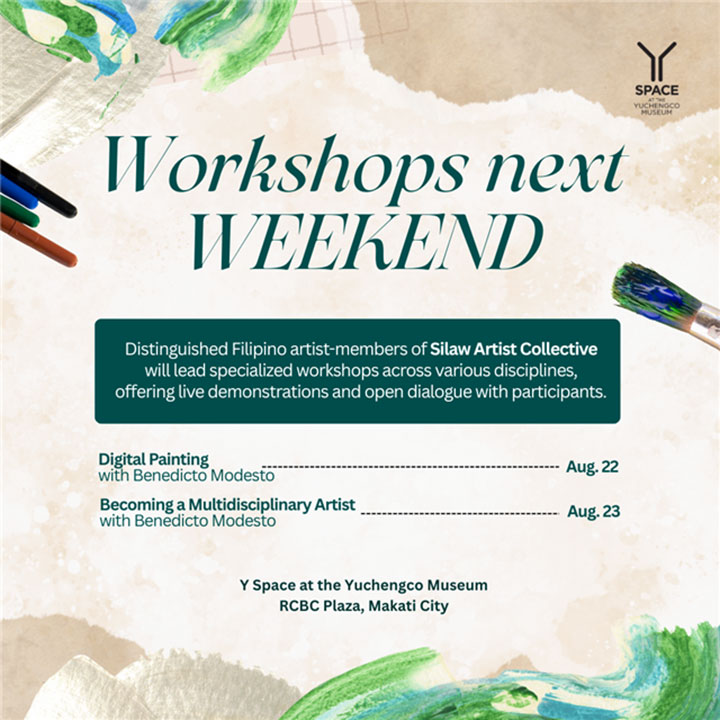
THE Y Space at the Yuchengco Museum will hold back-to-back workshops this week, both led by visual artist Benedicto Modesto. On Aug. 22, he will teach digital painting that merges classic painting techniques with digital tools, while on Aug. 23, he will talk about becoming a multidisciplinary artist. Each workshop is priced at P1,350. Slots can be reserved via yuchengcomuseum.org.


Exploding Galaxies releases 4th issue of e.g.

THE 4th issue of the journal e.g. by independent press Exploding Galaxies has crossed the mediums of page and film. It features Sarge Lacuesta’s process of transforming his short story “An Errand” into a feature-length film, which was part of last year’s Cinemalaya film festival. It explores the changes in the story, including the addition of a new character. The Weather Bureau is the issue’s featured artist.


Choral festival gathers 35 choirs

THE 6th Andrea O. Veneracion International Choral Festival in Manila will be held in the halls of Areté and other venues within the Ateneo de Manila University in Quezon City from Aug. 20 to 24. It will convene 35 choirs from the Philippines and around the world as part of a biennial tribute to National Artist for Music Andrea O. Veneracion, the legendary founder of the world-renowned Philippine Madrigal Singers. Presented by the Cultural Center of the Philippines, the festival keeps its opening and closing ceremonies open and free to the public while tickets for the competition proper are priced at P500. The grand Festival Finale Concert featuring the Philippine Madrigal Singers will be held on Aug. 24, 3 p.m., at the Hyundai Hall, with orchestra seats at P2,000 and balcony seats at P1,500.


Side Show: The Musical extended by one day

DUE to insistent public demand, The Sandbox Collective has announced the final extension of Side Show: The Musical on Aug. 24 with two shows at 3 and 7:30 p.m. The afternoon show cast will feature Krystal Kane, Molly Langley, CJ Navato, Tim Pavino, and Joshua Cabiladas, while the evening show will feature Tanya Manalang, Marynor Madamesila, Reb Atadero, Vien King, and Marvin Ong. Tickets to the final extension are now available online through ticket2me.net/sandboxsideshow. It runs at the Power Mac Center Spotlight Black Box Theater, Circuit Makati.


Flower-focused exhibit at Avellana Art Gallery

THE exhibition IN BLOOM: Flowers of the Archipelago is a quiet homage to the richness of Philippine flora, rendered through the delicate and studied strokes of Gizzele Delos Santos-Eustaquio. Her exhibit, running for the entirety of August, brings together a series of botanical images from the book Flowers of the Philippines: A Selection of Botanical Illustrations by Dr. Domingo A. Madulid, published by Gentry Press. It is held for the benefit of the Gentry Press Foundation, whose mission is to provide scholarships. Avellana Art Gallery is located on F.B. Harrison St., Pasay City.


Applications for Virgin Labfest writing fellowship

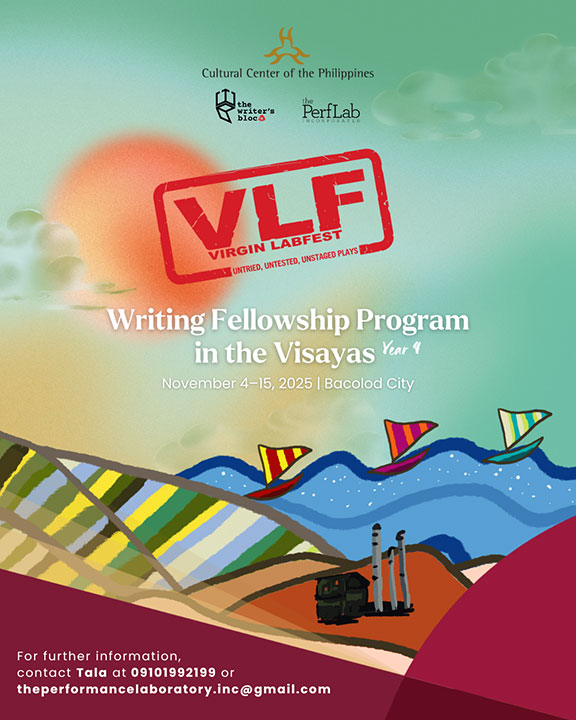
THE Cultural Center of the Philippines (CCP), through its Artist Training Division, is calling for applications for the Virgin Labfest (VLF) Writing Fellowship Program in the Visayas for the 4th year. In partnership with The Performance Laboratory, Inc., selected fellows will take part in lectures, discussions, and workshops on playwriting and script critiquing. Recordings of selected past VLF plays will also be accessible to them. On Nov. 15, the fellowship will culminate in a staged reading of the Fellows’ works. Fellowship applications are being accepted until Aug. 30. Full program details are available on the CCP Arts Education Programs Facebook Page.


Kenneth Montegrande pays tribute to Sansó

IN A HEARTFELT homage, artist Kenneth Montegrande mirrors two of Juvenal Sansó’s most beloved themes — flowers and seascapes — in his latest exhibition. The proceeds of the exhibit, titled Lines of Legacy: Kenneth Montegrande in Tribute to Sansó, will benefit Fundacion Sansó’s Fine Arts Students Scholarships and Grants Program. The exhibit runs until Sept. 1. Fundacion Sansó is located at 32 V. Cruz St., Brgy. Sta. Lucia, San Juan City.


TGA opens auditions for A Chorus Line

THEATRE GROUP ASIA (TGA) is opening auditions for its production next year of A Chorus Line, directed and choreographed by Emmy Award-winner and Broadway choreographer Karla Puno Garcia. The iconic 1975 Broadway hit will be staged in the Philippines with an all-Filipino cast. Auditions will be held across Manila, Cebu, Bacolod, and Davao starting Sept. 6, with in-person auditions prioritized. An online submission option is also available for those unable to attend on-site. Full details and registration links can be found on TGA’s social media pages.

Maya Bank, Cebuana Lhuillier team up to boost MSME financing

STOCK PHOTO | Image from Freepik

MAYA BANK, Inc. has partnered with rural lender Cebuana Lhuillier to widen financing access for micro, small and medium enterprises (MSME), including mom-and-pop stores and micro-merchants.

“Bringing together Cebuana Lhuillier’s trusted network and Maya’s digital banking creates a strong bridge between physical access points and modern financial services,” Shailesh Baidwan, Maya Group president and Maya Bank co-founder, said in a statement on Tuesday.

“It allows us to deliver credit, remittance and banking where they can make the biggest impact — at the grassroots,” she added.

Cebuana Lhuillier, which operates more than 3,500 branches nationwide and is widely known for its remittance services, will complement Maya’s digital banking and payment platform. The tie-up is expected to improve small businesses’ access to credit, international remittance and digital financial tools.

“Through this partnership, our agents can access the needed capital to grow their businesses, while Cebuana Easy Loan gives customers their first step into responsible credit,” Philippe André Lhuillier, Cebuana Lhuillier senior executive vice-president, said in the same statement.

As part of the collaboration, the companies rolled out Easy Loan, a revolving credit line ranging from P1,000 to P30,000. Cebuana Lhuillier’s authorized agents will be given access to a working capital loan tailored for mom-and-pop stores, independent sellers and other micro-merchants.

“Qualified agents can draw up to P350,000, receive funds in minutes and manage flexible repayments directly in the app,” according to the statement.

The partnership will also allow Maya Center agents to offer international remittance services while tapping Cebuana Lhuillier’s nationwide network, giving them income opportunities.

MSMEs make up more than 99% of businesses in the Philippines, but many face difficulty in scaling up due to limited funding and lack of credit access.

“Our goal has always been to bring financial services closer to every Filipino,” Cebuana Lhuillier President and Chief Executive Officer Jean Henri Lhuillier said. “This partnership allows us to provide our customers with more services on-ground and online to add value to their financial journey.” — Beatriz Marie D. Cruz

Jetstar taps Philippine travel demand with direct flights to Australia from Manila, Cebu

JETSTAR.COM

AUSTRALIAN low-cost carrier Jetstar Airways is expanding its footprint in the Asia-Pacific region with the launch of two new direct flights connecting the Philippines to Australia — servicing routes between Manila and Perth, and Cebu and Brisbane.

“We’re proud to be connecting more Australians with the Philippines, and just as importantly opening up new opportunities for Filipinos to travel, reunite with family, and grow tourism and trade,” Jetstar Group Chief Executive Officer Stephanie Tully said in a statement on Monday.

Jetstar will start operating direct flights between Manila and Perth three times a week, while it will offer direct flights between Cebu and Brisbane starting Dec. 3, also three times weekly.

The new services will bring over 108,000 seats annually to and from the Philippines, it said.

The launch of these new services is part of the airline’s commitment to expand its presence across the Asia-Pacific region, it said, adding that the expansion is fueled by Jetstar’s investment in new aircraft and the redeployment of wide-body aircraft for long-haul services.

Jetstar is a wholly owned subsidiary of Qantas Group — an aviation group operating Australia’s flag carrier, Qantas Airways.

To recall, Qantas Group’s unit Jetstar Asia permanently halted its operations on July 31, citing airport fees and other aviation charges that have made it too costly to continue flying.

The airline currently serves 16 intra-Asia routes and will continue operations through the end of July, albeit with reduced frequency.

According to its website, the decision to wind down operations does not affect Jetstar Airways services between Australia and Southeast Asia, or Jetstar Japan flights. — Ashley Erika O. Jose