Home Blog Page 1095

US as a steadfast ally among a growing list of friends
PRESIDENTIAL COMMUNICATIONS OFFICE

“Multilateral” is a good word to describe the Philippines’ foreign relations policy. It reflects our country’s consistent efforts to build partnerships and alliances with numerous countries who share our values and our commitment to international law. It is embodied in the pronouncement of President Ferdinand Marcos, Jr. that we are “a friend to all and an enemy to none.”

Our dealings with the outside world are determined solely by our national interest and by the increasingly crucial role we play in maintaining peace in the Indo-Pacific region and in the world.

President Marcos Jr. recently concluded a trip to India this month, during which he secured new defense agreements, expanded coast guard cooperation, and expressed interest in acquiring additional missile systems. In April this year, we signed a Visiting Forces Agreements with New Zealand, and there are now ongoing negotiations with France and Canada to establish similar defense arrangements.

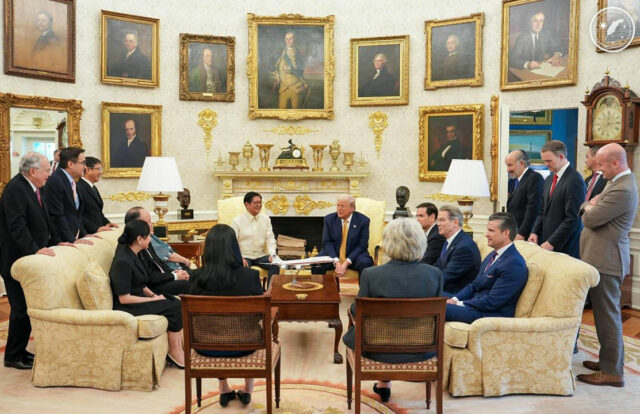
Last month, the President went to the United States and met with top officials led by US President Donald Trump. The meetings that transpired during that trip are a validation of the continuing strong alliance between the two countries.

The Philippines and the US have maintained a security alliance since the 1951 Mutual Defense Treaty, further reaffirmed and guided by the 2023 Bilateral Defense Guidelines that highlights their long-standing commitment to regional security. In recent years, the relationship has been reinvigorated due to the increasing threats posed by China, particularly its disregard for international law and its coercive actions against the Philippines.

A significant aspect of this cooperation involves US military equipment and financing aimed at bolstering the Philippines’ defense capabilities. As part of the fiscal year 2024 Indo-Pacific Security Supplemental Appropriations Act, the US supplied the Philippines with $500 million in Foreign Military Financing.

The US is encouraged to explore flexible financing options for the sale of F-16 fighter jets to the Philippines, potentially integrating these into a military aid deal, and to establish rotational basing of US Air Force F-16 squadrons in the Philippines for joint training.

Joint military exercises and strategic deployments form another critical component of the alliance. Cooperation currently includes purchases of military equipment from the US, joint naval and amphibious exercises, and the deployment of US Army intermediate-range missile forces.

The Enhanced Defense Cooperation Agreement (EDCA), which grants the US military access to 10 Philippine military bases to build and operate facilities and rotate troops, is foundational to these efforts. The effectiveness and interoperability of forces at these sites were notably tested during the 2024 Balikatan exercise, where US and Philippine militaries deployed troops from these bases.

And then, American forces operating in the Philippines are increasing rotational capabilities of integrated air and missile defense systems, including Terminal High-Altitude Area Defense (THAAD) systems and Short-Range Air Defenses (SHORAD).

Beyond military support for the defense sector, PHL-US cooperation extends to strategic alignment and infrastructure development. The US aims to work with the Philippines to build infrastructure at bases that host US rotational forces and maintain the deployment of key assets to the Philippines.

Such investment in Philippine infrastructure is expected to have positive economic effects, stimulating growth and job creation. It is also seen to improve the US military’s ability to deliver humanitarian aid during natural disasters.

In light of these developments, the Stratbase Institute, in partnership with The Heritage Foundation, hosted a roundtable event yesterday, Aug. 12, entitled “Prospects for the Philippines-United States Alliance in a Complex Geopolitical Landscape.” Two of the foundation’s senior experts — Wilson Beaver, Senior Policy Advisor for Defense Budgeting and NATO Policy, and Robert Peters, Senior Research Fellow for Strategic Deterrence — discussed their latest research, “Strengthening the US-Philippines Alliance.”

The paper falls under the Foundation’s Project 2025, a comprehensive policy agenda outlining strategic priorities for US governance, defense posture, and national security readiness.

Mssrs. Beaver and Peters’ paper underscored that the Philippines is a US ally that occupies a position of strategic importance in the Western Pacific, both for the United States and its neighbors. The initial steps that the Philippines is taking to defend itself from Chinese aggression will be the same capabilities that would deter broader regional action from China. Thus, the US commits to working with the Philippines to ensure that the latter can be an important and valuable member of a coalition of like-minded states that oppose China’s hegemonic ambitions.

Government officials and members of the security sector and of the academe were present during the forum to exchange ideas about the developments in and pathways for an enhanced Philippines-US cooperation amid these challenging times.

A recent Pulse Asia survey commissioned by the Stratbase Institute shows that 73% of Filipinos view the US as the top country the Philippines should partner with in asserting its rights in the West Philippine Sea. Indeed, as both nations invest in each other, their partnership grows stronger, more agile, and more meaningful. Together, the Philippines and the US are laying the foundations for lasting peace.

We hope to replicate this kind of steadfast friendship with many other countries that share our values and our regard for the rule of law. Amid these perilous times, such friendships are a gem — and an indispensable way to achieve an open, more secure Indo-Pacific region.


Victor Andres “Dindo” C. Manhit is the president of the Stratbase ADR Institute.

Portrait of an accidental art collector

A room of their own. — HOWARD CHUA-EOAN/BLOOMBERG

By Howard Chua-Eoan

I ONCE ENTERED the Manhattan apartment of a cantankerous, retired investment banker and almost walked into his Willem de Kooning. That would have been extremely unfortunate. I don’t know what he paid for that human-height painting, but one piece by the Dutch-American artist (who died in 1997) was purchased for a reported $300 million* in 2015, a couple of years after my near run-in. The ex-financier showcased his lavish art collection — including, if memory serves, another De Kooning — in a sprawling apartment, which was oddly dim because of sallow lighting. All that hoard did not glitter.

I don’t aspire to the life of an art collector — and certainly not one dealing with altitudinous sums of money. I like art, but I’m just a dabbler popping in and out of museums and galleries to admire and attempt to keep current. I wish I could be artsy for art’s sake, but the whirl — and lingo — can be bewildering. I’ve only just become aware that a huge and expensive mania for a generation of younger artists has come and gone. That speculative period is now called “zombie formalism” because the paintings evoked the style of deceased modern masters without incremental inspiration. I’m fascinated but afraid to bring up the zombie apocalypse. It’s so last decade.

Recently, there’s been a patter on the sidelines of my news feed about galleries closing. Being the uncle of a couple of art school grads, I figured that isn’t a good thing. How would they get their works into the world if the gallery system collapsed? Who’d introduce them to appreciative buyers and help them navigate the treacherous business? How would the world know they’d “arrived” if there weren’t prestigious showrooms to bestow that glory?

Still, it didn’t strike me as particularly surprising that the industry was in a bad way. The market has crashed a number of times this century; most recently, after the financial meltdown and during the pandemic. According to the latest Art Basel & UBS Art Market Report, sales plummeted by 12% last year to $57.5 billion. The high end — involving objects at seven figures and up — was particularly badly hit. Are discounted De Koonings now a thing?

All that said, I’ve wandered back into the art world. In my perpetual pursuit of good food, I was at René Redzepi’s Noma in Copenhagen in May and I was captivated by the lively paintings at the restaurant entrance. The same style was echoed in ceramic pieces within. As it turned out, I’d met the artist, Jenny Sharaf, at the wedding of mutual friends in Mexico City, but I’d never seen her work before. Sharaf was born in Los Angeles and lives in San Francisco, but — like me — she loves the Danish capital and was there for an extended stint, long enough to paint several panels. I loved them for the color and energy and how kaleidoscopic they could be — the image shifting with the angle at which you approached it. And, better yet, I could afford them.

However, more numbers were involved and they threw me. Calculating the costs of shipping the one I liked most to London plus insurance and the confusion over post-Brexit tariffs put me off sealing the deal. With US tariffs (and potential counter-tariffs) in the air, I didn’t want to consider the alternative: sending any of her paintings over from America. It’s a problem for the arts and antiques establishment as well: The arithmetic is antithetical to sales strategies and bottom lines. Who knows what those big beautiful duties might do?

As the UBS report notes: “Economic nationalism chips away at the foundations of economic growth. Tariffs worsen inflation and can threaten job security. Restrictions on capital flows can limit investment and may hit higher-income groups, which are more global in their behavior, disproportionately.”

So I suggested to the artist, if you get a chance to come to London, why don’t you create a painting for me using my apartment as a studio? In late July she did just that. It dovetailed, she said, with the way she was approaching her career, dealing directly with customers. “Artists shouldn’t hold back from forming relationships with collaborators and collectors.” She has several patrons, but she’d never painted for them in their own homes before.

For me, the process has been exhilarating. We discussed the artists influencing her direction on the project. As a hopeless dilettante, I appreciate being able to point to my art and name-drop Cy Twombly, Joan Mitchell, Lee Ufan, Hans Hoffman, Philip Guston, Ad Reinhardt, and Gunter Forg. After helping shop for supplies, I set her up in my flat so she could create directly in the space where the art would reside. We figured out which wall in my apartment would potentially be the best for display. As she progressed, she gauged my reaction to what was on the canvas. “I like the drippy bits,” I said. And, lo, more drippy bits appeared.

I won’t quite say I was Pope Julius and Sharaf was Michelangelo — she didn’t paint my ceiling — but I love what she produced after three sessions. In fact, I now have two Sharafs because her inspiration overflowed into a smaller piece.

My London flat now has metaphysical super-dimensions — intimations of Denmark and California with a resident-patron’s smiling presence in the beautiful blobs of paint. It’s art for my sake. And it’s fun. As the UBS report says: “The trend in consumer spending has recently skewed away from goods toward having fun.” Maybe fun is just what an art world in the doldrums needs.

And if you visit, you don’t have to worry about barging into them. They’re safely away from the front door.

*De Kooning originally sold the painting for $4,000 in 1955. It may sound like a steal but, after 70 years of inflation, that’s more than $47,000 today. — Bloomberg Opinion

Asialink, Kredit Hero team up to boost MSME financing

PHILIPPINE INFORMATION AGENCY

ASIALINK FINANCE Corp. has partnered with artificial intelligence (AI) lending marketplace Kredit Hero to increase access to financing for micro, small, and medium enterprises (MSMEs), particularly those in areas outside urban centers.

“This partnership is a pivotal step in our digital transformation journey because we believe MSMEs deserve the same seamless and efficient experience as large-scale borrowers,” Asialink President and Chief Executive Officer (CEO) Samuel Z. Cariño said in a statement on Monday.

“With Kredit Hero’s AI platform, we can break down long-standing barriers in the lending process, making financing faster, smarter, and more accessible,” he added.

Under the partnership, Asialink will gain access to Kredit Hero’s pre-screened loan applicants on the platform.

“A dedicated dashboard enables the company to efficiently manage and prioritize leads based on borrower profiles and financial needs,” the company said.

Meanwhile, Kredit Hero users will be able to explore and apply for Asialink’s loan products.

“Kredit Hero is built to remove friction in the lending process. By using AI to match quality leads with lenders like Asialink Finance Corp., we’re making it easier for SMEs with hard assets to get the financing they need, quickly and at scale,” Kredit Hero Founder and CEO Scott Moore said.

The partnership is part of Asialink’s push to expand its reach to underserved sectors through diversified product offerings.

In April, the company also partnered with Cebu-based digital vehicle marketplace AutoHousePH to boost access to auto financing.

Mr. Cariño previously said Asialink aims to disburse P24 billion in loans this year, while net income is projected to reach P2 billion from P1.1 billion in 2024.

Asialink hopes to conduct an initial public offering by 2028.

The company secured a P4-billion strategic investment from Malaysian equity firm Creador in February last year. — Aaron Michael C. Sy

Century Pacific expands plant-based portfolio with Loma Linda deal

CENTURYPACIFIC.COM.PH

CENTURY PACIFIC Food, Inc. (CNPF), a Filipino food and beverage company, said its US subsidiary Century Pacific North America, Inc. (CPNA), a plant-based food producer, has expanded its portfolio by acquiring the Loma Linda brand and related assets from Atlantic Natural Foods, Inc., a health food manufacturer, for under $10 million.

The acquisition covers other brands such as Tuno, neat, and Kaffree Roma, as well as formulations, select manufacturing assets, licenses, and remaining inventory, CNPF said in a regulatory filing on Tuesday.

CNPF Chief Operating Officer Gregory Francis H. Banzon said the transaction, valued at less than $10 million, is expected to be immediately accretive to the business.

“This is a strategic and synergistic move for CPNA. We are bringing together a trusted heritage brand and a disruptor brand under one roof — leveraging decades of consumer trust with bold innovation. This allows us to serve both loyal customers and new generations seeking accessible, nutritious, and sustainable food choices,” Mr. Banzon said.

Loma Linda is a 135-year-old brand that has catered to the dietary requirements of health-conscious consumers, especially among the Seventh-day Adventist community. It has product creations dating back 1890 by John Harvey Kellogg, from the family behind today’s Kellogg Co.

After ANF acquired Loma Linda in 2016, the brand emerged as a major name in health foods, offering products such as BIG FRANKS vegan hotdogs, SKALLOPS — the first plant-based seafood alternative — and TUNO, its flagship plant-based tuna, which are now available throughout North America and in more than 30 countries globally.

CNPF said that CNPA’s research and development capabilities and manufacturing attracted ANF as a supply partner, which eventually led to the acquisition.

“The acquisition reflects CPNA’s measured and profitable growth strategy: tapping into established markets while accelerating momentum for plant-based food adoption across diverse geographies. Ultimately, it reinforces the group’s broader mission of building a healthier, more sustainable portfolio that provides affordable nutrition to the consumers we serve,” Mr. Banzon said.

CPNA is known for plant-based products under the unMeat brand, which is available across major US retailers and over 13,000 stores globally.

CNPF shares dropped by 1.13% or 40 centavos to P35 apiece on Tuesday. — Revin Mikhael D. Ochave

Peso slips ahead of US CPI data

BW FILE PHOTO

THE PESO inched lower against the dollar on Tuesday as markets awaited the release of the latest US consumer inflation data overnight, which could affect the US Federal Reserve’s policy path.

The local unit closed at P57.075 per dollar, weakening by 3.5 centavos from its P57.04 finish on Monday, Bankers Association of the Philippines data showed.

The peso opened Monday’s session sharply weaker at P57.14 against the dollar. Its intraday best was at P57.04, while its worst showing was at P57.23 against the greenback.

Dollars exchanged went down to $1.83 billion on Tuesday from $2.19 billion on Monday.

The local unit was lower as the dollar gained on Tuesday amid expectations of slightly faster US July inflation, Rizal Commercial Banking Corp. Chief Economist Michael L. Ricafort said in a Viber message.

“The dollar-peso was range-bound today ahead of the release of US inflation data later tonight,” a trader said in a phone interview.

The dollar was also supported by the 90-day extension of the tariff truce between the US and China, Mr. Ricafort said.

For Wednesday, the trader sees the peso moving between P57 and P57.40 per dollar, while Mr. Ricafort expects it to range from P56.95 to P57.20.

The dollar was flat on Tuesday as market enthusiasm about Washington and Beijing extending their tariff truce to November was tempered by jitters about US inflation data later in the day, Reuters reported.

US President Donald J. Trump signed an executive order overnight pausing triple-digit levies on Chinese imports for another 90 days.

But the upcoming US consumer price index (CPI) data were more important to the direction of markets, investors said, because it comes just after a surprisingly weak jobs report on Aug. 1 and as businesses increasingly report inflationary pressures.

Ahead of the CPI data due at 1230 GMT, the dollar was up 0.1% to 148.31 yen, while the euro was flat at $1.1613.

“If we see an inflation print that is above consensus that is going to make it very difficult for the Federal Reserve to cut interest rates,” Foresight Group fund manager Mayank Markanday said.

“We are probably going to see more data validating fears that (US) stagflation is a key risk,” he added, referring to an economic scenario of slowing growth and rising inflation that has not been prevalent in the US since the 1970s.

Investors are currently pricing in at least two rate cuts in 2025, adding to pressure on the dollar, which has also been weighed down by policy uncertainty and Mr. Trump’s personal attacks on Federal Reserve Chair Jerome H. Powell for keeping monetary policy tight. — A.M.C. Sy with Reuters

Breaking the world’s addiction to US statistics is hard

STOCK PHOTO | Image by Azerbaijan_stockers from Freepik

By Daniel Moss

ONE of Jimmy Carter’s top aides was banned from talking about recessions or depressions. So the person in charge of the campaign against US inflation in the late 1970s came to describing downturns as “bananas.” Bendy food is again fashionable in economic parlance.

Banana-republic governance has been evoked to describe President Donald Trump’s firing of the government’s top labor statistician after a poor jobs report and threats against the head of the Federal Reserve for not lowering interest rates faster. The Oval Office’s disdain for anything it might consider bad news, and the instinct to dispose of those who deliver it, is not only corrosive, but sets a terrible example.

Not that long ago, the argument for countries in dire straits was to become like America. Certainly, that was the message that much of Asia received a generation ago. Now, the world ought to look in horror. If favorability is the benchmark by which numbers are considered credible, then the global economy will be flying without a pilot. Investors from Singapore to New York depend on the authority of reports that indicate the direction of prices, employment, and growth. And they trust what comes out of the US more than just about anywhere else.

I’ve reported on economic data from places that, at various stages of political and economic development, could have been equated with bananas — and some economies that, while quite sophisticated industrially, had shoddy practices. In a majority of instances, the flaws suggested something was wrong with not just policy, but the overall approach to decisions. Antipathy toward scrutiny was also present.

Malaysia was an eye-opener. Like many in the mid-1990s, I internalized the idea that there was a secret sauce to the booming economies of East Asia. So I was shocked to discover that when it came to documenting those impressive growth stories how behind the curve they were. There was no fixed date of release; figures just rolled out on the state news agency in an incomprehensible manner. I found a better way, but only just. If a reporter could call a particular person, at around a certain time each month, flatter them, and then go to the statistics bureau, they could receive the hard copy before almost anyone else. In Indonesia, to get the data you just had to be at a certain location at the right time for someone to meander out of an office and casually read a number.

In early 1999, Japan, at that time the second-largest economy in the world but beset by a series of bank collapses, also had its work cut out. I was stunned to see a quarterly assessment of gross domestic product — with all kinds of detail — appear in the Nikkei newspaper before its official release. Then I realized that’s how they do business — and to a great extent still do.

I came to realize that the US system at the departments of Labor and Commerce was superior — there were lengthy media lockups aimed at ensuring equal access to the data and a consistent release time, as well as experts available during that window who could answer technical questions. Investors knew that while there might be the odd glitch, the numbers that flashed on trading screens at 8:30 a.m. Washington time were at least grounded in reality and, more or less, reflected trends in the economy. They still do, no matter how Trump may try to create an alternative reality.

These departments aren’t perfect. Sometimes officials would break their own embargo. Nor was the whiff of politics always entirely absent. In 2012, an election year, the Labor department tried to greatly constrain the media’s access to lockups, citing a security risk that wasn’t satisfactorily explained at the time. (Trump abolished the lockups in his first term.) Questions about equitable access arose after a Bureau of Labor Statistics analyst last year corresponded with major Wall Street firms about a key inflation gauge. He sent several e-mails to a group called “my super users.” There is clearly work to be done, irrespective of the Oval Office tantrums and claims of bias.

Terms like “banana republic” can often serve a galvanizing purpose. Former Australian Prime Minister Paul Keating caused a sensation in the 1980s when, as treasurer, he warned that yawning trade deficits presaged a banana republic unless addressed. The ship was eventually righted, and the country enjoyed decades without a slump until the COVID-19 pandemic.

Things didn’t end as happily for Carter. He lost re-election in part because of a nasty recession. His adviser, Alfred Kahn, found another euphemism after complaints from a powerful fruit company about bananas and settled on “kumquat,” according to the New York Times. But bad news can only be massaged so much. DC statisticians do a decent job, no matter what Trump says. I’ve encountered plenty worse.

BLOOMBERG OPINION

Arts & Culture (08/13/25)


CCP Channel is now up

THOSE who want to access Filipino arts and culture at any time, anywhere, can now turn to the CCP Channel. It aims to be a gateway to exclusive performances, award-winning films, and original productions straight from the Cultural Center of the Philippines. Subscriptions are P99 monthly and P599 annually via cpchannel.culturalcenter.gov.ph.


Collection of essays on PHL cinema, TV published

THE Ateneo de Manila University Press recently released one of its newest titles, Are You Still Watching? Dispatches and Essays on Filipino Cinema and TV by Don Jaucian. It provides in-depth film journalism that plucks people from behind the screen and brings them closer to the reader, from fly-on-the-wall accounts of a rom-com’s premiere night to intimate reportage of an encounter with a National Artist for Film. It is available at the press’ store and website.


Love, Loss, and What I Wore in Cebu

THE play Love, Loss, and What I Wore is set to be staged from Aug. 16 to 17, 8 p.m., at the Marco Polo Plaza Hotel, Cebu City. Written by sisters Nora and Delia Ephron, based on the book of the same name by Ilene Beckerman, it is presented by 2TinCans Philippines. It is a heartwarming and hilarious collection of monologues and ensemble pieces about women, clothes, and memory, serving as a time capsule of a woman’s life told in the voices of a rotating cast of women. Directed by Charlene Virlouvet, this Cebu staging features members of the 2TinCans Theatre Company — Liana San Diego, Mikee Amagsila, Regina Binueza, Shanice Kae Suarez, Shifrah Bouchikhi-Enclona, and Vanessa Fe. Tickets are available via 2tincans-philippines.yapsody.com.


VLF XX: Hinog gets one-night-only extension

VIRGIN LABFEST: HINOG will present a special one-night-only extension on Aug. 21, 8 p.m., at the CCP Tanghalang Ignacio B. Gimenez (Blackbox Theater) after it was postponed last July due to inclement weather. Dubbed VLF XX: Extended, it will feature selected plays from its recently-concluded 20th edition: Minating ni Mariah ang Manto ng Mommy ni Mama Mary by Eljay Castro Deldoc, Mommy G by Jobert Grey Landeza, and Presidential Suite #2 by Siege Malvar. Tickets are priced at P800 (regular) and P1,000 (premium), available at Ticketworld and Ticket2Me websites, and at the CCP TIG Box Office.


Pinter’s Betrayal translated into Filipino

THE play Kaliwaan, which is an adaptation of Betrayal by Harold Pinter, freely translated into Filipino by Guelan Varela-Luarca, will be staged in August. Presented by Stages Production Specialists, Inc. and co-presented by MusicArtes, Inc., it is directed by Loy Arcenas and stars Missy Maramara, Nor Domingo, and Ron Capinding. The limited, two-weekend run will be from Aug. 22 to 31. For the full schedule and to buy tickets, visit https://bit.ly/KaliwaanMNL2025. Tickets range in price from P800 to P1,250. It will be staged at The Mirror Studio Theater, SJG Bldg., 8463 Kalayaan Ave., Makati City.


Cardboard art workshop at The M

THE Metropolitan Museum of Manila is holding a workshop for turning everyday cardboard boxes into expressive figurines. Participants will get to design, sculpt, and produce one-of-a-kind characters using recyclable materials. The workshop will be facilitated by Baste Cacho. It takes place on Aug. 30, 2:30 to 5 p.m., at the third floor art studio of The M in BGC, Taguig.


Manila International Book Fair returns in September

THE Manila International Book Fair (MIBF) will be held from Sept. 10 to 14 at the SMX Convention Center, Mall of Asia, Pasay City. This year’s theme is “Stories in Every Form,” celebrating the diverse and evolving landscape of literature and content creation.


Pingkian: Isang Musikal returns

AFTER a Best Musical win at the 2024 Aliw Awards, Pingkian: Isang Musikal will be back onstage from Sept. 12 to Oct. 12 at the Tanghalang Ignacio Gimenez in the Cultural Center of the Philippines Complex, Pasay City. The full-length musical follows the journey of Emilio Jacinto, the young revolutionary who navigates the complexities of leadership in the final years of the Philippine Revolution and the beginning of the Philippine-American War. It stars Vic Robinson as Emilio Jacinto. His co-stars include Gab Pangilinan, Tex Ordoñez-De Leon, Kakki Teodoro, Paw Castillo, Almond Bolante, Joshua Cadeliña, and Marco Viaña. It is directed by Jenny Jamora and written by Juan Ekis, with music by Ejay Yatco and choreography by Jomelle Era. Tickets are available via TicketWorld and Ticket2Me.


Dear Evan Hansen cast for Singapore announced

BASE Entertainment Asia has announced the cast for the award-winning musical Dear Evan Hansen, which will have its Singapore premiere at the Sands Theatre, Marina Bay Sands. It runs from Oct. 30 to Nov. 16. It stars Ellis Kirk as Evan Hansen, returning to the role after appearing in the West End production. He is joined by Rebecca McKinnis as Heidi Hansen, reprising the role she played in the original London cast.

Startups must strengthen governance, Kickstart says

GREATWORKGLOBAL.COM

PHILIPPINE STARTUPS need to adopt strong governance practices to build trust, attract funding, and withstand market and geopolitical headwinds, corporate venture capital (VC) firm Kickstart Ventures, Inc. said, noting that accountability and transparency are as vital in early-stage firms as in mature ones.

“Good governance is a key indicator of stability, especially in a climate where investors are more cautious,” Jecky Pelaez, partner for legal and compliance at Kickstart Ventures, said in a statement.

“Startups that embrace good governance are better positioned to build trust, attract funding, and scale sustainably.”

Kickstart cited the Philippines’ full-year 2024 gross domestic product of 5.6%, the second fastest in the ASEAN (Association of Southeast Asian Nations) region.

“These numbers signal growth opportunities that, if further supported by sound governance, can enhance local and regional investor confidence,” Kickstart said.

“Thus, Kickstart renews its calls for stronger good governance practices to startups and VCs alike; they must make it a shared responsibility and strategic imperative to maintain trust and secure long-term growth,” it said.

However, the VC firm noted that ongoing geopolitical instabilities are aggravating funding gaps in Southeast Asia’s startup ecosystem.

Likewise, several startups in the region face cases of mismanagement and financial misconduct, making investors “increasingly cautious,” it added.

Practicing good governance would help startups build a strong foundation to thrive amid challenging market conditions, Mr. Pelaez said.

“Good governance isn’t just about compliance; it’s about being proactive participants, building trust, staying transparent, and growing the right way,” he added.

Kickstart conducts due diligence checklists on its portfolio of startups before investing to ensure that they are well-equipped and committed to sustaining growth, it said.

Likewise, the VC firm’s post-investment support ensures that startups maintain their growth by providing strategic oversight.

“Coupled with the protocols and checklists are the efforts to foster and nurture trust between VCs and the people they work with. Altogether, this balanced approach helps ensure operational efficiency and continued profitability,” it said.

Kickstart Ventures is a wholly owned subsidiary of Globe Telecom, Inc. — Beatriz Marie D. Cruz

D&L profit edges up to P714 million in Q2

DNL.COM.PH

D&L INDUSTRIES, INC. reported a 2% increase in second-quarter (Q2) net income to P714 million, supported by strong results from its Batangas plant and export business amid elevated coconut oil prices.

Sales for the period rose 22% to P12.34 billion from P10.14 billion a year earlier, it said in a statement on Tuesday.

For the first half, D&L saw a 6% increase in its net income to P1.4 billion as sales climbed by 40% to P26.61 billion.

The Batangas plant booked P597 million in net income for the first half, up by more than threefold from the same period last year, and ahead of expectations of achieving breakeven within the first two years of operations.

Export revenue climbed by 18% to P7.4 billion and accounted for 28% of total revenue. D&L aims to increase this share to 50% over the medium term.

The food ingredients division saw a 52% drop in net income due to the surge in coconut oil prices.

Chemrez Technologies, Inc. saw a 28% volume growth, which led to the doubling of net income for the first half after coming off a low base last year, driven by increasing global demand for coconut oil-derived products and the higher biodiesel blend.

Earnings of the specialty plastics division were flat after a high base and strong performance last year.

Consumer products ODM (original design manufacturing) saw a 45% earnings growth with the continued ramp-up of the Batangas plant.

“If we just did the same net income in the second half versus the first half, we’ll be well above the 10% growth in net income. It will be 19% (growth). We’ll see. There’s a higher chance of exceeding rather than going below our income (growth) target,” D&L Chief Executive Officer and President Alvin D. Lao said during a virtual briefing.

Mr. Lao said D&L is set to benefit from easing inflation and expectations of further interest rate cuts, which could stimulate economic activity and consumer spending.

“With coconut oil prices appearing overstretched, the second half is expected to benefit from more stable and potentially lower prices, supporting a stronger earnings performance compared to the first half. We maintain our outlook for double-digit net income growth for the year,” he said.

He also said D&L does not anticipate a material impact from the higher US tariffs, as the US market accounts for only approximately 3% of total revenue. On Aug. 7, the US started charging a 19% tariff on goods from the Philippines.

He said the majority of products sold to the US are valued for their distinct technical and functional attributes, adding that exports will remain a key growth driver for the company.

D&L is also exploring new markets and applications, particularly those where coconut oil’s natural and sustainable profile serves as a key competitive advantage, to grow its exports business and mitigate risks.

“Our focus remains on executing our growth strategy, expanding into new markets, and strengthening our competitive position to capture the significant opportunities we see both locally and globally. We are committed to delivering sustainable value for shareholders and remain confident in the company’s long-term prospects,” Mr. Lao said.

D&L shares rose by 2.89%, or 14 centavos, to P4.99 per share on Tuesday. — Revin Mikhael D. Ochave

Security Bank appoints new wealth business head

SECURITY BANK Corp. has appointed its executive vice-president, Price Edward “Jim” C. Yap, as wealth business segment head effective Aug. 29.

Mr. Yap take over leadership of the Wealth Business segment from Jefferson T. Ko — who the bank said is leaving for personal reasons — while continuing to head the Financial Markets segment, it said in a statement on Tuesday.

Mr. Ko previously led the bank’s Investment Solutions Group. He was appointed as Wealth Business head at the start of this month when the segment was established.

Meanwhile, Mr. Yap joined Security Bank in 2016 as senior vice-president and head of Treasury Sales. He was also a director and Credit Sales head for Mitsubishi UFJ Securities from 2011 to 2015.

“Jim is a proven leader with a track record of driving results in highly competitive markets. With his deep market expertise and relentless focus on clients, he is well-positioned to accelerate the growth of our Wealth Segment and take our customer value proposition to new heights,” Security Bank President and Chief Executive Officer Sanjiv Vohra said. — A.M.C. Sy

Proof or it didn’t happen! New ruling on proof of payment

STOCK PHOTO | Image from Freepik

It is now standard for employers to automatically credit the salaries of their employees to their respective bank accounts. In this digital world, gone are the days when employers handed out cash or checks and required employees to sign physical pay slips. While direct deposit offers convenience, this arrangement may also present certain challenges, particularly in proving the actual payment of employees’ monetary benefits.

In a recent case involving an airline company, the Supreme Court has shed light on how employers with bank crediting arrangements can effectively prove payment of salaries and benefits.

This case stemmed from the money claims of 49 employees who were dismissed following their participation in an illegal strike. These employees filed a complaint for illegal dismissal and claimed non-payment of monetary benefits, including their salaries and 13th month pay. The company argued that the Payroll Listing and the 13th Month Pay Payroll Register it submitted were sufficient and constituted substantial evidence of payment of the purported unpaid salaries and 13th month pay.

The Supreme Court, however, disagreed. It stressed that the burden of proving money claims rests on the employer, citing the fact that pertinent personnel records, such as payrolls, are not in the possession of the worker but in the custody and absolute control of the employer. Moreover, the Supreme Court noted that the employer must meet the quantum of proof required in labor cases, which is substantial evidence — that is, such amount of evidence which a reasonable mind might accept as adequate to justify a conclusion.

While the Court has generally treated payroll sheets or vouchers as substantial evidence of payment of the employee’s money claims, it clarified that these are considered substantial evidence only if they establish both: 1.) the employee’s receipt of payment; and, 2.) the specific date or period covering the alleged payment.

In arriving at this conclusion, the Supreme Court examined existing jurisprudence. For example, in Salvaloza v. National Labor Relations Commission (G.R. No. 182086, Nov. 24, 2010), the payroll sheets provided by the employer were properly signed by the employee, thus clearly indicating receipt of payment. In Iran v. National Labor Relations Commission (G.R. No. 121927, April 22, 1998), while vouchers were presented, they failed to cover the full period claimed — resulting in the employer being held liable for the uncovered years.

However, in today’s digital age, employees rarely sign their pay slips. Most employers now use automatic bank crediting to disburse salaries and benefits. This arrangement generally involves three stages: 1.) preparation of the payroll by the employer; 2.) submission of the payroll or advisory and its corresponding receipt by the bank; and, 3.) crediting of the amounts to the bank accounts of the employees. At stage one, only the employer is involved; at stage two, both the employer and bank are involved; and at stage three, only the bank acts on the instructions received.

Thus, the Supreme Court held that, at a minimum, an employer relying on an automatic crediting arrangement must present evidence of the second stage, i.e., proof that the payroll or the crediting advisory was submitted to and received by the bank. This proof, according to the Supreme Court, would allow a reasonable mind to conclude that the bank duly carried out the crediting process. Once the employer provides valid proof of the bank’s receipt, the burden of evidence then shifts to the employee to show that the payment was not actually credited to their account.

In the said airline company case, the payroll records submitted by the employer only reflected the first stage of the process — payroll preparation — and failed to prove the second stage, i.e., transmittal of the payroll to the bank. Accordingly, the Supreme Court ruled that these payroll records cannot be treated as substantial evidence of payment.

In light of this ruling, employers must now reassess and recalibrate their payroll documentation protocols, particularly with regard to their internal arrangements with banking partners. It is no longer enough to show that payrolls were prepared, as employers must be able to prove that a copy of the payroll or a crediting advisory was actually transmitted to the bank.

After all, as the Supreme Court has declared: proof — or payment didn’t happen!

The views and opinions expressed in this article are those of the author. This article is for general informational and educational purposes only and not offered as and does not constitute legal advice or legal opinion.


Klarissa B. Santos is an associate of the Labor and Employment department of the Angara Abello Concepcion Regala & Cruz Law Offices (ACCRALAW).

kbsantos@accralaw.com

8830-8000

Rare ceremonial heads discovered in Peru shed light on ‘Warriors of the Clouds’

CHACHAPOYAS, Peru — Archeologists in Peru’s Amazon region have uncovered two rare, 1,000-year-old ceremonial stone club heads along with roughly 200 ancient structures and a unique zigzag frieze.

The discoveries were made at the Ollape site in the Amazonian district of La Jalca in an area where the Chachapoyas civilization, or “Warriors of the Clouds,” developed between 900 and 1,450 AD.

According to lead archeologist Pablo Solis, these findings offer a new understanding of the less-studied society that inhabited the area.

The intricately crafted club heads are believed to have held ceremonial significance, hinting at ritual practices of a society whose cultural footprint remains largely unexplored.

The intricate zigzag pattern is the first of its kind to be found in the region, and the number of structures suggests Ollape was an important ceremonial and residential hub.

Peru is rich in archeological discoveries, with researchers frequently uncovering ancient remains. The country is home to numerous historical sites, including the famous Machu Picchu in the Andean highlands of Cusco and the mysterious Nazca lines etched into the desert along the coast.

TEMPLE CLUES TO HUMAN SACRIFICES
Meanwhile, there had been a stark discovery on Peru’s northern coast, where archeologists have unearthed the 3,000-year-old remains of 14 people believed to be victims of a ritual human sacrifice, offering a glimpse into the country’s ancient past.

A research team found the skeletal remains near what is thought to be a ritual temple of the Cupisnique culture, a civilization that thrived more than a millennium before the Incas. Some of the dead were buried face down with their hands tied behind their backs.

“The way in which these individuals were buried is atypical, as are the traumas and injuries they suffered during life and the violence they endured,” said Henri Tantalean, the archeologist who led the excavation.

The position of the bodies, he explained, “is a typical form of human sacrifice.”

Unlike many elaborate burials found elsewhere in Peru, these victims were placed in simple pits in sand mounds, without any accompanying offerings or treasures.

The discovery was made near a beach in the La Libertad region, about 675 kilometers north of Lima, adding to the list of the country’s important archeological sites like Machu Picchu and the Nazca lines. — Reuters