Home Blog Page 1092

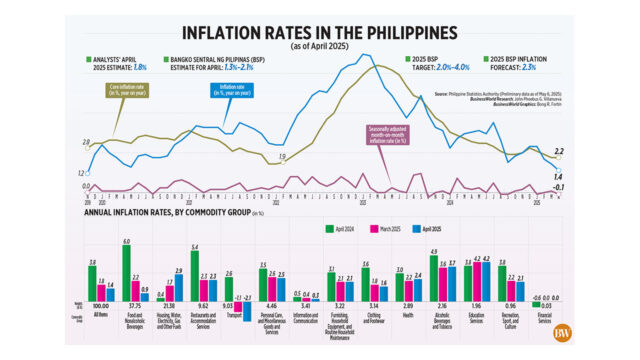
Inflation rates in the Philippines

HEADLINE INFLATION slowed to its lowest in over five years in April, amid a drop in food prices and transport costs, the Philippine Statistics Authority (PSA) said, giving the central bank room to further cut rates. Read the full story.

Inflation rates in the Philippines

Talino Venture to launch AI-powered property app

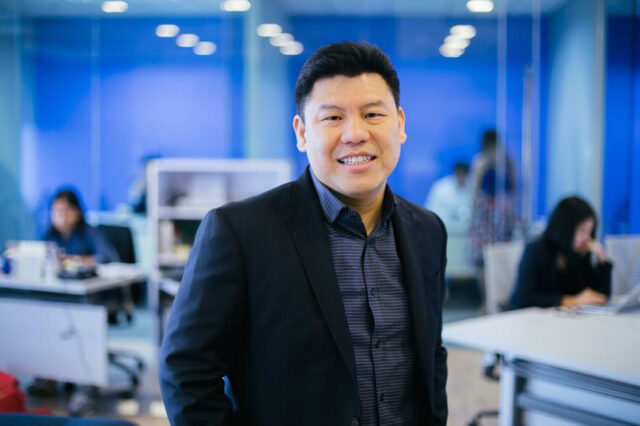
TALINO VENTURE STUDIOS President and Chief Executive Officer Winston L. Damarillo — TALINOVENTURES.COM

TALINO VENTURE STUDIOS is set to launch an artificial intelligence (AI)-powered property platform to help accelerate the growth of Philippine property developers.

The Bahai Deals app, created in partnership with Rizal Commercial Banking Corp. (RCBC), will be launched in July, Talino Venture Studios President and Chief Executive Officer Winston L. Damarillo told a news briefing on Tuesday.

The platform, which targets the global Filipino market, will simplify real property investments by giving users access to property listings, financing and sales processing.

The app will use smart property matching to personalize listing results based on the buyer’s lifestyle, budget and spending habits.

“We can further harness the opportunity to expand our local builders’ access to the global Filipino market, who are some of the most capable investors in the world,” Mr. Damarillo said.

The company has signed up six builders, Mr. Damarillo said, adding that they are confident about sustaining the number of homes they sold last year during the app’s testing phase.

About 145,000 houses worth a total of P1 billion were sold, with each costing about P7 million, he added.

To simplify the financing process for homebuyers, Talino Venture Studios has partnered with RCBC to power the end-to-end mortgage process within Bahai Deals.

“Buyers can seamlessly access loan pre-approval, application and processing, removing traditional barriers to homeownership and enabling a faster, more convenient path to property acquisition,” Talino Ventures said in a separate statement. Ashley Erika O. Jose

Laugh-In star Ruth Buzzi, scowling lady with the handbag, 88

WASHINGTON — Comic performer Ruth Buzzi, who played a counterpoint to the 1960s sexual revolution for laughs as the frumpy, hairnet-wearing, handbag-swinging spinster on US prime-time television hit Rowan and Martin’s Laugh-In, has died at age 88.

Ms. Buzzi succumbed to complications from Alzheimer’s disease at her ranch home near Fort Worth, Texas, on Thursday, 10 years after she was diagnosed, her longtime Los Angeles-based agent Mike Eisenstadt said in a statement.

“Her husband of almost 48 years, Kent Perkins, expressed to me that she was making people laugh just a few days ago,” Mr. Eisenstadt said in an e-mail message to Reuters on Friday.

Born and raised in New England, Ms. Buzzi moved to California after high school to study acting and joined the Pasadena Playhouse for the Performing Arts, alongside future Oscar winners Dustin Hoffman and Gene Hackman. She went on to an entertainment career spanning 60 years.

She was best known for her work on Laugh-In, a groundbreaking NBC ensemble comedy hour that premiered in the summer of 1968, helping to define the pop culture of the era and launching the careers of several stars, including Goldie Hawn and Lily Tomlin.

Ms. Buzzi devised a series of sketch comedy characters on the show. Gladys Ormphby, her most famous, was a scowling, irascible spinster who wore drab brown dresses and a hairnet with a spider-like knot in the center of her forehead. Sitting on a park bench, she would react to the approaches of a dirty old man played by Arte Johnson by mercilessly walloping him with her handbag when he muttered come-ons to her.

The Gladys and Tyrone bits offered a satiric contrast to the era’s sexually permissive vibe celebrated on the show, which ran until 1973. The Gladys character became so popular that she began appearing elsewhere on prime time, and it became a badge of honor for a celebrity to be thrashed by Ms. Buzzi.

Appearing on one of several televised celebrity “roasts” hosted by actor-singer Dean Martin, Ms. Buzzi encountered the heavyweight boxing champion Muhammad Ali. As Gladys, the diminutive Ms. Buzzi ranted about Ali interfering in her relationship with her boyfriend, then threateningly pointed her index finger at him.

“If you want to make something of it, I want you to meet me out in the parking lot, and we’ll have it out, man to man,” Ms. Buzzi tells him, unleashing dozens of rapid-fire handbag hits to the head and shoulders of the bemused champion, who took it all in good humor.

At another roast, Ms. Buzzi as Gladys tells Mr. Martin: “Look at you, sitting there so calm and cool, when last night you were yearning for my body.” Mr. Martin responds: “That wasn’t yearning, it was yawning,” precipitating a handbag assault, with entertainment legend Frank Sinatra looking on and laughing.

“No, it didn’t hurt,” Ms. Buzzi told interviewer Nick Thomas in 2016. “It looked vicious, but it was just a felt purse lined and filled with old pantyhose and cotton. I was able to swing it with all my might and it still wouldn’t hurt anyone, although it looked great and sounded great with a ‘thud’ when it landed.”

Ms. Buzzi earned three prime-time Emmy Award nominations in the 1970s — for Laugh-In and The Dean Martin Show — and two daytime Emmy nods in the 1980s and ’90s, including one for her work on the acclaimed children’s show Sesame Street. She won a 1973 Golden Globe award for Laugh-In.

Ms. Buzzi perfected a portfolio of zany characters.

“My favorite character to play was actually Doris Sidebottom, the sloppy drunk,” Ms. Buzzi said. “I also had fun with Busy Buzzi, the gossip columnist, and my hooker character, Kim Hither.”

In addition to guest appearances on various variety shows and sitcoms over the years, Ms. Buzzi occasionally played supporting roles in films such as Freaky Friday, The Apple Dumpling Gang Rides Again, and The North Avenue Irregulars. — Reuters

Discovery Hospitality partners with PAL’s Mabuhay Miles for member perks

DISCOVERY HOSPITALITY PROPERTY MANAGEMENT

DISCOVERY Hospitality Corp. (DHC), the property management arm of listed hotel and resort developer Discovery World Corp. (DWC), has entered into a partnership with Philippine Airlines’ (PAL) Mabuhay Miles loyalty program to offer special benefits for its members.

Under the agreement, Mabuhay Miles members will gain access to special rates and exclusive privileges at DHC’s properties, including Discovery Boracay, Discovery Coron, Discovery Samal, Discovery Primea, Discovery Suites, and Manami Resort, the property management firm said in a statement on Tuesday.

The collaboration is expected to support the growth of both leisure and business tourism in the Philippines, which aligns with the government’s target of attracting 7.7 million tourists this year, it noted.

Mabuhay Miles members enjoy several benefits, including earning miles on PAL flights, access to premium airport lounges, priority check-ins, and special discounts on hotels, car rentals, and more.

DHC operates a portfolio that includes Discovery Resorts, Primea, Discovery Suites, Kip&Kin, and Signature Collection.

On Tuesday, DWC shares declined by 0.88% or P0.1, closing at P1.13 each. — Beatriz Marie D. Cruz

Securing the vote: How blockchain technology can transform Philippine elections

FREEPIK

As the Philippines approaches its midterm elections, concerns about electoral fraud, vote manipulation, and the lack of transparency continue to dominate public discourse. Despite the implementation of automated voting systems in recent years, trust in the integrity of our elections remains fragile. In a time when technology is rapidly reshaping every aspect of society, blockchain presents itself as a powerful tool that could redefine the way we conduct our elections — making them safer, more transparent, and less prone to manipulation.

Blockchain is best known as the foundational technology behind cryptocurrencies like Bitcoin, but its real power lies in its ability to securely record data across decentralized networks. In simple terms, blockchain functions as a digital ledger that records transactions in a way that is tamper-proof and transparent. Applied to elections, this means every vote can be securely recorded, time-stamped, and verified by both the voter and third-party observers, without the possibility of it being altered or erased. Unlike centralized systems, which are vulnerable to hacking and internal manipulation, a blockchain-based voting system ensures that once a vote is cast, it is locked in a digital chain that cannot be broken or edited.

Globally, several countries have already started to explore and adopt blockchain technology in elections, offering valuable insights and early proof points.

In 2018, Sierra Leone conducted a pilot of blockchain voting during its presidential elections. The goal was to boost transparency and eliminate voter fraud — a significant step for a nation trying to recover from years of political instability. The United States has also experimented with blockchain voting, particularly in West Virginia and Utah, where the technology was used to enable overseas military personnel to vote securely via mobile devices. Thailand’s Democrat Party utilized blockchain in its internal primaries, allowing over 120,000 votes to be recorded securely and auditable. Estonia, often cited as a global leader in digital governance, has incorporated blockchain into its online voting system for national elections, demonstrating that secure, remote, and transparent voting is indeed possible at scale.

These global examples show that blockchain isn’t just a theoretical solution. It is a real-world technology that, when implemented properly, can help solve persistent problems in electoral processes — particularly in countries like the Philippines where issues such as vote-buying, ballot-box switching, and electoral fraud are unfortunately still part of our political reality.

In the Philippine context, the Commission on Elections (Comelec) has already expressed interest in the possible integration of blockchain technology into our automated election system. Preliminary discussions have considered how blockchain can be layered into existing processes to enhance transparency and auditability. This is a positive sign, but a lot more needs to be done to move from interest to implementation.

One major advantage of blockchain in elections is transparency. Every vote cast can be verified and audited without compromising voter anonymity. This would significantly reduce allegations of fraud and boost public trust in the process. Security is another crucial benefit. Because blockchain is decentralized, it becomes nearly impossible for any single entity to manipulate results. This would protect against both external cyberattacks and internal tampering. Moreover, blockchain voting systems could offer increased accessibility. Remote and digital voting would allow Filipinos working or living abroad, particularly our OFWs, to cast their ballots without the logistical challenges of traditional absentee voting.

However, adopting blockchain voting is not without its challenges. Digital literacy remains a concern in many parts of the country. To ensure inclusivity, voters must be educated on how the technology works and how to use it. Comprehensive digital literacy programs must accompany any rollout to avoid marginalizing voters who are less technologically savvy. Another challenge is infrastructure. A reliable and secure internet connection is essential for any blockchain-based system to function. The government must invest in nationwide digital infrastructure, particularly in rural areas, to ensure equal access. Then there is the need for a strong regulatory framework. Laws must be enacted to define the governance, accountability, and legality of blockchain voting. Clear policies must ensure data privacy and prevent misuse of voter information.

To make blockchain-based elections a reality in the Philippines, a phased and collaborative approach is essential. Initial pilot programs can be launched in controlled environments, such as student council elections in universities or in barangay-level polls. These pilots will help test the technology in real-world conditions and allow developers to address any technical or user-related issues.

Simultaneously, stakeholder engagement is critical. Government agencies, technology providers, civil society organizations, and academic institutions must work together to co-create systems that meet the unique cultural and operational requirements of the Philippines. Public education campaigns will also be needed to build awareness and trust. These should explain how blockchain works, why it matters for elections, and how ordinary citizens can benefit from it.

The infrastructure challenge, though formidable, is not insurmountable. With the Philippines’ rapid digital transformation and growing fintech sector, there is already momentum for technological upgrades. Investments in internet connectivity, cybersecurity, and cloud computing will serve both the election system and the broader digital economy. Alongside these efforts, a regulatory and legal framework must be developed. Comelec, in collaboration with Congress and legal experts, should work toward creating guidelines and laws that define the use of blockchain for voting, ensure transparency, protect voter rights, and lay out the protocols for audits and dispute resolution.

As we near the next midterm elections, it is unlikely that blockchain will be implemented in time to transform this cycle. However, what we can do now is begin the process. Start the pilots. Create the legal framework. Begin national discussions. Raise public awareness. Build the infrastructure. Doing so now will not only prepare us for future elections but also position the Philippines as a pioneer of transparent and secure democratic processes in Southeast Asia.

The way we vote reflects the health of our democracy. If we want to eliminate the shadow of doubt that clouds every election result, we must modernize how we secure our ballots. Blockchain offers us that chance — a technological lifeline to restore integrity, rebuild trust, and reimagine the way we conduct our most sacred democratic exercise.

Let us not wait for the next controversy or electoral crisis to act. The time to future-proof our elections is now. Blockchain may not be a silver bullet, but it is the strongest tool we currently have to ensure that every Filipino vote counts — and that it is counted with honesty, accuracy, and full transparency.

On June 10 and 11, our country will be hosting the Philippine Blockchain Week at the SMX in Pasay. We can expect discussions on blockchain uses for our country with speakers from around the world, while the Blockchain Council of the Philippines will be releasing its first country Philippine Blockchain Report. Do join us there.


Dr. Donald Lim is the founding president of the Global AI Council Philippines and the Blockchain Council of the Philippines, and the founding chair of the Cybersecurity Council, whose mission is to advocate the right use of emerging technologies to propel business organizations forward. He is currently the president and COO of DITO CME Holdings Corp.

How PSEi member stocks performed — May 6, 2025

Here’s a quick glance at how PSEi stocks fared on Tuesday, May 6, 2025.


Philippines expels Chinese ship for ‘illegal’ research near Ilocos coast

CHINESE Research Vessel (CRV) Tan Suo 3 — PCG

By Kenneth Christiane L. Basilio, Reporter

THE Philippine Coast Guard (PCG) on Tuesday said it drove away a Chinese vessel conducting illegal research in waters north of the Philippines, where it was seen retrieving a deep-sea exploration craft.

Authorities said the Chinese research vessel Tan Suo 3 did not respond to radio challenges while it was reeling a submersible vessel capable of deep-sea dives after it was intercepted on Monday by BRP Teresa Magbanua , the PCG’s biggest ship.

The Chinese research vessel was detected about 90 nautical miles (166 kilometers) off the coast of Ilocos Norte province, where it was conducting “illegal” marine research, PCG spokesman Jay Tristan Tarriela told a news briefing.

The Chinese Embassy in Manila did not immediately reply to a Viber message seeking comment.

“We were actually monitoring the movement of the Chinese research vessel, whether they are only going to conduct freedom of navigation or we have to confirm whether they are carrying out marine scientific research not permitted and allowed by the Philippine government,” Mr. Tarriela said.

“For almost two days of monitoring by satellite, the commandant decided to deploy a coast guard vessel to make sure that it’s going to be escorted out of our exclusive economic zone and document their illegal activities,” he added.

Tensions between the Philippines and China over the South China Sea have worsened in the past year as Beijing continues to assert its sweeping claim that covers maritime features disputed by Manila.

China claims more than 80% of the South China Sea based on a 1940s map, which a United Nations-backed arbitration court voided in 2016 for being illegal.

The Chinese research vessel was recovering a manned submersible capable of diving to depths of 4.5 kilometers, Mr. Tarriela said, adding that the incident “strengthens the possibility” that previous sea drones found across the country had been deployed by China.

The Philippine Navy said in mid-April several sea drones found in the country’s waters were likely deployed by Beijing and may have been used to survey underwater terrain in preparation for underwater warfare.

The recovered drones, which Philippine Navy spokesman Rear Admiral Roy Vincent T. Trinidad said had a “50% to 80%” likelihood of being deployed by Beijing, can record water depth, temperature, salinity and underwater sounds that could be transmitted to land stations, motherships or other drones via satellite communication.

Mr. Tarriela said the PCG did not try to seize the submersible due to legal complications. “Our mandate is only for them to be prevented from doing marine scientific research.”

“We are currently formalizing the result of our operation, and that will be submitted to the National Task Force for the West Philippine Sea,” he added.

The Justice and Foreign Affairs departments, which are members of the task force, will formulate a response to China’s “illegal activity” in Philippine waters, he said.

SHOAL ACTIVITY
Meanwhile, Chinese and Philippine ship activities near Scarborough Shoal spiked in the past year, with China’s coast guard gradually pushing its perimeter around the disputed shoal eastward, nearing the Philippines’ main island of Luzon, according to maritime transparency group SeaLight.

SeaLight’s monitoring detected 1.5 million Chinese ship identification pings around the shoal, up from 724,000 a year ago, while with Philippine activity surged fourfold to 200,000, Anna van Amerongen, SeaLight Tech Advisory Group director, told an online maritime forum.

“The perimeter around Scarborough Shoal has increased and became much more of a hotbed of activity,” she said.

Chinese ships have been preventing PCG vessels from getting within 32 kilometers of the shoal since May 2024, she added.

The shoal is 240 kilometers west of Luzon and is about 900 kilometers from Hainan, the nearest major Chinese landmass.

In 2013, the Philippines took the dispute over Scarborough Shoal to a United Nations-backed tribunal, which ruled in 2016 that China had interfered with Filipino fishermen’s rights to access the area. Beijing has since deployed a fleet of coast guard vessels to enforce its claim despite the ruling.

Manila is monitoring the situation at Scarborough Shoal and is trying to assert sovereignty over the disputed feature by ramping up its presence despite Chinese pushback, National Security Council Assistant Director-General Jonathan E. Malaya told the forum.

“Every instance wherein China carries out these activities supposedly to assert its control only demonstrates very clearly that it is acting contrary to international law,” Jay L. Batongbacal, director of the University of the Philippines Institute for Maritime Affairs and Law of the Sea, said at the same forum.

“The more that China tightens its grip around Scarborough Shoal, the more it loses it because it only demonstrates that its claim on it is illegal.”

The Philippines should file a second arbitration case against China for its conduct at the shoal, former Supreme Court Justice Antonio T. Carpio told the forum.

“We should be proceeding with the arbitration on the extended continental shelf,” he said. “Time is on China’s side, it is getting stronger every year.”

The Philippine government in June last year filed a claim with the United Nations (UN) seeking to register its extended shelf claim in the South China Sea amid repeated clashes with China.

Nations can extend their claims beyond the 200-nautical-mile exclusive economic zone if they provide evidence that their continental shelf reaches farther, securing rights to minerals and seabed resources, according to the UN Convention on the Law of the Sea.


Philippine, US soldiers hold exercises in bomb disposal under Balikatan

V-22 Osprey — COMMONS.WIKIMEDIA.ORG

PHILIPPINE and US military engineers were trained in repairing damaged airfields and disposing of explosives in the Visayas region as part of their annual Balikatan (shoulder-to-shoulder) exercise, the Philippine Army said on Tuesday. 

The Filipino soldiers conducted drills with their US counterparts on rapid runway restoration and bomb disposal to enhance military response capabilities, it said in a statement.

“Airfield repairs and explosive ordinance disposal skills are crucial in ensuring mission success as they ensure operational continuity through the rapid restoration of damaged runways and removal of explosive hazards,” the army said.

More than 14,000 Filipino and American troops are participating in the Balikatan exercise, held in areas of the Philippines facing regional flashpoints like the South China Sea and Taiwan, and featuring advanced US missile systems. It began on April 21 and will run until May 9.

Also on Tuesday, the Philippine Air Force held search and rescue drills off the coast of Zambales province to improve personnel recovery capabilities in war time conditions.

The Philippines’ 505th Search and Rescue Group and its American counterpart held realistic combat rescue drills at sea by simulating the recovery of a downed aircraft in hostile conditions, it said in a separate statement.

A US C-130 turboprop transport aircraft and V-22 Osprey tiltrotor transport aircraft participated in the drills alongside the Philippines’ Bell 205A and Super Huey helicopters.

Meanwhile, Swedish Ambassador to the Philippines Anna Ferry visited the Philippines’ military headquarters in Manila, where she paid a courtesy call on military chief Romeo S. Brawner, Jr. and talked about expanding security ties between the two nations.

“Both leaders discussed opportunities for expanding bilateral engagements and enhancing interoperability to address evolving regional and global security challenges,” the Armed Forces of the Philippines said in a separate statement.

The Philippines is forging deeper security ties with western countries and regional allies like Japan and Australia amid tensions with China over disputed features in the South China Sea.

Philippine forces have repeatedly sparred with Chinese ships and aircraft in the sea over competing claims on Spratly Islands and Scarborough Shoal, among other features.

Beijing asserts sovereignty over almost the entire waterbody based on its 1940s nine-dash line, which overlaps with claims of the Philippines, Brunei, Malaysia, Taiwan and Vietnam. — Kenneth Christiane L. Basilio

Half of party-list groups belong to political dynasties

BW FILE PHOTO

By Adrian H. Halili, Reporter

HALF of party-list groups participating in the 2025 Philippine midterm elections have been hijacked by political dynasties, a global human rights coalition said on Tuesday.

In a report, the International Coalition for Human Rights in the Philippines (ICHRP) said its International Observer Mission (IOM) concluded that at least 78 of the 156 party-list organizations certified by the Commission on Elections (Comelec) belong to political families.

“Political dynasties are inherent in a society marked by high inequality and poverty, which stem from the historical concentration of land and wealth ownership in the hands of a few,” it said.

The Philippine party list system was introduced in the 1987 constitution to give marginalized groups representation at the House of Representatives. 

“This system has been increasingly corrupted by political dynasties,” the coalition said.

Hansley A. Juliano, a political science lecturer from the Ateneo de Manila University, said the Philippines continues to be at risk from developmental stunting due to the country’s dynastic system.

“Any policy change is likely to perpetuate the status quo of rent-seeking behavior and elite domination of state resources,” he said in a Facebook Messenger chat.

Maria Ela L. Atienza, who teaches political science at the University of the Philippines, said the party-list system has failed to give marginalized sectors a voice.

“The party-list system has not achieved its purpose of leveling the playing field and promoting progressive and marginalized interests,” she said via Viber. “It’s time to reconsider.”

Ms. Atienza added that the party-list system could be reformed based on performance, while anti-dynasty laws could be enforced at the local level.

The ICHRP said 142 of district representatives seeking re-election on May 12 belong to political dynasties.

It added that these dynasties cover at least 87% of the Philippines’ provincial government, or 71 of 82 positions.

“Forty-seven of the 71 incumbent governors belonging to political dynasties are seeking re-election,” it said. “At the same time, 19 sitting governors who are not running for re-election have family members seeking to replace them.”

The group raised concerns about the impact of political dynasties on representation and diversity since power is frequently passed down to family members.

The coalition said three of the country’s 10 wealthiest tycoons are behind three of the biggest political parties, while a fourth political faction is led by President Ferdinand R. Marcos, Jr., who presides over the Marcos-Romualdez dynasty, it pointed out.

Filipinos will pick 317 congressmen and thousands of local officials. The biggest battle will be for 12 spots in the 24-member Senate, a chamber packed with political heavyweights and wielding outsized influence.

Senate frontrunners’ climate silence scored

PHILSTAR FILE PHOTO

FRONTRUNNERS in the 2025 senatorial race were silent on pressing environmental issues despite the climate crisis’s growing impact on the economy, according to a coalition of “green” groups.

In a statement, the coalition said 88% or 56 of 64 senatorial bets did not respond to its pre-election survey that sought to capture candidates’ position on crucial environmental issues facing the country.

“When climate justice is absent from platforms, it shows a dangerous disregard for the crises deepening hunger, worsening health, and driving poverty,” Lea B. Guerrero, country director at Greenpeace Philippines, said in the statement.

“We need leaders who will stand with people, hold polluters accountable and put climate at the top of the agenda,” she added.

The candidates who responded to the survey were Leodegerio “Ka Leody” De Guzman, Renecio “Luke” S. Espiritu, Jr., Teodoro “Teddy” A. Casiño, Jocelyn S. Andamo, Modesto “Mody” T. Floranda, David Delano D’Angelo, Norman C. Marquez and Arnel Bondilles Escobal.

But Greenpeace cited “previous positive efforts and track records” by nonrespondents like former Senators Francis Pancratius “Kiko” N. Pangilinan, who is cited for the Sagip Saka Act and legislative efforts to address single-use plastics, and Gringo N. Honasan for authoring the Clean Air Act and Solid Waste Management Act. 

The Sagip Saka Act empowered local governments to buy rice, vegetable and poultry for their feeding and relief programs directly from farmers’ groups without the need for bidding.

“While Filipinos grapple with climate disasters, plastic pollution and biodiversity collapse, our politicians cling and aspire to power through dynastic politics, smear campaigns and empty theatrics,” said Von Hernandez, Global Coordinator of the Break Free from Plastic movement.

Greenpeace said the state of the Philippine environment is “regressing,” citing the push for nuclear energy and waste-to-energy facilities.

It also cited the proliferation of single-use plastics, which the government had planned to tax, and attempts to open municipal fishing waters to commercial fishing interests.

The group urged policymakers to support a proposed ban on single-use plastics and institutionalize reuse and zero-waste solutions.

They should also reject “false fixes” like waste-to-energy incineration and nuclear energy, and push measures that would protect and rehabilitate the country’s terrestrial, coastal and marine resources, it added.

“Our communities are drowning in plastic, our coastlines are eroding, and our children are growing up in a world where clean water and safe food are no longer guaranteed,” said Wes Lipana, marine litter management officer at Ecowaste Coalition.

“Our environment is in a state of emergency, and that demands leadership,” he said. “Voters must demand bold environmental leadership and scrutinize candidate track records, not slogans.”

A World Bank report in 2022 showed that climate change could cut the Philippines’ gross domestic product by as much as 13.6% by 2040.

It said “adapting to the risks of climate change, including extreme events and slow-onset problems, is critical for the Philippines.” “It cannot wholly eliminate the costs of climate change, but it can greatly reduce them.” — Kyle Aristophere T. Atienza

Marcos declares May 12 a holiday

PHILIPPINE STAR/MIGUEL DE GUZMAN

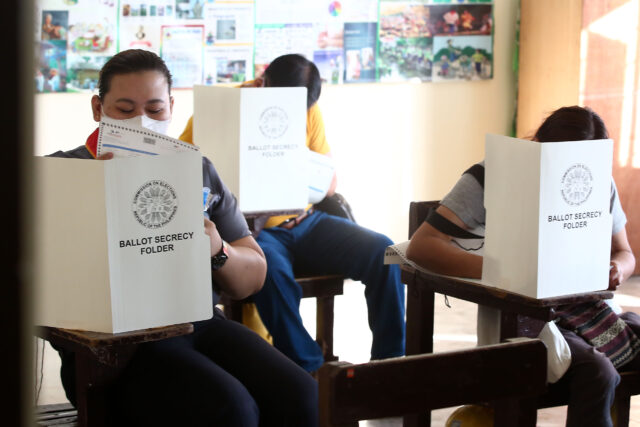
PRESIDENT Ferdinand R. Marcos, Jr., on Tuesday declared May 12 a nonworking holiday to allow Filipinos to vote in the midterm elections.

“There is a need to declare Monday, 12 May 2025, as a special (nonworking) holiday to enable the people to properly exercise their right to vote,” according to Proclamation No. 878.

The order was signed on May 6 in response to a request from the Commission on Elections (Comelec).  Previous elections have been declared special nonworking holidays.

Meanwhile, Comelec has extended the pre-enrollment period for overseas internet voting until May 10 from May 7.

Registered Filipino voters overseas must complete pre-enrollment before they can vote.

Also on Tuesday, The Comelec started distributing ballots for National Capital Region precincts. — Chloe Mari A. Hufana

Marcos bets dominate poll

PRESIDENT Ferdinand R. Marcos, Jr. attended a party convention in Pasay City where the administration’s senatorial bets for the 2025 elections were announced. The alliance comprises the country’s five major political parties — Partido Federal ng Pilipinas, Lakas-Christian Muslim Democrats, Nationalist People’s Coalition, Nacionalista Party and National Unity Party. — PPA POOL/ RYAN BALDEMOR

NINE of the 15 candidates in the “likely winning circle” in the pre-election senatorial preference survey are backed by the Marcos government, according to research firm WR Numero.

“Rule of thumb in every intervention under the current political system: the advantage is always on the administration,” Julio C. Teehankee, a political science professor from De La Salle University, told a news briefing.  “These individuals were selected by the administration because of their winnability.”

Party-list Rep. Erwin T. Tulfo and reelectionist Senator Christopher Lawrence “Bong” T. Go topped the list with 48.7% and 45.3%, respectively.

They were followed by former Senate President Vicente C. Sotto III with 37%, Senator Ronald M. Dela Rosa with 36.8% and Senator Pilar Juliana S. Cayetano wit 36.6%.

Broadcaster and independent candidate Bienvenido T. Tulfo (35.2%) and Senator Manuel “Lito” M. Lapid (34.8%) were ranked six to seven, while ex-Senator Panfilo M. Lacson, Sr., ranked eighth with 33.8%, followed by Makati Mayor Mar-len Abigail S. Binay at No. 9 with 31.7%.

Administration bets Camille A. Villar got 29.8% and Senator Ramon “Bong” B. Revilla, Jr. got 29.5% for ranks 10-11, while former Senator Paolo Benigno A. Aquino IV placed 12th with 28.5%.

Completing the “magic 15” were presidential sister Senator Maria Imelda Josefa Remedios “Imee” R. Marcos with 26.4%, former Senator and boxing camp Emmanuel D. Pacquiao, Sr. with 26.1% and former Senator Francis Pancratius N. Pangilinan with 24.5%.

In Metro Manila and the rest of Luzon, Mr. Tulfo was at the top with 49% and 59%, respectively, while in the Visayas, Mr. Go and Mr. Tulfo tied with 52%. In Mindanao, Mr. Dela Rosa was No.1 with 70%, trailed by Mr. Go with 63%.

“Looking at the survey results, it’s safe to say that the top two positions would be a toss-up between either Erwin Tulfo or Bong Go,” Mr. Teehankee said.

WR Numero interviewed 2,413 Filipino voters on April 23 to 30 for the poll, which had an error margin of ±2% points. — Almira Louise S. Martinez