Home Blog Page 1023

Xiaomi launches REDMI 15C

REDMI 15C — XIAOMI CORP.

XIAOMI Corp.’s new entry-level phone REDMI 15C is now available in the Philippines.

Pricing for the REDMI 15C starts at P5,299 for the 4-gigabyte (GB) memory + 128GB storage variant, while the 6GB+128GB model costs P5,799 and the 8GB+256GB model is priced at P6,599. It is now available via Xiaomi’s online and offline stores.

It comes in four colors, namely Midnight Black, Mint Green, Moonlight Blue, and Twilight Orange³, with Moonlight Blue and Twilight Orange.

The smartphone has a 6.9-inch HD+ display with an up to 120Hz AdaptiveSync refresh rate for smooth visuals. It also comes with a 50-megapixel AI (artificial intelligence) dual camera.

It is powered by a MediaTek Helio G81-Ultra processor and runs on Xiaomi HyperOS 2.

“Despite its slim build, the REDMI 15C packs a high-capacity 6,000mAh battery — supporting up to 22 hours of video playback or 82 hours of music,” Xiaomi said.

It also supports 33-watt turbo charging and comes with reverse charging that lets it power other devices.

The REDMI 15C has an IP64 dust and water resistance rating. — BVR

iPhone or ipon: How long does a Filipino need to work to buy the latest iPhone?

The average Filipino worker needs to grind for 101 days — nearly five months — just to afford the iPhone 17 Pro, priced at $1,099, according to Tenscope’s iPhone Affordability Index.

iPhone or ipon: How long does a filipino need to work to buy the latest iPhone?

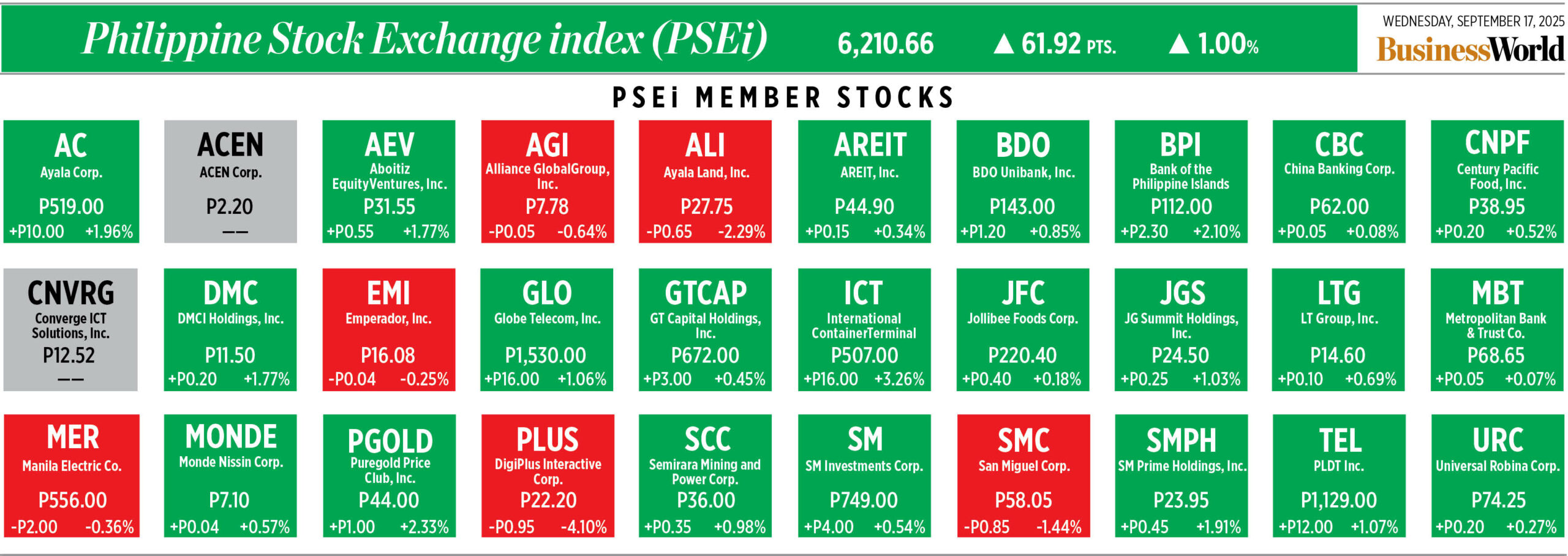
How PSEi member stocks performed — September 17, 2025

Here’s a quick glance at how PSEi stocks fared on Wednesday, September 17, 2025.


PSE index jumps to 6,200 level on rate cut hopes

BW FILE PHOTO

PHILIPPINE STOCKS rose on Wednesday, pushing the main index back to the 6,200 level, on hopes of more interest rate cuts here and in the United States.

The bellwether Philippine Stock Exchange index (PSEi) jumped by 1% or 61.92 points to close at 6,210.66, while the broader all shares index rose by 0.6% or 22.41 points to end at 3,728.61.

“The local market extended its rise as hopes of another BSP (Bangko Sentral ng Pilipinas) rate cut lifted sentiment,” Philstocks Financial Inc. Research Manager Japhet Louis O. Tantiangco said. “The decline in local yields and the strengthening of the peso also gave the market a boost.”

“The market was already positioning ahead of the US Federal Reserve’s decision, with sentiment also shaped by Finance Secretary Recto’s recent remarks suggesting the BSP may cut rates if the Fed does. With inflation still within the target range, a Fed cut could be a key trigger for the BSP to ease further later this year,” Regina Capital Development Corp. Head of Sales Luis A. Limlingan said.

Finance Secretary and Monetary Board member Ralph G. Recto said on Tuesday that the Philippine central bank may deliver one more rate cut before yearend, depending on the data and how markets react to the Fed’s policy statements overnight.

The BSP last month lowered borrowing costs by 25 basis points (bps) for a third straight meeting to bring the policy rate to 5%. It has now cut benchmark interest rates by a cumulative 150 bps since it began its easing cycle in August 2024.

Meanwhile, the Fed was widely expected to cut its benchmark interest rate by a quarter of a percentage point to the 4%-4.25% range at the end of its two-day monetary policy meeting overnight, Reuters reported.

The main focus beyond the rate decision will be on Fed Chair Jerome H. Powell’s comments on the outlook for US monetary policy.

Money markets expect the Fed to lower policy rates by nearly 70 bps by the end of 2026, according to LSEG data.

All sectoral indices closed in the green on Wednesday. Services went up by 1.9% or 42.01 points to 2,248.70; mining and oil climbed by 1.47% or 173.5 points to 11,977.50; financials rose by 1.02% or 21.30 points to 2,101.72; holding firms increased by 0.87% or 44.12 points to 5,072.14; property added 0.25% or 6.39 points to end at 2,468.97; and industrials moved up by 0.15% or 14.37 points to 9,043.38.

Advancers beat decliners, 104 to 83, while 59 names were unchanged.

“International Container Terminal Services, Inc. was the top index gainer, climbing 3.26% to P507. DigiPlus Interactive Corp. was the main index laggard, falling 4.1% to P22.20,” Mr. Tantiangco said.

Value turnover surged to P10.02 billion on Wednesday with 7.48 billion shares traded from the P6.56 billion with 3.69 billion stocks that changed hands on Tuesday.

Net foreign buying was at P693.91 million, a turnaround from the P35.46 million in net selling recorded the day prior. — Alexandria Grace C. Magno

Mining fiscal regime brings certainty to industry — DMCI

THE enhanced fiscal regime for large-scale metallic mining is expected to help generate long-term value for investors by keeping taxation stable and predictable, DMCI Mining Corp. said.

“We see the new fiscal framework as an opportunity to strengthen the mining sector’s role in generating long-term value for investors, communities, and the economy,” the company said via Viber on Tuesday.

“Furthermore, we welcome the fiscal stability it will bring to our operations,” it added.

The law, signed earlier this month, imposes royalties and profit-based levies on mining companies, boosting government revenue and sharing more of the gains with host communities.

It also introduces a windfall tax on companies whose profit margins exceed 30% and treats each mining contractor as a separate taxable entity.

Despite the increased taxes, Rizal Commercial Banking Corp. Chief Economist Michael L. Ricafort said that the law is a step in the “right direction.”

“It is more acceptable based on global standards or best practices. And it is more predictable for companies and more fair for the government,” he said via Viber.

Philippine metal production amounted to P135.62 billion in the first six months, up 15.1%, according to preliminary data issued by the Mines and Geosciences Bureau.

Meanwhile, DMCI Mining said it hopes to begin operations at the Long Point nickel mine in Palawan within the year, through Berong Nickel Corp., subject to the release of permits.

Once Long Point starts operations, DMCI Mining’s full annual operating capacity will increase to 3 million wet metric tons.

“Actual production in 2025 will depend on the timing of Long Point’s startup. With Long Point, DMCI Mining will eventually be operating three mines,” the company said.

“We are also evaluating other properties, such as the Dangla mine, for future development,” it added, referring to another nickel site in Palawan. — Justine Irish D. Tabile

Grab driver incentive program to be monitored one more year — PCC

THE Philippine Competition Commission (PCC) said it extended the review period of Grab’s driver incentive system by another year.

In a statement on Wednesday, the PCC said it signed an undertaking with Grab to reinforce its oversight of Grab’s incentive scheme for affiliated drivers.

“(This is to ensure) that such mechanisms safeguard commuter choice and promote fair competition in the ride-hailing market,” the PCC said.

In the undertaking, the ride-hailing company committed to submit quarterly compliance reports for review by a third-party monitor that the PCC will appoint.

Covering the period from May 1, 2023, to Oct. 31, 2023, the review seeks to assess whether Grab’s incentive schemes “violate its non-exclusivity commitments by discouraging drivers and operators from joining competing platforms.”

“The assessment will be guided by an incentives monitoring framework and several other factors, such as trip requirements, duration of incentive policies, coverage, and market behavior,” the PCC said.

“If the effects-based assessment determines that Grab’s incentives violate the Philippine Competition Act, the PCC shall have the authority to take enforcement action and impose penalties,” it added.

In a statement on Tuesday, Grab said that while it completed its voluntary commitments by Nov. 2023, the PCC has yet to complete its review of quarterly reports on driver incentives.

“Both parties therefore agreed to extend the review period for one year to allow the PCC to conclude its assessment,” Grab said.

The 2025 undertaking is the third agreement between Grab and the PCC after the ride-hailing company merged with Uber in 2018.

Through the merger, Grab acquired Uber’s ride-hailing and food delivery operations in Southeast Asia in exchange for Uber’s 27.5% stake in Grab. — Justine Irish D. Tabile

Trade dep’t sees fisherfolk benefiting from WTO agreement restricting fishing subsidies

BW FILE PHOTO

THE Department of Trade and Industry (DTI) said the World Trade Organization’s (WTO) Agreement on Fisheries Subsidies is expected to help fisherfolk by halting support for commercial fishing operations that deplete marine resources.

“For the Philippines… where fisheries are central to livelihood and food security, the entry into force of the agreement strengthens global efforts to protect marine resources and promote fair competition for small-scale and artisanal fishers,” the Bureau of International Trade Relations said in a social media post. 

“It also underscores the country’s strong commitment to promoting ocean sustainability and ensuring that fisheries subsidies support long-term economic growth and environmental resilience,” it added.

The agreement came into force on Monday after more than two-thirds of WTO members deposited their instruments of acceptance.

Adopted at the 12th Ministerial Conference in June 2022, the agreement prohibits subsidies that contribute to illegal, unreported, and unregulated fishing; to overfishing; and to fishing on the unregulated high seas.

“These disciplines seek to reduce harmful practices that accelerate the depletion of global fish stocks, ensuring long-term viability of fisheries and food security for coastal nations,” according to a DTI briefing document.

An element of the agreement is a Fisheries Funding Mechanism, or the Fish Fund, which will provide technical assistance and capacity-building support to help developing and least-developed countries implement their obligations under the agreement.

Receiving $18 million in pledges so far, the Fish Fund allows members to apply for grants of up to $300,000 for “institutional reforms, data collection, stock assessments, training, and strengthened monitoring, control, and surveillance systems.

The fund will help the country address critical gaps in data collection, monitoring, and enforcement, it said.

“The agreement represents a critical step forward in ensuring sustainable fisheries, protecting biodiversity, and strengthening global trade governance,” the DTI said. 

“By aligning domestic reforms with global disciplines and actively shaping the deployment of Fish Fund resources, the Philippines is well-positioned to secure long-term benefits for its marine ecosystems, its coastal communities, and its national economy,” it added. — Justine Irish D. Tabile

FAO: Farmers key to preserving heritage practices, biodiversity

REUTERS

THE Food and Agriculture Organization (FAO) said farmers play a key role in food security by preserving traditional knowledge and biodiversity.

At the Second Global Symposium on Farmers’ Rights, Lionel Dabbadie, the FAO’s representative in the Philippines, called farmers “stewards of land. They are protectors of agro-biodiversity. They are innovators of agriculture practices. They are the guardians of the world’s vast genetic resources. And overall, they are the guardians of our future wealth.” 

“When the preservation of biodiversity is done right, this will boost the value chain and improve the lives of farmers,” he added.

Gerald Glenn F. Panganiban, program director of the National Urban and Peri-Urban Agricultural Program, said some of the keys to protecting farmers’ rights are “preserving traditional knowledge, improving farmers’ access to seed, and strengthening their participation in decision making processes that directly impact their well-being and livelihoods.

“We remain committed to these initiatives and expanding efforts to protect farmers’ rights, especially in the face of evolving global challenges,” he added.

The Philippines is saddled with weak production, high food prices, and import dependence. President Ferdinand R. Marcos, Jr. has called food security one of the pathways to improving economic stability.

The symposium is due to conclude on Sept. 19. — Andre Christopher H. Alampay

DoH invites private sector to manage government hospitals

BW FILE PHOTO

By Justine Irish D. Tabile, Reporter

THE Department of Health (DoH) said it plans to bring in private partners to take on the operations and maintenance (O&M) of government hospitals.

“I am running the biggest conglomerate of hospitals, and I need the help of the private sector,” Health Secretary Teodoro J. Herbosa told the Health Leadership Summit 2025 on Wednesday.

“I am willing to share some of the hospitals and outsource the O&M contracts to make sure that the hospitals are functional.”

He said the DoH currently operates 83 hospitals of 500 to 1,500 beds.

“We are ready for public-private partnerships (PPPs). We are actually ready for them to be managed by (the private sector),” he said.

He said funding delays have become an issue for equipment maintenance, and noted that the government has changed strategy for healthcare facilities, preferring to add more Bagong Urgent Care and Ambulatory Services (BUCAS) Centers to opening new hospitals.

“Because of the Universal Health Care Law, I’m asking the private sector to partner in primary healthcare, in longevity medicine, in diagnostic outpatient testing, and in ambulatory care,” he said.

“I need more BUCAS Centers; I do not need more hospitals. Hospitals are difficult and expensive to manage,” he added.

Rafael Jaime V. Recio, chief strategy and investment officer at AC Health (Ayala Healthcare Holdings, Inc.), said that the private sector in other countries is already taking part in the O&M of government-owned hospitals.

“It is a model that works in other countries,” he told reporters on the sidelines of the summit.

However, he said that to make it a viable option for private companies, the agreements need to “make sense from a commercial standpoint.”

“There’s a balance that has to be struck between what the government needs, what we can deliver, and how incentives are aligned between the two sides,” he said.

He said incentives have to be tailored to each project.

AC Health is currently participating in various PPPs with local government units.

Meanwhile, he said that AC Health is planning to use the funding from investment firm ABC Impact’s acquisition of a 16% stake in the company to expand its network.

“The idea is that we want to focus on key geographies beyond Metro Manila,” he said.

“Obviously, Metro Manila is a priority for us. But then beyond Metro Manila, we’re looking at key cities outside that we’d want to double down on and create a tighter network,” he added.

He said AC Health sees acquisition opportunities but noted that the industry has become more competitive.

AC Health is hoping to expand its network to 10 hospitals, 300 clinics, and 1,150 pharmacies by 2027.

Asked if there are more plans to raise funding, he said, “I think our focus over the next maybe three to five years is really making sure that we’re able to effectively deploy the capital, work with our partners, and grow the portfolio, and then maybe at some point, if the need dictates, then we might look at it again.”

“We’re always evaluating funding options as and when needed. But for now, I think the focus is really execution, rolling out, and making sure that we’re able to deploy the capital effectively and grow the portfolio,” he added.


Lease, e-governance laws deemed investor-friendly — foreign chambers

PHILIPPINE STAR/MIGUEL DE GUZMAN

AMENDMENTS to the Investor’s Lease Act have enhanced the investment climate, the Joint Foreign Chambers (JFC) said.

The JFC added that other recent reforms like the E-Governance Act and the Enhanced Fiscal Regime for Large-Scale Metallic Mining Act “will foster a more stable, predictable, and competitive business environment.”

“These reforms signal the government’s strong commitment to unlocking the country’s economic potential, and the JFC commends President Ferdinand Marcos, Jr. and the Philippine Congress for their leadership in advancing them,” the JFC said in a statement on Wednesday.

It said the E-Governance Act will help reduce red tape, increase efficiency, and improve transparency.

Meanwhile, the extended lease period allowed by the amended Investor Lease Act provides foreign investors with long-term certainty, encouraging major investments.

The new mining fiscal regime simplifies tax policies for the industry and establishes a fair and transparent fiscal framework designed to attract responsible mining investment.

“The JFC applauds these transformative reforms, which together represent major steps toward building a more competitive, inclusive, and prosperous future for the Philippines,” it added. — Justine Irish D. Tabile

DEPDev pushing for amendments to feeding program, coco levy laws

PHILSTAR FILE PHOTO

THE Department of Economy, Planning, and Development (DEPDev) asked legislators to amend legislation governing the national feeding program and the coconut levy fund, citing implementation constraints that hinder service delivery and farmer access.

Speaking at a House Economic Affairs Committee briefing on Wednesday, Economy Undersecretary Rosemarie G. Edillon said DEPDev priorities include changes to Republic Act No. 11037, or the Masustansiyang Pagkain para sa Batang Pilipino Act, to relax the rules on milk sourcing.

“We actually want to relax the provision related to milk, because the options available to our supplementary feeding centers are extremely limited,” she said.

The law established a national feeding program to address hunger and undernutrition.

Under the law, National Government agencies and local dairies are tasked with incorporating fresh milk and milk-based products into fortified meals. It aligns with the Philippine Food Fortification Act of 2000, which promotes the use of locally produced milk to improve nutrition and support the dairy industry.

Proposed amendments to the Coconut Farmers and Industry Trust Fund Act will seek to overhaul provisions hindering farmers from accessing the trust fund.

The Coconut Farmers and Industry Trust Fund Act or Republic Act No. 11521 was signed into law by President Rodrigo R. Duterte in 2021. It placed coconut levy assets into a trust fund intended to support the rehabilitation and modernization of the coconut industry.

The Department of Finance has said that the proposed amendments aim to establish “practical rules” aligned with the fund’s objectives. She gave no further details.

Other legislative priorities include the proposed National Land Use Act and the Blue Economy Act. — Aubrey Rose A. Inosante

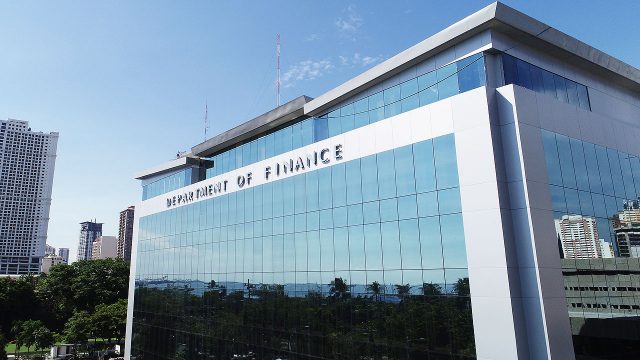
DoF seeking P38-B budget for 2026

DOF.GOV.PH

THE Department of Finance (DoF) is proposing a 2026 budget of P37.78 billion as it works to digitalize its operations.

The funding proposal, if granted, would represent a 1.09% increase from its allocation in the 2025 General Appropriations Act and account for 0.56% of the P6.793-trillion national budget for 2026, the DoF said.

In a briefing, Finance Secretary Ralph G. Recto said the proposed budget is equivalent to three days’ worth of its collections. It is tasked with collecting about P13.65 billion per day for the government.

“Digitalization and modernization initiatives remain a high priority across all agencies under the DoF to transform processes, integrate systems, and deliver faster, more efficient services,” he said.

The DoF said House Committee on Appropriations Vice Chair Bella Vanessa B. Suansing expressed support for the DoF budget, committing to “faithfully sponsor” the proposal before the Congress. — Justine Irish D. Tabile

ADVERTISEMENT
ADVERTISEMENT