Home Blog Page 10019

Spain’s Rafa Nadal secures comeback win to set up ATP Cup final against Novak Djokovic-led Serbia

SYDNEY — Rafael Nadal secured a come-back victory against Australia’s Alex De Minaur at the ATP Cup in Sydney on Saturday, propelling Spain into the final of the inaugural event to play the Novak Djokovic-led Serbian team.

The world’s top ranked player was ambushed early by the young Australian, who threatened to run away with the match, before the Spaniard recovered to win 4-6 7-5 6-1.

Earlier in the evening, Roberto Bautista Agut played a near flawless match to defeat a misfiring Nick Kyrgios 6-1 6-4, giving Spain an unassailable lead going into the doubles match.

The top 20-ranked De Minaur, who had previously not won a set against the Spaniard, threw his wiry frame at every shot, breaking Nadal’s serve in the first game of the match before going on to take the set.

The 20-year-old hopped into his backhands, such was his determination to throw himself forward, and launched into the air to hit his punishing forehands.

Nadal, one of the most dangerous players to serve against, remarkably did not earn a break point on the Australian’s serve until late in the second set, which he converted despite enjoying little momentum up until that point.

“He had a lot of energy, he plays with a lot of passion, sometimes a little too much,” Nadal said.

Spain has had a punishing schedule leading into the match, which included finishing the previous tie against Belgium in the early hours of Saturday morning.

Nadal reeled off four straight games at the start of the third to set up the victory as De Minaur’s error count rose, and the Spaniard found his range.

LONG RIVALRY
In the other semifinal, Djokovic played strong tactical tennis to overcome the enigmatic Russian Daniil Medvedev, to secure Serbia’s spot in the final.

The Serbian won the contest 6-1 5-7 6-4 after he found success pushing the 198cm (6.5 ft) tall Russian around the court, forcing Medvedev to constantly scrape shots off his shoe laces.

Less than two weeks out from the Australian Open, Djokovic gave the world’s top players a possible blueprint on how to beat the 23-year-old Russian who has been regularly toppling the game’s elite.

While Medvedev’s slapping forehand, flat backhand and big serve have proven hard to counter, Djokovic used dropshots and low slicing backhands to pull the world number five into awkward places.

Earlier, Serbia’s Dusan Lajovic beat his more highly ranked opponent, Russia’s Karen Khachanov, giving Serbia an unassailable 2-0 lead going into the doubles match.

Spain will have an opportunity in Sunday’s final against Serbia to confirm it has the world’s best men’s tennis team, having recently won the revamped Davis Cup and boasting two top 10 players in its ATP Cup side.

But Nadal will likely first need to reverse the momentum in his long rivalry with Djokovic, who has not lost to the Spaniard on hardcourts, like the court surface in Sydney, since 2013.

Nadal said late on Saturday he had not yet formed a game plan.

“No idea yet, I’m just happy for now, tonight, to be where we are,” Nadal said.

Djokovic leads Nadal 28-26 in their head-to-head which dates back to 2006. — Reuters

Rice inventory up 14% in early Dec. amid surge in NFA stocks

THE national rice inventory was estimated at 3.098 million metric tons (MT) as of Dec. 1, up 14% from a year earlier, the Philippine Statistics Authority (PSA) said.

According to the PSA’s Rice and Corn Stocks Inventory report, the inventory rose 4.6% month-on-month. The rice inventory is sufficient for about 96 days’ consumption based on an average daily consumption estimate of 32,000 MT.

Households accounted for 51.9% of inventories, commercial warehouses 32.6%, and the National Food Authority (NFA) 15.5%. No breakdown was provided for how much of the stocks were accounted for by imported rice.

Household inventory grew 5.3% year-on-year, while stocks held by commercial warehouses fell 7.3%. NFA stocks rose 370.6% from a year earlier.

All segments reported higher stocks month-on-month. Inventory held by households increased 5.3%, those of commercial warehouses grew 2.9%, and NFA holdings increased 5.9%.

The Department of Agriculture (DA) said that it is projecting palay production for 2019 of about 18.4 million MT, lower than the 19-million MT target, which factored in about P16.07 billion worth of agricultural damage during the period.

For 2020, it targets 19.6 million MT with the support of the P10-billion Rice Competitiveness Enhancement Fund (RCEF), which includes a P3-billion seed component. The DA’s distribution of inbred seed through the Philippine Rice Research Institute (PhilRice) started in late 2019 for dry-season planting in 2019 and 2020.

RCEF aims to reduce cost of production by about half from the current P12 per kilo, as well as to increase yield per hectare to 6 MT from 4 MT.

The corn inventory was reported at 794,870 MT, up 26.2% year-on-year, but down 33.7% month-on-month.

Corn held in commercial warehouses accounted for 77.1% of the total, while households held 22.9%. The NFA did not hold corn stocks.

Both sectors increased their holdings comparing year-on-year. Households raised their stocks 89.7%, while commercial warehouse inventory increased 14.8%.

Month-on-month, household inventory fell 18.1%, while holdings of commercial warehouses fell 37.2%. — Vincent Mariel P. Galang

Century Properties keen on REIT launch

CENTURY Properties Group, Inc. (CPG) said it is “very interested” to launch real estate investment trusts (REITs) once the government finalizes its rules on the real estate investment platform.

CPG President and Chief Executive Officer Jose Marco R. Antonio told reporters Friday the listed property developer is eyeing its office leasing portfolio to register for REITs once the plan is ripe.

“We’re very interested. I think it’s been a long-time coming for the Philippines… For us, as we’re growing our office portfolio, the REITs would be a great way to raise capital,” he said.

“We would participate once we are able to comply with the minimums and when we think there is a substantial or an adequate size to be able to have a REIT for CPG. If ever, it would definitely be more concentrated into office developments,” he added.

CPG’s leasing revenues as of the nine months of 2019 stood at P404.07 million, up 41.67% from the same period a year ago. CPG’s office assets are classified under this business segment, which is also comprised of Century City Mall in Makati, 160 medical suites in Centuria Medical Makati and the Pacific Star Low Rise Building where it has 50% ownership, among others.

“We look at the REITs as a long-term fund-raising tool and capital markets initiative that would allow us to actually accelerate further our expansion plans for commercial leasing assets,” Mr. Antonio said.

The government is targeting to finalize its guidelines on issuing REITs within the year, 11 years after Republic Act No. 9856 or the REIT Act was approved in 2009.

Based on the last draft rules that the Securities and Exchange Commission released in October, the proposal is to reduce the minimum public ownership for REITs to 33% from 40% and to require all income generated from REITs to be reinvested onshore.

Aside from CPG, Ayala Land, Inc. also said in December it wants to make its maiden REIT offering in 2020 for its prime Makati office assets.

CPG has set its capital spending at P30 billion until 2022 to finance its expansion plans. Earnings of the firm in the nine months to September rose 81% to P1.2 billion as revenues jumped 36% to P9.8 billion.

Shares in the company shed 2 centavos or 3.70% to P0.56 apiece on Friday. — Denise A. Valdez

Hopes for spike in US farm exports to China dim

CHICAGO/BEIJING — Days before a US-China trade deal is due to be signed, large Chinese purchases of Brazilian soybeans and a pair of unexpected policy moves by Beijing have dimmed US hopes that China would double its imports of American farm products this year.

US President Donald Trump has touted the prospect of China buying $40 billion in US farm products in 2020 as a pillar of the “Phase 1” agreement aimed at defusing the bitter trade war that erupted between the world’s two largest economies in 2018.

The conflict, marked by tit-for-tat tariffs, has disrupted the flow of billions of dollars in goods and threatened to slow global growth, rattling financial markets. It has also sent a chill through the US farm community, a key political constituency for Trump as he seeks re-election in November.

China announced on Thursday that Chinese Vice Premier Liu He, who has led Beijing’s delegation in the trade talks with the United States, would sign the Phase 1 deal in Washington next week.

But Chinese forward purchases of Brazilian soybeans, including about a dozen bulk vessels this week, or about 800,000 tonnes, are raising doubts Chinese buyers will have an appetite for vast supplies of US soybeans once the deal is done.

Margins in China for crushing raw soybeans into livestock feed and cooking oil have improved for mid-2020, the height of Brazil’s soy export season, according to two China-based traders.

China’s import needs have already been covered through the first quarter of the year, the traders said on condition of anonymity.

“The key factor for crushers is whether the beans are cheap, even with a trade deal. If the beans from South America are cheap, buyers will go for South America,” one of the traders said.

No details about the targeted $40 billion shopping list have been published, and China has not confirmed any purchase commitment. The US grain and livestock market rally that followed the Dec. 13 announcement of a trade deal has faded.

Adding to US concerns about the deal, sources in China told Reuters this week that Beijing has suspended its plan to implement a nationwide gasoline blend containing 10% ethanol this year. The plan had spurred hopes of a jump in US exports of the biofuel to China, as well as shipments of US corn to produce it domestically.

The news that China’s ethanol demand would not be rising broke a day after Beijing said it would not raise a low-tariff grain import quota to accommodate greater US exports.

Gao Feng, spokesman at China’s commerce ministry, said on Thursday that China will continue to improve the administration of tariff quotas for wheat, corn and soybeans in accordance with World Trade Organization commitments, and will make full use of quotas based on market conditions.

China could still expand agricultural imports from the United States, he said.

Even so, market observers question whether the United States’ $40 billion goal can be reached without large volumes of a wide array of goods.

“Such a lofty target makes (the market) very skeptical about the whole thing,” said Ted Seifried, chief strategist with Chicago-based brokerage Zaner Ag Hedge. “If China’s going to hit these numbers or get anywhere close, ethanol will have to be part of the mix.” — Reuters

Giving a soft cotton touch to the Mandaya’s Dagmay cloth

By Maya M. Padillo
Correspondent

DAVAO CITY — Local designer Wilson Niñofranco Limon is coming up with a clothing line that will combine cotton fabric and the Dagmay textile of the Mandaya indigenous people in Davao Oriental.

Dagmay is made from abaca fiber and its colors are extracted from barks, seeds, fruits, and other natural dyes.

Mr. Limon, whose Niñofranco brand has been known to use various indigenous cloths, said the new venture using Dagmay required not just permission but immersion with the Mandaya community who live in mountain areas.

“Strict kasi sila na tribe dahil pino-protektahan nila ang kanilang culture… Nag-immersion kami sa Mandaya community sa Sitio Sangab (They are a very strict tribe because they are protective of their culture… We went on an immersion in Sitio Sangab) and met the tribal leaders and discussed our plans of working with their artisans,” Mr. Limon told BusinessWorld.

The immersion, which Mr. Limon undertook in November last year together with representatives of the Department of Trade and Industry (DTI) regional office, was intended to give the designer a deeper understanding and appreciation of the Mandaya culture.

The DTI Davao Oriental provincial office has tapped Mr. Limon for a product development program on wearables — he is tasked to help the communities come up with new designs or incorporate Mandaya’s craftsmanship into modern clothing.

“We really need to tap the artisans directly. Before, I had to go through a middle man since there was no access to the community,” he said in mixed English and Filipino. He added that he also aims to help provide direct market linkages to the Mandaya weavers, who contrary to some perceptions, are thriving.

“The weavers say there are still many of them, they just don’t have the market. If Dagmay will be incorporated with cotton, we can help them market with designers and social entrepreneurs. Also with clients who are into contemporary ethnic clothing,” Mr. Limon said.

The designer is returning soon to the community to introduce cotton weaving, so the weavers themselves can start learning to incorporate it with the Dagmay designs as well as their traditional embroidery.

“We will evaluate their capacity and (how far) they are willing to collaborate,” he said.

For his brand Niñofranco, he said he has already produced a limited number of jackets using Dagmay and is still experimenting with shirts and blouses.

He said Mandaya designs are not commonly used yet, unlike those of the T’boli, or the beads of the Bagobo, and the Inaul from Lanao.

For his part, he said he is excited to tap more local artisans to give clients fresh designs.

Deft maneuvering

Rob Pelinka didn’t exactly stand on solid ground when the Lakers began their 2019–20 campaign. He had just gone through a busy offseason — one of tumult, fresh off yet another absence from the playoffs, the resignation of his boss Magic Johnson, the assassination of his character by the living legend, and a futile courtship of reigning Finals Most Valuable Player Kawhi Leonard. Still, he remained undeterred, facing the criticisms head on and in public, and, more importantly, doing his job as best he could. And for all the shadows being cast on the purple and gold, they looked to the future with optimism. Because of LeBron James and Anthony Davis. Because of him.

The other day, Pelinka found his exertions rewarded with a multi-year contract extension that accompanied his promotion as the Lakers’ new vice president of hoops operations. Needless to say, the development is a reflection of the absolute trust and confidence franchise owner Jeanie Buss has in him, and an offshoot of the tangible returns his leadership has generated. He certainly swung for the fences, risking significant roster turnover, not to mention a record number of draft assets, to acquire Davis, and then waiting for Leonard’s decision even as the free agent market was thinning. And while he didn’t bat a hundred percent, there can be no denying the outcome.

That the Lakers are firmly entrenched at the top of the highly competitive Western Conference despite whiffing on Leonard speaks to Pelinka’s deft maneuvering in the aftermath. There’s no doubt that they will ultimately go only so far as James and Davis will take them. On the other hand, the supporting cast has turned out to be an extremely productive, if imperfect, one. Weaknesses abound, but, as their shellacking of the Thunder on the road even without their two All-Stars proved, they’ve learned to become better than the sum of their parts.

Heading into the trade deadline, the grapevine has the Lakers exploring possibilities to improve their talent base. Per speculation, all and sundry not named James or Davis are available under the right circumstances. Indeed, it’s Pelinka refusing to be satisfied, and understanding that there should be no limits to the pursuit of excellence. True, he’s working with handicaps, not least among them the salary cap. Then again, he has always had hurdles to overcome and concerns to address, often borne from within. He’s used to the challenge, and, as his promotion underscores, reaping the benefits of experience.


Anthony L. Cuaycong has been writing Courtside since BusinessWorld introduced a Sports section in 1994. He is a consultant on strategic planning, operations and Human Resources management, corporate communications, and business development.

Hosting the 2030 Asian Games

Following the Philippines’ successful hosting of the 30th Southeast Asian Games, the Philippine Olympic Committee announced its intention to bid for the 2030 Asian Games. Other countries vying for the hosting rights are Qatar, India, Thailand, Taiwan, and Uzbekistan. If successful, this would be the second time the Philippines would host the Asiad — the first time being in 1954.

The Philippines is said to have a better-than fair chance of bagging the hosting rights given the strong support from government and availability of sporting venues. Also working to our advantage is our extensive experience in hosting international sporting events. Apart from having organized the 11th, 16th, 23rd, and 30th SEA Games, the Philippines also hosted the 2017 World Cup in Volleyball. In 2023, the country will again host the Basketball World Cup.

The Olympic Committee of Asia (OCA) may announce the winning bidder as early as the end of this year.

Hosting the Asiad is exactly what we need at this time. As an up and coming nation, the Philippines needs to overhaul its image and banish old stereotypes. From being perennially labelled as economically challenged and politically tumultuous, the time has come for us to be recognized as economically progressive, organized, reliable, and future-ready.

Hosting the Asiad will give us the platform to showcase whatever success we have mustered as a nation, our culture, our readiness for the future, and all the things that make us competitively unique. It is all about strengthening our “soft power” or our ability to gain supporters, followers, and cliques not by force or by money but by building a favorable reputation. Having soft power gives us a louder voice in the global arena and gravitas in geopolitical affairs.

After all, the Philippines is on track to become the 23rd largest global economy by 2030. It is only right that we act the part.

Apart from overhauling our image and the strengthening our soft power, hosting the Asiad promises a wealth of other benefits.

It will unite our people and foster national pride.

It will be a catalyst for economic growth. The experience of London and Sydney gives us an idea of the economic benefits a country can obtain by hosting Olympiads. The city of London invested $758 million to construct the facilities needed for the 2012 Summer Games. This amount was recovered three-fold through the sale of media rights alone which amounted to $2,569 million. Moreover, 20 million people visited the city and pumped $14 billion in cash into London’s coffers. Best of all, four billion people watched the opening ceremonies on television and this revolutionized London’s image from one that was old and staid to one that is culturally relevant. As for Sydney, its trade balance swung from a $1.3 billion deficit in August 2000 to a $677 million surplus during the month of the games.

Thousands of jobs will be created. In the case of Barcelona, 20,000 permanent jobs were created as a result of hosting the 1994 Summer Games. In Vancouver, 21,000 permanent jobs were generated from the boom in hotels, ski resorts, and restaurants as an offshoot of the 2010 Winter Games.

It will improve Infrastructure. Hosting the Asiad will provide the impetus to upgrade the country’s basic infrastructure such as roads, ports, transport systems, communication systems, and even disaster mitigation facilities. All these will improve the efficiencies of the host cities and benefit the local community who reside there. Moreover, it will set-up these cities nicely to host bigger events.

It will benefit tourism. The Philippines has some catching up to do when one compares our tourist arrivals against that of our neighbors. Hosting the Asian Games will give us the shot in the arm we need. In addition, millions of hoteliers, restaurants and shop owners will benefit from the influx of visitors.

It encourages the creation of new districts. As a result of the 30th SEA Games, New Clark City is now on the radar of investors. The same thing happened for the Sydney Olympic Park and the Newington district in Australia. Both have become thriving suburbs where people live and work. Property prices have increased in and around these suburbs. Best of all, these new districts decongested central Sydney. The same can happen for Clark, Cebu, and Davao, if they are named host cities.

Hosting the games puts the spotlight on our athletes. As we witnessed in the 30th SEA Games, our athletes were given the state support they needed to elevate their game and bring glory to the country. The same will happen in the years leading up to 2030.

Just as there are advantages, so are there risks in hosting the Asiad — the most glaring of which is having to spend billions on a new stadium that may be mothballed or rarely used after the games. This is what happened in Montreal, Beijing, and Athens.

Post-Game planning is essential to the overall success of hosting Olympic games. It’s important to consider how the sports facilities will be used after the influx of visitors leaves the city. In the case of London and Sydney, both purposely built their stadiums of medium size so as to be applicable for smaller-scale sporting events and concerts afterwards. During the opening and closing ceremonies of the games, they simply augmented their arenas with modular rafters to increase capacities.

In Los Angeles, they wisely decided not to build new structures, instead opting to modify their existing arena for the 1984 Summer Games.

Another risk is the inability to recover the billions of dollars invested to mount the games. Jakarta spent $3.2 billion to mount the 2018 Asiad while Incheon spent $2.05 billion in 2014. If ever, Manila will spend $5 billion 10 years from now. As mentioned earlier, good planning will enable the host country to recover the cost on the Olympic week itself, just as Los Angeles and London did. Also, media rights sales will play an even more important role in this digital age.

In evaluating the cost-effectiveness of hosting the Asiad, one must consider not only the revenues generated during the games alone — one must also compare the increase in the host city’s revenues after the games versus not hosting the games at all. The economic multiplier effect of hosting the games could last for decades.

But then again, financial profits are not the only determinant of success. The bigger consideration is the unquantifiable benefits on the country’s image and soft power.

I consider the decision to bid for the 2030 Asian Games a positive development. It is a potential game changer that civil society should support.


Andrew J. Masigan is an economist.

Launch of fully electric Taycan heads Porsche’s milestones in 2019

PORSCHE in 2019 began a new chapter in its history by simultaneously introducing in three continents the Taycan — the world’s first fully electric premium sports car to go into volume production. This year, the first batch of Taycan models are set to arrive in markets across the globe, included among which is the Philippines.

Besides launching the revolutionary Taycan, Porsche last year also achieved numerous other milestones. Here is a look back to some of these:

JANUARY
Three years after the premiere of the first Cayman GT4 Clubsport, Porsche unveiled its successor — the new 718 Cayman GT4 Clubsport. The model is a further development and came in a “Trackday” version meant for enthusiast racers, and “Competition” variant designed for national and international motor racing.

FEBRUARY
The Porsche Museum celebrated the 50th anniversary of the Porsche 917 by unveiling plans to restore the first 917 ever made to its original condition. Considered as one of the most successful racecars in history, the 917 — particularly the 917-001 — underwent various changes over time.

MARCH
Porsche launched three new sports models at the 89th Geneva Motor Show. The highlight was the new 911 Cabriolet. Displayed alongside this was the 718 T in both Boxster and Cayman forms, as well as the updated Macan S.

APRIL
In front of a capacity 4,400-strong crowd in Stuttgart’s Porsche Arena, Czech star Petra Kvitova finally won the Porsche Tennis Grand Prix on her seventh attempt. In a high-class final, she defeated Anett Kontaveit 6-3, 7-6(2) to earn for herself a Porsche 911 Carrera 4S Cabriolet as the main prize.

MAY
Porsche put the open-top, two-seat 911 Speedster into production. Exactly 1,948 units have been manufactured by the end of 2019 at Porsche’s plant in Zuffenhausen.

JUNE
Porsche works drivers Michael Christensen and Kevin Estre won the drivers’ world crown in the FIA World Endurance Championship at the season finale at Le Mans. The Project 1 customer squad dominated the GTE-Am class and at the same time claimed the drivers’ and team championship titles in the series.

JULY
For the first time, Porsche added an electric sports car to its lineup at the legendary Goodwood Festival of Speed. The debut was part of the Porsche Triple Demo Run, in which the Taycan made three appearances on three continents in three weeks. At Goodwood, the prototype competed with Mark Webber behind the wheel.

AUGUST
Porsche continued to consistently focus on electromobility, with the Cayenne range following the Panamera series in featuring a plug-in hybrid as its new flagship model. Like all Porsche plug-in hybrids, the new top-spec Cayenne is also one of the sportiest vehicles in the premium segment.

SEPTEMBER
Porsche presented its first fully electric sports car, the Taycan, to the public with a spectacular world premiere. Shortly after this, Porsche opened the new Taycan factory which sets new standards in terms of energy efficiency and environmental friendliness for production facilities.

OCTOBER
Following the launch of the Taycan Turbo S and Taycan Turbo, the third version of the four-door sports car, the Taycan 4S, was introduced.

NOVEMBER
On its Formula E debut season, Porsche works driver Andre Lotterer scored a strong second-place finish in the ABB FIA Formula E Championship 2019/2020 season-opening race. This was an encouraging debut for Porsche in the fully electric race series.

DECEMBER
Designers from Porsche AG and Lucasfilm Ltd. joined forces to develop a fantasy starship that brings together the design DNA of the two brands. For over two months, the project team worked together at their respective design studios in Weissach and San Francisco to create initial ideas and drafts before finally coming up with a concrete concept. The fantasy starship, named Tri-Wing S91x Pegasus Starfighter, was presented as a detailed model at the film premiere of Star Wars: The Rise of Skywalker, in Los Angeles.

Peso may strengthen on US-China phase one deal

THE PESO may strengthen against the dollar this week on the back of better risk appetite as the market waits for the ceremonial signing of the phase one trade deal between the United States and China.

The local unit closed at P50.66 per dollar on Friday, shedding less than a centavo from its P50.651 finish on Thursday, according to data from the website of the Bankers’ Association of the Philippines.

Meanwhile, it appreciated by 43 centavos from its P51.09 per dollar close on Jan. 3.

Rizal Commercial Banking Corp. (RCBC) Chief Economist Michael L. Ricafort attributed the sideways trading to the market’s anticipation of the phase one trade deal between the world’s two biggest economies.

“The financial markets are now anticipating the scheduled signing of the phase one deal amid continued easing of US-Iran tensions,” Mr. Ricafort said in a text message.

Reuters reported that White House officials have said on Friday that the Chinese translation for the key document which is set to be signed on Jan. 15 is yet to be completed.

Meanwhile, White House economic adviser Lawrence Alan Kudlow said in an interview with Fox Business Network that the document “is virtually complete” and all the signing is “all on schedule.”

A vital part of the deal is Beijing’s pledge to buy an additional $200 billion worth of products from the US for the next two years, a part of which is some $40 billion worth of agricultural products a year. In return, Washington will reduce tariffs imposed to nearly $160- billion Chinese goods by about a half.

UnionBank of the Philippines Inc. Chief Economist Ruben Carlo O. Asuncion also attributed the peso’s strength to subsiding tensions between Tehran and Washington.

“Risk appetites have seemingly improved across all markets as Iran and the US signalled their step back from increasing tensions in the Mid[dle] East,” Mr. Asuncion said in a text message.

Earlier, US President Donald J. Trump said he found it unnecessary for the US to hit back after Iran attacked their troops in Iraq as a retaliatory move for the death of military commander Qassem Soleimani through a drone strike by the US.

Mr. Trump assured that no Americans were hurt and that there was no major damage to the missile launches of Iran that targeted their base in Iraq.

“The fact that we have this great military and equipment, however, does not mean we have to use it. We do not want to use it. American strength, both military and economic, is the best deterrent,” Mr. Trump said, as reported by Reuters.

On Saturday, Iranian officials admitted that they had mistakenly shot down a commercial Ukrainian plane which killed all 176 aboard after initially denying they caused it in the tense aftermath of Iranian missile strikes on US targets in Iraq.

“The Islamic Republic of Iran deeply regrets this disastrous mistake,” Iranian President Hassan Rouhani wrote on Twitter, promising those behind the incident would be prosecuted.

For this week, RCBC’s Mr. Ricafort believes the market will continue to anticipate the phase one deal.

“Major catalysts include the widely expected signing of the phase one US-China trade deal on Jan. 15 that may be among the biggest positive lead for the global financial markets, including the peso,” he said.

Meanwhile, UnionBank’s Mr. Asuncion said the market will be on the lookout for key local data.

“The market would be waiting for the release of GDP (gross domestic product) growth numbers for 2019 Q4, slated for Jan. 23,” he said.

The economy grew by 6.1% in the third quarter, bringing the average growth for the nine-month period to 5.8%. In order to hit the government’s minimum target of 6% for 2019, fourth-quarter growth should hit at least 6.7%.

For this week, Mr. Ricafort sees the local unit playing around P50.40-50.90 a dollar, while Mr. Asuncion gave a forecast range of P50.50-50.80. — L.W.T. Noble with Reuters

Japanese firm eyes coconut processing plant in Davao Oriental

JAPAN-BASED Green Power Development Corporation is considering Davao Oriental as site for a processing plant for whole coconuts, according to the provincial government. In a statement, it said Governor Nelson L. Dayanghirang met last Thursday with the company’s top executives led by Chief Executive Officer Gen Kimitsuka and Consultant Jose Dante Mara. Based on the its submitted proposal, the investment will also involve supplying coconut seedlings to farmers and buying the harvest from them. Mr. Dayanghirang assured support to the venture as the company sets meetings with municipal government officials as well as indigenous people communities as some of the planned farm areas and processing plant site will cover ancestral lands. Green Power Development is also eyeing the establishment of hydro- and solar-powered energy facilities to provide supply to the plant.

Honda extends holiday promos this January

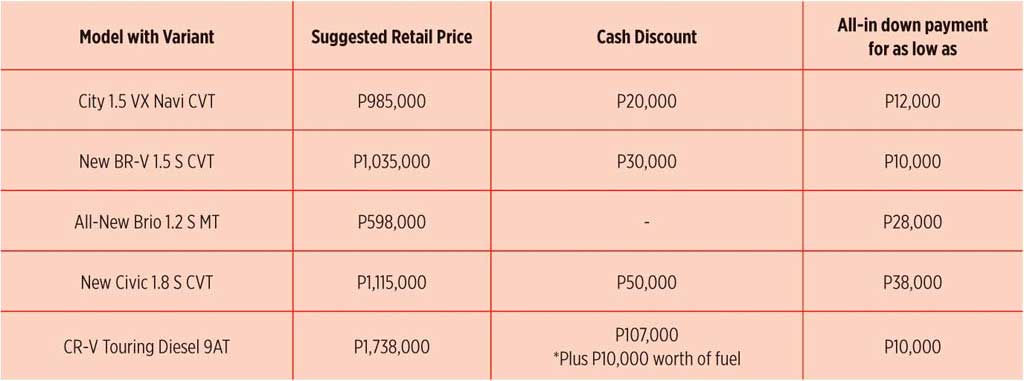
HONDA CARS Philippines, Inc. (HCPI) is pleased to announce the extension of its holiday promo, Cheers for Deals. This caters to customers planning to purchase Honda vehicles this January. This month’s promo covers the City, BR-V, Brio, Civic and CR-V with the following cash discounts and all-in low down payment offers:

The City 1.5 VX Navi CVT, New BR-V 1.5 S CVT, and All-New Brio 1.2 S MT are all available through a 10% special all-in cash out with payment terms of 36 up to 60 months through BPI Family Savings Bank, RCBC, Security Bank Corp., China Bank Savings, and Bank of Commerce only.

The CR-V Touring Diesel 9AT and New Civic 1.8 S CVT are available through 15% or 20% low net cash out with payment terms of 36 up to 60 months through BPI Family Savings Bank, RCBC, Security Bank Corp., East West Banking Corp., PNB Savings Bank, Philippine Savings Bank, China Bank Savings, Bank of Commerce, Sterling Bank of Asia, Maybank Philippines Inc., BDO Unibank, Inc., United Coconut Planters Bank, and Robinsons Bank only.

Other financing promo option offers are the Free One Month Amortization, available for 60 months payment term only and the Low Monthly Amortization, available for 15% and 20% all-in down payment for 36 to 60 months payment term.

All these extended holiday offers include three-year LTO Registration and Chattel Mortgage. Free one-year Comprehensive Insurance with Acts of Nature is also available through select bank partners.

To learn more about the latest news and promos, visit your nearest Honda dealership, or Honda Cars Philippines, Inc.’s official website at www.hondaphil.com. Hurry, offers are available until Jan. 31, 2020 only.

JG Summit’s share price down after raising stake in PLDT

By Mark T. Amoguis Senior Researcher

THE recent purchase of PLDT, Inc. shares by Gokongwei-led JG Summit Holdings, Inc. made the latter one of the most actively traded stocks last week with investors deciding to take profits.

A total of 6.54 million JG Summit shares worth P518.74 million exchanged hands from Jan. 6 to 10, data from the Philippine Stock Exchange showed.

The stock was lower by six percent on a week-on-week basis to P77.05 apiece last Friday from its P82-per-share close on Jan. 3. Since the start of the year, the stock has fallen by 1.2%.

“[B]ased on the movement of the share price, some investors of JG Summit decided to take profit because there’s still uncertainty as to how PLDT will be able to adapt in an environment where the third telco will be coming in,” Rachelle C. Cruz, senior research analyst at AP Securities, Inc., said in a phone interview.

“Investors are curious on the rationale behind the additional investment… Additional investment of JG Summit could be a sign of confidence on PLDT,” she added.

For Regina Capital Development Corp. Senior Equity Analyst Rens V. Cruz II, news of JG Summit buying into PLDT benefitted the latter more than the former.

“PLDT was trading on a sideways consolidation prior, so when a good name started buying into it — on top of reinforcing the fact it is still a good dividend play — [it] enticed most investors to buy up the stock for the week,” he said in an e-mail interview.

Last Tuesday, the holding firm of the Gokongwei family disclosed to the bourse that it bought 7.05 million common shares — representing 3.26% — of PLDT through the purchase and conversion of American Depositary Receipts of the telco company.

As a result of the acquisition, JG Summit increased its stake in the telco to 11.23% from 7.96%.

These shares were priced at $19.70 apiece, totalling $138.83 million. The deal was paid in cash and settled on Jan. 6.

JG Summit considers said it considers the deal as a “valuable investment” given PLDT’s good history of dividend payments. The company also said that this transaction will not have any adverse effect on its financial condition.

To recall, PLDT acquired JG Summit’s controlling stake (51.55%) in Digital Telecommunications Philippines, Inc. (Digitel). In exchange for the Digitel stake, JG Summit got 12.9% of PLDT, comprising 27.7 million common shares.

In November that same year, JG Summit sold 5.81 million and 4.56 million PLDT shares to Metro Pacific Resources, Inc. — an affiliate of Hong Kong-based First Pacific Co. Ltd. — and NTT Docomo, Inc, respectively. Both companies are major shareholders of PLDT.

Aside from telecommunications, JG Summit has business interests in branded consumer foods; agro-industrial and commodity food products; real property development; hotels; banking and financial services; petrochemicals; air transportation; and power distribution.

As of the third quarter, JG Summit posted a 50.3% increase in its net income attributable to equity holders of the parent company. This, despite recording a 2.4% drop in its attributable net income in the July-September period.

For this week’s trading, AP Securities’ Ms. Cruz pegged JG Summit’s support levels at P76.65 and P75.90 and resistance at P83.

Meanwhile, Regina Capital’s Mr. Cruz gave JG Summit a “near-interim” support of P76.85, followed closely by a “stronger” support level of P76.33. Meanwhile, he placed the stock’s resistance at P82.

Metro Pacific Investments Corp. is one of three Philippine units of First Pacific, the others being PLDT, Inc. and Philex Mining Corp. Hastings Holdings, Inc., a unit of PLDT Beneficial Trust Fund subsidiary MediaQuest Holdings, Inc., maintains interest in BusinessWorld through the Philippine Star Group, which it controls.

ADVERTISEMENT
ADVERTISEMENT