Mapping oil-gas dependence of countries, and Meralco’s Q1 income
Continued high oil and gas prices affect the cost of mobility and the various industrial and petrochemical products, down to fertilizers resulting in a higher cost of farming. Electricity generation can be somewhat insulated from very high prices for countries that rely more on coal, nuclear, hydro, geothermal, and other renewables.
I have here the breakdown of total energy supply by type of fuel. I grouped the countries by continent and sub-continents.
The heavy users of oil are Japan, South Korea, Brazil, Germany, Turkey, Saudi Arabia, Australia, Taiwan, Thailand, and Singapore. Heavy users of both oil and natural gas are the US, Canada, Mexico, the UAE, the UK, Italy, and Malaysia. And heavy users of natural gas are Russia and Iran.
The heavy users of coal are China, India, Indonesia, and Vietnam; the high users of coal and gas are Taiwan and the Philippines. Only France is heavily dependent on nuclear power.
Countries that are high energy users are also the countries with large GDP sizes. China leads as its GDP of $41.2 trillion and its total energy supply of 159 exajoules (EJ, a unit of energy equal to one quintillion joules) are a lot larger than the US’ GDP of $30.8 trillion and energy supply of 92 EJ.
When it comes to electricity generation, the archipelagic Philippines is larger than the city state of Singapore, with 130 vs. 60 terawatt-hours (TWh), but when it comes to total energy supply, Singapore’s is larger than the Philippines’, with 3.79 vs. 2.54 EJ. The main reason is that Singapore is used as a transportation hub by many airlines, shipping lines, cruise lines, and cargo ships.
Notable in Table 1 is that America and Europe have seen a small expansion in GDP size over the past two decades, 2005 to 2025. The global average expansion over the same time period is 3.1 times. The expansion of GDP size of the US, Canada, Germany, France, and the UK range from 2.1 to 2.4 times.

In contrast, China, India, Indonesia, Vietnam, Singapore and the Philippines saw GDP expansion of 4.2 to 6.9 times while Thailand, Malaysia, Taiwan, and South Korea’s GDPs expanded 2.8 to 3.8 times. These Asian economies have powered their industrialization and modernization with coal, gas, and oil, using more fossil fuels than renewable energy sources. Asia, and the Philippines in particular, should not veer away from this, they should distance themselves from the aggressive climate-climate agenda that promotes the use of renewable energy.
MERALCO
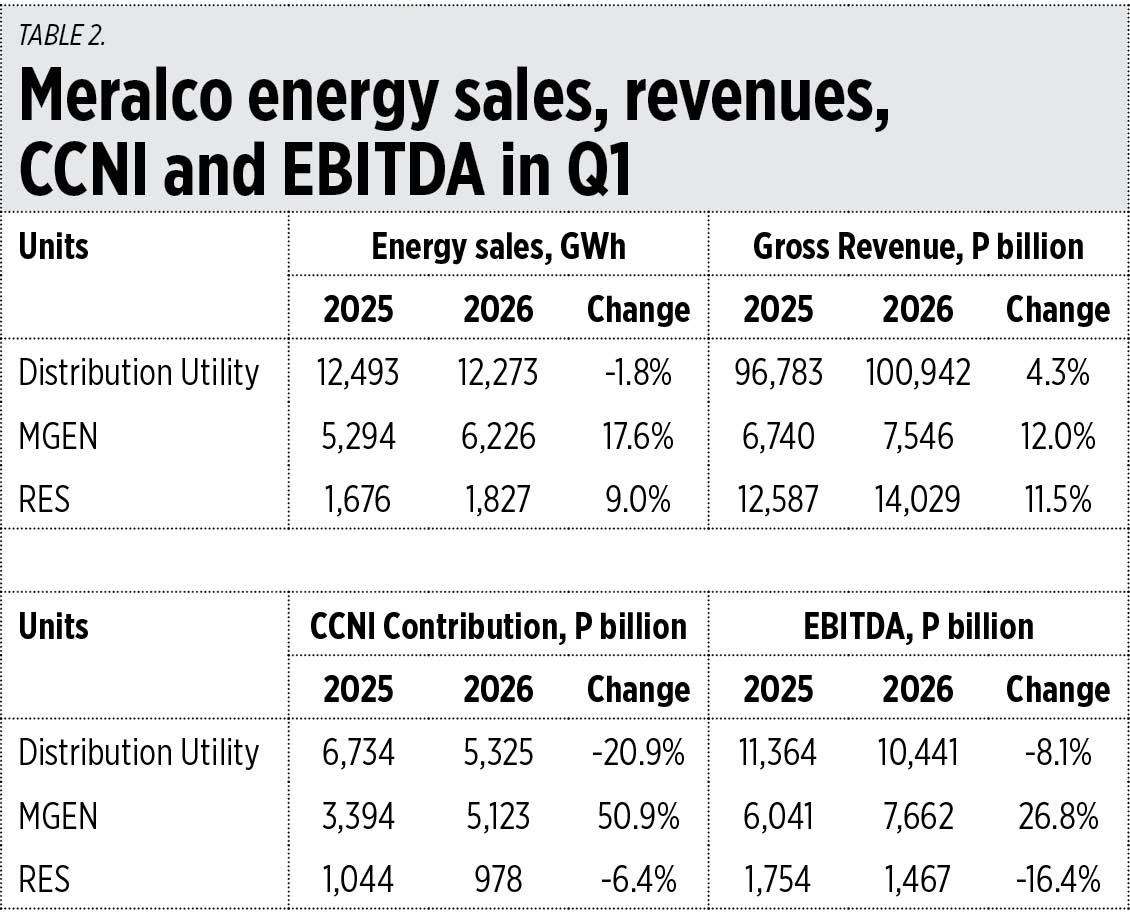
Last week, Meralco released their first quarter (Q1) 2026 Financial and Operational Highlights. Meralco proper as a distribution utility (DU) experienced a decline in energy sales at -1.8%, but the generation unit, the Meralco PowerGen Corp. (MGEN), experienced a 17.6% expansion, while its retail electricity supply (RES) units like Vantage and MPower saw a 9% expansion.
In Consolidated Core Net Income (CCNI), MGEN experienced a 51% expansion while the DU and RES suffered a contraction of 21% and 6.4% respectively. It is the same in Earnings Before Interest, Taxes, Depreciation, and Amortization (EBITDA), the DU and RES suffered contractions but MGEN experienced a 27% expansion (see Table 2).
MGEN remains the rock star of the Meralco group. The “lead singer” of this rock star unit, MGEN President and CEO Manny Rubio, identified in his presentation the dynamic parts of the company, namely MGEN Thermal (the coal plant units GBP and San Buenaventura), MGEN Gas (an investment in LNGPH through Chromite Gas, and Singapore-based PacificLight Power), and MTerra Solar for the timely delivery of an initial 250 megawatts (MW) of solar with battery. He also mentioned the $2.8-million US government grant to MGEN for nuclear study.
Meanwhile, here are some developments from other agencies.
The Department of Energy (DoE) reiterated its moratorium on new coal projects in the country. This is bad news. The good news is that there are exemptions to the moratorium — projects that were categorized in 2020 as committed for expansion, indicative projects with substantial accomplishments, those serving off-grid or island areas, facilities dedicated to the mining and processing of critical minerals, own-use projects within economic zones, and on-grid projects deemed necessary to avert an imminent power supply crisis.
The Energy Regulatory Commission (ERC) made three good rulings this month — resuming the Wholesale Electricity Spot Market or WESM operations, the issuance of clarificatory guidelines on Modified Administered Price to stabilize power costs during market suspension, and the suspension of the Green Energy Auction Allowance, or GEA-All, collection for the May and June 2026 billing period.
The National Grid Corp. of the Philippines reiterated they are ready with 10,260 MW of available transmission capacity, but there are not enough power plants in the right places, and many new power projects are far away from existing transmission facilities.
The Bureau of Customs issued an order extending solar importer accreditation validity from one year to three years. Good — that means less bureaucracy and additional costs.
Bienvenido S. Oplas, Jr. is the president of Bienvenido S. Oplas, Jr. Research Consultancy Services, and Minimal Government Thinkers. He is an internationa fellow of the Tholos Foundation.