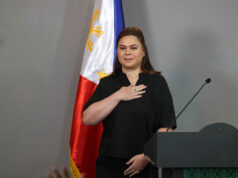
President Duterte approves federal constitution draft
President Rodrigo R. Duterte has approved the Consultative Committee’s (ConCom) draft federal constitution, Presidential Spokesperson Harry L. Roque, Jr. said.
“Approved na ito, except for request to amend transitory provision to provide for an elected president during transition,” Mr. Roque said in a text message to ConCom spokesman Ding Generoso.
“PRRD mentioned in cab meeting his request to amend transitory provision for elected transition leader,” Mr. Roque also said in a text message as shared by Mr. Generoso to reporters.
He said the President “wants to step out as soon as the draft constitution is ratified,” requesting instead a general election for a transitory leader.
The President also wants a “younger” leader to take over once he steps down.
In his speech on Monday, ConCom chairman retired Chief Justice Reynato S. Puno said the draft constitution seeks to create 18 federated regions, including federated regions of the Bangsamoro and Cordillera.
“We divided the powers of government guided by the Filipino spirit of bayanihan where both the federal government and the federated regions govern the people less in competition but more in cooperation and aligned with the maxim: The welfare of the people is the supreme law, Salus populi est suprema lex,” Mr. Puno said.
Citing several features of the draft federal constitution, Mr. Puno said it “democratizes the electoral process by prohibiting political dynasties that have long monopolized the elections.”
“At the same time, it transformed political parties as mechanisms of citizen representation and democratic governance,” he said. “Under the draft constitution, political turncoatism is also prohibited.”
The proposed constitution, according to Mr. Puno, prohibits “monopolies and oligopolies.”
“For this purpose, the draft constitution established an independent competition commission to stop these monopolies by the moneyed,” he said, saying the federal constitution is “pro-poor.”
“For the first time in our history, the socioeconomic rights of the poor to adequate food, comprehensive health care, complete education, adequate and decent housing and livelihood and employment opportunities are included in the Bill of Rights as rights demandable against the government,” he said.
Mr. Puno added that under this system, the country’s impoverished communities are guaranteed political representation in legislative bodies and federated regions.
“Finally, the draft constitution established a permanent and indissoluble nation because it recognized the ethnicity, culture, religion, customs, traditions, language, and distinct identities of our brothers and sisters in the Cordillera and Bangsamoro,” Mr. Puno said. — Arjay L. Balinbin