Gulf tankers will need protection, peace deal or not
By James Stavridis
US PRESIDENT Donald Trump has halted the US Navy’s nascent effort to guide commercial ships out of the Persian Gulf — pending the Iranians’ response to his latest peace proposal. But don’t let the pause fool you.
Even in the very unlikely event Iran agrees to a compromise, it would be naive to assume Tehran will stick to it. Either way, over the next few months the US will have to undertake significant maritime operations to ensure tankers can pass safely through the Strait of Hormuz, sweep it for mines, restore navigational coherence, and wrest operational control from Iran.
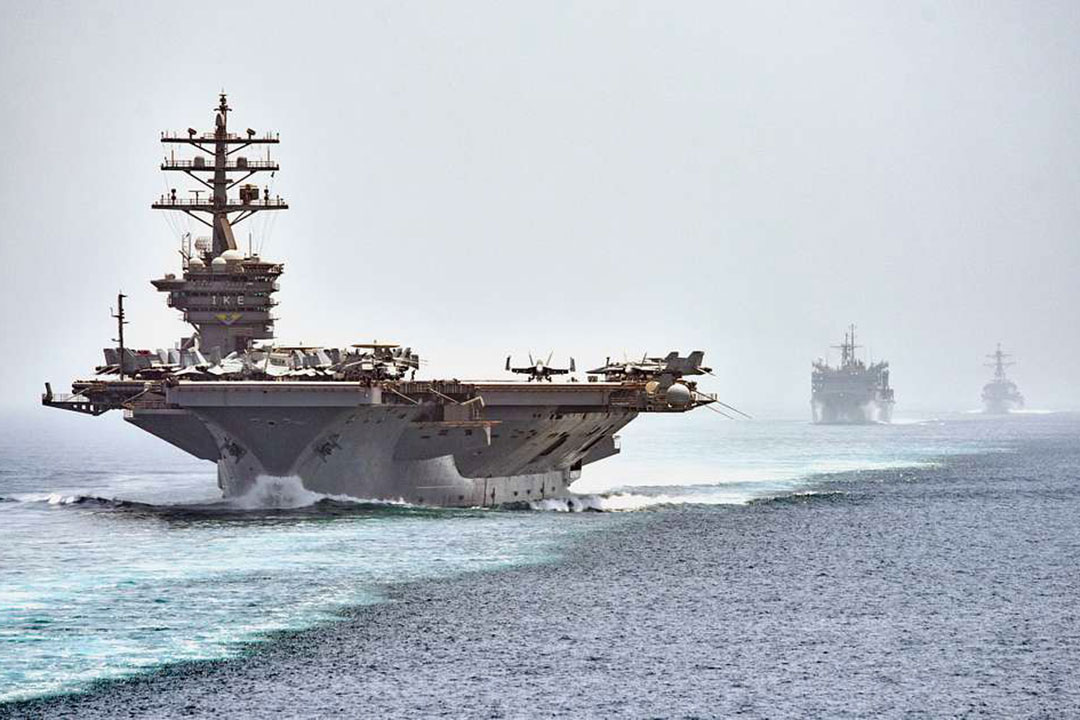
The Navy is wisely putting more combat power in place just south of the strait, and setting up alternative traffic lanes that are closer to friendly Oman and farther from the Iranian coast. While the Trump administration is sticking to the vague term “guiding” the ships, the Navy is no doubt planning for a full-blown escort mission, with warships accompanying convoys of commercial craft through the dangerous waters.
What kind of military resources would be required for this ambitious mission? As so often in military strategizing, the past can be a guide. So it’s worth looking back four decades at Operation Earnest Will, the mission that helped escort tankers out of the Gulf during the Iran-Iraq war.
In July 1987, I participated in that effort as the operations officer in a new Ticonderoga-class cruiser, USS Valley Forge. We were tasked with getting big merchant tankers, which had been reflagged to the US from Kuwait, through waters contested by Iran.
The circumstances are different in that the US was not an active combatant in the Iran-Iraq War, but simply provided the escort services to get oil flowing again. Today, of course, America is a co-belligerent with Iran in a war. But that shouldn’t change strategy at sea.
Earnest Will was planned carefully, with guided-missile destroyers and cruisers escorting several tankers at a time. It was the largest convoy operation since World War II, and the British and French navies participated alongside US ships.
The Iranians had mined the strait quite effectively, so the escort service quickly became a mine-hunting and minesweeping exercise. Early on, it threatened to turn into a fiasco: One of the supertankers, the Bridgeton, hit a mine (it didn’t sink). Had it been a US warship that was hit, the entire operation would have been in jeopardy. The Navy adjusted, with US vessels taking up station astern of the merchant ships so they wouldn’t strike any mines.
Ultimately, Earnest Will lasted for 14 months, with 30 US warships involved at the peak. Still, the harassment by Iran ended only after a significant US combat operation, called Operation Praying Mantis, destroyed Iranian oil platforms, ships, and planes. Tragically, the USS Vincennes accidentally shot down an Iran Air flight in July 1988, killing 290 people. The eight-year war between Iran and Iraq ended shortly thereafter, and the escort mission concluded that September.
The first lesson of Earnest Will is obvious: These missions require immense resources. Escorting the merchants in convoys would require at least a dozen guided-missile cruisers and destroyers strung out along the transit lane to provide air defense. You’d also need at least half a dozen minesweepers to set up new navigational tracks and repeatedly clear them of Iranian mines.
It would also require dozens of combat aircraft — including fighters, attack helicopters, and A-10 Warthog close-air-support planes — and a command-and-control center on an aircraft carrier or a large-deck amphibious ship. Special forces are also a key element. In the late 1980s, this included Navy SEALS, high-speed patrol craft, and stealthy helicopters.
Second, the Navy would need to be vigilant to avoid collateral damage involving shipping in the strait or neutral aircraft. It would be all too easy to have a repeat of the Vincennes disaster in the tight, constrained waters of the strait, especially with operators under extreme pressure and exhausting conditions.
Next, if the Iranians continue to attack merchant shipping and civilian infrastructure, we should reply with calibrated strikes around the strait: on small boat refueling, storage, and repair locations; any remaining mine inventories; drone-launching sites; and short-range ballistic missile batteries.
We would also need to realize that this would not be a bloodless mission. Sooner or later, some of the merchants and perhaps even a Navy warship would be struck by drones or a mine, with major damage and loss of life. During Earnest Will, several tankers ran into mines, and a frigate, the USS Samuel B. Roberts, nearly sank after hitting one.
Finally, it would be much better to undertake such a major operation with allied participation, as we had in Earnest Will. The US should press harder for the EU partners to send minesweepers and guided-missile warships to serve in a coalition under American leadership.
Barring an unlikely success in negotiations, we are entering a new and dangerous phase of the war with Iran. Looking back to the 1980s can provide some powerful lessons, if and when combat resumes.
BLOOMBERG OPINION
James Stavridis is dean emeritus of the Fletcher School of Law and Diplomacy at Tufts University. He is on the boards of Aon, Fortinet and Ankura Consulting Group.