

Movie Review
Quezon
Directed by Jerrold Tarog
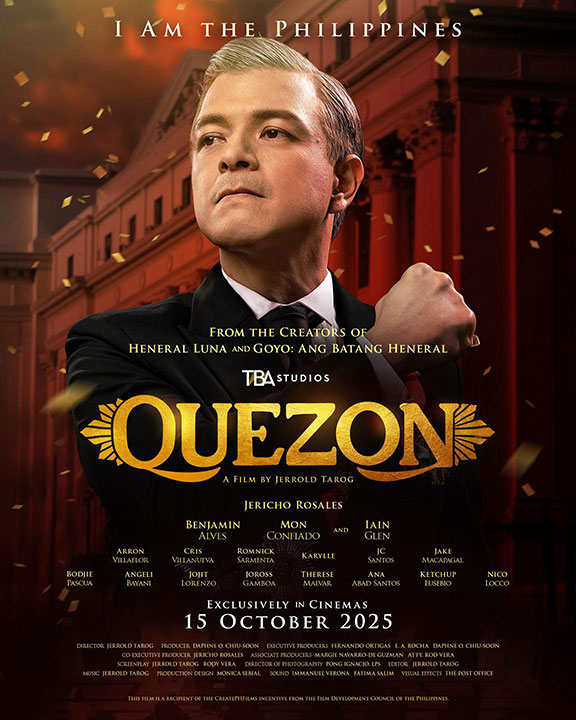
STARTING right off with a caveat: I am not a historian, merely a student of film. I can talk of storytelling and visual style, but of historical facts about the period and details of the man himself? I can at most repeat what I’ve found through online research, perhaps hazard a few inexpert opinions based on what I’ve read.
The film itself starts in quietly spectacular fashion, taking its cue from the film that inspired many an aspiring director, Welles’ Citizen Kane: a silent short depicting the younger Quezon (Benjamin Alves) during the Philippine-American War; for the rest of the running time fictional journalist Joven Hernando (Cris Villanueva) dogs Quezon’s heels, digging into and commenting on the man’s life the way Jerry Thompson dug into and commented on Charles Foster Kane. Director Jerrold Tarog, working with cinematographer Pong Ignacio (who lensed the previous two installments of the director’s period epic, Heneral Luna and Goyo: Ang Batang Heneral) employs the kind of sweeping camera movements Welles used in his second feature, The Magnificent Ambersons, or Bertolucci in 1900 or — to name a model closer to home — Peque Gallaga in his wartime drama Oro Plata Mata (mind you, I’m not ranking Mr. Tarog as equal to Welles or even Bertolucci, just citing influences).
More inspired in my book is Tarog’s editing and music score: Quezon prances to the rhythm of the tango, a sensual dance that, when played at a brisk pace, reveals a strong sardonic streak. The film isn’t so much biopic as it is musical, with passages that entirely take their cue — emotional tone, satiric edge — from a song; isn’t just any old musical but a dance musical, with Quezon himself (Jericho Rosales) and partner-in-crime Sergio Osmeña (Romnick Sarmenta) high-stepping their way into Leonard Wood’s (Iain Glen) office for a quick game of high-stakes hijinks.
Glen underplays wonderfully against Rosales and Sarmenta, coming across as the experienced civil servant trying to curb the enthusiasm of two overcaffeinated politicos — or, to push a different metaphor, like a schoolmaster trying to educate a pair of hyperactive juveniles. Rosales for all his yelling can’t match Glen’s gravitas, and this is deliberate, I think, a case of brown skinned David needling a pale faced Goliath. Glen plays it two ways: in an intimate scene he confides to Quezon (and us) that he’d like nothing more than to retire and go home but has a job to do; at the same time he comes across as someone who thinks he knows what’s best for us — a whiff of condescension taints his most solemnly stated intentions. When Quezon does pull one over Wood (as in the case of Wood’s appointee attempting to shut down the city gambling dens) you can’t help but cheer the Filipinos for their effrontery.
The film isn’t perfect, far from it. Its mediating consciousness, reporter Joven Hernando, is a rather bland persona, and necessarily so; Tarog isn’t about to spend millions of pesos telling his story (likewise Jerry Thompson in Kane was an equally anonymous creature). More interesting is the character of Emilio Aguinaldo (Mon Confiado) — a Machiavellian figure in Heneral Luna (General Luna), an equally shadowy figure in Goyo: Ang Batang Heneral (Goyo: The Boy General). One senses that he’s Tarog’s real focus, the director’s hidden agenda while selling the project to his producers: an epic on the Philippine-American War focused on three heroes — Luna, Del Pilar, Quezon — that really tells (in three chapters) the arc of Aguinaldo’s career, from revolutionary leader to first Philippine president to shadowy ghost from the political past, rising up to fight Quezon for the presidency.
Except we don’t really get a proper narrative; the focus remains on the three heroes. Tarog needs to tell each of their stories properly – he’s spending millions of other people’s money after all — and ends up short-changing the ex-president. Aguinaldo is granted a high point: when Quezon is challenged, he responds by taking away privileges and digging up skeletons in Aguinaldo’s past; the old man’s face grows grimmer and grimmer and grimmer, and at a certain point you start to feel a bit sorry for him. A bit.
Perhaps my biggest complaint is that Tarog doesn’t listen to the whispered voices in his head and turn the film into a dance musical, complete with sung-through lyrics and an original tango score (Quezon!). I can see the project exercising the director’s full talents as composer and editor, the results stylized enough to quell any outcry; after all, it’s hard to ask critical questions when your feet are tapping to the melody.
That’s my thoughts on the film as a film — if we’re talking of Quezon as darkly comic entertainment, Tarog largely pulls it off; the feature carries you along further and faster along the tides of history than his previous efforts Heneral Luna and Goyo. If we’re talking whether or not Tarog should have adopted that specific cynical tone, well…
The biopic is generally far from being my favorite genre; most productions have to tread carefully, especially when the subject is still alive or his descendants still around, ready and willing to threaten a lawsuit or restraining order (Citizen Kane anyone?). I don’t think disrespect is fatal to a biopic; I think it’s essential if the film is to be at all interesting. Hate, love, ambivalence, any and every emotion in the dictionary should inform the feelings of the filmmaker except indifference, or (god help us) unthinking reverence.
I also question the charge that Tarog has stained Quezon’s reputation; if anything, he’s taken the cold marble statue of the man and breathed a little life into him — instead of a halo, a pair of brass balls; instead of a stentorian megaphone, an insistent almost shrill voice. Someone questioned Rosales’ vocal performance: surely it’s inappropriate for a national hero? But if you listen to sound recordings of the real Quezon, especially when he was older, it was fairly high-pitched; a bit like Lincoln, whose voice has been described as a “falsetto, almost as high-pitched as a boatswain’s whistle.” Lincoln realized his voice was a handicap, and developed his diction and rhetorical style to compensate; I assume Quezon did something similar, and Rosales decided to stay true (or as true as ability allows) to historical record.
That assertion — that a national hero must have a heroic voice — feels naive. Surely we have come to know better; if not, it’s up to filmmakers like Tarog to try show us something better, or at least something different, not necessarily for the sake of being different but for that startling detail dug up from historical record that jolts us into realization: why, this is an actual person, one who walked on everyday pavement — in a pair of shoes, like the rest of us.
There’s the question of a pro-American slant and, yes, Tarog does paint a flattering portrait of Wood (ignoring, for one, the Governor-General’s record of massacring women and children in Bud Dajo — I didn’t like that exclusion). At the same time an old aphorism pops into my head: if you want to know a man, talk to his enemies. If you want to build up a man, build up his enemies, making his eventual triumph all the more impressive. These aren’t historical but dramatic imperatives, and this, after all, is a movie.
There are cries to be “fair and balanced” and “why didn’t they consult the family?” — but a fair and balanced account is important to a history; to a film it’s… a style, at best, and one to be carefully applied lest you fairly balance all the life out of your picture. Consulting the family might turn the film into an Official Account, the equivalent of the Marcoses’ Iginuhit ng Tadhana (Written in Destiny, 1965), a mythmaking biopic that glorified that particular president’s fictional wartime record. Could Tarog have done this instead? Maybe. I don’t know all the answers, I can at best wonder.
Finally: I did see that video, of Quezon descendant Ricky Avancena confronting the actor and his director after a screening, and have this to say: I applaud Mr. Avancena for the magnanimity of his gesture, urging everyone to see the picture anyway, even if he did hate it (and he has every right to hate it, that’s his grandfather after all); I applaud the generosity of his sentiment that a work should not be suppressed but discussed and, if one ends up feeling a certain way, condemned. I also liked his style — the fiery Quezon blood does shine through. So, following his lead, I recommend: go watch, if it’s still in theaters, or go watch, if it eventually comes to streaming, and go make up your own minds.


