‘Moderately free’ Philippines improves in economic freedom
By Beatriz Marie D. Cruz, Reporter
THE PHILIPPINES improved five spots to 77th out of 176 countries as its economy remains “moderately free,” according to a global index on economic freedom by The Heritage Foundation.
However, the Philippines’ progress is still hindered by corruption issues and the weak rule of law, the US-based conservative think tank said.
In the 2026 Index of Economic Freedom, the Philippines saw its score increase by 2.3 points to 62.9 from 60.6 in 2025.
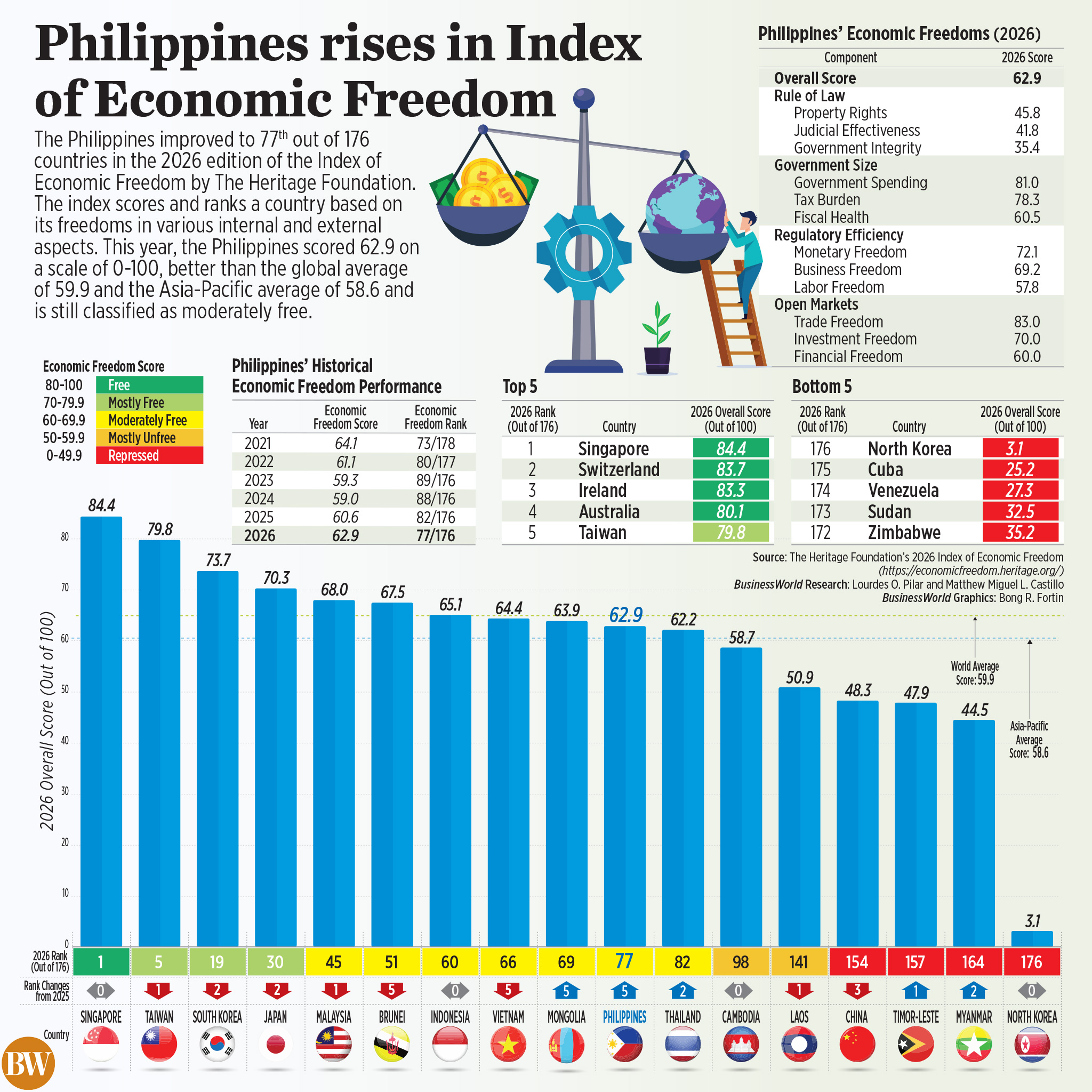
The Philippines’ latest ranking is equivalent to the economic freedom status of “moderately free” since 2025 when it ranked 82nd in the index.
The index measures 12 aspects of economic freedom, which are grouped by four broad pillars — rule of law, government size, regulatory efficiency, and market openness.
The report defines economic freedom as individuals’ liberty to acquire and use economic goods and resources in a country, based on the four pillars.
Singapore (84.4) topped this year’s index as the freest economy in the world, followed by Switzerland (83.7), Ireland (83.3), Australia (80.1), and Taiwan (79.8).
The bottom five countries include North Korea (with a score of 3.1, ranking 176th), Cuba (25.2, 175th), Venezuela (27.3, 174th), Sudan (32.5, 173rd), and Zimbabwe (35.2, 172nd).
Among 39 Asia-Pacific countries, the Philippines ranked 14th, outpacing the region’s average score of 58.6, and some of its Southeast Asian neighbors such as Thailand (82nd), Cambodia (98th), and Laos (141st).
However, the country lagged behind Malaysia (45th), Brunei Darussalam (51st), Indonesia (60th), and Vietnam (66th).
Based on the latest index, the Philippines’ rule of law is “weak,” as it scored below the world average in property rights (45.8), judicial effectiveness (41.8), and government integrity (35.4).
Under the pillar of government size, the country scored 78.3 in tax burden, 81 in government spending, and 60.5 in fiscal health.
According to the US-based think tank, the Philippines’ regulatory environment is “relatively well institutionalized but lacks efficiency.”
This was reflected in the Philippines’ business freedom score of 69.2, labor freedom score of 57.8, and monetary freedom score of 72.1.
Under the pillar of market openness, the country scored 83 in trade freedom and 70 in investment freedom, and 60 in financial freedom.
“Foreign investment is generally welcome, and the investment code treats foreign investors the same as it treats domestic investors. The financial sector is dominated by banking and relatively stable, but capital markets are underdeveloped,” the think tank said.
It also cited recent legislative reforms to improve the country’s business environment and to support the private sector.
“Despite some progress, corruption continues to undermine long-term economic development,” the Heritage Foundation said.
In 2025, economic growth slowed to 4.4%, falling short of the government’s 5-6% target range, as graft-linked infrastructure projects triggered a decline in business confidence and government spending.
Filomeno S. Sta. Ana III, coordinator of Action for Economic Reforms, said the lack of judicial action from last year’s corruption scandal confirms the country’s “weak” rule of law.
“The massive scale of corruption is a big barrier to the country’s economic growth and development. That’s why the call to make the guilty accountable, punish them, demand for greater transparency are essential reforms,” he said in a Viber message.
For Jose Enrique “Sonny” A. Africa, executive director at think tank IBON Foundation, some positive indicators in the Philippines’ index do not reflect the conditions of many Filipinos.
“The economic freedom scores are inconsistent with the economic realities faced by the majority of Filipinos who remain poor,” he said in a Viber message.
Mr. Africa noted that the index does not look into real development indicators like family incomes, job security, and access to social services and public utilities.