Cash remittances jump by 3.5% in January
By Katherine K. Chan, Reporter
MONEY SENT HOME by Filipinos abroad climbed by 3.5% year on year in January as a weak peso boosted foreign exchange gains, preliminary Bangko Sentral ng Pilipinas (BSP) data showed.
Cash remittances, or money coursed through banks from overseas Filipino workers (OFWs), rose to $3.02 billion in the first month of the year from $2.918 billion logged in January 2025.
However, the 3.5% growth was the slowest annual growth seen in three months or since 3% in October last year.
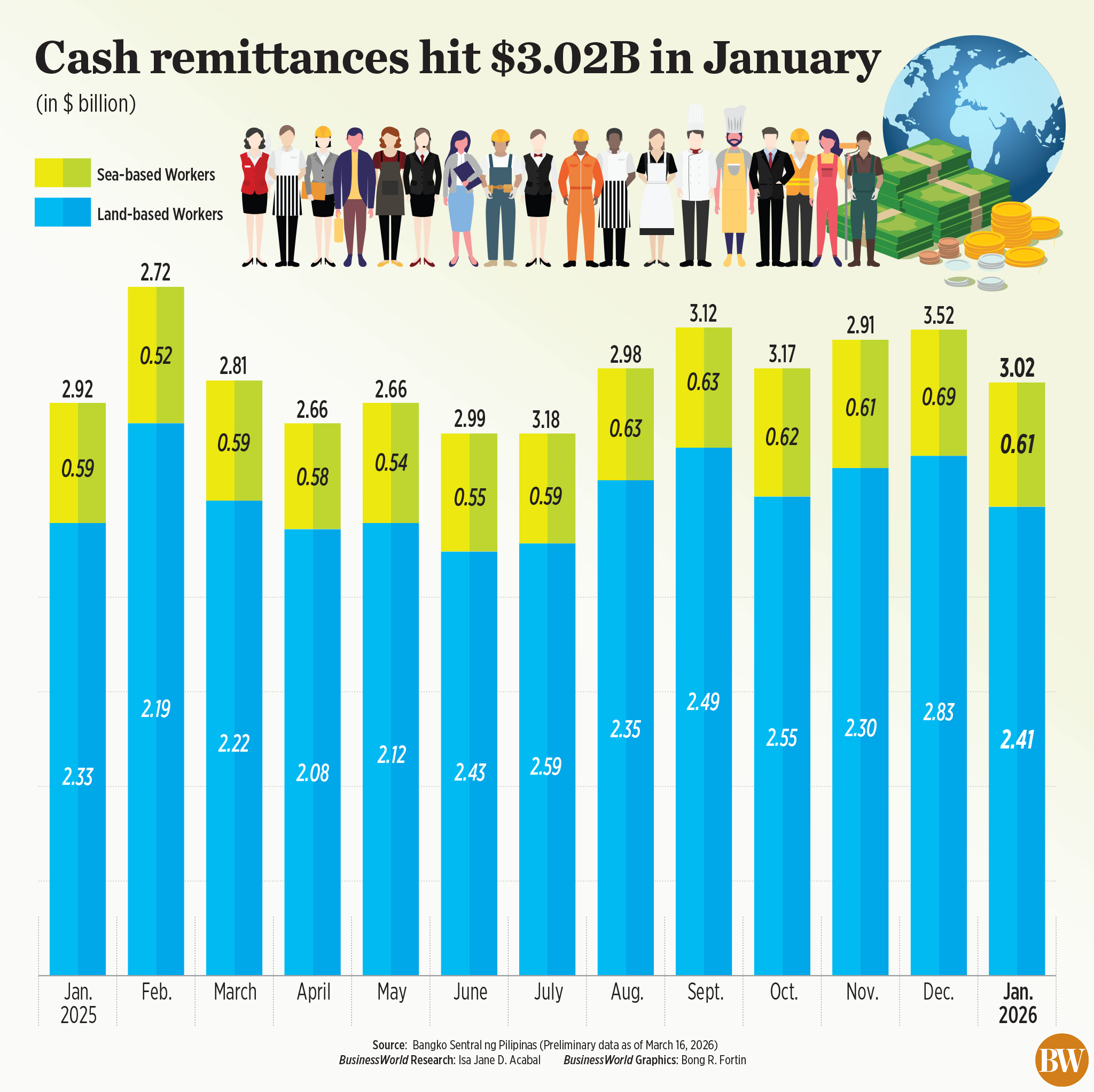
Month on month, cash remittances slid by 14.3% from the record-high $3.522 billion in December.
“The United States remained the top source of cash remittances to the Philippines in January 2026, followed by Singapore and Saudi Arabia,” the BSP said in a statement on Monday.
Filipinos in the United States sent most money home with 40.2% of the total, followed by Singapore (7.6%), Saudi Arabia (6.7%), Japan (5.8%), the United Kingdom (4.6%), the United Arab Emirates (3.7%), Canada (3%), Taiwan (2.9%), Qatar (2.8%) and Hong Kong (2.5%).
Cash remittances from land-based workers grew by 3.5% to $2.413 billion in January from $2.331 billion in the same month in 2025.
On the other hand, remittances from sea-based migrant workers rose by 3.5% to $607.777 million from $587.024 million last year.
Personal remittances likewise went up by an annual 3.5% to $3.358 billion in January from $3.243 billion a year ago. These include both cash coursed through banks and informal channels and in-kind remittances.
“The year‑on‑year increase reflects steady overseas employment conditions and sustained income flows from key host countries such as the United States, Singapore, and Saudi Arabia, which continue to anchor remittance growth,” Union Bank of the Philippines Chief Economist Ruben Carlo O. Asuncion said via Viber.
Mr. Asuncion noted that the month-on-month decline is not worrisome as remittance inflows usually normalize in January following the holiday-driven surge in December.
“Remittances typically peak during the holidays due to year‑end bonuses and one‑off transfers, then normalize in January, so this pullback is expected and not a cause for concern,” Mr. Asuncion said.
Meanwhile, Jonathan L. Ravelas, a senior adviser at Reyes Tacandong & Co., attributed the annual rise in remittances to the weaker peso and robust overseas employment, allowing Filipinos abroad to earn well.
“The pullback from December is largely seasonal after the holiday surge, but the key point is remittances are still higher than a year ago, showing OFWs’ income remains resilient,” he said in a Viber message. “A weaker peso and steady overseas employment continue to support flows.”
In January, the peso traded between P58 and P59 to the dollar, averaging P59.1622 versus the greenback during the month, according to BSP data.
In the coming months, the peso’s performance and geopolitical developments will determine the flow of remittances into the country, Mr. Asuncion noted.
“Remittance flows in the coming months will depend on labor market conditions in major host economies, exchange rate movements, and broader global growth and geopolitical developments that may affect hiring and wages for overseas Filipinos,” he said.
The peso has depreciated amid the escalating war in the Middle East, with the market anticipating a potential plunge to the P60-per-dollar level this week as the greenback continues to strengthen.
On Monday, the local unit plunged to an all-time low of P59.87 against the greenback, falling by 13.50 centavos from the previous record finish of P59.735 logged on Friday, Bankers Association of the Philippines data showed.
For Mr. Ravelas, remittances growth will likely remain positive this year unless the Middle East war intensifies to threaten OFW jobs in the region or disrupt payment flows.
“Looking ahead, the Middle East conflict adds uncertainty and could cause month‑to‑month volatility, but unless it leads to widespread job losses or payment disruptions, full‑year remittance growth should stay positive,” he said.
“For households, the priority is to use remittances wisely — rebuild savings, reduce debt, and be cautious with spending given ongoing global risks,” he added.
The BSP projects cash remittances to climb by 3% to $36.6 billion by yearend.