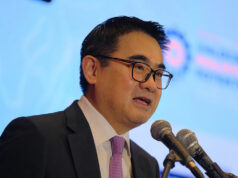
Marcos vows to boost jobs, investment through better environment for business

By Chloe Mari A. Hufana, Reporter and Erika Mae P. Sinaking
PRESIDENT Ferdinand R. Marcos, Jr. on Thursday said his administration aims to spur job creation and draw more investment by strengthening a “fair, transparent and enabling” business environment, as unemployment climbed to a three-month high in October.
Speaking at a job fair at the SM Mall of Asia in Pasay City, Mr. Marcos said improving the business climate remains central to his economic agenda.
“Be assured that this administration will continue to create a fair, transparent and enabling business environment — one that encourages both local and foreign investments, and rewards persistence with progress,” he said.
The job fair took place a day after the statistics agency reported the unemployment rate rose to 5% in October, leaving 2.54 million Filipinos jobless during a period usually boosted by holiday hiring.
Mr. Marcos cited deeper public-private cooperation as a key driver of development, pointing to work with the Private Sector Advisory Council that has led to more than 5,000 job fairs since 2023. These events have reached 1.3 million job seekers and produced at least 200,000 hired-on-the-spot placements, he said.
He also stressed the need to connect Filipinos to jobs that match their skills as industries rapidly adopt new technologies.
Thursday’s event combined job matching with digital upskilling, featuring the Asia Pacific College, National University and IBM, which showcased artificial intelligence training tools and other programs.
Mr. Marcos said upskilling is crucial for helping workers “not only adapt to the digital future but thrive in it.”
The Labor department held simultaneous job fairs in eight other sites and distributed cash aid. It also provided sacks of rice to microenterprises as seed capital and financial assistance to five micro, small and medium enterprises (MSMEs).
Other government initiatives include a holiday MSMEs bazaar at Ayala Malls by the Bay and a one-stop service hub at Robinsons Manila offering mentoring, assistance and job placements.
Mr. Marcos urged job seekers to take advantage of retraining programs as the labor market evolves and encouraged entrepreneurs to “build partnerships, explore new ideas and envision bigger possibilities.”
BEYOND HIS TERM
In a separate podcast released on Thursday, the President said his administration’s most important reforms must endure beyond his term, underscoring his push for structural changes that future leaders can’t easily reverse.
He said modern governance requires discarding outdated policy frameworks and institutionalizing systems that will continue “even if [he’s] not here anymore.”
“We don’t do things the same way anymore… This is a different world,” Mr. Marcos said, adding that he spends hours with advisers working on long-term solutions and program design.
His remarks come as the administration faces calls to accelerate reforms amid slowing economic growth and heightened public concern over governance.
Hansley A. Juliano, a political science lecturer at the Ateneo de Manila University, said it is natural for Mr. Marcos to seek policy continuity, as any democratically elected leader would.
The question, he added, is whether continuity is achievable given the Philippines’ history of presidential succession. He noted that the country has not experienced genuine administrative continuity since the terms of Corazon C. Aquino and Fidel V. Ramos.
He said Mr. Marcos’ best chance of maintaining momentum is to push key policies into law and finalize their implementing rules and regulations before his term ends in 2028.
“This is what ultimately killed momentum for previous administrations’ policies, whether under ex-President Gloria Macapagal Arroyo or Benigno S.C. Aquino III,” Mr. Juliano said in a Facebook Messenger chat. “He would do well to learn from them.”
The country is investigating a corruption scandal involving government contractors and senior officials in public works projects, contributing to weaker third-quarter growth and a record low for the peso earlier this week. Inves-tor sentiment remains cautious as the probe widens.
Mr. Marcos said his goal is to ensure reforms cannot be undone.
“My hope — and the reason structural change is important — is that even when I’m no longer here, the reforms we have started or already set in motion will continue so they can’t be undone,” he said in mixed English and Filipino.
Meanwhile, the Labor department said it expects the Philippines’ jobless and underemployment figures to improve in the next labor force survey, citing recovery patterns seen earlier this year.
In a note sent to BusinessWorld on behalf of Labor Secretary Bienvenido E. Laguesma, the agency said the recent rise in unemployment likely reflects temporary, seasonal disruptions rather than deeper structural issues.
The agency said similar increases in unemployment occurred earlier in 2025 — specifically in July, when it rose to 5.3% because of typhoons. This was followed by “quick recoveries and rebounds,” with unemployment dropping to 3.9% in August and 3.8% in September.
“Given such behavior, the October increase in unemployment may be temporarily driven by short-term disruptions rather than by issues that are structural in nature,” it added.
If November data mirrors the earlier trend, it said it is optimistic that unemployment can dip backwards, perhaps to 4% or lower. Underemployment could also ease as workers regain full work hours, it added.
Joblessness rose to 2.54 million in October, pushing the unemployment rate to 5% from 3.9% a year earlier.