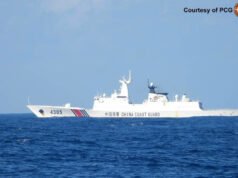
Lorenzana: PHL should protest Chinese structures in Spratlys
DEFENSE SECRETARY Delfin N. Lorenzana said on Monday, July 3, the Philippines will likely “protest” China’s reported militarization of the disputed South China Sea, following an update by a US think tank on Chinese military facilities there.
In a report dated June 29, the Asia Maritime Transparency Initiative (AMTI) of Washington’s Center for Strategic and International Studies (CSIS) said China has built new missile shelters and communications facilities on Fiery Cross (or Kagitingan, as named by the Philippines), Mischief (Panganiban), and Subi (Zamora) Reefs in the Spratly Islands, about 230 miles southwest of the country’s archipelago province of Palawan.
“Kailangan mag-protest tayo diyan (We should protest that),” Mr. Lorenzana said when interviewed by reporters. “’Di natin pabayaan ’yan (We won’t leave that be).”
“Pinag-aaralan pa namin kung meron ba talagang dagdag, kasi yung nakita kong picture doon ngayon na pinapakita ng CSIS, halos wala akong makitang pagbabago (We are still studying if there are really additional defense structures, because based on the pictures that CSIS showed, I don’t see any changes from the previous satellite images),” Mr. Lorenzana also said, adding that this would be discussed at the Cabinet meeting that Monday.
Last March, CSIS said Chinese structures on Spratlys believed to be for military purpose are near completion, adding that Beijing can now deploy defense assets, including warplanes and missile launchers “at any time.”
But the think tank also noted, “While the region is engaged in peaceful discussion, China remains committed to developing its power projection capabilities.”
In a related development that day, the leaders of China and the United States spoke in a scheduled call hours after relations came under renewed pressure as an American warship sailed near a disputed island in the South China Sea.
Presidents Xi Jinping and Donald J. Trump discussed efforts to denuclearize North Korea and improve US-Chinese trade relations, though the ship’s passage was not mentioned in a White House readout of the conversation.
Relations between the two nations had been warmer since Messrs. Xi and Trump met in April, but Washington has taken a series of actions that have infuriated Beijing in recent days.
‘SERIOUS PROVOCATION’
The latest move to anger China came on Sunday, when the USS Stethem destroyer sailed less than 12 nautical miles from tiny Triton Island in the Paracel Islands archipelago, which is claimed by China as well as Taiwan and Vietnam, a US official told AFP.
The distance is commonly accepted as constituting the territorial waters of a landmass. Such operations are meant to demonstrate freedom of navigation in disputed waters.
The move prompted China to deploy military vessels and fighter jets, foreign ministry spokesman Lu Kang said in a statement late Sunday, calling the US operation a “serious political and military provocation.”
The spokesman called on Washington to “immediately stop” operations that violate Chinese sovereignty and threaten the country’s security.
It was the second operation of its kind carried out by the United States since Mr. Trump took office.
Last week, China lashed out at Washington after Mr. Trump authorized a $1.3-billion arms sale to Taiwan, which China considers a rebel province, and the US Treasury department imposed sanctions on a Chinese bank accused of laundering North Korean cash.
Washington also vexed Beijing by voicing concern about freedom in semi-autonomous Hong Kong and placing China on a list of the world’s worst human trafficking offenders.
Hours after the naval operation, Mr. Trump held separate phone calls with Mr. Xi and Japanese Prime Minister Shinzo Abe focused on the regional tensions over North Korea’s nuclear program.
In his call with Mr. Xi, “President Trump raised the growing threat posed by North Korea’s nuclear and ballistic missile programs,” the White House said.
“Both leaders reaffirmed their commitment to a denuclearized Korean Peninsula,” it said.
While there was no mention of the warship in the White House statement, it said the two leaders discussed “a range of other regional and bilateral issues of mutual interest” and indicated the two would meet at the Group of 20 summit in Germany this week.
The recent tensions marked a sharp reversal in tone from April, when Mr. Xi traveled to Mr. Trump’s Mar-a-Lago resort in Florida for a first face-to-face meeting that Mr. Trump later said had helped build an “outstanding” relationship.
The latest US “freedom of navigation” exercise came as Beijing continues muscular efforts to cement its claim to nearly all of the South China Sea, parts of which are also claimed by Taiwan and Southeast Asian nations including the Philippines, Brunei, Malaysia and Vietnam.
On May 25, the USS Dewey guided-missile destroyer sailed less than 12 nautical miles from Mischief Reef — part of the disputed Spratly Islands in the South China Sea, south of the Paracel Islands. — AFP, Ian Nicolas P. Cigaral