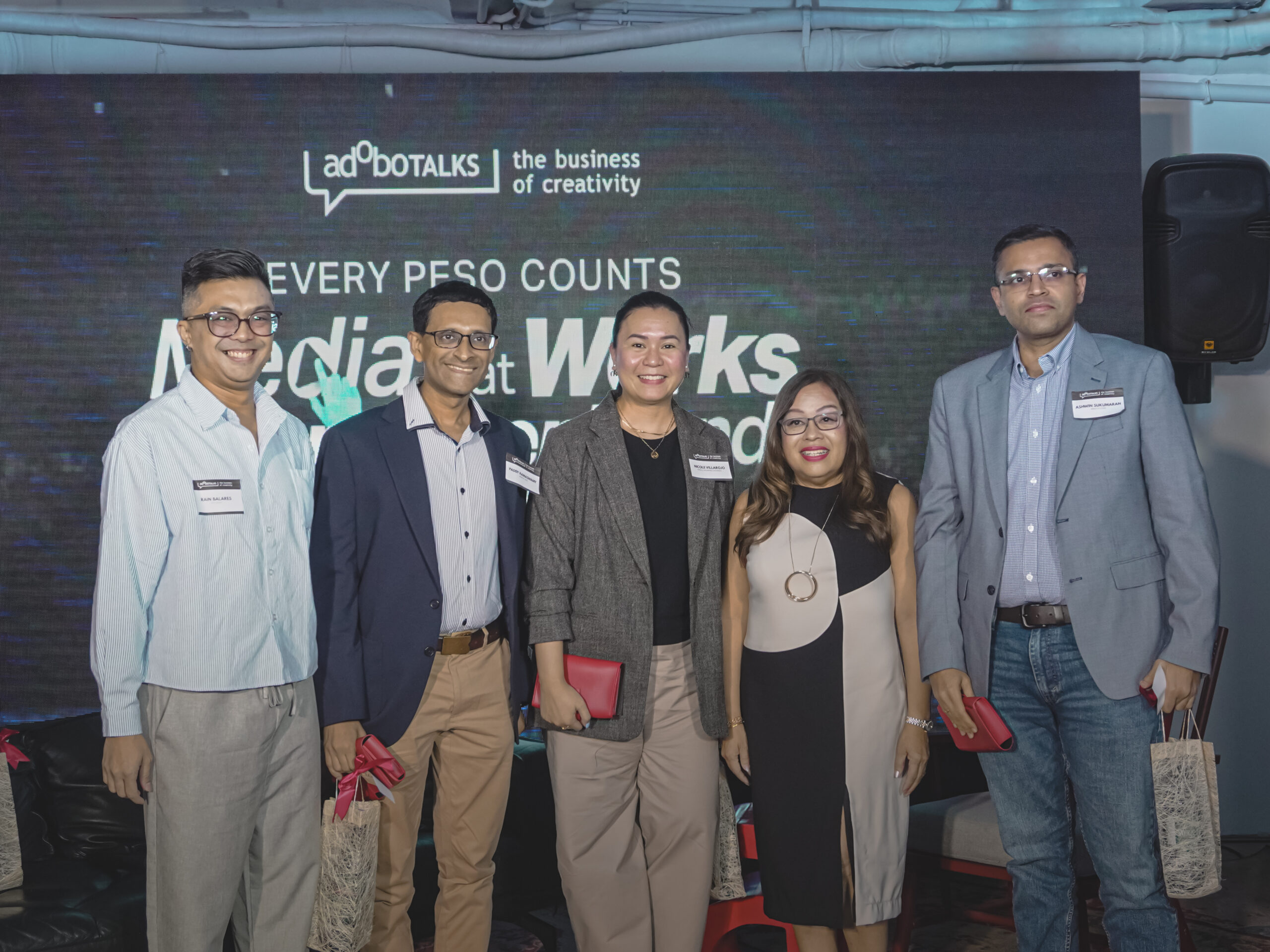
Senior marketers, agency leaders, and industry analysts recently gathered for a closed-door industry discussion examining how Philippine advertisers are reassessing media investment decisions amid tightening budgets, declining television consumption, and rising pressure to demonstrate measurable return on investment.
With the theme “Every Peso Counts: Media that Works for Consumer Brands in the Philippines”, the event conducted by adobo Magazine presented the study on how brands and marketers can ensure that every peso invested in media truly works in a marketing environment where budgets are under increasing scrutiny and performance accountability is paramount.
The study, done by leading global analytics firm Analytic Edge, a C5i group company, was anchored on the concept of media sufficiency, defined as investing at the level required for a channel to perform optimally, rather than spreading budgets thinly across multiple touchpoints. The firm noted that as audience attention fragments and traditional reach-based planning becomes less reliable, determining sufficiency has emerged as a critical discipline for effective media planning.
What Data Reveals About Media Performance

Insights shared during the session were drawn from fresh Marketing Mix Modeling (MMM) insights across 11 FMCG brands in the country that analyzed how different media channels contribute to actual sales performance.
According to the study, TV consumption in the Philippines continues to decline, even as it still commands a dominant share of media investment. At the same time, the share of media spend for short-form video platforms like TikTok has grown rapidly, rising from 1% to 17% in just five years, signaling its emergence as a core channel. This rapid growth reflects shifting consumer attention patterns toward mobile-first and short-form video environments.
Analyzing how different media channels contribute to actual sales performance, the analysis found that while digital video platforms now account for a growing share of consumer attention, advertiser investment has not always kept pace with their performance contribution.
Across the modeled brands, TikTok led ROI performance in approximately 70% of the models, delivering returns of around 2.2x on average — outperforming both digital and traditional media in the aggregated dataset. Specifically, in Consumer Packaged Goods (CPG) category, TikTok recorded relative ROI levels of 2.42x and up to 4.7 times that of other media in certain comparisons. In F&B, TikTok ROI was approximately 1.7 times that of total media.
Despite this, the study indicated that TikTok accounts for only five to six percent of total FMCG media spend, suggesting potential under-allocation relative to its modeled contribution.
The analysis further demonstrated that many brands are operating below sufficiency levels, particularly in high-impact, full-funnel digital channels. For TikTok, optimal performance was observed when investment levels reached between 86% and 160% of current spend, indicating substantial headroom before diminishing returns set in. According to the study, underinvestment, rather than channel inefficiency, is increasingly a key driver of lost ROI.
The study also examined how much new audience exposure is added when TikTok is used alongside TV. It found that audience overlap between TikTok and linear TV is about 48-49%, meaning that more than half of the people reached on TikTok are not fully duplicated by television.
In practical terms, this suggests TikTok is not simply repeating the same viewers, but extending reach to additional audiences. When both channels were used together, the modeling showed an incremental awareness lift of approximately +24.6%, indicating that the combination delivers stronger total impact than TV alone. This reinforces the idea that diversified sufficiency-led media investment can enhance overall media effectiveness, not just overlapping results, when integrated thoughtfully into the broader mix.
From Platform Results to Smarter Planning
Padmanabhan Ramaswamy, Managing Director, South-East Asia at Analytic Edge, emphasized that the real challenge for brands is not simply identifying high-ROI channels, but aligning budget allocations with modeled marginal return. In many cases, traditional budget habits may no longer match how people actually consume media today or which channels are truly driving additional sales.
“What this study highlights is not simply which platform performs well, but whether budgets are aligned with modeled sales contribution. Media sufficiency is about investing at the right scale so that channels can deliver their full potential, rather than being underfunded and misunderstood,” said Padmanabhan.
The study highlighted that certain channels perform most effectively only when funded at the right scale. This finding challenges conservative allocation practices and underscores the importance of data-led planning in an increasingly complex media environment.
Overall, the session reflected a growing consensus among industry leaders: as marketing effectiveness comes under greater scrutiny, success will depend less on experimentation and more on sufficiency-based investment decisions grounded in robust analytics. The insights from the discussion are expected to inform ongoing conversations as advertisers and agencies refine their media strategies for the year ahead.
Spotlight is BusinessWorld’s sponsored section that allows advertisers to amplify their brand and connect with BusinessWorld’s audience by publishing their stories on the BusinessWorld Web site. For more information, send an email to online@bworldonline.com.
Join us on Viber at https://bit.ly/3hv6bLA to get more updates and subscribe to BusinessWorld’s titles and get exclusive content through www.bworld-x.com.