

Home Blog Page 9985

Deadly as a virus

As of this writing, there were about 4,600 reported cases of Novel Corona Virus worldwide, and with about 100 deaths attributed to it specifically in China, where it all started. The world is worried, perhaps even more worried than when SARS or MERS wrought havoc years back. Incidentally, all these deadly viral infections started to occur only in the last 20 years.

There must be something really wrong with the world right now. Disease, plagues, deadly weather disturbances, and geological catastrophes are all happening, one after the other. Then, there is the threat of war in the Middle East, and other political upheavals globally. With the natural balance obviously upset, is the world trying to rectify the imbalance?

But there are things just as deadly as natural calamities and killer viruses. Man-made and technology-based, even mobile phones have become modern day killers. In itself, a cellular phone unit is nothing but a tool. But, in the wrong hands, or as the result of misuse or mishandling, it can also lead to serious injury or even death. Just as unpredictable as a virus.

Consider the US statistics from the National Highway Traffic Safety Administration (NHTSA), an agency under the US Department of Transportation. According to the NHTSA, distracted driving cases in the US claimed 3,166 lives in 2017 alone. And by distracted driving, it refers to “any activity that diverts attention from driving, including talking or texting on your phone, eating and drinking, talking to people in your vehicle, fiddling with the stereo, entertainment or navigation system — anything that takes your attention away from the task of safe driving.”

It adds that “texting is the most alarming distraction. Sending or reading a text takes your eyes off the road for five seconds. At 55 mph, that’s like driving the length of an entire football field with your eyes closed. You cannot drive safely unless the task of driving has your full attention. Any non-driving activity you engage in is a potential distraction and increases your risk of crashing.”

And while we have moved to address this particular issue locally by legislating against mobile phone use while driving or operating motorized vehicles, it appears the law is observed more in breach. I still see a lot of people fiddling with their phones or taking calls (holding their phones) while driving. Motorcycle riders are just as guilty, and are courting greater risk as they take one hand off the handlebar while moving.

One can only wonder about the local statistics for apprehension as well as the data with respect to accidents and deaths related to mobile phone misuse. When the Anti-Distracted Driving Act was new, there were a number of apprehensions reported out. To date, however, such violations no longer seem to rank high among the priorities of traffic enforcers.

ALEXANDRE BOUCHER/UNSPLASH

As the government continues the pilot testing for motorcycle taxis, with around 60,000 units nationwide, I believe we are now looking at the possibility of even more mobile phone-related accidents. It is for the simple reason that the operation of motorcycle taxis relies heavily on their drivers/riders using cellular units to book passengers and to navigate.

But distracted driving is only one side of the equation. Equally problematic, in my opinion, is the utter disregard for safety of selves and others by the “walking dead” — or zombie-like pedestrians who are glued to or are distracted by their mobile phones as they “navigate” city streets on foot. Add to this the riders of bicycles or scooters, whether powered by electricity or by feet, who are just as distracted by their mounted mobile phones.

This “viral” problem has its variations, which include the use of earphones or ear pods while walking, particularly while crossing streets, or while on public transportation. Worse, I see a lot of motorists — on cars and motorcycles — actually using ear pods while driving. By doing so, they unwittingly lose situational awareness. This, to me, makes mobile phone abuse just as deadly as a killer virus.

I truly believe “distracted walking” to be an emerging urban problem that requires immediate attention. USA Today has reported, for instance, that “pedestrian deaths [in the US] totaled nearly 6,000 in 2017 for the second straight year amid mounting signs that walkers and drivers are dangerously distracted, according to a new study,” adding that “experts suspect that smartphones and marijuana use are key factors in the deadly trend.”

The report added that “texting while walking is especially risky in urban environments. Combine that with drivers who are using their phones or touchscreens while driving, and it’s a recipe for fatalities.” USA Today even quoted a news source as commenting that “people outside cars are dying at levels we haven’t seen in 25 years.”

And while we have a local law against distracted driving, many might find it ridiculous to legislate against mobile phone use by pedestrians. However, the city of Montclair in California, for instance, has actually banned through local ordinance walking across the street while using a phone or headphones. Even Honolulu in Hawaii has a similar law, USA Today reported.

The bottom line, however, is that it will be difficult to legislate a statute to regulate undesirable human behavior. At best, public campaigns can be waged to remind people about the need to prioritize safety over convenience and the dangers of “distracted walking.” However, expect people to be dismissive of such campaigns unless there are rewards and penalties involved.


Marvin Tort is a former managing editor of BusinessWorld, and a former chairman of the Philippines Press Council.

matort@yahoo.com

Convenience stores and the Tokyo 2020 Olympics as a looking glass

I always visit the konbini whenever I visit Japan. Japanese convenience stores or konbini are not only open 24/7 and have quintessential Japanese snacks such as nikuman, karaage, oden, and onigiri; they also provide much needed services such as ATMs, delivery services, and bill payments. Indeed, konbini are inextricably linked to my Japanese experience: my first memories as an exchange student was eating curry bread from a konbini, I often practiced my Japanese whenever I bought and talked to the owner of our neighborhood konbini, and still I love to hear the “Irasshaimase” greeting as I enter a konbini.

CHALLENGES FACED BY KONBINI
Not only is the konbini different from stores in the Philippines due to its product lineup or its aesthetics layout, it differs because it has become an integral part of Japanese modern life: an accessible place for the community to buy meals, get essential services, and also a refuge during emergencies. Indeed, media news reports often show konbini providing much-needed food, supplies, and shelter during emergencies and natural calamities.

However, konbinis are facing plenty of challenges. Konbinis have reached a saturation point where there are too many stores. Lower profit margins, high franchise fees, and increasing operating costs also threaten konbinis. However, by far the biggest challenge faced by konbini is an acute shortage of labor. This is not due to low wages, harsh working conditions, or high turnover rates; rather there are simply not enough workers who want to work in konbinis. Thus, konbinis have been tapping a new labor source: foreign students.

SIDE DOORS TO JAPAN
While the usual narrative says that migrants take jobs away from locals, most migrant workers are actually employed in so-called 3D jobs that local workers do not want to do — Dirty, Difficult, and Dangerous. In the case of Japan, it is not that workers shun the konbini; rather, there are simply not enough workers due to its rapidly shrinking and ageing population. And yet, even as Japan needs foreign labor, its foreign population only makes up 2% of its total population and the country has one of the lowest migration rates among OECD countries. Various historical, economic, and cultural factors can explain this, but the most salient would be its belief that it is a monoethnic society that is not ready to receive a massive influx of foreigners.

So how does Japan get much-needed foreign labor while satisfying the conservative elements of Japanese society? By accepting foreign labor not through its front door, but rather through its side door. Since Japan explicitly only accepts skilled workers, much needed semi-skilled workers enter Japan through the side door. Most of the foreigners working in konbini have student visas. Entering Japan ostensibly to study the Japanese language, they are working in konbini or in factories to pay for their tuition and living costs. Thus, we see the sudden influx of Vietnamese and South Asians working in konbinis.

TOWARDS AN OPEN DOOR OR XENOPHOBIC BACKLASH?
In spite of cases of migrant labor abuse and the threat of xenophobic backlash, Japan is now gradually opening its doors.

While in previous years it has relied on its side door policy of getting “non-workers,” it has now passed new laws to gradually accept semi-skilled and skilled migrant workers. Known as the Specified Skilled Worker (SSW) Visa, Japan will now accept two types of workers. Type 1 workers will be employed in manufacturing, construction, healthcare, and service sectors, and the visa will allow guest workers to stay up to five years but they will not be allowed to bring their families to Japan. Type 2 workers, such as nurses, are considered highly skilled workers, and will have provisions for long-term settlement and for workers to bring their families to Japan.

While it is yet to be seen how Japan will implement these new policies and how the general public will react towards migrants, the policies seem to promise more humane, transparent, and equitable employment for its foreign workers.

In particular, workers from Indonesia, Vietnam, and the Philippines are seen as the best source of skilled workers under the SSW visa program, especially those who will be employed in the service, hospitality, and healthcare sectors. Will Filipinos who enter Japan become a permanent fixture of Japanese society? Will Japan become a more open multicultural society or will there be a xenophobic backlash from its conservative elements? It may be too soon to tell, but there might be a proxy measure to understand its future — the upcoming Tokyo 2020 Olympics.

SIGNIFICANCE OF THE 1964 AND 2020 TOKYO OLYMPICS
Other than the simply hosting an international sporting event, the 1964 Tokyo Olympic Games was Japan’s coming out party. Rising from the devastation and dark shadows of the Second World War, the games showed the world that Japan was not only a modern society with a bustling economy and a stable democracy, it was once again a respectable member of international society. Indeed the 1964 games also coincided with the opening of its iconic Shinkansen bullet train, with the games seemingly ushering its unprecedented post-war economic miracle.

Fast-forward more than 50 years later, the 2020 Olympics promises to be a glimpse of Japan’s not so distant future. Now that the 2020 Olympic Games will begin in a few months, let us look closely at how Japan will handle the challenges of hosting an international sports event with guests who needs various language and cultural requirements.

Perhaps, after the games Japan will realize that it needs to become a multicultural society. Perhaps, after the games its citizens will see the value of genuine multiculturalism — not only to help foreign workers and Japanese citizens coexist, but, above all, see that foreigners are productive and responsible guest workers who can help reinvigorate the Japanese economy. Perhaps the games will also become another coming out party for Japan — a sign to the world that it has become a truly genuine multicultural society.

Hopefully, next time I visit Japan and enter my beloved konbini, I will be welcomed not only with an “Irasshaimase,” but also a “Kamusta po?”


Benjamin A. San Jose is an assistant professor of Japanese studies and Political Science at the Ateneo de Manila University, Philippines. San Jose received his Ph.D. in international public policy from the University of Tsukuba. His current research focuses on the use of migration management in the labor migration policy process of the Philippines and Japan. He also teaches courses on International Relations, Philippine-Japan relations, and is pursuing research on Japan’s changing public diplomacy in the Asian region.

bsanjose@ateneo.edu

NCoV, IPR and WHO

The Novel Coronavirus (2019-nCoV) is new and hence, no existing vaccine and treatment can fight and control it. As of noon, Jan. 29, some 132 people have died and 6,000+ people are ill.

The good news is that some innovator pharmaceutical and biotechnology companies are quickly developing vaccines and other treatment. Among these companies and groups are Johnson and Johnson, and Hong Kong researchers.

The bad news are: it could take up to a year before the vaccines becomes available to the public after a series of clinical trials; and, the virus is already mutating, becoming “more easily spreadable” so that by the time the vaccines become available, new strains would have already emerged, requiring another set of vaccines and treatment.

The World Health Organization (WHO) is the main global agency that monitors and finds ways to control the virus. Their top officials have already met China PM Xi Jinping.

On Feb. 3 to 8, the WHO Executive Board (EB) will meet in Geneva, Switzerland. The EB is the decision-making arm of the WHO and it sets the agenda for the year’s work.

From what I gathered, the EB this year is considering a plan of work to weaken intellectual property rights (IPR) in order to improve access to new medicines and vaccines. These plans would be inimical and disruptive to innovation while doing little to improve access to medicines. The real reasons why access is poor in many countries is related to weak healthcare systems, regulatory barriers, taxes and tariffs, etc. and not IPR like patent protection.

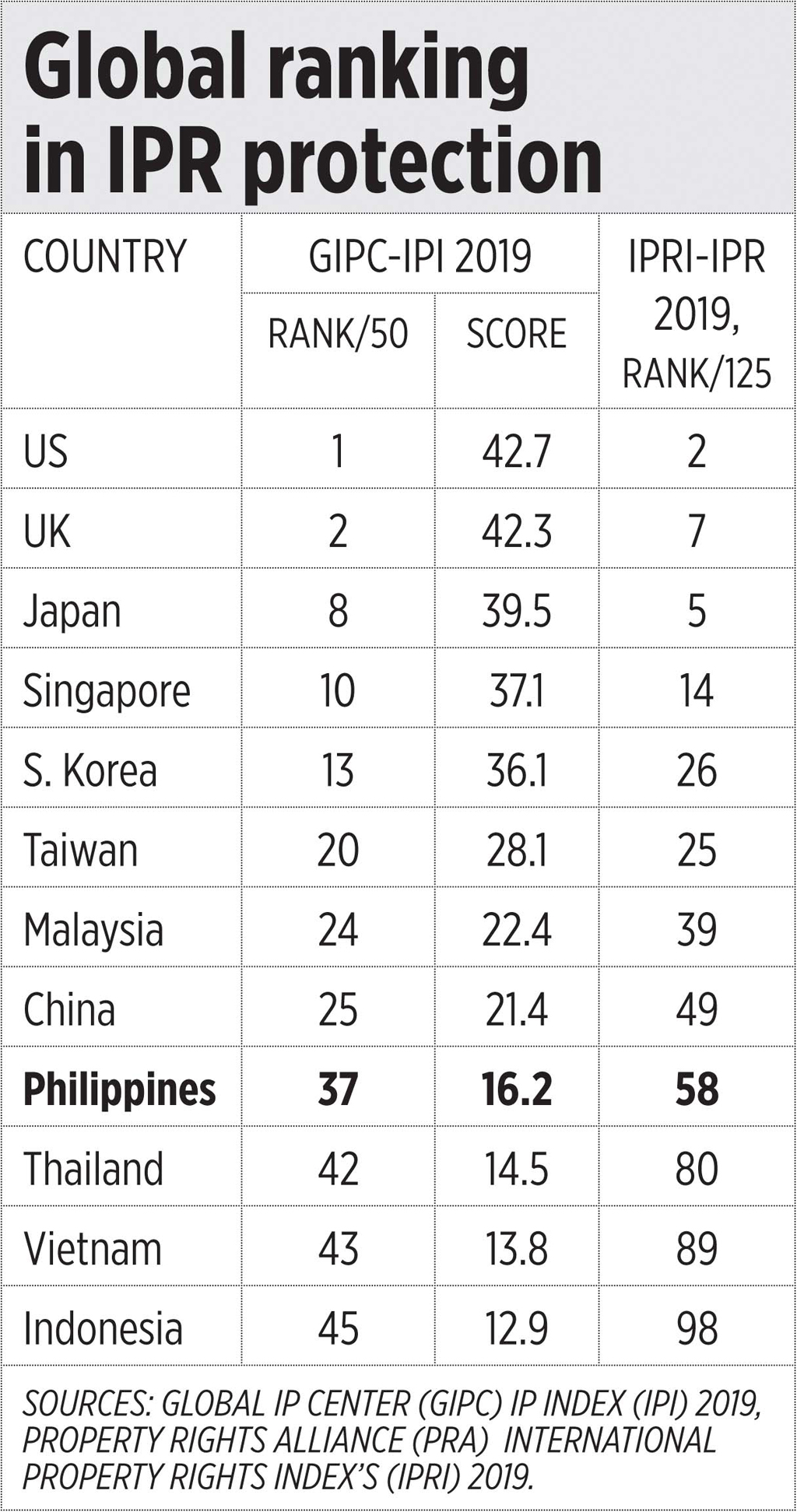
Last September, the Geneva Network (UK) plus five independent think tanks in the ASEAN including Minimal Government Thinkers (Philippines) launched their report, “The importance of IPR in progress: reform agenda for ASEAN countries” in Makati. The Philippines and many ASEAN countries do not rank and perform well globally in IPR protection (see Table).

Our report on IPR in the ASEAN noted that in the health sector, life science patents are becoming more difficult to obtain and there are concerns that compulsory licensing (CL) of famous, patented drugs may become more widely used by governments. CL is driven by envy more than desire for public health. Many pharma companies would not spend on very expensive and risky R&D (patients under clinical trials may suffer serious side-effects) but when the new drug molecule is later proven to be safe and effective in killing or controlling certain diseases, various lobbies to issue CL becomes louder. When CL becomes a norm, the likelihood that newly invented, more powerful medicines will be launched in developing countries like the Philippines will grow thin, which will also undermine the availability of generic medicines of the same molecule someday.

For now, the WHO has three important challenges.

One, set aside its itch for IPR-busting policies like CL. The evolving nCoV and other viruses will require evolving medicines and vaccines. IPRs like patents for newly developed treatments should be encouraged, not discouraged and demonized.

Two, encourage member-countries to speed up the examination of patents, do not discriminate against specific technologies in the granting of patents, restrict the use of CL of patents to true emergencies, and provide sufficient terms of regulatory data protection for medicines, veterinary and agricultural biotechnology.

Three, step back from producing and encouraging more regulations and restrictions in fighting non-communicable diseases (NCDs) and refocus its resources and research on really killer communicable and infectious diseases. There are many, past and present like ebola, SARS, MERS-CoV and nCoV.


Bienvenido S. Oplas, Jr. is the president of Minimal Government Thinkers.

minimalgovernment@gmail.com

Engagement and Experience: People helping other people

Following the Mindanao earthquake in late 2019 and the Taal Volcano eruption this January, both of which have left many people displaced and affected, companies and corporate foundations mobilized resources and organized relief operations. NGOs, local government units, and educational institutions, among many others, are also doing their share to aid those stricken. From supplying clean and potable water, mounting charging stations, organizing medical missions, to distributing relief packs, these efforts are nothing short of inspiring.

On the human resource front, situations like this provide an opportunity for employee engagement. Schaufeli and Bakker define engagement as “a positive, fulfilling, work-related state of mind that is characterized by vigor, dedication, and absorption.” It aims to establish a strong connection between employees and their work and company. Engagement fuels positive disposition and higher motivation. When a workforce is highly engaged, productivity is optimized and organizational goals are attained.

In 2019, the ADP Research Institute (ADPRI) measured the engagement levels of more than 19,000 workers. The employees were asked which working conditions they find acceptable and attractive enough to keep them in the workplace. APDRI’s Global Study of Engagement reported that only 16% of employees are fully engaged. This means that the remaining 84% of employees merely come to work for the sake of it and fail to contribute wholly to their organizations. While the report further states that engagement varies based on several factors, the global score gives impetus for business and HR leaders to rethink and reinvigorate engagement programs as an integral part of organizational culture and social responsibility.

When I was tasked to lead our company’s engagement program, I wanted to evolve our approach to lead to a more cogent, holistic, and integrated way of life for our people. I considered not only employee engagement but also a people experience that taps into the hearts, heads, and hands of our employees. I recommended designing engagement, communication, and empowerment activities that aim to: 1.) strengthen the emotional connection of employees to the organization; 2.) increase their engagement through information, learning, and knowledge-sharing; and 3.) nurture well-being, bolster productivity, and cultivate excellence in practice and performance.

The idea of employee experience (EX) has trended in HR circles over the past few years. Ryan Pendell, in his Gallup article “Employee Experience vs. Employee Engagement: What’s the Difference?,” describes EX as the “entire journey” an employee takes within an organization. Engagement and experience encompass a dynamic confluence, but should not be confused with each other. Carolyn Nevitte on LinkedIn defines engagement as the goal, and experience as the means to that end. Experience, therefore, constitutes the bigger picture and expands our customary approach to engagement by placing touchpoints throughout the life cycle of employees.

Creating meaningful experiences to engage employees humanizes the workplace, which advancing technology and changing values have made more complex. As managers, we must strive to elevate our employees’ experiences by connecting them to a higher purpose. In her Forbes article “The Future of Work: Corporate Social Responsibility Attracts Top Talent,” Jeanne Meister points out that employees want more than compensation. Employees yearn for a profound sense of meaning and fulfillment from their work. They desire to take pride in a company that reflects their values and that allows them to make a caring difference.

Our company launched an internal donation drive to help our employees and the local community affected by the Mindanao earthquake. Our employees in Luzon and Visayas pledged financial support through their personal resources, and the company supplemented the amount that was initially raised. The employees’ sheer generosity overwhelmed me. When Taal’s eruption affected a handful of our employees and their families, I was afraid that our colleagues would have already developed donor fatigue. Nevertheless, we again called on our people to donate — and I was proven wrong. The shining display of compassion was equally heartening, thanks in huge part to our employees in Mindanao, who may have felt that it was their turn to help. I believe this was a stellar example of people helping other people and deepening employee engagement and experience.


Michael Angelo E. Malicsi is the HR Business Partner for Support of Goldilocks, a leading bakeshop and fast food chain in the Philippines, and concurrently heads the company’s people experience program. He lectures part-time at the Ramon V. Del Rosario College of Business of De La Salle University. In 2016, he received an Australia Awards Scholarship from the Department of Foreign Affairs and Trade of the Australian Government.

michael.malicsi@dlsu.edu.ph

A brutal Brexit is lose-lose for the City of London and the EU

By Lionel Laurent

LONDON WASN’T always the be-all-and-end-all for European finance. It took a deregulation drive under Margaret Thatcher in the 1980s — known as the Big Bang — and Britain’s contribution to the launch of the European single market in the 1990s to decisively lure the headquarters of US, European, and Japanese banks to the City. By serving as a magnet for money, talent and office space, UK financial services now account for 7% of the country’s economic output and over 1 million jobs. It’s a national cash cow.

While that has meant a lot more prosperity for the UK, it has also created a lot of disgruntlement on both sides. The 2016 Brexit vote was an obvious wake-up call exposing the capital’s disconnection from the rest of the UK when it came to wealth, house prices, culture, and politics. Yet even before then, on the continent, regulators were fretting over London’s dominant position in euro trading and the risk to its financial stability. The symbiotic relationship between the two was a “master-slave” dynamic, as one EU official termed it.

As the UK and its biggest trading partner begin talks on their future ties after Brexit — which will happen on Friday — they should keep front-and-center the reality that they each have a lot to lose from a sudden break in the cross-border financial-services trade; but equally a lot to gain if they carefully engineer a long-term, gradual drift away from one another.

For policy-makers on the continent, Brexit is a chance to reduce the excessive concentration of euro trading on British soil — London currently accounts for about 86% of euro-denominated interest-rate swaps — and build up local hubs like Paris, Frankfurt, and Dublin. For the Brits, Brexit is a chance to diversify trade ties away from the EU: The bloc’s services deficit with the UK was about £28 billion ($37 billion) in 2018. These are intertwined markets with very different ambitions.

Achieving these aims will mean more regulatory autonomy for both sides. The EU wants to push for more integrated capital markets inside the bloc, and for a single rule-book that smooths out the inconsistencies between 27 very different member states. That’s incompatible with letting financial firms use their London base as a launchpad for frictionless trade into the bloc. Likewise, the UK has its own ideas about what it wants to do with financial regulation, and they don’t involve copying EU rules to the letter. If the UK’s ambition is to trade more with Asia or the US, or to promote other types of financial business, it may want new regulation.

The good news is that a system already exists that would make such a split amicable and manageable: Regulatory equivalence, an EU structure that the bloc uses to give controlled market access to non-members based on its rules being more or less the same. It’s a concept that both the UK and the EU have signed up to as part of their political declaration on post-Brexit ties, with each jurisdiction having the right to review the other’s regime and decide whether it’s similar enough to keep allowing for cross-border business.

Equivalence is not the same thing as frictionless market access — there are approximately 40 different equivalence provisions across 17 pieces of EU financial law, according to one study — but it’s not the same thing as full transposition of the law, either. The EU considers the US an equivalent market in some areas, for instance.

The bad news is that equivalence has a fair amount of political risk attached to it. The EU has used the prospect of withdrawing equivalence as a negotiating pressure tactic in the past in the case of Switzerland. There’s a fear on the UK side that it will meet the same fate if it is perceived to be deregulating too quickly. That the UK has made some pretty outrageous statements about the economic levers it could pull to compensate for a drop-off in EU trade after Brexit — including tax cuts and a slashing of EU rules — doesn’t help matters. It’s also likely that finance will become tangled up in negotiations over other sectors, such as fishing rights.

Both sides should pursue equivalence in good faith. With only 11 months to go before UK Prime Minister Boris Johnson’s stated deadline for a new bilateral trade deal with the EU to be done and dusted, neither side can really afford a “no-deal” scenario. Losing access to its biggest customer would be a blow to the City of London, while the hubs of Paris, Frankfurt, and Dublin would be in no shape to take its place.

Rather than assume Brussels or London always knows best when it comes to regulation, equivalence should allow market forces to influence both. Given they are starting at the same point in terms of rules, whichever side manages to achieve its goals first will have more influence to export its rules. And the threat of losing equivalent status should prevent the worst fears of a Singapore-on-Thames on one side or a Fortress Europe on the other from materializing.

The hope of keeping financial regulation free from political saber-rattling may be wishful thinking. But it would be a welcome surprise for businesses and investors after three years of messy uncertainty.


BLOOMBERG OPINION

China is perfectly prepared to fight the last virus

By Daniel Moss

CHINA HAS a bigger and more sophisticated toolbox to combat any economic slowdown from the coronavirus than in 2003, when it battled the SARS pandemic. The challenge now is a worsening backdrop both domestically and abroad, and how both hamper the effectiveness of Beijing’s response.

It’s hard to be precise about the damage given the situation is still unfolding. Bloomberg Economics is likely to downgrade its projection for China’s first-quarter growth from its current forecast of 5.9%. When Severe Acute Respiratory Syndrome (SARS) raged in the second quarter of 2003, China’s expansion cooled to 9.1% from 11.1% in the prior three months.

Trouble is brewing beyond China’s shores, too. With trade wars, heightened tension between Iran and the West, and declining demographics, there were plenty of challenges before this outbreak. The International Monetary Fund is penciling in growth of 3.3% this year, after crawling along at 2.9% in 2019. Yet that pace has stalled from the 3.4% estimate just a few months ago. In 2003, the world economy expanded more than 4% and approached 6% in 2007.

China has changed dramatically in the past 17 years. For starters, its economy is roughly eight times the size. But on a more granular level, key elements of monetary- and currency-policy frameworks have evolved. Most notably, the country has a more flexible exchange rate, to put it mildly. While the central bank still manages the contours of the yuan’s moves, the currency was pegged at 8.3 to the dollar for a decade until July 2005. Moreover, the People’s Bank of China (PBOC) now uses an array of rates to manage borrowing costs. In 2004, it was considered almost revolutionary when China raised interest rates, a measure that hadn’t been deployed as a tool of economic management in nine years.

These changes allow policy shifts to come more frequently. Faced with the trade war and a cooling domestic economy, the PBOC began 2020 with a statement of intent: The central bank cut the required reserve ratio for lenders by half a percentage point, the latest in a series of reductions. This signals that officials were aiming to shore up liquidity in the private sector well before the Wuhan outbreak. Damage from the coronavirus might conceivably tip the central bank’s hand.

Yet China’s perilous corporate-debt burden could remain a constraint. Over the course of last year, worries that a benchmark interest-rate cut wouldn’t reach the private sector kept the PBOC from acting, despite expectations it would do so. Whether easier monetary policy in China would trickle through the rest of the global economy remains an open question. Many multinational firms have already started to relocate their supply chains as a result of the trade war.

When SARS broke out, China was still basking in the glow of its entry to the World Trade Organization in late 2001. Six years later, growth reached a peak of 15%. Executives and officials the world over marveled at the mainland economy and Beijing’s decision-making prowess. Globalization was still very much in vogue and China became shorthand for a flattening world. Few dared offending Beijing, let alone consider imposing tariffs. (The idea of a trade war horrified President George W. Bush’s administration.) American economic diplomacy amounted to the Treasury Department’s gentle prodding that maybe China could, pretty please, end the yuan’s hard peg to the greenback.

Many of the people who went out of their way to praise China also urged it to rebalance its economy, to focus less on exports and investment and more on consumption. That shift has largely happened. But now China is more susceptible to changes in household sentiment — precisely the slice of the economy that a fresh outbreak will hit hardest. Since late last week, travel has been curtailed and Lunar New Year holiday activities were curbed in many parts of China.

The good news is that Beijing can deploy more weapons to address this slowdown than in 2003. But given the scale of the changes since then, that may not matter much. Nor will this arsenal be particularly effective if the global economy, which China feeds and relies upon, remains a shadow of its former self.


BLOOMBERG OPINION

Diaz boosts Tokyo 2020 Olympic push with gold medals in Rome

By Michael Angelo S. Murillo
Senior Reporter

OLYMPIC weightlifter Hidilyn Diaz fortified her push for a spot at the Tokyo 2020 Games after hauling gold medals at the Roma Weightlifting World Cup on Tuesday night (Manila time).

The Zamboanga native, who won a silver medal in the 2016 Olympic Games in Brazil, dominated the competition in the women’s 55kg category held in Rome, Italy, lifting 93kg in snatch and 119kg in clean and jerk for a total lift of 212kg.

She finished ahead of Ukraine’s Kamila Konotop (196kg) and Tunisia’s Nouha Landoulsi (194kg).

The win enhanced her world ranking in the women’s 55kg category where she currently sits at number four, trailing three Chinese weightlifters.

In the Tokyo Olympics, happening from July 24 to Aug. 9, only the top eight weightlifters will be competing with each country having only one representative.

In such a setup, if the Olympics started today, Ms. Diaz will be ranked second, very much in the thick of qualification.

Ms. Diaz is angling to join pole-vaulter EJ Obiena and gymnast Carlos Yulo, who to date are the only Filipino athletes qualified for the Olympics later this year.

She is also hoping to make it to her fourth straight Summer Games appearance.

Ms. Diaz’s triumph in the Roma World Cup came on the heels of her gold medal outing in the 30th Southeast Asian Games here in December.

She vowed to do her best to make another go in the Olympics and take a shot at that elusive gold medal for the Philippines.

Next for Ms. Diaz is the International Weightlifting Federation Asian Championships in Kazakhstan in April.

Muguruza downs Pavlyuchenkova, meets Halep in Australian Open semis

MELBOURNE — Garbine Muguruza stormed back into the Grand Slam big time with a 7-5, 6-3 win over Russian Anastasia Pavlyuchenkova to reach her first Australian Open semi-final on Wednesday.

The twice Grand Slam champion will meet former finalist Simona Halep on Thursday for a place in Saturday’s final after producing her most complete performance at Melbourne Park this year on a sunbathed Rod Laver Arena.

In a match of grunting baseline pounders, Spaniard Muguruza broke the 30th seeded Russian twice in the second set and charged to the finish in a hailstorm of winners.

Pavlyuchenkova saved a match point with a thumping backhand but was powerless to deal with the second as Muguruza sealed the match with a deft drop-volley.

HALEP GOING SHOPPING AFTER ROMP
Simona Halep needed just 53 minutes to thrash Estonian Anett Kontaveit 6-1, 6-1 to reach the semifinals of the Australian Open on Wednesday, a whirlwind victory that gives the fourth seed more time to go “shopping.”

The two-times Grand Slam champion had not lost a set in her previous two meetings with Kontaveit and the quarterfinal was no different, the 28th seed managing just one breakpoint on former world number one Halep’s serve.

The Romanian, runner-up at Melbourne Park in 2018, will meet Spaniard Garbine Muguruza for a place in Saturday’s final.

Halep said she would not watch the quarterfinal clash that followed her match and would instead relax and “enjoy the day.”

“I will chill, I will just do some shopping like every day because it motivates me,” the 28-year-old said. “Tomorrow I will think about the match, today nothing about tennis.”

After both players held serve to start the match, Halep simply took control, winning the next 10 games to take the first set and surge to a 5-0 lead in the second.

Kontaveit, playing in her first Grand Slam quarterfinal, could do nothing to stop the Romanian but received a huge round of applause from the crowd when she held serve to make it 5-1.

It was merely a consolation, however, as Halep then converted her second match point with her fifth ace.

Halep, who was yet to lose a set in the tournament, said she was delighted with her game.

“It’s a pleasure to play here in Australia and I’m really happy that I can play my best tennis and go into the semifinals,” she added.

“I felt great today on court. I feel my game, I feel strong on my legs. I knew how to play against her. I was just focused on every point I played.”

Halep thanked her Australian coach Darren Cahill for making her a better player and said a strong off-season was the reason for her good form.

“I worked a little bit more in the off-season. First time in my life I did the off-season away from home so I could be focused on what I have to do every day, no days off,” she said.

“Meant a lot for me and this year I started very well. I am feeling much stronger than before.” — Reuters

Ceres-Negros FC now turns to AFC Cup after falling short in ACL bid

By Michael Angelo S. Murillo
Senior Reporter

FALLING short in its quest to make it to the main draw of AFC Champions League (ACL) 2020, top local club Ceres-Negros FC now turns its focus to the AFC Cup which begins next month.

Bowed to FC Tokyo, 2-0, in their Champions League qualification match on Tuesday in Japan, Ceres saw its tournament aspirations crushed anew.

The “Busmen” competed against the J League team but just could not stop the latter once it got the breakthrough it was angling for.

Goals from Sei Muroya and Adailton Da Silva in the second half did it for the host team, ending in the process the Bacolod-based Ceres’ spirited run in the tournament.

The win pushed Tokyo to the main draw of the AFC Champions League, whose group play begins in February.

Played under heavy rain at the Tokyo Stadium, the two teams struggled to get their attack going in the first half, fighting to a nil-nil count at the break.

In the second half, Tokyo broke through early, with Mr. Muroya connecting from 15 yards to hand the 1-0 lead to his team.

Tokyo kept the pressure on Ceres’ defense after but the latter stood its ground.

The hosts got their second goal just before the match hit the 90th minute care of Mr. Adailton, which all but secured the win for them.

In the lead-up to the game, Ceres made it known that win or lose they intend to use their Champions League run as added learning to the team for this year and beyond.

In the AFC Cup, the Busmen will start their campaign in Group G along with Vietnam’s Tha Quang Ninh, Indonesia’s Bali United and a still-to-be-known team.

It begins its bid on Feb. 11.

In last year’s edition of the AFC Cup, three-time Philippines Football League champion Ceres reached the ASEAN Zonal semifinals where it lost to Ha Noi FC of Vietnam.

Badminton Asia Manila event groupings known

By Michael Angelo S. Murillo
Senior Reporter

THE Badminton Asia Manila Team Championships 2020 happening in the country next month took further form on Wednesday with the official draw of the groupings.

Held at the Century Park Hotel in Pasay City, the international badminton event from Feb. 11 to 16 will see four groups of three teams each competing in the initial phase for both the men’s and women’s division.

The event marks the first time since 2001 that the Philippines will be hosting an Asian championships in badminton.

Competition is expected to be tight as up for grabs are Olympic qualifying points for the Tokyo Games later this year.

Competing teams/nations for the tournament are China, Hong Kong (China), Indonesia, India, Japan, Kazakhstan, Korea, Malaysia, the Philippines, Singapore, Thailand and Chinese Taipei.

For the men’s side, tournament top seed and defending champion Indonesia is in Group A, joined by India and the Philippines.

China, Thailand and Hong Kong are in Group B; Chinese Taipei, Malaysia and Singapore in Group C, and Japan, Korea and Kazakhstan in Group D.

In the women’s side, top seed and defending champion Japan is Group W along with Malaysia and Hong Kong.

Group X has Korea, India and Kazakhstan; Group Y has Thailand, Indonesia and the Philippines; and Group Z has China, Chinese Taipei and Singapore.

Tournament format has the teams playing a single round robin in group play (three singles and three doubles) with the top two teams advancing to the knockout quarterfinals. The semifinals and finals follow.

“We welcome the hosting of this prestigious tournament. I think this is the first time that a lot of top-ranked players are going here to compete. Hopefully with this tournament more Filipinos would be inspired to pick up the sport,” said Alfredo Benitez, Smash Pilipinas president, during the official draw.

The Badminton Asia Team Championships is presented by Smart, Li-Ning, MVP Sports Foundation, TV5, Cignal, Smart Pilipinas and Leisure & Resorts World Corporation.

It will be played at the Rizal Memorial Stadium.

Mighty Sports sweeps group after ripping Beirut Sports Club

MIGHTY SPORTS Philippines completed a sweep of its group assignment at the 31st Dubai International Basketball Tournament after defeating Beirut Sports Club, 91-77, early Wednesday morning, time here in Manila.

Filipino-American Mikey Williams led the charge of Mighty Sports as they bucked early struggles and turned things around in the second half to beat the Beirut team and advance to the quarterfinals of the tournament which begins Thursday.

The win pushed Mighty Sports to a 4-0 record in Group B, the lone undefeated squad in the grouping.

Mighty Sports found itself having it tight early against Beirut Sports Club, with the latter keeping the former at bay in each of the first two quarters.

Beirut Sports Club held a 37-36 advantage at the break.

In the third quarter, however, Mighty Sports would explode, outgunning its opponent, 33-17, to take a 15-point lead heading into the final frame.

Beirut Sports Club tried to make a comeback in the payoff quarter but the Philippine side was steady in its attack, never allowing its lead to go down below 10 points en route to the victory.

Mr. Williams top-scored for his team with 22 points, going 6-of-8 from three-point land.

Renaldo Balkman backstopped him with 20 points while Andray Blatche had all-around numbers of 12 points, 13 rebounds and seven assists.

McKenzie Moore and Jamie Malonzo also scored double-digits for the Charles Tiu-coached squad with 14 and 10 points, respectively.

Jerom Johnson paced Beirut Sports Club with 30 points and nine rebounds.

In the quarterfinals, Mighty Sports will face the number four team in Group A, which was to be known after the final group play matches yesterday. — Michael Angelo S. Murillo

Goryachkina and the Jobava Attack

Women World Chess Championship
Shanghai / Vladivostok
Jan. 5-24, 2020

Final Standings:

Ju Wenjun CHN 2584, three wins six draws three losses, 6.0/12

Aleksandra Goryachkina RUS 2578, three wins six draws three losses, 6.0/12

Tiebreaks:

Ju Wenjun defeated Goryachkina 2.5-1.5

Time Control:

Regular Match — 90 minutes for the first 40 moves, then 30 minutes play-to-finish, with 30 seconds added to your clock after every move starting move 1

Tiebreaks — 25 minutes for the entire game with 10 seconds added to your clock after every move starting move 1

This was the final game of the world championship match (not counting tie-breaks) of Ju Wenjun and Aleksandra Goryachkina. Ju was a point ahead and Goryachkina had to win at all costs. What is she to do?

In the 1987 world championship match (Seville) between Kasparov and Karpov the defending champion Kasparov faced a similar situation and had to win “on demand.” In those days in case of a tied match the defending champion kept his title, so, in short, in case of a draw or loss Karpov becomes world champion. If Kasparov wins he remains world champion.

Kasparov, Garry (2740) — Karpov, Anatoly (2700) [A14]
World-ch33–KK4 Kasparov-Karpov +4–4=16 Seville (24), 18.12.1987

1.c4 e6 2.Nf3 Nf6 3.g3 d5 4.b3 Be7 5.Bg2 0–0 6.0–0 b6 7.Bb2 Bb7 8.e3 Nbd7 9.Nc3 Ne4 10.Ne2 a5 11.d3 Bf6 12.Qc2 Bxb2 13.Qxb2 Nd6 14.cxd5 Bxd5 15.d4! c5 16.Rfd1 Rc8?! 17.Nf4 Bxf3

[17…Be4? 18.dxc5 Nxc5 19.Qe5 Ncb7 20.Nh5 White wins]

18.Bxf3 Qe7 19.Rac1 Rfd8 20.dxc5 Nxc5 21.b4! axb4 22.Qxb4 Qa7 23.a3 Nf5 24.Rb1 Rxd1+ 25.Rxd1 Qc7 26.Nd3 h6 27.Rc1 Ne7 28.Qb5 Nf5 29.a4 Nd6 30.Qb1 Qa7 31.Ne5! Nxa4? 32.Rxc8+ Nxc8 33.Qd1?

There was a win with 33.Qb5! Kh7! (33…Nd6 34.Qc6 wins a piece for White) 34.Nc6 Qa8 35.Qd3+! f5 (35…g6 36.Qd7 Kg7 37.Ne5 wins) 36.Qd8 with the deadly threat of Ne7.

33…Ne7?

[33…Nc5!]

34.Qd8+ Kh7 35.Nxf7 Ng6 36.Qe8 Qe7 37.Qxa4 Qxf7 38.Be4

Kasparov is still clearly better.

38…Kg8 39.Qb5 Nf8 40.Qxb6 Qf6 41.Qb5 Qe7 42.Kg2 g6 43.Qa5 Qg7 44.Qc5 Qf7 45.h4 h5?

[45…Kg7]

46.Qc6 Qe7 47.Bd3 Qf7 48.Qd6 Kg7 49.e4 Kg8 50.Bc4 Kg7 51.Qe5+ Kg8 52.Qd6 Kg7 53.Bb5 Kg8 54.Bc6 Qa7 55.Qb4! Qc7 56.Qb7! Qd8 57.e5!

Tremendous game by Kasparov. He is now winning again.

57…Qa5 58.Be8 Qc5 59.Qf7+ Kh8 60.Ba4 Qd5+ 61.Kh2 Qc5 62.Bb3 Qc8 63.Bd1 Qc5 64.Kg2 1–0

Karpov resigns because his queen is stuck to the defense of the f8-knight and he will have to allow White’s bishop to go to the b1-h7 diagonal and start gobbling up his pawns. For example 64.Kg2 Qb4 65.Bf3 Qc5 66.Be4 Qb4 67.f3! (67.Bxg6?? Nxg6 68.Qxg6 Qb7+ 69.Kh2 Qg2+!!= with stalemate) 67…Qd2+ 68.Kh3 Qb4 (68…Qh6 69.f4 Qg7 70.Qxg7+ Kxg7 71.Bc6 the Black king will be zugzwanged into giving up his pawns) 69.Bxg6 Nxg6 70.Qxg6 Qxh4+ 71.Kg2!

After he won this game Kasparov was given the loudest and most prolonged (roughly 20 minutes) ovation he had ever been awarded outside of his own country. The threater walls were shaking and Spanish TV interrupted the broadcoast of a football match to switch to the conclusion of the game.

How did Garry did it? Well, he played to avoid exchanges, kept the position closed and just kept piling on the threats until Karpov collapsed.

Let us see how Goryachkina handled her own must-win situation.

Goryachkina, Aleksandra (2578) — Ju,Wenjun (2584) [D00]
Wch Women 2020 Shanghai/ Vladivostok (12.1), 23.01.2020

1.d4 d5 2.Nc3 Nf6 3.Bf4

The Jobava Attack! Black’s main options are: e6, Bf5, g6, and c5. If she had put this bishop on g5 then it would have been the Veresov Attack, which is usually followed up by f2–f3 and e2–e4.

3…e6

The most logical reply is 3…Bf5 but it can lead to some complications: 4.f3 (4.e3 e6 5.Nf3 can also be played, of course) 4…e6 5.g4 Bg6 6.h4 which was what Jobava used to run over Mamedyarov in Dubai 2014. Let me show you how deadly it can be: 6…h6 7.e3 c5 8.h5! Bh7 9.Nb5 Na6 10.c3 Be7 11.Bd3 Bxd3 12.Qxd3 Nd7 13.Ne2 0–0 14.a4 Bf6 15.Bd6 Re8 16.f4! Nb6 17.g5! hxg5 18.h6! g6 19.fxg5 Bxg5 20.h7+! Kg7 21.Be5+ f6 (21…Bf6 22.Nd6 Bxe5 23.dxe5) 22.Nd6 Rh8 (22…fxe5 23.Nxe8+ Qxe8 24.h8Q+ Qxh8 25.Rxh8 Rxh8 26.0–0–0 winning) 23.Nf4! With the dual threats of Qxg6 and Nxe6. 23…Bxf4 24.Bxf4 g5 25.0–0–0 Nc4 (25…gxf4 26.Qg6+!! Kxg6 27.Rdg1#) 26.Rh6!! (threatening Qg6+ followed by Qf7 mate) 26…Kxh6 27.Nf7+ Kg7 28.Nxd8 Raxd8 Jobava,B (2713)-Mamedyarov,S (2743) Wch Rapid Dubai 2014 1–0 37.

4.Nb5 Na6 5.e3 Bb4+

Forcing c2–c3 which cuts off White’s knight’s retreat.

6.c3 Be7 7.a4 0–0 8.Bd3 c6 9.Na3 c5 10.Nf3 Ne4 11.h3 f5 12.Nb5 c4 13.Bxe4 fxe4 14.Ne5 Nb8!

Getting her knight back into the game. Ju Wenjun has responded logically to White’s sudden offensive and, as of this time, there is nothing wrong with her position.

15.0–0 a6 16.Na3 Nd7 17.Nc2 Qe8 18.f3 Nxe5 19.Bxe5 Bd7 20.Ne1 Qh5 21.Kh2!

This is an attacking move. White plans a pawn advance starting g2–g4.

21…exf3 22.Nxf3 Be8 23.Qe1 Qg6 24.Bf4 Qe4 25.a5!

Preventing Black’s …g7–g5. Now White will slowly prepare e3–e4.

25…h6 26.Nd2 Qh7 27.e4! dxe4 28.Be5 Rc8 29.Rxf8+ Bxf8 30.Qe2!

Goryachkina gives Black something new to worry about — instead of taking the e4–pawn she can go after c4, which might be even more important.

30…e3 31.Nxc4

[31.Qxe3 Qd3!]

31…Bb5 32.b3 Qe4 33.Rf1 Qc6 34.Qxe3 <D>

POSITION AFTER 34.QXE3

34…Qe8

It turns out that the intended 34…Bxc4 35.bxc4 Qxc4 leads to a mating attack after 36.Qf3 Qxc3 37.Qf7+ Kh7 (If 37…Kh8 38.Qxb7 threatens Rxf8+ followed by Qxg7 mate) 38.Rf6!! (threatening Be5–f4 followed by Rxh6+) 38…Qxa5 39.Qg6+ Kg8 40.Rf7 to stop the mate Black has to give up her queen for the e5–bishop.

35.Qe2 Qg6 36.Rf3 Kh7 37.Qf2 Bc6 38.Rg3!

Of course not 38.Rxf8?? Rxf8 39.Qxf8 Qxg2#

38…Qf5 39.Qe2

The Black queen will be pushed back. Watch.

39…Rd8 40.Ne3 Qf7 41.Qd3+ g6 42.Rg4

On the way to f4.

42…Bg7 43.Bxg7 Kxg7 44.Nc4 Bb5 45.Qg3 Bxc4 46.bxc4 Rd7 47.Re4 Qf6 48.Qe3 Rd6 49.c5 Rc6 50.Kg1 Qf5 51.Rf4 Qg5 52.h4!

The final nail in the coffin.

52…Qe7

If 52…Qh5 53.g4! Qxh4 (53…Qd5 54.c4!) 54.Qe5+ Kg8 55.Qb8+ followed by mate.

53.Qe5+ Kg8 54.Rf6 Kh7 55.h5 gxh5 56.Qf4 e5 57.Qxh6+ Kg8 58.Qg6+ Kh8 59.Qxh5+ Kg8 60.Qg5+ 1–0

[60.Qg5+ Qg7 61.Qxg7+ Kxg7 62.Rxc6 bxc6 63.d5 Kf7 64.d6 Ke6 65.g4 one of the pawns will queen]

Of course, they have already changed the rule about defending-champion-keeps-the-title-in-case-of-a-drawn match. Nowadays they have to play tie-breaks. The 4-game tie-break at rapid time controls were duly played and Ju Wenjun prevailed. Never mind, Goryachkina’s time will come.

Many years ago, in the early 1950s, Botvinnik was world champion and his strongest rivals were David Bronstein and Issac Boleslavsky. All of them with a surname starting with “B”.

In the 30-year period 1970-2000 it was the K’s who dominated. First it was Karpov, then Kasparov, Korchnoi got into the act too and later on Kramnik, Kamsky and even later on Karjakin. Don’t forget that Alexander Halifman added a “K” to his name and immediately won the 1998 FIDE World Chess Championship. Even if second, GM Alexander Huzman, added a “K” to his name.

And then there is this thing with the initials “JB”. Haven’t you noticed that the super-spies all of those initials? Let’s see — James Bond, Jason Bourne and Jack Bauer of “24” fame. Then there is Julian Bashir of “Deep Space Nine” fame who oftentimes goes on the holodeck and pretends to be a super-spy himself. I noticed that several years ago when you had Justin Bieber who was at the height of his fame before he self-destructed. And, oh yes, Jojo Binay who ran for President of the Philippines and had a good chance to win. Well, that did not come to pass, but who knows?

The story now is that the initials “AG” will be the next letters to dominate the chess world. In the Candidates’ tournament for the World Championship you have Alexander Grischuk and Anish Giri. And here in the Women’s Championship you have Aleksandra Goryachkina.

Aleksandra is 21 years old and has proven that she has what it takes to contend for the world title. She has many playing years ahead of her and I predict will soon become women’s world champion. Soon, but not now.


Bobby Ang is a founding member of the National Chess Federation of the Philippines (NCFP) and its first Executive Director. A Certified Public Accountant (CPA), he taught accounting in the University of Santo Tomas (UST) for 25 years and is currently Chief Audit Executive of the Equicom Group of Companies.

bobby@cpamd.net