

Home Blog Page 9937

Yields on government debt drop on virus, rate cut bets

YIELDS ON benchmark government securities (GS) dropped last week amid continued concerns on the impact of the novel coronavirus acute respiratory disease (2019-nCoV ARD) on the global economy, dovish statements from the US Federal Reserve and the market’s anticipation of further rate cuts by the Bangko Sentral ng Pilipinas (BSP) this year.

Bond yields, which move opposite to prices, fell by an average of 7.2 basis points (bps) week on week, according to data on the PHP Bloomberg Valuation Service Reference Rates as of Jan. 31 published on the Philippine Dealing System’s website.

At the secondary market, rates of the 91- and 182-day Treasury bills (T-bill) fell by 0.4 bp (to 3.303%) and 4.4 bps (to 3.474%), respectively. The 364-day T-bills went the opposite direction, increasing by 2.6 bps to fetch 3.896%.

At the belly of the curve, the two-, three-, four-, five-, and seven-year Treasury bonds (T-bonds) rallied, with their yields declining by 4.1 bps (4.062%), 2.5 bps (4.232%), 3.8 bps (4.328%), 6.9 bps (4.382%), and 13.6 bps (4.427%), respectively.

Long-term debt papers also rallied with rates of the 10-, 20-, and 25-year T-bonds declining by 14.2 bps (4.456%), 16.9 bps (5.051%), and 15 bps (5.161%).

“Local yields fell broadly, mainly driven by market fears over the possible economic impact of the novel coronavirus to global economic activity. Moreover, yields likewise declined following dovish remarks from the Federal Reserve with its strong commitment to bring US inflation within the two-percent target,” a bond trader said in an e-mail interview, noting the declines were “amplified toward the long-end of the yield curve.”

“Yields were down across-the- board [last] week on speculation that the BSP will soon cut rates, and due to lower US Treasury yields,” Security Bank Corp. First Vice-President and Head of Institutional Sales Carlyn Therese X. Dulay said in a separate e-mail.

Ms. Dulay noted that yields also went down due to the “resounding success” of the government’s 23rd offer of retail Treasury bonds (RTBs).

The coronavirus outbreak started in Wuhan, China, with the death toll rising to 304 as of Feb. 1, with more than 14,000 cases recorded.

On Sunday, the Department of Health (DoH) reported the first 2019-nCoV ARD death outside of China, as another patient positive for the virus died on Feb. 1. This brought the confirmed cases in the Philippines to two.

The DoH said the first 2019-nCoV ARD fatality in the country was a 44-year-old man who traveled to the Philippines from Wuhan, China with the 38-year-old woman who was confirmed positive for the virus last week.

As of Sunday, the DoH said there are 36 persons under investigation for the virus.

Meanwhile, the Bureau of the Treasury awarded P134 billion worth of three-year RTBs at the rate-setting auction for the papers out of the total bids worth P149.827 billion. This was almost five times the initial offer of P30 billion, which prompted the government to upsize the acceptance.

The papers were quoted at a coupon of 4.375%, higher compared to the 4.25% coupon fetched for the three-year RTBs issued last April 2017 or RTB 3-08. Proceeds from the issue will be used for general budgetary purposes including the state’s critical infrastructure projects and social services.

The three-year RTBs are now being offered to the general investing public for minimum denominations of P5,000, with the public offer period set to run until Feb. 6, unless the Treasury closes it earlier.

On the other hand, BSP Governor Benjamin E. Diokno said the central bank is still looking to cut rates by at least 50 bps this year, with a 25-bp cut possible as early as this quarter.

The BSP’s Monetary Board will hold its first policy meeting for the year this Thursday. Its other review for the quarter is on March 19.

Mr. Diokno said the BSP’s policy decision will mainly depend on inflation and other data and need not follow the US Federal Reserve’s move to keep rates steady at their first review on Jan. 28-29.

Moving forward, Security Bank’s Ms. Dulay expects GS yields to continue its downward trend this week “as market players reposition.”

For the bond trader: “Local yields might show an upward bias amid likely stronger local inflation report for January 2020, which might be offset by the impact of a possible policy rate cut from the BSP and likely weaker US labor reports.”

“The increase in yields, however, might be capped by lingering concerns over the novel coronavirus and rising bets of a US rate reduction this year,” the bond trader added. — Edwin C. Aruta, Jr.

Nike’s carbon-fiber running shoes get clearance for Olympics

NIKE, INC.’s high-tech running shoes will be permitted in competitions like the Olympics and World Championships, following a landmark ruling from track and field’s international governing body.

World Athletics said Friday, however, that there is “sufficient evidence to raise concerns that the integrity of the sport might be threatened by the recent developments in shoe technology.” It issued a few new restrictions on shoe construction and said it would do more research to see if more parameters are needed.

The two main new guidelines: Shoes cannot have more than one carbon-fiber plate, and the height of the sole cannot exceed 40 millimeters. All of Nike’s Vaporfly shoes currently available to the public satisfy both those criteria. It’s unclear whether prototypes like the ones worn recently by elite marathoner Eliud Kipchoge would also be allowed under the new rules.

“It is not our job to regulate the entire sports shoe market, but it is our duty to preserve the integrity of elite competition by ensuring that the shoes worn by elite athletes in competition do not offer any unfair assistance or advantage,” World Athletics President Sebastian Coe said in a statement. “As we enter the Olympic year, we don’t believe we can rule out shoes that have been generally available for a considerable period of time, but we can draw a line by prohibiting the use of shoes that go further than what is currently on the market while we investigate further.”

LIGHTNING ROD
Friday’s ruling is at least a short-term boon to Nike and its professional athletes. Since the first Vaporfly shoe debuted in 2017, the technology has been a lightning rod for debate in the running community. Featuring thick foam, a steep forefoot and a carbon-fiber plate within the sole, the shoes were promised to increase efficiency — and therefore speed — by at least 4%. Over the course of a two-hour, 10-minute marathon, that’s a difference of more than five minutes.

The five fastest official marathons of all time have come in the shoes, all within the last two years. Two of the five fastest women’s marathons were also in Vaporfly. When the Kenyan runner Kipchoge last year became the first person to run 26.2 miles in under two hours — not an official time but nonetheless a barrier some thought impossible — he was wearing the latest prototype of the shoe.

The Nike shoes, which sell to the public for $250, also became popular among serious amateur runners. The starting lines at marathons across the country are speckled with the neon orange, green, and pink of Nike’s Vaporfly models.

The shoes worn by Kipchoge aren’t yet on sale to the public and it’s unclear if they’ll be allowed in the Olympics, since Nike hasn’t given the sneakers’ specifications. It’s also not clear how the ruling might affect other companies that are close to releasing similar shoes of their own.

The success of runners in those Nike shoes put pressure on pros to sign with the Beaverton, Oregon-based sportswear giant. It also put pressure on smaller shoe companies to create sneakers with similar properties.

LITTLE IMPACT
Analysts don’t expect the approval to make much difference to Nike’s bottom line. “Nike has not made a lot of these shoes,” said Matt Powell, NPD Group’s senior industry adviser for sports, before the decision was announced. “Impact will be minimal.”

A move of this sort by World Athletics, formerly the International Association of Athletics Federations, isn’t without precedent. About a decade ago, Speedo International Ltd. unveiled a full-body swimsuit that radically changed competitive swimming. More than 100 world records were broken in the Speedo suit or those like it, leading some to compare it to doping. The Federation Internationale de Natation, swimming’s governing body, voted overwhelmingly in 2009 to ban the high-tech suits, imposing restrictions on the materials and the amount of the body they could cover.

For decades, World Athletics has been intentionally vague about what footwear is and isn’t allowed. The governing body’s guidelines said only that shoes “must not be constructed so as to give athletes any unfair assistance or advantage.” It later added that the shoes must be “reasonably available” to the public.

Facing heat over the Vaporfly shoes, World Athletics’s Technical Committee formed a working group last year to help clarify the rules. The group, which included athletes, scientists, and ethics experts, sought a middle ground between innovation and fairness.

Nike isn’t the only company making shoes that might be affected. In the wake of the Vaporfly’s success, a number of other companies have released shoes with similar properties. Deckers Outdoor Corp.’s Hoka released its own $180 carbon-fiber shoe last May. Berkshire Hathaway, Inc.’s Brooks is planning a $250 elite running shoe this year; Saucony, Inc. has had one in the works for more than two years. — Bloomberg

Expectations of profitability boost PhilWeb’s stock price

By Jobo E. Hernandez

PHILWEB Corp. was among the most actively traded stocks last week with traders taking their cue from news regarding the firm being in talks with an online gaming provider in a bid to return to profitability this year.

A total of 166.27 million PhilWeb shares worth P720.59 million were traded from Jan. 27 to 31, data from the Philippine Stock Exchange showed. This makes the stock the 12th most actively traded in last week’s session.

PhilWeb’s shares closed at P3.45 per share on Friday, down nine percent from P3.79 a week ago. Since the start of the year, the stock’s price has risen by 36.9%.

“PhilWeb almost hit its ceiling on Jan. 24, on the news that it will be profitable again this year, and [that] it will be having a strategic partnership with a local firm working with the ‘biggest POGO (Philippine Offshore Gaming Operators) operator in the world,’” Philstocks Financial, Inc. Research Associate Claire T. Alviar said in an e-mail last Friday.

“These boost optimism in the investors’ sentiment that, after almost three years of losses, it will be able to turnaround into profits. This means that PhilWeb can declare dividends again,” she added.

Ms. Alviar noted that following the news, investors started to take positions and bargain hunt, causing a short-term rally of the stock. “This optimism [continued last week], reaching an intraday-high of P5.17 per share last Jan. 27, almost 37% up versus Jan. 24’s P4.12 closing price,” she said.

“However, profit taking prevailed as traders await further plans of PhilWeb for its recovery this year and to know the details on a strategic partnership. Some investors are waiting for the full year 2019 results to see if PhilWeb were able to continue to trim losses,” Ms. Alviar said.

Regina Capital Development Corp. Head of Sales Luis A. Limlingan shared this assessment, saying in a phone interview that investors are still speculating on the company’s profitability as the reported partnership “is still on the table.”

PhilWeb Vice-Chairman Crisanto Roy B. Alcid told reporters on Jan. 23 that the company was “officially in negotiations” with a local firm for a “strategic partnership” in order to expand its e-games and e-bingo business. He declined to identify the firm, but noted it to be working with “one of the biggest POGO operator in the world.”

PhilWeb is owned by Gregorio Ma. Araneta III after Roberto V. Ongpin sold all his shareholdings in the firm in 2017. The company draws the bulk of its revenues from about 66 e-Games outlets and more than 20 e-bingo outlets.

The company aims to have at least 100 e-gaming locations within the year.

Starting this month, PhilWeb will be under the leadership of Senior Vice-President for Gaming Brian K. Ng, who is replacing President Dennis O. Valdes as he moves to Ongpin-led Alphaland Corp.

The company trimmed its attributable net losses by 82.1% to P4.5 million in the third quarter last year from P25.2 million in the same period in 2018. In the nine months to September, its net loss was at P26.79 million, 62% less than P70.53 million in January-September 2018.

PhilWeb previously had 288 operating e-Games cafés licensed by the Philippine Amusement and Gaming Corp. (Pagcor), but the regulatory authority declined to renew the firm’s license in 2016, hampering its operations.

PhilWeb was able to resume operations with an initial 16 electronic gaming locations in December 2017 following the resolution of issues with Pagcor. The firm was then allowed to fully resume its operations in March 2018.

Regina Capital’s Mr. Limlingan placed the stock’s support at P3.30 and resistance at P4.80.

For Philstocks’ Ms. Alviar: “We see support around P3.20 and at psychological support of P3.00, while resistance is at P4.00 and second resistance is at P4.50.”

Raw sugar prices seen extending advance

LONDON — Raw sugar futures are expected to rise a further 3% by the end of the year boosted by a tightening in supplies, a Reuters poll of 12 traders and analysts showed on Friday.

Prices were seen ending 2020 at 15 cents per lb, up 3% from Thursday’s close and 12% above levels at the end of 2019, according to the median forecast.

The poll consensus was for a global deficit of 1.15 million tonnes in the 2020/21 season following a deficit of 6.72 million in the current season.

The smaller deficit was driven by an expected rise in Indian production with a median forecast for 2020/21 of 31.10 million tonnes, up from 26.55 million seen for the prior season.

Several respondents cited the extent to the recovery in India’s sugar production as a driver of prices in 2020.

Production in the Centre-South region of Brazil in 2020/21 was seen at 29.40 million tonnes, up from about 26.60 million in 2019/20.

Supplies of sugar are influenced heavily by relative prices of sugar and biofuel ethanol in Centre-South Brazil, both of which use cane as a feedstock.

The poll forecast that 36.5% of cane would be used to produce sugar although respondents noted that trends in energy markets could trigger significant shifts in production.

An all-time low of about 34.1% was allocated to sugar in the 2019/20 season.

One participant said the tightening in supplies had resulted in a premium for nearby delivery, known as a backwardation, which could encourage funds to further expand their current net long position.

Funds need to roll positions forward during the course of the year as they do not generally want to receive physical products. Rolling a long position forward when the market is in backwardation yields a profit.

Prices for white sugar were seen ending 2020 at $400 per tonne, down 2% from Thursday’s close but 11% above levels at the end of 2019 after a sharp rise this month, according to the median forecast. — Reuters

Peso seen to strengthen on possible BSP easing

THE PESO is likely to strengthen this week with a rate cut possibly on the table and with inflation still manageable despite a possible uptick.

The local unit ended at P50.83 on Friday, strengthening by 13 centavos from its P50.96-per-dollar finish on Thursday, according to data from the website of the Bankers’ Association of the Philippines.

However, it was weaker by 1.50 centavos from its P50.815 a dollar finish on Jan. 24.

UnionBank of the Philippines, Inc. Chief Economist Ruben Carlo O. Asuncion said there was positive sentiment in the market, with authorities calling for a stronger response against the novel coronavirus outbreak.

“Investors can be seen as still weighing the potential short-term impact of the virus spread. However, it seemed tilted to the positive with the WHO (World Health Organization) declaration including the commendation of China’s efforts to stop the disease,” Mr. Asuncion said in a text message.

Rizal Commercial Banking Corp. (RCBC) Chief Economist Michael L. Ricafort also said that market worries “somewhat eased” with WHO expressing “confidence on China’s ability to control the outbreak.”

Reuters reported that China’s new confirmed infections from the coronavirus outbreak increased by a daily record, up by 2,590 cases on Saturday to top 14,000, as the quickly growing epidemic prompted global travel restrictions and evacuations.

The death toll from the coronavirus outbreak in China had reached 304 as of the end of Saturday, state broadcaster CCTV said on Sunday, citing the country’s National Health Commission.

All the new deaths and most of the new infections on Saturday were in central Hubei province, the epicenter of the flu-like coronavirus outbreak.

The WHO this week declared the outbreak of the virus — officially called 2019 novel coronavirus acute respiratory disease (2019-nCoV ARD) — a public health emergency of international concern, but said global trade and travel restrictions are not needed.

On Sunday, the Department of Health (DoH) reported the first 2019-nCoV ARD death outside of China, as another patient positive for the virus died on Feb. 1. This brought the confirmed cases in the Philippines to two.

The DoH said the first 2019-nCoV ARD fatality in the country was a 44-year-old man who traveled to the Philippines from Wuhan, China with the 38-year-old woman who was confirmed positive for the virus last week.

As of Sunday, the DoH said there are 36 persons under investigation for the virus.

Analysts said markets will continue to track both local and international developments this week.

“This week, uncertainties may still be expected due to the 2019 coronavirus outbreak,” UnionBank’s Mr. Asuncion said.

Meanwhile, RCBC’s Mr. Ricafort said factors that may affect peso trading this week will include inflation, the central bank’s decision on policy rates, as well as developments related to the coronavirus.

“Major catalysts next week include the latest inflation data on Feb. 5 and the BSP’s (Bangko Sentral ng Pilipinas) monetary policy-setting meeting on Feb. 6, as well as developments related to the coronavirus especially on measures to contain it,” he said.

BusinessWorld’s poll of 13 economists yielded a median estimate of 2.7% for January headline inflation, with analysts citing upside risks from the Taal Volcano eruption and a rise in some food prices still due to the African Swine Fever.

If realized, the reading will mark the third straight month of an uptick in inflation and will be faster than the 2.5% seen in December. However, this is still slower compared to the 4.4% pace in January 2019 and also falls closer to the lower end of the 2.5-3.3% range given by the BSP. This is also well within the 2-4% target for the year.

Meanwhile, 10 out of the 13 economists who joined the inflation poll were of the view that the Monetary Board will ease rates by another 25 basis points (bps) this Feb. 6.

BSP Governor Benjamin E. Diokno last week said the central bank is still looking to bring down rates by around 50 bps in 2020. He said a 25-bp cut could also be considered as early as this quarter.

The BSP last year cut rates by a total of 75 bps, partially unwinding the 175 bps worth of hikes implemented in 2018 to quell multi-year high inflation.

Key policy rates currently stand at four percent for the overnight reverse repurchase facility, while overnight deposit and lending rates are at 3.5% and 4.5%, respectively.

For this week, UnionBank’s Mr. Asuncion gave a forecast range of P50.70-P51, while RCBC’s Mr. Ricafort said the peso may play around the P50.60-P51 levels. — L.W.T. Noble with Reuters

UNIQLO focuses on 1920’s style in latest special collection

AT the beginning of the year, BusinessWorld predicted that fashions from the 1920s would come back in style, thanks to Laver’s Law.* Japanese global retailer Uniqlo, in its latest collaboration with model and author Ines de la Fressange, has coming out with a collection based on the year 1924.

Uniqlo’s Ines de la Fressange 2020 Spring/Summer collaboration line features fashion inspired by the Summer Olympics of 1924, which was held in Paris. By then, the pre-World War strictures prescribed on women (in clothing, at least) were being chipped away. The corset, for example, was on its way out permanently. In certain contexts, trousers were seen on women (only at sea or at the beach, anywhere else would have been scandalous). But especially, the freedom of movement given to women by the ’20s also allowed them to participate in some sports (women had played sports in previous decades, but sportswear looked remarkably as heavy as daywear).

This is reflected in the loose, flowy garments suggestive of the gamine from the collection, rendered either in pastels, soft earth tones, or florals. Other pieces are inspired by French cowboys in Arles (the denim), as well as outdoor life in the 1920s (garden parties!).

There’s more than a touch here of the early styles that made Gabrielle “Coco” Chanel a household name in the 1920s. There are sweaters and jackets with contrast piping, beige and black cardigans, pussy bows, white cuffs on shirts, and a fit recalling relaxation in power. It’s an affectionate recall, as Mlle. De la Fressange, daughter of a marquis and a model, embodied the early Lagerfeld period of the Chanel brand. Rumor has it that she was selected as a model due to her resemblance to the house’s founder, Coco herself.

The complete 54-piece 1924-themed collection will only be available at the Uniqlo Flagship Store, Glorietta 5, and through uniqlo.com. A few pieces will be made available in stores nationwide. — Joseph L. Garcia

* https://www.bworldonline.com/the-1920s-in-the-2020s/

AVID sales up 12% in Dec., but 2019 still dips 0.5%

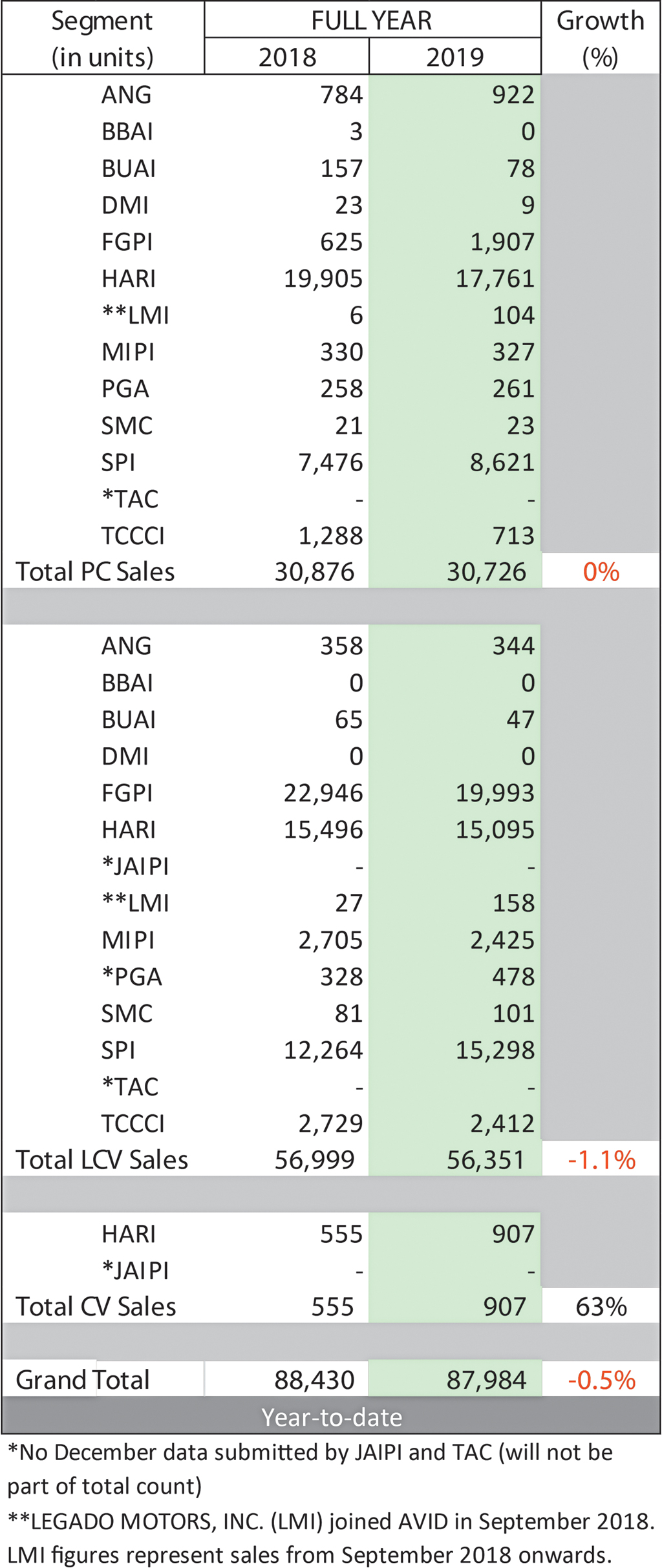
THE ASSOCIATION of Vehicle Importers and Distributors, Inc. (AVID) registered sales of 8,089 units in December 2019, representing a 12% increase versus the same month in 2018. The full-year total was 87,984 units — a decrease of 0.5% compared to 88,430 units sold the previous year.

Said AVID President Ma. Fe Perez-Agudo in a release: “AVID’s performance in the last month of the year augurs well for the automotive industry as we begin the Year of the Metal Rat and the new decade. The continued easing of inflation rates, lower fuel prices, and increased government spending will only bolster sales for the group. We will complement these positive indicators with new models, value-packed service offerings, and easier ownership schemes.”

Passenger car (PC) sales were lower by 0.5% from 30,876 units sold in 2018 to 30,726 last year. Hyundai sold the most in the segment — surpassing all reporting AVID members combined — with a total of 17,761 units in 2019. Suzuki followed with 8,621 units. The PC segment climbed by five percent in December 2019 alone with 2,608 units versus the same month in 2018.

In the light commercial vehicle (LCV) segment, AVID recorded a 1.1% dip in 2019 sales — from 56,999 units sold in 2018 to 56,351 units in 2019. December performance, however, was encouraging as sales increased by 16% in December 2019 alone with 5,362 units sold versus the same month last year. Ford led the segment with a total of 19,993 units sold, followed by Suzuki (15,298), and Hyundai (15,095).

AVID collectively recorded a 63% year-on-year increase in commercial vehicle (CV) sales, led by Hyundai trucks and buses.

The association said that with the approval of the P4.1-trillion national budget for 2020, and with the public works and highways department having one of the largest shares of the budget, “it is expected that industry performance will gain traction in the new decade with the help from its importers bringing in more models that meet the requirements of various markets for the Filipino people.”

Ms. Agudo asserted, “It is appropriate that the recent budget carries the theme ‘Continuing the journey to a more peaceful and progressive Philippines’ since it focuses on critical infrastructure, human capital development, and peace and order initiatives. AVID hopes to contribute to this aim by offering better mobility solutions for both public and private sectors.”

Kiehl’s offers skin checks at special set-up

AMERICAN beauty brand Kiehl’s is encouraging people to start the new year right with better skincare as it promotes its Ultra Facial and Ultra Facial Oil-Free Moisturizers to keep skin hydrated and protected from the elements.

“It doesn’t matter what skin type you have, you need a good moisturizer to keep your skin healthy,” Kaila Nicdao, business unit director for L’Oreal Luxe, told BusinessWorld during an event on Jan. 29 at the Glorietta Activity Center in Makati City.

The experience at the Glorietta Activity Center, which runs until Feb. 4, encourages visitors to have their skin checked by Kiehl’s customer representatives so they can “best determine the ideal skincare routine for your needs,” according to a press release.

Moisturizers are products that protect the skin from transepidermal water loss from the skin’s moisture barrier — in short, it helps the skin retain moisture. The skin’s moisture barrier — the skin’s outermost layer — protects the body against bacteria and environmental damage. If the barrier loses too much moisture, environmental aggressors can penetrate the skin.

The Kiehl’s Ultra Facial cream, which has been a company staple since the 1970s, and Oil-free formula both contain Antarcticine, a “glacial glycoprotein extract” meant to moisturize dry skin and hold even in extreme cold. It also contains Imperata Cylindrica roots said to contain high concentrations of potassium which provide “immediate and lasting hydration for the skin,” and the Kiehl’s signature product: squalane, a botanical lipid similar in molecular structure to natural skin lipids. Squalane is said to absorb easily in the skin and help restore the skin’s moisture balance.

Ms. Nicdao noted that while Kiehl’s original Ultra Facial Cream has always sold well, they noticed that in the past year that the oil-free gel formula has gotten more popular which is “a good sign that even people with oilier skin are starting to use moisturizers.”

“In the past, people with oily or combination skin shies away from moisturizers because they’d feel it makes them oilier, but with our oil-free formula, it provides moisture without making you feel oilier,” she said.

Both products claim to provide “24-hour hydration.” The Ultra Facial Cream is priced at P995 for a 28 ml tube, and P3,600 for 125 ml. The Oil-free gel cream is priced at P1,850 for 50ml. — Zsarlene B. Chua

Robinsons Bank targets to book P1-B net income

GOKONGWEI-LED Robinsons Bank Corp. is looking to grow its earnings to hit the P1-billion mark this year after ending 2019 with about P700 million in consolidated income, its top official said.

Robinsons Bank President and CEO Elfren Antonio S. Sarte told BusinessWorld that the bank will hit its P1-billion profit goal this year by growing its loan portfolio, especially its consumer loans, which posted double-digit growth in 2019.

While the bank has yet to release its full-year 2019 earnings report, Mr. Sarte said they likely hit their P700-million income target for 2019.

“Hopefully, we get to an income level of about a billion this year. From P700 (million) to P1 billion… We are growing our loan books quite fast. I think we are really more of a lending bank, both on commercial and corporate…but on consumer, we’re growing double-digit… I think year on year, we are growing about 30% in our consumer business,” he said on the sidelines of the central bank’s annual reception for the banking community on Jan. 24.

A P700-million consolidated income for 2019 will be more than double the P317-million bottom line Robinsons Bank booked in 2018.

The bank booked a net income of P461.28 million in nine months to September last year, surging by 56% from P294.96 million posted in the same period in 2018.

Mr. Sarte said the bank ended 2019 with P128 billion worth of assets and targets to grow this by at least P30 billion this year.

As of end-September 2019, Robinsons Bank was the 19th largest bank in the country in terms of assets with P107.638 million.

Mr. Sarte earlier said the Gokongwei-led bank will still push through with its plan to be upgraded to a universal bank and eventually do an initial public offering within four years or by 2024.

BOND OFFER
Meanwhile, Mr. Sarte said its P10-billion fundraising program that it will launch this year will be offered in two tranches worth P5 billion each.

He said they have yet to finalize the details of the bonds but they can issue them as corporate bonds, notes or long-term negotiable certificates of deposit (LTNCD).

“We can do either corporate bonds or we can also look at corporate notes and LTNCD, but total is P10 billion this year. I’m looking at possibly two tranches — P5 billion each,” he said.

The bank’s board members approved its P10-billion fundraising plan for the year last month.

In October last year, the lender raised P2.5 billion via two-year bonds, the second tranche of its P10-billion corporate bond program for 2019. The bank also raised a total of P5 billion from two-year bonds in August last year from the first tranche of the fundraising program. — Beatrice M. Laforga

Unifrutti plans banana farm in Basilan

DAVAO CITY — Banana exporter Unifrutti Tropical Philippines, Inc. is finalizing plans to develop a 1,000-hectare farm in the island province of Basilan.

“There is already a tripartite agreement between the local government, ourselves and the cooperatives there,” Unifrutti Philippines President Alberto F. Bacani said in a press conference Friday.

The agribusiness venture agreement is awaiting approval from the Provincial Agrarian Reform Council.

Mr. Bacani said the area is just the initial project, and they see a potential of developing the province into a “banana island in the future.”

The project will be financed by the Land Bank of the Philippines, with a loan value of about $30,000, or more than P1.5 million, per hectare that will be available to the growers.

Unifrutti will provide technical and management assistance as well as ensuring a market for output.

The project was proposed by local officials to develop former coconut plantations that were devastated by pests.

Mr. Bacani also announced that the company was finalizing a partnership for the development of new farms in the town of Ampatuan in Maguindanao.

He said Unifrutti continues to explore areas within the Bangsamoro Autonomous Region in Muslim Mindanao (BARMM), which includes Basilan and Maguindanao, because of the potential of its vast arable land that is “flat and can be irrigated.”

Unifrutti has previously developed a banana plantation in Paglas, Maguindanao and pineapple farms in Wao, Lanao del Sur.

Mr. Bacani said experience in the region has taught the company that the key to successful expansion projects is finding “good partners,” which means respected and dynamic community leaders who can bring together the individual growers to establish large-scale farming.

He added that the BARMM, set up last year replacing the Autonomous Region in Muslim Mindanao, has “technocrats that are not political, but they are people who know how to run businesses and do corporate governance.” — Carmelito Q. Francisco

China December soybean imports from US soar amid easing trade tensions

BEIJING — China’s imports of US soybeans surged in December from a year earlier, data showed on Friday, as China ramped up purchases during a thaw in the two country’s trade war.

China brought in 3.09 million tonnes of soybeans from the United States in December, 44 times the level a year ago, data from the General Administration of Customs showed.

The figure was also up from 2.56 million tonnes in November, after some delayed cargoes cleared customs, but was still shy of the six million-plus levels for US December imports to China in 2017 and earlier years.

Friday’s data provided a breakdown of China’s buying by origin after figures released earlier in January showed it bought 88.51 million tonnes of soybeans overall in 2019, just up from 88.03 million tonnes in 2018.

Beijing has pledged to buy billions of dollars more in agricultural goods from the United States as part of a Phase 1 deal to calm a bitter trade row. Soybeans made up more than half of its US agricultural purchases in 2017 before the trade war erupted and are expected to make up a key part of any increased purchases.

For all of 2019, China brought in 16.94 million tonnes of US soybeans, edging up from 16.6 million tonnes in 2018, when shipments nearly halved from the previous year due to the trade dispute.

China usually turns to US soybeans in the fourth quarter of the year when the American harvest dominates the market. But US cargoes nearly halted in late 2018 after Beijing slapped retaliatory tariffs on a list of US products including soybeans.

Chinese buyers, however, resumed some purchases of US beans after a truce in their trade row and after Beijing issued extra tariff-free waivers for some American shipments in a goodwill gesture to Washington.

China’s December shipments from Brazil, its largest supplier of the oilseed, came in at 4.83 million tonnes, up 10% from a year earlier, and up 25.1% from November.

For the full year, China brought in 57.67 million tonnes of soybeans from Brazil, down 12.8% from 66.1 million tonnes in 2018.

Chinese importers bring in soybeans to crush into cooking oil, and soymeal to feed the livestock sector.

Overall imports in 2019 were down from 95.54 million tonnes in 2017, with China’s demand curbed by the deadly African swine fever disease, which has nearly halved the country’s massive pig herd.

The 2017 imports included 32.85 million tonnes of US soybeans and 50.93 million tonnes from Brazil. — Reuters

Shares may move sideways as virus fears persist

By Denise A. Valdez
Reporter

PHILIPPINE SHARES may continue moving sideways this week as the novel coronavirus (nCoV) outbreak continues to scare investors into the sidelines.

The bellwether Philippine Stock Exchange index (PSEi) dropped 2.59% or 191.89 points to close at 7,200.79 on Friday. This translates to a 5.54% decline for the main index on a weekly basis.

“Funds sought safety, as headlines related to the novel coronavirus outbreak in more than 20 countries stymied global sentiment. The PSEi fell…, highlighted by a deep Friday sell-off, after DoH (Department of Health) reported the country’s first confirmed nCoV case,” online brokerage 2Tradeasia.com said in a market note.

Value turnover last week dropped 18% to an average of P5.49 billion, while foreign investors sold an average of P608.37 million from the prior week’s P330.83 million.

“Health outbreaks, such as that of the novel coronavirus, neither have timelines nor definite endgames — and markets would have to deal with this uncertainty for now,” 2Tradeasia.com said.

The Philippines reported its first death of a person with the novel coronavirus yesterday, the first casualty on record outside mainland China. The victim was a 44-year-old Chinese man from Wuhan who arrived in the country on Jan. 21. He was the companion of the 38-year-old woman that the Health department reported last week as the first case of coronavirus in the country.

Deaths in China due to the virus have soared to 304 with 14,380 confirmed cases as of end-Saturday, Reuters reported yesterday. More than 130 cases of persons with the virus have also been reported across more than 20 countries.

While the virus is often likened to the Severe Acute Respiratory Syndrome or SARS and Middle East Respiratory Syndrome or MERS outbreaks in 2003 and 2012, respectively, which “did little to spook the PSEi,” 2Tradeasia.com said it must be noted that the novel coronavirus has a faster mode of transmission due to a “more globalized 2020,” and its impact may be greater because of the “present global supply chain’s increased dependency on Chinese capital and labor.”

“Brace for further volatility from hereon, as markets digest developments on the nCoV side and its accompanying economic repercussions,” it said.

As questions on the virus outbreak pile up and with fears yet to subside, 2Tradeasia.com said the market could only hope for a positive inflation report from the government on Feb. 5 and the central bank’s policy decision on Feb. 6 to drive up activity from investors.

“Note that the central bank previously hinted trimming at least 50 bps (basis points) for 2020, 25 bps of which may come by (first quarter 2020). Any supportive move may inject zeal, in tandem with earnings announcements from sector giants Bank of the Philippine Islands and Globe Telecom, Inc.,” it said.

“Immediate support is 7,000, secondary at 6,900, resistance 7,300-7,400,” it added.

ADVERTISEMENT
ADVERTISEMENT