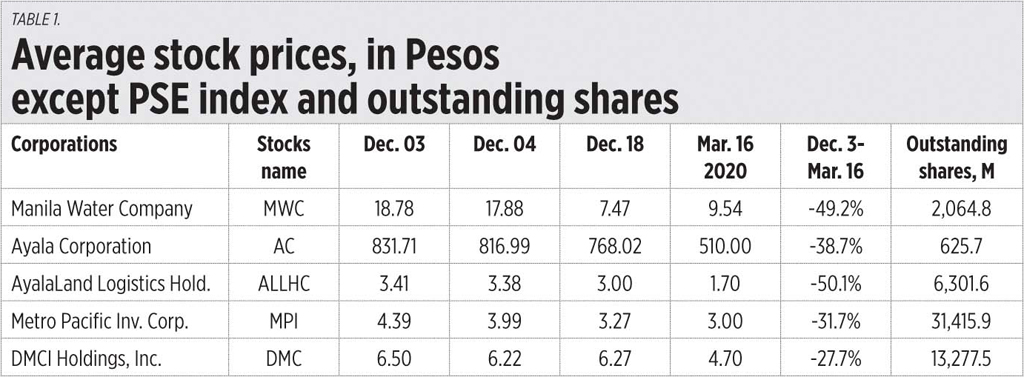
When President Rodrigo Duterte lashed out at Maynilad and Manila Water that hold concession agreements (CA) with the government via the MWSS on Dec. 3, 2019, the stock prices of both companies and their allied firms suffered significant declines starting Dec. 4, which continued until mid-December. I continued the series to last Monday, the last trading day of the Philippine Stock Exchange (PSE). The percentage decline of stock values until this week remains big, 49% and 32% for Manila Water Co. Inc. (MWC) and Metro Pacific Investment Corp. (MPI) respectively (see Table 1).
MWC has lost some P18 billion while MPI lost around P40 billion in stock value from the harassment by the President. Very irresponsible.
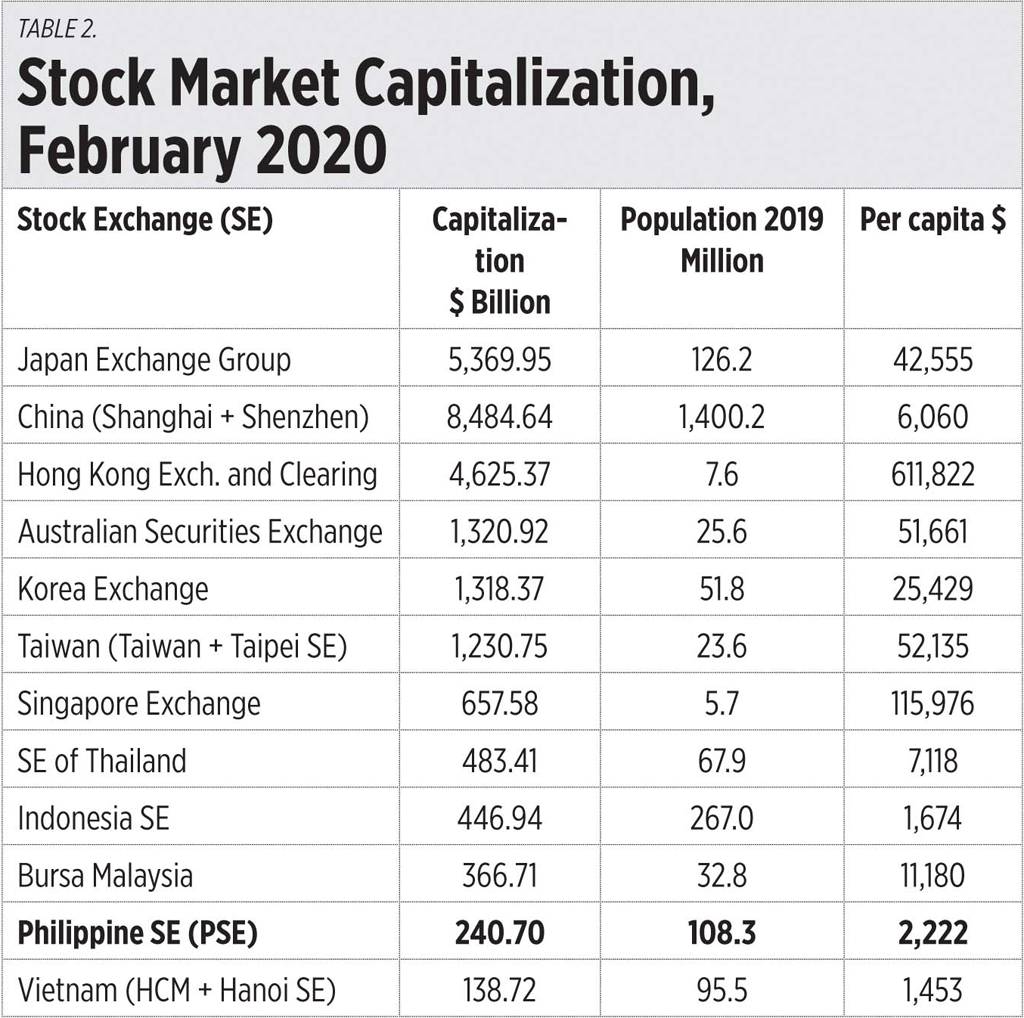
Consider also that the PSE is a lightweight in terms of market capitalization in Asia Pacific, only $241 billion as of February 2020 and our per capita capitalization was only $2,222, just a third of Thailand, a fifth of Malaysia and 1/50 of Singapore. Soon Vietnam and Indonesia might overtake us (see Table 2).
India has a market capitalization of $4.08 trillion and a higher per capita of $3,015 than us.
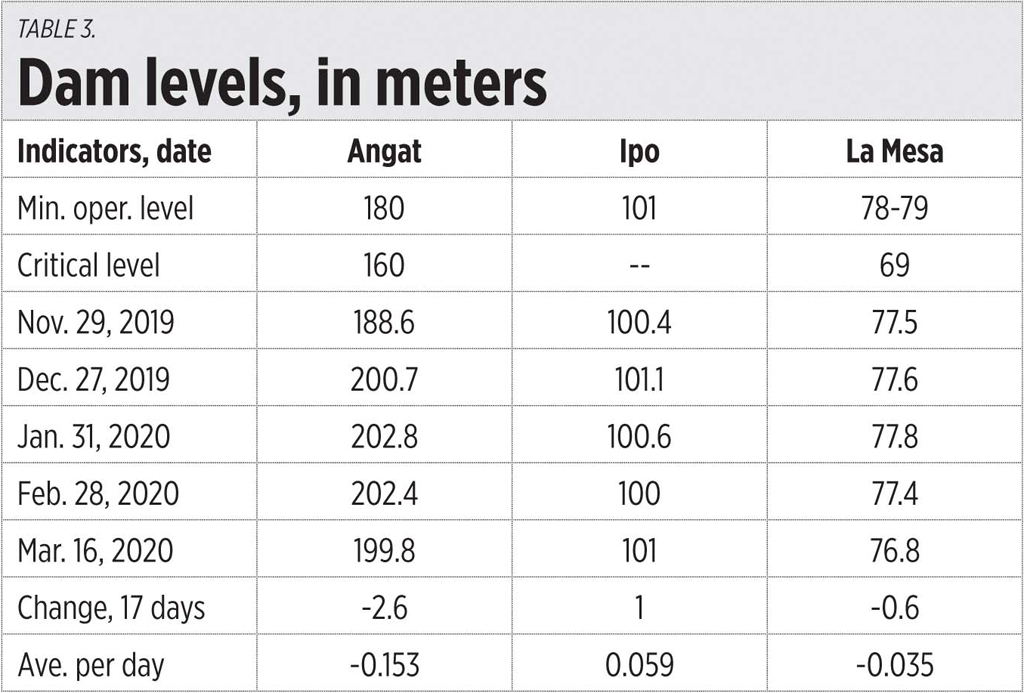
Now consider this COVID-19 or Wuhan virus, water demand is high this March as the hot season has started and people wash hands very often. I computed the decline in Angat Dam water in the first half of this month — it is 0.15 meters per day. At this rate, Angat water will reach the minimum operating level of 180 meters by around mid-May and water rationing will happen again after that (see Table 3).
It is important that the two concessionaires develop new short-term water sources and they will need even short-term loans to fund the immediate capex (capital expenditure) but banks remain hesitant to lend to them because of the Presidential harassment that hangs over them until today.
Despite these financial limitations, the Ayala and MPI groups have bent over backwards and extended billions of pesos to their employees, contractors, suppliers, lessors and customers during this virus situation. The Ayalas, for instance, extended a total of P2.4 billion for this. Payment of water bills, rentals, electricity bills have been postponed by at least one month with no penalties or disconnection notices by the two concessionaires.
The President’s political harassment should end and the original concession extension to 2037 should be honored. The Clean Water Act plus Supreme Court Mandamus have jointly raised the requirement from 50% to 100% sewerage coverage and it is estimated that this will require an investment of P458 billion until 2037.
When the political uncertainties are removed, the two concessionaires should be able to mobilize new loans to finance the huge investments needed for the remaining 17 years.
This virus scare has shown us many things, like the need for sustained hygiene and cleanliness, that requires lots of clean water flowing from our faucets to help remove the virus. May this lesson sink into the minds of the President and his officials regulating the water sector.
Bienvenido S. Oplas, Jr. is the president of Minimal Government Thinkers.
SHOULD OPINIONS and conversations always be about the issues of the day? Does the opinion page need to follow the events in the front page and the latest posts on the net? Can we talk about something else aside from the virus and the economic recession it seems to be causing along with the travel restrictions and their effects on the price of oil?
Can we change the topic?
If we do, there is the risk of being considered irrelevant. What’s wrong with that?
Relevance refers to being pertinent to the matter at hand. Can a person bringing up Bertrand Russell’s “In Praise of Idleness” when the topic under discussion is the disruption of the supply chain with the virus lockdown of China be summarily dismissed as irrelevant?
To rule something as irrelevant presumes that the real issue is clear and why an off-topic comment does not contribute to an understanding of it. Maybe an irrelevant topic like women’s volleyball or the social distancing caused by gadgets can jog a fresh outlook on the impact of the virus on sports events.
Lateral thinking developed by Edward de Bono holds that nothing is automatically irrelevant, just another angle to consider. He holds that approaching problems indirectly with irrelevant comments can provide different perspectives. Irrelevance is just one approach. Anyway, relevance is subjective. The effect of the virus on traffic or the workings of an art auction may be irrelevant but only to some.
Humor is considered inappropriate for serious topics, and thus automatically considered irrelevant as an approach to weighty matters. Roberto Benigni, actor and director, used a slapstick approach on a horrible human tragedy, the holocaust, and how the Italian Jews were sucked into it. His film, Life is Beautiful, a curiously light account of a painful historical event became an award-winning masterpiece. A recent movie, Jojo Rabbit, on the Hitler Youth and the Jews in Austria after the Anschluss does a similar comic take.
Still, irrelevance in literature has been practiced by Dickens and Shakespeare. The comic relief provided by Falstaff in Henry V has nothing much to do with the plot. Still, it provides a break to make the story more satisfying. Dickens’ Mr. Micawber and his little rules on life (“Income higher than expense is bliss; Income lower than expense is misery”) provides the same plot leavening of the novel, David Copperfield. This literary device is called “comic relief” as the levity and irrelevance give us a better perspective of tragedy.
The root word of relevance is Latin for lightening up, relieving, and raising up (as in levitate). Doesn’t irrelevance relieve and raise understanding? Getting too emotionally involved in an issue leads to passionate debate, taking sides, and introducing the ultimate irrelevance of name-calling.
If relevance implies pertinence to the matter at hand, isn’t it a priority to first define what the real subject is? Irrelevance has its benefits. It distracts us and provides distance for a better perspective.
Book reviews, karaoke behavior and what it reveals, delving into the intricacies of office politics, at the same time avoiding comments on dangling franchises, the spread of a virus (like panic), or the distant memory of ashfall give respite from doomsday scenarios.
Is irrelevance to be considered merely being out of touch, maybe even apathetic and unconcerned with weightier matters of life and death? Not really. Irrelevance can be refreshing as a form of social protest, even in the chat groups that can take themselves too seriously.
Reading a variety of books on history, like the execution of the Romanovs by the red forces or the instability, even the borderline lunacy, of a sitting president (of another country) can give a better understanding of current events. A reading program may be the best definition of “working from home.”
Life in the margins and how personal relationships develop and then deteriorate to hatred seem more interesting than following the rising or falling numbers of infected countries and the incidences of lockdowns.
Anyway, it’s too late to wonder how you, Dear Reader, got this far in the topic of irrelevance. It’s too late at this point to try to get back to something weighty or relevant… and definitely more gloomy.
IF COVID-19 spreads as fast as experts predict, the memories that will stick with Americans years down the road will be of desperately ill people turned away from hospitals.
The US has no capacity to cope with even a small surge in intensive care patients. There will be shortages of health care workers and equipment — especially respirators, which ran far short of the need in Italy.
But even under these terrible circumstances, there are ways to be as fair as possible about who receives care.
The public won’t tolerate rationing decisions made on the spot by governments, hospitals or hospital administrators — these will seem arbitrary and unfair. Coordination and uniformity across hospitals is critical, says Nir Eyal, a professor of bioethics at Rutgers University who has studied healthcare rationing. The alternative to a uniform plan is arbitrariness or a system where the people with the most money or the sharpest elbows get the best care. We need to allocate resources in a way that saves the most lives in the fairest way.
What’s needed are rules based on scientific and ethical principles, and put forward after long deliberation. Fortunately, the World Health Organization already has guidelines for dealing with healthcare shortages during a pandemic — drawn up in 2006, in response to the threat that an extremely deadly strain of bird flu would spread from person to person. These guidelines took weeks of collaborative work between scientists and ethicists.
“Now it’s as if there’s amnesia” says Daniel Wikler, a Harvard University professor of ethics and population health, who helped craft guidelines for the World Health Organization and the state of Massachusetts. Similar guidelines, he said, were created at a national level. But because bird flu later appeared to be a dud, he says, the world forgot about the plan.
It’s time to remember. The bird flu plan was aimed at a viral threat very much like the one we face now. That deadly virus, H5N1, jumped from birds to a few humans in the early 2000s. Some aspects of the threat were different, but the ethical principles are the same. Shortages of ICU beds or ventilators will mean that even the “least bad course of action will be awful,” he says. But we still have to implement what’s least bad.
The guidelines created for bird flu consider all lives equally valuable and seek to maximize the number saved, Wikler explains. Under those guidelines, patients would be divided into broad priority categories. In the first would be those whose deaths would cost other lives — healthcare workers, firefighters, police, and the people who keep up essential public works such as the water supply.
The next division is between the sickest and those likely to recover. Normally, the sickest people would be given first priority for intensive care treatment, but in a pandemic, priority should go to those whose lives are threatened, but who have a good chance of pulling through if treated. Those people would have priority over sicker people who have very little chance to survive even with medical care.
Those classifications won’t be enough, Wikler says. If there’s a big surge in cases, hospitals might see multiple people in the same category and beds for only half of them. If that happens, people should be chosen through random lottery. There’s more than ethical value in this approach: In scientific studies, randomization is a tool used to learn what works and what doesn’t. It sounds cruel to say we’re using people as guinea pigs, he says, but doctors can save lives down the road by learning as much as possible as they go along.
Nobody knows how big this pandemic will get or how US efforts at social distancing will help. But we do know that even in the best-case scenarios, hospital beds are scarce. The US has 12% fewer total beds than it did in 1975. According to a Kaiser Family Foundation study, quoted in the Wall Street Journal, there are 2.8 beds per 1,000 people in the US, while other developed countries such as Germany, Australia and Japan have an average of 5.4 beds per 1,000 people.
In the same WSJ piece, Harvard epidemiologist Mark Lipsitch has estimated that if things progress the way they did in Wuhan, the US will need three times as many ICU treatments as the number of ICU beds that are available.
So Americans need to plan for rationing but also seek to minimize it, though efforts to build field hospitals, or temporary hospitals in existing buildings such as hotels. The Chinese built a giant new hospital in the midst of their crisis. And the drastic changes in our lives with social distancing could help minimize a surge in cases. The object is not only to save ourselves but to save others, and save the principles of community and fairness that hold us together.
OPEC may not survive to celebrate its own 60th birthday later this year. Saudi Arabia’s decision to abandon output restraint and flood the market with cheap crude signals the end for a group dubbed the world’s most successful cartel.
In a selfish bit of showmanship, Saudi Arabia, by far the biggest producer in the Organization of the Petroleum Exporting Countries (OPEC), tore up an output agreement that had lasted since the start of 2017. It did so because Russia, the largest of OPEC’s external allies, wouldn’t play ball and refused to make deeper production cuts to help prop up oil prices in the face of the economic devastation being wrought by the COVID-19 virus.
The kingdom had probably hoped to shock the Kremlin into coming back to the negotiating table, but that clearly backfired. The impact — compounded by the deadly virus’s continued spread — will be much more damaging for OPEC’s other members, from Algeria to Venezuela, than it will be for Saudi Arabia’s nemesis in the wider OPEC+ coalition.
The de facto leader of OPEC could have made other calculated choices before taking an every man for himself approach and starting an all-out oil price war. After all, Russia offered to extend the current output cuts beyond the end of March, and there was nothing to stop OPEC’s 13 members from agreeing further reductions just among themselves.
But Saudi Arabia seems to have decided that the OPEC+ pact, which started life as a temporary coming together meant to last only six months, needed to continue further into its fourth year. If the external partners weren’t prepared to cut deeper, then OPEC wouldn’t act either. And, since not everyone saw eye to eye, the current agreement wouldn’t be extended, leaving everybody free at the end of March to pump as much as they want, or are capable of.
Then, rather than wait and see, Saudi Arabia acted with a vengeance, slashing the cost of its crude for loading in April. Official selling prices — set as differentials to regional benchmarks — were cut by the most on record after the OPEC+ deal fell apart. With Brent trading around $30 a barrel and the discount for sales of Saudi Arabia’s key Arabian Light grade set at $10.25 a barrel, there is an ocean of $20 oil set to head for Europe next month. There have also been big increases in the volumes allocated to buyers in both Asia and on the U.S. Gulf coast.
Saudi Arabia’s monopoly oil producer, Saudi Aramco, says that it will supply its customers with 12.3 million barrels a day in April. That’s more than the company can pump out of the ground, even if it opens the taps fully, thus implying that it will draw down crude stored at home and in tanks in Japan, the Netherlands and on Egypt’s Mediterranean coast.
While the kingdom can partially offset the collapse in oil prices with the boost in volumes, most of its fellow OPEC members are much less fortunate. They are already pumping almost as much as they can.
In Libya, for example, production has been cut to near zero after a local warlord closed almost all of the country’s export terminals. A peace deal could increase it by more than 1 million barrels a day, but that seems remote. Iran and Venezuela could both boost output were it not for US sanctions on their oil trade, although Venezuela’s upside is limited.
For the rest of team OPEC, Nigeria is the only country outside the Persian Gulf that can boost production by more than 100,000 barrels a day. But that’s not going to get it very far. A simple back-of-the-envelope calculation shows that lifting output to capacity would only reduce the West African nation’s losses from the price drop to $30 a barrel from $60 by 6%. For Angola, the region’s second-biggest producer, the potential reduction in its loss is just 3%. By contrast, Saudi Arabia, from its kingpin perch, could recoup more than a quarter of the oil revenue it would lose as a result of the price drop by increasing supply to 12.3 million barrels a day from 9.7 million.
This is not the first time that Saudi Arabia has cast smaller OPEC producers to the wolves. As a grouping of sovereign nations, they have little leverage over the group’s biggest producer. But the kingdom’s latest actions, in the face of an unprecedented hit to global oil demand, show its true disregard for fellow members.
When OPEC was originally formed back in 1960, part of its principal aim was “safeguarding the interests of Member Countries individually and collectively.” That goal was still paramount in the revised OPEC Statue, drawn up in 2012. So too was “eliminating harmful and unnecessary fluctuations” in oil prices. Saudi Arabia’s latest actions are diametrically opposed to those goals, and have helped cause oil prices to fall by almost 40% in a little over a week. That is certainly not in the collective interests of OPEC’s members.
The oil cartel was a useful fig leaf for Saudi oil policy when it wanted to support oil prices. Now that it wants to send them tumbling, OPEC is simply an inconvenience. The group has survived seemingly irreconcilable internal differences in the past. This one might just be a step too far.
THE PESO rebounded on Wednesday as governments around the world lay out initiatives to combat the impact of the virus. — BW FILE PHOTO
THE PESO bounced back on Wednesday after a trading halt on the back of positive market sentiment, with the United States baring fiscal strategies to cushion the impact of the coronavirus disease 2019 (COVID-19) outbreak.
The local unit ended trading at P51.05 per dollar yesterday, recovering 45 centavos from its P51.50-per-dollar finish on Monday, according to the website of the Bankers Association of the Philippines (BAP).
After the trading suspension on Tuesday, the peso opened Wednesday’s session at P51.80 per dollar. Its weakest showing for the day was at P51.85, while its intraday best was at P51.01 against the greenback.
Dollars traded slipped to $712.25 million from the $769.39 million seen on Monday.
In light of the enhanced community quarantine and the curfew set in Metro Manila, the BAP has shortened currency trading hours until further notice, with afternoon trading now ending at 2 p.m. from 4 p.m. previously.
A trader attributed the local unit’s strength to profit taking as well as the dollar’s weakness following remarks from US President Donald J. Trump.
“The peso strengthened today on profit taking from the dollar’s recent strength after local trading was halted on Tuesday,” the trader said in an e-mail on Wednesday.
“Recent statements from US Pres. Trump about a probable US recession has likewise contributed to the weakness of the greenback,” the trader added.
On Monday, Mr. Trump told Americans to clear most of their social activities in the next two weeks and to refrain from mass gatherings, according to a Reuters report.
He also warned that a recession is possible as stocks continued to drop. He added he will focus on addressing the crisis, as the economy will fare better if problems are resolved.
“We’ve made the decision to further toughen the guidelines and blunt the infection now,” Mr. Trump told reporters at the White House.
Meanwhile, UnionBank of the Philippines, Inc. Chief Economist Ruben Carlo O. Asuncion said the peso’s rebound was supported by market sentiment on headlines about US stepping up its initiatives to battle COVID-19’s economic impact.
“The peso rebounded from the previous decline as the US government steps up its fiscal rescue plan as COVID-19 continues to spread in advanced economies,” Mr. Asuncion said in a text message.
Reuters reported that Mr. Trump bared a plan to release money for Americans to ease the economic shock from the virus spread.
Meanwhile, US Treasury Secretary Steven Mnuchin said he was discussing plans with congressional leaders to send checks immediately to displaced citizens, whereby Mr. Trump said that some people should get $1,000.
The trader sees the peso moving around the P51 to P51.20 range today, while Mr. Asuncion gave a forecast range of P50.90 to P51.30. — L.W.T. Noble withReuters
PHARMACEUTICAL giant Pfizer, Inc. said it was working on a potential COVID-19 vaccine with BioNTech SE, a German company working on new kinds of immunotherapy treatments.
The drugmakers have signed to co-develop and distribute the vaccine outside China, they said in a joint statement.
The novel coronavirus outbreak has killed almost 8,000 people and sickened about 199,00 worldwide, mostly in China.
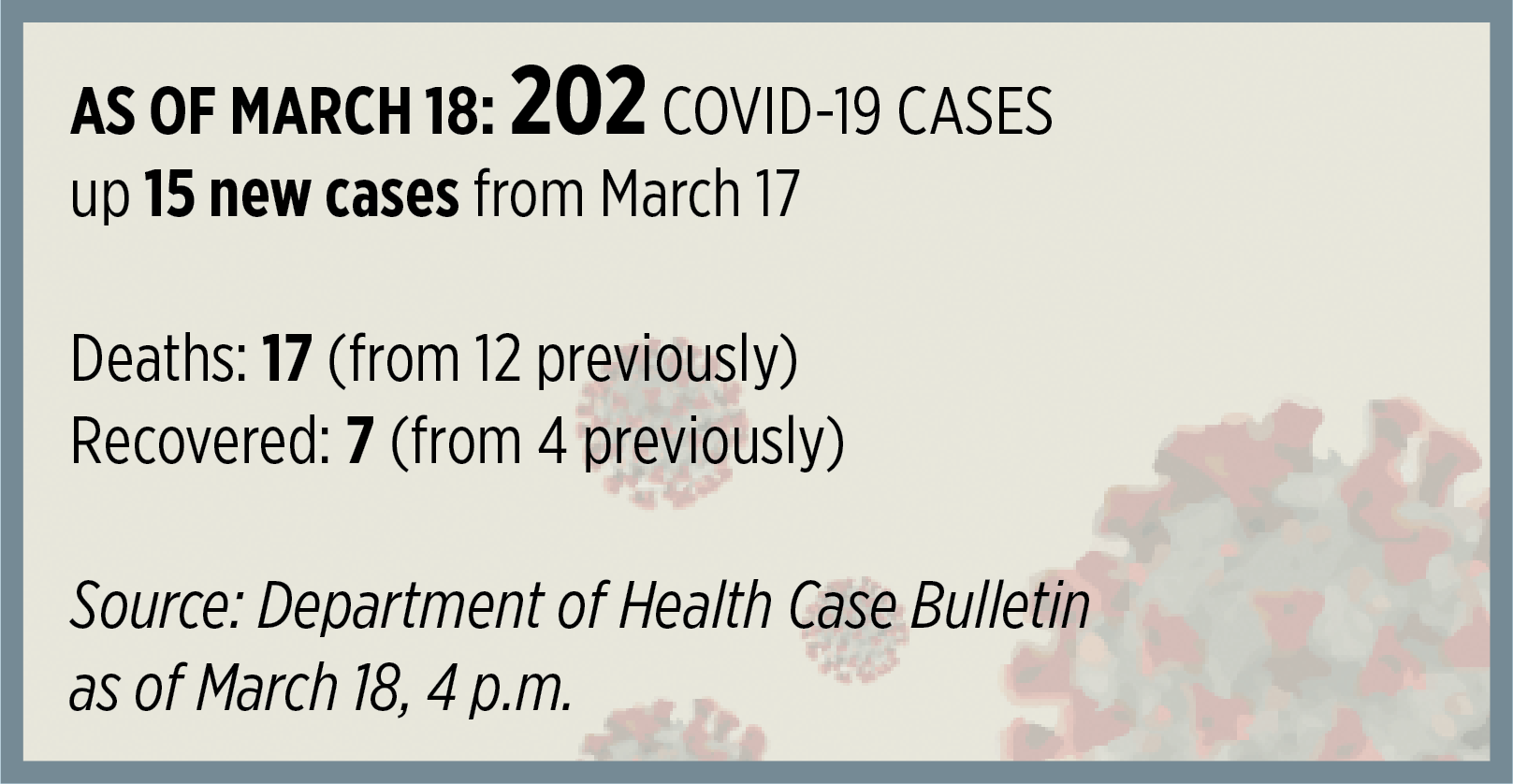
In the Philippines, the Department of Health reported 15 more coronavirus disease 2019 cases on Wednesday, bringing the total to 202, with 17 deaths.
The collaboration plans to speed up BioNTech’s potential vaccine program, BNT162, which is expected to start clinical testing by the end of April 2020, according to the joint statement.
The partnership reinforces Pfizer’s “commitment to do everything we can to combat this escalating pandemic as quickly as possible,” said Mikael Dolsten, chief scientific officer and president of Worldwide Research, Development and Medical at Pfizer.
Pfizer already collaborates with BioNTech to develop mRNA-based vaccines for influenza.
Health Undersecretary Maria Rosario S. Vergiere told a news briefing seven people have recovered after being given adequate treatment.
“There is no special formula that allowed these people to recover,” she said in Filipino, adding that the patients had mild symptoms and had no other serious ailments.
The three reported recoveries on Wednesday consisted of patient Nos. 13, 15 and 26 with ages 34, 24 and 34, respectively, DoH said in a separate statement. The three reported deaths had ages of 58, 65 and 86, it added.
President Rodrigo R. Duterte imposed a community quarantine on Metro Manila this week, suspending classes for a month and limiting travel to and from the capital and nearby cities to contain the outbreak.
He later expanded the lockdown to the entire Luzon island, suspending work and public transportation and regulating food and health services.
Meanwhile, life insurer Cocolife said it continues to extend full coverage to cardholders with COVID-19.
The company also said it had released the 13th month pay and other bonuses of its employees, and implemented a work-from-home arrangement.
“We have taken steps to mitigate the economic impact of this situation on our employees and agents such as immediate financial assistance packages and emergency loans, among others,” Cocolife said.
THE government has allowed financial markets to operate with a skeletal workforce during the month-long lockdown of the main island of Luzon.
The presidential palace released additional guidelines on the lockdown from an inter-agency task force, saying the central bank, Securities and Exchange Commission and Philippine Stock Exchange may operate starting March 18.
Also exempted from the work ban are employees of the Philippine Dealing and Exchange Corp., Philippine Security Settlement Corp. and Philippine Depository and Trust Corp.
“Your government won’t stop ironing out all the wrinkles,” Cabinet Secretary Karlo Alexei B. Nograles said late Tuesday evening, referring to lockdown rules.
A number of people exempted from the ban including health workers were unable to work on March 17 in the absence of public transportation.
The government later provided buses to ferry them to and from work.
Under the new guidelines, police will allow the movement of all types of cargoes.
The Department of Labor and Employment (DoLE) will facilitate a livelihood program for workers affected by the lock down.
Labor Secretary later issued an order giving work to affected employees for 10 days. The underemployed, self-employed and displaced marginalized workers who have lost their livelihood or whose earnings were affected by the quarantine will be eligible.
Meanwhile, the new guidelines also asked employers not to force their personnel to work unless they were engaged in making basic goods or providing basic services. Their failure to report for work should also not be a ground for dismissal.
Meanwhile, the government changed its travel policy, saying it would now allow international travelers except Filipino tourists from leaving the country during the lockdown period.
On Tuesday, the Transportation department said international travelers must leave or enter the country within 72 hours because international airports in Luzon will have been closed by March 20.
“Inbound international passengers are allowed entry, subject to strict immigration and quarantine protocols,” the Transportation department said.
Meanwhile, passengers from Italy and Iran must present medical certificates of good health validated by their respective embassies.
One person can accompany a passenger to or from the airport as long as the companion has a copy of the passenger’s airline ticket as proof of conveyance.
Hotels and other hospitality establishments were barred from receiving more guests. Guests who have existing accommodations as of March 17 and those with long-term leases may continue lodging there, according to the rules. — Arjay L. BalinbinandGillian M. Cortez
SENATORS on Wednesday urged government agencies and local governments to prioritize frontline health workers for assistance once calamity funds are released.
President Rodrigo. R. Duterte on March 16 issued a proclamation declaring a state of national calamity for six months amid a novel coronavirus outbreak.
“Declaring a state of calamity is necessary in order to be able to release the P16 billion calamity fund of the National Government as well as the use of calamity funds of local government units,” Senator Francis N. Pangilinan said in a statement yesterday.
Mr. Pangilinan said the government should prioritize buying more COVID-19 test kits, protective gears for health workers and medical equipment for hospitals. The budget may also be used to put in place more isolation wards for COVID-19 patients, he said.
Food supplies, relief goods and cash assistance should also be given to daily wage earners, the senator said.
“The decision is necessary to bolster sweeping relief and emergency efforts to contain the outbreak and at the same time ease the burden of our frontliners and ordinary citizens as we come to grips with this public health crisis,” Senator Grace S. Poe-Llamanzares said of the proclamation.
Senator Panfilo M. Lacson said he agreed with the proclamation, but asked government officials to ensure that the funding goes to the public.
“I cannot imagine concerned local government officials in charge of dispensing those funds can still have gall and malevolent intention of stealing the monies under their control,” he said in a separate statement. — Charmaine A. Tadalan
THE Quezon City government has placed under “heightened enhanced community quarantine” two villages where half-a-dozen COVID-19 cases came from.
The villages of Kalusugan and Tandang Sora had been classified as a “hot zone,” where people are barred from entering and leaving their houses, Karl Michael Marasigan, head of the city’s disaster office, said at a briefing streamed on GMA News.
Houses within the 500-meter radius of the hot zone will be under strict monitoring and surveillance, he said.
Quezon City Mayor Josefina G. Belmonte said the city has had 29 residents who tested positive for the novel coronavirus.
Access to a portion of E. Rodriguez Avenue where St. Luke’s Medical Center is located, and East Avenue from Elliptical Road until BIR Road, where the Philippine Heart Center, East Avenue Medical Center and National Kidney Medical Center are, will be restricted.
The public can pass through but will be subject to screening. — Vann Marlo M. Villegas
IBP national office workers to get half of 13th month pay
THE INTEGRATED Bar of the Philippines (IBP) will release early half of the 13th month pay and salaries of its national office employees located in the National Capital Region while Luzon is under enhanced community quarantine due to the novel coronavirus disease. In a statement, IBP National President Domingo Egon Q. Cayosa said these will be given to IBP National employees and legal aid clerks for the purchase of food supply and basic necessities. “Please prudently use the advanced benefits and salaries for basic necessities to weather lockdowns,” Mr. Cayosa reminded employees. “Observe the quarantine protocols prescribed by authorities and health experts.” For IBP chapters outside the capital, Mr. Cayosa said, “We have also directed the Chapters with enough resources to do the same for allowances from Chapter funds that are due to the Legal Aid Clerks.” Mr. Cayosa also recommended to President Rodrigo R. Duterte to suspend hearings and processes in all quasi-judicial and administrative tribunals in the country and to function only with “minimal staff on a rotation or on call basis.” Work from home arrangement was also recommended. The Supreme Court on Monday issued an administrative circular directing the drastic reduction of operations in all courts until April 15, maintaining only skeletal staff to act on “urgent matters.” All hearings are suspended except on matters involving bail and habeas corpus, promulgation of judgement on acquittals, reliefs or those arrested during the period. — Vann Marlo M. Villegas
Iloilo businesses encouraged to stay open, but customers shy away
THE ILOILO City government offices get disinfected as part of measures to mitigate the spread of the new coronavirus. — BW/ERSSANTIAGUDO
ILOILO CITY — The Tatoy’s Manokan and Seafoods Restaurant chain, popular among locals and tourists, is temporarily closing three branches in Iloilo as customers dwindle following the community quarantine declared by both the provincial and city governments to help stop the spread of the new coronavirus.
One of the biggest taxi operators in the city, Light of Glory Taxi, has also announced that it might suspend services soon.
lloilo Business Club (IBC) Executive Director Maria Victoria Lea E. Lara said while the private sector is mandated under the local quarantine guidelines to remain open though with shortened operating hours, many simply could not sustain the daily costs.
“While we want to follow our mandate to open, but who will we serve? No one is leaving their houses. We don’t really know,” Ms. Lara told BusinessWorld.
She said the impact is felt by both small enterprises and big businesses.
“Our local economy is service oriented and now we are reeling from the huge drop of sales and bookings… Trucks coming in from Manila will also surely face delays following the strict border restrictions. The logistics support and supplies needed by the restaurants and other establishments will be significantly affected,” she said.
Happy C. Abenir spokesperson of the Iloilo Hotels, Resorts, and Restaurants Association (IHRRA), said the tourism sector is “taking a big hit.”
“There are already no flights coming in to Iloilo and there is less movement of people. Accommodation sector, local hotels, and travel tours are all crying for help because there are no tourists and customers,” Ms. Abenir told BusinessWorld in a separate interview.
Restrictions are also in place at the borders of the provinces and main cities of the entire Western Visayas Region, which covers Antique, Aklan, Capiz, Iloilo, and Guimaras.
As of March 17, there are no confirmed cases of coronavirus disease 2019 (COVID-19) in the region.
“We are balancing the business side and how to maintain the work force at a level that the business can survive. We are aware of the plight of the workers and the business sector is doing all it can do in terms of saving the employees,” Ms. Abenir said.
Both the IBC and IHRRA officials, however, said job cuts and business closures are inevitable if the current COVID-19 national situation does not improve and the community quarantine is prolonged.
“We anticipate the job losses and it is a scenario if this will continue,” Ms. Lara said.
For now, Ms. Abenir said, “We are looking at what we can do, particularly in areas which needs assistance and how we will be able to help. We are closely coordinating with the local governments and DoH (Department of Health).” — Emme Rose S. Santiagudo
Davao businesses rush to migrate to online platforms amid COVID-19
DAVAO CITY — The Davao City business chamber has sought the help of the information and communications technology (ICT) sector to map out a scheme that establishments can adopt to maintain operations amid the COVID-19 threat.
“Our major concern is to keep business flowing while observing maximum precautions in line with government’s. We are closely coordinating with the city government of Davao on the matter,” Davao City Chamber of Commerce and Industry Inc. (DCCCII) President John Carlo B. Tria told BusinessWorld via phone Tuesday.
The Davao City government declared a community quarantine Sunday, setting restrictions on the movement of people at the borders.
DCCCII, meanwhile, said establishments have committed to continue to function as normal as possible while preparing to slowly migrate to e-commerce platforms for trade transactions and other online options for daily operations.
Shopping malls remain open but with shortened operating hours.
More local consumers, meanwhile, have been patronizing mobile application services for food and grocery delivery.
Small Basket, a third party delivery service that caters to orders from the supermarkets and various retail shops of homegrown New City Commercial Corp. (NCCC), appealed to its clients as early as last Saturday to understand their “dire situation” given the sudden “high volume of orders.”
As of this week, the next open slot for a Small Basket delivery is March 23.
Mr. Tria said they are also working with the city government for an economic plan that will address the disruptions and expected losses from COVID-19.
“The common sentiment of the business sector now is how to continue doing business amid the COVID-19 scare,” he said.
There are no confirmed cases in the city as of March 17.
In an earlier phone interview, Arturo M. Milan, regional governor of the Philippine Chamber of Commerce and Industry, said, “We need to stand and fight this virus by not shying away from our regular routine but doing what we are supposed to do for as long as we implement the necessary protocols… or else our economy will collapse.” — Maya M. PadilloandCarmelito Q. Francisco
WESM maintains operations, contingency measures in place
OPERATIONS IN the Wholesale Electricity Spot Market (WESM) is “business-as-usual” amid the Luzon-wide lockdown due to the new coronavirus disease 2019 (COVID-19) threat, the Independent Electricity Market Operator of the Philippines (IEMOP) said on Tuesday. Following the Department of Energy’s (DoE) advisory last March 15, the WESM operator implemented its business continuity plan, providing possible risk scenarios during the enhanced community quarantine from March 17 to April 13. This includes its coordination with the government’s Inter-agency Task Force on Emerging Infectious Diseases and the release of status updates on its market operations to all trading participants and stakeholders. If a confirmed COVID-19 case forces a lockdown of the Robinson Equitable Tower building in Pasig City, where IEMOP is based, or an employee tests positive of the disease, the electricity market operator assured that it will still be able to continue normal operations. On Wednesday, the DoE also asked suppliers of oil, coal, and steam to extend the deadline of payments of obligations and dues by energy generation firms to 30 days after April 14. It also called for the postponement of independent power producer administration payments, as well as universal and environmental charges to the Power Sector Assets and Liabilities Management Corp. (PSALM). Payments to the IEMOP, feed-in-tariff allowance remittance to the National Transmission Corp. and payments of Generation Rate Adjustment Mechanism and Incremental Currency Exchange Rate Adjustment to PSALM and the National Power Corp. (NAPOCOR) were also asked to be deferred.
NEA
Meanwhile, the National Electrification Administration (NEA) instructed all electric cooperatives (EC) across the country to ensure continued power services following the imposition of the Luzon-wide quarantine. In an advisory, NEA ordered all 121 ECs nationwide to operationalize their respective Vulnerability and Risk Assessment and Emergency Restoration Plans for Crisis Management, and for management to implement strategies to maintain their operations and support infrastructure. It also advised all community-owned power distribution utilities to implement their Business Continuity Plans. “Possible or assumed scenarios should be considered, including delayed payments by the consumers,” NEA Administrator Edgardo R. Masongsong said in a statement. The agency, which is tasked to implement rural electrification, stressed that power services to “critical loads” — such as hospitals and medical facilities, government offices, basic utility service providers, as well disaster risk reduction and management offices, the Philippine National Police, and the Armed Forces of the Philippines — must be unimpeded. — Adam J. Ang
Bill filed on protection of volunteer workers during emergencies
VOLUNTEER WORKERS during times of calamities or emergencies such as the ongoing coronavirus disease 2019 (COVID-19) pandemic will get protection for omissions if a bill passed by the House of Representatives gets enacted into law. Under House Bill 6091, or the Emergency Volunteer Protection Act, volunteers who commit omissions while in the performance of their duties during emergency situations will not be held liable. The bill was passed on third and final reading on March 10. The proposed law provides the following conditions: the volunteer was properly licensed, certified, or authorized by the appropriate authorities, either government entities or non-government organizations, for the activities undertaken in an emergency at the time of the act of omission; and the harm was not caused by willful or criminal misconduct, gross negligence, reckless misconduct, or a conscious, flagrant indifference to the rights or safety of the individual harmed by the volunteer. Volunteers who commit acts of misconduct constituting a crime under the Revised Penal code or an offense in any special penal law will not be covered. The approved bill was transmitted to the Senate on March 11. — Genshen L. Espedido
PARIS — The organizers of the French Open on Tuesday postponed the claycourt Grand Slam tournament until Sept. 20–Oct. 4 from its May start amid the coronavirus outbreak, with the new dates colliding with numerous events on the scheduled global calendar.
The French Open, the first major tournament to be hit by the spread of the coronavirus, had been initially scheduled to be played from May 24–June 7 at Roland Garros, but instead will now start just a week after the final of the US Open.
“While no one today can predict what the health situation will be like on May 18 (when qualifications were due to start), the lockdown measures in force make it impossible to prepare for it and therefore to organize it on the dates initially planned,” the French tennis federation (FFT) said in a statement.
The men’s ATP Tour had previously announced a six-week suspension due to the pandemic that has ground global sport to a halt while the WTA, which runs the women’s tournaments, had postponed events till May 2.
The International Tennis Federation has also suspended all its events, including next month’s newly launched Fed Cup finals in Budapest.
The new French Open dates mean that action at Roland Garros will begin seven days after the US Open concludes on Sept. 13.
This will leave players contesting a claycourt major right in the middle of what is traditionally the hardcourt swing of the tennis season and with almost no opportunity to play any warm-up events on the slow surface.
The Grand Slam will also clash with the previously scheduled Laver Cup, which is a team event featuring the best of Europe against a World team and has previously drawn top players such as Roger Federer and Rafa Nadal. Federer has already confirmed his participation for the fourth edition in Boston this year.
It will also clash with ATP tournaments in Metz, St. Petersburg, Chengdu, Sofia and Zhuhai and WTA events in Guangzhou, Seoul, Tokyo and Wuhan.
The decision of the FFT did not seem to have gone down well with the players.
“Excusez moi???,” said two-time Grand Slam winner Naomi Osaka on Twitter.
Argentine Diego Schwartzman also vented his frustration in a Spanish tweet: “Once again, we found out on Twitter.”
“This is madness. Major announcement by Roland Garros changing the dates to one week after the US Open. No communication with the players or the ATP.. we have ZERO say in this sport. It’s time. #UniteThePlayers,” said Vasek Pospisil, who sits on the ATP players council.
The ATP, WTA and the ITF did not immediately respond to a request for comment from Reuters.
FFT president Bernard Giudicelli said the organization had communicated with the ATP, the WTA and the ITF and also informed the other Grand Slam organizers about their decision.
“For us it was unthinkable [to cancel], the only thing we had in mind was the interest of the tournament and of the players,” Giudicelli told reporters.
A new roof on the main Philippe Chatrier court has already been installed but is not in service yet and needs more testing until the end of April, added officials.
The FFT said that ticket-holders for the French Open could either be reimbursed or change their tickets for the new dates.
“It is a difficult but courageous decision that we have taken at this exceptional and evolving time since this weekend,” said Giudicelli.
“We are acting responsibly, we must stand together in solidarity in this fight for everyone’s safety.”
The coronavirus outbreak has infected over 190,000 and killed more than 7,500 people worldwide as the epicenter of the pandemic has switched from China to Europe. — Reuters