Home Blog Page 9775

Peso sinks on virus fears

THE PESO finished trading at P50.85 against the dollar on Thursday, plunging 30 centavos. — BW FILE PHOTO

THE PESO sank against the greenback on Thursday due to negative investor sentiment as the coronavirus disease 2019 (COVID-19) continues to spread around the world, with the outbreak already declared a pandemic.

The local unit finished trading at P50.85 against the dollar on Thursday, plunging 30 centavos from its P50.55 close on Wednesday, according to data from the Bankers Association of the Philippines.

The peso opened the session at P50.65 against the dollar. The peso sank to the P51-per-dollar level intraday, dropping to as low as P51.05, while its intraday best was at P50.63 against the greenback.

Dollars traded went up to $1.375 billion from $934 million on Wednesday.

UnionBank of the Philippines, Inc. Chief Economist Ruben Carlo O. Asuncion said the peso’s weakness was driven by general risk-off sentiment in the market amid COVID-19’s spread in the country.

“Peso declined mirroring general sentiment in the market. Uncertainties continued to linger with the COVID-19 spread,” Mr. Asuncion said in a text message.

Rizal Commercial Banking Corp. Chief Economist Michael L. Ricafort also said there was negative sentiment in the market due to the virus.

“The peso exchange rate closed weaker amid increased global risk aversion, after renewed sell-off in stock markets around the world, triggered by the WHO’s (World Health Organization) statement that the coronavirus is now a pandemic,” he said in a text message.

In the Philippines, COVID-19 patients totaled 49 as of press time, with two reported deaths.

For today, Mr. Asuncion gave a forecast range of P50.80 to P51, while Mr. Ricafort said the peso will move around the P50.70 to P51 levels. — L.W.T. Noble with Reuters

PSEi sinks to 5,700 level as coronavirus spreads

By Denise A. Valdez, Reporter

THE MAIN INDEX succumbed to the 5,700 level yesterday, seeing a massive sell-off due to lingering worries over the coronavirus disease 2019 (COVID-19) pandemic.

The benchmark Philippine Stock Exchange index (PSEi) lost 616.99 points or 9.71% to 5,736.27 on Thursday, while the broader all shares index shaved off 315.96 points or 8.29% to 3,492.77.

This is the biggest single-day drop of the PSEi since Oct. 27, 2008 when it lost 12.27%, and its lowest close since Dec. 18, 2012 when it hit 5,636.59.

Trading yesterday also triggered the circuit breaker — or when the market halts trading after reaching a threshold — which in the case of the local bourse, was at least a 10% drop in the main index. The break was from 2:53 p.m. to 3:08 p.m., giving time to investors to digest the market’s movement.

The PSE said yesterday’s event was just the second time the circuit breaker was triggered since it was implemented in September 2008. The first one was on Oct. 27, 2008.

“The PSEi suffered one of its worst daily performances today in the last 20 years,” AAA Southeast Equities, Inc. Research Head Christopher John Mangun said in an e-mail on Thursday.

“Investors reacted to the possibility of a lockdown in Metro Manila to contain the COVID-19 disease before we have a massive outbreak. The sudden selling coupled with a lack of buying sent prices into a freefall, something we have not seen since the last financial crisis,” he added.

The meltdown was not limited to the Philippines, as global equities similarly declined yesterday. Japan’s Nikkei 225 and Topix indices lost 4.41% and 4.13%, respectively. Hong Kong’s Hang Seng index dropped 3.66%, China’s Shanghai Shenzhen CSI 300 index gave up 1.92% and South Korea’s Kospi index fell 3.87%.

US markets also recorded sell-offs on Wednesday. The Dow Jones Industrial Average, S&P 500 and Nasdaq Composite indices slumped 5.86%, 4.89% and 4.70%, respectively.

“The general sentiment has gone from fear to hysteria which may continue until we see more evidence that the virus can be contained,” Mr. Mangun said.

All sectoral indices at the PSE closed lower yesterday: mining and oil by 725.77 points or 12.76% to 4,961.75; property by 371.53 points or 10.82% to 3,061.86; financials by 153.50 points or 10.11% to 1,364.01; holding firms by 624.21 points or 10.02% to 5,600.90; services by 87.91 points or 7.11% to 1,148.31; and industrials by 481.38 points or 6.33% to 7,117.18.

Some 981.13 million issues valued at P7.96 billion switched hands yesterday, up from Wednesday’s 687.59 million issues worth P6.62 billion.

There were 226 names that declined at the market’s closing, beating the seven names that advanced. Some 25 names ended unchanged.

Foreign investors returned to selling with net foreign outflows of P773.90 million from Wednesday’s net foreign buying of P350.50 million.

What is to be done

By Benjamin R. Punongbayan

(Third of Three Parts)

TO ACCELERATE the development of far-flung areas with good economic potential, we have to connect them by air to the major trade centers. This will require building or modernizing appropriate-capacity airports at government expense. To attract private air carriers to provide flights to these far-flung areas, a system of fare-subsidy to the carriers can be developed based on seat capacity utilization such that, when the capacity utilization reaches an agreed-upon rate, the subsidy ceases. Airports must be provided with night landing facilities so that the airlines can fly their otherwise idle aircraft to these rural destinations at night.

Shifting the geographical development area. Most of the economically developed areas in the country happen to be concentrated in disaster-prone places, especially those frequently visited by typhoons. These are on the Pacific side, more specifically from Samar/Leyte and going northwest up to Isabela/Cagayan. I guess this condition developed because of the initial establishment of the center of activities in Manila, which has a deep port and, at that time, was easily defensible from naval attacks. When economic activity subsequently grew, the development automatically moved north, south, and east of Manila by extending the already established infrastructure in the capital city to these nearby areas. With the regular and frequent occurrence of typhoons, however, much output and, therefore, productivity are lost during the disaster and when destroyed utilities and productive facilities are replaced and repaired. Rather than continue to establish new growth centers in this typhoon belt, we have to locate these to underdeveloped geographical areas that are not disaster-prone. These are in Southwest Luzon (excluding the bulls-eye areas around Mt. Pinatubo), Western Visayas, Palawan, and the entire Mindanao region. I realize that there will be added cost, because these areas are currently underdeveloped; but it will be worth the extra cost because there will be much less disruptions in economic activity and much more economic growth in these less-developed areas and, thus, encourage those residents looking for better lives elsewhere to stay put, preventing further congestion in the Greater Manila Area.

Spreading communication access. To help drive economic growth in nonurban areas, the national or local government should provide free Wi-Fi facilities at the center of every town and underdeveloped city in the country. Such facilities will also help school learning. Preferably, this project should be designed as a joint undertaking between the national and local governments and have the cost split between them. I do not expect this project to cause an undue burden in the finances of both the national and local governments. In fact, some cities have already installed such a free facility.

Promoting non-tertiary education. The 2010 census released in 2013 showed a total population of 82 million, of which 57 million were 17 years and older (69.5% of total population). Of this age group, the highest educational attainment of 24 million Filipinos or 41% of this age group was high school undergraduate, which means they did not finish high school. While this age group included those who were 60 years old and above, which I was not able to extricate from my references, it is not an important information for purposes of this commentary. While it is too simplistic to extrapolate from this information from the 2010 census the possible number of Filipinos today who are not high school graduates, I did so just to get a broad indication. So applying simple relationships, the derived number is 30.7 million (69.5% x 41% x 108 million present population) for the present. Even when we depress this derived number of 30.7 million by one third, there are an approximate 20 million Filipinos today who are not high school graduates. This represents a large number of Filipinos living today who are not or are less productive and are possibly suffering from poverty.

To make these fellow citizens more productive, the national and local governments should employ all necessary means to enable all elementary and secondary school students to finish high school. The necessary measures may include providing subsidized meals and transportation to poor elementary school students. The barangay captain should be given the responsibility of monitoring nonattendance of school-age youth. They should determine the cause of the problem in each case and provide the solution with the help of the town or city government.

Upon graduation from high school, those not ineligible to attend college and those eligible but who cannot afford to do so, should be encouraged to acquire technical skills by completing the requirements for their preferred vocational work. This assistance should be given free, including subsidized meals and transportation to the training centers. For this purpose, the scope of assistance given presently by the Technical Education and Skills Development Authority (TESDA) may need to be expanded.

Funding the expenditure requirements. Of course, all of these new initiatives require raising a lot of money to get them going. Much of the difficulties in raising money especially arise in the early years. To the extent that we are able to grow the economy at a sustainable higher rate, the annual growth will feed the funding requirements of succeeding projects through increased taxes, increased investments, and enhanced ability and capacity to borrow.

At the early parts of this whole program for accelerated development, there are a number of things we can do. One is to make the funds provided by current revenues work more efficiently. The congressional pork barrel funds must be redirected. Instead of parceling the total of this barrel of money into expenditures for congressional districts, the total amount should be kept intact and used to finance big-ticket national items. In the 2020 budget, it was disclosed by a senator that the pork is either P16 billion or P83 billion inserted at the last minute of the bicameral conference. This was strongly denied. The denial is not believable, of course; it is just described as something else. However this fund allocation is described, it must be redirected to fund national development projects that will certainly produce much greater benefits to the Filipino people. Such redirected use may not reelect some congressmen, but it will certainly benefit millions of Filipinos. Just imagine multiplying these two amounts by 10 years. The product of P160 billion or P830 billion is a huge sum. The annual allocations inside the barrel can partly or easily fund, depending upon the actual amount of pork, the housing for the poor proposed in this commentary.

Another fund that can be used more efficiently is the Internal Revenue Allocation (IRA) to the local government units (LGUs) which, at present, is 40% of Bureau of Internal Revenue (BIR) collections.

As a result of the Supreme Court decision in 2018, the IRA will eventually be augmented by 40% of Bureau of Customs collections. To improve the use of these LGU funds, especially for spending on infrastructure developments in the geographical areas of the LGUs, local executives must be made clearly accountable for them. This can be done by making a mandatory disclosure of the IRA allocation of each province, city, town, and barangay through a publicly disclosed website and by requiring the LGUs to disclose their locally raised revenue and all actual annual expenditures through their respective websites together with a proper comparison or reconciliation of such expenditures with the total of their respective IRA and local tax collections.

It is about time that a comprehensive rule should be established and accepted by all concerned on who is responsible for funding a particular development project in a particular LGU. For example, a road network in a town would include those that only traverse the town, those that connect various towns in a province, and those that connect a province to another province or several provinces. Who is required to build and maintain which of these? The same is true for a sewerage system, flood control network, irrigation system, and the like. It seems to me that the responsibility for initiating these development activities is not very clear, such that there seems to be some kind of waiting game taking place and that the national government is still being asked for funding, but which may not come. I could be wrong, but I thought it may be helpful to bring this matter up. It may help make efficient use of the annual IRA which, by any measure, is a huge sum and should have shown observable cumulative improvements in the countryside over the years since 1991, when the Local Government Code, decentralizing the LGUs, became law — a long period of 28 years. The use of these IRAs should clearly show by this time. Does it?

Another source of funding is additional borrowings. Of course, this should be undertaken with prudence to avoid any consequent negative effects on the national economy. The indicators that are watched for this purpose are the deficit to GDP ratio and external debt to GDP ratio. For 2018, these ratios are 3.2% and 23.9%, respectively; for H1 2019, 0.5% and 23.8% respectively. Additional borrowings, including Official Development Assistance, should be stretched as prudently as possible. Moreover, as the economy grows steadily, the growth will naturally expand the country’s ability and capacity to borrow.

The third way is to stimulate much more private investment initiatives in infrastructure development. We have seen these private investments in recent years in the construction of expressways, airports, and railways. Similar investments should be pushed for the development of other infrastructure, such as seaports, bridges, undersea tunnels, and ferries to connect our many islands; tourism infrastructure; and irrigation and water supply and sewerage systems. It should be noted, though, that to attract private investments in such undertakings, investors require a fair return on their investments. Such condition necessarily translates to a higher usage price than if the facilities were built with tax money, but which funding is not possible under the circumstances.

Along this line of private investments, much of national government activities may be privatized, which can lead to cost savings, leaving more tax money for other national development activities. I can see some activities of the BIR that can be privatized. There may be many more activities that can be privatized. We should consider adopting a policy on privatizing national government activities where this is possible. Doing so may lead to better services to our citizens and cost savings. The New Zealand government has adopted such a policy. We can learn from them.

That said, the big question, of course, is whether this leapfrogging can be done under the present circumstances of the national and local governments.

I laid down the scope and contents of this leapfrogging to try to create interest in what we as a people can accomplish to recapture the failed promise of the lost decades. To the extent that I was able to do so, we can take the next step of booting out the jokers and bringing in the do-gooders. Whatever it takes. Within existing rules.


Benjamin R. Punongbayan is the founder of Punongbayan & Araullo, one of the Philippines’ leading auditing firms.

ben.buklod@yahoo.com

Exogenous shocks, local anchors and economic growth

The coronavirus continues to cause fear in civil society and financial markets. In my last column, assurance was given that the Philippine growth story is not mythical. There is substance to the signs, even as they might be wonders to some.

Five years ago, Joseph Stiglitz published The Great Divide. He argued that the “crisis of the real economy lies behind the Long Slump, just as it lay behind the Great Depression.” What happened in the Great Financial Crisis of 2007-2009 was not exactly financial implosion, but was more of a consequence of economic weakness.

We have been addressing various weaknesses of the Philippine economy for the last 21 years. These efforts yielded higher total factor productivity, improvements in economic efficiency, and favorable labor market dynamics.

Seven years prior to 1999, we started institutionalizing game-changing policy and structural reforms.

The list is quite long.

President Fidel V. Ramos (FVR) pioneered social and political engineering by dismantling monopolies in telecommunications, privatizing water services provision, and liberalizing both the power and oil industries. Congress passed the first law liberalizing the entry of foreign banks in the Philippines.

President Gloria Macapagal Arroyo (GMA) initiated fiscal reform by way of the Expanded Value Added Tax, the Securitization Act, privatization of both generation and transmission of power, and the establishment of the wholesale electricity spot market.

President Joseph E. Estrada (JEE) widened the coverage of the agrarian reform program, established the Farmer’ Trust Fund to consolidate small farm operation into medium and large-scale integrated enterprises, and worked to liberalize retail trade, domestic banking and commerce.

President Benigno S. Aquino III (BSAIII) worked for the liberalization of foreign investments as well as the passage of the second law on foreign banks’ greater participation in the local banking industry, and the country’s Competition Act.

President Rodrigo R. Duterte (PRRD) can be credited for the passage of several fiscal reform packages, the Ease of Doing Business Act, the National ID System, amendments to the BSP Charter, the Rice Liberalization Act, Universal Health Care Law, Revised Corporation Law, laws on tax exemption of small-scale gold miners on sale of gold to the BSP and Islamic banking.

The proposition is that in the last quarter of a century, through five presidencies from different political persuasions, a critical mass of institutional changes have been achieved. They all translate into a stronger economy.

We can see the evidence in terms of the good progress in output and inflation, balance of payments and public finance. If it were not for those exogenous shocks of international origin, we would have a higher trajectory of output growth and a lower inflation path.

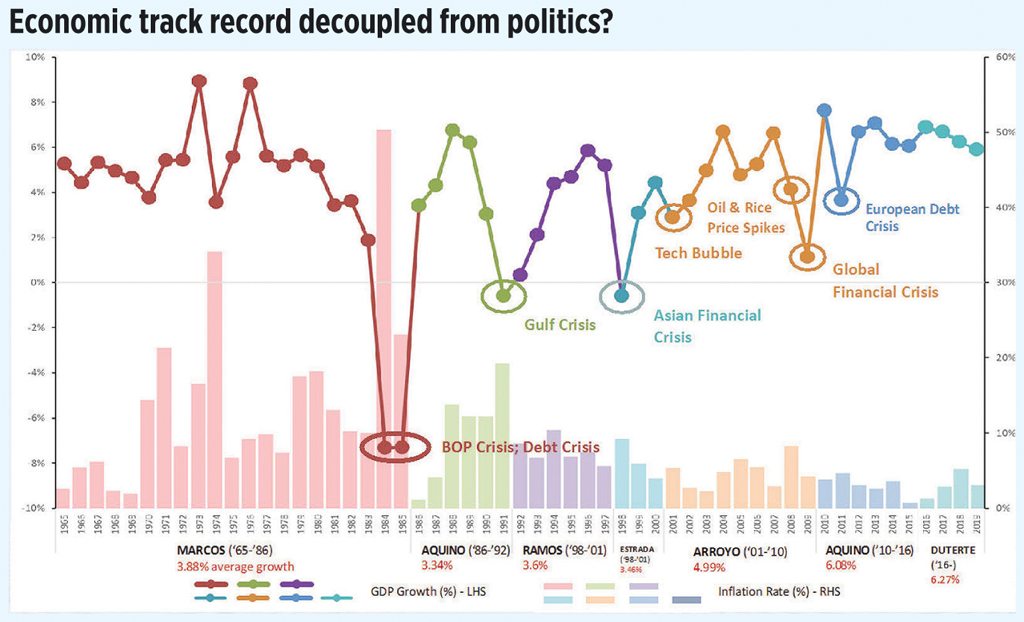
I show here one of my favorite charts that I used to present during investment roadshows and presentations to both the IMF and credit rating agencies for the last 15 of my 41 years at the Bangko Sentral ng Pilipinas.

We derive the following simplified commentaries:

One, output growth has been solid since 1999 and sustained positive economic growth has been recorded through 2019. This is a period of 21 years, spanning the presidencies of JEE through PRRD. But one can observe that building blocks started to pile up during the Cory Aquino and FVR administrations after EDSA I.

Two, while Ferdinand Marcos’ output record appears on a higher path, this was achieved by enormous unsustainable public borrowing. When the country’s creditors called in their loans, the Philippines had to declare a debt moratorium. Growth started to slow down in the early 1980s and plummeted in 1984 and 1985 with runaway inflation.

Three, for the last 21 years, the lowest points of the economic path were associated with external shocks. Cory’s challenge was the first Gulf War and its ramification on inflation. JEE’s crucible was the Asian Financial Crisis. GMA’s term was quite tumultuous, challenged by issues of the IT bubble, the oil and rice crises, and the Global Financial Crisis. BSAIII’s term was challenged by the European debt crisis. We have yet to see the full impact of COVID-19 and the VFA’s abrogation on growth under PRRD.

The big picture is that despite numerous exogenous shocks for the last 21 years, we have seen the resilience of the Philippine economy. One can argue that there has been a decoupling of the economy from politics. This is what those policy and structural reforms have contributed. We have seen the initial resurgence of manufacturing and services.

With privatization and liberalization of various economic sectors, competitive forces have been unleashed resulting in greater economic efficiency and productivity. This is the essence of a strong economy.

The strong domestic anchors are our safeguards against the headwinds in this increasingly globalized economy. On the right track with the Build, Build, Build program, PRRD is challenged to now allocate more funds to public health. Building on the foundation lain for the last two decades, the administration must now implement a strategic and coherent public policy approach against the deadly virus.


Diwa C. Guinigundo is the former Deputy Governor for the Monetary and Economics Sector, the Bangko Sentral ng Pilipinas (BSP). He served the BSP for 41 years. In 2001-2003, he was Alternate Executive Director at the International Monetary Fund in Washington, DC. He is the senior pastor of the Fullness of Christ International Ministries in Mandaluyong.

Entitled

By definition, the adjective “entitled” has two meanings.

The positive description applies to a person who is well off, privileged, and who has a better situation than others.

In medieval times, the nobleman, an aristocrat with power and property, held the title — Viscount, Duke, Baron, Lord. The eldest male heir would inherit it with the property and responsibilities.

In modern times, a knighthood can be bestowed on a deserving individual who has served the crown, the country, or the world. In the international scene, there are titles for culture and the arts — film, music, ballet, and painting. There is the prestigious Nobel Prize for Peace, the sciences and Literature. The Pulitzer Prize has different categories as well.

In the local setting, we have the coveted National Artist and National Scientist awards.

There are medieval orders and elite groups affiliated with the Church such as the Knights of Malta and St. Gregory.

In contrast, the other type of entitled person is the spoiled, selfish egoist. The sense of entitlement could apply to diverse characters in different fields — intellectual (academe), physical (sports or beauty), and socio-economic.

The aura of elitism and exclusivity may cause a person to lose his equilibrium. He thinks that he/she is special and deserves special treatment because he/she was born into and grew up in a privileged family, a certain class.

An entitled heir may not understand how people who are not rich actually live. He could be blissfully unaware or just apathetic about others. Perhaps it comes from being in a lofty, distant, insulated position, away from the harsh realties of life.

Fame, financial success, a windfall, marriage are other factors. The beauty queen, sports champion, showbiz star, or the politician may belong to this group with the entitled mentality. Their partners, and families may unwittingly pick up the haughty traits and disdainful attitude. The diva or prima donna comes in many forms.

These “special” persons may expect or demand freebies such as complimentary front row seats, upgraded trips and vacations, designer clothes, jewelry, food, gifts, house, car and other material perks.

One glaring flaw is the lack of punctuality and consideration. They keep other people waiting. Time is so precious. Keeping others in a holding pattern is like robbing a person of valuables. They don’t apologize. Courtesy, kindness, and thoughtfulness are not on top of their list of virtues and values.

The entitled one walks on air and cannot relate to people he considers beneath his class, rank, level or grade. He thinks that the world owes him and should give him certain privileges that he would not want to share with others. The shiny package and the cushion of comfort are only for him.

Social scientists point out that arrogance, superciliousness, and haughtiness are evident in this character’s attitude and behavior.

At the other extreme, the person with confidence and class, no matter what his/her background, has a quality of being sure of himself without being cocky. A writer once described it as “a surefootedness” that comes with having proven you can meet life. This refers to an individual who is grounded and real. He is equipped to meet and resolve all challenges.

We encounter an assortment of people who may have tolerable to irritating variations of self-centeredness. It is not easy to deal with narcissists. Everything revolves around their whims, caprices, and needs. They may not have what it takes to handle and surmount obstacles, to fight and win battles. They would expect someone else to go to the forefront and clear the way. The entitled spoiled one always feels special and he needs pampering. If he loses, he cannot accept defeat. The “I, Me, Myself” attitude can be boring, tiresome. Just as nonchalance and cynicism can affect the individual and hasten the ageing process. It alienates others.

The cure for this malady is to go outward — to broaden one’s outlook, to develop a genuine concern for other people and to share with the community.

“A passionate interest in what you do is the secret of enjoying life, whether it is helping old people or children, or making cheese or growing earthworms,” the American chef Julia Child once remarked. It is certainly more significant than feeling entitled.


Maria Victoria Rufino is an artist, writer and businesswoman. She is president and executive producer of Maverick Productions.

mavrufino@gmail.com

What the media need

It’s been said before, but has never been taken seriously by the members of a community whose egos are as vast as cathedrals: those in the media criticize anyone and anything except themselves. In more times than can be counted, irresponsible and ethically clueless practitioners excuse their own behavior no matter their consequences to the public they’re supposed to serve. They argue that they’re merely doing their jobs in behalf of the people’s right to know and the exercise of their rights to press freedom and free expression.

One such instance demonstrative of many media organizations’ and practitioners’ refusal to recognize their shortcomings and to do something about them was the way they covered the Aug. 23, 2010 hostage-taking incident at Manila’s Rizal Park that cost the lives of nine of the 18 hostages and the hostage-taker himself, and injured several others.

The coverage was irresponsible and costly enough for the Senate committees on information and mass media and on public services to summon the heads of the news departments of the major broadcast networks and to warn them that despite the Constitutional protection of press freedom, unless they “restrain” themselves, the Senate would be forced to pass a law to regulate their coverage of hostage-taking and similar crisis situations.

To a congressman in the House of Representatives, what happened was already enough reason for him to file a bill that would punish any reporter and media organization for reporting police and troop movements during similar crises. That bill nearly passed into law because of the public outrage over the media coverage’s prolonging the hostage-taking crisis and even contributing to its bloody conclusion.

Restraint was precisely what was lacking in the media coverage of the 2010 hostaging of a bus full of tourists from Hong Kong, China, and Taiwan by a former Manila police officer. Through its detailed, blow-by-blow accounts, one of the broadcast networks provided the hostage-taker, who was following through the tourist bus TV the media coverage of the crisis he had created, such real time information as the positions and deployment of police sniper and assault teams.

The two leading broadcast networks covered the entire crisis live. A radio station provided the hostage-taker the publicity he craved — which in fact had moved him to hijack the bus and to hold the tourists in it against their will — by interviewing him live. Although untrained in the often life or death arts of negotiating with hostage takers, one broadcaster also took on the non-media role of mediating between him and the police, and tied up the phone lines in the process, preventing police negotiators from doing their jobs. All the networks and their affiliates also covered the arrest of the hostage-taker‘s brother, which he saw on television and provoked him into shooting the hostages.

Confronted with these lethal blunders, all of the media organizations involved justified their actions, including their covering the crisis live. And yet all the above acts were in violation of long-standing journalism protocols on the coverage of hostage-taking, terrorism, and similar threats to public safety. The prohibition against live coverage and interviewing hostage-takers has in fact been in place for years in the Kapisanan ng mga Broadkaster ng Pilipinas (KBP — the Association of Broadcasters in the Philippines) Broadcast Code.

The reasons are fairly clear and should be evident to anyone with some understanding of the public impact of journalism practice. Covering such incidents live is likely to provide hostage-takers the information they need to prolong the crisis; especially in this digital age, one must assume that like everyone else, hostage takers too have access to television, radio, and other media. Interviewing them live can also encourage copycats by demonstrating that they too can use the media to disseminate their views to a wide audience to gain public sympathy.

The bloody consequences of the Aug. 23, 2010 incident for which the media were at least partly to blame were understandably enough for government officials to once more raise the specter of State regulation. That threat should have driven home to the media that their own failings can be another excuse for abridging press freedom and, by extension, free expression. But nine years and three months later, as another hostage-taking incident once more endangered dozens of lives, it seemed that the lessons of that nearly decade-old episode had been forgotten — or had never been learned at all.

A disgruntled security guard held several persons hostage on March 3 in the San Juan City mall where he had been employed. During negotiations with the police, he demanded as one of the conditions for his surrender that the media be present and that he be given the opportunity to present his case to the media audiences in a question and answer session with reporters. To calm him enough for them to overpower and arrest him, the police agreed to that condition, and, oddly enough, also allowed the hostage-taker to keep his firearm.

Some of the reporters from the TV networks whom the police called complained that they did not know that their interviewing the hostage taker was among the conditions for his surrender and that, in any case, the police had endangered their lives because they were within spitting distance of an armed crime suspect. So focused were they on getting a sensational story aired in furtherance of their stations’ commercial interests that it didn’t occur to any one of them that they could very well have refused to attend what amounted to a press conference by someone who, armed with a grenade and a pistol, had threatened to kill several people unless his demands were met, and who had earlier already shot someone.

The police could indeed be criticized for using the reporters for their purposes and without any regard for their safety, but so could the latter. They did not have to buy into the police determination to capture the hostage taker at all costs, among them by granting his demand for media coverage. As mature, presumably responsible practitioners, the reporters and their media organizations could have refused to interview the hostage-taker because of the risk of someone else’s holding people hostage so he can get media and public attention. That they did not was a violation of the fundamental ethical principle in journalism of not doing harm, or at least minimizing harm: others could be similarly hostaged, endangered, hurt or even killed by anyone with a grievance to publicize.

What happened last March 3 is better understood in the context of the current government focus on abridging press freedom and regulating the media. The Duterte regime could very well cite as a justification for reining in the media their in effect demonstrating to anyone with any grievance, whether real or imagined, that they can get the publicity they need by emulating the hostage-taker, or worse. In that sense, in the pursuit of their commercial interests, the media were practically asking for State regulation.

What they need is a large dose of self-criticism and self- restraint if they are to be true to the ethical imperative of not doing harm — and for them to truly deserve the Constitutional protection of press freedom and free expression that the heralds of State regulation and censorship are so eagerly undermining daily.


Luis V. Teodoro is on Facebook and Twitter (@luisteodoro).

www.luisteodoro.com

Creating a Commission on Unalienable Rights

Mid-2019 saw the creation of the US State Department’s Commission on Unalienable Rights, tasked with providing “advice and recommendations concerning international human rights matters. The Commission will provide fresh thinking about human rights discourse where such discourse has departed from our nation’s founding principles of natural law and natural rights.” Frankly, it’s an idea whose time has come.

Human rights, of course, needs to be respected. It is one of the fundamental principles of our society. But to do so, we must be able to face squarely and stand for unequivocally the root and foundation of those human rights.

Thus, to paraphrase of Cardinal John Henry Newman: we have human rights because we have responsibilities. Put another way: we have rights because corollary to those right are duties. They go together.

This is no isolated fringe academic matter. Former Chief Justice Reynato Puno’s spectacularly learned Separate Opinion in Republic vs. Sandiganbayan traced cogently the history and basis of our rights. And it starts with natural law. With disquisitions from Sophocles to Aristotle to Cicero to Aquinas, and then the trinity of political thought: Hobbes, Locke, and Rousseau.

All that found their way to the US Declaration of Independence: “We hold these truths to be self-evident, that all men are created equal, that they are endowed by their Creator with certain unalienable Rights, that among these are Life, Liberty and the pursuit of Happiness.” CJ Puno continues to say that “Locke’s modern natural law and rights theory was influential to those who framed and ratified the United States constitution and served as its theoretical foundation is undeniable.”

Natural law considerably influenced international law. The 1948 UN Universal Declaration of Human Rights has a heavy debt to one man, Jacques Maritain, who believed that human rights being based on natural law, then it can be fairly said that there can be no human right contrary to natural law: “The moral absolutes give legal reasoning its backbone. xxx These moral absolutes which are rationally determined and essentially determinate, constitute the most basic human rights.”

That natural law framework eventually made its way to our 1935 Constitution. Hence, Jorge Coquia once pointed out: “It is understood that the civil and political rights now provided for in the 1973 constitution, as they were in the original constitution, are based on natural law.”

Yet all of that was sought to be overturned by liberal progressives when they hijacked and weaponized rights talk.

Impliedly acknowledging that their advocacies are unacceptable in many countries, human rights activists picked on the tactic of preaching that “sui generis” myth of human rights laws and encouraged judicial activism (i.e., “the living constitution”) to bypass elected legislatures.

Thus the practice of dilution: making everything, from transgenderism to access to Netflix, a human right. The tragic disrespect many governments now have for rights can be blamed squarely on this.

Ironic but foreseeably, liberal progressive activism made human rights utterly incoherent and practically meaningless.

The situation is such that even our Supreme Court deemed it proper to offer this utterly relevant caution (from Ang Ladlad vs. COMELEC, 2010): “not everything that society — or a certain segment of society — wants or demands is automatically a human right. This is not an arbitrary human intervention that may be added to or subtracted from at will. xxx [To do so has] the effect of diluting real human rights.”

So the need to go back to the idea that human rights immutably proceeds from duties, and arising from our inherent human dignity and nature as rational creatures.

The US Commission on Unalienable Rights is a great step in that direction. As US Secretary of State Mike Pompeo noted, “many human-rights advocates turned their energy to new categories of rights. These rights often sound noble and just. But when politicians and bureaucrats create new rights, they blur the distinction between unalienable rights and ad hoc rights granted by governments. Unalienable rights are by nature universal. Not everything good, or everything granted by a government, can be a universal right.”

The 15 member Commission is currently chaired by renowned law professor Mary Ann Glendon, and includes such luminaries as Hamza Yusuf Hanson and Christopher Tollefsen. According to Secretary Pompeo, “members will address basic questions: What are our fundamental freedoms? Why do we have them? Who or what grants these rights? How do we know if a claim of human rights is true? … This may sound abstract, but the work is urgent.”

Predictably, liberal progressives are frenziedly attacking the creation of the Commission. Which suggests that it is a good idea indeed. In fact, it may be useful to have something similar here in the Philippines, reporting directly to the president, to provide oversight or advice perhaps regarding the work of the Commission on Human Rights, or even in policy-making or legislation.

Creating such a commission can definitely help towards making Filipino value and respect human rights more profoundly.


Jemy Gatdula is a Senior Fellow of the Philippine Council for Foreign Relations and a Philippine Judicial Academy law lecturer for constitutional philosophy and jurisprudence.

https://www.facebook.com/jigatdula/

Twitter @jemygatdula

Ceres stretches Group G lead with 4-0 win over Bali United

By Michael Angelo S. Murillo
Senior Reporter

AFC Cup Group G leader Ceres-Negros FC extended its lead on top of the heap after defeating Bali United FC, 4-0, in tournament action on Wednesday at the Rizal Memorial Stadium in Manila.

Played behind closed doors over concerns on the spread of the coronavirus disease 2019 (COVID-19), Ceres had its early struggles but once it got its groove it was simply not to be stopped.

The host team started the contest slow and hardly threatened the visiting squad.

But Ceres would finish the opening half strong with OJ Porteria connecting in the 35th minute to hand the “Busmen” the 1-0 lead, which they took all the way to the break.

Got the leverage it needed, Ceres started the reboot with added aggressiveness, with Bievenido Marañon doubling their lead in the 54th minute.

The Spanish striker did not stop there as 15 minutes later he scored another goal to create further separation, 3-0.

Bali United tried desperately to salvage the match but Ceres was not a willing party to it, making it a 4-0 lead in the 73rd minute care of Robert Lopez Mendy.

From there the Busmen were not to be threatened as they went on to bag the win.

Despite the comfortable lead they had in the end, Ceres coach Risto Vidakovic said it was not an easy game to win.

“It was not an easy game but I think after the first goal things opened up for us. We got better chances and went for them,” said Mr. Vidakovic following their match.

On playing behind closed doors, Ceres veteran Stephan Schrock said there was some weirdness to it but completely understood the situation.

“Despite the closed doors I’m very happy for the team. I think in the second half we played well and knew better what we had to do. We fought hard and we won,” said Mr. Schrock, who was named “Mr. Football” at the recent Annual Philippine Sportswriters Association Awards.

With its victory over Bali United, Ceres (2-1-0) now has seven points from three matches to date. Three clear from second-running Than Quang Ninh (1-1-1) of Vietnam.

Bali United slumped to a 1-0-2 record with three points and good for fourth place.

Third in Group G with three points is Preah Kahn Reach Svay Rieng FC (1-0-2) of Cambodia.

Ceres reengages Bali United in its next game in Bali on April 14.

Leader on the board after group play in the AFC Cup books a spot in the zonal semifinals.

Staying the course pays off for Magno as she books Summer Olympic berth

By Michael Angelo S. Murillo
Senior Reporter

INITIALLY did not have her way at the Asia and Oceania Olympic Boxing Qualification Tournament in Amman, Jordan, Filipino flyweight boxer Irish Magno stayed the course and saw it pay off as she booked a spot in the Tokyo Olympic Games later this year.

Ms. Magno, a silver medallist in the last Southeast Asian Games, earned a ticket to the Summer Games after defeating Tajikistan’s Sumaiya Qosimova by unanimous decision in their box-off on Wednesday to claim the last Olympic spot in her division.

It was an impressive bounce back after being relegated to the box-off following her unanimous decision defeat earlier in the qualifiers at the hands of Mary Kom of India.

Knowing that her Olympic aspirations in the Jordan qualifiers hinged on a win in the box-off, Ms. Magno, 28, worked accordingly, dominating her 19-year-old opponent in their contest.

The Filipino was aggressive at the opening bell, connecting on solid shots to dictate the pace.

Ms. Qosimova found her footing in the second frame but Ms. Magno continued to stay on top of things.

In the final round, the veteran fighter sustained her dominance with heavy shots on her opponent on her way to closing out things and booking the Olympic berth.

Following her victory, Ms. Magno shared that key for them was not stopping despite the early setback they had.

“I’m so very happy I made it with help from my coaches and my ABAP (Association of Boxing Alliances in the Philippines) family. I just listened to my coach. We saw the fight of my opponent … and we studied it and this is the result,” said Ms. Magno immediately after securing her Olympic spot.

With the win, Ms. Magno became the fourth Filipino athlete to book a place in the Tokyo Games, scheduled for July 24 to Aug. 9, joining earlier qualifiers EJ Obiena (athletics/pole vault), Carlos Yulo (gymnastics) and Eumir Felix Marcial (boxing). The latter secured his spot also at the Asia and Oceania qualifiers.

Other Filipino boxers who failed to secure an Olympic spot in Jordan, including world champion Nesthy Petecio, will have another chance of making it to Tokyo at the World Boxing Championships in Paris, France, in May.

DOUBLE CELEBRATION FOR MARCIAL
Meanwhile, Olympics-bound Marcial made it a double celebration at the Asia and Oceania Olympic Boxing Qualification Tournament as he also bagged the gold in the middleweight division.

Twenty-four-year-old Marcial defeated Abilkhan Amankhul in their gold medal match to partner with his Olympic berth qualification by entering the semifinals.

In the semis, Zamboanga native Marcial overwhelmingly defeated Ashish Kumar of India.

For the Philippines, boxing is traditionally a steady source of athletes in the Olympics. In 2016 in the Rio Games, two boxers competed for the country, namely light flyweight Rogen Ladon and lightweight Charly Suarez.

Boxing, too, has accounted for five of the total medals won by the Philippines in the Olympics, including two silver care of Anthony Villanueva (1964) and Mansueto Velasco (1996).

NBA suspends the season until further notice as it deals with virus pandemic

LOS ANGELES — The NBA announced that it will suspend the season after the Wednesday night schedule until further notice as it deals with the coronavirus pandemic.

“The NBA is suspending game play following the conclusion of tonight’s schedule of games until further notice,” the league said in a statement. “The NBA will use this hiatus to determine next steps for moving forward in regard to the coronavirus pandemic.”

The announcement came shortly after a game between the Utah Jazz and the host Oklahoma City Thunder was called off moments before tipoff.

According to the NBA, a Jazz player preliminarily tested positive for coronavirus — COVID-19. The NBA stated the affected player was not in the arena at the time.

ESPN’s Adrian Wojnarowski reported that the player in question is Utah center Rudy Gobert, and that players from the Jazz and Thunder were being quarantined at Chesapeake Energy Arena in Oklahoma City.

“This morning a player on the Utah Jazz tested negative for influenza, strep throat and an upper respiratory infection,” the Jazz said in a statement. “… In consultation and cooperation with NBA medical staff and Oklahoma health officials, the decision was made to test for COVID-19.

“A preliminary positive result came back right before tip-off of the Utah Jazz-Oklahoma City game. Subsequently, the decision was correctly made by the NBA to postpone the game,” the statement continued.

At the time of the announcement, the Dallas Mavericks’ home game against the Denver Nuggets was midway through the third quarter.

ESPN cameras caught Mavericks owner Mark Cuban finding out the news as he looked at a phone while sitting courtside, then walking to the Dallas bench before another man — presumably on the team’s staff — took the phone and talked to on-court officials.

“This is crazy. This can’t be true. This isn’t within the realm of possibility,” Cuban told ESPN. “I’m not an expert. I’m not going to try to be an expert. Our plan here was to defer to the NBA.

“I trust Adam (Silver, the NBA commissioner). It’s really not about basketball or money. If this is just exploding to the point that players and others have it … you think about your family. Stunning isn’t the right word. It’s not about the team. It’s about the country and life in general.”

Cuban said NBA teams are being permitted to “stay together” and hold practices.

He also turned his attention to team and arena employees certain to be impacted by any prolonged stoppage.

“In talking, when some of the things were coming up that we might not play games I reached out to folks at the arena and the Mavs to find out what it would cost to support people who might not be able to come to work to support them,” he said. “We’ve already started the process and putting plan in place. We might ask them to do volunteer work in exchange but this is important to me.”

Two other games — the New York Knicks at the Atlanta Hawks and the Charlotte Hornets at the Miami Heat — were late in the fourth quarter.

All three games were to be allowed to finish before the suspension goes into effect.

The New Orleans Pelicans were also scheduled to play at the Sacramento Kings for a 10:30 p.m. ET tipoff, but the game was officially postponed shortly after 10:30. — Reuters

San Miguel Beermen big man June Mar Fajardo leads awardees at PBA press corps awards night

By Michael Angelo S. Murillo
Senior Reporter

ACCOLADES continue to pour in for currently injured big man June Mar Fajardo of the San Miguel Beermen as he leads the roster of awardees at the 2019 PBA Press Corps Awards Night set for March 16 at the Novotel Manila in Araneta City.

The newly minted six-time Philippine Basketball Association most valuable player will get the Order of Merit award from the media covering the league after garnering the most number of Player of the Week honors last season that saw his team win two of three titles.

Mr. Fajardo last Sunday claimed his sixth straight PBA MVP award at the league’s annual awards.

He, however, is expected to miss a significant time this season after injuring his leg and undergoing surgery in the offseason.

Also set to feted is Columbian Dyip star CJ Perez, who is the Scoring Champion after leading the PBA with a 20.8 point per contest average in his rookie year.

To be awarded as well is the All-Interview Team, which is given to personalities who produce quotable quotes and at the same time always make themselves available for interviews.

Making up the team are Kiefer Ravena (NLEX), Beau Belga (Rain or Shine), Vic Manuel (Alaska), Arwind Santos (San Miguel), Christian Standhardinger (Northport) and coach Yeng Guiao (NLEX).

The Virgilio “Baby” Dalupan Coach of the Year award, meanwhile, is a toss-up between San Miguel Beer’s Leo Austria and Tim Cone of Barangay Ginebra.

Other awards to be given are the Game of the Season, All-Rookie Team, Mr. Quality Minutes, Defensive Player of the Year, President’s award, and the Danny Floro Executive of the Year.

To be honored as well are the D-League Finals MVPs, namely, Cignal-Ateneo’s Thirdy Ravena (Aspirant’s Cup) and Hessed Gabo of BRT-Sumisip Basilan-St. Clare (Foundation Cup).

The PBA Press Corps Awards Night is presented by Cignal TV.

Makati forces San Juan to sudden death in MPBL North Finals

MAKATI-SUPER Crunch survived a late surge from North leader San Juan-Go For Gold, 91-88, in a game that was held in closed doors to forge a decider in the 2020 Chooks-to-Go Maharlika Pilipinas Basketball League Lakan North Division Finals, Wednesday, at the FilOil Flying V Centre.

With San Juan down by 10 points, the quartet of Jhonard Clarito, Art Aquino, Orlan Wamar, and CJ Isit stepped up for the defending champions, putting up a 9-3 blast to trim the lead to just two, 87-89, with 20 ticks left to play.

Joseph Sedurifa, though, showed nerves of steel from the line to give Makati a slim four-point lead with 14 seconds remaining.

Lawrence Victoria then went for a split from the line, giving John Wilson one last chance to send the game to overtime. However, Wilson muffed his three-point attempt as the Knights suffered their first defeat at home.

“We talked to each other na we’ve been in this situation before, na our backs are against the wall. Kailangan bumalik tayo sa sistema natin, at siyempre, ‘yung depensa,” said Makati head coach Beaujing Acot.

Jeckster Apinan spearheaded Makati’s fight back, posting a near triple-double of 20 points, 12 rebounds, seven assists, along with two steals and a block.

Jong Baloria, meanwhile, poured 10 of his 18 points in the final period.

Sedurifa stuffed the stat sheet with 16 points, six rebounds, six assists, four steals, and three blocks while Joshua Torralba pumped in 14 markers.

Cedrick Ablaza, who rolled his right ankle in the third period, finished with 13 points and seven boards.

Makati was supposed to play on its home turf for Game Two, but had to surrender the advantage after failing to secure a venue.

However, the Super Crunch-backed squad enjoyed an almost neutral venue as fans were barred from entering the venue as a precaution from the coronavirus disease 2019 (COVID-19) outbreak.

“Actually sabi nga namin, God closes a door, he opens a window. Bawal yung court sa Makati, pero binigyan niya kami ng window of opportunity na maging closed doors,” Acot explained.

“So naging advantage sa amin ‘yun, walang home crowds both teams so it’s just really just a five-on-five basketball,” he added.

Wilson, who fired 17 points in the first half, was limited to just four the rest of the game, ending up with 21 points, five rebounds, and two assists.

Isit and Andoy Estrella were the two bright spots for the Knights with 17 points apiece while Clarito scored 12 points — all in the fourth period — and grabbed 11 rebounds in San Juan’s first home loss of the season.

Game Three of the North Finals, originally set for March 14, however, has been deferred to a still-to-be-determined date by the league on Thursday night. This is to safeguard the welfare of fans, players, officials and league staff against the threat of COVID-19.