Home Blog Page 975

Style (09/22/25)


Doc Martens’ Zebzag sole in two new boots

DR. MARTENS’ cushioned Zebzag sole staked its claim on summer with the Zebzag Mules. Now, the sole is wearable year-round with the introduction of two new pairs of boots. The Zebzag sole is designed with a cushioned core, fusing a lightweight EVA midsole with a durable PVC tread. The Zebzag Laceless boot is inspired by the brand’s 1460 boot with some relaxed adjustments. It is a slip-on style that maintains the aesthetic of a lace-up, wrapped in relaxed black Wyoming leather for a lived-in look fresh out of the box. It’s finished with the brand’s black and yellow scripted heel loop. Sitting slightly lower on the ankle is the Zebzag Rigger boot, inspired by industrial silhouettes and reformed for relaxed comfort. Another slip-on, the boot is fitted with dual pull-tabs and marked with Puritan stitch detailing. The Rigger boot is available in black Wyoming leather or water-resistant Milled Nubuck in a variety of shades. The new boots are also fitted with SoftWair insoles. The Zebzag Laceless and Rigger boots are available globally starting this month and the Zebzag sole will also appear elsewhere in the Dr. Martens Fall-Winter 2025 line-up.


Corso Como 88 opens at BGC

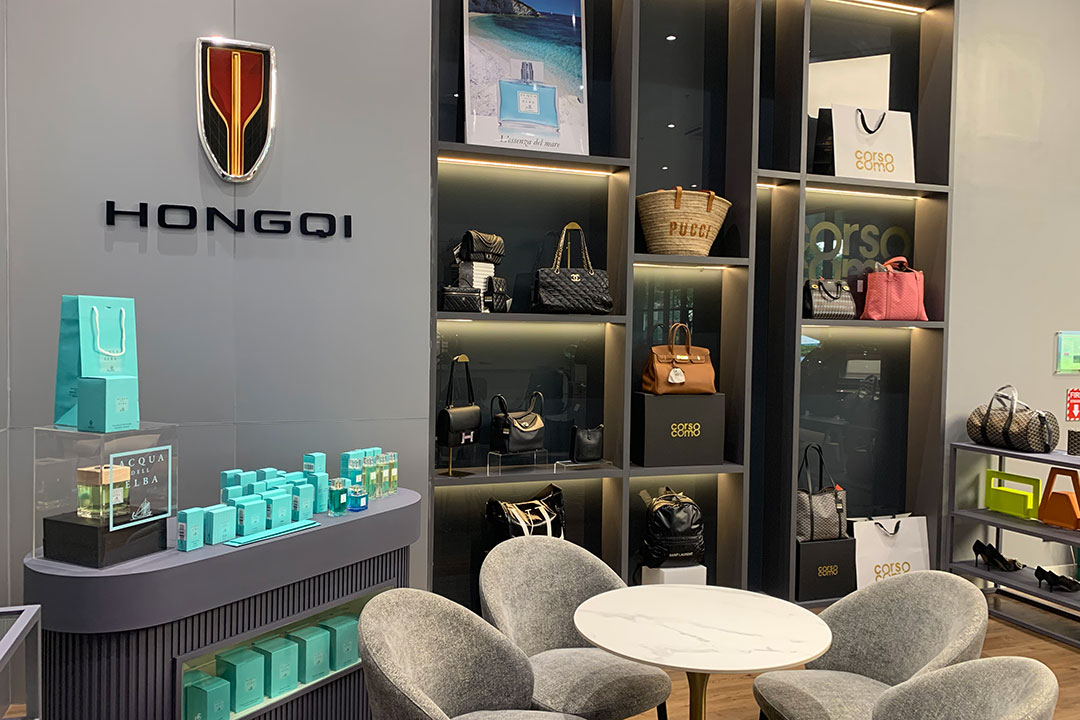
CORSO COMO, the luxury boutique known for its Italian leather pieces, is now in Bonifacio Global City (BGC). The newest Corso Como 88 store is located inside the Hongqi showroom, ground floor Asian Century Center, 27th Street corner 4th Avenue, BGC, Taguig. The outlet promises a unique shopping experience with fashion pieces displayed side by side with the latest sedans, SUVs, and EVs by Hongqi. The official distributor of Biagini, Buti Pelleterie, BOIS 1920, and Acqua dell’Elba in the Philippines, Corso Como 88 is home to luxe Italian leather pieces and other top European brands. “We always like to offer something different for our friends who frequent Corso Como 88,” said owner Imelda Menguito in a statement. “In One Ayala, aside from showcasing our leather pieces and accessories, we hold events and parties inside the store. And now in BGC we are inside a prestigious car showroom, a real treat for those who appreciate luxury, fashion, and style.”


Gap celebrates logo with sale

THE Gap is bringing back the Logo Weekend, spotlighting its signature logo collections. From Sept. 26 to 28, shoppers can check out the “Buy one Get one deal” on Gap’s logo apparel (hoodies, sweatshirts, tees, sweatpants, sweat shorts, accessories) for the whole family. Special promotions will be available in-store at branches at  Trinoma, SM Mall of Asia, SM Megamall, Shangri-la Plaza, Glorietta 4, Rustan’s Makati, Alabang Town Center, the Evia Lifestyle Center, Ayala Malls Manila Bay, and Abreeza, and online at gap.com.ph. For more information, visit the website or follow @gapphilippines on Facebook and Instagram.


COS shows at NYFW

COS returned to New York Fashion Week (NYFW) with its Autumn/Winter 2025 collection: a study in contrast, materiality, and craftsmanship, staged inside Brooklyn’s Greenpoint Terminal Warehouse. The show unveiled 47 refined and powerful looks. Womenswear explored sculptural draping, cocooning volumes, and versatile day-to-night dressing — highlighted by a softly sculpted silk dress. Menswear brought tailoring with oversized proportions, tactile knits, and tonal layering, grounded by timeless leather footwear. Accessories and bags echoed the same craftsmanship, completing sleek, contemporary silhouettes. Select pieces from the COS Autumn Winter 2025 collection are now available in the COS Store at SM Aura Premier and on cos.com, with limited drops arriving throughout the season.
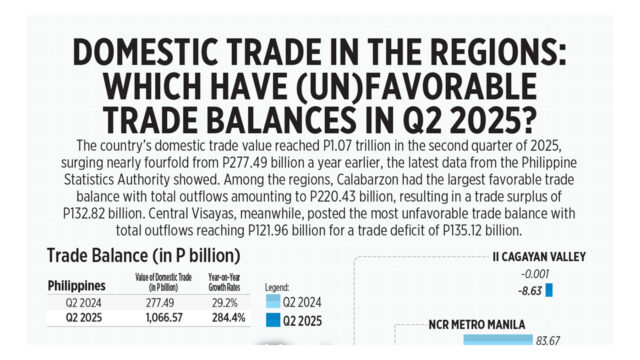
Domestic Trade in the Regions: Which Have (Un)Favorable Trade Balances in Q2 2025?

The country’s domestic trade value reached P1.07 trillion in the second quarter of 2025, surging nearly fourfold from P277.49 billion a year earlier, the latest data from the Philippine Statistics Authority showed. Among the regions, Calabarzon had the largest favorable trade balance with total outflows amounting to P220.43 billion, resulting in a trade surplus of P132.82 billion. Central Visayas, meanwhile, posted the most unfavorable trade balance with total outflows reaching P121.96 billion for a trade deficit of P135.12 billion.

Domestic Trade in the Regions: Which Have (Un)Favorable Trade Balances in Q2 2025?

Systemic changes needed to avert obesity crisis

STOCK PHOTO | Image by Vectorjuice from Freepik

The first week of September marks Obesity Prevention Awareness Week, a timely reminder of a growing health emergency that cuts across health, productivity, and social well-being. In the Philippines, nearly 40% of adults and close to 10% of children are overweight or obese, levels considered high by global standards. Left unaddressed, these numbers translate into millions of Filipinos facing higher risks of diabetes, heart disease, liver disease, and even cancer, conditions that take lives too soon and drain household incomes and public resources.

Obesity is not merely a lifestyle issue. It is now recognized worldwide as a chronic non-communicable disease (NCD), shaped by complex biological, social, and environmental factors. For families, this means more than medical costs. It means reduced productivity at work, lower quality of life, and intergenerational effects as children adopt unhealthy eating and activity patterns from an early age.

To confront this challenge, the National Nutrition Council (NNC), with support from the World Health Organization (WHO), developed the Philippine Strategic Plan in Addressing Obesity and Other Metabolic Disorders 2024–2028. This roadmap outlines measures to make healthy choices the easier choices: regulating food environments in schools, creating safe community spaces for physical activity, expanding access to nutritious food for vulnerable groups, and strengthening data and monitoring systems. Importantly, the plan ties into broader national goals, including the Philippine Development Plan and AmBisyon Natin 2040, which envision a healthier, more prosperous population.

The urgency of these reforms was underscored during the World Obesity Day Philippine Forum in March 2025, which brought together experts, policymakers, and advocates. The event highlighted how cross-sector collaboration, among government agencies, UNICEF Philippines, Department of Science and Technology – Food and Nutrition Research Institute, Philippine Association for the Study of Overweight and Obesity, WHO, and civil society, will be key to implementing sustainable solutions.

Globally, the World Obesity Federation reminds us that obesity is not simply about personal willpower. This year’s theme, “Changing Systems, Healthier Lives,” highlights how failing systems from food and healthcare to transport and the built environment drive rising obesity rates. Other countries have shown that systemic reforms work. Policies such as urban designs that promote walking and cycling, and mandatory nutrition labeling have all contributed to healthier outcomes.

For the Philippines, healthcare systems must first recognize obesity as a disease and embed prevention and management into primary care. This requires expanding insurance and universal health coverage to include obesity services, establishing monitoring and surveillance beyond Body Mass Index (BMI), and equipping the health workforce with training to provide compassionate and people-centered care.

But strategies must extend beyond hospitals and clinics. Local governments can design greener, more active communities by building parks, safe walking paths, and cycling routes. Fiscal incentives such as reduced taxes on sporting goods or subsidies for after-school sports programs can help make active lifestyles more accessible. Employers should also address stigma in the workplace, while the media can play a vital role in reshaping narratives around obesity and promoting healthier norms.

The economic case is compelling. Data from the Organisation for Economic Co-operation and Development show that obesity accounts for around 70% of all diabetes treatment costs, 23% of cardiovascular disease costs, and nearly 10% of cancer costs. Reducing obesity is therefore not only a health imperative but also a fiscal strategy to reduce the burden on health systems and free up resources for other pressing needs.

The global biopharmaceutical industry, through the International Federation of Pharmaceutical Manufacturers and Associations (IFPMA), continues to support the WHO Global NCD Action Plan 2013-2030. By addressing obesity as an NCD, we can prevent a cascade of related illnesses, extend healthier lives, and reduce treatment costs.

Tackling obesity is one of the defining public health challenges of our time. Success will require courage, collaboration, and commitment from policymakers who enact reforms, from communities who create healthier environments, from employers who champion wellness, and from industries who stand ready to partner in this mission. By working together, we can prevent an obesity crisis and build a healthier, more productive future for all Filipinos.


Teodoro B. Padilla is the executive director of Pharmaceutical and Healthcare Association of the Philippines, which represents the biopharmaceutical medicines and vaccines industry in the country. Its members are at the forefront of developing, investing and delivering innovative medicines, vaccines and diagnostics for Filipinos to live healthier and more productive lives.

Trump tariffs could fund bailout for US farmers — Agriculture secretary

REUTERS

THE TRUMP administration is drawing up plans to use tariff revenue to fund a program to support US farmers, the Financial Times reported, citing Agriculture Secretary Brooke Rollins.

“There may be circumstances under which we will be very seriously looking to and announcing a package soon,” Ms. Rollins told the newspaper in an interview.

Ms. Rollins said financing the bailout with “tariff income that is now coming into America” was “absolutely a potential.”

The White House did not immediately respond to a Reuters request for comment.

The report follows pressure from farm groups after China stopped purchases of soybeans from the US in their tit-for-tat trade dispute, and as tariffs have pushed up costs for fertilizer, machinery and other imported inputs.

Agriculture has emerged as a major point of contention between China and the US as the superpowers are locked in a tariff war launched by President Donald J. Trump. — Reuters

BSP bills fetch mixed yields

BW FILE PHOTO

YIELDS on the Bangko Sentral ng Pilipinas’ (BSP) short-term securities were mixed on Friday, even as demand was strong as it offered a lower volume compared to the previous week.

The BSP bills fetched bids amounting to P86.003 billion, higher than the P80-billion offer and the P112.781 billion in tenders for the P100-billion auctioned off a week prior. The central bank made a full P80-billion award of the securities.

Broken down, tenders for the one-month BSP bills reached P30.119 billion, just a tad above the P30 billion placed on the auction block but lower than the P46.395 billion in bids for a P40-billion offer in the previous auction.

Banks asked for rates ranging from 5.255% to 5.4%, a narrower but higher margin compared to the 5.198% to 5.395% seen a week earlier. With this, the average rate of the 28-day securities edged up by 0.23 basis point (bp) to 5.3454% from 5.3431% previously.

Meanwhile, the two-month papers attracted P55.884 billion in tenders, higher than the P50-billion offering but lower than the P66.386 billion in tenders for the P60 billion auctioned off the prior week.

Accepted rates were from 5.29% to 5.34%, narrower than the 5.25% to 5.359% band previously. This caused the average rate of the 56-day securities to decline by 1.52 bp to 5.3106% from 5.3258% a week prior.

The central bank uses the BSP securities and its term deposit facility to mop up excess liquidity in the financial system and to better guide short-term market rates towards its policy rate.

The BSP bills also contribute to improved price discovery for debt instruments while supporting monetary policy transmission, the central bank has said.

BSP officials last month said they are gradually shifting away from the issuance of short-term papers to manage liquidity as they want to boost activity in the money market.

“I think we’re beginning to move away from our short-term issuance of BSP securities. We still have enough government securities in our books, and there’s enough of it so we can reduce liquidity,” BSP Governor Eli M. Remolona, Jr. said on Aug. 28.

“I think we’ve been spoiling the banks by helping them manage liquidity too much, whereas in other places … there’s a money market that allows banks and other entities to manage short-term liquidity. We don’t have a money market. Somehow, our money market disappeared, and part of the reason may be us. We’re the money market for them, maybe. So, that’s something we’re looking very closely at.”

Data from the central bank showed that around 50% of its market operations are done through its short-term securities. — K.K. Chan

How PSEi member stocks performed — September 19, 2025

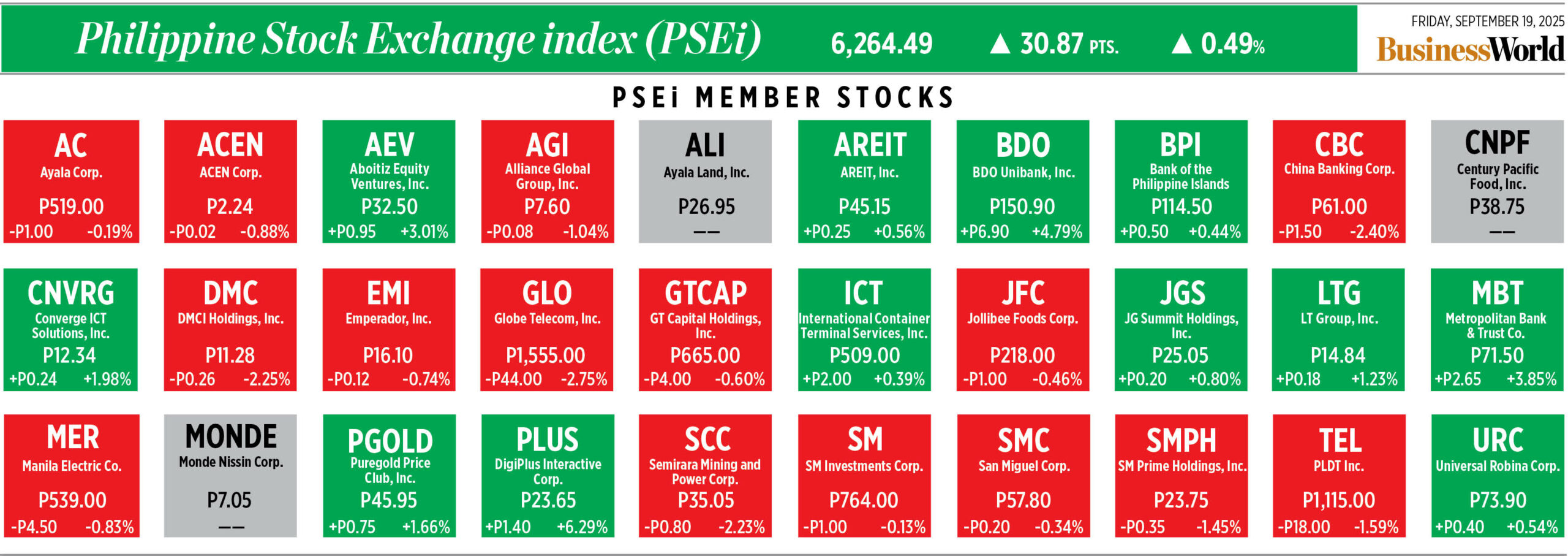
Here’s a quick glance at how PSEi stocks fared on Friday, September 19, 2025.


Shares to extend climb on Fed, BSP rate cut hopes

REUTERS

PHILIPPINE STOCKS may climb further this week as investors expect further monetary easing here and in the United States, which would support economic growth.

On Friday, the Philippine Stock Exchange index (PSEi) rose by 0.49% or 30.87 points to close at 6,264.49, while the broader all shares index increased by 0.17% or 6.36 points to 3,740.81.

Week on week, the PSEi also went up by 155.28 points from its 6,109.21 close on Sept. 12.

“The local market rose further, backed by positive cues from Wall Street and lower local yields,” Philstocks Financial Inc. Research Manager Japhet Louis O. Tantiangco said in a market note on Friday. “These come following the Federal Reserve’s move to cut their policy rates by 25 basis points (bps) together with their signal of more possible rate cuts within the year.”

“Philippine equities gained traction [last] week as momentum gained for more Fed rate cuts in its next policy meetings that may be seconded by local monetary authorities,” online brokerage 2TradeAsia.com said in a market report.

The Federal Reserve, goaded by the risk of rising unemployment, reduced interest rates on Wednesday for the first time since December and indicated more cuts would follow to halt any slide in a labor market already experiencing higher joblessness among Blacks, a declining workweek, and other signs of weakness, Reuters reported.

Fed Chair Jerome H. Powell, speaking in a press conference after the US central bank lowered its benchmark interest rate by a quarter of a percentage point to the 4%-4.25% range and indicated more cuts would follow at meetings in October and December, said the softening job market was now top of the mind for him and his fellow policymakers.

Meanwhile, last month, the Bangko Sentral ng Pilipinas (BSP) reduced borrowing costs by 25 bps for the third consecutive meeting, bringing the policy rate to 5%. It has slashed benchmark interest rates by a total of 150 bps since August 2024.

BSP Governor Eli M. Remolona, Jr. has left the door open to one more cut within this year to support the economy if needed.

2TradeAsia.com said prospects of more Fed and BSP cuts “should provide a tailwind to global risk assets as lower rates and a steeper yield curve tend to lift valuations.”

“This should also give opportunity for cyclicals and emerging markets a chance to shine, especially in the context of a weaker greenback.”

Lower rates would also boost corporate earnings, which will improve market sentiment, it added. It put the PSEi’s immediate support at 6,000 and resistance at 6,300.

Rizal Commercial Banking Corp. Chief Economist Michael L. Ricafort said in a Viber message that the end of the “Ghost Month” could boost market activity. The Ghost Month is a period in the Lunar calendar when some investors refrain from making big investments or decisions, resulting in lower trading volumes. For this year, it ran from Aug. 23 to Sept. 21. — A.G.C. Magno with Reuters

PCAB conflict-of-interest crackdown looming

PHILIPPINE STAR/MIGUEL DE GUZMAN

THE Department of Trade and Industry (DTI) said it is studying a more stringent licensing regime for contractors to deter corruption in public works.

Trade Secretary Ma. Cristina A. Roque said a fact-finding body created by the DTI will allow the DTI to look at what reforms should be put in place to improve the licensing process for contractors, which is currently overseen by the Philippine Contractors Accreditation Board (PCAB).

“We’re working with the Department of Public Works and Highways (DPWH) and the independent body that the President has established,” she told reporters.

Among the reforms being considered is a ban on contractors from serving on the PCAB.

“That’s a conflict of interest. It shouldn’t be like that. The law needs to be changed,” she added.

She said that the department’s internal investigation remains ongoing.

“We still have to verify (some matters). Once confirmed, we will issue a statement regarding companies that are owned by the PCAB members (or whether former) executive directors (also own companies),” she said.

“But it’s hard to say now because it’s all allegations. We can’t really tell until we really confirm,” she added.

Currently, she said the department is in the process of appointing new PCAB members.

“They are presidential appointees. We are just waiting for their appointments to come out,” she added.

In a notice last week, the PCAB said the approval and issuance of licenses can only proceed upon the appointment or reconstitution of the PCAB board.

“Until such appointments are made, all applications shall remain pending board action,” it added, noting that acceptance of license applications will continue through the PCAB online licensing portal. — Justine Irish D. Tabile

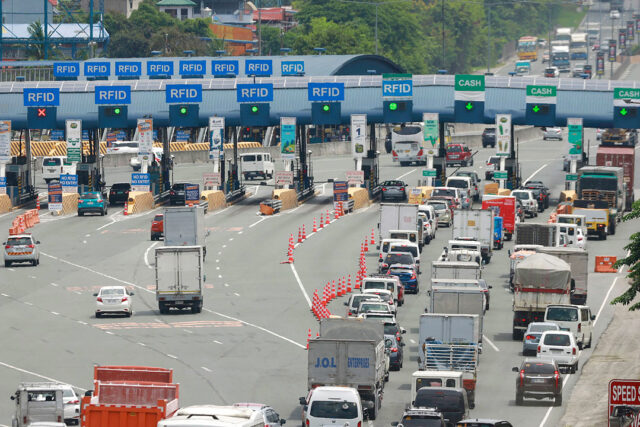
North terminal exchange study expected this year

PHILIPPINE STAR/ MICHAEL VARCAS

THE Department of Transportation (DoTr) hopes to complete the feasibility study for the northern Metro Manila integrated terminal exchange by the end of the year.

“The feasibility is now undergoing review. It is supposed to be for presentation to the department probably by the end of the year,” Undersecretary for Road Transport and Infrastructure Mark Steven C. Pastor told reporters on the sidelines of a transport forum.

Earlier this year, the DoTr said it is seeking out possible sites for the northern counterpart of the Parañaque Integrated Terminal Exchange (PITX).

So far, the government has not decided on a location, Mr. Pastor said, adding that the DoTr wants to ensure the viability of the plan before site selection.

“We have to rely on the study. We want it to be based on science and it should be technologically sound so we locate a particular area that will serve and cater to the commuters,” he said.

“It is under study now. I think our planning office will explore locations for the north for an ITX,” Mr. Pastor said.

The facility must be interoperable with the busway, he said, adding that the DoTr is also studying whether it can tap private operators.

Mr. Pastor declined to comment when asked whether the government’s plan to bid out the operations and maintenance of the EDSA Busway will proceed next year.

“What we can commit is that we want to construct or at least rehabilitate all the bus stops so that (all the stops) will be uniform,” he said.

The DoTr said in February that the EDSA Busway project is on hold pending studies on possible improvements and plans to upgrade the busway stations.

“The intention is for all the bus stops to have a uniform appearance and accessibility… If ever we go through with the privatization, the busway will already look good,” Mr. Pastor said.

The EDSA Busway Project initially involved the financing, design, construction, procurement of low-carbon buses and operations and maintenance of the busway, according to the Public-Private Partnership Center. — Ashley Erika O. Jose

CEPA with Chile seen boosting trade

STOCK PHOTO | Image from Freepik

A COMPREHENSIVE economic partnership agreement (CEPA) with Chile could create up to $9 million in expanded trade, the Department of Trade and Industry (DTI) said.

Bureau of International Trade Relations Director Marie  Sherylyn D. Aquia said the findings from a joint study indicate that “Gains from combined trade creation and trade diversion may range from $7.9 million to $9 million,” she said in a Tariff Commission hearing on Friday.

“Based on the partial equilibrium analysis of the impact of such an agreement, total trade creation will amount to $3.9 million, mostly in electronics, and then total trade diversion will amount to $4.68 million; the shift from Chile’s other imports to the Philippines will mainly affect China, the US, Vietnam, Thailand, and Peru,” she added.

If realized, the CEPA will be the Philippines’ first free trade agreement (FTA) with a Latin American country.

She said that the Philippine and Chilean economies are complementary, with Chile offering resources and technology and expertise and the Philippines offering labor, services and access to the Association of Southeast Asian Nations.

Last year, the Philippines exported $43.3 million of goods to Chile, while Chile exported $290.8 million to the Philippines.

Top exports to Chile are input and output units, personal deodorants and antiperspirants, video projectors, fishing nets, and fats and oils.

Meanwhile, top imports from Chile are copper ore and concentrates, Atlantic salmon, frozen Pacific salmon, paperboard, and frozen offal of fowl.

“For Philippine products that are currently exported to Chile, we aim to lock in and secure the best possible concessions,” she said.

“We (also) want to analyze and check those Philippine products that have not been exported to Chile or are exported in very small quantities, for which there is potential for the Philippines to supply to Chile,” she added.

The Philippines and Chile are set to hold a third round of negotiations between Oct. 5 and 10 in Manila.

For the third round, she said the two sides “will continue with text-based negotiations and will aim to clear up as many as possible and conclude non-contentious chapters.”

She added a realistic target is to conclude negotiations for a CEPA this year for signing next year. — Justine Irish D. Tabile

UK signals strong interest in PHL offshore wind, other renewables

REUTERS

By Justine Irish D. Tabile, Reporter

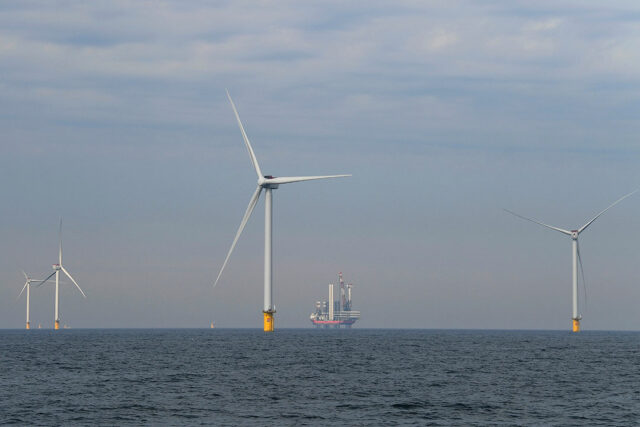
RENEWABLE ENERGY (RE) firms from the UK are looking to the Philippines as a potential investment destination, especially for offshore wind projects, the British Embassy in Manila said.

Lloyd Cameron, economic and climate counsellor at the embassy, said many investors see the Philippines as holding the potential for many such projects.

“Everyone’s looking at the Philippines, everyone’s taking notice of the Philippines now, and it’s just making sure that those opportunities are shared with the right people,” he told reporters last week.

He said apart from offshore wind, other industries being looked at are nuclear energy, particularly small modular reactors.

“Offshore wind, absolutely, because the UK is one of the world leaders in offshore wind, and that has led to the development of a really strong UK supply chain and really strong UK expertise that these companies and firms are looking to export,” he said.

“And then there are a lot of investment companies in the City of London who have the capital to invest in projects, so it’s them as well,” he said, referring to the British capital markets. “They’re generally sector agnostic; they’re just looking for RE opportunities.”

He said the Philippine government has signaled its intent to grow RE capacity and created a conducive investment climate.

“A government is in place that  is sending a really strong signal to the market that it wants to grow renewable energy capacity, and that the Philippines is open for business and open for investment,” he added.

He noted reforms like the green-lane permit system, longer leases for investors, and right-of-way reform, among others.

“You see the Philippines ranking second in listings for emerging markets in RE,” he said.

“It’s a whole-of-government approach, and then it’s the passion and the ingenuity of Philippine businesses as well, who can be partners in that,” he added.

He said that if the UK becomes a top source of foreign direct investment (FDI), it will be driven by RE projects.

“The year to date, there haven’t been the same big projects agreed upon, but that’s normal. These big projects don’t come along every couple of months, so it may ebb and flow,” he said.

“It may not be this year, but I’m sure that there are investors looking at big projects here, if not this year, next year, or down the line,” he added.

Last year, the UK was among the top sources of FDI net inflows, accounting for 35% of the total, or $8.93 billion.

GOCC salary grades adjusted to provide cost-of-living relief

THE Governance Commission for Government-Owned or -Controlled Corporations (GCG) said it released a new salary framework for employees of state-run firms to provide them cost-of-living relief.

The revised Compensation and Position Classification System (CPCS II), approved by President Ferdinand R. Marcos, Jr., introduces enhanced salaries and expanded benefits, it said.

“The CPCS II contains a new salary framework for the GOCC workforce, designed to mitigate the erosion in purchasing power due to inflation and other economic factors,” the GCG said in a statement over the weekend.

The new system expands the previous 20 Job Grades under Executive Order No. 150, series of 2021, to 30 Pay Grades. It also reclassifies positions previously grouped under a single grade, following recommendations by an external consultant.

The GCG said GOCC employees will receive annual medical allowances under a tiered system, depending on the financial capacity of their agency.

Employees of Category 1 GOCCs, which rely on National Government subsidies, will receive P7,000.

Categories 2 and 3, self-sustaining GOCCs funded through non-commercial and commercial activities, respectively, will receive allowances ranging from P10,000 to P35,000 across five tiers.

It starts with P10,000 for Tier 1, P15,000 for Tier 2, P20,000 for Tier 3, P27,000 for Tier 4, P35,000 for Tier 5.

“Guidelines covering the grant of the medical allowance will be issued by the GCG En Banc,” the GCG said.

The regulator said the GCG En Banc will refer to the implementing guidelines for the CPCS II to help GOCCs in the transition to the new salary framework. The GCG will also issue Authorities to Implement the CPCS II.

“With the issuance of the CPCS II, the GCG reaffirms its role as a partner and not merely a regulator of the GOCC sector,” it said.

“The GCG is steadfast in its commitment to provide effective regulatory mechanisms to help sustain the efficiency of operations of GOCCs under its jurisdiction, and to set sustainable policies and systems that will continue to attract talent and retain quality workforce in the GOCC sector.”

Last week, Finance Secretary Ralph G. Recto said state-run firms are expected to generate P157 billion in remittances this year, up 14.60%.

As of Sept. 3, Mr. Recto said 53 GOCCs transferred P116.84 billion to the Bureau of the Treasury, with 15 remitting at least P1 billion each. — Aubrey Rose A. Inosante

ADVERTISEMENT
ADVERTISEMENT