

Home Blog Page 9728

The Great Isolation

First, there was the Great War, or the First World War, that ran from 1914 to 1918. Then, there was the Great Depression, or the worldwide economic recession that started in the United States in 1929 and lasted until the late 1930s. And prior to these, there was the Great Plague or the “Great Mortality” of 1347-1351, deemed the most devastating plague pandemic in history.

And now, we have the “Great Isolation” of 2020, a “lockdown” of billions of people around the world in an effort to “flatten the curve” and stem the rise of COVID-19 cases globally. And the impact, both positive and negative, of this “containment” effort will continue to affect all 7.8 billion people on our planet in the coming years.

There should be no big rush back to “business as usual.” It already seems that many of us will not be around to witness a return to some degree of “normal” by 2021 or 2022. We will survive this new “global terror,” that’s for sure. But there is no doubt in my mind that our planet and the people on it will never be the same after this pandemic. There is no going back to pre-2020.

Locally, we are now into our third week of the Luzon-wide enhanced community quarantine or ECQ. But for all intents and purposes, it is practically a national quarantine or a national lockdown. Some provinces and cities and towns in the Visayas and Mindanao have already implemented some form of quarantine or containment measure to quell the spread of COVID-19.

I do not expect the Luzon-wide ECQ to continue on, as it is, after the April 14 deadline. I am foreseeing modifications to the “lockdown” order. Worst case, particularly for Luzon, perhaps another two weeks of the same, or until end-April. In my opinion, that will be the ECQ limit. As it is, we are already fighting for national survival on two fronts: medical and economic.

At the individual level are the same two battle fronts. People grapple with avoiding or surviving the disease, and also surviving the quarantine. For some of us who are more fortunate to continue to have access to the necessities and the means to acquire them, then quarantine is manageable. Inconvenient, but tolerable. It is a matter of putting off things for later.

But to many others, it is a different story, especially when in their minds, they are desperately ready to risk disease just to avoid hunger. And this is where things can get dicey. And, I believe this is a major consideration for our leaders. Absolutely no one knows how and when this pandemic will end. But what is certain is that we will not go through it unscathed.

Quarantine measures may have to remain for areas with many cases, but the rest of Luzon should have some relief from ECQ. By this, I mean monitoring and isolation of people who are sick and those who have been in contact with the sick. Then, the widespread use of masks and the strict exercise of stringent hygiene measures. Forced quarantine for PUIs and isolation of PUMs. No foreign arrivals meantime.

As one associate noted, if, for instance, someone tests positive, then close the establishment and disinfect it. Then reopen it when feasible. Limit the disruption. Start contact tracing and then put PUMs and PUIs in isolation or quarantine. But, don’t prolong the suspension of operations via a general lockdown.

Also, give more support for medical services and health workers. It seems the Philippines is losing more doctors and health workers relative to the number of sick patients than other countries. Fact is, we will still need all if not more doctors and health workers after this Great Virus is over. Life will have to go on. And from birth to death, that thing most constant is medical service.

But allow businesses to operate, especially food production and services. Limit lockdowns to areas under strict quarantine, and only if absolutely necessary. Lockdowns should be very selective, moving forward. Allow public transportation to restart and remove restrictions on the movement of goods and people. But temporarily maintain restrictions on shopping malls, and other public places and gatherings. Schools may have to remain suspended.

I am sure none of this is lost on our leaders and decision makers. I am likewise certain they are monitoring practices in other countries that may be applicable to us. It is anticipated that the government will modify in particular checkpoint guidelines to allow the freer movement of food as well as agricultural and fishery products, perhaps even of farmers and factory workers involved in food production. This will necessarily entail some changes on guidelines for the transportation of goods and people.

Other than food, we need to restart manufacturing and exports. And, also services, whether B to B or B to C. By the end of the ECQ, many people will already need various forms of services, including financial, and access to consumer durables and other consumer goods. Retail will need to have some form of restart as well. The basic needs of people go beyond food.

A modified scheme may have to remain in place until June or July, and then maybe phased down again by the third quarter. It all depends on where we are by then in terms of limiting the spread of COVID-19. But physical distancing, wearing of masks, and strict hygiene measures will have to remain with us for the rest of the year, at least.

I dare put the period of “The Great Virus” at 2020-2024, and some respite for the Philippines perhaps by 2025. I also expect us to be back firmly on our feet by 2026, under a “new normal.” I have not lived through a world war, nor a global plague. I have no crystal ball, nor science nor mathematics, to back my claim. I cannot predict the future. All I have, at this point, is a gut feel of how and when this great crisis will end. God, for those of us who believe in Him, and Science will work together to save us from it.


Marvin Tort is a former managing editor of BusinessWorld, and a former chairman of the Philippines Press Council.

matort@yahoo.com

Rage killed the Cat — and other musings on COVID-19

We know the saying, “Curiosity killed the cat.” But recently, one cat wasn’t curious enough to understand why Filipinos thronged at a checkpoint despite the social distancing rule imposed during the COVID-19 lockdown.

A socialite/influencer was roasted over social media for her remarks on her Instagram page live. While watching the news on her 52-inch plasma TV at home, she raged against the longsuffering commuters clogging the checkpoint, and her outburst was recorded. A few hours after she had posted her video on March 17, she was lambasted on her Instagram account and was forced to take down the video. She became headline news on GMA online, Rappler, and ABS-CBN online, to name a few. Although she later apologized on her Twitter and Instagram accounts, netizens were unappeased.

From her privileged position, she did not realize that the commuters were trying to make a living because of their companies’ policy of no work, no pay — a crucial HR issue that has now become a cause of concern for our government.

As an HR professor, I stress to my students the importance of humanistic management — making sure that running a business is not just about profit, but also about the welfare of its most important asset: the employees.

Because of our month-long enhanced community quarantine (ECQ), I have been unable to meet my classes in person. In our last online discussions, my students felt bad that we would meet face-to-face (should the ban be lifted as declared) only on the last day of the term. I consoled them by saying that this crisis is the best time to see the importance of human resources. Work-from-home (WFH) arrangements, the early release of the 13th-month pay, consumption of leaves, and other safety nets that private enterprises can offer to alleviate the plight of their employees are all HR concerns that business students must understand.

During this nationwide health crisis, we salute our hardworking government officials and the frontliners in both the government and the essential services sector. We also salute HR personnel who process the WFH schemes, salaries, and logistics of the company for their skeleton forces. Other HR responsibilities are explaining to management the directives coming from the Department of Labor and Employment, and operationalizing these given the company’s resources. These tasks are not easy, for so many things are uncertain, including the quarantine period, which might be extended if the number of COVID-19 cases increase.

However, this health crisis is not just a governance or HR issue. It is personal. It requires being sensitive to the welfare of others. While a lot of people are busy making quarantine memes or jumping on the TikTok craze to entertain themselves at home, many more are stressing about how to walk, say, the 91 kilometers from Dau, Pampanga, to Basista, Pangasinan, because the Luzon-wide ECQ had been imposed without warning and public transportation had been suspended; about where their families’ next meals will come from; or even about whether they will still have jobs after a month of no profit by their SME employers.

Let us thus think twice, even thrice, before posting on social media. Let us research thoroughly to check the validity of what we see in our newsfeeds (remember the banana cure fake news?), and reflect on the effects of our posts and shares before clicking the button lest we cause more harm than good.

Check your privilege. As for your posts about being so bored that you’re counting the grains of your rice, or so frustrated that you can’t celebrate your birthday, all I can say is that other people wish they had your “problems.”

While staying indoors during this ECQ, let us engage in more productive pursuits such as praying for God’s mercy and healing for everyone affected by COVID-19, donating online to worthy causes, and, if we have stable internet connections, attending MOOCs that can increase our knowledge and develop our critical thinking and communication skills.

Above all, let us not be catty.

The views expressed above are the author’s and do not necessarily reflect the official position of De La Salle University and its faculty and administrators.


Alvin Neil A. Gutierrez is an Assistant Professor of the Management and Organization Department of the Ramon V. Del Rosario College of Business. He teaches Strategic Human Resources and Organizational Behavior to undergraduate students.

alvin.gutierrez@dlsu.edu.ph

Virus, bacteria, and pneumococcal diseases

MACROVECTOR/FREEPIK

Before the China virus — a.k.a. SARS-Cov-2 which causes Covid-19 — scare, pneumococcal diseases caused by a bacteria called Streptococcus pneumonia and their treatment were in the news. The bacteria can affect people of all ages, from babies to senior citizens, and pneumococcal diseases are a leading cause of death among children below five years old. When the bacteria invade the lungs, they can cause pneumonia and death. They can also invade the bloodstream and cause bacteremia, or invade the tissues and fluids surrounding the brain and spinal cord and cause meningitis.

The best way to combat the bacteria is pneumococcal conjugate vaccine (PCV). The Department of Health (DoH) first procured PCV10 in 2012 — this vaccine protects against 10 strains of the bacteria. Then the DoH shifted to tridecavalent PVC13 in 2014, which protects against 13 strains of pneumococcal bacteria, after the World Health Organization (WHO) cost-effectiveness studies showed that PCV13 is more cost-effective than PCV10. PCV13 was then included in the Philippine National Formulary.

The three bacteria strains not covered by PCV10 are serotypes 3, 6A, and 19A. Serotype 19A in particular is more serious, can lead to meningitis, invasive diseases, and severe pneumonia. Pneumonia is estimated to kill over 50,000 people in the Philippines yearly, the third most deadly disease in the country.

An issue came out in late 2019 when some individuals or groups questioned why PCV procurement — a total of P4.9 billion for 2020 — specified only a single vaccine, PCV13.

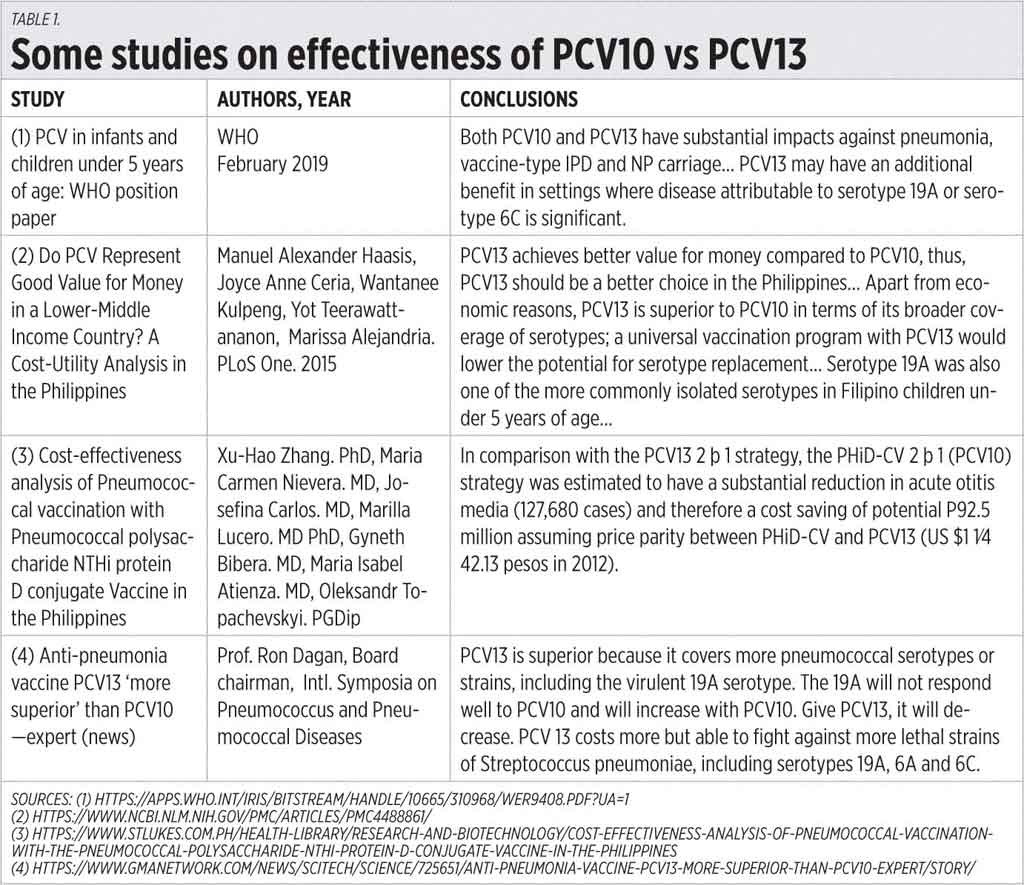
I got curious about the difference between the two vaccines, I made my own brief research and I found these four studies and report (see Table 1).

So from a technical and medical perspective, PCV13 is superior. From a financial and fiscal cost, PCV13 is more costly by about 105. An estimate of the fiscal cost if universal vaccination is done nationwide was made in 2015, the only study I have encountered so far (see Table 2).

From this 2015 study, it comes to a difference of P2 billion over five years, or P400 million/year for vaccines of PCV13. Updated to 2020 costs this comes to about P500 million/year — but PCV13 will protect thousands or millions of children from more virulent diseases. The DoH should be guided more by thousands of children’s lives that will be saved, than the extra cost of half a billion pesos that it can save.


Bienvenido S. Oplas, Jr. is the president of Minimal Government Thinkers.

minimalgovernment@gmail.com

Politics and Crisis: A Discussion SeriesGoverning the pandemic

By the Ateneo de Manila Department of Political Science

(Second of an eight-part series)

THE FIRST TWO WEEKS of dealing with the COVID-19 pandemic have unraveled the fractures of an already fragile relationship between our national and local governments. This is notwithstanding the fact that the current administration’s response to the crisis has been framed as a whole-of-government approach, with the national government exercising general supervision, and the local government units (LGUs) implementing the stipulations and guidelines coming from the national, albeit with differing capacities in implementation. As such, understanding the government’s response to the COVID-19 situation could most fruitfully be pursued by parsing through this national-local divide; governing the pandemic would anyway necessitate the coordination between these two levels of government.

DECISION MAKING IN CRISIS SITUATIONS
In their book Public Choices and Policy Change (1991), Grindle and Thomas argue that a situation becomes a crisis when policy makers perceive it as one, and when consensus among policy elites is achieved to acknowledge the crisis, the pressure to not act on it immediately would lead to disastrous consequences. This explains why the time it takes for different countries and local governments to act on the pandemic is varied.

Aside from timing, the stakes of policy making is also different. Policy options are normally filtered through these four lenses: technical feasibility, the bureaucracy’s absorptive capacity, political support, and international pressure. During a crisis however, because the policy elite’s reputation is at stake, external factors weigh more than internal ones, particularly regime maintenance or political legitimation and international pressure.

A crisis such as the COVID-19 pandemic, ironically, is a great equalizer. It threatens both the powerful and the weak, the wealthy and the marginalized. It is borderless and it does not care about ideologies. More importantly, it poses an opportunity to implement policies that would instigate radical and innovative reforms as opposed to incremental ones that would not have been possible in a politics-as-usual environment. Unfortunately, however, the content of this “radical” reform will depend highly on what policymakers believe that they can get away with, in the event that these fall short of the expected gains.

RECENTRALIZATION VERSUS DECENTRALIZATION
The policy of enhanced community quarantine (ECQ) amplified what many of us already know: the stark divide between those who can afford to stay indoors with good enough space for each household member, and those whose living quarters are cramped with barely enough resources (most especially, food) to get by each day. The declaration of the ECQ caught many LGUs off-guard. Nevertheless, they did — and continually are doing — their best to respond to the social and economic consequences of such. The LGUs as such were also serving the frontlines, tasked with delivering localized solutions in the most effective and efficient manner as possible.

What we have been seeing lately, however, is an effort by the national government to maintain its relevance by centralizing control as much as it can. Doing so lessens or even stifles the ability of LGUs to decide what is best for their localities, given the unique conditions that they have. This runs counter to the principle and spirit behind devolution, enshrined in the Local Government Code (LGC) of 1991.

Devolution is unapologetically political. It is a critical part of deepening democracy since its primary goal is the increase of citizen participation in local decision making. Devolution as such makes the LGU more accountable and responsive to the needs of the people it serves.

What re-centralization of decision making does is that it takes away the power of local governments to deliver sound, prompt, and localized responses. Inadvertently, re-centralization makes the LGUs more dependent on whatever decisions are made by the agencies and elites at the national level. In doing so, LGUs are now evaluated based on their administrative performance and loyalty to the national elites (i.e., simply following orders from the top, regardless of whether these directives make sense in their own contexts) rather than their political acuity, entrepreneurial character, and responsiveness to the demands of the people they serve. Many of the LGUs who have received the brunt of the national government’s ire in the early stages of the ECQ are those who, ironically, found creative ways of doing their job based on what little resources they have.

STRATEGIC LEADERSHIP AND GOVERNANCE IN A PANDEMIC
The COVID-19 pandemic is a wicked problem that requires not just broader, but more importantly, deeper ways of understanding both the problem and the solutions. To be able to collaborate better and not compete against each other, both national and local governments must strategically find themselves in the complex web of the policy environment of crisis. They, too, must understand that they are not the only players in the policy process. There are other stakeholders that must be accounted for to ensure that the policies generated are inclusive.

Not all LGUs are created equal — in terms of both the supply (i.e., bureaucratic capacities, ability to generate and to analyze data, communications strategy, etc.), and the demand (i.e., critical citizenry engaged in demanding transparency, accountability, and quality service from public officials) sides of governance. What makes a local government stand out compared to others is not how much resources it has at its disposal, but how its leadership is able to make strategic choices, even in the face of political opposition and uncertainty in the next round of elections. For this kind of leadership to thrive, it needs the backing of local institutions that are: strong — able to resist capture of local predatory powers; flexible — not afraid to innovate administrative routines to make it more responsive to the demands of the time; and modern — professional, well-trained local bureaucracy able to generate evidence-informed and proactive policies at all times.

Procedural policies have long-term substantive consequences. The National Action Plan (NAP) along with other national and local resolutions will continue to have an impact on the ways by which the national and local governments relate to one another beyond the COVID-19 pandemic. It will also affect how we will look at and appreciate public goods: health, education, housing, transportation, social security, just employment, and food sufficiency, to name just a few. The one good thing that this pandemic arguably has caused us is that it has flattened our curve of individualism and has forced us to think and behave collectively.

POWER TO THE PEOPLE
How the problem is initially defined critically shapes how solutions are designed.

In the short term, what we need is access to correct information based on verifiable and reliable data. The amount of misinformation and disinformation circulating impacts the way we behave as a community, which in turn affects how public policies are made and are being made. Moreso, disinformation fuels the unnecessary tension between national and local policy elites. It also has become an opportunity for local political elites to discredit one another for political gains.

In the long term, we need to rebuild and strengthen our national and more so our local institutions so that they will continue to supply effective public policies, even in the presence of strongmen and populist politics. Rebuilding institutions means that we, the people, must reclaim the power by demanding more from our government, and holding them accountable when they fall short of our collective expectations.

Beyond inputs, we would like to know exactly what activities are expected to be created (output) and, more importantly, whether these have improved the conditions of those affected by the crisis (outcomes). Hence, it is not enough to know that the government is allotting P200 billion in aid for poor families. What activities will this fund, for whom, and will these ameliorate the lives of those in the receiving end?

Unfortunately, the current articulated public policies concerning this pandemic fall short in terms of moving towards measuring what matters most. Beyond the presence of strategic leadership and strong local institutions, what will push the national and local governments to carry out their responsibility is how well-organized our engagements are as a collective. A fragmented and incoherent demand will never gain the attention of those who control the policy agenda.

For it is only when we have the power to determine what is true and what is false information, to decide how much power must be given to the government, to understand what makes policies effective, and to demand that all politicians should be made accountable without impunity, that lives can be saved — pandemic or not.

Food supply is the next virus headache

By Clara Ferreira Marques

IT’S NOT JUST MANUFACTURING that’s struggling with disrupted logistics. As more countries bring down the shutters to limit the spread of the coronavirus, risks are rising for the world’s complex food supply networks. Snarl-ups in processing and transport could result in painful price spikes for many fresh goods, even if farms in developed markets can keep working through the outbreak.

The picture isn’t all gloomy. On a global scale, stocks of corn, wheat, soybeans and rice are healthier than before previous periods of food inflation. While some prices have been heading higher, increases aren’t across the board. Sugar and corn have been held back by reduced demand from biofuels producers as oil plummets. Low fertilizer and crude prices, meanwhile, will help offset other rising costs for farmers.

Yet with infection rates rising there are worrying signs of fraying nerves, as countries engage in their own version of the toilet paper panic. Kazakhstan has banned exports of buckwheat and wheat flour to preserve domestic supplies. Russia, the world’s top wheat shipper, could limit some sales overseas, a threat that has already pushed up prices. Vietnam, meanwhile, is stockpiling rice and has suspended new export contracts. During the 2006-08 spike, such behavior accounted for 45% of the increase in rice prices, and almost a third for wheat, according to a study published by the World Bank.

For now, such protectionism isn’t the norm. Kazakhstan, after all, accounts for less than 5% of wheat exports. And cereal harvests are looking decent. The US Department of Agriculture expects global wheat production to rise almost 5% this year, while rice is seen as stable. Still, supply of key products is concentrated. With restrictions dragging on and more countries scrambling to contain the virus, the resilience of the world’s shopping basket will face further tests.

After years of low food inflation, several factors were already pushing up bills before the coronavirus pandemic: severe droughts in Southeast Asia and Australia; an African swine fever outbreak in China that decimated the world’s largest pork producer; and, more recently, swarms of locusts in Kenya, Pakistan, India and beyond. The United Nations’ Food and Agriculture Organization said in January that, left unchecked, the number of crop-munching insects could increase 500 times by June. One desert locust can eat its own weight in a day — about 2 grams — and swarms contain hundreds of millions.

While prices are still well below 2008 or 2011, there are glimpses of how quickly the situation could change. Chinese food prices surged more than a fifth in January from a year earlier as the epidemic took hold, and pork prices more than doubled. Rice is already feeling the combined impact of drought, rising demand from stockpiling households, and export restrictions. Prices for standard Thai white rice have risen for six straight weeks, to more than $500 a metric ton, the highest level since 2013. Such gains encourage more beggar-my-neighbor economic policies, to the detriment of all.

Then there are bottlenecks caused by virus restrictions. Deliveries and logistics have caused trouble since the outbreak began. Transpacific shipping troubles hampered exports to China from the US; in China, livestock producers struggled even within the country, finding themselves unable to get feed, and then blocked from sending poultry and eggs to market. It’s a problem that could easily repeat itself elsewhere. Coffee traders are already warning of disruptions: Closures in Brazil, El Salvador and Colombia, and missing stevedores, are driving the volatility.

Labor is an additional concern. Virus restrictions prevent workers such as distributors and pickers from moving across borders. Laborers migrating to farms in France, or heading to pick fruit in Australia, may find it harder unless they are already in place. France’s agriculture minister last week encouraged unemployed people to go to work on farms; it’s unclear how many can or will heed his call, and at what price.

Workers also face the risk of getting ill. That particularly threatens more labor-intensive corners of the industry, such as palm oil plantations or meat processing plants, as Aurelia Britsch, head of commodities research at Fitch Solutions, points out. In both, contaminated workers have already proved disruptive. Malaysia’s biggest palm-producing state, Sabah, has closed down operations in several districts until mid-April after some workers fell sick.

In much of the world, preemptive policies can keep things moving. China’s Ministry of Agriculture and Rural Affairs, for example, brought in incentives for sowing and mechanization in early February, as well as support for livestock farming, and “green channels” to help the movement of feed, breeding animals, and produce. Governments can encourage trade, rather than nation-level hoarding. As the virus spreads, wealthier countries may also need to support developing ones, especially those hit by elevated import bills and weakened currencies.

Disruptions will be inevitable. A global food crisis doesn’t have to be.


BLOOMBERG OPINION

On-demand services platform MyKuya looking for enterprise partners

While much of the country is still unable to work due to the declaration of enhanced community quarantine in Luzon on March 16, businesses managing motorcycle-based services may consider partnering with on-demand services platform, MyKuya, as an Enterprise Partner.

MyKuya has seen a 300% rise in requests since the announcement of community quarantine in Metro Manila. These requests—mostly for personal shopping, grocery delivery, or an assistant on bike—are coming from users wary of checkpoints, long lines, and of course potential exposure to the COVID-19 virus.

Every user gets serviced by a polite, friendly kuya or ate—the on-demand service providers powering MyKuya—these are not the independent contractors you typically see in the gig economy. All kuyas and ates are employed by an Enterprise Partner. These partners provide the driver recruitment, training, and fleet management, while MyKuya brings the demand.

“It’s easy to talk about digital transformation, but the practical reality of doing so for an MSME is very difficult,” said Shahab Shabibi, founder of MyKuya. “By serving as their digital storefront, we can connect them with customers in desperate need of their services, providing them with a level of demand that helps them not only survive but thrive.”

Shahab says that the success of Enterprise Partners enables them to maintain and employ more workers, many of them recently laid off due to the lockdown

During this time of crisis, each partner also plays an important role in ensuring service continuity by keeping everyone safe. Enterprise Partners provide and regularly replenish the personal protective equipment (PPE) of kuyas and ates, while MyKuya assists them in case they have any trouble, such as difficulty passing through a checkpoint.

“On other platforms, you’re a driver or operator, and you’re that forever,” Shahab said. “There’s no chance to build something bigger. On MyKuya, we give them the tools and technology to not only be an individual operator, but to manage an entire fleet as an Enterprise Partner. In this way, we enable them to scale their business, the service to our users, and the number of jobs we create, effectively making the platform a growth engine for the Philippines.”

MyKuya’s roster of Enterprise Partners consists of companies that employ people with motorbikes who want to generate income and keep employees while core business is down, such as a restaurant chain with an in-house delivery fleet. Also included here are driver cooperatives, individuals or organizations that may not have a fleet but are willing to onboard and manage drivers (such as an influential community leader or local barangay), and even companies with an existing fleet of riders in need of a technology platform.

MyKuya serves as both demand aggregator and technology provider, offering robust enterprise-grade tools, such as real-time tracking of drivers, mechanisms for user reviews and ratings, and online payment, which is now not only a matter of convenience but of safety in the COVID-19 era.

“Before joining MyKuya, we used to only have 65 riders on our team. Now we have 200 riders,” said Lhen D. Dela Cruz, the co-owner of GoMoto Phils. “The demand and technologies provided by MyKuya has helped us grow, even amid this crisis. With remote tracking, the ability to chat with customers in real-time, and get access to ratings and reviews, we have been able to radically improve our service to our customers.”

Shahab says that new Enterprise Partners can go live with MyKuya in under 24 hours. “The time is now to collaborate with one another in the spirit of bayanihan,” he said. “Mobilizing more Enterprise Partners creates a virtuous cycle that benefits all Filipinos. With every new Enterprise Partner, we can help more Filipinos with their basic needs, create more jobs with additional kuyas and ates, and grow even more businesses,” he said.

Interested Enterprise Partners who want to learn more should visit https://www.mykuya.com/enterprise-partners or contact the MyKuya team directly at enterprise@mykuya.com or 0977-291-1496.

Isuzu Philippines lends vehicles to transport healthcare workers, frontliners

Isuzu Philippines Corporation (IPC), responding to the immediate needs of the country’s healthcare and frontline workers fighting to stem the outbreak of the Coronavirus Disease 2019 (CoViD-19), lent on March 28 two units of the Isuzu D-MAX and one Isuzu mu-X to authorized representatives of the Binan local government.

Following the strict government protocols on social distancing and disinfection, the three Isuzu light commercial vehicles were completely sanitized and sterilized, and will be delivered to the Municipality of Biñan, Laguna.

These vehicles will be used to support the frontliners in Biñan and Sta. Rosa Laguna, to transport them going to and from the several hospitals to help them fulfill their critical duties in this public health crisis.IPC also lent one mu-X and one NLR PUV to Medical City in Sta. Rosa, Laguna, which will be used as the Medical City’s frontliners’ service. IPC still continues to reach out to other hospitals to address their mobility problems.

IPC President Hajime Koso paid tribute to the country’s healthcare workers and frontliners. “As the world, including the Philippines, faces an unprecedented health crisis threatening countless lives, our healthcare workers and frontliners—the doctors, nurses, medical researchers, hospital and clinic technicians, and other staff—have risked their own lives to help stop the pandemic, while caring for those who have contracted the disease. And they have been performing such selfless work tirelessly, without letup. With these vehicles, we at IPC hope that our dedicated and enduring heroes in the hospitals would find comfort and safety in their transport. Through our vehicles, we can help them fight the virus more effectively.”

IPC also assures that its aftersales service program, the Isuzu Mobile Medics, will still be offered for Isuzu vehicles used in essential operations for the duration of the Luzon-wide enhanced community quarantine. With the Isuzu Mobile Medics service, owners, operators, and drivers of Isuzu vehicles can avail of expert and experienced technicians and troubleshooters wherever and whenever they are needed.

“The Isuzu Mobile Medic is an onsite emergency servicing will be essential for Isuzu vehicles to continue operating uninterrupted in the government, armed forces, utility companies, logistics, and healthcare sectors,” Mr. Koso added.

To add to Isuzu owners’ peace of mind, IPC’s nationwide network of 45 dealers has also offered a 30-day grace period on all Isuzu vehicles with scheduled PMS (periodic maintenance service) during the enhanced community quarantine, while all Isuzu vehicles whose warranty coverages will be lapsing within the quarantine period will also be given a 30-day warranty extension.

For more info please log on to www.isuzuphil.com

AMA Online Education launches learn now, pay later program

AMA Online Education (AMA OEd), the country’s first full online educational platform, launched a program last week for students and professionals looking to continue learning through the enhanced community quarantine brought by the COVID-19 pandemic.

With AMA OEd’s “Learn Online Now, Pay Later” scheme, students and professionals get access to a variety of programs and short courses offered by AMA OEd without having to pay any tuition fee until April 15, 2020.

Even with the enhanced community quarantine in place until April 14, 2020, students can now enroll in AMA OEd for Senior High School, Undergraduate, and Master’s programs. Professionals who are looking for continuous professional development (CPD), can also take short courses on the platform that are accredited to give them the CPD points they need for professional license renewals.

“This Learn Online Now, Pay Later Program is our own way of ensuring that learning never stops,” said Dr. Amable C. Aguiluz IX, Vice-Chairman and CEO of AMA Education System. “As we stay indoors for the time being, we wish to empower students and professionals with more knowledge through the various courses offered on our platform, which they can take at their own pace from home and online.”

Those interested in availing of this program can log on to the AMA OEd Website and do the following steps:

  • Step 1: Choose any program from Senior High School, Undergraduate, Master’s, or short courses. CPD enrollees can enroll up to a maximum of three short courses.
  • Step 2: For Senior High School, Undergraduate, and Master’s programs, applicants will be required to submit a scanned copy of their transcript of records from their previous school. For Master’s applicants, an endorsement email from an immediate professional supervisor with contact details is needed.
  • Step 3: Once enrollment is confirmed, you can start studying through AMA OEd’s platform.

Access is then free until April 15, 2020. To continue studying after that date and to get certificates for the programs and courses enrolled in, students will need to pay the assessed tuition fee.

PHL plans rice imports amid lockdown

By Revin Mikhael D. Ochave

THE government is planning to import 300,000 metric tons (MT) of rice to ensure there is enough domestic supply as Luzon remains under enhanced community quarantine.

At the same time, the country is facing a garlic shortage as local production is not enough to offset the loss of imports from China due to the coronavirus disease 2019 (COVID-19) pandemic, the Agriculture department said.

Cabinet Secretary Karlo B. Nograles on Tuesday said the Inter-Agency Task Force for the Management of Emerging Infectious Diseases (IATF) recommended the importation of rice via government-to-government arrangements.

“The Department of Agriculture (DA) and other government agencies are coordinating with other Southeast Asian countries to make sure that their commitments for rice imports will be uninterrupted,” Mr. Nograles said in a briefing.

The Philippines was the world’s biggest rice importer in 2019, after purchasing a record 2.9 million MT — mostly from Vietnam and Thailand. This after the country removed caps on rice imports, allowing the private sector to purchase unlimited volumes.

However, Vietnam temporarily suspended new rice export contracts, as part of efforts to ensure food security amid the pandemic. Reuters reported that rice traders expect Vietnam to lift the suspension this week, with the government imposing a quota.

Samahang Industriya ng Agrikultura (SINAG) Chairman Rosendo O. So said that instead of boosting rice imports, the government should provide funding for better farming and post-harvest facilities, free farm inputs, and higher support price for palay.

“I think we are the only country who believes in the ‘unli-import’ mindset. The response of our economic managers to Vietnam’s export ban is regrettably, but expectedly, to import an additional 300,000 MT of imported rice,” Mr. So said in a mobile phone message.

Agriculture Secretary William D. Dar earlier said there is enough rice supply which can last up to four months. He said that rice supply for the whole country is at 2.661 million MT, equivalent to a 75-day supply, including stocks from commercial traders, households, and government agencies.

Moreover, National Food Authority (NFA) Administrator Judy Carol L. Dansal said the agency’s current rice inventory is at 481,800 MT, equivalent to a 14-day supply for the entire country. NFA also bought 86,711 MT of palay from individual farmers, cooperatives, and associations during January and February.

Latest data from DA showed that weekly rice demand for Metro Manila is at 26,241 MT with a committed supply of 929,358 MT, enough for a 35-week supply.

GARLIC SHORTAGE LOOMS
Meanwhile, Mr. Dar said in a radio interview on Tuesday that there is currently a huge shortage of garlic in the country.

“Around 8% of garlic requirement is produced locally. Most of our garlic supply comes from other countries like India and China,” he said, noting that they are unable to import garlic from China because of COVID-19.

Mr. Dar said there is no choice but to increase local garlic production. Data from the Philippine Statistics Authority (PSA) showed local production of garlic in 2019 fell 4% to 7,300 MT, compared to 7,600 MT in 2018.

For the 2018-2019 cropping season, imported garlic reached 71,048 MT, data from the DA showed. Local demand for garlic is said to be around 128,000 MT per year.

However, the production of local garlic remains low because it is smaller but also more expensive than Chinese imports.

“China supplies garlic to countries such as Malaysia, Thailand, and Philippines. China garlic is cheap compared to local garlic which is small, low solid content, and expensive,” Rolando T. Dy, executive director of Center for Food and Agri-Business of the University of Asia and the Pacific (UA&P), said in a mobile phone message.

In a text message, DA Assistant Secretary Noel O. Reyes said that department is still in the process of asking farmer groups regarding the situation. — with Reuters

Virus to cut Philippine growth — World Bank

THE Philippine economy is seen growing at a slower pace this year due to the fallout from the coronavirus disease 2019 (COVID-19) outbreak, and may even contract by as much as 0.5% if the Luzon-wide enhanced community quarantine will be extended, the World Bank said in a new report.

The World Bank gave a 3% forecast for the country’s gross domestic product (GDP) growth this year, down from the 6.1% projection it gave in January, according to its Regional Economic Update report for April titled “East Asia and Pacific in the Time of COVID-19” published Tuesday.

Meanwhile, growth is seen picking up to 6.2% next year, maintained from the January projection, and will accelerate to 6.4% in 2022, higher than the previous 6.2% forecast.

These projections reflect the multilateral lender’s baseline scenario. In its lower case forecasts, the World Bank sees the economy contracting by 0.5% this year but recovering to a 4.1% growth next year.

These projections compare to the government’s goal to notch 6.5-7.5% GDP growth for 2020-2022.

Despite the 2020 forecast downgrade, the Philippine economy is still seen to be the third-fastest growing economy this year along with Myanmar’s 3% and is only behind Lao PDR’s 3.6% and Vietnam’s 4.9% and faster than 1.3% regional average expected for the whole developing East Asia and Pacific excluding China, based on the baseline scenario. The region is expected to contract by 2.8% this year in the lower case scenario.

“Real GDP growth is projected to significantly decelerate from 5.9% in 2019 to 3.0% in 2020 due to the impact of the COVID-19 outbreak and the associated community quarantine,” the report read.

“Nevertheless, economic growth is expected to accelerate rapidly in 2021-22 as global conditions improve, and with more robust domestic activity bolstered by the public investment momentum and a boost from 2022 election-related spending.”

Due to the month-long Luzon lockdown, the World Bank expects a sharp decline in domestic consumption in the first semester, which could be further dampened by the slower inflow of remittances, delayed implementation of the government’s infrastructure program, postponed investments from the private sector, as well as a negative impact on exports due to travel restrictions and disruptions in global supply chains.

The World Bank said its baseline forecast of three percent GDP growth this year assumes that economic activity in the country will resume in the third quarter. Risks to this forecast, which could result in a contraction of as much as 0.5% in its lower case scenario, are “a rapid surge in confirmed cases resulting in a prolonged community quarantine, lengthier disruptions to government and business activities, loss of incomes, and a protracted weakening of the public health system.”

“In this case, economic growth could contract in 2020 driven by a drastic slowdown in domestic consumption and investment, with echo effects into 2021. External risks could derive from a prolonged containment of the virus globally, leading to a global recession which will impact the Philippines through manufacturing, trade, tourism, and remittance channels,” the World Bank said.

It said this will likely significantly affect those working in the informal sector.

RECESSION
Meanwhile, Socioeconomic Planning Secretary Ernesto M. Pernia said yesterday the economy might contract in the last two quarters of the year, which will already be considered a recession, if the enhanced community quarantine will be extended.

“[Possibly,] zero growth rate or slightly negative [in the] third quarter, something similar, depending on if the enhanced community quarantine will be extended… [This] is still a speculation. We hope that it’s not negative,” Mr. Pernia said in an ABS-CBN News Channel interview yesterday when asked on his projections for third and fourth quarter GDP growth.

The National Economic and Development Authority earlier said it sees GDP growth of between -0.6% and 4.3% this year due to the virus outbreak.

The World Bank said besides “immediate public health response to prevent, detect, and contain local transmission” of COVID-19, the government needs to implement fiscal and monetary stimuli to cushion the economy against the negative impact of the virus and protect the vulnerable population.

“Specifically, the timely execution of public investments, targeted financial support to the poor and vulnerable sectors can restore confidence and soften the negative impact of the outbreak,” it said.

The World Bank said the country should also strengthen its health care system to prepare for future shocks similar to COVID-19 aside from accelerating structural reforms to improve the business environment and competition in the country and boosting productivity growth.

“Sustained support must be ensured for bills that improve competitiveness, such as the passage of the Corporate Income Tax and Incentives Rationalization Act, and amendments to the Public Services Act,” it added.

Despite expectations of slower growth, the World Bank still sees the country’s poverty incidence continuing to decline to 20.5% this year and to 18.3% in 2022, from 21.9% in 2018.

The World Bank also sees inflation settling at two percent this year, the current account to record a deficit of 0.3% of GDP and net foreign direct investments to decline to 0.5% this year of GDP.

The country’s budget gap is likewise expected to balloon to 3.9% of GDP from 3.5% in 2019, while outstanding debt is seen reaching 36.9% of GDP from 35.7% last year, due to increased spending and borrowings amid the COVID-19 crisis. — BML

Inflation likely slowed in March as oil price plunges

THE overall rise in prices of widely used goods likely slowed in March, the central bank said on Tuesday, as oil prices plunged and food prices remained stable due to a price freeze amid the coronavirus disease 2019 (COVID-19) outbreak.

In a statement on Tuesday, the Bangko Sentral ng Pilipinas (BSP) Department of Economic Research said inflation could settle between 2% to 2.8% in March. The range is closer to the low-end of the 2-4% target by the BSP for 2020 and 2021.

Inflation stood at 2.6% in February, slower than the 2.9% in January and the 3.8% print in February 2019.

“The sharp decline in the prices of petroleum products due to the significant fall in global crude oil prices contributed to the downward price pressures for the month,” the central bank said.

Oil prices plunged in early March when Saudi Arabia, the world’s biggest oil exporter, lowered its selling price to compete against Russia, its closest competitor, despite falling market demand due to the COVID-19 outbreak.

The Monetary Board last month downgraded its average inflation outlook for 2020 to 2.2% from the 3% previously penciled in. It also revised its 2021 average inflation forecast to 2.4% from the previous 2.9%.

“The BSP forecasts tamer inflation this year and next… The main driver for the downward adjustment is the collapse of world crude oil prices. Dubai crude oil price is now at its 18-year low of $22.51 per barrel from its recent peak of $85 per barrel in 2018,” BSP Governor Benjamin E. Diokno told reporters in a Viber message on Tuesday.

The central bank said slower inflation in March will also be supported by stable food prices as the government imposed a price freeze on basic necessities from March 16 to May 15.

“The prices of selected food products remained broadly stable in March due to adequate supply and favorable weather conditions along with the price freeze imposed on basic necessities by the Department of Trade and Industry and the Department of Agriculture,” the BSP said.

At the same time, the BSP flagged a slight uptick in electricity rates for those areas served by Manila Electric Co. (Meralco).

The distribution utility raised overall electricity rates for the month to P10.4961 per kilowatt-hour (/kWh), up by P0.0894/kWh from the previous month.

Amid the enhanced community quarantine in Luzon, Meralco announced it will temporarily suspend physical meter reading and bill delivery. It said the monthly bill will be based on customers’ average electric usage for the past three months as per the advice of the Energy Regulatory Commission.

The Philippine Statistics Authority will report March inflation data on April 7. — Luz Wendy T. Noble

PHL airlines seek gov’t help to survive virus

By Arjay L. Balinbin
Reporter

LOCAL AIRLINES are appealing for government help, as the “catastrophic impact” of the coronavirus disease 2019 (COVID-19) pandemic threatens their survival.

“The Philippine carriers are facing an existential threat to their survival which is faced by other airlines in the region and in other parts of the world,” the Air Carriers Association of the Philippines (ACAP) said in a March 25 letter addressed to the heads of the Departments of Transportation, Finance, Tourism and Trade, and the National Economic and Development Authority.

The group, composed of Philippine Airlines, Inc. (PAL), Cebu Air, Inc. (Cebu Pacific), Philippines AirAsia, Inc., Air Philippines Corp. (PAL Express), and Cebgo, Inc., emphasized that they are not seeking a “handout” at the expense of the taxpayers but only want to have ready working capital to allow them to restart and continue operations.

“Given these extraordinary times where the survival of the domestic airline industry is at stake, ACAP member airlines urgently appeal… for timely government intervention which is indispensable if Philippine aviation will have the capacity to resume its vital role of connecting people for trade, commerce and tourism,” ACAP said.

ACAP said its member-airlines temporarily shut down passenger operations until April 14 after Luzon was placed under enhanced community quarantine (ECQ). Over 30,000 flights were canceled, affecting nearly five million passengers.

Airlines are now unable to generate revenues in the next few weeks or even months, while banks have tightened credit lines.

ACAP asked the government to provide a credit guarantee scheme “that guarantees the banking sector’s loans and credit lines, most of which are secured with collateral, to remove its aversion to the poor credit risk of the airline industry under the present operating environment.”

The group also requested the government to give them access to emergency lines of credit to fund six months of operations of airlines and other aviation-related companies, “in order for the industry to remain viable until overall demand recovers.”

“We request that upon the lifting of the ECQ hopefully by April 14, uniformity in aviation transport regulations would be implemented in the entire country, and that LGUs be mandated to align with National Government,” it added.

To ensure airlines successfully recover, ACAP said they need a “long-term facility with attractive rates or a guaranty facility to allow them to restructure their debt at manageable levels, and secure better terms from aircraft lessors, bankers and creditors.

Lastly, the local airlines sought a full waiver of all navigational and airport charges, which include airport office rentals and land leases, until the end of 2020.

“ACAP member-airlines assure the government that these financing will be used for legitimate business stabilizaton purposes with the corresponding corporate governance in place,” the local airlines group said.

Sought for comment, Finance Secretary Carlos G. Dominguez III told BusinessWorld in a mobile phone message that they “will ask the BSP (Bangko Sentral ng Pilipinas) to support the banks that support their clients, including airlines.”

Transportation Assistant Secretary Goddes Hope O. Libiran, speaking for Transportation Secretary Arthur P. Tugade, said in a mobile phone message that ACAP’s request will be discussed during a meeting of the Inter-Agency Task Force (IATF) for the Management of Emerging Infectious Diseases.

The International Air Transport Association (IATA) last week said without government support, up to 50% of global airlines face possible bankruptcy in the coming weeks. IATA estimated revenue losses from the COVID-19 crisis to reach over $250 billion this year.

Earlier, the Australia-based Center for Asia Pacific Aviation (CAPA) has said airlines in Asia-Pacific countries, including the Philippines, will be the most badly affected by the COVID-19 pandemic.