Home Blog Page 97

CoA named WTO External Auditor, begins six-year term

The Commission on Audit (CoA) has been appointed as the new External Auditor of the World Trade Organization (WTO), reflecting its credibility and strong reputation in international auditing and growing influence in advancing good governance around the world.

The Philippines’ audit body, an independent constitutional commission, succeeds France’s supreme audit institution, the Cour des Comptes, and will serve a non-renewable term of six years.

In its role, the CoA will oversee the audit of the WTO’s financial statements, pension plan, and operations in line with the Organization’s financial regulations.

The audit body was selected by the WTO General Council on the recommendation of its Committee on Budget, Finance and Administration (CBFA). The committee cited how the CoA’s proven track record in auditing international organizations will help strengthen financial accountability and reinforce trust in the WTO’s governance framework.

CoA Chairperson Gamaliel A. Cordoba

“CoA’s appointment as the WTO’s new external auditor demonstrates how the world views our capabilities as an independent audit body — reliable, trustworthy, and world-class. We are committed to upholding the highest standards of independence and professionalism in our work with the WTO, continuing our mission to promote transparency and accountability in international institutions,” said CoA Chairperson Gamaliel A. Cordoba.

He said the WTO appointment represents a significant milestone for the CoA, illustrating its expanding influence and growing force in advancing transparency, accountability, and good governance not just in the Philippines, but around the world.

The CoA earlier served as External Auditor for several major specialized United Nations agencies, including the World Health Organization (WHO), the International Labor Organization (ILO), the United Nations Industrial Development Organization (UNIDO), and the Food and Agriculture Organization (FAO).

In these assignments, the CoA was commended for its rigorous standards and contribution to strengthening transparency and accountability in global governance.


Spotlight is BusinessWorld’s sponsored section that allows advertisers to amplify their brand and connect with BusinessWorld’s audience by publishing their stories on the BusinessWorld Web site. For more information, send an email to online@bworldonline.com.

Join us on Viber at https://bit.ly/3hv6bLA to get more updates and subscribe to BusinessWorld’s titles and get exclusive content through www.bworld-x.com.

Philippine inflation quickens to 4.1% in March, fastest in nearly 2 years

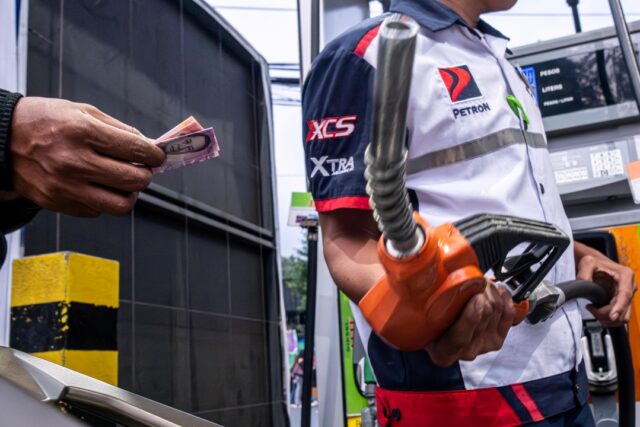
A motorist hands his payment to an attendant at a gasoline station in Paco, Manila. — PHILIPPINE STAR/RYAN BALDEMOR

By Katherine K. Chan, Reporter

Faster price increases in fuel, electricity and food, including rice, pushed Philippine inflation past the Bangko Sentral ng Pilipinas’ (BSP) target for the first time in nearly two years, the Philippine Statistics Authority (PSA) reported.

The consumer price index (CPI) quickened to 4.1% in March from 2.4% in February and 1.8% in the same month last year.

This was the fastest pace in nearly two years or since the 4.4% in July 2024, and likewise marked the first time since then that the headline print breached the BSP’s 2%-4% target.

March inflation also came in above the 3.8% median forecast in a BusinessWorld poll of 18 analysts and the central bank’s 3.1%-3.9% estimate for the month.

In the three months to March, inflation averaged 2.8%.

National Statistician Claire Dennis S. Mapa attributed the pickup to faster price increases in the transport index, particularly in gasoline and diesel, which accounted for 54.8% of the overall inflation rate in March.

During the month, transport inflation stood at 9.9%, a reversal from the -0.3% clip recorded in February.

This came as weekly pump price hikes pushed gasoline and diesel inflation to its fastest in over three years at 27.3% and 59.5%, respectively. It likewise marked a reversal from -5.7% and -1.3% the previous month.

Asked if the faster transport and food inflation was driven by the ongoing oil crisis from the Middle East war, Mr. Mapa said: “Yes, definitely.”

He noted that oil price surges have already spilled over to several commodity groups last month, including food, housing, water, electricity, gas and other fuels.

“Of course, we’ve already seen this in 2022 to 2023, where there were direct and immediate effects on other commodity groups when gasoline and diesel prices rose,” Mr. Mapa told a news briefing on Tuesday. “First, we saw it in power, housing, water, electricity, gas, and other fuels. So there are spillover effects.”

“And based on previous years, when we also had spikes in fuel prices in the world market, the impact was quick on other commodity items. That’s why in the 13 commodity groups we track, almost 10 of them rose,” he added.

Meanwhile, core inflation, which excludes volatile food and fuel prices, picked up to 3.2% in March from 2.9% in February and 2.2% a year earlier. This was the fastest core print in two years or since the 3.4% in March 2024.

UN expected to vote on watered-down Hormuz resolution on Tuesday

United States Ambassador to the United Nations Mike Waltz addresses a Security Council meeting to discuss 'ongoing US aggression' against Venezuela at the UN headquarters in New York City, US, Dec. 23, 2025. — REUTERS

THE UN SECURITY COUNCIL is expected to vote on Tuesday on a resolution to protect commercial shipping in the Strait of Hormuz, but in significantly watered-down form after veto-wielding China opposed authorizing force, diplomats said.

Oil prices have surged since the US and Israel struck Iran at the end of February, unleashing a conflict that has run for more than five weeks and seen Tehran largely close the Strait, a vital energy artery.

Efforts by Bahrain, the current chair of the 15-member Council, to secure a resolution have involved multiple drafts seeking to overcome opposition from China, Russia and others. The latest iteration, seen by Reuters, drops any explicit authorization of the use of force.

Instead the text, “strongly encourages States interested in the use of commercial maritime routes in the Strait of Hormuz to coordinate efforts, defensive in nature, commensurate to the circumstances, to contribute to ensuring the safety and security of navigation across the Strait of Hormuz.”

It says such contributions could include “the escort of merchant and commercial vessels,” and the text also endorses efforts “to deter attempts to close, obstruct or otherwise interfere with international navigation through the Strait of Hormuz.”

Diplomats said the watered-down version had a better chance of passing, but it remained unclear if it would succeed. It requires at least nine votes in favor and no vetoes from the five permanent members, Britain, China, France, Russia, and the US.

Bahrain, which has been backed in its efforts by other Gulf Arab states and Washington, issued a draft last Thursday that would have authorized “all defensive means necessary” to protect commercial shipping, but votes on this were postponed on Friday and Saturday.

Bahrain had previously dropped an explicit reference to binding enforcement.

Last Thursday, China opposed a resolution authorizing force, saying this would be “legitimizing the unlawful and indiscriminate use of force, which would inevitably lead to further escalation of the situation and lead to serious consequences.”

Iran said on Monday it wanted a lasting end to the war, and pushed back against pressure to reopen the Strait, while US President Donald Trump warned the country could be “taken out” if it did not meet his Tuesday night deadline to reach a deal.

Chinese Foreign Minister Wang Yi said on Sunday after speaking to his Russian counterpart that China was willing to continue to cooperate with Russia at the Security Council and make efforts to calm the Middle East situation.

Mr. Wang said the fundamental way to resolve the Strait issue was to achieve a ceasefire as soon as possible. China is the world’s largest buyer of oil moving through the Strait. — Reuters

Artemis II moon crew flies farther than humans have ever gone before

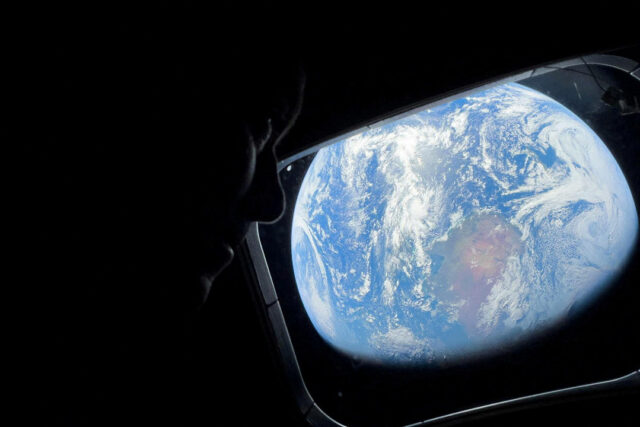
NASA astronaut and Artemis II Commander Reid Wiseman peers out of one of the Orion spacecraft’s main cabin windows, looking back at Earth, as the crew travels towards the Moon, April 2, 2026. — HANDOUT VIA REUTERS/NASA

HOUSTON — The four astronauts of the National Aeronautics and Space Administration’s (NASA) Artemis II mission flew deeper into space on Monday than any humans before them, as they cruised through a rare flyby of the shadowed far side of the moon that revealed a lunar surface under cosmic bombardment.

The six-hour survey of the normally hidden hemisphere of Earth’s only natural satellite was highlighted by the astronauts’ direct visual observations of “impact flashes” from meteors pelting the darkened and heavily cratered lunar surface.

About two dozen scientists packed a conference room adjacent to mission control at NASA’s Johnson Space Center in Houston to record the lunar phenomena witnessed by the Artemis crew in real time as their Orion spacecraft, about the size of an SUV, sailed around the moon roughly a quarter million miles (402,000 kilometers) from Earth.

The six-hour flyby, which swooped to within 4,070 miles of the lunar surface, came six days into a spaceflight marking the world’s first voyage of astronauts to the vicinity of the moon since NASA’s Cold War-era Apollo missions more than half a century ago.

Six of those missions landed two-man teams on the moon between 1969 and 1972 — the only 12 humans ever to walk on its surface.

Artemis, a successor to the Apollo program, aims to repeat that achievement by 2028, ahead of China’s first landing, and to establish a long-term US lunar presence over the next decade, including a moon base to serve as a proving ground for potential future missions to Mars.

While designed as a crewed dress rehearsal for future lunar excursions, Artemis II generated a wealth of new material for lunar scientists to study, including meteor impact flashes recorded during Monday’s flyby that were reminiscent of sparks and streaks of light described by some of Apollo’s astronauts.

The Artemis II crew, riding in their Orion capsule since launching from Florida last week, began their sixth day of spaceflight as they awoke on Monday to a pre-recorded message from the late NASA astronaut Jim Lovell, who flew aboard the Apollo 8 and Apollo 13 moon missions.

“Welcome to my old neighborhood,” said Mr. Lovell, who died last year at age 97. “It’s a historic day, and I know how busy you’ll be, but don’t forget to enjoy the view… good luck and Godspeed.”

Hours later, the crew consisting of US astronauts Reid Wiseman, Victor Glover and Christina Koch along with Canadian astronaut Jeremy Hansen, made spaceflight history by venturing farther from Earth than any humans have before, at 252,756 miles.

The previous record, roughly 248,000 miles, was set in 1970 by Apollo 13 after a nearly catastrophic spacecraft malfunction cut short that mission, forcing Mr. Lovell and his two crewmates to use the moon’s gravity to help return them safely to Earth.

NAMING CRATERS
En route to the far side of the moon, the Artemis astronauts spent some time assigning provisional new names to lunar features that previously lacked official designations.

In a radio message to mission control in Houston, Mr. Hansen suggested one crater be dubbed Integrity, after the name given to the crew’s Orion capsule, and that another be named in honor of Mr. Wiseman’s late wife, Carroll, who died of cancer in 2020.

“A number of years ago we started this journey, our close-knit astronaut family, and we lost a loved one,” Mr. Hansen said of the mission commander’s late spouse, his voice choking with emotion as he described the position of her lunar namesake. “It’s a bright spot on the Moon, and we would like to call that Carroll.”

Mr. Hansen later said the crew had viewed a number of lunar features that “no human has ever seen before, not even in Apollo.”

As Orion hurtled around the moon’s far side, the astronauts photographed a rare moment in which Earth, dwarfed by their record-breaking distance from the planet, set and rose with the lunar horizon as they swung around the moon, a striking celestial reversal of the rising and setting moon typically seen from Earth.

Because the moon rotates at the same speed as it revolves around the Earth, its far side always faces away from our planet and only the Artemis and Apollo astronauts have ever gazed directly on its surface.

RARE DETAILED PHOTOS
Monday’s lunar flyby plunged the crew into darkness and a 40-minute communications blackout as the moon blocked them from NASA’s Deep Space Network, a global array of massive radio communications antennas the agency has been using to talk to the crew.

Following the flyby, US President Donald J. Trump congratulated the four crew members on an audio link from the White House as they appeared on camera by live satellite feed from space.

“Today, you’ve made history and made all America really proud, incredibly proud,” Mr. Trump said. “You’ve really inspired the entire world. Really, everybody’s watching.”

Ms. Koch told Mr. Trump that one of her most unforgettable moments of the flyby was “coming back from the far side of the moon and having the first glimpses of planet Earth again.”

Asked by the president how they felt when all communication with Earth was cut off as Orion flew behind the moon, Mr. Glover answered, “I said a little prayer, but then I had to keep rolling.” — Reuters

Asian airlines trim schedules and carry extra fuel as supplies tighten

STOCK PHOTO | Image from Pixabay

HONG KONG/SINGAPORE — Airlines across Asia are cutting flights, carrying extra fuel from home airports and adding refueling stops as the Middle East conflict squeezes jet fuel supply in some countries, adding to pressure on an industry already hit by a sharp jump in fuel costs.

European carriers are bracing for similar disruption after Iran’s closure of the Strait of Hormuz cut off nearly 21% of global seaborne jet fuel supply, according to Kpler.

Previous oil shocks mainly drove up prices, but this one is also constraining physical supply, forcing governments, airlines, and airports to consider rationing.

“In my conversation with airlines, they are very concerned about what the future looks like, because we do not know when the war will end and we don’t know when the supply chain, the feedstock, will come from the Gulf area,” said Shukor Yusof, founder of aviation consultancy Endau Analytics.

Asia, Europe, and Africa are most exposed, analysts say, because the US has ample domestic supplies.

Within Asia, the pain has so far been sharpest in lower-income, import-dependent markets such as Vietnam, Myanmar, and Pakistan after China and Thailand halted jet fuel exports and South Korea capped them at last year’s levels.

Budget airline AirAsia X is now loading extra fuel in Malaysia before flying to Vietnamese airports, CEO Bo Lingam told reporters on Monday.

“Not to say that they are not giving us fuel, but they limit the amount of fuel,” he said of Vietnam.

JET FUEL RATIONING
Past temporary jet fuel shortages at airports due to shipment disruptions or contamination have usually led to rationing rather than complete outages.

Airlines have typically responded by loading extra fuel at home airports, adding refueling stops on longer routes or carrying less cargo.

For a more prolonged crisis, another solution is cutting flights, Ryanair CEO Michael O’Leary said last week when he expressed concerns the Middle Eastern conflict may not end this month.

“If there’s a risk to 10% or 20% of the fuel supply in June or July or August, then we and other airlines will have to start looking at canceling some flights or taking some capacity out,” he told reporters.

Asia, which has a thinner supply cushion than Europe and is more dependent on Hormuz flows, has been hit more quickly.

Vietnam Airlines has cut 23 domestic flights per week to conserve fuel, according to the country’s aviation authority.

Airlines based in Myanmar suspended domestic flights for part of March due to jet fuel shortages, its transport ministry said, and some of its carriers have also cut capacity in April, according to aviation data provider Cirium.

Air India is making refueling stops in Kolkata on its return from Yangon to Delhi due to fuel shortages at Yangon airport, according to a source familiar with the matter.

In the South Pacific, Tahiti International Airport has restricted refueling for international flights to quantities essential for flight operations due to the Middle Eastern crisis, a notice to pilots shows.

In Pakistan, pilots are being advised to carry maximum fuel from abroad.

That practice, known as “tankering”, is costly because carrying extra fuel increases fuel burn.

“Some countries are in better shape than others,” said Brendan Sobie, a Singapore-based independent aviation analyst. “Some may be limiting (fuel for) foreign airlines, which then leads to the tankering. This could be proactive as some countries fear they could run out.”

DEMAND DESTRUCTION
A more than doubling of jet fuel prices since the start of the Iran war has pushed some airlines to cut capacity, while others have hiked fares and imposed fuel surcharges.

In one of the starkest examples, Batik Air Malaysia has slashed domestic capacity by 36%, with CEO Chandran Rama Muthy describing the cuts as a necessary and proactive response to a “crisis-mode” environment.

“If we were to continue operating without making adjustments, it could further expose the company to operational and financial risk,” he said.

Gulf carriers such as Emirates and Qatar Airways have been operating well below normal capacity due to the conflict, while other global airlines have also cut flights as fare increases needed to cover fuel costs deter price-sensitive travelers.

Even with flight cuts, airline demand is not falling fast enough to match the drop in jet fuel supply, analysts said.

At least 400,000 barrels per day of jet fuel that normally is produced in the Asia-Pacific region via crude that transits the Strait of Hormuz have been affected since the crisis started, according to Reuters’ calculations.

“There is no easy way to replace the lost volumes, especially as Asian supply will start to tighten as refiners cut runs,” said Alex Yap, senior oil products analyst at Energy Aspects.

Industry sources estimate flight cancelations have lowered April demand in Asia specifically by only about 50,000 to 100,000 barrels per day, suggesting deeper cuts may be needed.

“We’re only just at the start of that cycle (of flight cuts) as demand from passengers seems to be resilient, but I think any oil-spike induced economic slowdown could hit demand in the second half of the year,” said Cirium’s Asia editor, Ellis Taylor. — Reuters

Middle East war threatens Philippine growth outlook

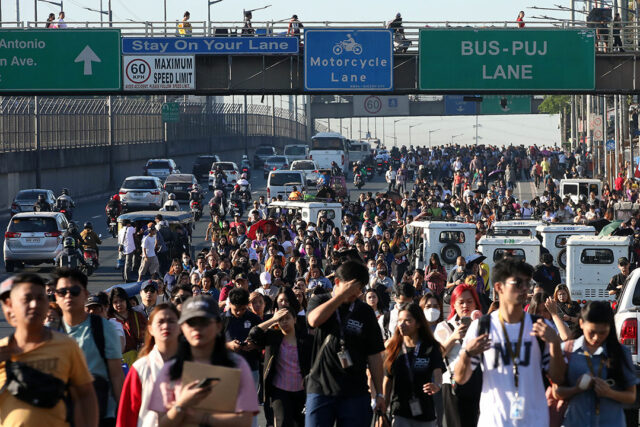
Commuters wait for public transportation along Commonwealth Avenue, Quezon City, March 25, 2026. — PHILIPPINE STAR/MIGUEL DE GUZMAN

By Katherine K. Chan, Reporter

THE MIDDLE EAST conflict threatens the Philippines’ growth prospects but a rebound in private spending and robust exports could still position the country as the second fastest-growing economy in the region, the ASEAN+3 Macroeconomic Research Office (AMRO) said.

AMRO Chief Economist Dong He said Philippine gross domestic product (GDP) is expected to expand by 5.3% this year, unchanged from their forecast in January, and by 5.8% in 2027.

“This makes the Philippines one of the faster-growing economies in the region — above the ASEAN (Association of Southeast Asian Nations) average of 4.6% and the ASEAN+3 average of 4%,” Mr. He told BusinessWorld in an e-mail interview. “The acceleration reflects an expected recovery in private consumption and stronger exports.”

If both projections hold true, the Philippines would be the second fastest-growing economy within the ASEAN, only trailing Vietnam which is seen to expand by 7.4% this year.

The country is also seen to outpace Indonesia (5%), Cambodia (4.9%), Laos (4.6%), Malaysia (4.6%), Singapore (3.4%), Myanmar (2.5%), Brunei (1.9%) and Thailand (1.7%).

The Philippine economy is also expected to surpass its 4.4% growth last year or when the flood control graft scandal slowed government spending, household consumption and investments in the country.

AMRO’s projections are within the government’s 5-6% GDP growth goal for this year and 5.5-6.5% for 2027.

Household spending, which accounts for over 70% of the country’s GDP, grew by 3.8% in the fourth quarter, the weakest pace seen since the -4.8% in the first quarter of 2021. Full-year household spending growth eased to 4.6% in 2025 from 4.9% in 2024.

Although AMRO maintained its growth estimate for the Philippines, it noted that domestic demand may continue to be subdued throughout the year.

“In 2026, tariff effects are expected to materialize and dampen external activity, while domestic demand is also expected to remain soft in a few economies, notably Thailand and the Philippines,” AMRO said in its latest Regional Economic Outlook for 2026.

While the country may be well positioned this year, Mr. He also noted that global trade uncertainties and financial market volatility and energy shocks amid the ongoing conflict in the Middle East could weigh on its economic growth.

“The conflict in the Middle East and the resulting disruption to the Strait of Hormuz pose the most immediate risk to the outlook — a protracted disruption to global energy supply could push inflation higher and weigh materially on growth,” he said.

“Other key risks include unpredictable US trade policy shifts, the uncertain trajectory of technology demand, and volatile global financial markets,” he added.

Oil trade disruptions have led to energy price shocks globally, with the Philippines facing oil price surges and looming fuel shortages as the war drags on.

AMRO Group Head and Lead Economist Allen Ng said the economy could grow even faster if not for the economic drags triggered by the global oil crisis from the Middle East war.

“I think there was strong momentum in growth in the Philippines prior to the escalation of the conflict, and it’s driven a lot by domestic demand activities,” Mr. Ng said at a press briefing on Monday.

“So, what we have seen is that if, again, if the Iran conflict (had) not occurred, the growth could have been higher for the case of the Philippines,” he added.

EXTERNAL HEADWINDS
Meanwhile, Mr. He said the Philippines will likely remain resilient against tariff and trade disruptions.

“The Philippines has been relatively less affected by tariff and trade disruptions, reflecting its more domestically driven growth and lower reliance on goods exports,” he said.

“However, vulnerabilities remain in electronics and semiconductor exports. To mitigate risks, the country should further diversify export markets, improve trade facilitation and logistics, and attract firms looking for supply chain relocation to strengthen external resilience,” he added.

The country’s goods exports grew by 15.2% to $84.41 billion last year, exceeding the Bangko Sentral ng Pilipinas’ (BSP) projected 9% growth to $60 billion.

For this year, the BSP expects goods exports to rise modestly by 3% to $65.3 billion amid reduced front loading and elevated trade costs, before picking up by 4% to $67.9 billion in 2027.

The information technology and business process management (IT-BPM) and finance sectors may also help drive the country’s growth this year, Mr. He said.

However, he noted that the IT-BPM industry needs policies to support its shift toward knowledge process outsourcing (KPO) and global capability centers (GCCs) activities.

“For the Philippines, the high value-added knowledge-based services, such as the IT-BPM and finance would continue to be the key sources of value-added creation,” Mr. He said. “However, with AI (artificial intelligence) becoming increasingly prevalent, a concerted shift is required toward higher-value segments, namely, KPO, GCCs and digital trade services.”

Amid current economic shocks, Mr. He also said the Philippines has a “sharper mandate than usual” in tightening regional cooperation and addressing shared economic challenges as it takes the helm in the ASEAN.

“The current moment — where trade disruptions and an energy shock are testing the region simultaneously — gives the chairmanship a sharper mandate than usual,” AMRO’s chief economist said.

Mr. He said the National Government must pursue local reforms alongside regional development efforts, especially by drawing in private investments, enhancing infrastructure delivery and strengthening capital markets.

“The current external environment raises the cost of delaying these reforms,” he added.

This year, the Philippines assumed chairship of the 11-member regional bloc, composed of Brunei, Cambodia, Indonesia, Laos, Malaysia, Myanmar, the Philippines, Singapore, Thailand, Vietnam and Timor-Leste.


BSP may hike if inflation breaches 4%, says AMRO

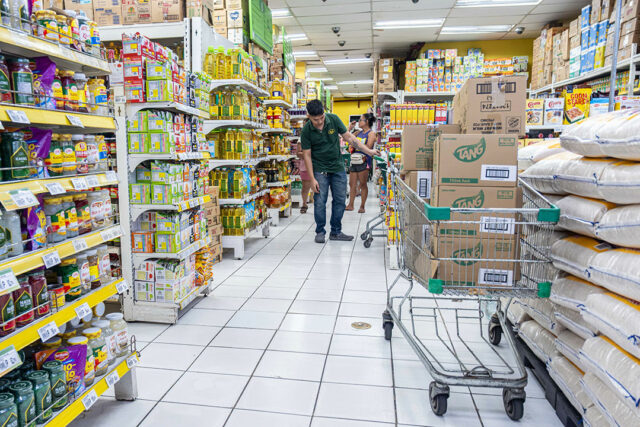
People shop inside a grocery store in Ermita, Manila. — PHILIPPINE STAR/RYAN BALDEMOR

By Katherine K. Chan, Reporter

THE Bangko Sentral ng Pilipinas’ (BSP) easing cycle has likely ended, with rate hikes now on the table as energy shocks amid the Middle East war could stoke inflation this year, the ASEAN+3 Macroeconomic Research Office (AMRO) said.

In its latest Regional Economic Outlook for 2026, AMRO said it sees the country’s consumer price index (CPI) picking up to 3.9% this year if oil prices hold around $80-$90 per barrel.

This is faster than its previous 3.2% estimate and the 1.7% inflation print in 2025.

By next year, AMRO sees inflation cooling to 3.6%.

If realized, the CPI would settle near the upper end of the central bank’s 2%-4% goal for two straight years.

AMRO Chief Economist Dong He noted that the Philippines’ heavy reliance on imported oil from the Middle East makes it vulnerable to price and supply shocks.

“The Philippines is one of the more affected countries in the region,” he told BusinessWorld in an e-mail interview. “As a net oil and gas importer, with 98% of its oil imports sourced from the Middle East, the Philippines is exposed to higher oil prices and potential supply disruptions.”

For now, Mr. He said the BSP may adopt a “wait-and-see” approach while assessing the duration of the oil supply shocks.

“The policy advice is really to probably wait and see, and see how long the shock would last. I think it’s the persistence of the shock that matters,” he said at a press briefing on Monday. “If the persistence is longer than expected, then of course, and we see continued inflationary pressures, the central bank may need to react because it has an inflation target range of 1% plus and minus around the 3% target.”

Asked if he still sees room for further easing, Mr. He said: “We don’t see space for cutting rates at the moment because we see upside risks to inflation in the Philippines.”

He noted that the central bank may consider monetary policy tightening if inflation breaches the BSP’s target band for a prolonged period.

“If it goes out of the range, then there may be a need to review, particularly if the shock is expected to last longer, and then the central bank may need to tighten, and that’s the framework that’s in place,” Mr. He said.

Last month, the BSP kept its benchmark rate unchanged at 4.25% in an off-cycle meeting to calm markets worried over uncertainties arising from the US-Iran war.

Its next regular policy meeting is scheduled for April 23.

BSP Governor Eli M. Remolona, Jr. said the Monetary Board arrived at the decision after noting that the current price pressures are supply-driven, and hiking rates immediately risk derailing the country’s economic recovery.

He added that future monetary policy decisions will consider second-round price effects, particularly a potential uptick in transport fares, food and fertilizer prices, electricity rates and wages.

Mr. He said the central bank must “respond decisively” once such second-round effects materialize.

However, Mr. He told BusinessWorld that the BSP must be cautious in adjusting its monetary policy as the country’s growth momentum remains weak.

“Given heightened uncertainty, the authorities should remain vigilant and stand ready to recalibrate policy parameters to mitigate the impact of external shocks,” he added. “Specifically, amid rapidly evolving geopolitical tensions, volatile energy prices, and weaker growth momentum, the BSP should remain cautious in making monetary policy adjustments.”

AMRO expects the Philippine economy to expand by 5.3% this year, though noted that subdued domestic demand and energy shocks poses risks to its growth outlook.

“Meanwhile, enhanced coordination between fiscal and monetary authorities is required to cushion the impact of supply-driven inflation and prevent adverse effects on growth,” Mr. He added. “In this regard, the government could consider timely administrative measures, such as targeted subsidies to highly exposed sectors and reducing tariffs on energy imports.”

AMRO Group Head and Lead Economist Allen Ng also noted that monetary and fiscal authorities should prioritize preventing the supply-driven oil shocks from worsening further.

“I think the key point that we wanted to highlight is the fact that, in this environment, the policy priority is really to stop a supply-driven shock from becoming broader and more persistent,” Mr. Ng said during the briefing.

“That means staying alert for second-round effects, with monetary policy remaining cautious, and fiscal policy focused on timely, well-targeted support for the most exposed sectors and households,” he added.

Pump prices continue to rise; diesel may top P170 per liter

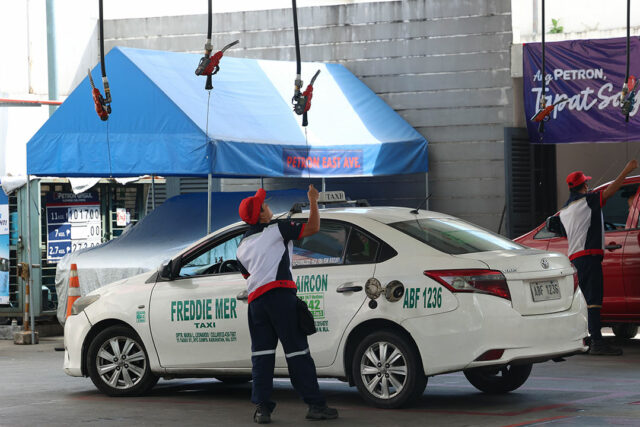
AN ATTENDANT prepares to fill a taxi’s tank with fuel at a gas station in Quezon City. — PHILIPPINE STAR/MIGUEL DE GUZMAN

By Sheldeen Joy Talavera, Reporter

PUMP PRICES are expected to continue to go up this week, with diesel likely to go above P170 per liter as the Iran war enters its second month.

In separate advisories on Monday, some major oil companies announced a fresh round of hikes with diesel prices set for another double-digit increase starting Tuesday (April 7).

Shell Pilipinas Corp. will raise prices by P19.80 per liter for diesel, P5.90 per liter for gasoline, and P9.10 per liter for kerosene.

Petron Corp. is set to hike diesel prices by P18.80 per liter, gasoline by P4.90 per liter, and kerosene by P8.10 per liter.

Seaoil Philippines, Inc. will implement an increase of P17.95 per liter for diesel, P4.90 per liter for gasoline, and P8.10 per liter for kerosene.

On the other hand, Jetti Petroleum, Inc. will hike prices by P18.60 per liter for diesel and P5.40 per liter for gasoline starting Friday, April 10.

“We believe the delayed implementation will help cushion the impact of the significant increase, particularly on diesel,” Jetti President Leo P. Bellas said in a Viber message.

Other oil firms have yet to announce their respective price adjustments as of press time.

With the latest price hikes, diesel prices may go up as high as P172 per liter while gasoline prices may hit nearly P120 per liter.

The Philippines is a net importer of crude oil and relies heavily on crude supplies from the Middle East, the world’s top oil-producing region that is currently being disrupted by the Iran war. This dependence makes the country highly vulnerable to global crude price swings.

Since the outbreak of the US-Israel attack on Iran on Feb. 28, the increases in diesel prices have already totaled P100.05 per liter, while gasoline and kerosene have surged by around P52.30 and P82.40 per liter, respectively.

These price spikes are partly linked to the ongoing conflict in the Middle East, brought by Iran’s blockage of the Strait of Hormuz, a strategic waterway and critical chokepoint that handles a significant share of global crude shipments.

The Department of Foreign Affairs last week said Iran had agreed to allow Philippine‑flagged vessels to transit the waterway.

While the deal could reduce the risk of fuel supply disruption, Energy Secretary Sharon S. Garin said this would not immediately lower pump prices, as oil prices remain elevated due to geopolitics and global trading conditions.

As of March 27, the country’s average petroleum supply is equivalent to 50.94 days.

Jose M. Layug, a former Energy undersecretary and executive board member of the Philippine Energy Research & Policy Institute, said market pricing would remain volatile as long as the Middle East conflict persists.

“The oil market continues to be volatile and reacts to a drawn-out Middle East conflict. The best long-term solution for the Philippines is still to reduce reliance on the use of oil,” he told BusinessWorld.

Albert Dalusung III, energy transition advisor at Institute for Climate and Sustainable Cities, said the Philippines is not under a dire situation with the supply in place, but warned that prices have little room to decline.

“It’s not dire, but it’s a very difficult situation because we don’t know where the prices will go. As for me, I’m hopeful that this will end, and I hope that we can learn from it,” Mr. Dalusung told ANC’s Headstart on Monday.

He said the Philippines must develop its indigenous resources, such as renewable energy, to reduce reliance on imported energy resources.

Philippines at ‘high risk’ for political instability amid Middle East conflict

Philippine flags are seen in Rizal Park, Manila. — PHILIPPINE STAR/NOEL PABALATE

By Beatriz Marie D. Cruz, Senior Reporter

THE PHILIPPINES remains at “high risk” for political instability as the widening conflict in the Middle East threatens local supply chains and energy security, according to Washington‑based South Asia Foresight Network (SAFN).

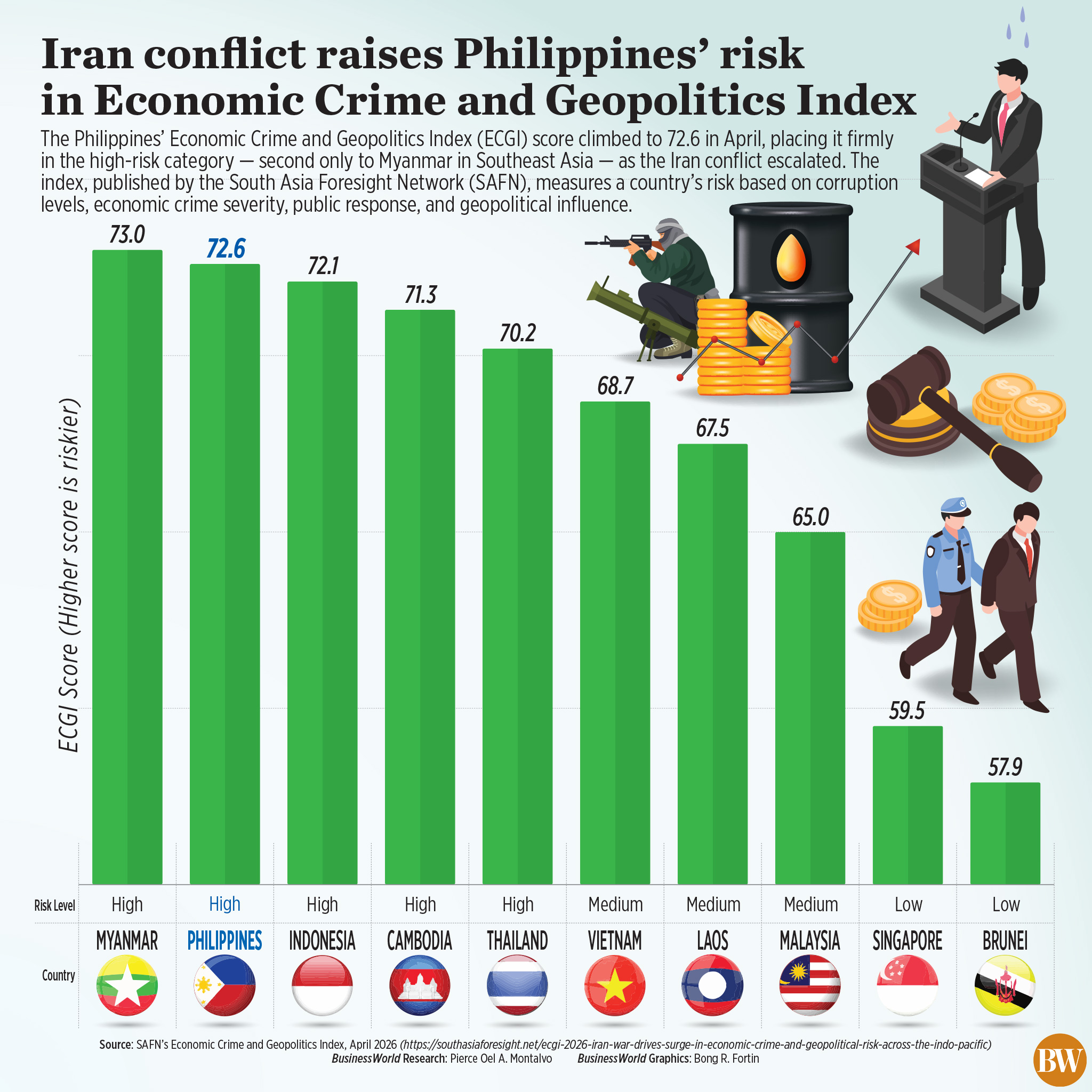
In its 2026 Economic Crime and Geopolitics Index (ECGI), the Philippines’ score rose to 72.6 from 71.65 in November 2025. This score keeps the Philippines at a “high risk” level.

The country first reached the “high risk” level in November last year amid heightened public unrest from the corruption scandal.

The index assesses how a country’s corruption levels, severity of economic crime, public response, and geopolitical pressures shape political stability.

Aside from the Philippines, other Southeast Asian countries considered as “high risk” include Myanmar (73), Indonesia (72.1), Cambodia (71.3), and Thailand (70.2).

On the other hand, Vietnam (68.7), Laos (67.5), and Malaysia (65) were classified as “medium risk” countries, while Singapore (59.5) and Brunei (57.9) were considered “low risk.”

The Philippines obtained a score of 32 in the 2025 Corruption Perceptions Index, 7 in economic crime severity, 7 in public response exposure, and 7.5 in geopolitical influence.

Asanga Abeyagoonasekera, executive director of SAFN at the Millennium Project in Washington, D.C., said the Philippines’ archipelagic geography and maritime connectivity make it highly exposed to trade disruptions.

“The Iran war acts as a direct transmission mechanism of risk: energy shocks translate into fiscal pressure, social unrest, and increased opportunities for economic irregularities, reinforcing the Philippines’ high-risk classification,” he told BusinessWorld in an e-mail.

Conflicts in the Middle East, which drove global oil prices and freight costs higher, pose risks to import-dependent economies like the Philippines, Mr. Abeyagoonasekera said.

“The country’s geography makes it inherently dependent on maritime trade routes for energy, food, and industrial inputs. This structural dependence amplifies the impact of global supply chain shocks,” he noted.

The Philippines is a net importer of oil and relies heavily on Middle East crude, which accounts for 98% of its imports.

“Economic crime risks persist in areas such as procurement, customs, and fuel distribution — sectors that become particularly vulnerable during periods of crisis,” he said.

Geopolitical risks affect the Philippines through economic stress than direct security threat, Mr. Abeyagoonasekera said.

“Economic hardship intensifies public expectations, while government capacity is tested in managing subsidies, price controls, and social protection mechanisms,” he noted.

Vulnerable sectors include food supply, transport and logistics, customs and procurement, and small and medium enterprises, Mr. Abeyagoonasekera said.

Fuel prices and inflation directly affect households, which could trigger protests and political pressures, Mr. Abeyagoonasekera also said.

SAFN noted that economic crime risks are no longer concentrated within national boundaries but are directly affected by external shocks. Geopolitical influence has now shifted to a “shock-sensitive driver of risk,” it added.

“Supply chain centrality has heightened the vulnerability of economies like Vietnam, Bangladesh, and the Philippines, whose integration into global manufacturing networks now exposes them more directly to external shocks,” SAFN said.

It also noted that maritime states like Sri Lanka, Singapore, Indonesia, and Malaysia play a key role as shipping routes are reshaped by tensions in the Middle East.

SAFN said that conflict spillovers have increased the exposure of countries like Myanmar and Afghanistan to instability.

The ECGI showed South and Central Asian countries had the highest risk due to their proximity to the conflict. These include Afghanistan (78.5), followed by Pakistan (76.5), Sri Lanka (76.2), Bangladesh (74.3), India (73.2), and Nepal (73.2).

To cushion geopolitical risks on the Philippines, Mr. Abeyagoonasekera said the country should diversify its energy sources, especially renewables; enhance transparency in Customs, procurement and fuel distribution; stabilize the price of goods; increase subsidies; and leverage cooperation with its regional neighbors.

“Without urgent corrective action — particularly in energy governance, procurement transparency, institutional accountability, and regional coordination mechanisms — these risks will continue to intensify,” SAFN said.

PCC flags competition concerns in retail power market

STOCK PHOTO | Image by Rawpixel.Com from Freepik

THE PHILIPPINE Competition Commission (PCC) said the government may need to review rules governing companies involved in both electricity generation and retail supply, citing competition concerns in the retail electricity market.

Citing its market study, the PCC said retail electricity suppliers (RES) affiliated with power generators may have easier access to electricity supply, making it more difficult for other industry players to compete.

“If generators would prioritize supplying electricity through bilateral contracts, spot market, and retail supply agreement with their affiliate retailer, independent retailers would be left with residual supply,” the competition watchdog said in a statement on Monday.

The PCC said revisiting policies on vertical integration between generation and retail distribution may be necessary to enhance competition in the retail market.

There are 57 licensed RES and 30 authorized local RES, based on Energy Regulatory Commission (ERC) data as of end-2025.

Electricity retailing allows licensed suppliers to sell electricity directly to eligible consumers, as stipulated under the Electric Power Industry Reform Act (EPIRA).

The law mandates the implementation of retail competition and open access (RCOA), which allows consumers to choose their electricity supplier.

As of end-2025, there were 3,737 eligible end-users that met the threshold, representing an actual demand of 6.36 gigawatts, according to the ERC.

Initial findings of the PCC’s market study showed that barriers continue to limit the ability of eligible customers to switch to RES, including limited awareness of the process and delays in the procurement and installation of retail metering systems.

The PCC also noted a high level of “affiliate switching,” where customers move between retail suppliers affiliated with the same parent company.

It said such practices do not necessarily result in increased competition and may require measures to ease the entry of independent retailers to broaden consumer choice.

The agency recently conducted a strategic policy dialogue with the Independent Electricity Market Operator of the Philippines (IEMOP) to discuss the findings of its study on competition and switching barriers in the retail electricity market.

IEMOP operates the Wholesale Electricity Spot Market, where energy companies can purchase power when long-term contracted supply is insufficient.

Both agencies expressed interest in collaborating, including sharing data and research outputs, as well as promoting awareness of customer choice programs available to eligible electricity consumers.

Starting June, the minimum threshold for participation in the retail market will be lowered from 500 kilowatts (kW) to 100 kW, a move expected to increase customer participation and potentially support competition.

To prepare for the anticipated increase, IEMOP is upgrading its central registration system to streamline and automate customer switching requirements. — Sheldeen Joy Talavera

The magic is still there

FACEBOOK.COM/ENCHANTEDKINGDOM.PH

By Joseph L. Garcia, Senior Reporter

AFTER EVERYTHING I’ve tasted in the years between my childhood visits to Enchanted Kingdom to my 30s, I thought the theme park, built in 1995, would get stale. Not a chance. On a trip to the Sta. Rosa, Laguna, theme park last month, I learned how nice it was to revisit places that brought us joy in childhood (and especially now with adult wallets).

The theme park, I am glad to note, has changed little, save for a few new rides: they have the new EKlipse, a ride with rotating arms, and Agila The EKsperience (think Soarin’ Over California in Disneyland, but set here; due to time constraints, we did not try this ride). They also reopened the Wheel of Fate, the old-fashioned Ferris wheel taking riders up 130 feet to offer a view of the park (which, due to the same reasons, we were not able to ride).

Enchanted Kingdom gave me all-day passes, and along with my friend Alyssa and her 10-year-old daughter Lia (an alias), we all went to the very back of the park for the Jungle Log Jam, a water ride that lifts a log that seats four up a slope followed by a drop into water that splashes everyone inside the car. This was Lia’s first “big girl” ride, but we noted that there are now seatbelts in the ride (our high school memories are now hazy, but we don’t recall using them as teens). After the climb and the splash, Alyssa hastily wiped her face because of her worry about the water’s purity. But as we were laughing as we disembarked from our log, we concluded we had a pretty good time (except for Lia, who resisted going on the next ride).

It was the Space Shuttle: in our teen years, it was seen as a rite of passage to ride on this rollercoaster that turned guests upside-down six times, forward and backward. We actually lost count how many times we were flipped by the ride, and our only real memory was screaming our heads off. Alyssa was the same girl I sat with on this ride as a 14-year-old, and we noted both with some satisfaction that now in our 30s, we could still do the Space Shuttle (but not anytime soon again). Another girl I knew, who was also at the park, approached me afterwards and asked if I was the one screaming all the R-18 expletives during the ride (I was). Well, I wasn’t allowed to back then, but who’s going to tell me not to, now?

Another thing I did that I didn’t do back then was get my pictures from the rides. They were expensive then, and they’re still expensive now (P350 for each photo! One can access them digitally through a QR code provided with each photo, but still). No longer tied down with a limited allowance, I asked before getting on any ride where the cameras were so I could prepare and pose. I’m glad to know that I can hold a pose on a thrill ride.

After riding the relatively tame childhood classic Roller Skater (as a favor to Lia — due to the ride’s popularity with the younger crowd, we were in line for more than an hour), Alyssa and I promised to join Lia in something more thrilling: the EKstreme, a drop ride that takes one 40 meters up in the air while strapped in one’s seat, before going on a fall at 76 kilometers per hour. We were not able to ride this when we were younger, so there was no familiar feeling to lean back on. The cameras captured our suffering: my lips were pursed tightly on our ascent (I developed a discomfort with heights after high school), then the various photos showed my initial gasp then scream as we dropped, then my face scrunching up waiting for our descent, then a whistle of relief while clutching the black pearl necklace I hid under my shirt (for safety reasons).

Taking out my pearls, we decided on something we thought would be more calming: the new EKlipse, the ride with the rotating arms with a gondola on each end. The theme park’s website says the ride was designed by Italian company Zamperla, and takes one up 36 feet in the air. We were wrong about the ride’s calming quality: the ride’s spin offered us a screaming view of the park at nighttime, not to mention more than a few minutes just dangling up in the air. Of course, after the ride was over, we shook ourselves off and figured it was really great fun (though not to be repeated soon).

Alyssa took Lia to the Grand Carousel for something really calming, then went to the Rio Grande Rapids, another rite-of-passage ride from our teens. On a circular boat, a party is taken through a rushing “river,” and waterfalls and the inevitable splashes are designed to give one a good soak. Since guests emerge from the ride dripping wet, the theme park has installed dryers (that we swore were not there 20 years ago, in 2006), but they cost about P200 to use — and at that point we had already spent thousands on ride photos. Alyssa whispered that she knew a better way to dry off: the Flying Fiesta, another classic. One rides in a giant swing that takes your legs high off the ground, but spins at a less-thrilling pace.

By the time we got off the ride, it was 8 p.m. and the park was closing, so it was time to go home.

I’m glad to note that after everything we’ve been through since high school, our bodies and spirits can still withstand everything Enchanted Kingdom can throw at us. The rides gave us wholesome highs and brought out an innocence that we’d forgotten was still there. If we remember correctly, the park’s old tagline was “The magic is here,” but it has since changed to “The magic lives forever.” We’re inclined to agree.

Ayala group keeps largest share in retail renewable energy segment — PEMC

ACENRES.COM

THE AYALA GROUP, through ACEN Corp.’s retail electricity supply arm ACEN RES, retained the largest share in the retail renewable energy (RE) market for three consecutive years, according to the Philippine Electricity Market Corp. (PEMC).

In its annual retail market assessment report, PEMC said the Ayala group’s market share in terms of end-users rose to around 65% in 2025 from 36% in 2022.

This made the Ayala group the largest provider under the Green Energy Option Program (GEOP), a government initiative that allows eligible consumers to source electricity from RE suppliers.

According to PEMC, the increase in the Ayala group’s share of GEOP end-users tracked the rise in its overall energy share.

“This suggests that its customer base is not only large in number but also meaningful in terms of aggregate energy demand,” the agency said.

Lopez-led First Gen Corp. was the second-largest RE retailer last year with a market share of 20%, followed by the Meralco group at 2% and the Aboitiz group at 1%.

Launched in 2021, GEOP allows eligible consumers with a monthly average peak demand of 100 kilowatts (kW) to source 100% renewable energy from a preferred supplier.

The threshold is set to be lowered to 50 kW after the Department of Energy revised the rules and guidelines governing GEOP implementation.

PEMC said the GEOP segment grew in 2025, with the number of end-users increasing to 791 from 199 in 2022.

Supplier participation also increased, with registered RE suppliers rising to 21 and active suppliers to 13 by yearend.

PEMC reported that GEOP demand increased during the year, rising from 67 gigawatt-hours (GWh) in January to nearly 98 GWh by December.

GEOP end-users in the commercial sector accounted for most of the demand, while industrial end-users, though fewer, provided stable consumption levels. — Sheldeen Joy Talavera

ADVERTISEMENT
ADVERTISEMENT