Home Blog Page 966

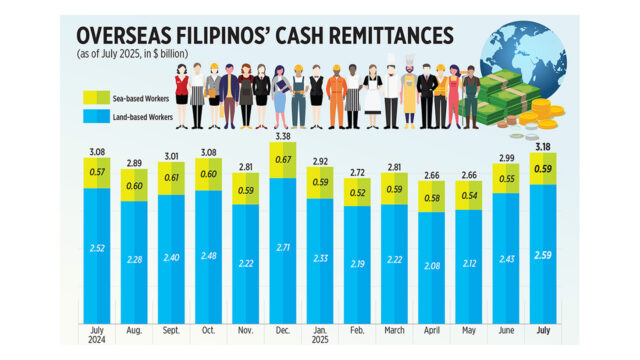
Overseas Filipinos’ Cash Remittances

FILIPINOS ABROAD sent more money home in July, hitting a seven-month high as remittances from sea-based workers grew at a slightly quicker pace than those from land-based workers, the Bangko Sentral ng Pilipinas (BSP) said on Monday. Read the full story.

250916OFW_Remittances

‘It feels like, almost, he’s here’: How AI is changing the way we grieve

ETERNOS

By Hani Richter

DIEGO FELIX DOS SANTOS never expected to hear his late father’s voice again — until AI made it possible. “The tone of the voice is pretty perfect,” he says. “It feels like, almost, he’s here.”

After the 39-year-old’s father unexpectedly passed away last year, Dos Santos traveled to his native Brazil to be with family. It was only after returning to his home in Edinburgh, Scotland, that he says he realized “I had nothing to actually remind [me of] my dad.” What he did have, though, was a voice note his father sent him from his hospital bed.

In July, Dos Santos took that voice note and, with the help of Eleven Labs — an artificial intelligence-powered voice generator platform founded in 2022 — paid a $22 monthly fee to upload the audio and create new messages in his father’s voice, simulating conversations they never got to have.

“Hi son, how are you?” his father’s voice rings out from the app, just as it would on their usual weekly calls. “Kisses. I love you, bossy,” the voice adds, using the nickname his father gave him when he was a boy. Although Dos Santos’ religious family initially had reservations about him using AI to communicate with his father beyond the grave, he says they’ve since come around to his choice. Now, he and his wife, who was diagnosed with cancer in 2013, are considering creating AI voice clones of themselves too.

Dos Santos’ experience reflects a growing trend where people are using AI not just to create digital likenesses, but to simulate the dead. As these technologies become more personal and widespread, experts warn about the ethical and emotional risks — from questions of consent and data protection to the commercial incentives driving their development.

The market for AI technologies designed to help people process loss, known as “grief tech,” has grown exponentially in recent years. Ignited by US startups such as StoryFile (an AI-powered video tool that lets people record themselves for posthumous playback) and HereAfter AI (a voice-based app that creates interactive avatars of deceased loved ones), this tech markets itself as a means to cope with, and perhaps even forestall, grief.

Robert LoCascio founded Eternos, a Palo Alto-based startup that helps people create an AI digital twin, in 2024 after losing his father. Since then, more than 400 people have used the platform to create interactive AI avatars, LoCascio says, with subscriptions starting from $25 for a legacy account that allows a person’s story to remain accessible to loved ones after their death.

Michael Bommer, an engineer and former colleague of LoCascio’s, was among the first to use Eternos to create a digital replica of himself after learning of his terminal cancer diagnosis. LoCascio says Bommer, who died last year, found closure in leaving a piece of himself behind for his family. His family has found closure from it too. “It captures his essence well,” his wife Anett Bommer, who lives in Berlin, Germany, told Reuters in an e-mail. “I feel him close in my life through the AI because it was his last heartfelt project and this has now become part of my life.”

The goal of this technology isn’t to create digital ghosts, says Alex Quinn, the CEO of Authentic Interactions, Inc., the Los Angeles-based parent company of StoryFile. Rather, it’s to preserve people’s memories while they’re still around to share them. “These stories would cease to exist without some type of interference,” Quinn says, noting that while the limitations of AI clones are obvious — the avatar will not know the weather outside or who the current president is — the results are still worthwhile. “I don’t think anyone ever wants to see someone’s history and someone’s story and someone’s memory completely go.”

One of the biggest concerns surrounding grief tech is consent: What does it mean to digitally recreate someone who ultimately has no control over how their likeness is used after they die? While some firms such as Eleven Labs allow people to create digital likenesses of their loved ones posthumously, others are more restrictive. LoCascio from Eternos, for example, says their policy restricts them from creating avatars of people who are unable to give their consent and they administer checks to enforce it, including requiring those making accounts to record their voice twice. “We won’t cross the line,” he says. “I think, ethically, this doesn’t work.”

Eleven Labs did not respond to a request for comment.

In 2024, AI ethicists at Cambridge University published a study calling for safety protocols to address the social and psychological risks posed by the “digital afterlife industry.” Katarzyna Nowaczyk-Basińska, a researcher at Cambridge’s Leverhulme Centre for the Future of Intelligence and co-author of the study, says commercial incentives often drive the development of these technologies — making transparency around data privacy essential.

“We have no idea how this (deceased person’s) data will be used in two or 10 years, or how this technology will evolve,” Nowaczyk-Basińska says. One solution, she suggests, is to treat consent as an ongoing process, revisited as AI capabilities change.

But beyond concerns around data privacy and exploitation, some experts also worry about the emotional toll of this technology. Could it inhibit the way people deal with grief?

Cody Delistraty, author of The Grief Cure, cautions against the idea that AI can offer a shortcut through mourning. “Grief is individualized,” he says, noting that people can’t put it through the sieve of a digital avatar or AI chatbot and expect to “get something really positive.”

Anett Bommer says she didn’t rely on her husband’s AI avatar during the early stages of her own grieving process, but she doesn’t think it would have affected her negatively if she had. “The relationship to loss hasn’t changed anything,” she says, adding that the avatar “is just another tool I can use alongside photos, drawings, letters, notes,” to remember him by.

Andy Langford, the clinical director of the UK-based bereavement charity Cruse, says that while it’s too soon to make concrete conclusions about the effects of AI on grief, it’s important that those using this technology to overcome loss don’t “get stuck” in their grief. “We need to do a bit of both — the grieving and the living,” he says.

For Dos Santos, turning to AI in his moment of grief wasn’t about finding closure — it was about seeking connection. “There’s some specific moments in life … that I would normally call him for advice,” Dos Santos says. While he knows AI can’t bring his father back, it offers a way to recreate the “magical moments” he can no longer share. — Reuters

NHA turns over 1,099 housing units in Laguna for PNR relocations

FACEBOOK.COM/PIAGOVPH4A

THE National Housing Authority (NHA) has distributed 1,099 housing units in San Pablo City, Laguna to families displaced by the government’s railway projects.

The houses are located at St. Barts Southville Heights in Barangay San Bartolome, San Pablo City, and form part of the relocation program for the Philippine National Railways (PNR) South Long Haul Project-Segment 2-7, the NHA said in a statement on Monday.

It said several community facilities are under construction, including a three-storey, 15-classroom school building, a two-classroom daycare center, a multi-purpose covered court with a training area, a health center, a wet and dry market, a livelihood training center, a tricycle terminal, and a material recovery facility.

In Quezon province, the NHA said five more housing projects are lined up to accommodate other families affected by the PNR project.

The PNR South Long Haul, spanning 577 kilometers, will have 33 stations linking Metro Manila to Batangas and the Bicol region.

The NHA is a government-owned and -controlled corporation under the Department of Human Settlements and Urban Development.

It was recently granted a 25-year extension of its corporate life under Republic Act No. 12216, which also doubled its capitalization to P10 billion, payable over 10 years.

The law authorizes the NHA to engage in public-private partnerships, undertake land banking, and issue bonds to support housing programs.

It also expands its mandate to include building climate-resilient communities and establishing a Disaster and Emergency Response Housing Office to address post-disaster resettlement needs. — Beatriz Marie D. Cruz

BankCom completes core system upgrade

BANK of Commerce (BankCom) has fully replaced its legacy core infrastructure, upgrading its branch and automated teller machine (ATM) network to deliver improved services to its clients.

“These enhancements are a significant part of our digital transformation, as we continue to innovate to help ensure we’re delivering better banking experiences for our customers,” BankCom President and Chief Executive Officer Michelangelo R. Aguilar said in a statement on Monday.

The upgrade was supported by solutions from Infosys and IBM. BankCom said the system migration took only one weekend to complete.

This is expected to result in improvements in both in-person and online transactions, the bank said.

“Apart from bringing flexibility to our product and service offerings, we will also have the capability to deliver a more efficient, reliable, and secured banking experience for all,” Mr. Aguilar said.

BankCom has 140 branches and 272 ATMs.

Its net income rose by 53% year on year to P993.31 million in the second quarter. For the first half, its net earnings increased by 31% to P1.86 billion.

The bank’s shares declined by 18 centavos or 2.28% to close at P7.70 apiece on Monday. — A.M.C. Sy

Cebu Pacific posts 15% increase in Jan.-Aug. passenger traffic

CEBUPACIFICAIR.COM

CEBU PACIFIC AIR, Inc. reported a 15.2% increase in passenger traffic to 18.13 million in the first eight months of 2025, with demand expected to pick up in the fourth quarter.

Domestic passengers grew 14% to 13.51 million, while international traffic climbed 18.8% to 4.62 million, the airline said in a statement on Monday.

For August alone, Cebu Pacific carried 2.1 million passengers, slightly down 0.4% from the same month last year.

“The softer year-on-year traffic in August reflects the usual lean travel season in the Philippines, particularly for domestic routes, while international passenger growth remained strong,” Cebu Pacific Chief Executive Officer Mike Szucs said.

He added that the dip is temporary, with traffic expected to rebound as peak travel season begins and aircraft availability improves.

Cebu Pacific said overall seat capacity rose 15.1% to 21.3 million, while the local seat load factor averaged 85.2%.

Mr. Szucs noted that domestic capacity growth in August was moderated due to unscheduled engine removals, a flyadeal wet-lease, and scheduled maintenance in preparation for the busy holiday months.

The airline operates 37 domestic routes and 26 international destinations. — Sheldeen Joy Talavera

Paramount criticizes pledge by entertainers to boycott Israeli film institutions

WASHINGTON — Paramount said on Friday it condemned a pledge signed earlier this week by more than 4,000 actors, entertainers and producers, including some Hollywood stars, to not work with Israeli film institutions that they see as being complicit in the abuse of Palestinians by Israel.

Paramount became the first major studio to respond to the pledge released on Monday last week.

Some organizations have faced calls for boycotts and protests over ties with the Israeli government as the humanitarian crisis in Gaza from Israel’s military assault grows, and images of starving Palestinians, including children, spark global outrage.

“We do not agree with recent efforts to boycott Israeli filmmakers. Silencing individual creative artists based on their nationality does not promote better understanding or advance the cause of peace,” Paramount said.

“We need more engagement and communication — not less,” it added.

The pledge from last week said it was not urging anyone to stop working with Israeli individuals but instead “the call is for film workers to refuse to work with Israeli institutions that are complicit in Israel’s human rights abuses.” Film Workers For Palestine, which published the original pledge, reiterated as much after Paramount’s statement.

Israeli film institutions had engaged in “whitewashing or justifying” abuse of Palestinians, the pledge had said, drawing parallels with how entertainers had made a similar pledge in the past against apartheid-era South Africa.

Signatories included actors Olivia Colman, Emma Stone, Mark Ruffalo, Tilda Swinton, Riz Ahmed, Javier Bardem, and Cynthia Nixon.

“We sincerely hope that Paramount, in its statement today, isn’t intentionally misrepresenting the pledge in an attempt to silence our colleagues in the film industry,” Film Workers for Palestine added.

US ally Israel’s assault on Gaza since October 2023 has killed tens of thousands of people, internally displaced Gaza’s entire population, and set off a starvation crisis. Multiple rights experts and scholars assess it amounts to genocide.

Israel casts its actions as self-defense after an October 2023 attack by Palestinian Hamas militants in which 1,200 people were killed and more than 250 taken hostage. Reuters

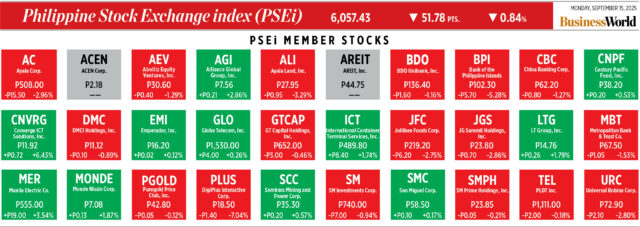
How PSEi member stocks performed — September 15, 2025

Here’s a quick glance at how PSEi stocks fared on Monday, September 15, 2025.


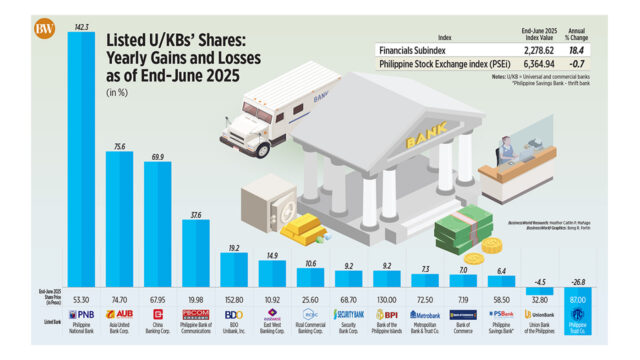
Listed U/KBs’ Shares: Yearly Gains and Losses as of End-June 2025

BANKING STOCKS rose in the second quarter as rate cuts coupled with steady inflation impacted profit margins, analysts said. Read the full story.

Listed U/KBs’ Shares: Yearly Gains and Losses as of End-June 2025

PSEi slides to 6,000 level as market seeks leads

REUTERS

PHILIPPINE SHARES sank to the 6,000 level on Monday to hit a five-month low due to selling pressure amid a lack of leads, weak market sentiment, and lingering corruption concerns.

The benchmark Philippine Stock Exchange index (PSEi) declined by 0.84% or 51.78 points to close at 6,057.43, while the broader all shares index decreased by 0.4% or 15.02 points to end at 3,670.57.

This was the PSEi’s worst finish in over five months or since it closed at 6,006.34 on April 8.

“The index continued to flirt with the 6,000 level as political noise continues to cloud investor sentiment,” AP Securities, Inc. said in a market report.

President Ferdinand R. Marcos, Jr. said no one will be exempt from an independent investigation into alleged anomalies in infrastructure projects, as he vowed to rebuild public trust as protests over corruption loom, Reuters reported.

Mr. Marcos assured the graft-weary public that the probe would break from past efforts, calling it an “inflection point” in how the government operates and spends funds.

He appointed a former Supreme Court justice to lead a newly formed commission and said it would tackle all wrongdoers no matter who they are, with congressional investigations already implicating several powerful political figures.

“The local market declined on its first day of the week, weighed by the weakness of the Philippine peso against the US dollar,” Philstocks Financial Inc. Research Manager Japhet Louis O. Tantiangco said in a market report. The peso dropped by 8.10 centavos to close at P57.181 per dollar on Monday, and has ended at the P57 level for four consecutive sessions as markets await the US Federal Reserve’s policy meeting this week, where it is expected to deliver its first rate cut since late last year.

“The lack of a local positive catalyst also caused investors to exit the market. Foreign investors were net sellers for the day, with net outflows… adding to the market’s drop,” Mr. Tantiangco said.

Net foreign selling was at P473.25 million on Monday, a reversal of the P293.44 million in net buying recorded on Friday.

Most sectoral indices closed lower. Financials fell by 2.43% or 50.02 points to 2,006.24; holding firms decreased by 1.19% or 60.31 points to 4,985.73; property went down by 1.19% or 29.90 points to 2,473.36; and mining and oil dropped by 0.29% or 33.82 points to 11,436.02.

Meanwhile, services increased by 0.99% or 21.43 points to 2,178.54, and industrials climbed by 0.32% or 28.90 points to 8,983.85.

Value turnover went down to P6.24 billion on Monday with 3.48 billion shares traded from the P6.82 billion with 6.27 billion stocks that changed hands on Friday.

“Converge ICT Solutions, Inc. was the day’s top index gainer, jumping 6.43% to P11.92. DigiPlus Interactive Corp. was the main index laggard, plunging 7.04% to P18.50,” Mr. Tantiangco said.

Decliners outnumbered advancers, 117 to 84, while 53 names were unchanged. — A.G.C. Magno with Reuters

Shares of listed Philippine banks rise in 2nd quarter

The article “Listed banks’ share prices rise in Q2” by Heather Caitlin P. Mañago in BusinessWorld’s quarterly banking report published on Sept. 15 misstated that Philippine Savings Bank (PSBank) posted a 50.8% share price decline in the first half, but it actually rose by 6.4%. The article also misstated that Bank of Commerce stock contracted by 94%, but it went up by 7%.

We deeply regret the errors and extend our apologies to PSBank, Bank of Commerce and our readers.

BANKING STOCKS rose in the second quarter as rate cuts coupled with steady inflation impacted profit margins, analysts said.

They also cautioned investors to further monitor rate cuts from the Bangko Sentral ng Pilipinas (BSP) and further actions by the US Federal Reserve.

The Philippine Stock Exchange index (PSEi) inched down by 0.7% year on year to 6,364.94 at the end of the second quarter.

Listed U/KBs’ Shares: Yearly Gains and Losses as of End-June 2025

However, the financials subindex, which includes banks, climbed by 18.4% annually to 2,278.62 during the period.

During the period, 11 out of the country’s 13 listed universal and commercial banks (U/KBs) posted growth in their share prices year on year.

Philippine National Bank (ticker symbol: PNB) led with 142.3% year-on-year surge. It was followed by Asia United Bank Corp. (AUB, 75.6%), China Banking Corp. (CBC, 69.9%), Philippine Bank of Communications (PBC, 37.6%) and BDO Unibank, Inc. (BDO, 19.2%).

Listed thrift bank Philippine Savings Bank also grew by 6.4% year on year.

Meanwhile, Philippine Trust Co. (PTC) stock contracted by 26.8%, year on year as of end-June while Union Bank of the Philippines’ (UBP) dropped by 4.5%.

Aggregate net income of universal and commercial banks grew by 3.1% to P184.46 billion as of end-June from P178.91 billion in the same period a year ago, data from the BSP showed.

Gross total loan portfolio of these big lenders rose by 11% to P14.7 trillion as of end-June from P13.25 trillion a year ago.

The big banks’ gross nonperforming loans (NPLs) ratio improved to 3.05% as of end-June from 3.21% the previous year.

Meanwhile, the big banks’ net interest margin (NIM) — a ratio that measures banks’ efficiency in investing their funds by dividing annualized net interest income to average earning asset — rose to 4.13% as of end-June from 4.04% recorded a year earlier.

Provision for credit losses by these big banks reached P71.81 billion, up by 67.6% from P42.84 billion in June 2024.

RATE CUTS AND TARIFFS
Luis A. Limlingan, head of sales at Regina Capital Development Corp., said that BSP rate cuts are one of the primary drivers of the performance of listed banks for the second quarter.

He pointed out that reduced interest rates not only encourage borrowers to tap into cheaper loans — driving loan growth and broadening the banks’ customer base — but also led to increased profits from trading activities.

“Overall, the rate cuts created a dual benefit: stronger loan growth and enhanced investment returns, both of which supported the banking sector’s bottom line,” Mr. Limlingan said in a Viber message.

Kervin Laurence S. Sisayan, vice-president and head of research at Maybank Securities Philippines, Inc., said that another BSP movement, which influenced banks’ performance during the period, were the reserve requirement ratios (RRRs) jumbo cut made as of end-March.

“A cut in RRR would reduce the pressure on funding costs for banks in general and would typically be margin accretive,” he said in an e-mail.

As of end-March, the central bank reduced RRRs by 200 basis points (bps) to 5% for U/KBs from 7%. Additionally, RRR for digital banks were also slashed by 150 bps to 2.5%, while the ratio for thrift lenders was lowered by 100 bps to 0%.

He added that subsequent cuts in policy rates have pushed industry asset yields lower, offsetting the potential improvement from the RRR cut.

For Abigail Kathryn L. Chiw, first vice-president and head of research at BDO Securities Corp., the steady improvement in the macroeconomic conditions of the Philippines helped sustain strong loan demand on the back of corporate and consumer segments.

“Easing funding costs and rising mix of higher-margin consumer loans also resulted to sequential upturns in lending margins,” said Ms. Chiw in an e-mail.

However, she also said that the aggressive expansion in unsecured consumer loans, such as credit cards, prompted banks to increase their provisions to guard against NPL risks which has dragged earnings.

Ralph Jonathan B. Fausto, research associate in Chinabank Securities Corp., said that outlook for monetary policy from the BSP and the US Federal Reserve, coupled with uncertainties in external trade policy, remain key drivers during the period.

These factors, he said, have direct implications for loan demand and net interest margins.

“The sustained expansion of listed banks into the consumer lending segment has been underpinned by stable and low domestic inflation, and robust employment conditions — which continue to support a constructive outlook for household consumption,” he said in an e-mail.

In June, headline inflation picked up to 1.4%, inching up from 1.3% in May. However, this was still slower than the year-earlier 3.7%.

In the six months to June, inflation averaged 1.8%, slower than the 3.6% average in the same period last year.

This prompted the central bank to implement a second straight rate cut, lowering the policy rate from 5.5% to 5.25%, marking its lowest level in two and a half years.

During its August policy meeting, the BSP reduced the target reverse repurchase rate by 25 bps bringing it down to 5% from 5.25%, the lowest rate in nearly three years, since November 2022.

Since its easing cycle in August 2024, the BSP lowered borrowing costs by a total of 150 basis points.

Jash Matthew M. Baylon, equity analyst at The First Resources Management and Securities said that aside from the BSP rate cuts, global uncertainty due to tariff wars added a cautious stance across business confidence which impacts banks’ operations.

In April, US President Donald J. Trump announced a reciprocal tariff rate of 17% on goods from the Philippines, but the implementation was postponed until July.

Then, in early July, he raised the tariff rate to 20% and after a meeting with Philippine President Ferdinand R. Marcos, Jr., Mr. Trump implemented a new tariff of 19% on Philippine goods, which took effect on Aug. 7.

STANDOUTS
BDO, PNB, Bank of Commerce (BNCOM), and CBC stood out in the second quarter amid loan expansions and strong earnings, analysts said.

For Mr. Limlingan, PNB and BNCOM stood out in terms of bottom line, “posting some of the highest returns among banks during the period.”

“[They] benefited from strong loan portfolio expansion and robust trading gains, reflecting sustained growth momentum,” he said.

He added that banks remain aggressive in expanding their lending activities, buoyed by expectations of possible rate cuts in the next few months.

For Ms. Chiw, CBC stood out with robust earnings growth and return on equity for the quarter. The solid 18% earnings growth and 15% return on equity of CBC during the period was driven by strong loan expansion, improved NIMs, solid asset quality with a nonperforming loan ratio, and one-off foreclosure gains covering increased provisions.

For Mr. Fausto, BDO’s corporate loan growth accelerated in the second quarter, indicating a recovery in business borrowing after being dampened by US tariff uncertainties in the prior quarter.

Meanwhile, Security Bank Corp. (SECB) “reported higher-than-anticipated provisions in [the first half of the year], largely attributable to its aggressive expansion in the credit card segment,” he added.

For Mr. Baylon, smaller banks could maximize the current economic situation, which could potentially enhance their net interest margins in a lower rate environment. On the other hand, larger universal banks experience a negative impact on their earnings.

OUTLOOK
Ms. Chiw said that the central bank can deliver one more rate cut this year as inflation remains below the BSP target.

“Accommodative interest rates are supportive of growth, which should be a net positive for banks,” she said.

She expects banks to deliver healthy earnings growth and sees lower borrowing costs could lead to an increase in lending activity and a reduction in NPL stress. This, in turn, would enable banks to reduce their provisioning costs.

“Volatile financial markets may also provide trading gains or losses,” she said.

Similarly, for Mr. Limlingan, he is supportive of further rate cuts from the BSP as it can allow banks to broaden their markets.

“In the short term, profitability may improve as trading gains strengthen. However, we also anticipate increased pricing competition among banks, as adjustments in product pricing could pose risks to their margins,” he said.

He added that further rate cuts could boost banks’ revenues and bottom lines through several channels that benefit from a more dovish policy stance.

Mr. Sisayan expects recent policy rate cuts to put further pressure on NIMs.

“With lower rates, and more clarity on global trade, the weakness in NIMs could be offset by stronger loan growth as corporates become more confident to pursue expansion plans,” he said.

Chinabank Securities’ Mr. Fausto and BDO Securities’ Ms. Chiw advised investors to closely monitor loan growth, NIMs, and asset quality of banks.

Mr. Fausto said the BSP’s 25-bp rate cuts in April and June are expected to help loans grow faster, especially within the corporate lending space.

“Net interest margins, however, are expected to be broadly stable — with some seeing marginal uplift from lower funding costs,” Mr. Fausto said.

He added that with major listed banks growing their high-yield loan segments, it’s important to keep an eye on credit costs and NPL ratios.

Additionally, Ms. Chiw said that key concerns right now are Mr. Trump’s erratic trade policies and attempts to undermine US Fed independence.

“These may result to renewed interest rate and exchange rate volatility potentially hurting consumption and investment appetite,” she said.

Moreover, for Mr. Baylon, investors should keep an eye on global events, especially decisions by the US Fed, since these can affect the local currency and foreign investments, which in turn influence bank operations.

He also anticipates that consumer and retail banking will be a major earnings contributor for large banks this year, driven by improved purchasing power and stronger domestic spending as inflation eases.

He added that even with the potential for a policy rate cut from the BSP, robust consumer activity may sustain credit demand, particularly for personal loans, auto financing, and credit cards.

“This volume-driven growth could help offset margin compression, positioning big banks to benefit from a more consumption-led recovery,” he said. — HCPM


Manila urged to raise China concerns at UN General Assembly this month

A LANDSAT 7 image of Scarborough Shoal in the South China Sea. — WIKIPEDIA

By Adrian H. Halili, Reporter

THE PHILIPPINES should seize the opportunity to raise its concerns over Chinese actions in the South China Sea during the United Nations (UN) General Assembly in New York later this month, analysts said, as Beijing presses ahead with measures that undermine Manila’s claims in the contested waters.

“The Philippines, through the President, may rally support in line with his participation in the United Nations General Assembly later this month,” Josue Raphael J. Cortez, a diplomacy instructor at De La Salle-College of St. Benilde, said in a Facebook Messenger chat.

Philippine President Ferdinand R. Marcos, Jr. will not attend the UN General Assembly in New York next week since he plans to focus on local issues, the Palace said on Monday.

“The President has delegated his engagements at the UN General Assembly to the secretary of Foreign Affairs to allow him to focus on local issues,” Communications Secretary Dave M. Gomez told reporters in a Viber chat.

The Department of Foreign Affairs (DFA) earlier said it is studying the possibility of filing a resolution at the assembly that would tackle Chinese activities in the South China Sea.

“This attendance may also serve as an avenue for the President to highlight the importance of adhering to international norms and standards, as well as to international agreements and covenants,” Mr. Cortez added.

Hansley A. Juliano, a political science lecturer at Ateneo de Manila University, said Manila should ensure its position is framed as independent and not merely extensions of US policy.

“The only real possible concern is if our position will be accepted specifically as our own standing, or will we continue to suffer with the American association,” he said.

Relations between Manila and Beijing have been strained in recent years due to frequent confrontations in the South China Sea, where China has expanded its presence despite a 2016 arbitral ruling by a UN-backed tribunal that voided its sweeping claims. Beijing has ignored the decision.

Mr. Cortez said Mr. Marcos’ absence in the assembly would not affect Manila’s campaign for a nonpermanent seat at the UN Security Council (UNSC).

He noted that Mr. Manalo, the Philippine ambassador to the UN, is “articulate enough” to represent Manila’s interests in the UN.

“With a blueprint at hand — particularly on how we will be highlighting our campaign for a UNSC seat — the Philippine delegation is already equipped with the pertinent skills needed during the high-level week,” he added.

Lucio B. Pitlo III, a research fellow at the Asia-Pacific Pathways to Progress Foundation, said the Philippines should also use the upcoming Association of Southeast Asian Nations (ASEAN) meetings to raise its concerns, especially as the Philippines assumes the chairmanship of the bloc next year.

The Philippines will host ASEAN’s annual summit a year earlier than scheduled, after Myanmar gave up its turn due to political unrest. Manila is expected to put the South China Sea disputes high on the agenda.

Analysts warned that China’s latest move to establish a “nature reserve” at Scarborough Shoal could erode Manila’s position. Beijing recently approved the creation of the marine reserve, which will cover more than 3,500 hectares of coral reefs.

“This latest development of China converting the shoal to a marine sanctuary will further undercut the Philippines’ position,” Mr. Pitlo said. “China will use the environmental card to buttress its claim, leveraging its on-the-ground control since 2012.”

The DFA said at the weekend the Philippines had lodged a diplomatic protest against Beijing’s plans at Scarborough Shoal, known locally as Bajo de Masinloc.

Mr. Cortez said the Philippines should also push discussions through the bilateral consultation mechanism with China, created in 2017 to manage sea disputes.

“It may serve as a platform where our two countries can fully discuss China’s proposition, and for us to directly remind them that such move may be considered a violation of our territorial integrity,” he said.

Envoys last met under the mechanism in January. — with Chloe Mari A. Hufana

DA to get 90% of subsidized rice next year from farmers

PHILSTAR FILE PHOTO

By Kenneth Christiane L. Basilio and Adrian H. Halili, Reporters

THE DEPARTMENT OF AGRICULTURE (DA) would obtain 80-90% of rice for next year’s subsidized rice program from local farmers and the rest from imports, targeting 1.5 million metric tons (MMT) worth P29 billion, its chief told congressmen at a House of Representatives hearing on Monday.

Agriculture Secretary Francisco P. Tiu Laurel, Jr. said sourcing from imports would significantly cut costs, adding that getting everything locally would be fiscally unsustainable.

“This might be controversial, but if we want to make it cheap, we could wholly source it from imported rice and it would only cost us P7 billion,” Mr. Laurel told lawmakers in Filipino.

He added that sustaining the government’s P20-per-kilo rice program would be difficult without continued state intervention.

President Ferdinand R. Marcos, Jr. campaigned in 2022 on a pledge to lower rice prices to P20 per kilo, but the early years of his administration have been marked by a surge in rice costs.

Imported fancy rice cost P57.33 per kilo, while premium grain was P44.71 per kilo and regular-milled rice was P36 per kilo, according to the Agriculture department’s marketing monitoring data on Sunday.

Locally sourced fancy rice was slightly cheaper at P56.83 per kilo, while premium rice was P50.67 and regular-milled rice was P36.60 per kilo.

Mr. Laurel said the government is seeking to sell cheap grain to at least 15 million households next year.

“I don’t think it’s possible without subsidies,” he said in Filipino. “The only country that can keep rice prices low is Vietnam. As for India, we really can’t compare because they provide 90% of fertilizers to their farmers for free.”

“We can’t compete with that kind of system,” he added.

A decline in global fertilizer prices to pre-Ukraine war levels could lead to sustainably lower rice prices, he said. “That’s the situation… [so] I don’t think it’s possible at this time.”

Meanwhile, Agriculture Undersecretary Asis G. Perez said the Philippines has grown increasingly reliant on agricultural imports, creating an imbalance at the expense of locally produced goods.

“In the last years, trade grew, but the trade is [lopsided],” he told lawmakers at the same House hearing. “There’s been an increase in imports in the past 10 years, with exports not growing. We are not in a very good state.”

The Philippines imported about 2.94 MMT of rice in the first nine months, according to DA data.

Mr. Marcos on Sept. 1 ordered a 60-day suspension of rice imports to protect Filipino farmers affected by low unmilled rice prices during the harvest season.

Mr. Laurel said it pegged this year’s rice yield target at 20.3 MMT, about 6.3% higher than the four-year low 19.09 MMT output last year.

“Originally, the rice production target for this year was 20.45 MMT,” he said in Filipino. “We’re revising the target based on what we’re seeing for the rest of the year.”

FARM SMUGGLING
Also on Monday, the Senate agriculture committee summoned farm traders who skipped its inquiry into farm goods smuggling, which lawmakers said has deprived the government of billions of pesos in revenues.

At a hearing, Senator Francis “Kiko” N. Pangilinan said subpoenas would be issued to 10 traders who failed to appear.

Mr. Pangilinan cited data from the Department of Finance and Bureau of Customs showing that smuggling has cost the government at least P983 million since 2024. “Just like corruption in flood control projects, billions are also being stolen from the country due to smuggling,” he said.

He also questioned the DA over its alleged failure to charge major players a year after the Anti-Agricultural Smuggling Act was enacted.

“One year after the law was signed, why are there still no big-time syndicates jailed?” he asked.

The law classifies smuggling, hoarding, profiteering and their financing as economic sabotage, punishable with life imprisonment and fines five times the value of the goods involved.

The hearing also looked into reports of “consignees for hire” who lease import permits to brokers and traders.

Customs Commissioner Ariel F. Nepomuceno said the agency has documented cases of corporations renting out their licenses. “There are clear cases of consignees being hired, wherein the consignees allow their corporations to be used by importers,” he told senators.

Agriculture Undersecretary Carlos C. Carag added that using import clearances by anyone other than those named in the permit is illegal.

Import permits for crops are issued by the Bureau of Plant Industry, while the Bureau of Animal Industry handles meat import licenses.