Home Blog Page 9399

To love is to ‘co-create’

“Well, she looked at me/ And I, I could see/ That before too long/ I’d fall in love with her”

I “Saw Her Standing There” by The Beatles

It is so romantic to think of love as capturing that lightning-in-a-bottle, falling-in-love-at-first-sight feeling. The Beatles sang about it perfectly: giggles, laughter, and hearts going “boom” during the honeymoon stages of a romantic relationship.

It seems that businesses and customers seek to fall in love at first sight, too. This is most evident during creation and enjoyment of new products: shiny packaging, fantastic promotions, mouth-watering introductory prices, and top-notch quality.

But before long, reality kicks in, and the illusion breaks. We realize that love at first sight is untenable. We are biased and prone to misperceptions. To add, putting their best foot forward all the time is just not viable for both parties. Romantic partners begin to see flaws, businesses use lower-quality ingredients to save costs, and customers begin to expect more but feel disappointed. How do we learn from this?

Enter the “theory of value co-creation.” Drawing from research of other experts on this theory, Galvagno and Dalli, in a 2014 literature review, summarize “co-creation” as a collaborative value creation process between businesses and customers. This perspective rethinks what it means to create value. Previously, value creation was simply a business producing goods, then making customers fall in love at first use. But after much examination and research on business-customer relationships, especially in a service setting, scholars and practitioners have realized that value creation is not the same as production of goods. Rather, customers participate in reimagining how products can be used in ways that businesses may not have intended. Sticky notes came from failed attempts to create new adhesives, but both 3M and its customers found value in using non-permanent adhesives in paper. Bubble wrap failed as a textured wallpaper, but it gained enduring success when it was reimagined as packaging material for fragile goods.

Guided by this theory, we can also deepen our understanding of what it means to love. It is not anymore about loving at first sight, but loving through a thousand fights. Similar to the classic examples cited, co-creation is a collaborative process that is inevitably filled with tension, disagreements, and initial failures. This is challenging, yet beautiful. Although the old paradigm of loving at first sight is great at crafting first impressions, it is prone to fail in managing expectations and relationships in the long term. On the other hand, value co-creation iterates toward more harmonious relationships.

Love, both in business and personal relationships, should then not be about controlling the other. No single party can dictate value; rather, both parties can only craft value propositions that are jointly experienced and improved, similar to the technology and social media platforms we enjoy in this sharing economy. This idea may be uncomfortable for some, but perhaps it brings us closer to understanding true love. To love is to co-create.

“The love you take is equal to the love you make.” — “The End” by The Beatles

Happy Valentine!


Patrick Adriel H. Aure is an Assistant Professor of the Management and Organization Department, Ramon V. Del Rosario College of Business. As head of the Social Enterprise Research Network of the Center for Business Research and Development (CBRD-SERN) and as co-chair for strategic directions of the Lasallian Social Enterprise for Economic Development (LSEED) committee at De La Salle University, he advocates social entrepreneurship.

patrick.aure@dlsu.edu.ph

COVID-19, NCDs and ENDS

“How to make the fitting adjustment between individual independence and social control is a subject on which nearly everything remains to be done… To an ordinary man, however, his own preference… is not only a perfectly satisfactory reason, but the only one he generally has for any of his notions of morality, taste, or propriety…”

John Stuart Mill, On Liberty (1859), Ch. 1 Introduction

As of Feb. 11, the novel coronavirus — now called COVID-19 by the World Health Organization (WHO) — has 44,000+ cases and killed 1,100+ people in China alone. The number of infected and dead people is rising every day and there is no existing proven treatment or vaccine. The nearest vaccine/s would be 12 to 18 months away because there are many processes and clinical trials needed before a new medicine or vaccine can be officially declared as safe and effective.

I checked the website of Pharmaceutical Research and Manufacturers of America (PhRMA), the biggest association of innovator pharma and biotech companies and research institutes in the world, for drugs that are undergoing various clinical trials and research, on top of existing proven medicines (see Table 1).

This should be the result of many years of virtue signalling by the WHO and various Ministry or Department of Health of many countries that the main problem in the world now are non-communicable diseases (NCDs), not infectious diseases like COVID-19. Now we see how unprepared these global and national health authorities are when the real killer diseases come.

And still the WHO and country governments continue with more regulations of products and lifestyles to “protect people from themselves,” the evolving role of a nanny state. Target products are alcohol, tobacco, electronic cigarettes, sugar, and salt/sodium. Despite the fact that anywhere in the world, people are living longer and healthier even if they have rising consumption of alcohol, tobacco, sugar/fatty food and drinks.

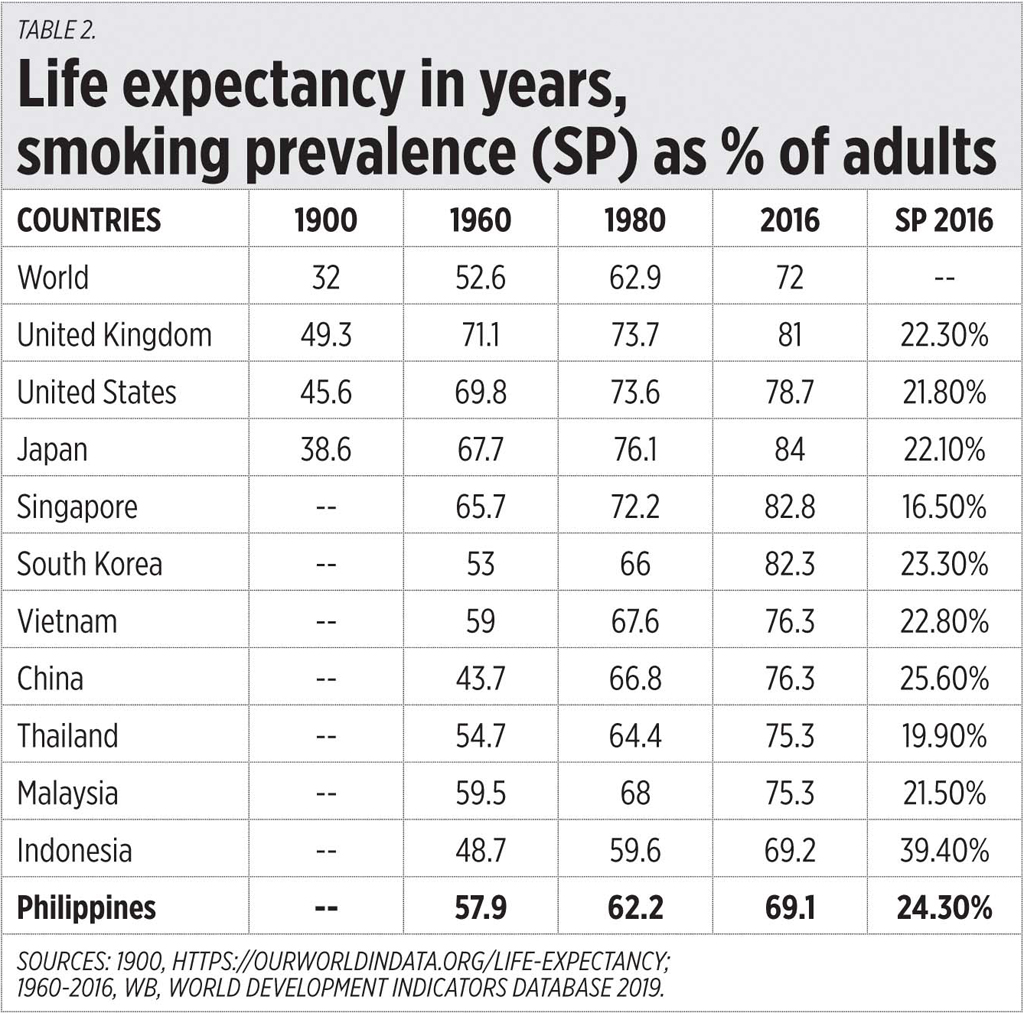
I checked the narrative that “more alcohol and tobacco = more sickness and deaths,” the numbers show that it does not hold water. For instance, China and Indonesia have higher smoking prevalence (SP) than the Philippines yet they have higher life expectancy than us. The US, UK, and Japan have higher SP than Thailand yet they have longer life expectancy than the latter (see Table 2).

In Congress, I saw a bill on “Non-Combustible Nicotine Delivery Systems Regulation Act of 2019” and I was surprised at the huge number of new regulations, restrictions, and prohibitions for e-cigarettes or electronic nicotine delivery systems (ENDS), electronic non-nicotine (ENNDS), heated tobacco products (HTPs) as if these are the normal tobacco, alcohol, prohibited drugs.

For example there are outright bans and prohibitions for those ENDS/HTPs: banning their sale within 500 meters from any perimeter of a school or playground; banning advertisement, promotion, and sponsorship; banning use in schools/universities, hospitals, government offices and facilities; banning users who are below 21 years old.

Then there are allowed but highly restricted acts: online trade, advertisements in retailer establishments, flavorings, designated vaping areas (DVAs), product requirements, etc.

Just recently, Congress raised the tax on those products along with regular tobacco and alcohol products. Meaning government wants more tax money from them to fund its universal healthcare (UHC) and related programs, yet government wants less use and sale of these products. Which is which?

On raising the minimum age for vaping or smoking to 21, this is more double talk. At the age of 18, the government currently believes that people are mature enough to vote and determine political leadership at local and national levels, they can drive vehicles and are mature enough not to cause injuries or deaths on the road, they can get married, and so on. Then government changes the rules because people below 21 are still immature and need to be protected from themselves.

More bans, restrictions, and taxation only encourage more corruption and smuggling. The result is more drinking, smoking, vaping, and drugs because the smuggled products are cheaper. JS Mill has warned of the dangers of more social control — government must heed this.


Bienvenido S. Oplas, Jr. is the president of Minimal Government Thinkers.

minimalgovernment@gmail.com

Into deeper waters

By Raju Mandhyan

HER PALMS were sweaty and her throat was dry. She clenched her notes and the clicker with shaky hands. As she reached the microphone, she was afraid that the audience would hear her heart — it was thudding wildly in her chest.

As she glanced at the expectant faces of her colleagues she suddenly realized that they knew the truth: She was scared to death. She wasn’t sure of what she was going to say and her position at ACME International was now teetering on a cliff. She had to prove that she was an able and confident young woman.

She felt like crying. She would have given her life and soul to be anywhere else but behind the lectern. Somehow, she was able to mumble her way out of the situation. Later that night, when she was alone, she swore to herself that she would never let something like that happen to her again.

That was nearly 25 years ago. Today, Janel Poe is known as a CEO par excellence. She sits on the board of several multi-national corporations and does a lot of social and civil work. She is constantly on the invitation lists of major businesses and social functions organized in the country. In her field of Information Technology, she is referred to as the “Guru.”

After that first disastrous event as a young ACME executive, she took it upon herself to master the art and science of public speaking. Something inside her told her that all her past accomplishments as an honor student in school would not amount to anything if she did not learn to express herself with clarity, creativity, and wit. She took up public speaking like one would pursue a doctoral course. Now in her fifties, she constantly speaks, trains, and practices just as doggedly as she did in her twenties. Over the years her public speaking abilities have become the driving force in her life. Today, she listens effectively, thinks with clarity and precision, and speaks with wit and wisdom.

I asked her once, Janel, as far as public speaking abilities go, do you think you have arrived?” With a twinkle in her eyes she gently answered, “Like Newton, I feel like I am on the edge of an ocean, constantly collecting pebbles while all that is yet to be discovered lies ahead of me.”

Today, across the world there still are thousands of executives and businesspeople who break out into a cold sweat or become dry-mouthed when facing an audience. The cause, without a doubt, is fear in any of its forms; anxiety, nervousness, shyness or what have you. Some quarters call it the imposter syndrome. Whatever your knowledge and expertise level might be, you feel as you do not belong at the helm of the room and whatever you have to say has a hidden agenda, yours.

The way out of this malady is strong resolve and then continuous exposure and learning towards the discipline like Janel Poe in the story. Another insightful way is to trust and strongly believe that what you are bringing to the table or the lectern, while it may be simple and common, is of extreme importance to the audience and you are not the message itself but just a humble messenger, a harbinger. That way your success or failure at the performance becomes secondary to the mission of delivering the message. Ergo, your ego takes the back seat and you become a servant, a leader.

This holds true not just in public speaking but every endeavor and every initiative a leader takes. She steps upon her ego and takes a leap from the edge of the ocean into deeper waters of success and growth for others.


Raju Mandhyan is an author, coach and learning facilitator.

www.mandhyan.com

Coronavirus stokes mask production and mass confusion

By Shuli Ren

FOR FACTORIES to reopen, people to get back to work and the coronavirus to stop spreading, China needs tens of millions of face masks each day. And yet the country’s sprawling bureaucracy is sending out mixed messages about its ability to provide them. The repercussions have been felt even in Hong Kong, where throngs of panicked shoppers cleared the shelves of masks and, more perplexingly, toilet paper last week.

The world’s biggest mask producer is facing a severe shortage. Even running at full capacity, China can make only 20 million a day, nowhere close to meeting the needs of the 776 million who are slowly returning to work. As for prized surgical and N95 masks (which provide even more coverage), China can produce only about 2.2 million and 600,000 daily. The country has roughly 12 million medical professionals.

In the last week of January, China had to purchase more than 56 million masks from overseas, the government said. Apple supplier Hon Hai Precision Industry Co. took matters into its own hands when it started to make masks for employees at its flagship factory in Shenzhen.

Once again, China’s bureaucrats have proven their incompetence, starting with the government of Hubei province, whose slow response accelerated the viral spread in the first place.

Even under lockdown, Hubei of all provinces shouldn’t be this short of protective medical gear. Xiantao, a provincial city there, is a major industrial hub for the non-woven products used in surgical masks. But last week, local officials told producers that unless their goods have been cleared for sale within China, factories can’t reopen until Feb. 14.

This has created a social uproar. Many of these masks aren’t cleared for sale in the mainland because they’re exported. These businesses often lack domestic licenses precisely for this reason. Within days, the provincial government had to reverse course, because the proposed regulation would have shut down roughly half of Xiantao’s production capacity.

In the manufacturing hub of Guangdong, meanwhile, officials went into overdrive, encouraging local businesses to switch to mask production by offering generous subsidies. Companies that purchased production lines and got online by Feb. 7 received as much as 80% in rebates from the government; those meeting a Feb. 20 deadline can have up to half of their equipment costs paid for.

It’s no surprise that companies are now making masks, including automakers such as BYD Co. and Guangzhou Automobile Group Co. But this shift has stoked its own form of panic. When China’s fourth-largest tissue-paper brand, Guangdong-based C&S Paper Co., said it purchased five production lines with a daily capacity of about 350,000 masks, speculation was rife on social media about possible disruption to the paper-goods supply chain. This helps explain why Hong Kong had a toilet-paper run last week: The likes of C&S might just be too busy making surgical masks.

Judging by how well the stock market is doing, it seems global investors have learned to forgive China. Many have argued that, of all countries, China with its centralized command system can weather this epidemic better than others.

The reality is a lot murkier. We have one province so bogged down by licensing issues that its much-needed factories are lying fallow; another whose overly generous subsidies could be providing the wrong incentives and inadvertently stoking consumer panic. As it turns out, China’s bureaucracy is a lot less efficient than we imagined. Don’t be surprised if we see a diaper run, too. Even those manufacturers have switched to making masks.


BLOOMBERG OPINION

Yes, coronavirus is more troubling than the flu

By David Fickling

IS THE WORLD losing its collective mind about the coronavirus (now called COVID-19 by the World Health Organization)? So far 1,115 people have died from the infection — all but 45 of them at the epicenter of the outbreak in Wuhan province, and only two of them outside China.

By contrast, some 10,000 people have died this winter from influenza in the US alone, and worldwide between 290,000 and 650,000 people die each year from seasonal flu. H1N1 swine flu, which first emerged in Mexico and quickly spread across the globe, ultimately killed between 151,700 and 574,600 people in its first year alone. Instead of worrying about the progress of COVID-19 in China, shouldn’t we be asking about that public-health failure?

Well, no. Pandemics are unique, and apples-to-oranges comparisons often obscure more than they illuminate. The current coronavirus outbreak is legitimately more alarming than normal seasonal flu, and public-health officials are probably right to be responding with unusually drastic measures. Such actions shouldn’t be taken with every disease outbreak, though, unless we’re prepared to accept dystopian restrictions on basic freedoms as a routine part of life.

The most obvious difference between COVID-19 and influenza is that it’s considerably more deadly. The case fatality rates for most flu strains, including the pandemic ones like H1N1 that crop up every 25 years or so, tend to be in the region of 10 or 20 deaths for every 100,000 infections. COVID-19 appears to be several orders of magnitude more dangerous, with the equivalent of 2,359 deaths per 100,000 confirmed cases so far.

There’s considerable uncertainty about all these figures. Unlike with COVID-19, most cases of influenza aren’t laboratory-confirmed. That could mean we’re exaggerating the odds of dying from the current outbreak, because we’re measuring deaths only as a proportion of people whose symptoms were severe enough to merit testing.

The extraordinary burden being placed on the health system in Hubei may also be skewing things. More than 3% of cases there have resulted in death, but downriver in Zhejiang there have been no fatalities despite 1,117 confirmed cases. Across China outside Hubei, the fatality rate is around 0.4%. It’s possible that the triage being undertaken by hard-pressed Hubei doctors means they’re only taking in and confirming the most serious cases.

There’s also the possibility that fatality rates are too low. COVID-19 has spread with extraordinary speed, and to date nearly 90% of cases have resulted in neither recovery nor death. If we see increasing mortality from that population over the coming weeks, it may be the case that fatality rates were low simply because people hadn’t died yet.

It’s hard to point with certainty to any rock-solid facts amid this thicket of hypotheses and estimates — and that’s precisely why public-health officials, in China and elsewhere, are now taking this outbreak so seriously. On one hand, coronavirus might fizzle out in weeks or months as the measures currently being taken gain traction. On the other, it might grow into a pandemic that infects 60% of the world’s population, according to the Guardian, likely resulting in millions of deaths.

The brutal truth of epidemics is that in their initial stages there’s no magic bullet to preventing them. New vaccines can’t be developed overnight. The regulatory burden of getting them approved in multiple countries and the manufacturing challenge of producing them are, if anything, bigger bottlenecks than the laboratory work. After enormous efforts to expand pandemic influenza preparedness, in 2015 the world still only had enough production capacity to immunize about 43% of the global population.

Basic hygiene practices such as hand-washing, mouth-covering, and simply staying home will certainly help, too — but beyond that, the sort of quarantine we’re seeing in China is one of the few preventative measures at hand.

The advance of vaccines and antibiotics over the 20th century meant that so-called community quarantine — where entire populations are isolated to prevent the spread of disease — had largely died out as a public-health measure before it came roaring back with Severe Acute Respiratory Syndrome in 2003.

It’s still often controversial. Riots broke out in Liberia when community quarantine was imposed during the Ebola epidemic of 2014. While surveys in Asian and North American countries suggest reasonable levels of support for the practice, that tolerance no doubt has its limits.

It’s unclear if the world is ready for a situation where draconian restrictions like those being used in China become more commonplace. Governments and health officials need to reckon with that possibility, though. Epidemics thrive on large, dense populations. With 7.8 billion people and 21 billion livestock on the planet, we’re providing novel infections an ever-improving environment in which to spread.


BLOOMBERG OPINION

Ceres takes joy in dominant win in AFC Cup ’20 opener

By Michael Angelo S. Murillo
Senior Reporter

FOLLOWING a master class in its AFC Cup 2020 opener where it dominated its opponent, 4-0, Ceres-Negros FC said it takes joy in the solid start it had in the tournament and expressed hope that the team gets to stay the course moving forward.

Took on visiting Preah Khan Reach Svay Rieng FC of Cambodia in their first game in Group G of the competition, the “Busmen” did not waste much time trumpeting its intent to make another solid run in the AFC Cup.

It was something that Ceres coach Risto Vidakovic said he was happy about, seeing how his players played that way they were supposed to.

“It was not an easy game. But we deserved to win because we created a lot of chances,” said Mr. Vidakovic following their game against Svay Rieng on Tuesday night at the Rizal Memorial Stadium.

“I’m happy with the way we played. We’re still adjusting but I think it is a good sign for the team. We have a style of playing and we were able to execute it. Hopefully we get to do that in our next games,” he added.

Ceres was at its element at the onset against Svay Rieng.

It got the leverage early on after midfielder Takashi Odawara and defender Josh Grommen scored back-to-back goals in the 12th and 14th minute, respectively.

The twin goals set the tone for the Busmen the rest of the way en route to the win that set their AFC Cup campaign to a promising start.

Striker Bienvenido Maranon also played a key part, scoring a brace in the 55th and 70th minute, which put the game away and earned for him man of the match honors.

“The team is showing maturity and they’re growing in each game,” said Mr. Vidakovic of his team, the three-time Philippines Football League champion and coming off a spirited showing in the preliminary rounds of the AFC Champions League.

Mr. Vidakovic also took note of the impact come-backing Ceres player Manny Ott had on their team’s performance

“Manny Ott, like what I said before, is an important player for us. He is one of the best players in the team. He has great control and makes our attack better,” said the Ceres coach of Mr. Ott, who spent last season playing in the Thai league.

Next for Ceres is another home game on Feb. 25 against Than Quang Ninh of Vietnam.

It was supposed to be an away match but with the Vietnamese government’s decision to bar any sports event in light of the ongoing COVID-19 acute respiratory disease outbreak, the game was rescheduled to be played here instead.

Than Quang Ninh also played last Tuesday and lost to Bali United FC, 4-1, in Indonesia.

PHL women’s team swept anew at Badminton Asia tournament

By Michael Angelo S. Murillo
Senior Reporter

THE Philippine women’s badminton team continued to find the going tough on the second day of the 2020 Badminton Asia Team Championships, swept anew, 5-0, this time by Indonesia in tournament action on Wednesday at the Rizal Memorial Coliseum.

Looking to bounce back from the 5-0 rout they absorbed at the hands of Thailand on opening day on Tuesday, the Filipinas still competed but just could not get the breakthrough in the best-of-five match.

The loss meant the Philippine women’s team was already eliminated from the running in the tournament which serves as a qualifier for the 2020 Thomas and Uber Cup this May.

The Philippine contingent got off to a strong start with Airah Albo taking the first set of her match against Indon opponent Gregoria Mariska Tunjung, 21-19.

It was only the second set the Philippine team (men’s and women’s) had won at that point of the tournament, which is organized by the Philippine Badminton Association and backed by Smart Communications Inc., MVP Sports Foundation, Leisure and Resorts World Corp., Cignal and TV5.

But Ms. Tunjung would recover from the early setback, dominating the match in the next two sets, 21-11, 21-9, to hand Indonesia the 1-0 lead in the tie.

The Indonesian team padded its lead to 3-0 in the next two matches as the Philippine doubles tandem of Alyssa Leonardo and Thea Pomar and singles player Bianca Carlos lost their respective matches.

Misses Leonardo and Pomar dropped their match against Greysia Polii and Apriyani Rahayu, 21-18, 21-12.

Ms. Carlos, meanwhile, lost to Ruselli Hartawan, 21-10, 21-18.

The Indonesian sweep was completed after the doubles team-up of Siti Fadia Silva Ramadhanti and Ribka Sugiarto got the better of Filipinas Joella Rivera and Chanelle Lunod, 21-7, 21-8, and Putri Kusuma Wardani ruled her singles joust with Sarah Barredo, 21-19, 21-14.

As of this writing, the Philippine men’s team was still to face Singapore where it hopes to extend its tournament life.

UAAP moves to postpone opening of volleyball tourney, other events

By Michael Angelo S. Murillo
Senior Reporter

THE opening of the volleyball tournament of Season 82 of the University Athletic Association of the Philippines (UAAP) will not push through as scheduled as the league board moved for its postponement and other events over concerns on the coronavirus disease 2019 (COVID-19) outbreak.

In an announcement made on Wednesday afternoon, the UAAP’s Board of Trustees and Board of Managing Directors said they deemed it proper to postpone all league events for the time being to ensure the safety of the entire UAAP community in light of the serious threat that COVID-19 poses.

The decision, the league reiterated, was also in compliance with the advisories of the health and education departments discouraging people from going to large gatherings, like sporting events, to avoid the further spread of the disease in the country.

“The University Athletic Association of the Philippines upholds, in the highest regard, the well-being, health and safety of the League’s community — players, coaches, students, their families and fans in general,” said the league’s statement, which was co-signed by UAAP President Emmanuel Fernandez and Executive Director Rene Saguisag, Jr.

It added, “In light of the COVID-19 outbreak, the UAAP, after thorough deliberation by the Board of Trustees and the Board of Managing Directors, have come to a decision to postpone all sporting events starting Saturday, 15 February.”

The decision was a turnaround from the league’s announcement made on Tuesday at the press conference for the second-semester sports that the league’s events would push through amid the COVID-19 threat as preventive measures were already in place.

Directly hit by the decision was the start of the marquee volleyball tournament which was set to unfurl on Saturday, Feb. 15, at the Mall of Asia Arena.

Also postponed were the men’s football tournament which was set to begin on Feb. 16, softball tournament (Feb. 17), seniors baseball tournament (Feb. 19), athletics (Feb. 19-23), and judo (last week of February).

The playoffs for the high school beach volleyball and basketball tournaments were also set to be moved.

The fencing tournament and the 10th match day of the high school boys’ football tournament though will still take place this week.

The UAAP did not say when the postponement will be lifted but said it will continue to monitor the COVID-19 situation and make the decision as things move along.

It went on to say that it was a tough decision to make but something needed to be done even as they asked for understanding from all concerned.

MPBL breaks for All-Star event at MOA Arena

By Michael Angelo S. Murillo
Senior Reporter

REGULAR Maharlika Pilipinas Basketball League (MPBL) action takes a break as the growing league holds its All-Star festivities today at the Mall of Asia Arena.

The Chooks-To-Go-MPBL/Lakan All-Star Day will see top stars of the league compete in the different events lined up as their way of thanking the MPBL’s fans and supporters.

Festivities begin at 3 p.m. with the 3×3 games followed by the side events at 5 p.m.

At 7 p.m., the Executive Game tips off before the All-Star Game proper.

In the All-Star Game, participants from the two league divisions — North and South — will play.

Starting for the Northern team are Jai Reyes from the Nueva Ecija Rice Vanguards, Michael Juico (Pampanga), John Wilson (San Juan-Go for Gold) Aris Dionisio (Manila-Frontrow) and Ryan Batino (1Bataan-Camaya Coast).

They are joined by JR Taganas (Bulacan), Mark Benitez (Rizal-Xentro Mall), Jeric Teng (Pasig-Sta. Lucia), Paulo Hubalde (Valenzuela-Carga Backload Solutions), Marwin Taywan (Navotas-Uni Pak Sardines), Cedric Ablaza (Makati-Super Crunch), Dhon Reverente (Pasay), Paul Sanga (Caloocan-Victory Liner), Clark Derige (Quezon City-WEMSAP) and Jayboy Solis Parañaque). Coach of the North team is Randy Alcantara of San Juan.

The South team, meanwhile, will have Davao Occidental’s Mark Yee, Jeff Viernes (Batangas-Tanduay), Allyn Bulanadi (Basilan-Jumbo Plastic), Gab Banal (Bacoor) and Will McAloney (Cebu-Casino Ethyl Alcohol) as starters.

Completing the team are Rob Celiz (GenSan-Burlington), Pari Llagas (Sarangani), Gerald Anderson (Imus-Luxxe Slim), GJ Ylagan (Muntinlupa-Angelis Resort), Paolo Javelona (Bacolod-Master Sardines), Rodel Vaygan (Mindoro), Allan Mangahas (Biñan-Luxxe White), Ronjay Buenafe (Bicol-LCC Stores), Richard Escoto (Iloilo) and Alvin Pasaol (Zamboanga Family’s Brand Sardines). Coach of the South team is Don Dulay of Davao Occidental.

In the side events, headlining the Chooks-to-Go Slam Dunk Contest is Makati Super Crunch’s David Carlos. Joining him are Bacoor’s RJ Ramirez and Nick Demusis, Manila-Frontrow’s Gian Abrigo, Marikina’s Ato Ular, and Davao Occidental-Cocolife’s James Forrester.

In the three-point shootout, the participants are composed of Mr. Wilson of San Juan, Anton Asistio and Robin Roño of Zamboanga, Mikee Cabahug of Navotas, Mark Pangilinan and Rocky Acidre of Bacoor, Jerome Garcia of Bicol, Jordan Rios of Rizal, Rhaffy Octobre of Cebu, Lester Alvarez of Bulacan, and James Martinez of Nueva Ecija.

97 teams join PAL Seniors Interclub golf tourney

NINETY-SEVEN teams have signed up for the 34th Philippine Airlines (PAL) Seniors Interclub golf team championships set on Feb. 26-29 in Bacolod City.

The field includes 45 clubs based in the United States, Canada, the Middle East, Australia and New Zealand.

Defending champion Luisita is gunning for its first back-to-back title since completing a six-peat in 2005.

Save for Edmund Yee, Luisita is fielding the same team that posted a three-point win over Canlubang at last year’s PAL Interclub in Cebu City.

Taking Yee’s place is returning member Jingy Tuason who played for the team two years ago.

The other Luisita players are Eddie Bagtas, Benjamin Sumulong, Chino Raymundo, Chito Laureta, Rafael Garcia, Rodel Mangulabnan and Demetrio Saclot.

Canlubang, on the other hand, is made up of Tommy Manotoc, Abe Rosal, Zaldy Villa, Rolly Viray, Damasus Wong, Abe Avena and Mari Hechanova. Pem Rosal is not in the lineup and will be most likely replaced by Rene Unson.

Play for the 2020 PAL Interclub will be at the Negros Occidental Golf and Country Club (formerly Marapara) and at the Bacolod Golf Club (Binitin).

The Molave scoring system will be used in the four-day event. Par is worth 3 points while a birdie and bogey are worth 4 and 2, respectively. An even par round is worth 54 points.

The field is divided into five brackets: Championship, Founders, Aviator, Sportswriter and Friendship.

Each team is allowed to field four players for each round, but only the top three scores are counted. Each player can only play a maximum of two rounds.

The Seniors tournament precedes the 73rd Men’s Regular event slated March 4 to 7 with Cebu Country Club defending its title.

National flag carrier Philippine Airlines is the host of this prestigious international sporting event. The platinum sponsors are Asian Air Safari, Vanguard Radio Network, Fox Networks Group, and Radio Mindanao Network, Inc.

Major sponsors include The Boeing Co., University of Mindanao Broadcasting Network, Avolon Aerospace Singapore Pte Ltd, Rolls Royce, Manila Broadcasting Co., Primax Broadcasting, Rolls-Royce Singapore Pte Ltd., and CIGNAL TV, Inc.

Other supporters are Uniglobe Travelware Co., Inc. (The Travel Club), Philippine Manila Standard Publishing, Inc. (Manila Standard), Officine Corp., GE Aviation, SEDA Hotels, BDO Unibank, Smart Communications, Inc., People Asia Magazine, A+E Networks Asia (History), and Allianz PNB Life.

Gibraltar Masters

Gibraltar Masters 2020
Caleta Hotel, Gibraltar
January 21-30, 2020

Final Top Standings

1-7. Andrey Esipenko RUS 2654, Wang Hao CHN 2758, Daniil Yuffa 2566, David Paravyan RUS 2629, Maxime Vachier-Lagrave FRA 2770, David Navara CZE 2717, Mustaf Yilmaz TUR 2607, 7.5/10

8-23. Parham Maghsoodloo IRI 2674, Jan Werle NED 2545, Veselin Topalov BUL 2738, Aryan Chopra IND 2562, Mikhail Kobalia RUS 2609, Murali Karthikeyan IND 2606, Michael Adams ENG 2694, Le Quang Liem VIE 2713, Gawain Jones ENG 2679, Ivan Saric CRO 2655, Krishnan Sasikiran IND 2648, Jules Moussard FRA 2600, Rameshbabu Praggnanandhaa IND 2602, Bogdan-Daniel Deac ROU 2626, Tan Zhongyi CHN 2493, Daniele Vocaturo ITA 2622, 7.0/10

Total Participants: 250 players

Time Control: 100 minutes for the first 40 moves, then 50 minutes for the next 20 moves followed by 15 minutes for the rest of the game with 30 seconds added to your clock after every move starting move 1.

Have you ever heard of David Paravyan? He was born March 8, 1998 in Russia and earned his grandmaster title in 2017. Before Gibraltar he had not won anything big. The biggest accomplishment so far is his 10th place finish with 7/11 (won four, drew six, lost one) in the FIDE Grand Swiss Tournament last year. That was a really strong tournament because it gave the winner an automatic slot to the March 2020 Candidates Tournament, and his performance rating there is 2774.

GM David Paravyan

On my part I first took note of his name when he was nominated for the Chess.Com “Game of the Year 2018” for his victory over Golubov in the Korchnoi Memorial. This game was also adjudged the Best Game of Informant 137 by the Chess Informant Board.

Paravyan, David (2630) — Golubov, Saveliy (2470) [C42]
Korchnoi Memorial St. Petersburg (6.7), 20.08.2018

1.e4 e5 2.Nf3 Nf6 3.Nxe5 d6 4.Nf3 Nxe4 5.d4 d5 6.Bd3 Bd6 7.0–0 0–0 8.c4 c6 9.Qb3 dxc4 10.Bxc4 Nd7 11.Re1 Ndf6 12.Nbd2 Nxd2 13.Bxd2 Qb6 14.Qd3!?

First, a small offering of a pawn on b2.

14…Qxb2 15.Rab1 Qa3 16.Qc2

Threatens 17.Re3, which forces Black to give up a piece with 17…Bxh2+ otherwise his queen is lost.

16…Nd5?

Incredibly, White now has a winning attack. Correct is 16…b5, giving the queen an escape square on a6.

17.Rb3 Qa4 18.Bxd5 cxd5 19.Ng5 g6 20.Nxh7!

The knight still cannot be captured because then his queen falls to a discovered attack.

20…Bf5 21.Nf6+ Kg7 22.Bh6+! Kxf6

[22…Kxh6 23.Rh3+ followed by taking the Black queen on a4]

23.g4! Bf4

Alternatives also end up in mate:

23…Bxg4 24.Qd2;

23…Bxc2 24.Rf3+

24.Qc7! Bxh6

No salvation.

24…Bxc7 25.g5#;

24…g5 25.Qe7+ Kg6 26.gxf5+ Kh7 (26…Kxh6 27.Qf6+ Kh7 28.Rh3+ Kg8 29.Rh8#; 26…Kxf5 27.Re5+ Bxe5 28.Qxe5+ Kg6 29.Qxg5+ Kh7 30.Qg7#) 27.Qf6 etc

25.Qe5+ Kg5 26.h4+ Kxh4

[26…Kxg4 27.Rg3+ Kh5 28.Qe2+ Kxh4 29.Qf3 with forced mate]

27.Rh3+! Kg5

[27…Kxh3 28.Qg3#]

28.Qe7+ 1–0

[28.Qe7+ f6 (28…Kxg4 29.Qh4#; 28…Kf4 29.Qe3+ Kxg4 30.Qg3#) 29.Qe3+ Kxg4 30.Qg3#]

As they said, 2018 must have been a banner year if such a masterpiece only got third place. See for yourself — here is the winner:

Hillarp Persson, Tiger (2544) — Laurusas, Tomas (2484) [A11]
43rd Olympiad 2018 Batumi GEO (7.2), 01.10.2018

1.Nf3 d5 2.g3 Nf6 3.Bg2 g6 4.c4 c6 5.b3 Bg7 6.Bb2 0–0 7.0–0 a5 8.Nc3 Ne4 9.Na4 Bxb2 10.Nxb2 Nd7 11.d3 Nef6 12.d4 b6 13.Rc1 Bb7 14.Nd3 Rc8 15.Nfe5 Nxe5 16.dxe5 Nd7 17.Qd2

White’s idea is to play 18.e6! fxe6 19.Bh3 Rf6 because now he can follow-up with 20.Qe3 Nf8 21.c5 with pressure on the Black position.

17…dxc4 18.Rxc4 Nxe5

Black has won a pawn because of the pin on the d3–knight, but it turns out that White’s attacking chances offer more than enough compensation. And attacking chances are dangerous in the hands of the Tiger.

19.Rh4 h5 20.Rd1 Nxd3 21.Qh6 Qd6 22.Rxd3 Qf6 23.Be4

Amongst others, there is a threat of 24.Rxh5 gxh5 25.Qh7 mate.

23…Ba6 24.Re3

[24.Rxh5 Qg7 25.Qxg7+ Kxg7 both of white’s rooks are under attack]

24…Qg7 25.Qg5 Rcd8 26.Qxe7 Rd1+ 27.Kg2 Qa1 28.Bxc6 Rg1+ 29.Kf3 Qf1

The idea is 30…Qg2+ followed by 31.Qxc6.]

30.Kf4!

Suddenly everything becomes clear — the White king is not running away, it is running towards.

30…Qxf2+ 31.Kg5! Kg7 32.Rf4 Qxh2 33.Qf6+ Kh7 34.Qxg6+! Kh8

[34…fxg6 35.Re7+ Kg8 36.Bd5+ forces mate]

35.Kh6! 1–0 An amazing King walk!

But I digress.

The 21-year-old David Paravyan, virtually unknown outside Russia and ranked only 22nd in a stellar field, tied for 1st place with six others (Andrey Esipenko RUS 2654, Wang Hao CHN 2758, Daniil Yuffa 2566, David Paravyan RUS 2629, Maxime Vachier-Lagrave FRA 2770, David Navara CZE 2717, Mustaf Yilmaz TUR 2607) in the Gibraltar Masters and then proceeded to win the tie-breaks to take home the L30,000 first prize (almost 2 Million Phil Pesos). All the others who tied with him got a check for L10,500 each (nothing to sneeze at — around PhP 700,000).

Paravyan’s best production is this game.

Paravyan, David (2629) — Krysa, Leandro (2522) [C64]
18th Gibraltar Masters Caleta Hotel, Gibraltar (5), 25.01.2020

1.e4 e5 2.Nf3 Nc6 3.Bb5 a6 4.Ba4 Bc5 5.c3 Nge7 6.0–0

The problem of 5…Nge7 against 5…Nf6 is that White can now play 6.Nxe5!? the Bulgarian GM Georgi Tringov tried it against Mato Damjanovic: 6…Bxf2+ 7.Kxf2 Nxe5 8.d4 N5g6 9.Rf1 0–0 10.Kg1 d5 11.Nd2 c6 12.Bc2 white is much better. Tringov, G-Damjanovic, M Buesum 1968 1-0 24.

6…Ng6 7.d4 Ba7 8.Bg5 f6 9.Be3 0–0 10.d5 Nb8

Not 10…Bxe3?? 11.dxc6 Bb6 12.cxd7 Black loses a piece.

11.Bxa7 Rxa7 12.d6! b5 13.Bb3+ Kh8 14.c4 Bb7 15.Re1 c5 16.Nc3 b4 17.Nd5 Nc6 18.h4 Rf7

Vacating f8 for his knight.

19.h5 Nf8 20.Nh4 Nd4 21.Ne7 Ra8 22.Nef5

White is threatening 23.Ng6+ Nxg6 (23…Kg8 24.Nfe7+; 23…hxg6 24.hxg6 Nxg6 25.Qh5+) 24.hxg6 hxg6 25.Nh4 Kg8 (25…Kh7 26.Qg4) 26.Nxg6 Rf8 27.Qh5 Re8 28.Bd1!

22…Nfe6?! 23.Ng6+ Kg8

[23…hxg6 24.hxg6 Nf4 25.Qg4 etc]

24.Nfe7+ Rxe7 25.Nxe7+ Kh8 26.Ba4 a5 27.Qg4 Ra6 28.h6 Rxd6

Or 28…g6.

29.Nf5 Nxf5 30.exf5 Rd4 31.Qg3 Ng5 32.hxg7+ Kxg7

Has Black survived the worst?

33.Rad1 Kh8 34.Rxd4! cxd4 35.f4 Ne4 36.Qh4 Nc5 <D>

POSITION AFTER 36…NH5

Just when Black thinks he is out of the woods comes the final attack.

37.fxe5! Nxa4 38.exf6 Qg8

Just in case White overlooks the mate threat on g2.

39.Re2 d3 40.Qd4! 1–0 Mate in 4.

Winning the Gibraltar super-open is a big deal for a player, and from this day forward he will no longer be described as a “virtual unknown from Russia.” Vladislav Artemiev last year won this tournament and followed it up by winning the European Championship. We look forward to seeing how Paravyan will surprise us next.


Bobby Ang is a founding member of the National Chess Federation of the Philippines (NCFP) and its first Executive Director. A Certified Public Accountant (CPA), he taught accounting in the University of Santo Tomas (UST) for 25 years and is currently Chief Audit Executive of the Equicom Group of Companies.

bobby@cpamd.net

Knicks woes

Losing out on Kevin Durant and Kyrie Irving in free agency was the first real sign the Knicks didn’t have as much pull off the court as they continued to think. There was no question of their lack of competitiveness on it; they headed into the offseason having missed the playoffs for the sixth straight year. Yet, their poor record and all the attendant problems it indicated notwithstanding, they felt they had the juice as first among equals in the National Basketball Association. Until, that is, the windfall that head honcho James Dolan so brazenly alluded to well before their 2018-19 campaign ended failed to materialize. And, amid their backpedaling, they finally admitted they didn’t have any clout, after all.

The Knicks did well just by knowing there was a problem. Still, it was just the first of many steps, and they had to nail the next ones as well in order to push forward. Which was why they let head coach David Fizdale go, why they kicked president Steve Mills upstairs, and why they needed to hire a branding consultant. Their name was being sullied, and it had to be polished anew. Even as whether or not most of the luster was being lost from within mattered, so, too, did their acknowledgment of the need to do something — anything, really — to address it.

In this regard, the arrival of Steve Stoute, head of respected advertising agency Translation, should prove to be a boon. When the benefits will be tangible is up in the air, though. Dysfunction has been with and around the Knicks for a long while now, and often associated, rightly or wrongly, with Dolan’s presence. Results won’t come overnight. It also won’t help that the newest addition to the head table and the very person in charge of changing negative perceptions wound up reinforcing them in an appearance on ESPN’s First Take, during which he spoke out of turn and appeared to support a coaching change.

Overreaching has been a cause of the Knicks’ woes, and the last thing Stoute wants is to do the same. The good news is that he stumbled early on, and that his extensive experience, while mostly in the music industry, should help him quickly pick up the pieces. He’s charged with raising a name that remains valuable — based on Forbes’ latest accounting, still tops in the league at $4.6 billion. Being situated in the media capital of the world and playing in the Mecca of hoops will certainly keep the number up. That said, how hard the task will be and how long the turnaround takes depend on their capacity not to fall all over themselves.


Anthony L. Cuaycong has been writing Courtside since BusinessWorld introduced a Sports section in 1994. He is a consultant on strategic planning, operations and Human Resources management, corporate communications, and business development.