Home Blog Page 9120

Power cooperatives donate P12M to customers as lockdown subsidy

AN association of electric cooperatives pledged to donate P12.1 million to power utilities operating in the countryside for their electricity subsidies program in aid of poor customers affected by lockdown measures to fight the coronavirus disease 2019 (COVID-19) pandemic.

In a statement over the weekend, One EC Network Foundation, the foundation arm of the Philippine Rural Electric Cooperatives Association (Philreca), said its board of trustees passed in April a resolution donating P100,000 to each electric cooperative across the country.

Lately, all 121 rural cooperatives committed to cover the cost of electricity of their poor customers with at least 20 kilowatt-hours (kWh) of consumption, or the so-called lifeline consumers.

They said, however, that they may have different parameters in implementing the subsidies program.

The Pantawid Liwanag is a corporate social responsibility initiative led by Philreca to support over 3 million poor customers affected by the government’s quarantine measures.

To fund this program, the cooperatives have realigned their budgets from canceled activities, such as annual general membership assemblies and district election of directors.

An total of P365 million has already been allocated to implement the program, the group said, which is higher than its estimated P250 million budget.

The electric cooperatives said earlier that they plan to waive their qualified customers’ electricity bills falling from March 26 to April 25. — Adam J. Ang

Hip-hop singer LIRAH releases new love song

FILIPINO hip-hop singer LIRAH has released her newest single, “Bakit Hindi,” today. The song is about facing one’s budding romantic feelings for a friend.

Written during the ongoing COVID-19 quarantine, the song’s official music video, directed and edited by Sean Daniel Pollisco, was shot purely on mobile phone by Pollisco and Andreah Bermudez.

Lirah Bermudez, who goes by the stage name LIRAH, got her start in the industry at the tender age of 13 when she was named runner-up in GMA’s reality singing contest Protégé in 2011.

She also collaborated with rap singer Gloc-9 on the song “Asintado,” in 2014. It was the theme song for the Cinemalaya film entry of the same name, directed by Luisito Ignacio.

Her debut single “Sahod” earned her a Best New Artist nomination from Wave 89.1’s Year-End Awards 2019. “Sahod” was followed by a collaboration with Ex Battalion’s Bosx1ne and Flow G titled “Mahal Mo Rin Ba Ako?” this year. The song has been featured in several playlists including Apple Music’s Absolute OPM.

Bakit Hindi” tells the story of a girl who is uncertain about the feelings her male friend has for her, and she begins to question her own feelings. The track was composed by Lester Vano, who also composed the viral hit “Nadarang” (2017), sung by rapper Shanti Dope. “Bakit Hindi” was produced and arranged by Samuel Mopal of Sandiwa.

LIRAH’s “Bakit Hindi” is available in all digital music stores starting May 8. — ZBC

Gov’t missed irrigation targets despite higher funding — think tank

THE Philippine Institute for Development Studies (PIDS) said that irrigation development targets set by the National Irrigation Authority (NIA) were not accomplished even after recent increases in national budget funding.

Arlene B. Inocencio and Roehlano M. Briones, authors of the study, Irrigation investments: Some recurrent and emerging issues, said that the increase in the budget allocation to P41.7 million in 2018 did not result in the achievement of the irrigation development targets under the Philippine Development Plan (PDP) 2017-2022.

“Despite the increase in allocation, the NIA has (not) met its annual physical targets for new area development,” the authors said.

The PDP 2017-2022 calls for an increase in irrigated land of 7.74% by 2022, thereby facilitating increased production and higher farm incomes.

The PDP 2017-2022 also tasked NIA with investing P71.8 billion for small reservoir irrigation projects and P31.3 billion for the repair and rehabilitation of communal irrigation systems.

The authors concluded that the failure to meet the PDP targets was due to the decline in the capacity of various NIA units due to a rationalization plan which did away with certain capabilities within the agency.

The study also cited typhoons and the rainy seasons, which limited the window for NIA project implementation.

“The trends in actual versus target irrigated areas have been generally below 100%. This means that NIA never got to realize its new target area, except in 1997. Its accomplishment was even 50% or less in 16 years of the 29 year-period data,” the authors said.

They added that the rapid conversion of irrigated land into non-agricultural uses that wasted the irrigation investment allocated to those areas.

Central Luzon saw the most such land conversions of about 12,000 hectares in 2017.

The study noted that while conversions account for only 3% of the total service area since 2010, these might have cost the government about P14 billion.

“With this conversion, the public investment is effectively wasted,” the authors said.

The study also found that while Republic Act 11203 or the Rice Tariffication Law lowered rice prices for consumers, “the Rice Road Map 2030 projects that more farms will no longer be viable and will be getting out of rice production.”

This could result in an increase in investment in non-rice irrigation and crop diversification. However, the authors said that between 2014 and 2017, irrigation for non-rice areas was largely unchanged and remained negligible relative to the total irrigated rice area. — Revin Mikhael D. Ochave

Treasury bills, bonds may fetch lower rates on strong demand

RATES OF government securities to be auctioned off this week will likely decline on strong demand as investors continue to flock to safe-haven assets.

The Bureau of the Treasury (BTr) is planning to borrow P20 billion via Treasury bills (T-bills) on Monday, broken down into P5 billion each in 91- and 182-day papers and P10 billion in 364-day instruments.

On Tuesday, the BTr will offer P30 billion worth of reissued seven-year T-bonds with a remaining life of two years and 11 months.

A bond trader interviewed Friday said rates of T-bills could drop by 10-20 basis points (bps) or more from the previous auction.

The Treasury increased to P24 billion the volume of T-bills it awarded last week from the P20-billion offer as rates declined across-the-board.

Broken down, it raised P7 billion each from the three- and six-month papers, higher than the programmed P5 billion, at lower average rates of 2.479% and 2.625%, respectively.

The government, meanwhile, made a full award of the P10-billion one-year T-bills it offered at an average rate of 2.945%.

For the seven-year bonds, Rizal Commercial Banking Corp. (RCBC) Chief Economist Michael L. Ricafort said yields could decline to 3.1-3.2%, while the bond trader sees it ranging from 3.15% to 3.3%.

On Jan. 21, the BTr raised P27.2 billion in seven-year papers out of the P30-billion program as the offer was almost twice oversubscribed. The papers fetched an average rate of 4.732%.

At the secondary market on Friday, the 91-, 182- and 364-day T-bills fetched rates of 2.699%, 2.773% and 2.879%, respectively, while the yield on the seven-year IOUs was at 3.249%.

Mr. Ricafort expects strong demand for safe-haven assets like government securities to continue this week, as observed in previous auctions, which could pull rates down.

“Major catalysts/leads [also] include…stronger peso exchange rate among the best in more than two years that help lower inflation and interest rates [and] recent signals about a possible pause in monetary easing measures for now,” he said in an e-mail over the weekend.

Bangko Sentral ng Pilipinas (BSP) Governor Benjamin E. Diokno earlier signaled a pause in monetary easing, citing “manageable inflation environment and stable inflation expectations.”

The Monetary Board has aggressively slashed benchmark interest rates delivering a total of 125 bps in reductions to help cushion the blow of coronavirus disease 2019 pandemic on the economy.

The latest reduction was a 50-bp off-cycle cut on April 16, following the 50-bp cut in March and the 25-bp cut in February.

This brought key policy rates to record lows of 2.75% for the overnight reverse repurchase facility and 3.25% and 2.25% for the overnight lending and deposit facilities, respectively.

Mr. Ricafort added that “improvement in market sentiment” recently could help drive yields lower on expectations of easing enhanced community quarantine to a less strict general enhanced community quarantine in some parts of the country as well as the gradual relaxation of lockdown restrictions overseas.

Metro Manila and some high-risk areas have been under strict lockdown for nearly two months as the enhanced community quarantine status was extended until May 15, while some parts of the country have slowly transitioned to relaxed quarantine protocols.

The government is planning to borrow P170 billion from the local market this month, P110 billion via its weekly T-bill auctions and the remaining P60 billion via T-bonds to be offered fortnightly. — Beatrice M. Laforga

PLDT expects opportunities in e-learning, BPOs

TELECOMMUNICATIONS company PLDT Inc. is working to build a “new normal” ecology for the education sector, which is expected to become an “essential” part of its business, company officials said.

It also expects opportunities in the business process outsourcing (BPO) industry, which has been implementing a work-from-home arrangement for its employees since the start of the coronavirus lockdown.

PLDT Chairman, President and Chief Executive Officer Manuel V. Pangilinan said the company is working with the Department of Education (DepEd) and the Commission on Higher Education (CHEd) to address the needs of the education sector in the new setup, which requires connectivity, e-learning platforms, and even cybersecurity.

“[The challenge is to] implement [this] as quickly as we can, not a hundred percent but at least a portion of the students who will have to go digital,” Mr. Pangilinan told reporters in a recent virtual briefing, noting that basic education classes will reopen on Aug. 24.

PLDT Chief Revenue Officer Alfredo S. Panlilio said the company was looking at both online and offline learning systems and the possible involvement of Cignal TV, Inc. in the initiative as it has its own educational program.

“So we are really building up an ecosystem for that. We have been talking about this for the past couple of weeks already,” he said.

PLDT Senior Vice-President and Head of Enterprise Business Groups Juan Victor I. Hernandez noted that there are schools whose learning management systems are housed outside of the Philippines.

“That’s now going to be a challenge because when we implement e-learning, it is now going to be a question whether the students can really access the contents effectively, and that’s where our data center business comes into play,” he added.

Mr. Panlilio said that aside from PLDT’s possible partnership with DepEd on the provision of connectivity, content, and solutions, cybersecurity is also going to be “a very important aspect” of the entire platform that the company will offer to schools.

“That’s something we are developing now, and it is going to be an important part of our business,” he added.

Mr. Hernandez noted that there are about 1.2 million teachers, 80,000 schools, and 32 million students that PLDT needs to help shift.

“Our primary goal is for our kids to study effectively. I mean any revenue opportunities, moving forward, later na ‘yun,” he added.

HOME-BASED BPO EMPLOYEES
Mr. Hernandez said the demand for high-speed internet has been rising since the start of the enhanced community quarantine (ECQ).

“During the first two weeks of the ECQ, the surge in demand happened first because the BPOs were grappling with the fact that they had to enable their work-from-home employees,” he said.

PLDT, according to Mr. Hernandez, has been working closely with BPO companies.

“If we look at the workflows that a BPO company has to do, for them to be able to enable a work-from-home arrangement, maybe wireless internet is not the more dependable [connection]. We are now working with them to look at the fiber connections,” he said.

“From a demand perspective, we’ve seen a surge in demand for fiber. We are very excited when the ECQ will be lifted so we can install all of these lines. If you are going to take a look at the magnitude, we are talking about 1.2 million FTEs (full time employees) nationwide. And if the BPOs will implement that 50% of their workforce will be at home, then you could see the magnitude of the demand that we will be working on,” Mr. Hernandez added. — Arjay L. Balinbin

How will the post-lockdown showroom look like?

IF YOU’VE been paying close attention to the recent deluge of auto news online, beyond the heartening work that many brands are doing amid the quarantine — this clichéd “new normal” that’s anything but — you would have noticed that a number of marques are bracing to open shop as soon as the government gives the thumbs-up. It has indeed happened in a number of areas now under the less severe, so-called “general community quarantine (GCQ).”

For the rest of us still under lock and key, the light at the end of the tunnel is appearing once more. Though the chance for a renewed extension remains very real, business surely can’t wait to get in gear.

As we’ve discussed in this section over the course of the past weeks under lockdown, the auto sector (just like other industries) has been hemorrhaging. Once bustling showrooms and service centers have been rendered into ghost towns, minus the tumbleweed. And really, did we even have the opportunity to rejoice and savor pump prices in free fall because, well, when was the last time you even got behind the wheel — much less had the need to gas up?

But there’s no time to get down on ourselves. Rather, we need to use the time that we’ve got plenty of these days to engage in positivity and apply ourselves on what we can change and improve. That COVID-19 virus is not going away soon, or even next year. So, in the absence of a vaccine, we have to work around it, and apply ourselves toward making sense of that much-ballyhooed “new normal.” Thumbing our noses at the virus and going in denial is not going to help in any way — unless we want more of us to get sick and die.

Last Tuesday, automotive portals Carmudi Philippines and Zigwheels Philippines presented a webinar predicated on the findings of third-party business analytics, research, and advisory firm Praxis Global Alliance. “Preparing for a Post-COVID Future: Impact on Car Buyers” attempted to divine the future of the Philippine automotive scene by looking at the effects of the pandemic, considered by many to be a “black swan” event. The theory developed by essayist, scholar, and statistician Nassim Nicholas Taleb refers to a high-profile yet improbable occurrence — and pandemics obviously fit this description. The webinar ascertained the “economic shock” on the business environment, and looked at the business indicators in China to reckon what lessons or similar trajectory we can expect here. Praxis also interviewed close to half-a-thousand Filipinos looking at buying a vehicle, whether brand-new or used.

Among the findings is that people are now, more than ever, keen on doing digital transactions — from browsing and even buying vehicles. To be clear, this does not sound a death knell for brick-and-mortar dealerships, but this new reality does ask them to take a long hard look at how they should conduct business in this time of COVID-19.

I posed a number of questions to dealer principal Vincent Licup, who is involved with the following brands (in alphabetical order): Chery, Chevy, Foton, MG, and Nissan. He expressed confidence in the industry being able to bounce back. Interestingly, Mr. Licup reported that, contrary to logical assumptions, there were vehicle sales completed during the lockdown period utilizing online channels. Yes, not all has been gloom and doom. “One dealer group even reported almost 4,000 applications online for 50 days,” he shared.

Here’s our exchange with Mr. Licup.

TALK BOX: How will the showroom experience change in dealerships?

Vincent Licup: Showroom visits will be by appointment. Norms like temperature checking, disinfecting, and the wearing of face masks will be strictly followed.

Will there still be room for sales associates?

We are looking at one group on duty per day. Those who are not on duty will work from home online.

Aside from the obvious option to browse online or digitally, how can potential customers choose or examine vehicles?

We recently pioneered a demo through Facebook live featuring one of our dealerships. It garnered 30,000 views in five hours, with 600 inquiries.

What if they want to test-drive?

This will also be for appointment, and with social distancing. We recommend a maximum of three people in the vehicle, including our representative.

How will a typical customer lounge look like?

It’s going to be the same, but there will be disinfectants/sanitizers in every corner. We obviously have to limit the number of people there as well.

Do you see a change in the layout of a typical dealership?

In the future, yes. I think boutique dealerships will be the norm.

How are you aiming to redefine traditional car displays in places like malls?

This is a bitter pill we have to swallow. There will no longer be mall displays until the antivirus or vaccine is developed. We’re looking at rolling out FB live features and YouTube channel demos, at least for our dealer group.

How will vehicle marketing evolve in this new normal?

One hundred percent of it will be done online.

When people go for their PMS or any service for that matter, what changes can they expect — aside from having to schedule an appointment in advance to manage traffic?

We’re even anticipating payments to be done online — through PayPal, GCash, and other gateways. And while we’re promoting physical distancing, customers don’t have to feel like they’re out of touch. We will be installing a CCTV camera in each repair bay so they can monitor the work done on their car from the comforts of their home via an app. Speaking of repair bays, the Philippine Automotive Dealers Association is also suggesting to keep adjacent repair bays vacant for proper distancing of our technicians. There will be one technician per bay as well.

As far as staffing goes, we see that under GCQ, government is mandating that industries or establishments work on skeleton force or even 50% complement. What does that mean for the dealership work force?

As much as possible, we want to keep our existing work force intact. We look at it as another CSR (corporate social responsibility) effort. One idea is to have a three- or even four-tier dismissal time: 3 p.m., 4 p.m., 5 p.m. and 6 p.m.


Palay farmgate price rises 0.71% in third week of April

THE farmgate price of palay, or unmilled rice, rose 0.71% week on week to P18.54 per kilogram in the third week of April, with prices up 0.32% year on year, according to the Philippine Statistics Authority (PSA).

In its weekly update on palay, rice, and corn prices, the PSA said that the average wholesale price of well-milled rice rose 0.08% to P39.10 while the retail price rose 0.5% to P42.33.

The average wholesale price of regular-milled rice rose 0.52% to P35 while the retail price rose 0.48% to P37.58.

The farmgate price of yellow corn grain rose 2.46% to P12.50.

The average wholesale price of yellow corn grain fell 24.27% to P19.13 while the retail price fell 11.71% to P23.29.

The farmgate price of white corn grain rose 1% week on week to P15.10. The average wholesale price of white corn grain fell 24.48% to P18.88 while the retail price fell 11.91% to P27.60. — Revin Mikhael D. Ochave

Yields on gov’t debt drop on inflation, GDP data

YIELDS ON government securities (GS) fell last week following lower April inflation as well as the contraction of the Philippine economy in the first quarter to its worst performance in more than 20 years.

Debt yields, which move opposite to prices, declined 15 basis points (bps) on average week on week, according to the PHP Bloomberg Valuation Service Reference Rates of May 8 published on the Philippine Dealing System’s website.

At the secondary market last Friday, yields were lower than week-ago levels across all tenors, except for 25-year papers which inched up 9 bps to 4.555%.

The 91-day Treasury bill went down 27.5 bps to yield 2.699%. The 182- and 364-day papers likewise declined 29.1 bps and 13.1 bps, respectively, to fetch 2.773% and 2.879%.

At the belly, rates of two-, three-, and four-year bonds went down 15.8 bps (2.919%), 17.9 bps (2.980%), and 19.1 bps (3.045%), respectively. Yields on the five- and seven-year papers likewise dropped 19.3 bps (3.112%) and 16.4 bps (3.249%).

At the long end of the yield curve, rates on the 10- and 20-year notes decreased 14 bps and 2.1 bps, respectively, to 3.350% and 4.300%.

“Local yields fell due to some safe-haven demand ahead of the Philippine inflation and economic growth reports. Later [last] week, these data turned out to be weaker readings which pulled yields further,” a bond trader said in an e-mail last week.

In a separate e-mail interview, Security Bank Corp. First Vice-President and Head of Institutional Sales Carlyn Therese X. Dulay said GS yields continued to move lower last week on “strong buying interest from clients and market participants and on expectations of more rate cuts by the Bangko Sentral ng Pilipinas (BSP).”

She also added that the first-quarter gross domestic product (GDP) results “put a slight damper on the rally” last week.

On March 5, the Philippine Statistics Authority (PSA) reported April inflation eased to a five-month low of 2.2%, slower than 2.5% annual rate in March, and three percent in April 2019.

The April reading was slower than the 2.1% median estimate in a BusinessWorld poll of 13 economists conducted last week but still within the 1.9%-2.7% forecast range given by the BSP Department of Economic Research for the month.

Year to date, inflation settled at 2.6%, still within the central bank’s 2%-4% target band and above the revised two-percent forecast for the entire 2020.

The central bank already cut benchmark rates thrice this year — a 25-bp cut in February followed by 50-bp reductions in March and April — now ranging from 2.25% to 3.25%.

Last Thursday, BSP Governor Benjamin E. Diokno said this 125-bp cumulative cut to interest rates is “appropriate” to cushion the country’s growth momentum and boost market confidence to weather strong headwinds.

The central bank chief has said they will assess banks’ response to the policy moves as well as regulatory relief measures at the Monetary Board’s (MB) next meeting on June 25.

The MB has called off its May 21 meeting following the off-cycle 50-bp cut on April 16.

The PSA reported last Thursday the Philippine economy snapped its 84 quarters of uninterrupted growth after the gross domestic product (GDP) contracted 0.2% during the first three months of the year.

The last time GDP fell into negative territory was in the fourth quarter of 1998, when the economy shrank three percent at the height of the Asian financial crisis.

The first-quarter result was a reversal from the 6.7% and 5.7% growth recorded in the previous quarter and in the first three months of 2019, respectively. This also came unexpectedly lower than BusinessWorld median consensus of 2.9% growth for that period.

However, this was still within the Cabinet-level Development Budget Coordination Committee’s projection last month that the economy could contract by 0.8% or post zero growth this year.

“The weak economic imprint for the first quarter of 2020 might increase expectations of easing actions from the BSP either in the lowering of the policy rate or the reserve requirement ratio, both of which will cause local yields to drop,” the bond trader said.

Moreover, the bond trader expects that there could be some “safe-haven demand” amid uncertainty over possible government quarantine policies beyond May 15.

Meanwhile, Ms. Dulay said the recent outlook downgrade from Fitch Ratings may cause yields to move sideways to slightly higher this week.

Less than three months since it gave a “positive” outlook, debt watcher Fitch downgraded last Thursday the country’s sovereign rating outlook to “stable” as the economy faces a recession due to coronavirus disease 2019 pandemic.

Meanwhile, it maintained the country’s credit rating at “BBB” – a notch above the minimum investment grade which it gave in December 2017.

“The latest move by Fitch Ratings essentially minimized our prospects of a near-term credit upgrade to an ‘A’ level,” the bond trader said, adding that this development “might put some upward pressure on local yields, however, broad market expectations of monetary easing from the BSP in the future might offset this bias.” — Jobo E. Hernandez

Tribute song for frontliners released

PROMINENT Filipino singers have banded together to create a tribute single for the COVID-19 frontliners “who work tirelessly to keep society functioning despite collective struggles.”

Titled “Life in Your Hands,” the song — written by Chito Ilagan, Therese Marie Villarante, Ito Rapadas, and Njel de Mesa, produced by Ito Rapadas and arranged by Rye Sarmiento — brought together artists from PolyEast Records and Universal Records.

The artists who lent their voices to the project were Martin Nievera, Christian Bautista, Ebe Dancel, Julie Anne San Jose, TJ Monterde, Eunice Jorge of Gracenote, Tutti Caringal of 6Cyclemind, Kyle Juliano, Janina Vela, Kiara San Luis of Imago, Daniel Paringit of Better Days, Kurei, Sassa Dagdag, Drei Rana, Selena Marie, and Raffy Calicdan.

The song uses Scottish folk song “Auld Lang Syne” as its backing track but it has been modernized and given lyrics apt to the current situation of a world suffering from a pandemic.

“With gratitude in their hearts and the song’s calming and reassuring lyrics, the song hopes to give further thanks to the silent heroes of our world today,” a press release said.

“Life In Your Hands” is now available for purchase on iTunes and streaming on Spotify and all platforms under Universal Records. — ZBC

NHMFC remits highest dividends to National Government at P264M

STATE-OWNED National Home Mortgage Finance Corp. (NHMFC) has remitted P264 million to the national government, marking its highest ever dividends comprising those for calendar year 2019 net earnings and back dividends for past years.

In a statement, the secondary mortgage firm said the amount is 49% higher compared with P177 million for in 2018.

It said from 2012 to the present, NHMFC has remitted a total of P937 million dividend contributions. It expects the remaining dividends for the past years to be paid out next year.

Under Republic Act No. 7656 known as the “GOCC’s Dividend Law,” government-owned and controlled corporations are required to declare and remit at least 50% of their annual net earnings as cash, stock, or property dividends to the national government on or before May 15th of each year.

However, with the challenges from the coronavirus disease 2019 (COVID-19) outbreak, GOCC’s are requested by the Department of Finance (DoF) to remit their dividends a month earlier in support to the Bayanihan to Heal as One Act.

“Given the current health emergency, our early dividends remittance will help our government in its effort to lighten the economic situations faced by our people most affected by the COVID-19 crisis,” said Department of Human Settlements and Urban Development (DHSUD) Secretary Eduardo D. Del Rosario, who also chairs the NHMFC board of directors.

NHMFC is one of the government’s key shelter agencies under DHSUD.

“We assure you that we at the housing sector are also committed to working with our government in sourcing more funds to battle this pandemic,” he added.

This year, NHMFC’s dividends are paid through the transfer of government securities carried at fair value, in which any under- or over-remittance of dividends due to market fluctuations is to be reflected as an adjustment to dividends in arrears. This scheme has been approved by DoF.

NHMFC said it had continuously proven its strong financial performance as it is also set to pay its highest corporate income tax for calendar year 2019 amounting to P83.43 million on June 12, 2020. It said the amount exceeds the previous year’s remittance by 119% or P45.38 million.

The corporation also said it had paid its percentage tax levied from its gross sales/receipts amounting to P34.34 million, or 160% or P21.13 million higher that the 2018 remittance.

Mr. Del Rosario said that NHMFC is among the GOCCs that steadily contributes to the national treasury through its yearly increasing annual payment of dividends and corporate taxes.

Local shares to move sideways on ECQ decision

LOCAL SHARES may move sideways this week as investors digest talks between the United States and China and watch out for announcements on an extension or lifting of the enhanced community quarantine (ECQ) in Metro Manila.

The benchmark Philippine Stock Exchange index (PSEi) closed Friday’s session down 31.22 points or 0.55% to 5,621.94. On a weekly basis, it slid 1.38% to end two straight weeks of uptrend.

Value turnover improved 14.4% to an average of P5.66 billion. Foreign investors remained net sellers at the local bourse, but outflows were trimmed 26.4% to P493.07 million.

Online brokerage 2TradeAsia.com described last week’s trading activity as “mixed and narrow,” noting sentiment was focused on coronavirus disease 2019 (COVID-19) statistics and the timeline of reopening of economies.

This week, it said investors’ attention would be on the possible lifting or extension of the ECQ after May 15, as this would indicate the chances of resumption of local businesses.

“Uncertainties could resurface depending on approaches that will be taken by city mayors, specifically whether they would uphold May 15’s ECQ extension deadline, or further extend this to June 15,” 2TradeAsia.com said in a market note.

“Any motion to get things restarted on GCQ (general community quarantine) basis by May 15 would be lauded. Otherwise, negative undertone should be seen in case NCR (the National Capital Region) lags behind similar reopening plans from regional peers,” it added.

For Diversified Securities, Inc. Equity Trader Aniceto K. Pangan, the local market has a chance to go up this week to follow the movement of US markets last Friday.

“The local market may try to break the 5,750 level as US Market moved up at last trading session…on renewed investors optimism after US-China had an amicable trade talk last week…,” he said in a text message.

Reuters reported US President Donald Trump was “very torn” on ending the first phase of the US’ trade deal with China following tensions over the COVID-19 pandemic.

Despite possible investor optimism due to this, Mr. Pangan said investors may remain cautious as they assess further economic impact of the pandemic. The Philippines’ gross domestic product in the first quarter contracted 0.2% despite only accounting for two weeks of ECQ.

2TradeAsia.com said investors will also start to factor in the capital expenditure adjustments of listed firms in their portfolio building.

“Braving the investing environment against the backdrop of COVID-19 takes a lot of patience and deep sense of courage. Overall however, listed companies are further flexing their micro approaches, as changes in the macro setting evolve,” it said. “Include in portfolio selection stocks with solid operating cash flows and prime assets.”

The brokerage is putting immediate support for the PSEi at 5,500 and resistance at 5,750. — Denise A. Valdez

Dashboard (05/11/20)

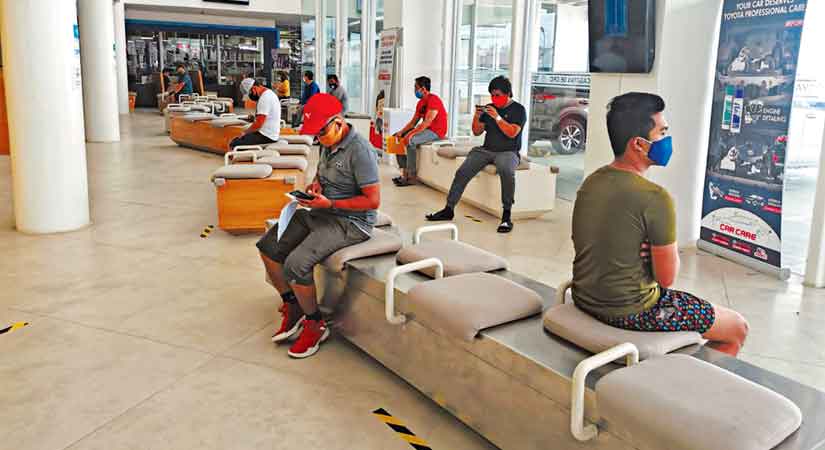
Toyota Cagayan de Oro customers practice safe physical distancing through floor markings on the dealership floor.

Toyota dealers reopen in GCQ areas

TOYOTA MOTOR PHILIPPINES (TMP) reports that it is opening its dealership network once the enhanced community quarantine (ECQ) transitions into a more relaxed general community quarantine (GCQ).

In connection, it is issuing guidelines and SOPs in accordance with Department of Health (DoH) and World Health Organization (WHO) protocols to ensure the safety of all customers and employees.

First, dealers are directed to take the temperature of customers of employees, as well as to perform regular disinfection of the entire facility. Common areas will be disinfected more frequently. Physical distancing will be ensured through a change in the layout of showrooms and service reception areas, designed to control the number of persons inside the facility at any given time.

Customers are highly encouraged to set appointments before visiting the dealer, as dealers will only be accommodating confirmed service appointments — easily booked through the recently launched digital tool MyToyota PH (mytoyota.ph).

Meantime, Toyota Financial Services Philippines extends payment terms for customers as well as expiring insurance policies under Toyota Insure. Warranty coverage of Toyota vehicles are likewise extended until after the ECQ is lifted. Toyota vehicles scheduled for periodic maintenance services are also given a grace period after the quarantine is lifted.

Said TMP President Atsuhiro Okamoto, “While we are facing challenging times, this also presents an opportunity to come back better and stronger, to review our current processes and find improvements, to constantly provide ever better products and services, and to make our team members’, customers’, and partners’ lives safer and more convenient.” He continued, “The new normal will take a while to get used to but together we can overcome this. Stay home, stay safe, and please observe precautionary measures if you need to go out. We are working hard to prepare our dealerships and ensuring that everyone will be safe upon their visit. We look forward to serving our valued customers again. See you in our dealerships.”

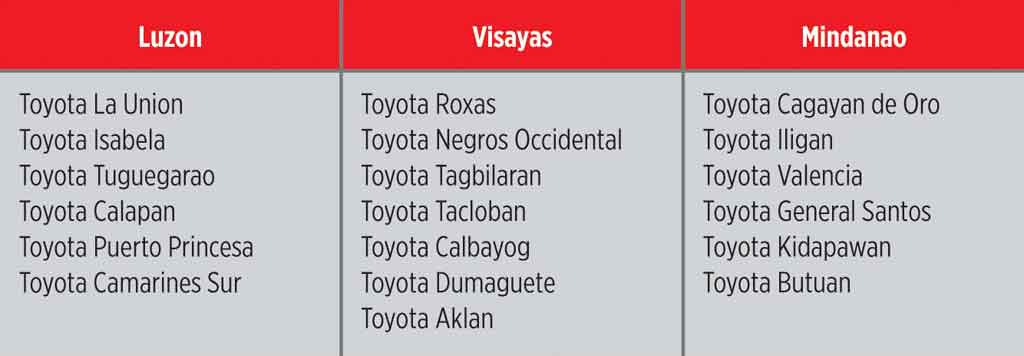
To date, the following Toyota dealer outlets located in areas under general community quarantine have resumed operations:

For more dealership updates, visit https://toyota.com.ph/news/ToyotaAdvisory. For more Toyota updates, visit www.toyota.com.ph or check out Toyota’s official social media pages at ToyotaMotorPhilippines (Facebook and Instagram), and @ToyotaMotorPH (Twitter).


Two sessions of the BMW Live Chat happen today.

BMW PHL holds ‘live chat’ today

BMW in the Philippines will hold a “simultaneous live chat session” today with select dealer partners, allowing the network to engage with existing customers and aspiring BMW owners.

In a release, SMC Asia Car Distributors Corp. (SMCACDC), authorized Philippine distributor and service provider of the Munich-headquartered brand, said “select BMW dealers will be standing by to communicate with participants for two hours in the morning (10 a.m. to 12 p.m.) and two hours in the afternoon (3 p.m. to 5 p.m.). The chats will be leveraging Facebook as a messaging platform, and the so-called BMW Live Chat aims to answer questions, give proper guidance, and assist customers and clients with regard to products, experiences, and service or after-sales initiatives — essentially anything about the brand. The BMW Live Chat will be able to address chat messages only.

“We want to ensure people that BMW is just a click away despite these difficult times, and will always continue to be ready to help. BMW has always maintained a strong digital presence, and the brand has always found new ways to engage and make itself more accessible for fans and customers,” said SMCACDC President Spencer Yu. More information on the specific BMW Live Chat schedules may be found on the Facebook pages of participating BMW dealers:

Autoallee BMW (Eton Centris, Brgy. Pinyahan, Quezon Avenue corner EDSA, 1100 Quezon City)

https://www.facebook.com/autoalleeBMW36994/

Autobahn BMW (Zone 15, North National Highway, Talisay City, Negros Occidental, 6115)

https://www.facebook.com/AutobahnBMWTalisay/

Motor Ventures BMW (Madrigal Business Park, Commerce Avenue, Alabang, Muntinlupa)

https://www.facebook.com/motorventuresbmw/

Premier Cars BMW (CGIC Bldg., San Fernando-Olongapo Road, San Fernando, Pampanga)

https://www.facebook.com/PremierCarsBMWPampangaPage/

RSA Motors (184A E. Rodriguez Jr. Avenue, Bagumbayan, Quezon City)

https://www.facebook.com/rsamotorsbmw/